Implications
Methane eructated from ruminants represents a loss of ingested energy and contributes to global warming. Mitigation of rumen methane emission has received increasing attention. Fumarate is a key intermediate metabolite in the rumen and an alternative electron acceptor to methanogenesis. This study is the first to investigate the effects of disodium fumarate (DF) supplementation on methane emission, ruminal fermentation and microbial abundance at varying forage (F) : concentrate (C) ratios in vivo. The results showed that DF could beneficially affect methane reduction and that these effects appear to be related to the stimulation of fumarate-reducing bacteria and the depression of methanogens.
Introduction
Reducing the methane production from ruminant livestock is desirable in order to both reduce greenhouse gases in the atmosphere and improve energy capture during digestion. Fumarate is a key intermediate of the citric acid cycle and also an alternative electron acceptor to methanogenesis (Ungerfeld et al., Reference Ungerfeld, Kohn, Wallace and Newbold2007). Effects of fumarate on methane production by the rumen were reported in many studies, but the effects are not consistent. In vitro studies showed that addition of DF could increase concentrations of propionate and total volatile fatty acids, and reduce methane production (Giraldo et al., Reference Giraldo, Ranilla, Tejido and Carro2007). However, results from in vivo studies are controversial. Bayaru et al. (Reference Bayaru, Kanda, Kamada, Itabashi, Andoh, Nishida, Ishida, Itoh, Nagara and Isobe2001) observed a 23% decrease in methane production when fumaric acid was added at 20 g/kg dry matter (DM) to a complete forage diet fed to two steers. On the contrary, no effect on methane emissions was reported on steers fed barley silage and concentrate with fumaric acid (12 g/kg DM; McGinn et al., Reference McGinn, Beauchemin, Coates and Colombatto2004), or on wether lambs fed dried ground lucerne with up to 100 g/kg fumaric acid (Molano et al., Reference Molano, Knight and Clark2008). These contradictory results could be due to the differences in the type of diet. In addition, factors such as dry matter intake (DMI) and F : C ratio could be crucial to the amount of methane produced in the rumen and/or interacts with fumarate supplementation (De Oliveira et al., Reference De Oliveira, Berchielli, Pedreira, Primavesi, Frighetto and Lima2007).
Several studies have reported a positive effect of fumarate on the growth of different rumen microorganisms. Nisbet and Martin (Reference Nisbet and Martin1993) reported that 10 mM fumarate stimulated the growth of Selenomonas ruminantium in pure cultures, and Asanuma et al. (Reference Asanuma, Iwamoto and Hino1999) showed that 30 mM fumarate increased the growth of Fibrobacter succinogenes, S. ruminantium, Veillonella parvula, Selenomonas lactilytica and Wolinella succinogenes in pure cultures. Our previous in vivo study with goats showed that DF could increase the diversity of rumen bacterial community as revealed by denaturing gradient gel electrophoresis (Mao et al., Reference Mao, Zhang and Zhu2008). To our knowledge, however, no information is available on the effects of DF under different F : C ratios on the abundances of key rumen microorganisms in vivo.
Therefore, the purpose of this study was to assess the effects of supplementation of DF at varying F : C ratios on methane emission, ruminal fermentation and microbial abundance in vivo.
Material and methods
Animal, diets and experimental design
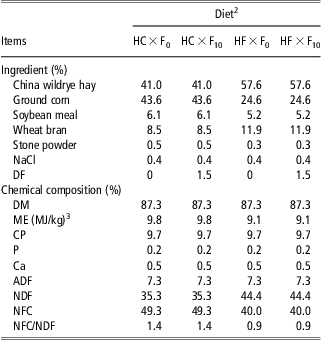
Four ruminally fistulated, castrated male goats with mean initial body weight of 24 ± 1.43 kg were used. Goats were housed in individual pens and had free access to fresh water throughout the experimental period. Diets (Table 1) were formulated to meet the nutrient requirement of maintenance for goats (NY/Y 816-2004; Ministry of Agriculture of China, 2004). The diet (650 g DM per goat) was offered twice in equal portions at 0800 and 2000 h. DF was added in the concentrate portion and mixed before fed to animals. Feeds offered and refused were recorded daily.
Ingredients ratio and chemical composition of experimental dietsFootnote 1 (%, DM basis)
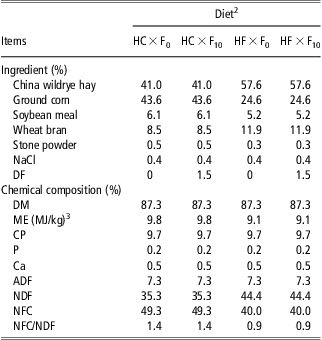
DM = dry matter; HC = high-concentrate diet; HF = high-forage diet; ME = metabolizable energy; NFC = non-fibrous carbohydrate; DF = disodium fumarate.
1 Diet was formulated to meet the ‘Feeding Standard of Meat-producing Sheep and Goats’ (NY/Y 816-2004; Ministry of Agriculture, 2004).
2 HC (forage : concentrate = 41 : 59), DF0: 0 g/day DF; HF (forage : concentrate = 57.6 : 42.4), DF10: 10 g/day DF.
3 ME was calculated based on composition of individual feedstuffs (NY/Y 816-2004; Ministry of Agriculture, 2004).
The experiment was carried out according to a 4 × 4 Latin square design with a 2 × 2 factorial arrangement of treatments, with the main factors being the F : C ratio and DF supplementation. Purity of DF was 99.87% (Jiaoda Rising Weinan Chemical Industry Co., Ltd, Weinan, Shanxi province, China). The high-concentrate diet (HC) had a F : C ratio of 41 : 59 and the high-forage diet (HF) had an F : C ratio of 58 : 42 on DM basis, respectively. In both cases, Chinese wildrye hay (Aneurolepidium chinense (Trin.) Kitag, CP 74 g/kg DM, neutral-detergent fiber 569 g/kg DM) was used as the forage source. Both diets either were supplemented with DF at 10 g/day (DF10) or received no supplement (DF0), summarising the treatments as HC × DF0, HC × DF10, HF × DF0 and HF × DF10. Dosages of DF were based on the results of a previous in vivo study with growing goats (Mao et al., Reference Mao, Zhang and Zhu2008). The experiment comprised four periods of 21 days each. Animals were subjected to a 15-day adaptation period after the diet was changed and during the following 3 days ruminal content samples were collected. After the ruminal sampling, the four goats were moved to four ‘simple open-circuit respiratory chamber’ (described below) to measure methane production for 3 consecutive days.
Simple open-circuit respiratory chamber design
The simple open-circuit respiratory chambers (Lockyer and Jarvis, Reference Lockyer and Jarvis1995) for in vivo methane measurement were cuboids (1.0 m × 1.2 m × 1.2 m) and constructed using concrete flooring with steel frames covered with clear flexible polyvinyl chloride sheeting. Through a pump set to the outlet, outside air was supplied to the chamber from one side and chamber air was removed from another side. The velocities of the air through the chambers were recorded by a flowmeter (Lutron AM-4202, Taipei, Taiwan) set to the outlet. The methane production was calculated according to the methane concentration of the air samples taken from the inlet and outlet, and the volume of air that flowing through the chamber. The velocity of the air (∼2.5 m/s) flowing through the chamber was recorded; outlet gas samples were not monitored continuously, but a gas sample was collected from the outlet every 2 hours. Air samples were collected with gas-tight collection bags and analyzed immediately for methane concentration by gas chromatography (GC-14B, Shimadzu, Japan) equipped with a Flame Ionization Detector and a capillary column (30 m × 0.32 mm × 0.25 μm film thickness, Supelco, Bellefonte, PA, USA).
Sampling procedures
Approximately 100 ml ruminal content was sampled via the ruminal cannula from each goat before morning feeding (0 h) and then at 2, 4, 6, 9, 12 h after morning feeding on 3 days of each period (days 16, 17 and 18). pH in fresh ruminal contents was measured immediately using a portable pH meter (HI 9024C; HANNA Instruments, Woonsocket, Rhode island, USA). To obtain a representative sample (only for DNA extraction), the six rumen samples (5 ml of per time point) were pooled to a single daily sample, which was mixed with a vortex (Vortex-Genie2, MO BIO Laboratories, Inc., Carlsbad, CA, USA). Five milliliters of the pooled sample was used for DNA extraction and kept at −20°C for microbial abundance analysis by real-time PCR. A portion of ruminal contents was squeezed through two layers of cheesecloth, and 3 ml filtrate was then fixed with 3 ml of 10% formalin solution in normal saline (0.9% NaCl; Sylvester et al., Reference Sylvester, Karnati, Yu, Morrison and Firkins2004) and stored at 4°C for later protozoa counting. Other rumen contents were then strained through four layers of cheesecloth. A portion of 10 ml filtrate was acidified with 1 ml 0.5 mol/l HCl and stored in a freezer (−20°C) for NH3-N analysis. Five-milliliter filtrate was shaken in a vortex for 45 s to separate the microbes from the feed particles. Filtrate then was centrifuged at 408 × g for 5 min to remove feed particles. Aliquots were kept at −20°C for microbial CP analysis. Two milliliters of freshly prepared 25% meta-phosphoric acid was added to 8 ml of filtrate. Five-milliliter filtrate were then centrifuged (12 000 × g for 10 min), and supernatant fluid was stored at −20°C for volatile fatty acid determination.
Chemical analysis of feed and rumen fermentation samples
Feed samples were dried in an oven at 55°C for 48 h and ground to pass through a 1 mm screen and analyzed using the standard methods of Association of Official Analytical Chemist (AOAC, 1990) for DM, ash and acid-detergent fiber. Neutral-detergent fiber in samples was estimated according to Van Soest et al. (Reference Van Soest, Robertson and Lewis1991) with the addition of α-amylase and the results were calculated with residual ash. Total nitrogen (N) in feed samples was determined according to AOAC (1990). Methane and volatile fatty acids (VFA) in ruminal fluid were measured by using a capillary column gas chromatograph (GC-14B, Shimadzu, Japan; Capillary Column: 30 m × 0.32 mm × 0.25 μm film thickness). For methane determination, column temperature = 80°C, injector temperature = 100°C, detector temperature = 120°C; for VFA determination, column temperature = 120°C, injector temperature = 180°C, detector temperature = 180°C (Qin, Reference Qin1982). NH3-N concentration was measured by the indophenols method (Weatherburn, Reference Weatherburn1967). Ruminal microbial CP concentration was determined by a colorimetric method with 1 mg/ml bovine serum albumin solution (Sigma-Aldrich Co., LLC, St. Louis, Missouri, USA) as a standard equivalent (Makkar et al., Reference Makkar, Sharma, Dawra and Negi1982). Protozoa cells were counted in a haemacytometer under a light microscope (Sylvester et al., Reference Sylvester, Karnati, Yu, Morrison and Firkins2004). The abundances of methanogens, total anaerobic fungi, predominant fibrolytic bacteria and S. ruminantium were determined by real-time quantitative PCR as described below.
Primers and real-time quantitative PCR
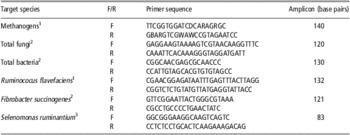
Total DNA was extracted from rumen contents by the bead-beating method as described by Denman and McSweeney (Reference Denman and McSweeney2006). The PCR primers for methanogens, fungi, total bacteria, Ruminococus flavefaciens, F. succinogenes and S. ruminantium are listed in Table 2 (Denman and McSweeney, Reference Denman and McSweeney2006; Denman et al., Reference Denman, Tomkins and McSweeney2007; Khafipour et al., Reference Khafipour, Li, Plaizier and Krause2009). Species of Methanobrevibacter sp. (from CSIRO Livestock Industries, St. Lucia, QLD, Australia), R. flavefaciens and F. succinogenes (from Aberystwyth University, UK), rumen anaerobic fungi isolated from rumen contents by Cheng et al. (Reference Cheng, Mao, Pei, Liu and Zhu2006) and S. ruminantium L9 isolated from rumen contents by Long et al. (Reference Long, Mao, Su and Zhu2008) were used to generate standards for real-time PCR analysis. DNAs of these species were extracted and the conventional PCR was performed, respectively. Amplification condition was as follows: one cycle at 95°C for 10 s for initial denaturation, followed by 40 cycles at 95°C for 15 s and 60°C for 60 s. PCR products were quantified using a Nanodrop spectrophotometer ND-1000 UV-Vis (Thermo Fisher Scientific, Inc., Madison, Wisconsin, USA). For each standard, copy number concentration was calculated based on the length of the PCR product and the mass concentration (Yu et al., Reference Yu, Michel, Hansen, Wittum and Morrison2005). The target DNA was quantified by using serial 10-fold dilutions from 10 to 1010 DNA copies of the previously quantified DNA standards. The species-specific real-time quantitative PCR was performed using the ABI 7300 real-time PCR system (Applied Biosystems, Foster, California, USA) with fluorescence detection of SYBR green dye. Amplification conditions were as described before. Specificity of amplified products for each primer was confirmed by melting temperatures and dissociation curves after each amplification. Amplification efficiencies for each primer pair were investigated by examining dilution series of total ruminal microbial DNA template on the same plate in triplicate.
PCR primers for real-time PCR assay

F = forward; R = reverse.
1Denman et al. (Reference Denman, Tomkins and McSweeney2007).
2Denman and McSweeney (Reference Denman and McSweeney2006).
3Khafipour et al. (Reference Khafipour, Li, Plaizier and Krause2009).
Statistical analysis
All data were analyzed as a 4 × 4 Latin square design with a 2 × 2 factorial arrangement, using the GLM procedure of SPSS 16.0. Data of pH, VFA, NH3-N, microbial protein content (MCP) and protozoa were analyzed as repeated measures by a GLM procedure. Sampling time of the rumen contents was treated as a repeated variable. The model was
 $${{Y}_{ijklm}}\,{\rm{ = }}\,\mu \,{\rm{ + }}\,{{T}_i}\,{\rm{ + }}\,{{S}_j}\,{\rm{ + }}\,{{P}_k}\,{\rm{ + }}\,{{H}_l}\,{\rm{ + }}\,{{G}_m}\:{\rm{ + }}\,{{T}_i}\,\times \,{{S}_j}\,{\rm{ + }}\,{{e}_{ijklm}}$$
Data of microbial population abundance analyzed by real-time PCR and methane production were analyzed by the univariate statement of GLM. For molecular work, samples within each day have been pooled, and thus ruminal content days (days 16, 17 and 18) were treated as normal replicates. The model was
 $${{Y}_{ijklm}}\,{\rm{ = }}\,\mu \,{\rm{ + }}\,{{T}_i}\,{\rm{ + }}\,{{S}_j}\,{\rm{ + }}\,{{P}_k}\,{\rm{ + }}\,{{D}_l}\,{\rm{ + }}\,{{G}_m}\,{\rm{ + }}\,{{T}_i}\,\times \,{{S}_j}\,{\rm{ + }}\,{{e}_{ijkm}}$$
In models (i) and (ii),Yijklm is the dependent variable; μ the overall mean; Ti the fixed effect of F : C (i = 1 to 2); Sj the fixed effect of DF (j = 1 to 2); Pk the fixed effect of period (k = 1 to 4); Dl the fixed effect of sampling day (l = 1 to 3); Hl the fixed effect of sampling time (l = 1 to 18); Gm the random effect of goats (m = 1 to 4); Ti × Sj the interaction of F : C and DF; eijkm the residual error. When there was an interaction, differences within F : C or fumarate-means was tested. Tukey's multiple comparison tests were used to assess differences between the Ti × Sj-means. Effects of the factors were declared significant at P < 0.05 unless otherwise noted and trends were discussed at P < 0.10.
Results
Ruminal methane emission
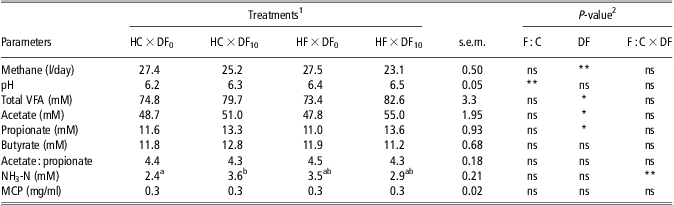
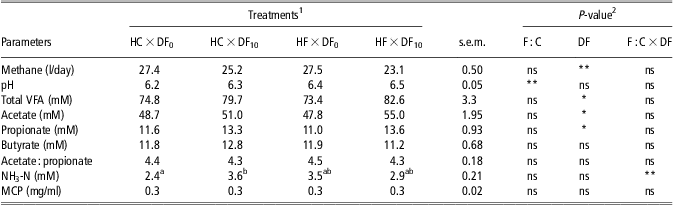
In the present study, the goats were fed on the basis of maintenance requirements and no refusals were recorded (650 g DM/day). DF at the dosage used in the present study was consumed completely along with concentrate and represented ∼15.4 g/kg DM. Methane production of the goats is shown in Table 3. DF supplementation both to high-concentrate or high-forage diets reduced methane production by on average 11.9%. Methane emission (g/day) was not affected by the dietary F : C ratio.
Methane production, VFA profile, NH3-N concentration and MCP in the rumen of goats fed different Chinese wildrye hay and concentrate proportions (HC and HF) and supplemented (DF10) or not (DF0) with DF
VFA = volatile fatty acid; MCP = microbial protein content; HC = high-concentrate diet; HF = high-forage diet; DF = disodium fumarate; F = forage; C = concentrate.
a,bDifferent letters in the same row means significant differences (P < 0.05).
1HC (forage : concentrate = 41 : 59), DF0: 0 g/day DF; HF (forage : concentrate = 58 : 42), DF10: 10 g/day DF.
2ns = non-significant (P > 0.05); *P < 0.05; **P < 0.01.
Ruminal fermentation
The effect of F : C ratio and DF supplementation on ruminal fermentation parameters is shown in Table 3. VFA profiles were significantly influenced by the addition of DF. The concentrations of total VFA, acetate and propionate were greater in the rumen of goats fed diets supplemented with DF. But the concentrations of butyrate, NH3-N, MCP and ratios of acetate : propionate were not affected by the DF supplementation. Changes in NH3-N concentrations through DF addition depended on F : C ratio. DF supplementation group increased NH3-N in association with a high-concentrate diet, whereas no changes were observed for high-forage levels. DF supplementation tended to increase the pH values in rumen (P = 0.07). However, the pH values of the ruminal fluid were significantly affected by F : C ratios (P < 0.01). The pH values were lower in the rumen of goats fed high-concentrate diets as compared with those fed high-forage diets, although differences were small. F : C ratios of diet had no effects on other parameters.
Ruminal microbial population
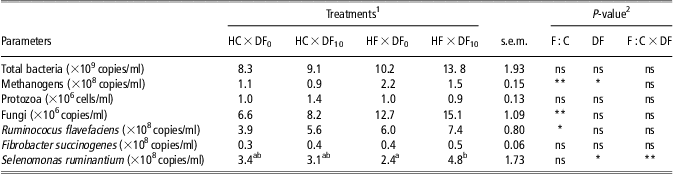
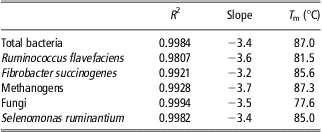
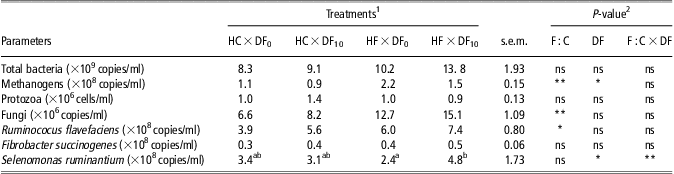
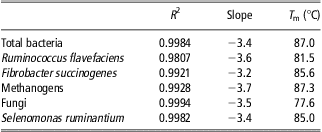
Table 4 shows the effects of DF and F : C ratios on abundance of microbial species within the rumen microbial population. Standard curve slopes are presented in Table 5, revealing that all primer sets of DNA template produced PCR efficiencies approaching 100%. Methanogens were less abundant in the rumen of goats fed DF (P < 0.05). Interactions (P < 0.05) between F : C ratio and DF supplementation were observed for the abundance of S. ruminantium, which was more predominant when DF was supplemented to high-forage diets whereas no changes were observed when DF was supplemented to high-concentrate diets. Methanogens, fungi and R. flavefaciens were more abundant (P < 0.05) in the rumen of goats fed high-forage diets as compared with those fed high-concentrate diets. Total bacteria, protozoa and F. succinogenes were not affected by F : C ratio or DF supplementation.
Microbial abundances in the rumen of goats fed different Chinese wildrye hay and concentrate proportions (HC and HF) and supplemented (DF10) or not (DF0) with DF
HC = high-concentrate diet; HF = high-forage diet; DF = disodium fumarate; DF0 = 0 g/day DF; DF10 = 10 g/day DF; F = forage; C = concentrate.
a,bDifferent letters in the same row means significant differences (P < 0.05).
1HC (forage : concentrate = 41 : 59), DF0: 0 g/day DF; HF (forage : concentrate = 58 : 42), DF10: 10 g/day DF.
2ns = non-significant (P > 0.05); *P < 0.05; **P < 0.01.
Standard curve line fit, slope and T m values using real-time PCR
Discussion
The ratio of forage to concentrate of a diet can alter the VFA profile and methane production in the rumen (Iqbal et al., Reference Iqbal, Cheng, Zhu and Zeshan2008). Adjusting the F : C ratios is an effective means to manipulate ruminal fermentation pathways and reduce ruminal methane production due to a shift in ruminal fermentation patterns to propionate (Fahey and Berger, Reference Fahey and Berger1988) and a decline in the ruminal pH (VanKessel and Russell, Reference VanKessel and Russell1996). Increasing dietary concentrate level has been demonstrated to have a significant effect on enteric methane production on an individual animal or production system scale (Lovett et al., Reference Lovett, Shalloo, Dillon and O'Mara2006). However, in the present study, methane production and VFA parameters examined did not significantly respond to a change in ratio of F : C in the diet. Most likely the difference of F : C ratios between these diets (41 : 59 v. 58 : 42) was not great enough to cause significant differences on methane production or VFA profiles.
Fumarate is a direct metabolic precursor of propionate, and thus has potential to reduce methane emissions by directing hydrogen into succinate rather than into methane (Lopez et al., Reference Lopez, Valdes, Newbold and Wallace1999). It has been widely reported that methane reductions were coupled with an increase in VFA production after the addition of fumarate to different substrates in in vitro fermentation (Asanuma et al., Reference Asanuma, Iwamoto and Hino1999; Carro and Ranilla, Reference Carro and Ranilla2003). However, with animal trials, results were not consistent. With Holstein steers, Bayaru et al. (Reference Bayaru, Kanda, Kamada, Itabashi, Andoh, Nishida, Ishida, Itoh, Nagara and Isobe2001) reported that 20 g/kg DM fumaric acid supplementation caused a 23% decrease in methane production and increased propionate concentration, but had no effect on the concentration of ruminal acetate. McGinn et al. (Reference McGinn, Beauchemin, Coates and Colombatto2004) fed 12 g/kg DM fumaric acid to cattle and reported no effect on methane production, total VFA concentration and propionate proportions. Difference in responses might be dose or diet related. In the present experiment, the addition of 15.4 g/kg DM disodium fumarate increased the concentration of total VFA, acetate and propionate. Interestingly, this significant increase in VFA concentration was coupled with a decrease in methane production. We showed that DF supplementation both to high-concentrate or high-forage diets reduced methane production on average by 11.9%. Thus, it may indicate that the addition of DF could stimulate the production of VFA, notably propionate, at the expense of methane. Conversion of one mol of fumarate to propionate stoichiometrically would reduce methane production by 6.4 l (1 mol of gas ∼25.6 l at standard 39oC and standard pressure). On the basis of a 100% conversion of fumarate to propionate, 10 g DF would reduce methane production by 0.4 l/day. Table 3 reveals that the actual decrease in methane (2.2 l/day for HC; 4.4 l/day for HF) was greater than the predicted reduction. This might be due to a cumulative starvation effect of fumarate on ruminal methanogens. The lack of 2 H required for methanogenesis might have reduced their numbers and activity. Our results indeed showed that methanogens were less abundant after DF supplementation. Zhou et al. (Reference Zhou, McSweeney, Wang and Liu2011) reported that the abundance of methanogens within the microbial population decreased significantly in the fluid-associated samples of sheep fed with 20 g/kg DF. It may indicate that DF can stimulate some bacteria to compete with methanogens for hydrogen or formate. Methane production can be reduced by increasing the utilization of hydrogen and formate by fumarate-reducing bacteria rather than methanogens (Asanuma et al., Reference Asanuma, Iwamoto and Hino1999). S. ruminantium can decarboxylate succinate to propionate (Strobel and Russell, Reference Strobel and Russell1991) and its growth could be stimulated by fumarate (Nisbet and Martin, Reference Nisbet and Martin1993). Zhou et al. (Reference Zhou, McSweeney, Wang and Liu2011) reported that DF (20 g/kg DM) had a stable and stimulating effect on Prevotella-like bacteria, Selenomonas dianae and Clostridium sp. Our results showed DF indeed increased the abundance of S. ruminatium when supplemented to high-forage diets. This is in line with the numerically stronger reduction in methane production and methanogens when supplementing DF to high-forage diets. Nevertheless, methanogens were consistently more abundant when feeding high-forage diets. Eventually, other fumarate-reducing bacteria also might have been stimulated by DF under the high-forage diet.
F. succinogenes, Ruminococus albus and R. flavefaciens have been recognized as the major fibrolytic bacterial species in the rumen (Forsberg et al., Reference Forsberg, Cheng and White1997), and the increase in cellulolytic bacteria abundance may lead to an improvement in fiber digestion in ruminants. The present study through quantitative PCR assays showed that the abundance of R. flavefaciens and F. succinogenes was not affected by 15.4 g/kg DM DF supplementation. In an in vitro study with Rustic fermenters, Giraldo et al. (Reference Giraldo, Ranilla, Tejido and Carro2007) also reported that the number of rumen fibrolytic bacteria was not affected by DF supplementation (30 g/kg DM) as quantified by the Most Probable Number method. It seems that DF may have little effect on fibrolytic bacteria. However, Zhou et al. (Reference Zhou, McSweeney, Wang and Liu2011) showed that changes of R. flavefaciens, F. succinogenes and R. albus due to DF addition (20 g/kg DM) were variable and different between fluid and solid phase, as well as long- or short-term of addition. Thus, the effect of DF on cellulolytic microorganisms activity needs further studies.
In addition to the major fibrolytic bacteria, the rumen also harbors highly fibrolytic anaerobic fungi that are regarded to play an important role in fiber degradation within the rumen particularly on poor diets (Theodorou et al., Reference Theodorou, Zhu, Rickers, Nielsen, Gull and Trinci1996). The effect of DF on rumen fungi was investigated in the present study, but showed no influence on the ruminal fungi abundance as revealed by real-time PCR. Most likely, none of these diets was of real poor quality. Rumen protozoa were thought to play an important role in methane production as the surface of some of the rumen protozoa is colonized by methanogens. Thus, any effect on rumen protozoa could lead to an indirect influence on methane production. Zhou et al. (Reference Zhou, McSweeney, Wang and Liu2011) showed that DF (20 g/kg DM) caused a transient effect on abundance reduction of protozoa within the fluid of sheep. In our present study, the protozoal abundance in the rumen was not affected by DF supplementation. This was in agreement with a previous in vitro report (Asanuma et al., Reference Asanuma, Iwamoto and Hino1999).
Combining results of fiborlytic bacteria, rumen fungi and rumen protozoa, supplementation of DF seems not to affect fibrolytic microorganisms in the rumen. Thus, the methane-suppressing effects of DF are not directed through action against fibrolytic microoganisms, but probably due to stimulation of fumarate-reducing bacteria and inhibition of methanogens, consequently leading to the higher production of propionate and low production of methane.
In the present study, animals were restricted fed based on maintenance requirements. However, DMI is a crucial factor affecting methane output. To generalize the current observations to production circumstances, it is required to investigate the effects of fumarate and F : C ratio on the rumen methane production at higher intake levels. To our knowledge, no such in vivo studies have been so far reported. Nevertheless, the results from the present study using restricted maintenance feeding strategies may be applicable for low intake or restricted intake feeding systems, for example, dry period of dairy animals, suckler animals.
Conclusion
The present study demonstrated that supplementation of DF at a rate of 15.4 g/kg DM to diets with different F : C ratios beneficially affected rumen fermentation by increasing the concentration of total VFA, acetate and propionate and by reducing methane production. The DF supplementation did not affect the growth of fungi, protozoa and fibrolytic bacteria, the generally recognized fiber-degrading and hydrogen-producing microorganisms, but stimulated a species of fumarate-reducing bacterium and reduced the number of methanogens. This may suggest that the DF supplementation does not act against hydrogen producers.
Acknowledgments
This work was supported by a grant from the National Natural Science Foundation of China (Nos. 30530560 and 31072052). The authors thank Dr Christopher S. McSweeney (CSIRO Livestock Industries, Australia) for providing Methanobrevibacter and Dr Eun Joong Kim (Aberystwyth University, UK) for R. flavefaciens and F. succinogenes.