The recent outbreak of severe acute respiratory syndrome coronavirus 2 (SARS-CoV-2) led to the development of coronavirus disease 2019 (COVID-19), which was originally reported in the wet market of Wuhan, China, in December 2019. SARS-CoV-2 is included in the group of beta-coronaviruses in the Coronaviridae family, which are closely related to the previously emerged SARS-CoV in 2003, also known as the SARS outbreak. Reference Sun, Dong and Wang1–Reference Ahmad, Tayib and Mohamed4 The SARS-CoV-2 has rapidly spread globally; therefore, by late January 2020, the World Health Organization (WHO) declared a state of emergency and COVID-19 was declared a pandemic on March 11, 2020. According to the WHO’s COVID-19 Weekly Epidemiological Update (Edition 57, published 14 September 2021) more than 224 million people have been infected with the virus worldwide, with more than 4.6 million deaths directly caused by the disease. 5 Of these, 80% are mild cases and 40-45% are asymptomatic SARS-CoV-2 carriers. Reference Sun, Dong and Wang1,Reference Van Vinh Chau, Lam and Dung6 According to daily data released by the Ministry of Health in Kurdistan Region of Iraq on September 1, 2021, SARS-CoV-2 has resulted in 295,616 positive cases and more than 4000 deaths. In response to the COVID-19 pandemic, the Autonomous Kurdistan Regional Government of Iraq (KRG) decided to open the borders with neighboring countries for all travelers in late July 2020, but only after each traveler was subjected to a mandatory reverse transcription polymerase chain reaction (RT-PCR) screening on arrival at the border crossing. The aim of this study is to determine the rate of infection with SARS-CoV-2 among the travelers entering Kurdistan region through Ibrahim Al-Khalil crossing point with Turkey, from August 2020 to August 2021. 7
Methods
Study Design
All travelers arriving at the Ibrahim Al-Khalil border crossing between Iraq and the Republic of Turkey underwent a RT-PCR test according to the manufacturer’s protocol. Reference Hur, Park and Lim8,Reference Claas, Smit and van Bussel9 The data were reviewed from August 21, 2020 to August 21, 2021. The data were retrieved from the Ibrahim Al-Khalil Border Crossing Coronavirus Testing Center database. A cross-sectional study was performed to determine the occurrence of COVID-19 patients among travelers returning to Iraq.
Sampling
Oropharyngeal swabs and nasal swabs were taken from all travelers and stored in viral transport medium (VTM) and directly transferred to the Ibrahim Al-Khalil Border Crossing Coronavirus Testing Center for subsequent extraction and RT-PCR directly.
RNA Extraction and RT-PCR
SARS-CoV-2 RNA virus was extracted from the VTMs of oropharyngeal swabs and nasal swabs using QIAprep and amp Viral RNA UM Kit according to the manufacturer’s protocol (Qiagen). The RNA then was subjected to detection through 1 step multiplex real-time RT-PCR Using QIAprep and amp Viral RNA UM Kit following the manufacturer’s protocol (Qiagen). To lower the costs and turnaround time, we applied a pooling of samples method of testing which involved mixing 4 different samples before RNA extraction, and then re-testing samples from a positive pool separately a second time. Reference Lohse, Pfuhl and Berkó-Göttel10–Reference Regen, Eren and Heuser14 For a 1-stage pooling strategy, a pool size was selected based on the capacity to find the appropriate balance between projected infection rates in asymptomatic SARS CoV-2 carriers, the sensitivity & specificity of the test (both estimated to be 100% accurate according to the rRT-PCR kits manufacturers) as well as the technical and practical limitations. A pool size of 5 samples was judged best according to the positivity rate observed in our laboratory. Reference Hanel and Thurner12
The data were collected from the publicly available database of the KRG Ministry of Health. A retrospective cohort analysis was performed to determine the occurrence of COVID-19 patients among travelers returning to Iraq. All travelers (arriving at the Ibrahim Al-Khalil border crossing between Iraq and the Republic of Turkey underwent an RT-PCR test according to the manufacturer’s protocol. Reference Hur, Park and Lim8,Reference Claas, Smit and van Bussel9 The data were reviewed from August 21, 2020 to August 21, 2021.
Results
The Ministry of Health in the Kurdistan region of Iraq has issued a strict directive for residents or visitors traveling to the Kurdistan Region to bring an RT-PCR negative report, no older than 48 h. Those without the report will be required to undertake a self-paid RT-PCR test at the Kurdistan Region border crossings. All travelers must sign a pledge form, committing to 14 d of self-isolation following their arrival in the Kurdistan region of Iraq. 7
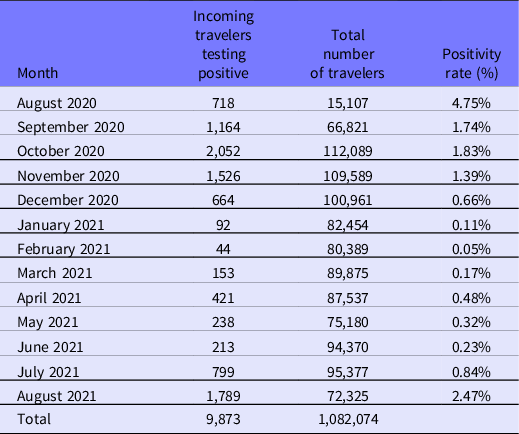
During the study, we found that 9873 of 1,082,074 tests were positive for SARS-CoV-2 at the Ibrahim Al-Khalil border crossing between Iraq and Turkey. All the cases that tested positive were contacted immediately, and local health authorities were informed to ensure that the infected travelers were isolating and complying with the home quarantine measures until further testing proves the case negative, usually after 10 d of self-isolation.
Discussion
In January 2020, the WHO declared COVID-19 a public health emergency of international concern. An increasing number of confirmed COVID-19 cases were being reported worldwide. The ensuing months saw an almost complete cessation of international travel with quarantine measures required in many countries for all travelers. After the first wave peaked, many countries started to ease the travel restrictions imposed previously, to provide an environment for the economic resilience of these countries; this has resulted in an increase in new cases being reported. To overcome the increased number of imported cases, countries around the globe have started implementing obligatory travel policies to slow down the spread of this virus.
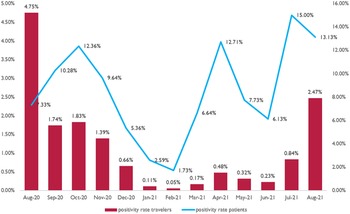
The data presented in this study show that the average percentage of infected cases among travelers entering the country was around 1.25%, which was 4.75% at the peak in August 2020, and lowest (0.05%) in February 2021 (Table 1). When comparing the data of positive cases recorded in the border with those of COVID-19 patients reported by the official data from the Duhok Governorate (which is the nearest governorate in Iraq to the border crossing), we observe that there is a trend that is similar in both data sets (Figure 1). There are 3 peaks, the first being from August 2020 to November 2020, the second was from March 2021 to May 2021, and the third was in July and August 2021. The first peak was caused by the Wuhan or original variant, the second was globally due to the Alpha variant (Kent variant) and the third was caused mainly by the Delta variant.
Monthly figures of positive COVID-19 cases among travelers versus total passengers

SARS-CoV-2 Positivity rate in Ibrahim Al-Khalil Border Crossing lab and Duhok Governorate labs in Iraq (positivity rate patients).

Thermal scanning for all travelers was 1 of the measures taken in the early days of the pandemic to help detect cases of COVID-19. However, checking for fever alone is insufficient in detecting cases of COVID-19. Reference Bielecki, Crameri and Schlagenhauf15 The negative results of temperature checks for asymptomatic cases would give a false sense of security, resulting in cases being imported into the country and further outbreaks thereon.
In December 2020, the first coronavirus vaccine was administered worldwide, including in the United Kingdom. 2 As of July 2021, approximately 3.42 billion doses of COVID-19 vaccines have been administered worldwide. Reference Ritchie, Mathieu and Rodés-Guirao16 The relative success of vaccination programs in some countries with high vaccination rates has encouraged the travel industry globally. However, the emergence of new variants with high degrees of immune evasion has cast doubts on the omission of testing travelers for COVID-19. Reference Becker, Dulovic and Junker17 In this study, the data of positive samples correlates with those in reported daily in the KRI through the MOH daily case reports on COVID-19. Our current study also shows that the infection trends are comparable to the worldwide waves of COVID-19. With the rise of new variants globally, testing travelers to prevent COVID-19 is still a crucial tool to prevent further outbreaks. Until the pandemic is under control, testing is still considered a cornerstone in fighting this pandemic.
In conclusion, this study shows the importance of mass testing of travelers at border crossings to control the spread of SARS-CoV-2 infection.