

Introduction
Coccidiosis control is essential in broiler production, because even subclinical infections decrease the performance of chickens and makes them susceptible to necrotic enteritis (NE) or other secondary enteric infections (Dalloul and Lillehoj, Reference Dalloul and Lillehoj2006; Van Immerseel, Reference Van Immerseel, Rood, Moore and Titball2009). The bacterial species Clostridium perfringens is the causative agent of NE. This natural inhabitant of chicken caecum can, under predisposing conditions such as coccidial infection or sudden change in the diet, increase colonisation in the small intestine leading to necrosis of the intestinal epithelium (Van Immerseel et al., Reference Van Immerseel, Rood, Moore and Titball2009; Timbermont et al., Reference Timbermont, Haesebrouck, Ducatelle and Van Immerseel2011). Emerging resistance problems against anticoccidial drugs in Eimeria species, as well as demands or even regulations to limit the use of antibiotic growth promoters (AGPs) or ionophore coccidiostats in poultry diets have raised interest in alternative products and practices that can limit the risk of enteric pathogen outbreaks in commercial broiler operations.
A novel dietary product extracted from coniferous Norway spruce (Picea abies) and Scots pine (Pinus sylvestris) trees described as the resin acid composition (RAC), may improve gastrointestinal health of broiler chickens through microbial modulation (Kettunen et al., Reference Kettunen, Vuorenmaa, Rinttilä, Grönberg, Valkonen and Apajalahti2015). Resin of coniferous trees contains a mixture of diterpene resin acids such as abietic, dehydroabietic, pimaric, neoabietic, levopimaric and palustric acid (Fallarero et al., Reference Fallarero, Skogman, Kujala, Rjaratnam, Moreira, Yli-Kauhaluoma and Vuorela2013). These compounds have antimicrobial, antifungal and antiparasitic activity and protect the tree against the attacks of insects, fungi, bacteria and other pathogens (San Feliciano et al., Reference San Feliciano, Gordaliza, Salinero and Del Corral1993; Savluchinske-Feio, Reference Savluchinske-Feio, Curto, Gigante and Roseiro2006). The antibacterial effect of resin acids are likely related to solubilisation of the bacterial cell wall (Söderberg, Reference Söderberg, Johansson and Gref1996) or altered cell membrane proton gradients (Jokinen and Sipponen, Reference Jokinen and Sipponen2016), and is mainly directed against Gram-positive bacteria. Many of the opportunistic pathogenic bacteria of human and animals, like C. perfringens, are Gram-positive. In fact, the potential of resin acids in wound-healing was recently reported in medical science (Jokinen and Sipponen, Reference Jokinen and Sipponen2016).
In a previous study, RAC inhibited the in vitro growth of C. perfringens, favourably modulated ileal microbiota of broiler chickens, and increased their weight gain under a NE challenge (Kettunen et al., Reference Kettunen, Vuorenmaa, Rinttilä, Grönberg, Valkonen and Apajalahti2015). As the effect of any potential modulator of intestinal microbiota is likely to be affected both by diet and environment, these initial findings on the positive effects of RAC warranted further supporting data from other locations, different dietary formulations and a longer rearing period. The present trial was conducted to study the effects of dietary RAC on broiler chickens in two established European research institutes, using local feed formulations and bird management practices. Experiment 1, conducted in Poland, measured bird performance, footpad dermatitis (FPD) lesions and litter quality over a 42-day rearing period. Experiment 2 was a 35-day NE challenge study in the Netherlands which studied the effects of RAC on bird performance and on the caecal microbial community and short chain fatty acid (SCFA) profiles.
Materials and Methods
Test Product
The test product RAC (Progres®, Hankkija Ltd/Suomen Rehu, Hyvinkää, Finland, patent no FI124918) consisted of 8.5% resin acids, 88.5 to 89.5% free fatty acids, and 2 to 3% neutral components, and was in liquid format. The fatty acid profile of the product was 4 to 6% saturated acids, 27 to 31% monounsaturated fatty acids, and 63 to 69% of polyunsaturated fatty acids with an n-3 to n-6 -ratio of approximately 1:4. The resin acid fraction of the product contained abietic acid (33%), dehydroabietic acid (18%), and pimaric acid (14%) as well as smaller concentrations of other resin acids of Scotch pine and Norway spruce trees.
Experiment 1
Experiment 1 was conducted at the poultry facility of the Department of Animal Nutrition and Feed Science, University of Warmia and Mazury, Olsztyn, Poland. The Animal Ethical Review Committee of the University of Warmia and Mazury approved the experiment. The trial design was completely randomised as a 2 × 2 factorial design, with two dietary RAC and two coccidiostat treatments: T1 - RAC 0 mg/kg + chemical coccidiostat (CC) diclazuril 1 mg/kg (Clinacox®, Janssen Pharmaceutica N.V., Beerse, Belgium); T2 - RAC 0.5 mg/kg + CC 1 mg/kg; T3 - RAC 0 mg/kg with ionophoric coccidiostat (IC) salinomycin (Sacox®, Huvepharma AD, Sofia, Bulgaria) 70 mg/kg; and T4 - RAC 0.5 mg/kg + IC 70 mg/kg.
A total of 1400 one-day-old, mixed sex Ross 308 broiler chickens were randomly allocated into the treatments to give seven replicate pens of 50 chicks per treatment. The chickens were reared in floor pens measuring 4.4 m2, on straw bedding, in a commercial broiler shed. The lighting schedule was 24L:0D on day one, 23L:1D from day two to seven, 20L:4D from day eight to 11 and 18L:6D from day 12 to 42. The ambient temperature gradually decreased from 34 °C on day one until 20 °C on day 42. The birds had unrestricted access to water throughout the experiment, and unrestricted access to feed until day 41. They were slaughtered on day 42.
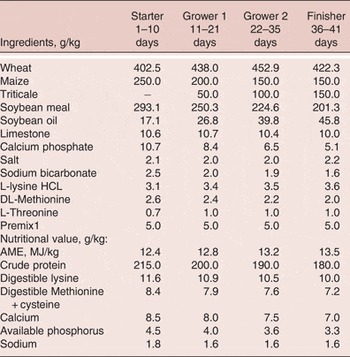
Mash-form diets (Table 1) in four dietary phases included a starter (days one to 10), grower one (days 11 to 22), grower two (days 22 to 35) and finisher (days 36 to 41). Coccidiostats were included in starter and grower premixes but not in the finisher premixes. All the premixes contained feed enzymes: endo-1,4-β-xylanase (to provide 1,100 visco units/kg feed) and endo-1,3(4)-β-glucanase (to provide 100 AGL units/kg feed; both from Rovabio® Excel AP, Adisseo, Antony Cedex, France), as well as phytase to provide 500 FTU/kg feed (Phyzyme® XP, Danisco Animal Nutrition, Marlborough, Wiltshire, UK). Furthermore, all diets contained antioxidants BHA (E320), BHT (E321) and ethoxyquin (E324).
Composition and nutritional value of diets in Experiment 1

1 provide per kg diet in a 0.5% dose: vitamin A 12,000 IU; vitamin |D3 2,400 IU; vitamin E 50 mg; vitamin K3 1.5 mg; vitamin B1 2.0 mg; vitamin B2 7.5 mg; vitamin B6 3.5 mg; vitamin B12 20 mcg; Niacin 35 mg; D-pantothenic acid 12 mg; Choline chloride 460 mg; Folic acid 1.0 mg; Biotin 0.2 mg; Fe 80 mg (as FeSO4•H2O); Cu 12 mg (as CuSO4•5H2O); Zn 120 mg (as ZnSO4•H2O); Mn 85 mg (as MnO); Co 0.4 mg (as CoSO4•7H2O); I 0.8 mg (as KI); Se 0.15 mg (as Na2SeO3)
Body weight (BW) per bird, feed intake (FI) per pen and the visual health condition of the birds were recorded on a weekly basis, and body weight gain (BWG) and feed conversion ratio (FCR; feed/weight gain) were calculated. The European Efficiency Index (EEI) was calculated as follows:
 $${\rm EEI } = \left({\rm liveability } \times {\rm BW},{\rm kg }/\hbox{length of rearing period}, {\rm days } \times {\rm FCR} \hfill \right) \times 100.$$
Footpad dermatitis (FPD) lesions were scored at days 14, 28 and 42. For each pen, a random sample of 25 birds feet were macroscopically examined and scored according to the classification of Ekstrand et al. (Reference Ekstrand, Algers and Svedberg1997) as follows: 0 - No lesions; no or very small superficial lesions, slight discoloration on a limited area, mild hyperkeratosis; 1 - Mild lesion; discoloration of the foot pad, superficial lesions, dark papillae; 2 - Severe lesion; ulcers or scabs, signs of haemorrhages or swollen foot pads. To calculate the FPD score the following formula, presented in the EU proposal COM (2005), was used:
 $${\rm FPD \ score } = \left( \matrix{\hbox{number lesion class }1 \ast 0.5 \hfill \cr + \hbox{number lesion class }2 \ast 2 \hfill} \right) \times 100)/25.$$
Thus, the feet with score 0 did not contribute to the FPD score.
Litter quality in each pen was scored by visual inspection at day 14, 28, and 42 as a standard procedure at the experimental farm using Welfare Quality® (2009) scoring scale as follows: 0 - Completely dry and flaky, i.e. moves easily with the foot; 1 - Dry but not easy to move with foot; 2 - Leaves imprint of foot and will form a ball if compacted, but ball does not stay together well; 3 - Sticks to boots and sticks readily in a ball if compacted; 4 - Sticks to boots once the cap or compacted crust is broken. At each assessment, a score was given for five separate sites in each pen and for an overall score per pen average of the five scores was calculated.
The data were analysed statistically by analysis of variance (ANOVA) using the statistical software STATISTICA 10 (StatSoft Inc., Dell Software, Tulsa, Oklahoma, USA), with pen as the experimental unit. Treatment means were separated and compared using Duncan's test. Effects were considered statistically significant at P < 0.05 and near-significant trends at P < 0.10.
Experiment 2
The experiment was performed at the poultry facility of Schothorst Feed Research (Lelystad, the Netherlands), and was approved by the Animal Ethical Review Committee of Schothorst Feed Research. A total of 510 male hatchling Ross 308 broilers with an average body weight of 42.3 g were randomly divided into 30 metabolic cages with wire mesh floors and a floor space of 1.0 m2. Each cage had one feeder and three drinking nipples, and started with 17 birds per cage, but was standardised to 16 birds per cage on day nine, to correct for mortality that had occurred during the first nine days. The lighting schedule was 24 light (L):0 dark (D) on day one and 22L:2D on day two. From day 3 to 35 the birds had 3L:1D:3L:1D:3L:1D:3L: 1D:4L:4D. The ambient temperature gradually decreased from 34 °C on day one until 20 °C on day 35. The birds had unrestricted access to feed and water throughout the experiment.
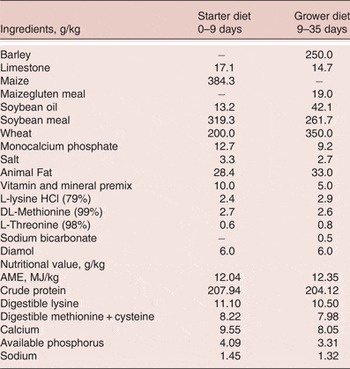
The experiment had a completely randomised design with five dietary treatments, each replicated six times, comprising a non-challenged, non-supplemented control treatment, and four NE challenged treatments with 0 (challenged control), 1, 2, and 3 g/kg of RAC. The dietary composition and nutrient profiles of the diets are shown in Table 2. The starter diet was given from day one to nine (pellet diameter 2.3 mm) and the grower diet from day nine to 35 (pellet diameter 3.0 mm). RAC was included in both feeding phases. For this experiment, RAC was absorbed into silicon dioxide (Tixosil 38X, Rhodia Group, Collonges au Mont d'Or, France) at 1:1 ratio before mixing to the feed. The inclusion rate of RAC has been given as the weight of the liquid product without carrier throughout the text. In the formulation, RAC was exchanged for diamol as an inert carrier, thus preventing dilution of energy and nutrients. The grower diet contained high levels of barley and wheat, which contain soluble NSPs, which increase intestinal viscosity which is considered to provide a beneficial environment for C. perfringens growth.
Composition and nutritional value of diets in Experiment 2

Feed intake and BW were recorded per cage on days nine, 20, and 35. From this data, BWG and FCR were calculated per cage for the periods from day nine to 20 (challenge period) and from day nine to 35 (overall experimental period). On day nine the birds in the non-challenged control group were orally placebo-treated with 1.0 ml phosphate buffered saline solution (PBS), whereas all other birds were orally inoculated with 1.0 ml PBS containing 104 sporulated Eimeria maxima oocysts. On day 14, the birds in the non-challenged control group were orally placebo-treated with 1.0 ml sterile liver broth, whereas all other birds were inoculated with 1.0 ml liver broth containing 108 colony forming units (cfu) of C. perfringens. The inocula were prepared by the GD Animal Health Service Ltd. (7400 AA Deventer, The Netherlands).
On day 15, four birds per cage were randomly selected and euthanised by intracardiac injection of T61® (Intervet, Boxmeer, the Netherlands) for visual examination of the intestinal lining and collection of caecal digesta material for microbial profiling and SCFA analysis. The intestines were lesion scored according to the method of Johnson and Reid (Reference Johnson and Reid1970). Caecal contents were collected and pooled per cage, giving six replicated pooled samples per treatment for both days. The samples were stored at -20°C until analysis.
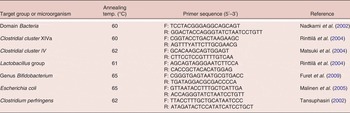
The caecal samples from day 15 were analysed for the abundance of total eubacteria (domain Bacteria), the butyrate-producing Clostridial clusters IV and XIVa, Lactobacillus group, genus Bifidobacterium, Escherichia coli and C. perfringens with real-time qPCR. The target gene was the phospholipase c (plc) gene for C. perfringens and 16S rRNA for all the other microbial groups or species. The annealing temperatures, target gene sequences and references to previously published methods are presented in Table 3. Microbial DNA of the caecal digesta samples was extracted and the real-time PCR analysis was conducted as described in Kettunen et al., (Reference Kettunen, Vuorenmaa, Rinttilä, Grönberg, Valkonen and Apajalahti2015). From the same samples, the SCFA profiles consisting of the concentrations of acetic, propionic, butyric, iso-butyric, 2-methyl-butyric, valeric, iso-valeric and lactic acid were analysed with gas chromatography following the previously published procedure (Kettunen et al., Reference Kettunen, Vuorenmaa, Rinttilä, Grönberg, Valkonen and Apajalahti2015). The total SCFAs were calculated as the sum of all aforementioned SCFA classes. The total concentration of branched chain volatile fatty acids (BCVFAs) was calculated as the sum of iso-butyric, 2-methyl-butyric and iso-valeric acids.
Real-time PCR assays of Experiment 2. The target gene was the phospholipase c -gene for Clostridium perfringens and 16S rRNA for the other groups or species

Performance data were analysed by ANOVA using GenStat® statistical software (17th edition, VSN International Ltd., Hemel Hempstead, UK), with Fisher's Least Significant Difference as a post-hoc test, with cage as the experimental unit. For the real-time PCR results, the number of gene copies (or genomes in the case of C. perfringens) was initially log10 transformed to achieve a normal distribution. Subsequently, the average and standard error of the mean from both microbial and SCFA results were calculated for each treatment, respectively. Comparisons between the infected control group and other treatments were calculated with Dunnett's two-sided post-hoc test using IBM SPSS 22 software (SPSS Inc., Chicago, IL). Effects were considered statistically significant at P < 0.05 and trends at P < 0.10.
Results and discussion
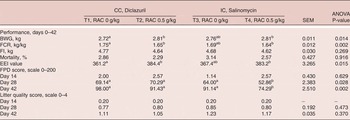
Experiment 1. Dietary RAC had a positive effect on the bird performance over the 42-day rearing period. As shown in Table 4, combined with CC, RAC significantly improved the final BW by 3.3% and FCR by 5.7%. When combined with IC, RAC tended to improve FCR by 3.0% (P < 0.1). Moreover, RAC significantly improved the EEI value by 6% in combination with CC and a trend towards the same direction was observed when RAC was combined with IC (P < 0.1). Feed intake and mortality were similar in all treatments. The EEI calculation indicated the efficacy of broiler production, as it took into account the feed consumption, final body mass, mortality and the length of the rearing period, and the result suggested that dietary RAC may bring economic benefits to broiler production. Experiment 1 was the first trial to demonstrate the positive performance effects of RAC in a mixed-sex flock of broiler chickens in a commercial-type broiler operation environment.
Effect of dietary supplementation of resin acid composition (RAC) and either chemical coccidiostat (CC) or ionophoric coccidiostat (IC) on the performance of broilers, the foot pad dermatitis (FPD) score and litter quality score in Experiment 1

FPD score = (number lesion class 1 * 0.5 + number lesion class 2 * 2) x 100)/25. The mean value for each treatment, the pooled standard error of the mean (SEM) and ANOVA P-value are given. Different superscripts (a,b) in same row indicate significant difference between the treatments (P < 0.05).
One of the indicators of welfare in broiler operations is the litter quality, which is affected e.g. by diarrhoea. Wet litter is one of the causes of necrotic lesions in the footpads, referred to as foot pad dermatitis (FPD; Shepherd and Fairchild, Reference Shepherd and Fairchild2010). Dietary RAC did not affect litter quality, but it significantly improved FPD scores on days 28 and 42 in the IC group (Table 4). Further research is needed to reveal whether RAC affects footpad health through microbial modulation or some other mechanism.
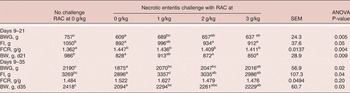
Experiment 2. During the starter diet period (days one to nine), the treatments did not affect the production variables (data not shown). During the challenge period, the challenged control birds had a 15% lower feed intake, 20% lower body weight gain and 6% impaired FCR compared to the non-challenged control birds (Table 5). However, the challenge induced only a few clinical signs of illness to the birds, and the intestinal lesion scoring revealed only few, mild lesions with no difference between the treatments (data not shown). The challenge significantly decreased FI by 11% and BWG by 14% in the overall study period, compared to the non-challenged control birds.
Effect of dietary supplementation of resin acid composition (RAC) on the performance of birds during the challenge period (days 9 to 21) and the overall study period (days 9 to 35) in Experiment 2

The mean value for each treatment, the pooled standard error of the mean (SEM) and ANOVA P-values are given. Different superscripts (a, b, c) in same row indicate significant difference between the treatments (P < 0.05).
Dietary RAC partly compensated for the negative effects of the NE infection during the challenge period: the BWG in the RAC 1 g/kg group was significantly higher than in the challenged control group (Table 5). The beneficial effects of RAC continued in the overall study period: RAC at 1 and 2 g/kg increased BWG, and RAC at 1 g/kg increased the BW on day 35. FCR or FI were not significantly affected by RAC, but it is still noteworthy that FI was numerically higher in the RAC-treated groups than in the non-supplemented challenged group both during the challenge and overall study period. In fact, it seems that FI in the (challenged) RAC 1 g/kg group was not depressed by the infection at all. Reduction of FI is indicative of a compromised health status, due to anorexic effects of pro-inflammatory cytokines (Shen et al., Reference Shen, Piao, Kim, Wang and Liu2010).
Supporting earlier findings of Kettunen et al. (Reference Kettunen, Vuorenmaa, Rinttilä, Grönberg, Valkonen and Apajalahti2015) and Vuorenmaa (Reference Vuorenmaa2015), the positive effect of RAC on the challenge period performance of the chickens was dose-dependent. Birds in the RAC 1 and 2 g/kg groups performed better than their counterparts in the RAC 3 g/kg group. In comparison, in experiment 1, RAC at 0.5 g/kg improved both BWG and FCR. Thus, there seems to be a relatively low optimum dose of RAC, and exceeding it decreased rather than increased bird performance.
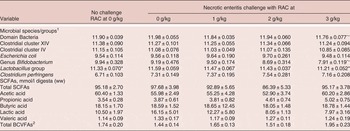
The microbial and SCFA results are presented in Table 6. The abundance of C. perfringens, E. coli and Clostridial clusters IV and XIVa and the SCFA profiles were unaffected by dietary treatment. RAC at 1 and 2 g/kg did not affect any microbial groups selected for the study. However, RAC at 3 g/kg significantly decreased the abundance of the Lactobacillus groups and tended to decrease that of total eubacteria and the genus Bifidobacterium, compared with the non-supplemented control. The SCFA profile was unaffected by the treatments. Previously it has been observed that RAC at 1 g/kg reduced the NE-associated peak of microbial lactic acid production in ileal contents (Kettunen et al., Reference Kettunen, Vuorenmaa, Rinttilä, Grönberg, Valkonen and Apajalahti2015). In the present experiment, RAC at 2 and 3 g/kg numerically decreased caecal lactic acid concentration. Thus, the present data lends little support to the hypothesis that performance effects of RAC are mediated through any influence on caecal microbiota. It was noteworthy that performance effects did not seem to be directly related to the caecal abundance of C. perfringens, a finding supported by earlier work on ileal digesta of NE-challenged broiler chicks (Kettunen et al., Reference Kettunen, Vuorenmaa, Rinttilä, Grönberg, Valkonen and Apajalahti2015). However, the data did not preclude the possibility that some other variables of caecal microbiota might have a role in the process. Future studies are needed on the role of intestinal microbiota in the effects of RAC on poultry.
Effect of RAC on the abundance of microbial species or groups and on the short chain fatty acid (SCFA) profiles in the caecal digesta samples in Experiment 2, expressed as the mean ± S.E. (standard error of the mean)

Statistical difference from the challenged nonsupplemented (RAC 0 g/kg) treatment is expressed with asterisks: * - p < 0.05; ~ - p < 0.1 (Dunnett's two-sided post-hoc test). 1Log10 number of the target gene sequence copies/g digesta wet weight (ww) 2Branched chain volatile fatty acids (sum of iso-butyric, 2-methyl-butyric and iso-valeric acids).
Conclusions
The present study showed that dietary RAC improved the performance of broiler chickens both under intentional NE challenge and under natural background challenge of a commercial setting. Moreover, the study implied that performance benefits of RAC can be seen throughout the entire five to six-week duration of a broiler grow-out period, using commercial-type diets containing feed enzymes and anticoccidial drugs. Furthermore, the study suggested that the performance benefits of RAC were not associated with a certain microbiological and/or dietary environment, and can be reproduced under varying dietary regimens and environments. The caecal microbial parameters selected for the study did not explain observed performance effects of RAC. The mechanism by which RAC improves the performance of broiler chickens remains to be unveiled in future investigations.
Acknowledgements
The research was funded by Hankkija Ltd.
Declaration of interest
J. Vuorenmaa and E. Valkonen are employed by Hankkija Ltd.