Introduction
The field of epigenetics is currently one of the most rapidly expanding fields of biology, Reference Weber1,Reference Cavalli and Heard2 resulting in increasing public interest. Reference Dubois, Louvel, Le Goff, Guaspare and Allard3,Reference Dyke, Ennis and Joly4 However, research today is only beginning to delve into the potential links between epigenetics and disease risk, with findings still too preliminary to provide recommendations for daily living. Reference Richardson, Daniels and Gillman5 While the field of epigenetics may be finally “coming of age” (p. 796), Reference Cavalli and Heard2 there is still much to be learnt about epigenetics and the developmental origins of health and disease (DOHaD) theory, and their respective effects on human health. Reference Holliday6,Reference Sharp and Relton7
There has been some research outlining public understanding of genetic and environmental susceptibility to disease, in line with the “nature versus nurture” debate. Reference Condit8,Reference Morris, Gwinn, Clyne and Khoury9 These studies suggest the public views genetic factors (over environmental ones) as contributing only a small role to human disease and only associated with severe, incurable disease. Reference Morris, Gwinn, Clyne and Khoury9 This is contrary to literature showing that genetic susceptibility plays a role in a number of human diseases which are generally considered to be caused by environmental factors, such as lung cancer caused by cigarette smoking, pesticide and lead toxicity, infectious diseases, and the effects of certain drugs. Reference Morris, Gwinn, Clyne and Khoury9 Furthermore, while the majority of people understand that both genetic and environmental factors contribute to an individual’s overall health, they tend to treat each as discrete, noninteracting entities. Reference Condit8 In fact, the interaction between genes and our environment is fundamental to nearly all human disease. Reference Morris, Gwinn, Clyne and Khoury9 Simply put, the public views genetics “through the lens of heredity” (p. 1) Reference Condit8 rather than by understanding the underpinning biological mechanisms by which inheritance operates. Overall, the public’s understanding of common disease genetics is low. Reference Tercyak, Hensley Alford and Emmons10
With the acceleration of epigenetic research in recent years has come increasing public interest and media coverage. Reference Dubois, Louvel, Le Goff, Guaspare and Allard3,Reference Dyke, Ennis and Joly4 However, evidence to date suggests that mass media portrayal of the complex research surrounding epigenetics is poor and littered with misconceptions and overestimation of potential implications for human health. Reference Dubois, Louvel, Le Goff, Guaspare and Allard3,Reference Dyke, Ennis and Joly4 Despite this, no studies have examined the public’s perception of epigenetics directly.
Public knowledge of genetics, epigenetics, and DOHaD concepts has implications for overall public health. This was demonstrated in a New Zealand study showing that both knowledge and health outcomes were improved following an in-school educational intervention for adolescents. Reference Bay, Mora and Sloboda11 Participants showed increased positive lifestyle changes as well as understanding of the long-term and intergenerational value of such behaviors. Reference Bay, Mora and Sloboda11 Subsequent impacts include the passing down of information to future generations, providing further benefit to the extended family. Reference Bay, Mora and Sloboda11 However, knowledge translation (the process of communicating scientific evidence to the general public) is best achieved when the public’s prior understanding is well understood. Reference Molster, Charles, Samanek and O'Leary12 Therefore, to best improve communication and other health promotion activities delivered to the public, we first need to understand the public’s current view of these concepts; understanding this knowledge is essential in the development of educational interventions to influence health outcomes. This study aimed to do this through the administration of a survey to the Australian public examining their knowledge and opinion of epigenetics and epigenetic concepts, to provide a baseline for future research and to assist in the development of public health interventions.
Method
Questionnaire design
An online questionnaire was developed following a comprehensive literature review using terms including “epigenetics,” “genetics,” “attitudes to health,” “developmental origins of health and disease,” “parents,” “opinions,” and “chronic health.” A number of experts in relevant fields were consulted to provide feedback on a draft version. These included several leaders in community child health organizations; researchers in the fields of community child health and nutrition sciences, and one pediatric nutritionist/dietician. This group provided recommendations for further questions to be added in accordance with their expertise and modifications to existing questions to maximize informative data collection. The questionnaire was then piloted to 37 individuals, including students and researchers with a background in genetics, and lay people, including friends and family, who provided feedback on readability, length, and other questionnaire design elements. These pilot responses were not included in the final analysis.
The questionnaire was estimated to take approximately 20–30 min to complete. It comprised five sections, with questions grouped according to theme. A maximum of 57 questions were included, dependent on participant answers and subsequent branching logic. Sections included questions on demographics; knowledge and experience of genetics and epigenetics; personal and family history; perceptions of epigenetic concepts for self; and perceptions of epigenetic concepts for children. The questionnaire included mainly quantitative questions, with some open-ended question responses. A summary of the content of the questionnaire is presented in Table 1, and the full questionnaire is included in supplementary materials.
Summary of questionnaire content

* These five conditions were chosen as they have all been shown to likely have underlying epigenetic components and are conditions usually recognized by the general population.
Recruitment
Individuals over the age of 18 and able to read and write English were eligible to participate. Participation was anonymous. Participants were recruited through online and social media advertising. The questionnaire was advertised through a selection of Facebook pages and Twitter accounts, as well as the Raising Children Network website (https://raisingchildren.net.au/). The social media avenues of recruitment were the Murdoch Children’s Research Institute (Facebook and Twitter); Andrology Australia (Facebook); Medicine, Dentistry & Health Sciences at the University of Melbourne (Facebook and Twitter); and Moonee Valley Maternal and Child Health (Facebook). Avenues of advertising were chosen to maximize recruitment of parents (though nonparents could also participate) and men, an often underrepresented group in parenting research. Reference Davison, Charles, Khandpur and Nelson13
Data collection and analysis
Questionnaire data were collected and managed using REDCap electronic data capture tools hosted at the Murdoch Children’s Research Institute. Reference Harris, Taylor and Thielke14,Reference Harris, Taylor and Minor15 Data from REDCap were exported and statistical analysis performed using Stata, version 15. 16 Descriptive statistics were used to analyze demographics data. Categorical data were analyzed using basic statistical analyses including frequency and percentage. Continuous data were analyzed using means and standard deviations. Chi-squared tests were used to analyze the differences in understanding of epigenetic concepts between groups (of different age, gender, education level, and parent status) to determine statistical significance. Due to the study’s exploratory nature and methodology, power calculations were not applicable.
Three terms/phrases were chosen to examine in detail participants’ recognition and understanding of epigenetics concepts: ‘epigenetics’; “developmental origins of health and disease’; and ‘the first 1000 days.” These were chosen based on common language used in relevant literature and the authors’ own experiences of communicationg epigenetics concepts to lay audiences. Free text responses to knowledge-based questions were systematically scored on a scale of zero to three, based on how many elements of the definition the participant was able to identify. This was dependent on a consensus definition for each term or phrase, as decided by the researchers, and based on a review of the literature. Each response was scored by all authors, and the consensus score was used in the analysis. The elements of each definition used in the analysis are presented in Table 2.
Definitions used in the analysis

Results
Outcome of recruitment
A total of 606 questionnaires were completed. Two hundred and fifteen questionnaires were excluded based on insufficient completeness (participants who did not complete any questions past Section 1, Demographics), leaving 391 to be included in the analysis.
The largest number of participants (n = 153, 39.1%) were reached through the Murdoch Children’s Research Institute (MCRI) Facebook page, followed by the Raising Children Network website (n = 96, 24.6%). Some participants (n = 85, 21.7%) were reached through other avenues on Facebook or Twitter, such as through their friends’ shared posts and retweets. Distribution of participants accessed through the various recruitment avenues is presented in Supplemental Fig. S1.
Participant demographics
The majority of participants were female (n = 370, 94.6%), and parents (n = 265, 76.8%). The mean age of participants was 37.5 years, and the median age was 36 years; age itself followed an apparently normal distribution. The mean number of children parents had was 1.9, and the average age of their children was 8.3 years. Most participants were married (n = 232, 62.9%) and had private health insurance (insurance purchased from a registered health insurer that allows for treatment in a private hospital and health care that is not covered by the public health system in Australia) (n = 252, 68.9%), with the main source of income for their household being wages or salary (n = 344, 93.7%).
One hundred and sixty-six (45.2%) participants had a postgraduate degree, 124 (33.8%) had an undergraduate degree, and a further 48 (13.1%) had some form of college certificate or diploma, resulting in 92.1% (n = 338) of participants having completed some form of tertiary education.
Most participants were born in Australia (n = 300, 82.2%), and the majority currently resided in the country (n = 350, 94.6%). Most participants (n = 226, 61.6%) stated that they identified with no religion, while 17.7% (n = 65) of participants identified as Catholic (the second largest group, after no religion). Additionally, 252 (68.5%) participants indicated that their religious beliefs do “not at all” influence their everyday decision making, with only 3.8% (n = 14) of participants indicating that their religious beliefs “significantly” influence their everyday decision making.
The majority of participants spoke at least English at home (n = 329, 98.5%), and 1.5% (n = 5) of participants did not speak English at home at all. Two hundred and ninety-six (80.7%) participants identified their ethnicity as “Australian.” Participant demographics are outlined in detail in Supplemental Table S1.
Participants’ knowledge and experience of genetic testing
Participants were asked whether they had heard about a selection of types of genetic testing, and whether either they or their children had undergone any of the types. The most recognized type of genetic testing was diagnostic genetic testing, with 72.6% (n = 284) of participants indicating they had heard about it. This was closely followed by predictive genetic testing, which 70.6% of participants (n = 276) had heard about, and carrier testing, which 70.3% (n = 275) of participants had heard about. Pharmacogenetic testing was the least recognized, with 45.0% (n = 176) of participants indicating they had heard about it.
The most common type of genetic testing reported by participants was genetic screening or testing in pregnancy, with 27.6% of participants (n = 108) indicating they had had this type of test. Following this, 10.0% of participants (n = 39) indicated they had had carrier testing for a genetic disease, and 9.5% of participants (n = 37) said they had had genetic screening as a newborn baby.
Of those who were parents, 141 (36.1%) participants said that their child/children had undergone newborn screening. Thirty-one (7.9%) participants’ children had had genetic testing or screening in pregnancy, and just one (0.3%) participant’s child/children had undergone pharmacogenetic testing. A full outline of responses is displayed in Fig. S2.
Participants’ knowledge of epigenetics and epigenetic concepts
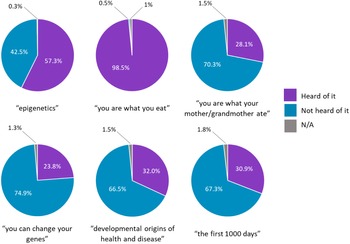
Participants had varied knowledge of the epigenetic concepts that were included in the questionnaire. The phrase most recognized was “you are what you eat,” with 385 (98.5%) participants having heard of this phrase. The least familiar phrase was “you can change your genes,” with the majority of participants (n = 293, 74.9%) having never heard of this phrase.
Two hundred and twenty-four participants (57.3%) had heard of the term “epigenetics,” with the majority hearing about it from a health professional (n = 79, 35.3%) or the internet (n = 54, 24.1%), followed closely by formal education such as university studies (n = 50, 22.3%). Of the 385 participants who had heard of the phrase “you are what you eat,” 156 (40.5%) could not remember where they had heard about it, while 34.8% (n = 134) indicated they had heard about it through television or the radio. One hundred and ten (28.1%) participants had heard the phrase “you are what your mother/grandmother ate,” with the highest proportion having heard about it from the internet (n = 25, 22.7%), television or radio (n = 20, 18.2%), or a health professional (n = 18, 16.4%). Of the participants who had heard of the phrase “you can change your genes,” most had heard about it from the internet (n = 24, 25.8%) and television or radio (n = 22, 23.7%). A further 29.0% (n = 27) could not remember where they had heard about it. Around one-third of participants (n = 125, 32.0%) had heard of the phrase “developmental origins of health and disease.” Of these, 36.0% (n = 45) had heard about it from a health professional, 19.2% (n = 24) from formal education, and 17.6% (n = 22) from the internet. Finally, the majority of participants (n = 263, 67.3%) had not heard of the phrase “the first 1000 days.” Of those who had, most had heard about it from the internet (n = 33, 27.3%) or a health professional (n = 31, 25.6%), while 31.4% (n = 38) of participants could not remember where they had heard about it. The full distribution of responses is outlined in Figs. 1 and 2.
Participants' recognition of epigenetics concepts.

Where participants had heard about a set of phrases relating to epigenetics. Phrases included (a) “the first 1000 days” (n = 121); (b) “developmental origins of health and disease” (n = 125); (c) “you can change your genes” (n = 93); (d) “you are what your mother/grandmother ate” (n = 110); (e) “you are what you eat” (n = 385); and (f) “epigenetics” (n = 224).

Participants’ understanding of epigenetics concepts
The questionnaire examined participants’ knowledge and understanding of epigenetics concepts using three specific terms and phrases: “epigenetics,” “developmental origins of health and disease,” and “the first 1000 days.” Participants were asked if they had heard of each term, whether they understood its meaning, and were then given the opportunity to provide an explanation of their understanding in a free-text response.
Epigenetics
Of the 224 who said they had heard of the term “epigenetics,” nineteen participants (8.5%) indicated they did not know what it meant. Of those who proposed a definition, only 7 (3.6%) could correctly identify all three elements of the definition of the term. Fifty (25.4%) could identify two elements of the definition, 93 (47.2%) were able to identify one element, and the remaining 47 participants (23.9%) were not able to identify any elements of the definition of the term. Some example free-text responses are shown in Table 3.
Proportion of participants who identified the different elements of the definition of “epigenetics,” with indicative participant responses (n = 197)

Of the three elements of the definition of “epigenetics,” the first element (modifications of gene expression, rather than alteration of the genetic code itself) was the most commonly identified (n = 103, 52.0%). The second element (influenced by the environment) was also well recognized, with 47.0% (n = 93) of participants identifying this element in their definition. Only 14.1% (n = 28) of participants identified the third element (transmitted across generations) in their definition. These results are shown in Table 4.
Elements of the definition of “epigenetics” (n = 198)

* Does not equal 100% as some participants identified more than one element, while some identified no elements.
Developmental origins of health and disease
Of the 125 participants who had heard of the phrase “developmental origins of health and disease,” ten participants (8.0%) did not know what it meant. Of those that said they did, and provided a definition, 13 participants (12.9%) were able to correctly identify all three elements of the definition of the phrase. Thirty-six participants (35.6%) gave responses that included two of the elements of the definition, 15 (14.9%) gave responses that included one element of the definition, while 37 (36.6%) did not identify any elements of the definition of the phrase. Some example free-text responses are shown in Table 5.
Proportion of participants who identified the different elements of the definition of “developmental origins of health and disease,” with indicative participant responses (n = 101)

The most well-recognized element of the definition of the phrase “developmental origins of health and disease” was the third element (consequences for health and disease in later life), with 36.6% (n = 37) of participants identifying this element. The first element (early life environment) was identified by 29.7% (n = 30) of participants, and 17.8% (n = 18) of participants were able to identify the second element (factors that affect development) in their definition. These results are shown in Table 6.
Elements of the definition of “developmental origins of health and disease” (n = 101)

* Does not equal 100% as some participants identified more than one element, while some identified no elements.
The first 1000 days
Six of the 121 participants (5.0%) who had heard of the phrase “the first 1000 days” indicated that they did not know what it meant. Of those who provided a definition, four participants (3.7%) could correctly identify all elements of the definition of the phrase. Twenty-five participants (23.4%) could identify two elements of the definition, while 45 (42.1%) gave responses that included one element, and a further 33 (30.8%) gave responses that did not include any elements of the definition. Some example free-text responses are shown in Table 7.
Proportion of participants who identified the different elements of the definition of ‘The first 1000 days’, with indicative participant responses (n = 107)

The most commonly recognised element of the definition of “the first 1000 days” was the third element (impacts the future health of the child), with 43.0% (n = 46) of participants identifying this element in their definition. Thirty-one participants (29.0%) were able to identify the first element of the definition (first 1000 days from conception to age 2), while 18.7% (n = 20) of participants identified the second element (environmental factors and events that occur during this time) in their definition. These results are shown in Table 8.
Elements of the definition of “the first 1000 days” (n = 107)

* Does not equal 100% as some participants identified more than one element, while some identified no elements.
Effect of age, gender, education level and parent status on knowledge of epigenetics and epigenetic concepts
Participants’ age showed no evidence of an association with their knowledge of the majority of epigenetic terms and phrases, except for the term “epigenetics” itself, where there was evidence that age affected people’s recognition of the term (χ 2(3) = 9.1177, p = 0.028). All analyses are shown in Supplemental Table S2.
Participants’ gender showed no evidence of an effect on their knowledge of epigenetics and epigenetic concepts. All analyses are shown in Supplemental Table S3.
Participants’ level of education showed no evidence of an effect on their knowledge of the majority of terms and phrases, except for the term “epigenetics” itself, where tertiary educated participants were more likely to have heard of the term (χ 2(1) = 5.0776, p = 0.024). All analyses are shown in Supplemental Table S4.
Whether participants were parents or not showed no evidence of an effect on knowledge of the majority of terms and phrases related to epigenetics, except for the term “epigenetics” itself, for which non-parents were more likely to have heard of it (χ 2(1) = 20.1600, p < 0.001). The full distribution of responses is shown in Supplemental Table S5.
Multiple test correction was not performed for this portion of analysis.
Participants’ perceptions of the effect of genetics and environment on the development of disease
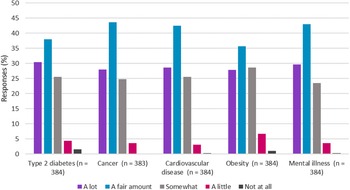
Participants were asked how much they thought the environment and family history, or genetics, influence the development of five conditions: type 2 diabetes, cancer, cardiovascular disease, obesity, and mental illness. The majority of participants thought that the environment influences the development of type 2 diabetes and obesity “a lot” (57.3% (n = 220) and 56.9% (n = 218) respectively). The most common response for how much the environment influences cancer, cardiovascular disease, and mental illness was “a fair amount” (36.2% (n = 139), 40.4% (n = 155), and 37.6% (n = 144), respectively). Most participants thought that a family history influences the development of all five conditions (type 2 diabetes, cancer, cardiovascular disease, obesity and mental illness) “a fair amount” (38.0% (n = 146), 43.6% (n = 167), 42.5% (n = 163), 35.7% (n = 137), and 42.9% (n = 165), respectively). A full distribution of responses is shown in Figs. 3 and 4.
How much do you think the environment influences the development of the following conditions?

How much do you think family history or genetics influences the development of the following conditions?

The majority of participants (n = 205, 53.8%) somewhat agreed with the statement “your environment can change how your genes work.” The majority of participants (n = 224, 58.6%) also indicated that they strongly agreed with the statement “your mother’s environment during pregnancy can influence your future health.” Two-hundred participants (52.6%) indicated that they strongly agreed with the statement “the food a woman eats when she is pregnant affects the health of her baby,” however, the most common response to the statement “the food a woman eats when she is pregnant affects the health of her baby when it is grown up” was “somewhat agree” (n = 176, 46.4%). The majority of participants said that they strongly agreed with the statements “the food I eat now will affect my health in future,” and “it is important for me to eat healthy food now” (71.4% (n = 270) and 79.7% (n = 303), respectively), while a portion of participants indicated that they either “strongly agree” (n = 104, 27.4%) or “somewhat agree” (n = 104, 41.2%) with the statement “the food I eat now may affect the health of any child I have in the future.” Responses to all statements are outlined in Fig. S3.
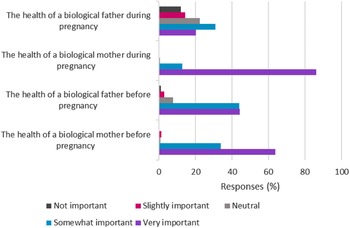
The majority of participants thought that “the health of a biological mother before pregnancy” and “the health of a biological mother during pregnancy” were “very important” to the health of a future baby (63.9% (n= 242) and 86.5% (n = 327), respectively). The most common responses regarding “the health of a biological father before pregnancy” were that it was either “very important” (n = 168, 44.3%) or “somewhat important” (n = 167, 44.1%) to the health of a future baby. “The health of a biological father during pregnancy” was considered by 117 participants (30.9%) to be “somewhat important.” The full distribution of responses is shown in Fig. 5.
How important do you think the following are to the health of a future baby? (n = 379).

Discussion
Understanding of epigenetic concepts
Participants’ recognition of epigenetics and epigenetic concepts was varied. Knowledge of the more technical terms (“epigenetics,” “developmental origins of health and disease,” and “the first 1000 days”) was high. However, more general phrases such as “you are what your mother/grandmother ate” and “you can change your genes” were not well recognized. While this may be a result of the highly educated nature of the participant population, it may also suggest that the more general phrases are not in common use.
Although many participants indicated that they had heard of the three key terms and phrases, fewer understood their meaning, and only a very small proportion were able to correctly define each concept. This is consistent with research investigating public understanding of genetics, showing that public awareness of genetic concepts is greater than understanding of their meaning. Reference Molster, Charles, Samanek and O'Leary12 This may be due to incidental exposure to these concepts through popular media rather than formal education. Reference Molster, Charles, Samanek and O'Leary12 This factor is also evident in this study by the large proportion of participants who had heard of epigenetic concepts from the internet, television, and radio.
Despite being the most well-understood concept presented to participants, understanding of the DOHaD concept was still low, with each participant showing variability in their individual understanding. This may reflect the complexity of the theory itself. The DOHaD theory is inherently difficult to define Reference Barker17 and is often referred to by other names such as the “fetal basis of adult disease” or the “early origins theory,” Reference Dolinoy, Weidman and Jirtle18 causing confusion and differing levels of understanding of each name. The concept of epigenetics was less well understood, with the element of its transgenerational nature only identified by 14.1% of participants. While there is only developing evidence in humans to support transgenerational inheritance of epigenetic markers, the potential inheritability of some epigenetic traits may have significant implications for not only families, but overall public health. Reference Gluckman, Hanson and Beedle19 Finally, while almost one-third of participants identified that the first 1000 days begins at conception, a common misconception throughout responses was that the 1000 days begin at birth. Misconceptions such as these are disadvantageous when concepts are use in public health messaging, as there is a risk that the health message may be misunderstood Reference Molster, Charles, Samanek and O'Leary12 and would therefore be important to address in future public health messaging.
We demonstrated no association between an individual’s gender and their knowledge of epigenetic concepts, in contrast to previous studies showing that an individual’s genetic knowledge is more likely to be of a higher standard if they are female. Reference Molster, Charles, Samanek and O'Leary12,Reference Henneman, Vermeulen and van El20 This study also indicated that individuals with a tertiary education were more likely to understand epigenetic concepts than those who were not tertiary educated. This is consistent with previous research showing that higher education is associated with a greater knowledge of genetic concepts. Reference Molster, Charles, Samanek and O'Leary12,Reference Henneman, Vermeulen and van El20 Additionally, in this study, participants who did not have any children were more likely than parents to have heard of epigenetics. This may be because those who have no children are likely to be younger, suggesting that younger participants are more likely to have heard of epigenetics. Existing literature also suggests younger individuals are more likely to have a better understanding of genetics. Reference Molster, Charles, Samanek and O'Leary12 This study also independently showed that age had an effect on whether participants had heard of epigenetics; however, no analysis was undertaken to explore this in more detail.
Opinions of environmental versus family history influence on chronic disease
This study showed that in general, participants thought that the environment influenced the development of type 2 diabetes and obesity more strongly than cancer, cardiovascular disease, or mental illness. Despite this, most participants believed that a family history of the condition influenced the development of all five conditions similarly. Overall, participants thought that the environment and family history both played a significant role in the development of all five conditions. There is conflicting literature examining the public’s views of the contribution of genetics and environment to disease. Some literature suggests that the public believe that genetic susceptibility factors play only a small role in diseases which are considered to be mainly environmentally influenced, Reference Morris, Gwinn, Clyne and Khoury9 while other studies have suggested that the public believe that many health conditions are influenced by both genetics and the environment. Reference Condit8,Reference Henneman, Vermeulen and van El20 A recent study showed that the American public’s estimate of the heritability of a number of human traits is close to published estimates, with educated mothers of multiple children demonstrating particular accuracy. Reference Willoughby, Love and McGue21 Irrespective, however, the public still tends to view genetic and environment factors and separately acting entities, Reference Condit8 without recognizing the important epigenetic interactions at play.
Opinions of DOHaD concepts
The majority of participants agreed that eating healthily was important for their own current and future health, indicating that participants were aware that their current actions could influence their health later in life. Most participants also agreed that the food they ate now could affect the health of their future children, showing that participants were aware of the implications of their current lifestyle on the health of their offspring in future, a fundamental characteristic of epigenetics. Reference Rothstein, Cai and Marchant22
Only a slight majority felt strongly that a mother’s environment during pregnancy could influence a child’s future health. This is important as the idea that the environment within which a fetus develops has long lasting effects is the underlying concept of the DOHaD (or fetal basis of adult disease) theory. Reference Dolinoy, Weidman and Jirtle18 In addition, most participants strongly agreed that the food a woman eats when she is pregnant affects the health of her baby; however, fewer agreed that the food a woman eats when she is pregnant affects the health of her baby when it is grown up, suggesting that participants saw a difference in these statements. The responses to these statements were also stronger than that about a mother’s environment, possibly indicating that participants believe that that which a mother has more control over (her diet) has a greater impact on fetal development than that which she has less control over (her environment). Despite this subtle differentiation of the two, it is generally accepted that both nutritional and other environment factors during prenatal development and early life influence developmental plasticity and impact health in adult life. Reference Dolinoy, Weidman and Jirtle18
The dichotomy often observed between men’s and women’s health with regard to reproduction Reference Hessler23 was evident in this study. Participants considered a mother’s health (both before and during pregnancy) to be more important to the health of a future baby than a father’s health during the same time periods. The health of a biological father during pregnancy was considered of the lowest importance; however, the most common response was that it was still somewhat important. This may be representative of a more palpable link between a mother’s environment during pregnancy and her child’s health, or a reflection of the overwhelming research trend toward investigating maternal, over paternal, factors impacting offspring health. Reference Sharp, Lawlor and Richardson24,Reference Sharp, Schellhas, Richardson and Lawlor25 It is important to note, however, that although historically, much blame has been put on mothers for the health of their children Reference Hessler23 research is beginning to suggest that fathers play just as large a role in the epigenetic inheritance of their offspring. Reference Richardson, Daniels and Gillman5
Implications for public health intervention
With the rapid evolution of epigenetics research in recent years has come a growing public interest in the field and its impact on human health. Reference Dubois, Louvel, Le Goff, Guaspare and Allard3,Reference Dyke, Ennis and Joly4 However, as is the case with much basic research, media portrayal of epigenetics and epigenetic concepts is often widely inaccurate. Reference Dubois, Louvel, Le Goff, Guaspare and Allard3,Reference Dyke, Ennis and Joly4 This study provides evidence to demonstrate the impact of this portrayal on the public’s understanding and opinion of epigenetics and epigenetic concepts, facilitating guidance for future public health messaging and intervention.
Particularly, using terms for which the public have a better recognition and understanding (such as DOHaD) may be more effective in public health messaging. However, care should be taken when using these technical terms to avoid common misconceptions and address differing understandings between individuals, as was evident in this study. Further public education is also needed to address misunderstandings surrounding the impact of health behaviors on future generations. For example, that only a small majority of participants believed that a mother’s environment during pregnancy affected the future health of her child is concerning in light of growing evidence supporting the DOHaD theory.
Limitations
Despite the large sample size, the participant population of this study was more highly educated and had a greater proportion of females and parents than the general population, 26 limiting the generalizability of results to the wider population. Additionally, findings are restricted due to the limited diversity of ethnicities represented. Further, because online recruitment is vulnerable to ascertainment bias via participant self-selection into the study, Reference Sue and Ritter27 these results are likely to represent the thoughts and attitudes of an already engaged population of individuals. This group is therefore not a random sample of the general population and findings cannot be used to make inferences about the wider public. Non-English speakers, and those without tertiary education, may have a lesser understanding of these concepts overall, making these important groups to consider in further research.
Future research
To date, there has been little research conducted exploring the public’s views and opinions of epigenetics and epigenetic concepts. While this was a preliminary, exploratory study, future research should involve detailed analysis of the concepts explored, including further investigation of how participants’ demographics influence their responses. Additionally, because of the limitations of the current study, similar research should also be conducted with groups more representative of the general population to address the bias in this sample toward female, highly educated parents.
This study provides the foundation for further analysis of public perception, awareness and understanding of epigenetics and epigenetic concepts, and findings should be used to guide research in this area with different populations (for example, in other countries) and specific subpopulations (for example, those at greater risk for noncommunicable diseases).
Conclusion
This study was the first of its kind to explore the public’s understanding, views, and opinions of epigenetics and epigenetic concepts, including the developmental origins of health and disease theory.
This research showed that participants had varied views of epigenetics and epigenetic concepts. Overall, recognition of epigenetic terms and phrases was high, while understanding of these terms and phrases was low. The phrase “developmental origins of health and disease” was most understood, in comparison to “epigenetics” and “the first 1000 days.” Participants who were female, and did not have children, were more likely to have heard of epigenetics. Age also had an effect on participants’ recognition of this term.
These findings should be considered in the development of public health messaging surrounding epigenetics concepts. Particularly, using terms and phrases most recognized and accurately understood by the public would be most beneficial. That many participants accessed this information from online sources is an important finding, and one that should be considered when deciding on the method of such messaging.
Epigenetic research is still in its infancy, and there is currently very little research exploring the public’s knowledge of these concepts. This research provides a solid foundation for further detailed investigation of these themes, all of which will be important data to help inform future public health messages regarding epigenetic concepts.
Acknowledgements
This research was completed in partial fulfillment of the requiements for FL’s Master of Genetic Counselling from the University of Melbourne. The authors thank the experts who reviewed the original questionnaire: Emma Robinson (Paediatric Nutritionist and Dietician at Boab Health, Queensland), Kate Armstrong (President and Founder, CLAN (Caring & Living as Neighbours)), Jane Willcox (Research Fellow, School of Exercise and Nutrition Sciences, Deakin University), Jo Buckman (Healthcare Nutrition Director, Danone Nutricia Early Life Nutrition), Associate Professor Julie Green (Executive Director, Raising Children Network), Sue West (Associate Director, Centre for Community Child Health), and Megan Keyes (Manager of Strategy and Operations, Centre for Community Child Health. The authors thank all survey respondents for their participation.
Supplementary materials
For supplementary material for this article, please visit https://doi.org/10.1017/S2040174421000520
Financial support
This research received no specific grant from any funding agency, commercial, or not-for-profit sectors.
Conflicts of interest
None.
Ethical standards
The authors assert that all procedures contributing to this work comply with the ethical standards of the relevant national guidelines on human experimentation (National Statement on Ethical Conduct in Human Research) and with the Helsinki Declaration of 1975, as revised in 2008, and has been approved by the institutional committees (Royal Children’s Hospital Human Research Ethics Committee, HREC ID: 36359A).