A bidirectional relationship exists between linguistic and social information, meaning that linguistic information conditions social perception, and social information conditions linguistic perception (Campbell-Kibler, Reference Campbell-Kibler2009, Reference Campbell-Kibler2010; Squires, Reference Squires2013; Walker, García, Cortés, & Campbell-Kibler, Reference Walker, García, Cortés and Campbell-Kibler2014), resulting in a Gordian knot of input and evaluations at the linguistic and social levels. In spite of these perceptual intricacies, listeners are astoundingly successful at identifying social information about a speaker through his or her speech. In fact, listeners are so attuned to sociophonetic cues that Purnell, Idsardi, and Baugh (Reference Purnell, Idsardi and Baugh1999) find that listeners in the United States are able to identify a speaker's dialect with over 80% accuracy when presented only with the word, “Hello.”
Given the impressive accuracy with which listeners interpret social information about speakers, numerous publications attempt to decipher how socially meaningful information is conveyed through linguistic variables. Interestingly, listeners seem to rely on a limited set of more salient linguistic variables when they interpret social information about a speaker (Clopper & Pisoni, Reference Clopper and Pisoni2004). In American English, for instance, vowel shifts are readily detected and used more than other shifts to identify a speaker's origins (Fridland, Bartlett, & Kreuz, Reference Fridland, Bartlett and Kreuz2004). The alveolar or velar production of (ING) represents another salient variable listeners use to gauge social information about a speaker. Campbell-Kibler (Reference Campbell-Kibler2009) found that alveolar productions decreased speakers' ratings of education and intelligence but only when they were perceived as coming from a working-class background.
Manipulating a single phone is sufficient to alter listeners’ evaluations of a speaker (Barnes, Reference Barnes2015; Drager, Reference Drager2010; Fridland et al., Reference Fridland, Bartlett and Kreuz2004; Plichta & Preston, Reference Plichta and Preston2005; Szakay, Reference Szakay2008; Walker, Reference Walker, Trouvain and Barry2007; Walker et al., Reference Walker, García, Cortés and Campbell-Kibler2014). Vowel manipulation in American English has been shown to change the perception of a speaker's southernness, but male and female voices tend to be evaluated differently (Plichta & Preston, Reference Plichta and Preston2005). In terms of perceptual differences based on consonantal manipulations, Pharao, Maegaard, Spindler, and Kristiansen (Reference Pharao, Maegaard, Spindler and Kristiansen2014) determined that fronted /s/ increased ratings of perceived gayness for speakers assumed to be white Danes, but the same effect was not found for speakers who sounded like immigrants. These studies demonstrate that listeners use the information available about a speaker to make social evaluations rather than associating one variant with a monolithic assortment of social features.
In addition to the perceptual bidirectionality of social and linguistic information, listener and speaker information also interact to condition evaluations of speakers. Listeners tend to evaluate speakers of their own dialects more highly than speakers of external dialects (Aune & Kikuchi, Reference Aune and Kikichu1993; Preston, Reference Preston and Schneider1996; Street, Brady, & Putman, Reference Street, Brady and Putnam1983),Footnote 1 and listener judgments also differ based on their regional backgrounds (Paltridge & Giles, Reference Paltridge and Giles1984) and genders (Ball, Reference Ball1983; Gordon, Reference Gordon1997). Individual listeners’ experience with and exposure to different dialects may also contribute to their perception of a variant (Clopper & Pisoni, Reference Clopper and Pisoni2004; Schmidt, Reference Schmidt, Carvalho and Beaudrie2013; Szakay, Reference Szakay2008). Crucially, even listeners from the same speech community may vary in their evaluations of linguistic variation, with multiple interpretations when a variant is considered alongside our impressions of the speaker producing it (Campbell-Kibler, Reference Campbell-Kibler2008).
The multiplicity of a variant's possible interpretations given the speaker, listener, and context has given rise to a popular model for visualizing the complexities of indexical meaning. Eckert (Reference Eckert2008), expanding on Silverstein (Reference Silverstein2003), presents the notion of the indexical field of meaning, which links a linguistic variant with a constellation of ideological meanings. For example, velar (ING) may index education, effort, formality, or pretentiousness (Campbell-Kibler, Reference Campbell-Kibler2007; Eckert, Reference Eckert2008), just as hyperarticulated final /t/ may index precision, nerdiness, or prissiness depending on the context (Bucholtz, Reference Bucholtz2001; Podesva, Reference Podesva2006). When a listener accesses the social meanings indexed by a particular variant, listeners’ backgrounds and experiences interact with perceptions of the speaker and broader social context, contributing to the mutable interpretation of a variant's use. This active and malleable construction of social meaning is consistent with a third-wave approach to variation (Eckert, Reference Eckert2012), in which social identities are continually negotiated and renegotiated (Niño-Murcia & Rothman, Reference Niño-Murcia, Rothman, Murcia and Rothman2008) based on social practice.
The present work seeks to build upon this third-wave vein of research on social meaning by exploring the interpretation of two variants of the most commonly occurring (Navarro Tomás, Reference Navarro Tomás1968) and most widely studied consonantal phoneme (Brown & Torres Cacoullos, Reference Brown, Torres Cacoullos, Johnson and Sanchez2002) in the Spanish language: /s/. Intervocalic /s/ in Costa Rican Spanish is variably realized as standard [s] or nonstandard [z], for example, oso ‘bear’ as [oso] or [ozo]. I find that intervocalic (s) is associated with status, certain social features, and heteronormativity, but the interpretation of [z] depends crucially on the speaker's gender. To understand the implications of these results based on prior studies, the following sections first discuss the relationship between gender and variation and then detail /s/ processes, with a focus on intervocalic /s/ voicing.
GENDER AND VARIATION
In third-wave sociolinguistic studies (Eckert, Reference Eckert2012), rather than a monolithic constant or a reflex of one's biological sex, gender is something that is (re)negotiated and performed on a daily basis, and the conflation of very different groups of women and men into two simple categories may erase the interesting behavior of outliers or yield inconsistent results (Eckert, Reference Eckert1989; Eckert & McConnell-Ginet, Reference Eckert and McConnell-Ginet1992, Reference Eckert and McConnell-Ginet1999; Uchida, Reference Uchida1992). Nevertheless, gendered tendencies should not be disregarded entirely, as the results of gender-based linguistic patterns have proven to be incredibly robust across dialects and languages (Chambers, Reference Chambers, Chambers, Trudgill and Schilling-Estes2002:353).
Summarizing the results of a large body of linguistic work, Labov (Reference Labov1990, Reference Labov2001:261–293) concluded that three main principles apply to the majority of gendered treatment of variants. First, Labov argued that women tend to use standard variants more than men in cases of stable variation. Second, women also tend to use standard variants more than men when a change is in progress that is above the level of consciousness. Finally, if a change is below the level of consciousness, women tend to use the incoming variant more than men. Labov (Reference Labov2001:293) noted that these gendered differences seem paradoxical, as women are both more innovative and more conservative depending on the type of variation. To resolve this paradox, Labov claimed that two groups of women, those who conform to the norm and those who deviate from the norm, can explain the seemingly divergent behavior (376). Critiques of this gender paradox have been raised (Eckert, Reference Eckert1989; Eckert & McConnell-Ginet, Reference Eckert and McConnell-Ginet1992, Reference Eckert and McConnell-Ginet1999; Uchida, Reference Uchida1992), but, as Chambers pointed out (Reference Chambers, Chambers, Trudgill and Schilling-Estes2002:353), support for the genders’ treatment of nonstandard variants has been so consistent that exceptions to the rule actually warrant more detailed explanations.
Several explanations have surfaced to account for why women are the leaders of change below the level of consciousness, leading men by a full generation (Labov, Reference Labov2001:501). The predominant explanation is that the women leading linguistic change are noncomformists, establishing their social difference by speaking differently (Eckert & McConnell-Ginet, Reference Eckert and McConnell-Ginet2003:302; Labov, Reference Labov2001:410). Working- and lower-class women tend to lead these linguistic changes, upper-class women resist the innovation, and men fall between the two extremes, a phenomenon that Eckert and McConnell-Ginet (Reference Eckert and McConnell-Ginet2003:302) interpreted as women using variation to construct social differences with other women while men avoid such extreme incoming variant use. In other words, linguistic innovation and social projection go hand in hand, and women tend to be (a) more sensitive to linguistic forms and (b) more susceptible to change (Shin, Reference Shin, Carvalho and Beaudrie2013:145).
Other works have attempted to explain why women are more conservative in their use of nonstandard variants in cases of stable variation and change from above the level of consciousness. Milroy and Gordon (Reference Milroy and Gordon2003:103) proposed that women not only adopt prestige forms but also create their own prestige by using these variants more than men. Gordon (Reference Gordon1997) argued that women's use of prestige variants is an act of avoidance, as women attempt to distance themselves from judgments of sexual immorality associated with women's use of nonstandard variants. Trudgill (Reference Trudgill1972:182–183), on the other hand, explained women's use of the standard through social expectations and judgments: while men are judged primarily based on what they do, women tend to be judged on their appearance and presentation, making them more sensitive to standard and nonstandard variants. Eckert (Reference Eckert2000), expanding upon Trudgill (Reference Trudgill1972), argued that women make greater use of symbolic resources such as speech, clothing, and makeup as they position themselves as part of a group or in opposition to a group.
The social meaning associated with nonstandard forms has been explored by Gal (Reference Gal1995) and Preston (Reference Preston2002), who found that the status of speakers who produce the nonstandard is usually considered lower than speakers who use standard variants. This general tendency applies to Spanish as well. For example, the Asturian contact features [u] and [es] (rather than Spanish [o] and [as]) increase evaluations of a speaker's ruralness, while [u] decreases perceptions of a speaker's status (Barnes, Reference Barnes2015). The use of nonstandard features associated with a particular dialect often evokes social stereotypes (Giles & Billings, Reference Giles, Billings, Davies and Elder2004; Lambert, Hodgson, Gardner, & Fillenbaum, Reference Lambert, Hodgson, Gardner and Fillenbaum1960) or leads to dialect discrimination, particularly against minority populations (Cukor-Avila, Reference Cukor-Avila2000; Lippi-Green, Reference Lippi-Green1997; Preston, Reference Preston1993).
In spite of the decrease in status precipitated by nonstandard variant use, several authors have found that higher evaluations of solidarity (Labov, Reference Labov1972:314), or covert prestige (Trudgill, Reference Trudgill1972:187–188), accompany vernacular forms, particularly for the working class and for men. Linguistic convergence toward nonstandard forms, while not overtly prestigious, “is prestige in the sense of being favourably regarded by one's peers, and of signalling one's identity as a member of a group” (Chambers & Trudgill, Reference Chambers and Trudgill1998:85). In other words, nonstandard variants may actually increase listeners’ evaluations of a speaker's friendliness, loyalty, and other positive social attributes, making nonstandard variants a useful social tool in their own right.
INTERVOCALIC /S/ VOICING
As the most studied consonantal phoneme in Hispanic linguistics, a great deal of research exists on a range of /s/ phenomena in Spanish. The phenomenon studied most prolifically is, unquestionably, coda /s/ reduction, with nonstandard variants generally employed more by lower social classes (Calles & Bentivoglio, Reference Calles, Bentivoglio and de Alba1986) and men (Terrell, Reference Terrell, Sankoff and Cedergren1981) in more casual speech (Lafford, Reference Lafford, Núñez Cedeño, Urdaneta and Guitart1986).Footnote 2 Less studied is the intervocalic voicing of /s/ in word-initial, word-medial, and word-final positions, such as, Preparo sopas así ‘I prepare soups like this’ as [pɾepaɾo sopas asi], or [pɾepaɾo zopaz azi]. The production has been noted in numerous dialects of Spanish, including those of Spain (Davidson, Reference Davidson, Lahousse and Marzo2014; McKinnon, Reference McKinnon2012; Torreblanca, Reference Torreblanca1986; Torreira & Ernestus, Reference Torreira and Ernestus2012), Ecuador (Aguirre, Reference Aguirre2000; Calle, Reference Calle2010; Chappell, Reference Chappell, Michnowicz and Dodsworth2011; García, Reference García2011, Reference García2015; Lipski, Reference Lipski1989; Robinson, Reference Robinson1979; Strycharczuk, Reference Strycharczuk2012), and Buenos Aires (Bárkánya, Reference Bárkányi2013). In several dialects, [z] is more likely in men's speech (García, Reference García2011; McKinnon, Reference McKinnon2012), word-finally (Chappell, Reference Chappell, Michnowicz and Dodsworth2011; Davidson, Reference Davidson, Lahousse and Marzo2014; McKinnon, Reference McKinnon2012), in faster speech, and in unstressed syllables (Davidson, Reference Davidson, Lahousse and Marzo2014; García, Reference García2011).
While the origins and histories of intervocalic [z] may vary based on dialect,Footnote 3 intervocalic /s/ voicing in Costa Rican Spanish does not seem to be a change in progress. Intervocalic /s/ variation has been observed in earlier dialectal surveys (Lipski, Reference Lipski1994:223), and a recent apparent time study on Costa Rican /s/ voicing finds similar rates of [z] production across age groups (Chappell & García, Reference Chappell and García2016). Consequently, intervocalic [z] voicing appears to be a case of stable variation in Costa Rican Spanish, and with stable variation, it has been shown time and again that men produce the nonstandard variant more often than women (Labov, Reference Labov1990:205). No research has been conducted on the perception of intervocalic /s/ voicing to determine what the indexical field might be like for the intervocalic (s) variable and whether the indexical meaning differs based on gender. The methodology of this study, presented in the following section, is designed to answer these questions.
METHOD
Stimuli
Six monolingual Costa Rican Spanish speakers from the Central Valley were recorded using a Zoom H2 Handy Recorder, three women and three men between the ages of 18 and 40 who had spent their entire lives in or around San José. Following Walker et al. (Reference Walker, García, Cortés and Campbell-Kibler2014), the speakers were presented with two simple maps, and they were asked to give the investigator directions from a starting point to specific locations. Each location was designed to elicit intervocalic /s/, for example, casa ‘house’, posada ‘inn’, or casino, as were the street names, which included Calle Santa Rosa de Pocosol and Calle Los Olimpos.Footnote 4 Upon completion of the map task, the speakers were asked to imitate the intervocalic [s] and [z] pronunciations of the author, which evoked clear productions of both variants to facilitate later splicing of the variants. Although some speakers did struggle to produce this allophonic distinction, all speakers ultimately produced several tokens of intervocalic [s] and intervocalic [z].
From each speaker's recording, two clauses were extracted with at least two cases of intervocalic /s/ involving directions to one of four locations—la posada ‘the inn’, la soda ‘the diner’, el casino ‘the casino’, and la casa ‘the house’, for example, “Trescientos metros al norte sobre la Calle Los Olimpos puede encontrar la posada” ‘Three hundred meters north on Los Olimpos Street you can find the inn’. Following the methodology of Walker et al. (Reference Walker, García, Cortés and Campbell-Kibler2014), each clause was used to create two final versions: the first with spliced [s] in each intervocalic /s/ context and the second with spliced [z] in the same contexts. Depending on the success of each speaker in the post–map production task, the spliced material was either taken from that task or a clear intervocalic realization of [s] or [z] in the map task itself. The amplitude did not need to be adjusted for the spliced material, but tokens of [s] and [z] were shortened in unstressed syllables.Footnote 5 Two linguists and two native Spanish speakers judged the manipulated recordings as natural sounding, and the linguists could clearly tell which variant—[s] or [z]—had been used in the manipulated recordings.Footnote 6
Experiment design
The manipulated recordings were uploaded to and organized in SurveyGizmo (Vanek & McDaniel, Reference Vanek and McDaniel2006), an online survey tool. I opted to put the experiment online to create easy access to the experiment, ensure similar experiences for all listeners, and simplify data collection and aggregation. To facilitate interpretation of the listeners’ responses, basic demographic questions were asked of all listeners, including regional background, age, gender, and whether the listener used headphones or speakers to listen to the recordings. To minimize any potential suspicion about the similarity of the voices in the recordings, listeners were told they would be listening to 25 different speakers from three families. My goal was to encourage listeners to dismiss any perceived similarities in the voices they would hear as similarities based on familial relations.
Listeners were asked to pay attention to each recording and evaluate the speaker on a set of social characteristics, which were chosen based on the social characteristics often associated with /s/ variation in the Spanish-speaking world (see Figure 1). These characteristics, rated on a six-point scale, were de clase baja/de clase alta ‘low/high class’, menos educad@/muy educad@ ‘less educated/very educated’, segur@/insegur@ de sí mism@ ‘sure/unsure of himself/herself’, antipátic@/simpátic@ ‘unpleasant/pleasant’, definitivamente heterosexual/definitivamente homosexual ‘definitely heterosexual/definitely homosexual’, muy masculino/menos masculino ‘very masculine/less masculine’ for men and muy femenina/menos femenina ‘very feminine/less feminine’ for women, and muy tic@/menos tic@ ‘very Costa Rican/less Costa Rican’. Age was rated on a seven-point scale, and listeners were asked if any additional social information came to mind based on the speaker they had heard.
Screenshot of the evaluation matrix online (following Walker et al., Reference Walker, García, Cortés and Campbell-Kibler2014).

A pseudorandom order was used in the presentation of the recordings, and this fixed order was maintained for all listeners. In the first six recordings, each speaker was heard once by the listeners before any speakers were presented a second time. In these first six recordings and the three sequences that followed, three recordings were spliced with [z] and three were spliced with [s].Footnote 7 This presentation order allowed me to gauge whether listeners were aware of the purpose of the study and if so, how that awareness impacted results. I planned to use a partial comparison of the data should there be a detrimental effect but hoped to analyze the entire dataset following Lambert et al. (Reference Lambert, Hodgson, Gardner and Fillenbaum1960) with direct comparisons between one [s]-spliced recording and its matched [z]-spliced recording. An attempt was made to alternate between male and female voices and to maximally distance the recordings differing only in [s] or [z] splicing in the hopes that the listeners would be exposed to so many similar recordings they would not recognize the repetition. Each listener heard a total of 25 sentences involving two distinct clauses with [s] per speaker and the same clauses with [z] per speaker. One filler recording was included midway through the experiment to distract from the similarity of the voices.
In line with what Walker et al. (Reference Walker, García, Cortés and Campbell-Kibler2014) concluded with their similar experimental design, the recognition of a speaker did not seem to play a large role in listener ratings. Only two listeners of 106 mentioned noticing any repetition, and even if a listener did recognize a voice, it is highly unlikely they recalled their exact ratings for the speaker. When asked about the perceived purpose of the study, no listeners mentioned anything about the /s/, nor did anyone comment on the perceived manipulation of the fricative. A statistical analysis found no effect for the order of presentation, and the entire dataset is analyzed as a result.
Participants
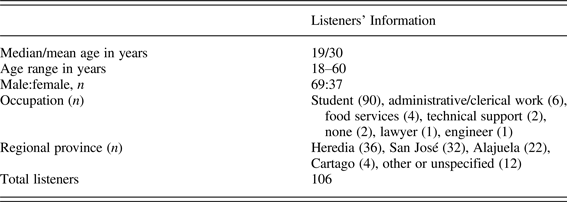
I traveled to Costa Rica in the summer of 2015 to recruit participants for this study. I sent e-mails and social media messages to my Costa Rican friends and colleagues asking them to participate remotely in my study, and I also recruited both students and employees in person at the Universidad Latina, a private university in Heredia. A total of 106 listeners participated in the study, and their basic demographic information is provided in Table 1.Footnote 8
Listeners’ demographic information

Statistical analysis
Before a statistical analysis could be applied to the data, the listeners’ checkbox responses had to be transformed into scalar, numerical values. Raters’ evaluations of age were ranked from the youngest group (1) to oldest (7), the social evaluations were ranked from lower class (1) to higher class (6), less educated (1) to more educated (6), unsure of him/herself (1) to very sure of him/herself (6), unpleasant (1) to pleasant (6), definitely heterosexual (1) to definitely homosexual (6),Footnote 9 less masculine (1) to more masculine (6), and less Costa Rican (1) to more Costa Rican (6). Due to the different ranges for age and social evaluations, the scores were centered and standardized to create comparable scales. Zero is to be understood as the central point of the scale, with negative numbers falling on the lower end and positive numbers falling on the higher end of the spectrum.
A factor analysis (using the Kaiser rule) was conducted on the ratings of the speakers’ social attributes with R's factanal function (R Core Team, 2014). A factor analysis determines the factors that best explain the behavior of the data and also finds correlations between the social features. Based on the results of the factor analysis, the eight social factors could be reduced to two combined factors and one lone factor that together accounted for the majority of the data's deviation from the mean. The first factor is a combined “status” factor, loading for both class and education level. The second factor is a combined “positive social features” factor, loading for niceness, confidence, and how Costa Rican each speaker sounds. Finally, the third, lone factor involves a “gendered” evaluation that considers how masculine each speaker sounds. Age did not clearly map onto any factor, and while heterosexuality contributed somewhat to the gendered dimension, it did not account for enough variance in the data to be included in a combined factor. These two factors are therefore excluded from further discussion here.
Once the three most important dimensions were selected using factor analysis, three separate linear mixed models were created with R's lmer function (Bates, Maechler, Bolker, & Walker, Reference Bates, Maechler, Bolker and Walker2014) to establish the effect of [s] or [z] production on the social evaluations of the speakers. In each model, speaker and listener were included as random effects, and treatment contrasts were used for the categorical fixed effects. The independent variables tested in the models included listener gender (reference level = female), speaker gender (reference level = female), variant played to the listener (reference level = [s]), listener age, speaker age, and presentation order (reference level = [s] first). Presentation order was included to test whether evaluations were influenced by the order in which listeners heard the variants.
In the construction of each regression model, a stepwise procedure was used to add independent variables, and model comparison using the analysis of variance function (R Core Team, 2014) determined which predictors significantly improved the model. Interactions between main effects were tested, and significant interactions were kept in the best fit models.
RESULTS
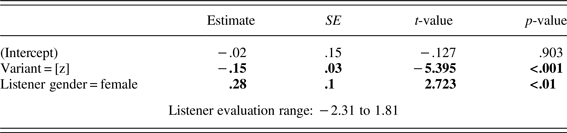
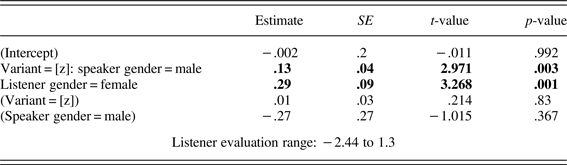
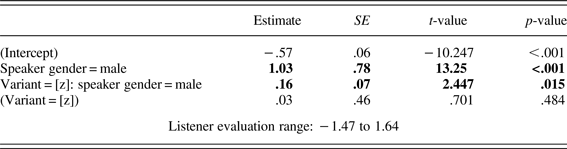
All three models (fitted to the status, positive social features, and gendered factors) showed a significant effect for variant alone or variant interacting with another main effect, meaning that the raters’ evaluations for the speakers were significantly different when an intervocalic [z] was produced rather than an intervocalic [s]. The results of all three models are presented in Tables 2, 3, and 4, and each table includes the model's estimate, standard error, t-value, and p-value. In these tables, positive estimates indicate that the level displayed, for instance variant = [z], received a higher evaluation than the reference level, which would be variant = [s]. A negative estimate indicates the opposite directionality, meaning that the level shown received a lower evaluation than the reference level. Each model will be discussed independently.
Best fit mixed effects model for the status factor: perceived social class and education level of the speaker
Note: Significant predictors’ values are bold. n = 2,544. See Figure 2.
Best fit mixed effects model for the positive social features factor: perceived niceness, confidence and Costa Rican-ness of the speaker

Note: Significant predictors’ values are bold. n = 2,544. See Figure 3.
Status
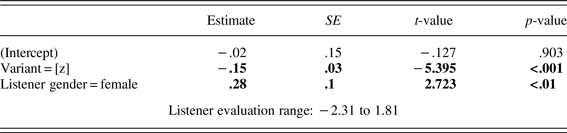
In the factor analysis conducted prior to fitting these models, status was shown to be the factor that best accounted for [s] and [z] evaluation deviance in the data. The best fit mixed effects model for the status factor is shown in Table 2.
First, Table 2 shows that the [z] variant conditioned listeners’ evaluations of the speakers’ status, with intervocalic [z] production leading to significantly lower evaluations of status. There was no interaction between speaker gender and variant, showing that [z] production decreased evaluations of status for both male and female speakers in a similar way. The boxplot shown in Figure 2 illustrates these different evaluations for male and female listeners.
Boxplot of perceived status for [s] and [z] by listener gender.

Second, female listeners exhibited a tendency to rate speakers as higher status than their male listener counterparts. The lack of interaction between listener gender and variant shows this was not based on the variant played to the listener for female listeners, but rather a tendency to rate all speakers more positively than the male listeners. An interaction approaching significance emerged between female listeners and male speakers, with a slight tendency for female listeners to evaluate male speakers as higher status, but this interaction was excluded from the final model as it did not reach significance (p > .09).
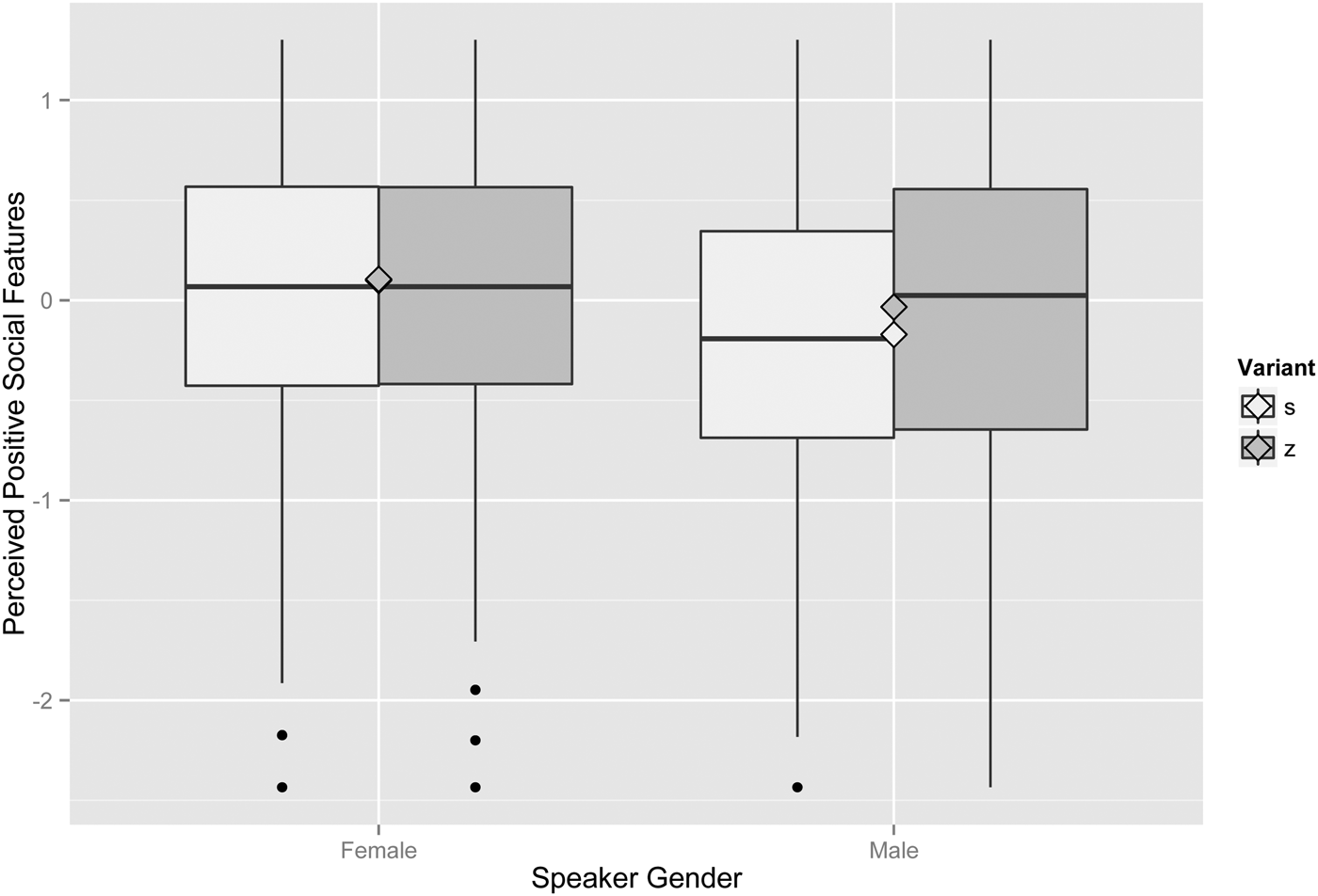
In each of the boxplots presented here, the box itself represents the middle 50% of all values, and the black line through each box shows the median. The diamonds above and below the median line indicate the 95% confidence interval of the mean, and the dots above or below the vertical lines signify outliers. The vertical line extending above the box shows the highest 25% of all values, and the line extending below the box shows the lowest 25% of all values. As the boxplot in Figure 2 shows, female listeners provided higher status ratings for the speakers overall, but both male and female listeners’ evaluations of status change based on variant, with male evaluations of [z] resulting in a lower median score than for [s] and female evaluations of [z] skewing lower than their evaluations of [s].
Positive social features
The second model, Table 3, was fitted to a series of positive social features that loaded onto a single factor in the factor analysis, including niceness, confidence, and Costa Rican–ness.
As was the case with listener evaluations of status, female listeners again showed a tendency to rank all speakers higher on the scale of positive social features than male listeners (p < .002). Again, the lack of interaction between variant and listener gender shows that hearing [s] or [z] is not driving these elevated evaluations.
The results for variant and speaker gender alone are presented in parentheses in Table 3, as the interaction between variant and speaker gender is the most significant result. This interaction shows that evaluations of confidence, niceness, and localness are higher for men who produce intervocalic [z] over [s], but female speakers who produce intervocalic [z] do not see their evaluations for positive social features increase. In fact, Figure 3 shows that listeners’ evaluations of female speakers in this factor do not change based on variant, while male speakers’ evaluations rise when they produce [z].
Boxplot of perceived positive social features for [s] and [z] by speaker gender.

Gendered (Masculinity)
To test for gender differences, evaluations of female speakers’ femininity were originally considered separately from evaluations of male speakers’ masculinity, and two mixed effects models were fitted to (a) femininity rankings for female speakers and (b) masculinity evaluations for male speakers, respectively, with variant played to the listener (either [s] or [z]) as an independent variable in both models. Hearing [z] over [s] did not result in a significant difference in listeners’ evaluations of female speakers’ femininity, but listeners did provide significantly different evaluations of masculinity when [z] was heard over [s]. The same effect emerged when female speakers’ scores were inverted and combined with male speakers to allow for comparison along a single scale. As a result, the final model (Table 4) was fitted to the lone factor of “gendered,” using a modified scale fit to masculinity.
Best fit mixed effects model for masculinity: perceived masculinity of speaker

Note: Significant predictors’ values are bold. n = 2,544. See Figure 4.
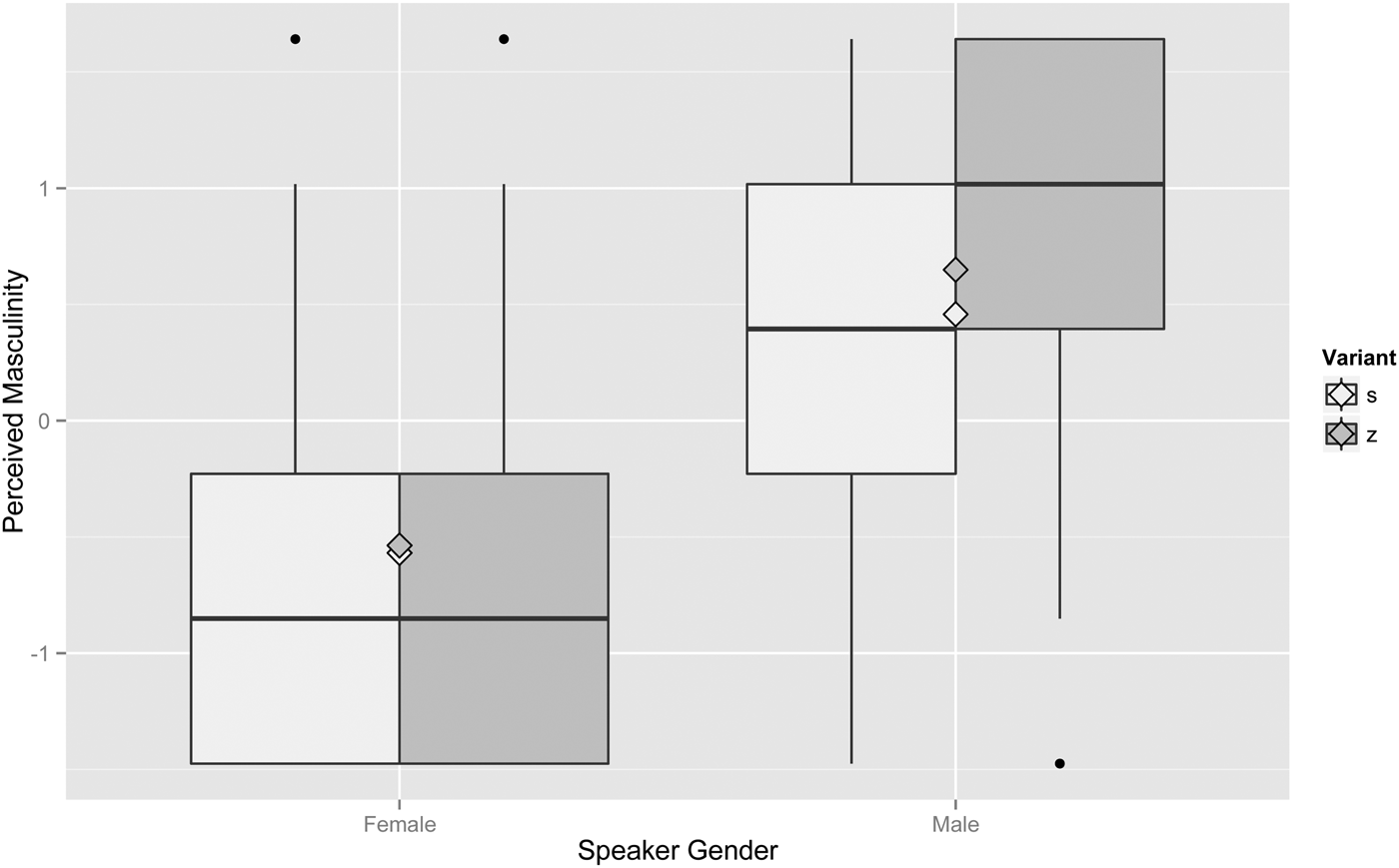
Unsurprisingly, male speakers were rated as significantly more masculine than their female counterparts (p < .001). More interesting is the fact that [z] production only increased gendered perceptions for male speakers, with no significant difference detected for female speakers when [z] was produced instead of [s]. In other words, intervocalic [z] production made male speakers seem more masculine, but women who produced [z] were not viewed as more masculine or feminine than when they produced intervocalic [s]. This gender discrepancy is illustrated in Figure 4.Footnote 10
Boxplot of perceived masculinity for [s] and [z] by speaker gender.

DISCUSSION
The preceding results show that the production of intervocalic [z] by both men and women prompts a dip in their perceived status; listeners associate intervocalic [s] production with more education and a higher class, while listeners perceive [z] as indicative of the lower classes and lower levels of education. Interestingly, for female speakers, this decrease in perceived status is the only significant difference based on variant production, but male speakers receive a more nuanced evaluation from both male and female listeners in two other categories. First, male speakers who produce [z] are seen as significantly nicer, more confident, and more Costa Rican, while female speakers did not benefit from [z] production in this arena. Finally, male speakers who produce [z] are considered significantly more masculine, while gendered rankings for females who produced [s] or [z] did not noticeably change.
Let us begin with an exploration of the status dimension, which is the most straightforward result, as the directionality for both male and female speakers is the same. Given the results of other studies that have analyzed standard and nonstandard variant production (Gal, Reference Gal1995; Preston, Reference Preston2002), the results for nonstandard [z] production are not entirely surprising. As the standard variant, [s] is imbued with social prestige, evoking semiotic connections to literacy (Bucholtz, Reference Bucholtz2001:92), as well as to education and power (Eckert, Reference Eckert2008:470). On the other hand, intervocalic [z] constitutes an articulatory reduction of /s/ and tends to occur in faster speech and more casual contexts across dialects of Spanish. Hypoarticulated variants such as [z] can evoke social associations with carelessness or laziness (Eckert, Reference Eckert2008:466). In other words, distancing oneself from the standard variant linked to prestige and education spurs deviations from the most prestigious evaluations as well.
In spite of these decreased evaluations of status, male speakers have other social reasons to produce intervocalic [z]. In line with previous research, male speakers may choose to employ the nonstandard variant to access covert prestige (Alfaraz, Reference Alfaraz2000; Labov, Reference Labov1972:314; Trudgill, Reference Trudgill1972:179), substituting an evaluation of high status for solidarity with their interlocutor. Male Costa Rican speakers who produced [z] were rated as more confident, nicer, and more local, and receiving higher evaluations for these positive social qualities may have more concrete and immediate benefits for the speaker than ensuring the perception of high social status. Constructing an identity consistent with high social status is akin to establishing a social hierarchy between speaker and listener, which increases the social distance between interlocutors. Nonstandard variants, on the other hand, are more likely to decrease social distance between a male speaker and his listener, subtly assuring the listener that the speaker considers himself part of the group. Through the use of a nonstandard variant, a male speaker can prove his status as an in-group member, show his value at the local level, and position himself as an integrated member of the speech community.
Beyond creating solidarity with the group, men are presented with yet another social benefit for using the nonstandard intervocalic [z]: they are perceived as significantly more masculine when they produce it. Considering that machismo and traditional gendered expectations continue to predominate in Costa Rican culture (Biesanz, Biesanz, & Zubris Biesanz, Reference Biesanz, Biesanz and Zubris Biesanz1999:186–190),Footnote 11 a male speaker who presents himself as a standard, masculine speaker is expected to receive more positive social evaluations from others.Footnote 12
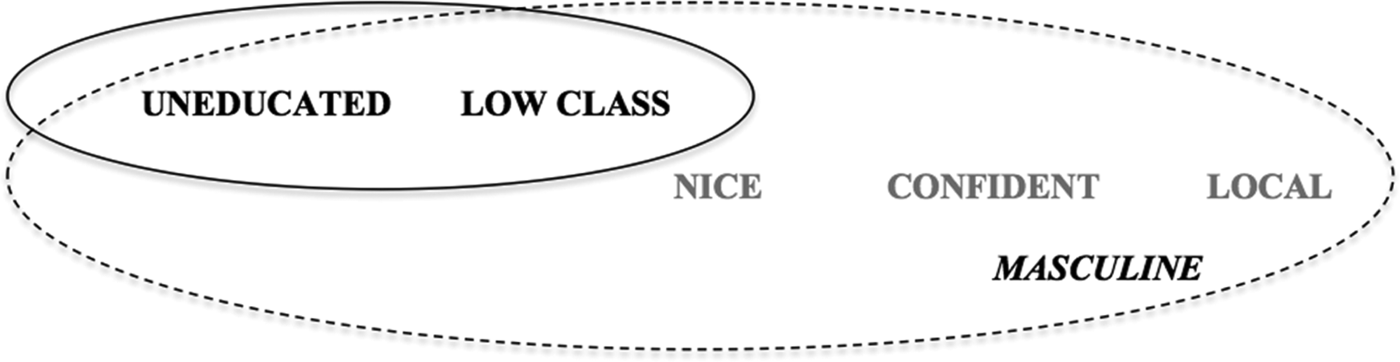
Taking the preceding discussion of the social meanings ascribed to intervocalic [z] into account, I propose a nonexhaustive indexical field of intervocalic /s/ voicing in Figure 5.Footnote 13 Bolded features map onto the status dimension, grayed features map onto the positive social features dimension, and the italicized factor maps onto the gendered dimension.Footnote 14
Nonexhaustive indexical field of intervocalic /s/ voicing grouped by dimension.

Although an indexical field is intended to be a fluid domain—a constellation of indexical meanings that may be evoked in different contexts (Eckert, Reference Eckert2008)—the listeners’ evaluations clarify that not all speakers have access to all possible meanings. As shown in the results section, female speakers receive no positive judgments at the local level to compensate for their loss of status when they produce intervocalic [z]. With this in mind, I have revised the indexical field in Figure 6 to reflect the gender-specific accessibility of certain social meanings. The solid line reflects indexical meanings accessible to female speakers, while the dashed line indicates meanings accessible to male speakers.
Nonexhaustive indexical field of intervocalic voiced /s/ based on gendered accessibility. Solid line = indexical meanings accessible to women, dashed line = indexical meanings accessible to men.

Based on the results of this study, I contend that the key difference for male and female speakers lies in the potential social benefits of nonstandard variant use. Women are evaluated as less educated and lower class when they produce intervocalic [z], and even though they do not receive harsher evaluations in the positive social features and gendered factors when they use [z], they stand to gain very little socially from its production. This means that female speakers are more limited in terms of their variant selection, while men have more options. On the one hand, men can opt to increase their status with intervocalic [s], presenting themselves as highly educated, high-status individuals. On the other hand, they can show their local value with intervocalic [z], constructing an identity as nice, local, confident, and masculine. Given this differential social payout, it is not entirely surprising that men, who stand to gain much more from nonstandard [z] use than women, opt for the voiced variant more than female speakers across dialects of Spanish.
As a result, I contend that male speakers and female speakers differ in their treatment of variation based primarily on their disparate access to nonstandard variants’ indexical fields. Male speakers, who stand to benefit socially from production of both the standard variant and the nonstandard variant are able to choose the variant most suited to their needs given the context and social identity they hope to project. Female speakers, however, are limited in how they are able to negotiate a positive social identity through their variant use, and, as a result, are more inclined to employ the only variant that benefits them socially: the standard intervocalic [s]. That is, women are more limited in the indexical meanings activated by their use of nonstandard variants, and their awareness of this limited accessibility impedes their use of said variants.
Such a conclusion calls into question previous work that has suggested that women produce standard variants more frequently because they are more concerned with social capital than men. While greater social capital may be the outcome of women's higher rates of standard variant use, my data indicate that this trend is less of an option and more a social necessity for women, who intuitively recognize that they stand to gain very little from attempting to access a nonstandard variant's covert prestige. Men agentively navigate the intervocalic (s) variants by determining which one suits their needs in a given context, and women do the same. However, if access is blocked to the positive indexical meanings of a nonstandard variant, female speakers must make use of the meanings available to them to create the most positive social image at their disposal, taking into account others’ perceptions of male and female speech.
This proposal also helps to resolve the gender paradox that arises from Labov's (Reference Labov1990, Reference Labov2001:261–293) generalizations about gender and variation. In spite of the critiques raised against the paradox, the robustness of research on the genders’ use of variants in different speech communities continually reaffirms the tendencies noted by Labov. Considering men and women's accessibility to the variants’ indexical fields elucidates the gendered behaviors for stable variables. When women's social gains from using a nonstandard variant are limited due to their partial access to the indexical field, more women will choose to use the only variant associated with positive social evaluations: the standard.Footnote 15
Research on other varieties and languages is needed to confirm whether the indexical field associated with [z] presented here holds true for all dialects of Spanish, and to examine differences in female speakers’ accessibility to nonstandard variants’ indexical fields across languages and cultures. In addition to more research on cases of stable variation, matched guise studies on changes in progress from above and below the level of consciousness would determine how generalizable my proposal truly is. Should female speakers have a limited ability to positively impact social perceptions through their use of other salient, nonstandard variants, there may be additional evidence of gendered exclusivity for the nonstandard indexical field.
CONCLUSION
In this paper, I have shown that male and female Costa Rican speakers who employ the nonstandard intervocalic [z] appear to have differential access to the variant's indexical meanings. Both male and female speakers’ use of [z] indexes a lower education level and lower class, but men are also able to access several positive social meanings, including niceness, confidence, a local status, and masculinity. Diverging from previous work on men and women's treatment of stable variation, I argue that women do not use prestige variants because they are more concerned with social norms and social capital than are men, nor are they avoiding heightened criticism for using the nonstandard. Rather, I propose that women's partial access to the indexical field of [z] prompts them to opt more for the standard variant, as they recognize the extent of indexical meanings available to them and know that their social losses would outweigh their social gains if they should employ nonstandard [z].
I have not attempted to resolve in this short work the complicated matter as to why women are more limited in their access to indexical meanings. This may be a reflection of women's lower social status, their more limited roles in public life, or gendered expectations about “appropriate” speech. This may also be the result of men, being less sensitive to linguistic variation and a full generation behind female speakers, utilizing the more salient nonstandard variants to construct social meaning, and these variants then become associated with masculinity and male speech. Regardless of the social cause, the end result is that women do not seem able to access the entirety of the nonstandard variant's indexical field in cases of stable variation. Recognizing their limited indexical power through nonstandard variants, female speakers present the most positive social image they can, opting more for the intervocalic [s] that heightens evaluations of their social status.
APPENDIX
Perception experiment stimuli with all cases of intervocalic (s) spliced with [s] in one recording and [z] in another
-
Speaker 1—male, 25 years old
-
1 ¿La po(s)ada? Tenés que caminar. Llegá(s) a la esquina, doblá(s) a la derecha y de lado izquierdo hay un rótulo que di(s)e la po(s)ada.
-
2 Para llegar a la po(s)ada hay un rótulo fuera del local que di(s)e la po(s)ada.
-
-
Speaker 2—male, 18 years old
-
1 Eh, doscientos cincuenta ha(s)ia el oeste y unos ciento (s)incuenta ha(s)ia el norte en frente de (s)oda la U.
-
2 Como al frente de la po(s)ada en la Calle (s)anta Ro(s)a de Poco(s)ol.
-
-
Speaker 3—female, 29 years old
-
1 Toma la calle (s)anta Ro(s)a de Poco(s)ol hasta el final de la cuadra, al norte encuentra la ca(s)a con techo rojo.
-
2 Trescientos metro(s) al norte (s)obre la Calle lo(s) Olimpos puede encontrar la po(s)ada.
-
-
Speaker 4—female, 36 years old
-
1 Entonces vamo(s) a (s)ubir una dos tre(s) y doscientos cincuenta metro(s) al norte y allí está la po(s)adita.
-
2 Doblamo(s) a mano derecha doscientos metro(s) y unos veinti(s)inco metro(s) ha(s)ia el norte a la (s)oda.
-
-
Speaker 5—female, 20 years old
-
1 Doblando en la (s)iguiente calle a la izquierda (s)obre Calle (s)anta Ro(s)a de Poco(s)ol se llega al ca(s)ino.
-
2 Empe(s)amos para Avenida (s)e(s)enta y (s)eis doblamo(s) en la primera calle a mano derecha que (s)ería calle (s)anta Ro(s)a de Poco(s)ol y encontramos la po(s)ada.
-
-
Speaker 6—male, 40 years old
-
1 Vamo(s) a doblar en la esquina cru(s)ando por en frente de mi ca(s)a y (s)oda la U y al lado derecho está el ca(s)ino y al lado izquierdo la po(s)ada.
-
2 Vamo(s) a doblar a la derecha. A mano izquierda te va(s) a encontrar mi casa, a mano derecha está el mu(s)eo y a mano izquierda encontramo(s) el ca(s)ino.
-