Introduction
Grief is the psychological and behavioral response to the loss of a loved one. These responses include identity disruption, disbelief, avoidance of reminders, intense emotional pain, reintegration difficulties, emotional numbness, a sense of meaninglessness, and intense loneliness (APA, 2022). Grief has been linked with mental health problems in children such as anxiety, depression, and suicidality (Berg et al., Reference Berg, Rostila and Hjern2016; Hill et al., Reference Hill, Kaplow, Oosterhoff and Layne2019; Kaplow et al., Reference Kaplow, Saunders, Angold and Costello2010; Keyes et al., Reference Keyes, Pratt, Galea, McLaughlin, Koenen and Shear2014; Melhem et al., Reference Melhem, Porta, Shamseddeen, Payne and Brent2011, Reference Melhem, Porta, Payne and Brent2013) and functional impairment even controlling for mental health problems (Cerel et al., Reference Cerel, Fristad, Verducci, Weller and Weller2006; De López et al., Reference De López, Søndergaard Knudsen and Hansen2020; Melhem et al., Reference Melhem, Porta, Shamseddeen, Payne and Brent2011; Melhem et al., Reference Melhem, Moritz, Walker, Shear and Brent2007, Reference Melhem, Porta, Payne and Brent2013). Concern over grief that impairs functioning over a prolonged period, has led to the creation of a diagnostic classification for prolonged disordered grief by the International Classification of Disease (ICD-11; WHO, 2018) and the Diagnostic and Statistical Manual of the American Psychiatric Association (DSM-5-TR; APA, 2022). The classification of prolonged grief as a disorder emphasizes the need to better understand grief responses over time and to examine the association between children’s grief response trajectories and their mental health problems. The current study will examine grief trajectories over 6 years of children who have experienced the death of a parent as well as the factors that predict grief trajectories and the adjustment outcomes that are associated with each trajectory.
Past research has used growth mixture modeling (GMM; Muthén & Muthén, Reference Muthén and Muthén1998–2017) and latent class growth analysis (LCGA; Nagin, Reference Nagin1999) to identify unique trajectories of grief responses in adults (Bonanno et al., Reference Bonanno, Wortman, Lehman, Tweed, Haring, Sonnega, Carr and Nesse2002; Kristensen et al., Reference Kristensen, Dyregrov and Gjestad2020; Sveen et al., Reference Sveen, Bergh Johannesson, Cernvall and Arnberg2018). One study identified three distinct patterns of grief (i.e., common grief in which level of grief starts high but decreases over time, chronic grief in which the level of grief stays high over time and resilience in which the level of grief stays low over time) over a year and a half post-bereavement in a sample of conjugally bereaved adults (Bonanno et al., Reference Bonanno, Wortman, Lehman, Tweed, Haring, Sonnega, Carr and Nesse2002). These trajectories indicated that most bereaved adults (46%; resilience) experienced relatively low levels of grief over time and can be considered naturally resilient, whereas a minority (15 %; chronic grief) reported chronically high levels of grief and would have benefitted from effective interventions to prevent the occurrence of prolonged grief or treatment for existing prolonged grief. Other examinations of grief trajectory patterns in adults have found similar resilient and chronic trajectories across time, ranging from one and a half to 6 years following bereavement (Djelantik et al., Reference Djelantik, Smid, Kleber and Boelen2017; Kristensen et al., Reference Kristensen, Dyregrov and Gjestad2020; Lenferink et al., Reference Lenferink, Nickerson, de Keijser, Smid and Boelen2020; Sveen et al., Reference Sveen, Bergh Johannesson, Cernvall and Arnberg2018).
The only study to examine trajectories of grief in children found three distinct patterns over a 33-month period post-bereavement (Melhem et al., Reference Melhem, Porta, Shamseddeen, Payne and Brent2011). After experiencing the sudden death of a parent, most children (58.8%) initially experienced low levels of grief that decreased and stabilized over time, some children (30.8%) started with high levels of grief that decreased over time, and a minority of children (10.4%) reported high levels of grief that remained high over time (Melhem et al., Reference Melhem, Porta, Shamseddeen, Payne and Brent2011). Children with chronically high levels of grief were more likely to have a history of depression and were associated with later high levels of mental health problems, including depression and functional impairment (Melhem et al., Reference Melhem, Porta, Shamseddeen, Payne and Brent2011). The current study adds to this body of work by exploring unique grief trajectories among parentally-bereaved youth, specifically intrusive distressing and impairing grief thoughts, over a longer period of time (i.e., 6 years as compared to 33 months) and to investigate how grief trajectories were associated with child adjustment six and 15 years following baseline assessment.
Grief is a multi-dimensional construct, comprising diverse cognitive, affective, and behavioral responses. These typical grief responses may in some cases persist at a high level and impair functioning over time (Shear et al., Reference Shear, Simon, Wall, Zisook, Neimeyer, Duan, Reynolds, Lebowitz, Sung, Ghesquiere, Gorscak, Clayton, Ito, Nakajima, Konishi, Melhem, Meert, Schiff, O’Connor and Keshaviah2011; Prigerson & Jacobs, Reference Prigerson, Jacobs, Stroebe, Hansson, Stroebe and Schut2001; Kaplow et al., Reference Kaplow, Layne, Pynoos, Cohen and Lieberman2012; Melhem et al., Reference Melhem, Moritz, Walker, Shear and Brent2007). One cognitive aspect of grief that has received considerable research attention is rumination or preoccupation with the death, which is a key criterion for ICD-11 prolonged grief disorder (WHO, 2018). Eisma & Stroebe, (Reference Eisma and Stroebe2017) provided an overview of empirical research and theoretical models of grief-related rumination. Distinct from depressive rumination in which thoughts are focused on depressive symptoms, grief rumination encompasses “repetitive and recurrent thinking about causes and consequences of the loss and loss-related emotions,” including situations leading to the death, the meaning of the death, and the response of self and others to the death (Eisma & Stroebe, Reference Eisma and Stroebe2017, p. 60). Studies of grief rumination in adults have demonstrated concurrent and longitudinal associations with depression, anxiety, post-traumatic stress, and prolonged and complicated grief (Boelen & van den Hout, Reference Boelen and van den Hout2008; Eisma et al., Reference Eisma, de Lang and Boelen2020; van der Houwen et al., Reference van der Houwen, Stroebe, Schut, Stroebe and Bout2010).
Another aspect of grief-related cognitions concerns the degree to which distressing and impairing thoughts are perceived as involuntary or intrusive (Tait and Silver, Reference Tait, Silver, Uleman and Bargh1989). Theoretically, the persistence of involuntary and distressing thoughts about a major life event, such as bereavement, reflects the unsuccessful processing of the meaning of the loss and its implications for one’s ongoing life circumstances (Tait and Silver, Reference Tait, Silver, Uleman and Bargh1989). Intrusive thoughts have been linked to adverse outcomes in adults who were exposed to multiple stressful events (Craig et al., Reference Craig, Heisler, Baum, Sarason and arason2014; Sundin & Horowitz, Reference Sundin and Horowitz2003; Tait & Silver, Reference Tait, Silver, Uleman and Bargh1989). To understand the associations between intrusive grief thoughts and child outcomes, a measure of intrusive grief thoughts was developed as part of the evaluation of the Family Bereavement Program (FBP), an intervention for parentally-bereaved youth (Sandler et al., Reference Sandler, Ma, Tein, Ayers, Wolchik, Kennedy and Millsap2010). Using a bi-factor approach, items assessing intrusive grief were found to contain a specific grief response that was above and beyond general grief assessed by other grief responses across multiple measures (Kennedy, Reference Kennedy2006; Sandler et al., Reference Sandler, Ma, Tein, Ayers, Wolchik, Kennedy and Millsap2010). High intrusive grief at one year following the program predicted suicidal ideation/attempts 6 years later controlling for the effects of multiple covariates such as general grief response, baseline internalizing problems, and post-traumatic stress disorder (Sandler et al., Reference Sandler, Tein, Zhang, Wolchik and Thieleman2021). Evaluation of the FBP found that the program reduced intrusive grief thoughts at one year following the program (Sandler et al., Reference Sandler, Tein, Zhang and Wolchik2023) and 6 years later (Sandler et al., Reference Sandler, Ma, Tein, Ayers, Wolchik, Kennedy and Millsap2010). Program effects to reduce intrusive grief at one year also partially mediated program effects to reduce child internalizing problems and negative views of the self 6 years later, controlling for program effects on coping, emotional suppression, and parenting (Sandler et al., Reference Sandler, Tein, Zhang and Wolchik2023).
The current study is a secondary analysis of longitudinal data from the randomized controlled trial of the FBP (Sandler et al., Reference Sandler, Ayers, Wolchik, Tein, Kwok, Haine, Twohey-Jacobs, Suter, Lin, Padgett-Jones, Weyer, Cole, Kriege and Griffin2003). The study investigates three research questions. First, the study describes unique trajectories of intrusive grief across 6 years of assessment. Second, the study assesses the associations of trajectories of intrusive grief across 6 years with baseline demographic variables, cause of the death, family factors and child characteristics. Third, the study tests the associations between children’s intrusive grief trajectories and their mental health problems, and prolonged grief assessed at 6 years and 15 years following baseline assessment.
Methods
Participants
The study included 244 youth (54% males) and their caregiver (63% mothers, 21% fathers, 16% non-parental adults) from 156 families who participated in the randomized controlled trial of the Family Bereavement Program (FBP). Participating youth had experienced the death of a parent between 3 and 30 months (M = 10.81; SD = 6.35) prior to beginning the program and were between the ages of 8 and 16 (M = 11.39; SD = 2.43) at baseline. Children’s race/ethnic distribution was 67% non-Hispanic Caucasian, 16% Hispanic, 7% African American, 3% Native American, 1% Asian or Pacific Islander, and 6% other. Cause of death was 67% illness, 20% accident, and 13% violent death (i.e., homicide or suicide).
All study procedures were approved by the university’s Institutional Review Board. Sandler et al. (Reference Sandler, Ayers, Wolchik, Tein, Kwok, Haine, Twohey-Jacobs, Suter, Lin, Padgett-Jones, Weyer, Cole, Kriege and Griffin2003) presented full details on eligibility criteria and the study procedures which are only briefly described here. Families were recruited from community agencies that had contact with bereaved children (e.g., schools, service agencies) and media presentations. Families and/or youth were compensated for participating in the interviews at each wave of assessment. Youth and caregivers were interviewed in their homes or a public place at baseline (T1) and 3 months (T2; 98% retention), 14 months (T3; 90% retention), and 6 years (T4; 89% retention) after baseline. Youth and key informants (individuals that youth reported knew them the best) were also interviewed at 15 years (T5; 80% retention) after baseline. Prior to completing the interviews at each assessment, participants were informed about the study and signed informed consent (for parent and youth who were 18 years old or older at the time of the assessment) or assent (youth who were younger than 18 at the time of the assessment) forms.
Measures
Grief trajectories
Intrusive grief thoughts. At T1–T4, Children completed the 10-item Intrusive Grief Thoughts Scale developed for the FBP study (IGTS; Sandler et al., Reference Sandler, Ma, Tein, Ayers, Wolchik, Kennedy and Millsap2010; e.g., “How often did you find yourself thinking how unfair it is that your parent died, even though you didn’t want to think about it?”). Youth indicated the extent to which they experienced each item in the past month using a 5-point Likert scale (1 = not at all, 2 = less than once a week, 3 = once or twice a week, 4 = about once a day, 5 = several times a day). The measure has been found to have strong internal consistency (Sandler et al, Reference Sandler, Ma, Tein, Ayers, Wolchik, Kennedy and Millsap2010; α = .88–.93 for T1–T4) and validity as a predictor of internalizing problems and suicidal ideation/attempts over time (Sandler et al., Reference Sandler, Tein, Zhang, Wolchik and Thieleman2021; 2023).
Baseline predictors
Covariates assessed at baseline
Youth age, youth gender (0 = males, 1 = females), and cause of parental death (i.e., two dummy variables for accident vs. illness and violent vs. illness) and intervention condition (0 = control; 1 = FBP) were assessed at baseline.
Child mental health
Baseline child mental health problems was a composite of the standardized scores of caregiver- and youth-reports of internalizing and externalizing problems. T1 externalizing problems were assessed with the caregiver-report of Child Behavior Check List-Externalizing Problems (CBCL; Achenbach, Reference Achenbach1991a) and youth-report of Youth Self Report-Externalizing Problems (YSR; Achenbach, Reference Achenbach1991b); T1 internalizing problems were assessed with the caregiver-report of CBCL-Internalizing Problems and youth-report of Children’s Depression Inventory (CDI; Kovacs, Reference Kovacs1981) and Revised Children’s Manifest Anxiety Scale (R-CMAS; Reynolds & Richmond, Reference Reynolds and Richmond1978). Cronbach α’s for these risk indicators ranged between .86 and .90.
Caregiver psychological distress
Two highly correlated measures (r = .78), the 27-item Psychiatric Epidemiology Research Interview (Dohrenwend et al., Reference Dohrenwend, Shrout, Egri and Mendelsohn1980; α = .93) and 21-item Beck Depression Inventory (Beck et al., Reference Beck, Steer and Brown1996; α = .89), were composited to give a measure of caregiver psychological distress levels.
Positive parenting
Positive parenting was a composite of caregiver-child relationship quality and discipline measures based on a multi-informant and multi-method factor analysis with the same sample (Kwok et al., Reference Kwok, Haine, Sandler, Ayers, Wolchik and Tein2005). For caregiver-child relationship quality, caregivers and children completed the 16-item Acceptance subscale and the 16-item Rejection subscale from the Child Report of Parental Behavior Inventory (CRPBI; Schaefer, Reference Schaefer1965; α = .87–.92), the 7-item Dyadic Routines Scale (Wolchik et al., Reference Wolchik, West, Sandler, Tein, Coatsworth, Lengua, Weiss, Anderson, Greene and Griffin2000; α = .76-caregiver; .74-youth) and the 5-item Stable Positive Event Scale (Sandler et al., Reference Sandler, Wolchik, Braver and Fogas1991; α not applicable). Caregivers also completed the 6-item Talk with Reassurance subscale of the Caregiver Expression of Emotion Questionnaire (Jones & Twohey, Reference Jones and Twohey1998; α = .74) about how they communicated with their children about stressful family events. In addition, children completed the 10-item Sharing of Feelings Scale (Ayers et al., Reference Ayers, Sandler, Twohey and Haine1998; α = .85) to assess their perceptions that their caregiver understands and has empathy for their feelings. For discipline, caregivers and children completed the 8-item Consistent Discipline subscale of CRPBI (Schaefer, Reference Schaefer1965) and the 8-item adaptation of the Parent Perception Inventory (Hazzard et al., Reference Hazzard, Christensen and Margolin1983) to assess use of positive reinforcement (α = .80–.92). In addition, caregivers completed the 6-item follow-through subscale of the Oregon Discipline Scale (Reid, Reference Reid1991; α = .88). As described more fully in Kwok et al. (Reference Kwok, Haine, Sandler, Ayers, Wolchik and Tein2005) the second-order confirmatory factor analysis has adequate fit (χ2(113) = 207.45; CFI = .93, RMSEA = .06; SRMR = .06).
Youth normative grief
The 13-item Present Feeling subscale of the Texas Revised Inventory of Grief measure (Faschingbauer, Reference Faschingbauer1981; α = .88) assessed what is considered to represent youth’s normative experience and present feelings about the death (Neimeyer et al., Reference Neimeyer, Hogan, Laurie, Stroebe, Hansson, Schut and Stroebe2008).
Youth depression
Youth depression was assessed by youth-report of Children’s Depression Inventory (CDI; Kovacs, Reference Kovacs1981; α = .87).
Youth active coping
Child report of the 24-item Active Coping dimension of the Children’s Coping Strategies Checklist–Revision 2 (Ayers et al., Reference Ayers, Sandler, West and Roosa1996; α = .90) was assessed.
Youth coping efficacy
The 7-item Coping Efficacy Scale (Sandler et al., Reference Sandler, Tein, Mehta, Wolchik and Ayers2000; α = .72) was used to assess youth own satisfaction with handling problems in the past and their anticipated effectiveness in handling future problems.
Youth active inhibition
Youth completed the 11-item Active Inhibition Scale (Ayer et al., Reference Ayers, Sandler, Twohey and Haine1998; α = .89) to assesses inhibition of emotional expression.
Six-year outcomes
Internalizing problems
Internalizing problems during the past month were assessed using the Youth Self-report-Internalizing Problems (YSR; Achenbach & Recorla, Reference Achenbach and Rescorla2001) for youth younger than 18 years and Young Adult Self-Report-Internalizing Problems (YASR; Achenbach, Reference Achenbach1997) for those age 18 years or older. Because the items in the measures for adolescents and young adults are not identical, item response theory (IRT) was applied on a large data set obtained from Achenbach (Thomas M. Achenbach, PhD, unpublished raw data, 2003) that contained self-report scores (n = 800) on the YSR/YASR to conduct an equating transformation that selected conceptually equivalent items and put the scale scores on a common metric (Kolen & Brennan, Reference Kolen and Brennan1995; see Sandler et al., Reference Sandler, Ma, Tein, Ayers, Wolchik, Kennedy and Millsap2010). The IRT ended with a 22-item YSR (α = .90) and 22-item YASR subscales for internalizing problems (α = .88).
Polydrug use
Using the Monitoring the Future Scale, polydrug use was assessed by counting the number of different substance and drugs used, including alcohol, marijuana, and other illegal substances (Johnston et al., Reference Johnston, Bachman and O’Malley1993).
Major depression
Youth major depression disorder in the past year was assessed using the caregiver and youth versions of the Diagnostic Interview Schedule for Children (DISC) and Diagnostic Interview Schedule for Children—Young Adult (YADISC; Shaffer et al., Reference Shaffer, Fisher, Lucas and Hersen2003).
Traumatic grief
A 26-item scale representing the prolonged problematic grief (e.g., “To what extent have you felt a lost sense of security or safety over the past month?”), derived from the adult version of the Inventory of Traumatic Grief (ITG) (Prigerson & Jacobs, Reference Prigerson, Jacobs, Stroebe, Hansson, Stroebe and Schut2001; see Sandler et al, Reference Sandler, Ma, Tein, Ayers, Wolchik, Kennedy and Millsap2010), was administered to youth at T4. To obtain a more differentiated assessment of grief, a previous study (Kennedy, Reference Kennedy2006) examined the factor structure of the items and showed that a bi-factor measurement model with one specific factor and one general traumatic factor, that were not correlated with each other, fit the data the best. The 7-items that loaded highly on the specific dimension, labeled Social Detachment/Insecurity involved lack of social trust, loneliness, lack of control, and hyperarousal (i.e., jumpiness). Factor scores of General Traumatic Grief and Social Detachment/Insecurity factors were examined as two outcome variables.
Aversive self-views
The mean of three highly correlated youth report scales (rs = .66–.70) with the same response format were used to indicate aversive self-views. Mastery was assessed with a 7-item scale (Pearlin & Schooler, Reference Pearlin and Schooler1978) plus three additional items developed for this project (“I am sure that the future will include more bad things,” “I cannot control what will happen to me,” and “There is no sense in trying hard to make my future better”). Identity was assessed using the 12-item Identity subscale of the Psychosocial Maturity Inventory (Greenberger, Reference Greenberger1984). Self-esteem was assessed using the 10-item Self Esteem Scale (Rosenberg, Reference Rosenberg1965; αs ranged from .81 to .89). Scores were rescaled so that high scores indicate high aversive self-views.
Fifteen-year outcomes
Internalizing problems
Internalizing problems during the past month were assessed using the Adult Self-Report-Internalizing Problems measure (ASR; Achenbach & Rescorla, Reference Achenbach and Rescorla2003; α = .93).
Substance use
Youth substance use at the 15-year follow-up was the sum scores of Tobacco, Alcohol, and Drug use subscales from Adult Self-Report (ASR; Achenbach & Rescorla, Reference Achenbach and Rescorla2003).
Major depression
The World Health Organization World Mental Health Composite International Diagnostic Interview (CIDI; Robins et al., Reference Robins, Wing, Wittchen, Helzer, Babor, Burke, Farmer, Jablenski, Pickens, Regier, Sartorius, Leland and Towle1988) was administered to the young adults. Using computerized algorithms, the CIDI defines whether the individual meets all criteria for major depression disorder as defined by the DSM-IV and ICD-10. This study focused on MDD where the onset of the disorder occurred after the 6-year follow-up.
Inventory of traumatic grief - Social Detachment Grief
The seven items of Inventory of Traumatic Grief (Prigerson & Jacobs, Reference Prigerson, Jacobs, Stroebe, Hansson, Stroebe and Schut2001; see Sandler et al, Reference Sandler, Ma, Tein, Ayers, Wolchik, Kennedy and Millsap2010) that loaded on the specific dimension of Social Detachment as described earlier was assessed at T5 (α = .85).
Intrusive grief thoughts
Youth report of the 10-item Intrusive Grief Thoughts Scale (IGTS; Sandler et al., Reference Sandler, Ma, Tein, Ayers, Wolchik, Kennedy and Millsap2010; α = .90) at T5 was assessed.
Aversive self-views
Two of the three scales used as the indicators of aversive self-views for the 6-year follow-up were administered at the 15-year follow-up: the modified 10-item Mastery (Pearlin & Schooler, Reference Pearlin and Schooler1978; α = .86) and the 10-item Self Esteem Scale (Rosenberg, Reference Rosenberg1965; α = .97). The mean of these two scales was used to indicate aversive self-views.
Six-year and 15-year outcome
Suicide ideation or attempts. A dichotomous variable was created to indicate endorsement of suicide ideation or attempt on any of the 6-year or 15-year assessments of the following items. Endorsements at both assessment times were combined to a single score because of the low base rate at either assessment. At the 6-year follow-up, it was assessed by the parallel versions of the items, “Deliberately harms self or attempts suicide” and “Talks about killing self” from the Child Behavior Check List (CBCL; for youth 18 years old or younger) or Young Adult Behavior Check List (YABCL; for youth over 18 years of age) for caregiver reports and the Youth Self Report (for youth 18 years old or younger) or young Adult Self Report (YASR; for youth over 18 years of age) for youth self-report (Achenbach & Rescorla, Reference Achenbach and Rescorla2001) and “Thoughts of death, suicide ideation, suicide attempt or plan” from the youth and caregiver versions of the DISC (Shaffer et al., Reference Shaffer, Fisher, Lucas and Hersen2003). At the 15-year follow-up, youth and key informant reports of the two items, “Deliberately harms self or attempts suicide” and “Talks about killing self,” from the YASR and YABCL were used. The time frame for each of these measures was in the past month, except for the key informant report which was in the last 6 months.
Statistical analyses
We conducted the analyses in three phases to examine: 1) trajectory patterns of intrusive grief across 6 years using growth mixture modeling; 2) the association of youth intrusive grief trajectories with baseline demographic variables and family and youth characteristics using multinomial logistic regression; and 3) the association of youth intrusive grief trajectories with substance use, mental health problems, and prolonged grief at 6 and 15 years following baseline using multiple regression. All analyses were conducted in Mplus 8 (Muthén & Muthén, Reference Muthén and Muthén1998–2017). Intervention condition was included as a covariate in the model for testing the association of grief trajectories with baseline variables and outcomes. The study controls for but does not address the effects of the intervention on trajectory classification which will be the subject of a future analysis. We note here that intervention condition is not expected to affect membership classifications in a randomized trial, but that its effect would be to lower or raise the slope within each latent class trajectory pattern within each latent class (Liu et al., Reference Liu, Hedeker, Segawa and Flay2010; Muthén et al., Reference Muthén, Brown, Masyn, Jo, Khoo, Yang, Wang, Kellam, Carlin and Liao2002).
Growth mixture modeling (GMM)
GMM explored unobserved (or latent) profiles of children with similar trajectory patterns of the intrusive grief thoughts scores over T1–T4 assessments and estimated the posterior probability of each child being a member of each profile. Time since death was used as the time frame for the trajectory. For example, if parental death happened three months before the baseline assessment, then the assessments occurred at 3, 6, 17, 75 months since death. Youth could have experienced the death between 3 and 30 months prior to the baseline assessment (mean of 10.29 months). We compressed the time unit by every 4 months (i.e., divided months since death by 4) for the growth modeling. Mplus settings for conducting GMMs leverage all available data, thus youth with at least one timepoint of intrusive grief data were included in the growth models. Four youth had intrusive grief data missing in all four assessments and were excluded from the study. All of the other missing data were handled with the full information maximum likelihood method. We accounted for family clustering by computing robust standard errors using a sandwich estimator (Muthén & Muthén, Reference Muthén and Muthén1998–2017).
GMMs with 1- to 6- class models were conducted by successively increasing the number of profiles by one until model fit indices leveled off. The residual variances were sometimes constrained to zero for the growth factors (i.e., intercept, linear slope, quadratic slope) to avoid convergence problems (i.e., LCGA; see Hox, Reference Hox2002). To avoid getting local maximum solutions, we repeated models with multiple sets of start values and ensured that the best log-likelihood value was replicated (Muthén, Reference Muthén and Kaplan2004). We determined the optimal number of profiles based on several fit indices and likelihood ratio tests (Tein et al., Reference Tein, Coxe and Cham2013): Bayesian information criterion (BIC; Schwarz, Reference Schwarz1978), sample-size adjusted Bayesian information criterion (SABIC; Sclove, Reference Sclove1987), and Vuong-Lo-Mendell-Rubin likelihood ratio test (VLMR; Lo et al., Reference Lo, Mendell and Rubin2001). A better fitting model has lower BIC and SABIC. A p-valule ≤ .05 for the VLMR test indicates that the K0-class solution is significantly better than the K−1- class solution. In addition, we relied on entropy to gauge whether the latent profiles were highly discriminating (Nylund et al., Reference Nylund, Asparouhov and Muthén2007; Ram & Grimm, Reference Ram and Grimm2009) as well as took substantive interpretations, trajectory patterns, and the proportion of the sample within each latent growth profile into consideration for deciding the final model. Without substantive theory about the forms of the trajectories, we compared the results of linear growth models to quadratic growth models. Given an acceptable entropy, which indicates that individuals were classified with confidence and there were adequate separations between the latent classes (Celeux & Soromenho, Reference Celeux and Soromenho1996; Muthén, Reference Muthén2023), each child was assigned to the most likely profile based on the estimated posterior probabilities for each profile (using the “SAVE = CPROBABILITIES” syntax; Asparouhov & Muthén, Reference Asparouhov and Muthén2014). We then conducted separate analyses to examine the associations of the profiles with baseline predictors and outcomes as described below (i.e., how the baseline predictor and outcome variables differed across the profiles). Although the 3-step approach of testing the associations of the baseline predictors and outcomes were better at accounting for the uncertainty of classification (Asparouhov & Muthén, Reference Asparouhov and Muthén2014), as shown in the results section, the small sizes for a couple of the classes threatened the use of such a model for testing the associations.
Multinomial logistic regression test baseline correlates of grief trajectories
Using the posterior classifications, we conducted multinomial regression models to examine whether youth with different patterns of the grief trajectories had different scores on baseline demographics (youth age, gender), cause of death, family factors (parenting, caregiver mental health problems), and youth characteristics (depression, normative grief, active coping strategies, coping efficacy, active inhibition). The discrete trajectory classification was treated as the nominal dependent variable. When there were more than two profiles, we alternated the reference group/profile and examined how the predictor variables were related to the probability of being in a specific group versus the reference group. Statistically, we estimated the odds ratio of being in a certain group in comparison to the reference group giving one unit change of the predictor variable.
Multiple regression test grief trajectory association with outcomes
Multiple regression models were applied to examine whether trajectory membership was associated with substance use, mental health problems, and measures of traumatic grief at 6 and 15 years. Basically, we compared the means of the specific group to the reference group through dummy variables. We alternated the reference group when there were more than two profiles. We controlled for youth age, youth gender, cause of parental death, baseline child mental health problems, and intervention condition.
Results
GMM of intrusive grief
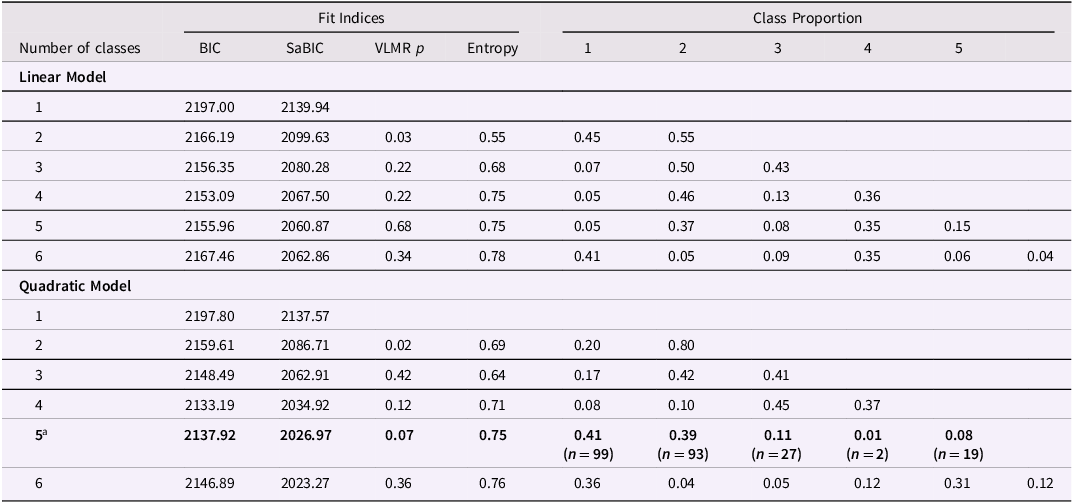
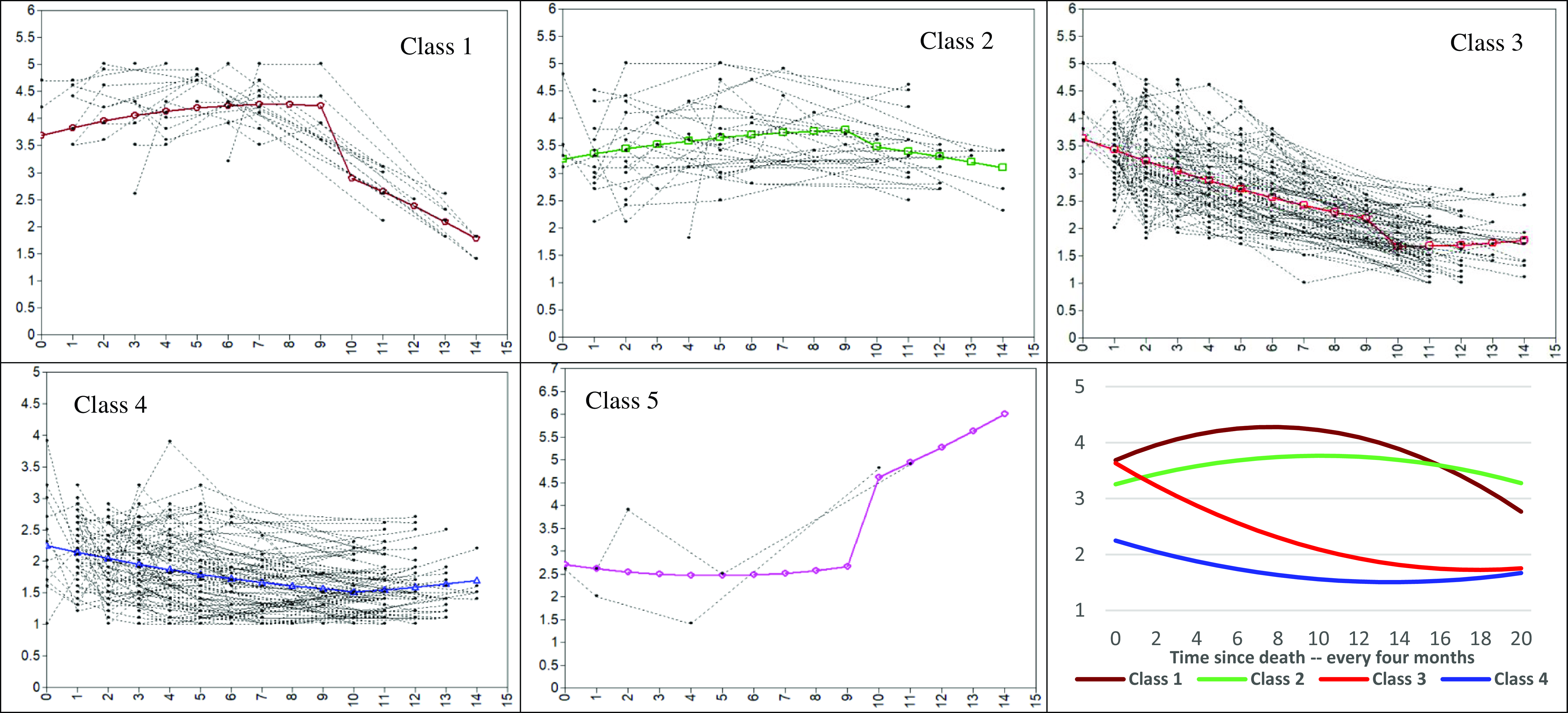
Table 1 presents the results of the systematic GMM model fitting processes and the proportion of children classified in each latent class. The quadratic models were better than the linear models consistently. By considering multiple fit indices, interpretability, and sample proportions, it was concluded that the 5-class quadratic growth model provided the optimal solutions. Table 2 provides the parameter estimates of the growth factors (i.e., intercept, linear slope, quadratic slope). Profile 1 (n = 19; 8%), labeled high chronic intrusive grief, represented youth who evidenced heightened intrusive grief (occurrences ranged between every day and once or twice a week) from the time after parental death, although the levels decreased a little at the 6-year follow-up assessment. Profile 2 (n = 27; 11%), labeled moderate chronic intrusive grief, represented youth who had moderate level of intrusive grief (occurring more than once or twice a week) which persisted over the years since parental death to a level comparable to Profile 1. Youth in Profile 3 (n = 99; 41%), labeled grief recovery, started with a high level of intrusive grief similar to those in Profile 1; however, the level of grief decreased markedly over 6 years to a level comparable to Profile 4 (between less than once a week and not at all). Profile 4 (n = 93; 39%), labeled grief resilience, included youth who started with a low-level of intrusive grief (occurring less than once a week) and the grief diminished even more over the years (occurrences ranging between not at all to less than once a week). There was a tiny fraction of youth in Profile 5 (n = 2, 1%) whose grief increased from “Once or twice a week” right after parental death to “Several times a day” at the six-year assessment. Due to the small numbers in this profile, we disregarded this profile in the following analyses. Figure 1 illustrates the individual observed data and estimated means separately for each profile from the Mplus output and the estimated growth trajectories of the first four profiles.
Fit statistics for GMM with 1- to 6-class solutions and sample posterior probabilities in each latent class

Note: BIC and SaBIC: a lower value represents a better fit.
LMP p-value: <.05 indicates that the K0-class model provides significantly better fit to the observed data than the K−1-class model. Entropy: a value approaching .80 indicates that the latent classes are highly discriminating.
a The selected model based on the fit indices and interpretation.
Parameter estimates of the growth factors for the 5-class quadratic growth model

Note: ***p < .001; **p < .01; *p < .05.
Growth mixture model of intrusive ruminative grief for the 5-class quadratic model, both observed and estimated trajectories.

Association of baseline predictors and trajectory patterns
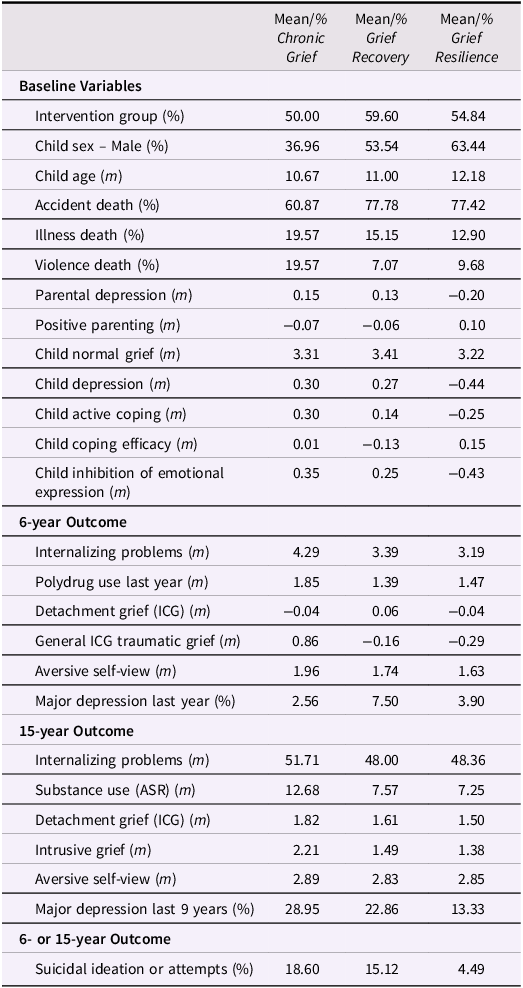
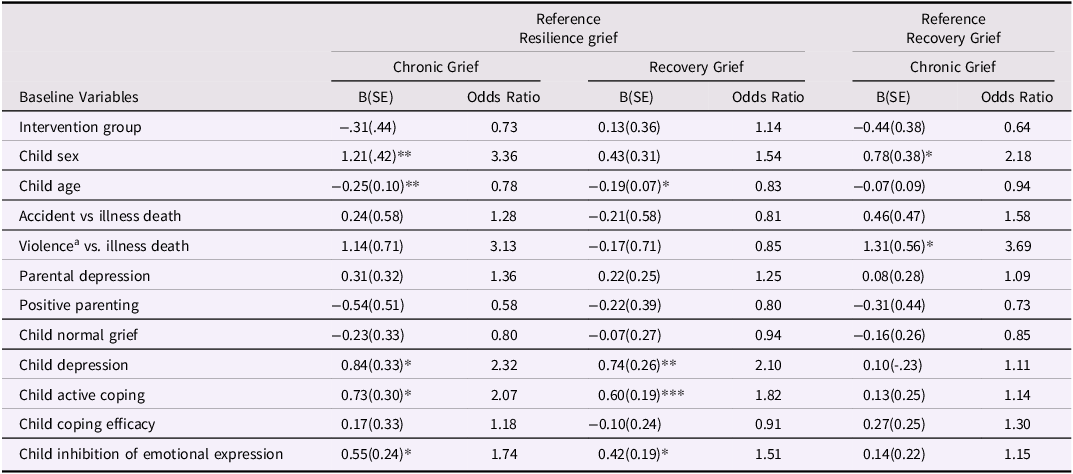
We examined whether the trajectory patterns from the GMM model were associated with the baseline demographic, cause of parental death, family, and youth factors. We combined the high and moderate chronic intrusive grief groups into one group (n = 46) for all comparisons and relabeled this as the chronic grief group. Table 3 listed the means or percentage of the predictor variables for the observed data across the three groups. We compared the grief resilience group with the grief recovery and chronic grief group to assess predictors of resilience. Next, we compared the chronic grief with the grief recovery group to assess differences between those who recover from high levels of grief and those whose high levels of grief persist over 6 years. All analyses of predictors of group differences were done using multinomial regression. Table 4 presents the results of the two sets of multinomial regression analyses, one using grief resilience group as the reference group and the other using grief recovery group as the reference group. Compared to youth in the grief resilience group, those in the chronic grief and grief recovery groups were more likely (i.e., higher odds) to be young, have higher levels of depression and active inhibition, and to use active coping strategies; youth in the chronic grief group were also more likely to be females as compared to the grief resilience group. Compared to youth in the grief recovery group, those in the chronic grief group were more likely to be females and more likely to have the deceased parents die by suicide or homicide rather than die of illness.
Means or percentages of the predictors and outcome variables across chronical grief, grief recovery, and grief resilience trajectory groups

Demographic, individual and family factors predicting intrusive grief trajectory groups compared to the reference group

Note: ***p < .001; **p < .01; *p < .05. Sex is coded 0 = male, 1 = female.
a Violence death included homicide and suicide.
Association of outcomes and trajectory patterns
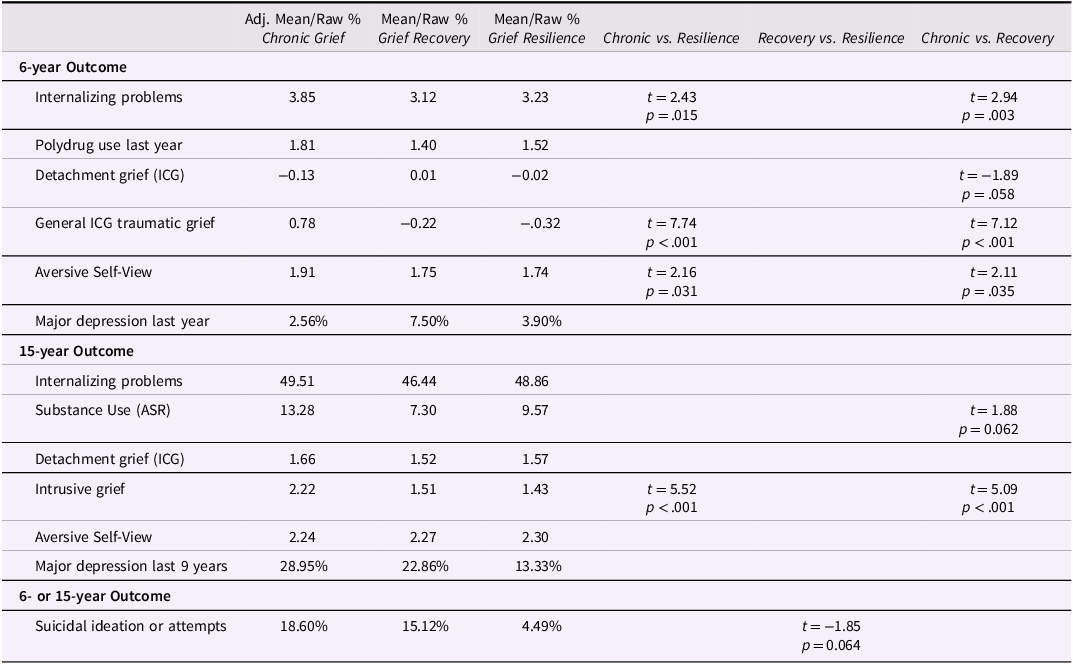
Multiple regression analyses were conducted to examine the differences between the three trajectory groups on the six- and 15-year outcomes. Table 3 also listed the means or percentages of the observed outcomes across the three groups. Table 5 shows the adjusted means of the continuous outcomes and raw percentages for the binary outcomes by trajectory groups and significant and marginal differences (i.e., t-statistics and p-values) for group comparisons. For the six-year outcomes, youth in the chronic grief group had significantly higher scores on internalizing problems, general traumatic grief, and aversive view of self than the grief recovery and grief resilience groups. For the 15-year outcome, youth in the chronic grief group had significantly higher scores than the grief recovery and grief resilience groups on intrusive grief.
Mean or percentage differences across the chronic grief, grief recovery, and grief resilience groups

Discussion
The findings add to our understanding of the course of children’s intrusive grief after parental death over time in three ways by: 1) adding descriptive information about different trajectories of intrusive grief over 6 years; 2) identifying the baseline characteristics of youth associated with different trajectories of grief over 6 years; and 3) identifying associations of grief trajectories with problem outcomes across six- and 15 years. The implications of each of these findings are discussed as well as their theoretical and practical implications. Limitations of these findings and directions for future research are also discussed.
Descriptions of the trajectories indicated that 19% of youth showed chronic intrusive and distressing grief (between every day and once or twice a week) that persists over 6 years following the death. This is about twice the percent of prolonged grief over 33 months identified by Melhem and colleagues (2011), but similar to the rate of those meeting criteria for persistent complex bereavement disorder in another sample of treatment-seeking bereaved youth (Kaplow et al., Reference Kaplow, Layne, Oosterhoff, Goldenthal, Howell, Wamser-Nanney, Burnside, Calhoun, Marbury, Johnson-Hughes, Kriesel, Staine, Mankin, Porter-Howard and Pynoos2018). The higher percent in the chronic grief groups in the current sample and in one prior study (Kaplow et al., Reference Kaplow, Layne, Oosterhoff, Goldenthal, Howell, Wamser-Nanney, Burnside, Calhoun, Marbury, Johnson-Hughes, Kriesel, Staine, Mankin, Porter-Howard and Pynoos2018) as compared to Melhem and colleagues’ (2011) sample may be due to the fact that these are both samples of youth who are in families seeking services, while Melhem’s study assessed youth in a community sample of youth who had experienced sudden death of a parent, but were not selected based on involvement in an intervention. Other sample differences such as measures of grief and causes of death in the different samples are alternative explanations for differences in the percent experiencing chronic grief.
It is also notable that although 60% of the sample (consisting of profile 1,2,3) had high levels of grief at baseline, 68% of these (those in profile 3) recovered and at 6 years had a level of grief that was equivalent to the grief resilient group who had low levels of grief across all assessments. Melhem et al. (Reference Melhem, Porta, Shamseddeen, Payne and Brent2011) similarly found that although 40% of her sample had high grief scores (in the top 75 percentile of her sample) at 9 months, 75% of those showed a significant decline over the following 24 months while 25% of those (10% of the total sample) had chronically high levels of grief that did not decline over 33 months of assessment. These findings indicate that high levels of children’s grief within approximately nine to twelve months following the death may indicate high risk rather than a stable condition of prolonged grief disorder.
The finding that youth in the resilient group had lower levels of depression symptoms at baseline than those in the recovery or chronic grief group replicates Melhem et al. (Reference Melhem, Porta, Shamseddeen, Payne and Brent2011) finding that children’s baseline depression is associated with a trajectory of chronic grief. It may be that the underlying emotion regulation or cognitive biases in the processing of negative events associated with depression (e.g. Auerbach et al., Reference Auerbach, Stanton, Proudfit and Pizzagalli2015, Reference Auerbach, Bondy, Stanton, Webb, Shankman and Pizzagalli2016; Horowitz et al., Reference Horowitz, Bonanno and Holen1993) predispose youth to elevated intrusive grief. The finding that those with a resilient trajectory have lower levels of inhibition of emotional expression than those with recovery or chronic grief trajectories, adds to prior findings to support the protective role of not inhibiting or suppressing emotional expression (Dodd et al., Reference Dodd, Hill, Alvis, Rooney, Layne, Logsdon, Sandler and Kaplow2020). The causal role of the protective effect of not inhibiting emotional expression for bereaved youth is further supported by a finding that experimentally induced reduction of inhibition of emotional expression mediated the effects of an intervention on mental health problems one and 6 years later (Sandler et al., Reference Sandler, Tein, Zhang and Wolchik2023; Tein et al., Reference Tein, Sandler, Ayers and Wolchik2006). The finding that those in the recovery and chronic intrusive grief groups had higher levels of active coping than those in the resilient group, although seemingly counterintuitive, may reflect the likelihood that they were experiencing a higher level of stress, leading them to use a wide range of overall coping, both those that are often associated with adaptive outcomes (e.g. active coping such as problem solving) as well as maladaptive strategies (e.g., avoidance, suppression).
The finding that those who experienced chronic grief as compared to those who experienced recovery grief were more likely to have lost a parent due to a violent death (homicide or suicide) extends prior findings of relations between cause of parental death and children’s grief response (Kaplow et al., Reference Kaplow, Layne, Oosterhoff, Goldenthal, Howell, Wamser-Nanney, Burnside, Calhoun, Marbury, Johnson-Hughes, Kriesel, Staine, Mankin, Porter-Howard and Pynoos2018; Melhem et al., Reference Melhem, Porta, Shamseddeen, Payne and Brent2011).The finding that those in the chronic grief group as compared with those in the resilient or recovery groups were more likely to be female is consistent with several other studies finding higher levels of grief in girls than boys (Hill et al., Reference Hill, Dodd, Oosterhoff, Layne, Pynoos, Staine and Kaplow2020; Sandler et al., Reference Sandler, Ma, Tein, Ayers, Wolchik, Kennedy and Millsap2010). However, see Melhem et al. (Reference Melhem, Porta, Shamseddeen, Payne and Brent2011) for an exception. The finding that youth in the recovery and chronic grief groups were more likely to be younger than those in the resilience group is consistent with a prior finding (Hill et al., Reference Hill, Dodd, Oosterhoff, Layne, Pynoos, Staine and Kaplow2020) of higher levels of grief-related separation distress and personal and social identity distress in younger as compared with older children. Future research that identifies the underlying coping processes that account for these differences (Eschenbeck et al., Reference Eschenbeck, Kohlmann and Lohaus2007; Hampel & Petermann, Reference Hampel and Petermann2005; Copeland & Hess, Reference Copeland and Hess1995) are needed to identify processes to target in personalized interventions to facilitate adaptive coping with grief for younger children and girls.
This study is the first to show that trajectories of grief predict six- and 15-year outcomes. At 6 years, controlling for youth age, youth gender, cause of parental death, baseline child mental health problems, and intervention conditions, youth in the chronic grief group had significantly higher scores than the grief recovery and grief resilience groups on general traumatic grief, internalizing problems, and aversive view of self. The finding that chronic high levels of grief is associated with elevated scores on general traumatic grief as assessed by items from the ITG is not surprising. The ITG general grief measure consists of multiple indicators of distressing and maladaptive grief that persist over time. The current study finds that it is the persistence of intrusive grief rather than elevated grief 6 years earlier that is associated with a broader measure of traumatic grief assessed 6 years later.
The finding that chronic high levels of intrusive grief are associated with higher levels of internalizing problems at 6 years is consistent with prior findings from studies which found that those meeting diagnostic criteria for disordered grief had higher levels of depression and post-traumatic stress symptoms (Kaplow et al., Reference Kaplow, Layne, Oosterhoff, Goldenthal, Howell, Wamser-Nanney, Burnside, Calhoun, Marbury, Johnson-Hughes, Kriesel, Staine, Mankin, Porter-Howard and Pynoos2018) and incidence of depression disorder (Melhem et al., Reference Melhem, Porta, Shamseddeen, Payne and Brent2011). The finding that the chronic grief trajectory is also associated with higher aversive views of the self may help explain the previously identified (Sandler et al., Reference Sandler, Tein, Zhang and Wolchik2023) link between grief and bereaved youth’s development of long-term major depression. The aversive self-views measure is a composite of low self-esteem and a lack of both a sense of mastery and personal identity (Zhang et al., Reference Zhang, Sandler, Tein and Wolchik2021). Prior research has reported that intrusive grief thoughts assessed at a single point in time 6 years earlier was predictive of both aversive self-views and internalizing problems. The current study finds that this association is due to those who have high levels of chronic high intrusive grief that does not abate over 6 years. It was hypothesized that a common underlying process between internalizing problems and aversive views of the self may be negative self-referential processing of stressful events (Sandler et al., Reference Sandler, Tein, Zhang and Wolchik2023). Negative self-referential processing includes negative cognitions such as self-focus, self-criticism, or worry in response to negative events and has been associated with major depression in multiple prior studies (Auerbach et al., Reference Auerbach, Webb, Gardiner and Pechtel2013; Frewen et al., Reference Frewen, Schroeter, Riva, Cipresso, Fairfield, Padulo, Kemp, Palaniyappan, Owolabi, Kusi-Mensah, Polyakova, Fehertoi, D’Andrea, Lowe and Northoff2020). It may be that the pathway from chronic grief to internalizing problems and aversive self-views may explain the relations between parental bereavement and major depression in adulthood (Berg et al., Reference Berg, Rostila and Hjern2016).
The current study has practical implications for the design and evaluation of interventions. The findings indicate the importance of assessing grief at multiple points over time to identify those at highest risk for prolonged problematic grief. Although 60% of the sample showed a high level of grief approximately within the first nine to twelve months following the death, intrusive grief decreased over time for two thirds of them, and they were no more at risk for mental health problems than those who had consistently low levels of grief. These findings have implications for identifying the time following the death when prolonged grief is likely to stabilize and when an intervention to prevent or treat prolonged disordered grief may be most appropriate. For example, although 60% of youth with high levels of intrusive grief at baseline recover over time, 40% experience chronically high levels of intrusive grief 6 years later. It may be that a preventive intervention might be effective to prevent youth who experience high levels of intrusive grief from experiencing prolonged intrusive grief and accompanying impairment over 6 years or longer. A second implication is that children with elevated levels of depressive symptoms, and who have experienced a death from homicide or suicide are more likely to experience chronically high levels of grief that lasts over 6 years and should be considered at high risk for prolonged grief. A third implication is that interrupting the occurrence of chronic intrusive grief thoughts may be one of the pathways to the prevention of the onset of major depression as well as prolonged traumatic grief for parentally bereaved children.
Several limitations of the current study are acknowledged. The relations between the measure of intrusive grief and other measures of children’s grief, or prolonged grief disorder by other studies (e.g. Kaplow et al., Reference Kaplow, Layne, Oosterhoff, Goldenthal, Howell, Wamser-Nanney, Burnside, Calhoun, Marbury, Johnson-Hughes, Kriesel, Staine, Mankin, Porter-Howard and Pynoos2018; Melhem et al., Reference Melhem, Porta, Shamseddeen, Payne and Brent2011) is not known, limiting integration of the current findings with that of prior literature. The baseline measures of covariates were not obtained prior to the death, so that the associations found between them and grief trajectories on variables such as depression may reflect the co-occurring effects of the death on both rather than a predisposition of those with a history of depression to experience elevated chronic grief. There is a long gap between assessment at eleven months and 6 years, and increased data points are needed to more precisely describe the shape of the trajectories. However, despite these limitations the study makes a significant contribution as a rare study of the predictors and outcomes of the longitudinal course of intrusive grief in parentally-bereaved children.
Author contributions
The first and second authors are equal contributors to this work and designated as co-first authors.
Funding statement
Fundings for this research were provided by NIMH Grant R21 MH 127288-01 and NICHD Grant F31 HD 110247 which are gratefully acknowledged.
Competing interests
None.