Introduction
Many societies are confronted with ageing populations, on the one hand, and persistent negative images of older people, on the other hand. Indeed, images of old age associated with incompetence, fragility, and decline are ever present in the media and everyday discourse (Donlon et al., Reference Donlon, Ashman and Levy2005; Nelson, Reference Nelson, Wiener and Willborn2011). These images have negative consequences for older people in many ways, including their cognitive and physical performance, health and longevity (Levy, Reference Levy2009; Lamont et al., Reference Lamont, Swift and Abrams2015; Swift et al., Reference Swift, Abrams, Lamont and Drury2017). However, baby-boomers born after the Second World War now enter retirement in better health, with more financial resources and higher education than any generation before them. They are also more diverse as a group (North and Fiske, Reference North and Fiske2013). Some engage in voluntary or civic activities, others continue to pursue their careers, while others re-enter the labour force because of financial necessity. Many baby-boomers thus view themselves as active citizens, contributing to society in one way or another (Perrig-Chiello and Höpflinger, Reference Perrig-Chiello and Höpflinger2009). Research on the implications of images of old age has not yet simultaneously taken into account the possible discrepancy between older people's personal beliefs and their perceptions on what others think about them as a group (i.e. their meta-stereotypes), nor the actual age stereotypes that prevail in society. What is more, an enabling societal context that allows older people to maintain their functioning and autonomy may help buffer the detrimental implications of negative images of old age on their wellbeing.
The purpose of this paper is to examine age stereotypes and their implications for older people's wellbeing through several frames of reference and in various contexts. By doing so, this paper offers novel insight into the implications of age stereotypes for older people. First, it examines whether age stereotypes must necessarily be personally endorsed before they harm older people, or whether it is the social climate, reflected by normative beliefs such as meta-stereotypes or societal stereotypes, and structural factors that are more influential. Second, it extends research on age stereotypes and wellbeing by examining replicability across different contexts and reveals the extent to which the implications of age stereotypes are generalisable across or are distinctively shaped by societal differences. The evidence then leads us to consider strategies to combat negative age stereotypes at the individual as well as the societal level.
Age stereotypes: content and frames of reference
A large body of evidence confirms that older individuals are generally perceived and often treated more negatively than younger individuals (for a meta-analysis, see Kite et al., Reference Kite, Stockdale, Whitley and Johnson2005). Yet, at the same time, these stereotypes tend to be complex, including both negative as well as positive associations (Marques et al., Reference Marques, Lima, Abrams and Swift2014). The fact that stereotypes of social groups are often mixed or ambivalent is an essential claim of the Stereotype Content Model (SCM; Fiske et al., Reference Fiske, Cuddy, Glick and Xu2002). According to the SCM, stereotypes of groups can be described along the two dimensions of warmth and competence. Competence describes whether a group is viewed as capable of obtaining their goals, and it is predicted by a group's status in social structure. Warmth, in turn, refers to the group's good intentions and positive overall demeanour in the social structure. Older people are often stereotyped as being relatively lower in competence and higher in warmth – an ambivalent stereotype pattern labelled as ‘doddering but dear’ (Cuddy and Fiske, Reference Cuddy, Fiske and Nelson2002) – which is also very persistent in the media (e.g. Donlon et al., Reference Donlon, Ashman and Levy2005). Such stereotypes may appear well intended, aiming at helping older people; however, they often result in patronising policies that are detrimental for older people's empowerment (Lamont et al., Reference Lamont, Swift and Abrams2015).
For older people, how they believe they are viewed by society may be an important element of age stereotypes. Indeed, members of lower-status groups depend highly on comprehending and predicting what others think of them and how others might react towards them (Lammers et al., Reference Lammers, Gordijn and Otten2008), and are therefore particularly sensitive to meta-stereotypes. Meta-stereotypes are beliefs or the awareness that a relevant outgroup has a certain view of one's group (Vorauer et al., Reference Vorauer, Main and O'Connell1998). Older people's meta-stereotypes are assessed by asking them how most in their society view their age group. We expect that age meta-stereotypes represent an interpretative grid that encapsulates normative expectations about how older people are likely to be viewed and treated in a social situation (Elcheroth et al., Reference Elcheroth, Doise and Reicher2011).
Meta-stereotypes are not necessarily congruent with the personal endorsement of that stereotype (Devine, Reference Devine1989). Group members are motivated to positively distinguish their group from other groups (Tajfel and Turner, Reference Tajfel, Turner, Austin and Worchel1979). Because intergroup relations are often described as distrustful, meta-stereotypes can be expected to be more negative than personal beliefs about the ingroup (Frey and Tropp, Reference Frey and Tropp2006). Discrepancies between the two are especially likely among members of social groups who are personally targeted by negative stereotypes, but have the opportunity to seek strategies for positive distinctiveness for their ingroup (Tajfel and Turner, Reference Tajfel, Turner, Austin and Worchel1979). This should be the case for baby-boomers who enter retirement age in better health and with more financial resources than previous generations.
Hence, for our first set of hypotheses (H1) we expected that:
(H1a) Older people's age meta-stereotypes should not be isomorphic with their personal beliefs about their age group.
(H1b) Because the latter concern evaluations about their ingroup, personal beliefs are likely to be more positive than age meta-stereotypes.
(H1c) Since older people are often portrayed as higher on warmth than on competence, we can expect to find the doddering-but-dear stereotype pattern for various elements of age stereotypes.
Implications of age stereotypes at the individual level
Based on the assumption that meta-stereotypes are not isomorphic with ingroup beliefs, the question arises as to which of the two is more relevant for individuals’ wellbeing. With respect to age stereotypes, two assumptions can be made. Focusing on personal beliefs, stereotype embodiment theory (Levy, Reference Levy2009) suggests that old-age stereotypes harm individuals’ health and wellbeing by being internalised across the lifespan and becoming self-relevant at a later age. Longitudinal studies show that individuals who endorse negative age stereotypes at a young age are more likely to have a cardiovascular event or die at a younger age than those with more positive age stereotypes (Levy et al, Reference Levy, Zonderman, Slade and Ferrucci2009; Ng et al., Reference Ng, Monin, Allore and Levy2016). From a stereotype embodiment perspective, it is thus the internalised and personally endorsed age stereotype that affects wellbeing.
Shifting the reference point to how others view one's own group, research has shown that meta-stereotypes impact individuals’ quality of life, functioning and social relations. Negative meta-stereotypes were linked to an increased sense of rejection, loneliness, low self-esteem, reduced perceived social fairness and more negative beliefs regarding employability (Gordijn and Boven, Reference Gordijn and Boven2009; Owuamalam and Zagefka, Reference Owuamalam and Zagefka2014). Negative age meta-stereotypes have also been related to higher perceived age discrimination (Vauclair et al., Reference Vauclair, Lima, Abrams, Swift and Bratt2016), which in turn is a crucial factor contributing to lower psychological wellbeing (Schmitt et al., Reference Schmitt, Branscombe, Postmes and Garcia2014). Furthermore, negative age meta-stereotypes have been linked to increased intergroup anxiety, thereby leading to a preference for avoiding intergenerational contact (Fowler and Gasiorek, Reference Fowler and Gasiorek2020). Negative contact experiences following negative meta-stereotypes, in turn, are linked to reduced wellbeing (Gordijn et al., Reference Gordijn, Vacher and Kuppens2017).
Conceptually closely related to meta-stereotypes (Fowler and Gasiorek, Reference Fowler and Gasiorek2020), research drawing on the stereotype threat paradigm (Steele and Aronson, Reference Steele and Aronson1995) has shown that being aware of the negative stereotype associated with one's group in a particular stereotype-relevant situation causes deficits or decrements in a number of performance outcomes. These effects have been confirmed for older people's cognitive and physical performance (e.g. Swift et al., Reference Swift, Abrams and Marques2013; Lamont et al., Reference Lamont, Swift and Abrams2015). What is more, stereotype threat increases anxiety (Bosson et al., Reference Bosson, Haymovitz and Pinel2004; Osborne, Reference Osborne2007) and feelings of dejection (i.e. disappointment, frustration, sadness; Keller and Dauenheimer, Reference Keller and Dauenheimer2003).
From a meta-stereotype and stereotype threat research perspective, normative beliefs about one's age group are thus sufficient to produce detrimental effects on individuals over and above personal beliefs. Because meta-stereotypes are particularly relevant for lower-status groups (Lammers et al., Reference Lammers, Gordijn and Otten2008), and they not only have direct implications for older people, but also through crucial social determinants of wellbeing such as perceived discrimination and intergenerational contact, we expect meta-stereotypes to be stronger predictors of older people's wellbeing compared to their personal (ingroup) beliefs.
With respect to the stereotype content dimensions, perceived negative evaluations on the competence dimension should be particularly detrimental, as this dimension reflects a group's status in the social structure, and thus its access to resources, influence and respect. The large body of stereotype threat literature confirms this assumption by showing that expected negative evaluations on the competence dimension have implications for older people on performance and learning outcomes which, in turn, are related to dependent behaviour and social withdrawal (Lamont et al., Reference Lamont, Swift and Abrams2015), as well as on difficult emotions (Keller and Dauenheimer, Reference Keller and Dauenheimer2003; Osborne, Reference Osborne2007).
Nevertheless, much of the stereotype threat research was conducted in Western countries where individualistic, autonomy-oriented cultural values prevail (Schwartz, Reference Schwartz2006). In more collectivistic countries, which view the individual as embedded in a group and emphasise achieving group goals, the more relational warmth dimension of meta-stereotypes – feeling valued as a caring and trusted member of community – may also be important for older people's wellbeing.
Our second set of hypotheses (H2) are therefore that:
(H2a) Age meta-stereotypes should predict wellbeing in older people more strongly than do personal beliefs about their age group.
(H2b) Competence meta-stereotypes rather than warmth meta-stereotypes predict older people's wellbeing.
(H2c) When extending the sample to a larger set of countries and having greater statistical power, warmth meta-stereotypes may also predict older people's wellbeing.
The role of normative age climates and the socio-economic context
The normative climate surrounding old age is reflected in a variety of aspects of social life, including discriminatory and exclusionary norms, policies, practices and institutions, thereby affecting the experiences of older individuals in multiple ways. For example, in the workplace, older people may face negative treatment including discriminatory hiring practices (Abrams et al., Reference Abrams, Swift and Drury2016), fewer promotions or forced retirement (Cuddy et al., Reference Cuddy, Fiske and Glick2007). In the health and social sector, older people are frequently denied services and treatment because their concerns are considered a natural consequence of ageing (Swift et al., Reference Swift, Abrams, Lamont and Drury2017). It is thus crucial to examine the normative age climates that sustain such discriminatory policies and practices on a larger scale. The normative age climate can be derived from the age stereotypes that are widely shared in society (Vauclair et al., Reference Vauclair, Lima, Abrams, Swift and Bratt2016, Reference Vauclair, Hanke, Huang and Abrams2017). Such societal stereotypes can create and re-create a social reality by becoming self-fulfilling prophecies. The few studies measuring societal stereotypes of old age have mostly focused on the doddering-but-dear pattern and generally confirmed it across a number of individualistic and collectivistic countries (e.g. Cuddy et al., Reference Cuddy, Norton and Fiske2005) with greater differences on the competence dimension (Vauclair et al., Reference Vauclair, Hanke, Huang and Abrams2017). Studies that empirically examine the implications of such societal stereotypes are still rare, but given their function as part of a normative climate, societal age stereotypes should affect older people's wellbeing.
A highly developed socio-economic environment should also help to support older people's wellbeing, especially if older people are enabled to maintain their functioning and autonomy through employment, social participation and pensions. A revised version of modernisation theory (Palmore and Manton, Reference Palmore and Manton1974) supports the assumption that older people are devalued in the early stages of modernisation; however, perceptions about older people's status and competence increase in more advanced stages of modernisation. This assumption was recently confirmed by showing a link between perceived social status of older people and the socio-economic context of a country (Vauclair et al., Reference Vauclair, Marques, Lima, Bratt, Swift and Abrams2015). Countries in which older people benefit from a higher social status, in turn, have been shown to produce better health outcomes for them (Marques et al., Reference Marques, Swift, Vauclair, Lima, Bratt and Abrams2015). Similarly, ‘the paradox of wellbeing’ – the fact that many older individuals succeed in maintaining their wellbeing despite potential stressors – appears limited to countries with a high economic development (Swift et al., Reference Swift, Vauclair, Abrams, Bratt, Marques and Lima2014). These findings suggest that socio-economic circumstances pertaining to the actual resources of a country crucially shape the wellbeing of older people.
Finally, it has been shown that normative climates and structural factors interact with each other, thereby creating a particular context that shapes individuals' attitudes and intergroup relations (Fasel et al., Reference Fasel, Green and Sarrasin2013; Sarrasin et al., Reference Sarrasin, Green, Fasel, Christ, Staerklé and Clémence2012). According to self-determination theory (Ryan and Deci, Reference Ryan and Deci2000; Deci and Ryan, Reference Deci, Ryan and Ryan2012), contexts such as the economic and social system of a country impact individuals by facilitating or impairing the satisfaction of their needs regarding competence, relatedness and autonomy. We contend that in socio-economic contexts in which older people are empowered to develop their competence and pursue their talents, a normative climate characterised by positive societal age stereotypes should boost their wellbeing. In contexts that deny them such opportunities, societal age stereotypes related to competence should turn into external expectations older people cannot live up to. They may be perceived as pressuring rather than supportive, thereby possibly even harming older people's wellbeing. Thus, our third set of hypotheses (H3) are:
(H3a) Societal age stereotypes of competence are related to older people's wellbeing.
(H3b) In an enabling environment characterised by a high socio-economic development, older individuals report higher wellbeing.
(H3c) In an enabling context with high socio-economic development, societal age stereotypes of competence are more positively related to older people's wellbeing than in countries with low socio-economic development.
We now turn to the empirical examination of our hypotheses. The hypotheses focusing on comparing personal beliefs with age meta-stereotypes (H1) and their implications for wellbeing (H2) are tested with a survey study conducted in the UK (Study 1) and replicated with a survey study in Switzerland (Study 2). Study 3 examines whether some of these hypotheses can be generalised across a set of 29 different countries. Finally, the societal-level hypotheses (H3) are also investigated with Study 3.
Study 1
Method
Sample
We used data from a survey conducted in the UK in 2010 with older people. Individuals were contacted through a number of non-profit organisations, charity shops and hospices, and invited to fill in a self-completion questionnaire either on-site or at home to be returned by post. Individuals with missing data on the dependent variable, predictors and binary control variables (i.e. gender) were dropped (N = 29). Missing values of continuous control variables (i.e. age) were replaced by the mean (N = 34). The final sample of N = 171 consisted of 123 (71.9%) women and 48 (28.1%) men. Individuals were aged between 51 and 94 years and the mean age was 69.85 years (SD = 7.38).
Measures
Dependent variable
Participants were asked to rate their subjective wellbeing on three items. The items ‘Taken all things together would you say you are from 1 = extremely unhappy to 7 = extremely happy’) and ‘Compared to my peers I consider myself from 1 = less happy to 7 = more happy’ were taken from the Subjective Happiness Scale (Lyubomirsky and Lepper, Reference Lyubomirsky and Lepper1999). The third item, ‘How often in the past week have you felt on top of the world? From 1 = not at all to 7 = very often’ measured positive affect based on the affect balance scale (Bradburn, Reference Bradburn1969). The three items showed good reliability (Cronbach's α = 0.81) and were averaged into a mean score of wellbeing.
Predictors
Meta-stereotypes were measured with single items to assess the stereotype content model dimensions (Cuddy et al., Reference Cuddy, Fiske and Glick2007) of competence (‘How likely is it that most people in Britain view those over 70 as competent’) and warmth (‘How likely is it that most people in Britain view those over 70 as friendly’) on a seven-point scale from 1 = not at all likely to be viewed that way to 7 = very likely to be viewed that way. Personal beliefs of competence and warmth were assessed with the questions ‘To what extent do you personally see those over 70 as competent’ or as ‘friendly’ on the same seven-point scale.
Control variables
Control variables included gender and age.
Results
Age meta-stereotypes and personal beliefs were moderately correlated with each other for the competence (r(171) = 0.44, p < 0.001) and warmth (r(171) = 0.50, p < 0.001) dimension. Therefore, in line with our assumption (H1a), only 19.4 per cent of variance between personal beliefs and meta-stereotypes is shared for competence and 25.0 per cent for warmth. This confirms that it is reasonable, statistically as well as conceptually, to examine them as separate constructs. Confirming H1b, personal beliefs were significantly more positive than meta-stereotypes for both competence (mean = 4.90, standard deviation (SD) = 1.25 versus mean = 3.87, SD = 1.42; t(170) = 9.55, p < 0.001) and warmth (mean = 5.41, SD = 1.27 versus mean = 4.66, SD = 1.44; t(170) = 7.24, p < 0.001).
Moreover, supporting the doddering-but-dear pattern (H1c), warmth meta-stereotypes were rated as more likely to be held than competence meta-stereotypes (t(170) = 6.88, p < 0.001). Note that personal beliefs about warmth were also more positive than those about competence (t(170) = 6.25, p < 0.001).
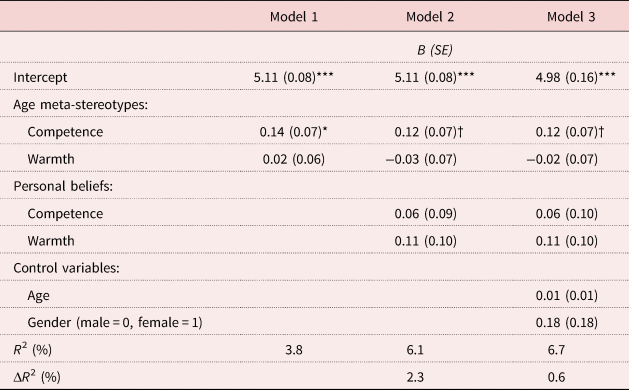
The links between the stereotype measures and wellbeing were tested with hierarchical regression performed with SPSS 23. All continuous predictors were centred at the grand mean. In a first model, meta-stereotypes of competence and warmth were entered, explaining 3.8 per cent of variance in wellbeing (F(2, 168) = 3.33, p = 0.04). Including the two dimensions of personal beliefs in Model 2 did not significantly improve model fit (F(2, 166) = 2.01, p = 0.14). Finally, adding the control variables in Model 3 did not improve model fit (F(2, 164) = 0.57, p = 0.57). Unstandardised regression coefficients and their standard errors are displayed in Table 1.
Study 1: hierarchical multiple regression analyses on wellbeing

Note: B: unstandardised regression coefficient. SE: standard error.
Significance levels: † p < 0.10, * p < 0.05, *** p < 0.001.
The analyses revealed that the competence meta-stereotype was positively related to subjective wellbeing, but the warmth meta-stereotype was not significantly associated with wellbeing. Findings of Model 2 showed that neither of the personal beliefs were significantly related to wellbeing. The effect of the competence meta-stereotype became marginally significant when entering the personal beliefs. Note that analyses of a reversed order of Models 1 and 2 (not shown) did not reveal any significant links between personal beliefs and wellbeing. Model 3 showed that the link between the competence meta-stereotype and wellbeing remained marginally significant, while age and gender had no impact on wellbeing. These findings confirm our hypotheses that age meta-stereotypes play a greater role for wellbeing than personal beliefs (H2a), and that it is the competence rather than the warmth age meta-stereotype that is related to older people's wellbeing (H2b).
Discussion
Study 1 revealed that there is only a moderate overlap between older people's personal beliefs and their meta-stereotypes of older people, and that personal beliefs were generally more positive than meta-stereotypes. The doddering-but-dear stereotype pattern was found, and the age meta-stereotype of competence was the only predictor related to wellbeing. This is in line with stereotype threat research, indicating that awareness of an incompetence stereotype is especially detrimental for older people (Swift et al., Reference Swift, Abrams and Marques2013; Lamont et al., Reference Lamont, Swift and Abrams2015).
Study 1 has a few limitations that need to be addressed. First, men were under-represented in the sample. Due to their socialisation towards economic success, men's retirement status and social status are more strongly related to their wellbeing than for women (Pinquart and Sörensen, Reference Pinquart and Sörensen2000; Kim and Moen, Reference Kim and Moen2002). Since retirement and ageing processes are often associated with changing roles and a loss in social status, the under-representation of men may partially account for the relatively weak link found between the competence meta-stereotype and wellbeing. Moreover, the sample covered a rather large age range, and individuals were asked to rate their agreement with stereotypes of individuals ‘in their 70s’. Thus, although old age defines a category with fluid boundaries, some individuals may not have felt personally concerned by the age stereotype assessed. In addition, apart from gender and age, no information was collected on participants’ socio-demographic background. Yet, it is known that variables such as education, financial situation, having a partner or religiosity play a role in shaping the wellbeing of older people (e.g. Pinquart and Sörensen, Reference Pinquart and Sörensen2000). Furthermore, health is known to contribute to wellbeing among older people (Smith et al., Reference Smith, Borchelt, Maier and Jopp2002). Studies examining the link between age stereotype and wellbeing should thus control for these covariates. Finally, the wellbeing measure was based on items from the Subjective Happiness Scale which has shown good test–retest reliability and convergent and discriminant validity (Lyubomirsky and Lepper, Reference Lyubomirsky and Lepper1999), and a positive affect item (Bradburn, Reference Bradburn1969). Together, they showed good reliability, indicating that they reflected a higher-order construct of wellbeing. Yet, emotional intensity tends to decline with age and aroused types of positive affect generally reveal less stable compared to cognitive components of wellbeing such as life satisfaction (Diener et al., Reference Diener, Suh, Lucas and Smith1999), which was not included in the current study. With Study 2, we aimed to address these issues as well as to replicate the key finding with an independent sample.
Study 2
Method
Sample
Participants were recruited via flyers and newspaper advertisements in German-speaking Switzerland. The study invited individuals born between 1948 and 1954 to participate in an online study on baby-boomers. Data were collected in summer 2014 using an online-questionnaire. Individuals with missing data on the dependent variable, predictors as well as the binary control variables (i.e. relationship status) were deleted (N = 22). Missing data on continuous control variables (i.e. religiosity, N = 13) were replaced by the mean. The final sample (N = 400) consisted of 228 women (57.0%) and 172 men (43.0%). The mean age was 63.5 years (SD = 1.70). In general, participants were highly educated, with N = 167 (41.8%) holding a university or other tertiary degree, N = 109 (27.3%) having higher vocational training and N = 124 (31.0%) with primary/secondary education or primary vocational training. Participants reported high financial satisfaction on a scale from 1 = very unsatisfied to 5 = very satisfied (mean = 4.15, SD = 0.82). The majority were living in a relationship (N = 312, 78%) and had already retired (N = 244; 61.0%). Individuals reported being somewhat religious, on a scale from 1 = not at all religious to 5 = very religious (mean = 3.88, SD = 1.59). Self-reported health was composed of two (recoded) items measuring agreement (from 1 = disagree to 5 = agree) with the statements ‘I am hampered in my daily activities by physical illness or infirmity’ or ‘mental health issues’ (r(400) = 0.34, p < 0.001). The majority reported relatively good health on the composite health score (i.e. low hampering in daily activities; mean = 4.46; SD = 0.86).
Measures
Dependent variable
Subjective wellbeing was composed of four items (α = 0.79) pertaining to agreement (from 1 = disagree to 5 = agree) with the affective (e.g. ‘In the last month, I was generally happy’) and cognitive (e.g. ‘I am generally satisfied with my life’) components of wellbeing (see Diener et al., Reference Diener, Suh, Lucas and Smith1999).
Predictors
Meta-stereotypes of competence and warmth were assessed asking participants to rate the extent to which they agreed with the statement ‘Most people in Switzerland view individuals my age as competent’ or ‘friendly’ on a five-point scale, with a higher value indicating stronger agreement. Personal beliefs related to competence and warmth were assessed with agreement with ‘I generally view people my age as competent’ or ‘friendly’ on the same five-point scale.
Results
As expected (H1a), meta-stereotypes and personal beliefs of the two dimensions were moderately related to each other (competence r(400) = 0.26, p < 0.001; warmth r(400) = 0.52, p < 0.001). Yet, especially for competence, this association is quite low, with the two ratings only sharing 6.9 per cent in variance. For warmth, 26.5 per cent are shared. In line with our hypothesis (H1b), personal beliefs were significantly more positive than meta-stereotypes for both competence (mean = 4.19, SD = 0.78 versus mean = 3.50, SD = 0.98; t(399) = 12.78, p < 0.001) and warmth (mean = 3.81, SD = 0.87 versus mean = 3.41, SD = 0.92; t(399) = 8.91, p < 0.001). Against our expectations (H1c), the doddering-but-dear stereotype pattern was not confirmed. Individuals scored slightly higher on competence meta-stereotypes than warmth, t(399) = 2.09, p = 0.04. For personal beliefs, the pattern was even more clear-cut, t(399) = 10.23, p < 0.001.
To test our hypotheses regarding the link between the stereotype measures and wellbeing, we carried out hierarchical regression analyses using SPSS 23. All continuous predictors and control variables were mean-centred. In a first model, we entered the competence and warmth dimensions of meta-stereotypes. In a second model, we included the two stereotype dimensions as personal beliefs. In a final model (i.e. Model 3), we controlled for age, gender, education, financial satisfaction, religiosity, retirement status, living with a partner and self-reported health.
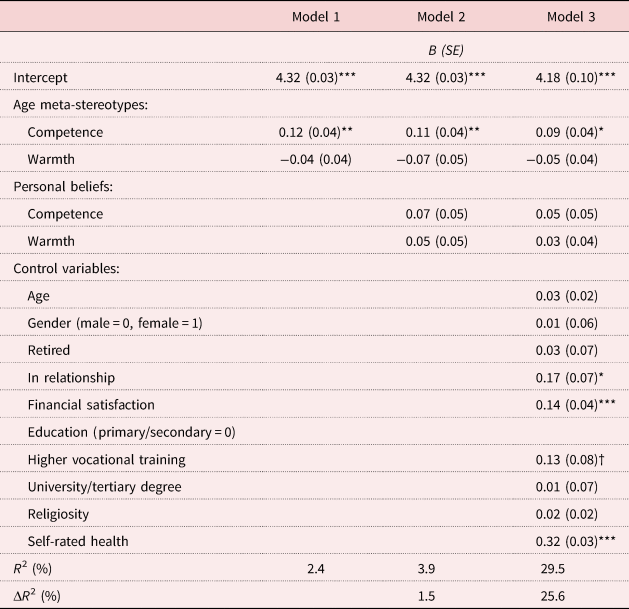
Unstandardised regression coefficients and their standard errors are displayed in Table 2. Model 1 revealed that the competence dimension of the age meta-stereotype was significantly and positively related to wellbeing. The warmth meta-stereotype was not significantly related to wellbeing. The competence meta-stereotype–wellbeing link remained significant when the two stereotype dimensions were added as personal beliefs in Model 2. Neither of the two personal beliefs were significantly related to wellbeing. These findings confirm our hypothesis that age meta-stereotypes play a greater role for wellbeing than personal beliefs (H2a), and that it is particularly the competence age meta-stereotype that is related to older people's wellbeing (H2b).
Study 2: hierarchical multiple regression analyses on wellbeing
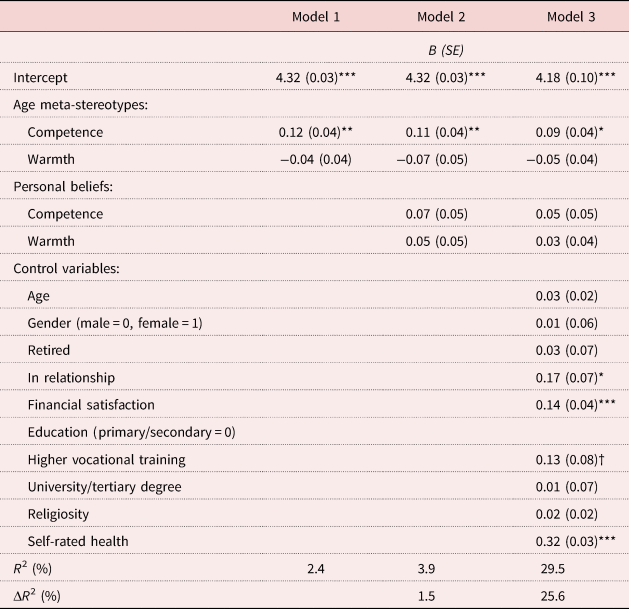
Note: B: unstandardised regression coefficient. SE: standard error.
Significance levels: † p < 0.10, * p < 0.05, ** p < 0.01, *** p < 0.001.
Additional analyses reversing Models 1 and 2 (not shown) revealed that the link between the competence dimension of personal beliefs and wellbeing was marginally significant when entered first. However, this effect disappeared when the competence age meta-stereotype was entered into the model, which remained a significant predictor for wellbeing.
When controlling for socio-demographic variables and self-rated health in Model 3, the competence meta-stereotype also remained significant. Financially satisfied individuals and individuals living with a partner reported higher wellbeing. Compared to individuals with primary or secondary education, individuals with higher vocational training reported marginally higher wellbeing. None of the other socio-demographic control variables were significantly related to wellbeing. Finally, as expected, self-rated health yielded a positive effect on wellbeing.
Discussion
The finding that age meta-stereotypes and personal beliefs were only weakly related with each other among the sample of baby-boomers in Switzerland provides empirical evidence for the anticipated gap between their own views of their age group and their perceptions of how they are viewed in society. Moreover, confirming the findings from Study 1, the competence meta-stereotype proved to be the only stereotype measure linked to subjective wellbeing, with a significant effect even after controlling for personal beliefs, self-rated health and relevant socio-demographic variables. This finding points to the normative influence of meta-knowledge over and above personal beliefs and suggests that in the current sample, the influence of meta-stereotypes and stereotype threat dynamics may have played a greater role than stereotype embodiment processes.
Against our expectations, the doddering-but-dear stereotype pattern was not supported. In fact, participating baby-boomers viewed their own group as higher on competence than warmth, a pattern that was also found for their meta-stereotypes. While the finding related to their personal beliefs can be explained by their actual social status in society (i.e. highly educated, financially well-off), the second finding related to their meta-stereotypes is more intriguing. There is, however, evidence that an older individual portrayed as competent tends to elicit lower warmth ratings (Cuddy et al., Reference Cuddy, Norton and Fiske2005). In a sense, stereotype disconfirming attributes – such as the ones displayed by the current sample – are thus punished by society through evaluating individuals as less likeable, which in turn, would explain the lower warmth meta-stereotypes reported by this sample.
Moreover, similar to Study 1, the warmth dimension of meta-stereotypes was not significantly related to wellbeing. This confirms our assumption that the competence dimension reflecting a group's social status is more important for older people's wellbeing than warmth, especially in Western countries in which much of stereotype threat research was conducted. Indeed, both the UK and Switzerland are Western European countries that endorse rather individualistic, autonomy-oriented cultural values (Schwartz, Reference Schwartz2006). In a larger sample containing more collectivistic-oriented countries, warmth meta-stereotypes may be of greater importance for older people's wellbeing.
To test whether the link between the competence meta-stereotype and wellbeing generalises to different countries, and to examine whether the warmth dimension also predicts older people's wellbeing in a larger set of countries, in Study 3 we turn to large-scale social survey data and the appropriate analytic strategy (i.e. multi-level analyses). This procedure also allows for the testing of our societal-level hypotheses (H3) by including the societal age stereotypes of a representative sample of the population and the country's socio-economic context.
Study 3
Method
Sample
We used data from 29 countries included in the fourth wave of the European Social Survey (ESS). Data were collected through computer-based personal interviews in 2008 and 2009. Only individuals aged 65 or older were included (N = 10,803). Individuals with missing data on the dependent variable, the predictors or control variables were excluded. We chose the cut-off criteria of 65 years because it roughly corresponds to the upper limit of retirement age for men in Europe at the time of data collection, a threshold frequently associated with entering ‘old age’ by the broader culture. On average, N = 373 individuals were included per country (minimum 182 and maximum 735). The mean age was 73.51 (SD = 6.37) years and women (58.0%) were slightly over-represented. As additional control variables, dissatisfaction with household income on a scale from 1 = living comfortably on present income to 4 = very difficult on present income (mean = 2.27, SD = 0.94), years of full-time education (mean = 9.75, SD = 4.51), religiosity on a scale from 0 = not at all religious to 10 = very religious (mean = 5.71, SD = 2.92), being retired (84.7%) and living with a partner (52.7%) were included. Self-reported health was measured with one item (i.e. not being hampered in daily activities by illness/disability/infirmity/mental problem) from 1 = yes, a lot to 3 = no (mean = 2.37, SD = 0.72). All continuous predictors and controls were centred at the grand-mean.
Measures
Dependent variable
Wellbeing was measured as subjective wellbeing with two items pertaining to the cognitive and affective dimensions of the construct (Diener et al., Reference Diener, Suh, Lucas and Smith1999): ‘All things considered, how satisfied are you with your life as a whole nowadays?’ and ‘Taking all things together, how happy would you say you are?’ from 0 to 10, with higher scores indicating greater satisfaction and happiness (r(10,657) = 0.74, p < 0.001). The intraclass correlation coefficient was 0.27, indicating that wellbeing varied considerably across countries.
Individual-level predictors
The competence and warmth dimensions of age meta-stereotypes were assessed with the ESS items: ‘How likely is it that most people in [country] view those over 70 as competent’ or ‘friendly’ from 0 = not at all likely to be viewed that way to 4 = very likely to be viewed that way.
Contextual-level predictors
Societal age stereotypes were aggregated means based on a separate data-set containing the full representative sample across all ages (N = 58,543). By grand-mean centring the age meta-stereotypes of individuals aged 65 and older, their views were controlled for (see Vauclair et al., Reference Vauclair, Lima, Abrams, Swift and Bratt2016), indicating that any effect of societal age stereotypes found on the country level represents a true contextual effect.
The socio-economic context of a country was measured with the Human Development Index (HDI) for the year 2007 (Human Development Report, 2009). The HDI comprises measures of life expectancy at birth (to assess health technology), educational attainment (to assess education) and Gross National Income per capita (to assess economic advancement), and is indicated as a value between 0 and 1. In the ESS sample, the HDI covered countries from 0.80 to 0.97 (mean = 0.91, SD = 0.05).
Model building
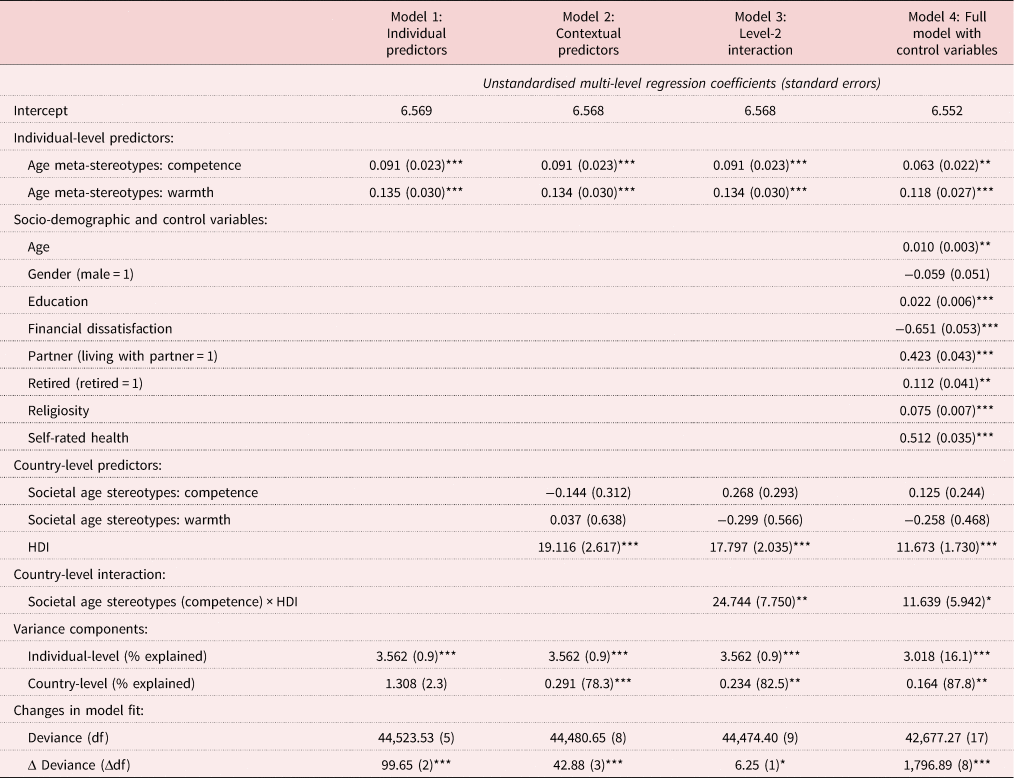
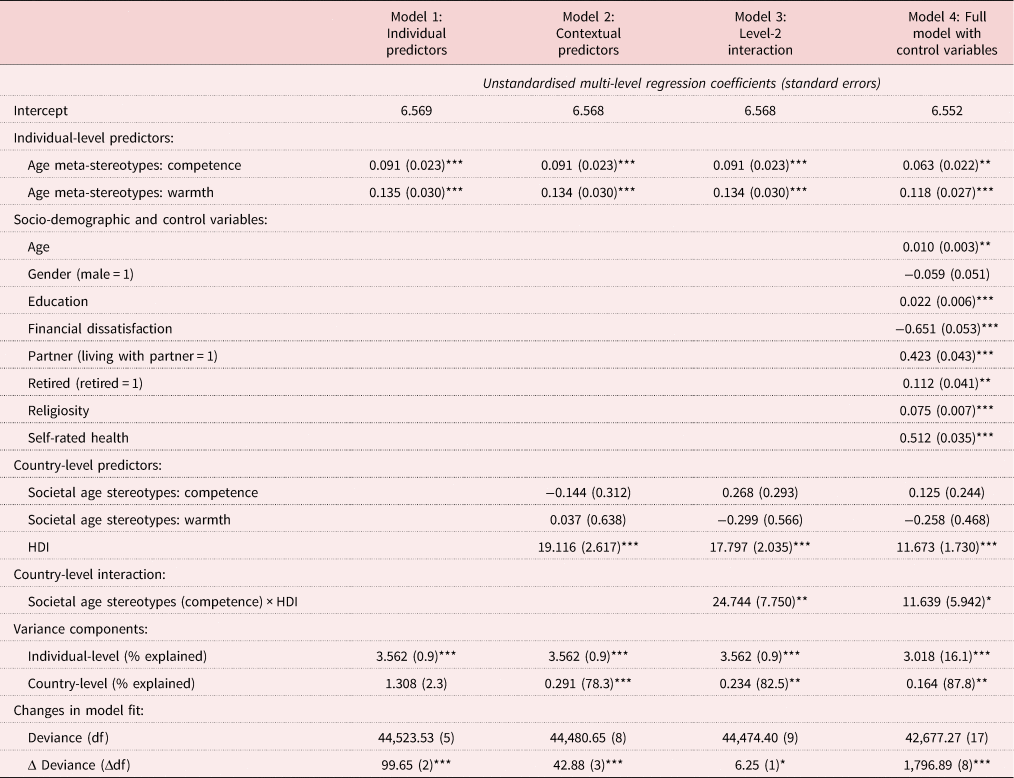
The data are structured on two levels: individuals are nested within countries and thus not independent from each other (e.g. Hox, Reference Hox2010). To account for this type of structure and to simultaneously test individual-level and country-level effects, we carried out multi-level regression analyses with Mplus 5.21 software. Models were built step by step. In a first step, individual-level predictors were entered (Model 1), followed by contextual-level predictors (Model 2) and the country-level interaction (Model 3). In a final model (Model 4), control variables were entered to ensure that the effects were not confounded with socio-demographic variables or self-rated health. Model fit was significantly improved in each step (see Table 3 for changes in deviance (−2*log-likelihood)).
Study 3: unstandardised multi-level regression coefficients of wellbeing of individuals aged 65 and older
Notes: HDI: Human Development Index. Deviance: -2*log-likelihood. Df: degrees of freedom. Deviance (df) of Model 0 is 44,623.18 (3).
Significance levels: * p < 0.05, ** p < 0.01, *** p < 0.001.
Results
The doddering-but-dear stereotype pattern (H1c) was confirmed at both levels. At the individual level, the warmth dimension of meta-stereotypes (mean = 2.96, SD = 0.92) was more positive than the competence dimension (mean = 2.61, SD = 1.01), t(10,802) = 37.23, p < 0.001. At the country-level, the warmth dimension of societal age stereotypes (mean = 2.92, SD = 0.20) was also more positive than the competence dimension (mean = 2.44, SD = 0.29), t(28) = 7.72, p < 0.001.
Table 3 displays the results of the multi-level regression analyses for Models 1–4. Confirming the findings of Studies 1 and 2 and in line with our hypothesis (H2b), at the individual level, the competence dimension of age meta-stereotypes was significantly and positively related to wellbeing among the sample of older adults across 29 countries. Moreover, in this larger sample, the warmth dimension of meta-stereotypes also predicted wellbeing, confirming our hypothesis (H2c).
Findings of Model 2 containing the country-level predictors revealed that neither of the societal age stereotype dimensions yielded a significant effect on wellbeing over and above older individuals’ meta-stereotypes, thus not confirming H3a. As expected (H3b), HDI was positively related to wellbeing. Moreover, when including the country-level interaction between the societal age stereotype dimensions and HDI in Model 3, in line with our expectation (H3c), a significant interaction emerged for competence. We also examined the interaction between the warmth dimension of societal age stereotypes and HDI. The interaction was not significant and model fit did not improve. For reasons of parsimony, this interaction was excluded.
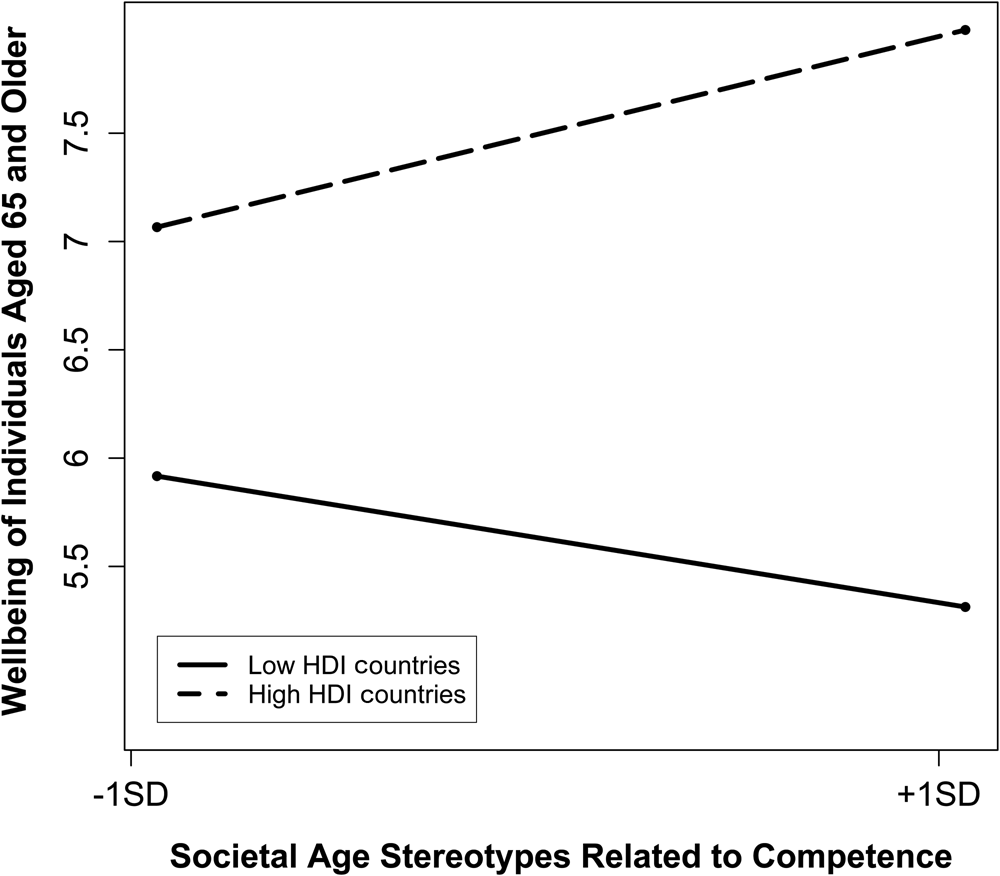
To interpret the country-level interaction between societal age stereotypes of competence and HDI, we carried out simple slope analyses, displayed in Figure 1 (Preacher et al., Reference Preacher, Curran and Bauer2006). In accordance with our expectations on the role of enabling socio-economic contexts (H3c), the societal age stereotype of competence was positively related to wellbeing only in countries characterised by higher levels of socio-economic development (HDI + 1SD: b = 1.593, SE = 0.646, p = 0.01). In countries with lower socio-economic development, societal competence age stereotypes were even linked to a decrease in wellbeing (HDI −1SD: b = −1.057, SE = 0.316, p < 0.001).
Study 3: simple slope analyses of country-level interaction.
Notes: HDI: Human Development Index. SD: standard deviation.

In the full model including control variables (Model 4), age, education, religiosity, being retired, living with a partner and self-reported health were all positively linked to wellbeing. Dissatisfaction with income was negatively related to wellbeing. Gender was not significantly associated with wellbeing. Importantly, the effects of the individual-level predictors, the contextual-level predictor as well as the interaction remained significant.
Discussion
The findings of Study 3 revealed that across 29 ESS countries, warmth meta-stereotypes were rated higher than competence meta-stereotypes by individuals aged 65 and older. This pattern was also found for societal stereotypes at the country level, thus confirming the doddering-but-dear stereotype at both levels. Moreover, at the individual level, competence and warmth age meta-stereotypes were positively related to wellbeing in older individuals. The link between competence age meta-stereotypes and wellbeing confirmed our findings from Studies 1 and 2 and was further generalised to a wider set of countries. This shows that the perception of being seen as a member of a competent group – a reflection of the group's status in the social structure – appears to be a relevant predictor of older people's wellbeing across a wide range of countries. Warmth age meta-stereotypes also emerged as a predictor of older people's wellbeing. Indeed, meta-perceptions of warmth have previously been linked to lower perceived discrimination in older people across European countries (Vauclair et al., Reference Vauclair, Lima, Abrams, Swift and Bratt2016). In more collectivistic countries that place greater importance on relational and co-operation-oriented qualities, characteristics of older people related to their friendliness, trust, care and wisdom are likely to be rewarded. Older individuals who feel valued on these dimensions may therefore experience greater inclusion and wellbeing.
At the country level, societal age stereotypes – the aggregation of the two stereotype dimensions on the basis of a representative sample of the adult population – did not yield any significant effects over and above older people's own age meta-stereotypes or the state of socio-economic development of the country (i.e. HDI) which, in turn, was associated with higher wellbeing. Yet, interaction analyses revealed that the competence dimension of societal age stereotypes interacted with the state of socio-economic development of a country. In socio-economically developed countries providing an enabling environment, societal competence stereotypes were linked to higher wellbeing in older people, while they showed a negative relationship with wellbeing in countries with low socio-economic development. This is in line with self-determination theory (Ryan and Deci, Reference Ryan and Deci2000; Deci and Ryan, Reference Deci, Ryan and Ryan2012): societally shared beliefs of older people as competent only have an empowering effect in societies that simultaneously provide opportunities for older people to prosper. Where opportunities are limited, societal competence stereotypes may actually result in frustration and dissatisfaction owing to the lack of opportunity to demonstrate competence. Such a mismatch between the available resources and the societally held expectations directed towards older people may be perceived as external pressures that undermine autonomy and wellbeing.
A few limitations need to be addressed. First, data for Study 3 were collected between 2008 and 2010, a period corresponding to the height of the global financial crisis. It is thus possible that findings such as the interaction between societal stereotypes and socio-economic context may have been accentuated through the prospects and particularities of this time period. To investigate period effects and to re-examine our findings with more recent data, it would be valuable to collect contemporary cross-national representative data on age stereotypes.
The variance explained by age meta-stereotypes was low in this study, explaining only 1 per cent at the individual level. Due to their specificity, it is not rare to find single stereotype or attitude measures having limited predictive power on relatively broad concepts such as subjective wellbeing. Literature confirms that older people's wellbeing is strongly influenced by their health, financial satisfaction, social relationships or living conditions (e.g. Smith et al., Reference Smith, Borchelt, Maier and Jopp2002). These factors have multiple direct consequences for older people's everyday lives, such as their autonomy, mobility, and access to support and care. Yet, since the determinants of these factors are complex and difficult to tackle, meta-stereotypes as a form of acquired beliefs that can be changed remain an important avenue for investigation.
Finally, the HDI represents a rather coarse measure of socio-economic development of a country. It can be argued that not all countries with a high HDI allocate resources equally to all age groups. To further assess country differences in conditions for optimal ageing and equal access to resources across all age groups, future studies could examine how more age group-specific indicators of socio-economic development interact with societal age stereotypes.
General discussion
With three studies, including an age-diversified sample of older individuals in the UK, a sample of baby-boomers in Switzerland and a sample of older individuals drawn from representative data across 29 European countries, we examined various elements of age stereotypes and their relationship with wellbeing. Personal beliefs and meta-stereotypes were largely ambivalent and supported the doddering-but-dear pattern, with the exception of the high-skilled sample of baby-boomers (Study 2) that reported higher competence than warmth evaluations. This highlights the need for age stereotype research to account for the diversity in today's ageing generations, and an interest in including the ‘newly old’ who tend to see themselves as active members of society well into their retirement years. As expected, personal beliefs only partially overlapped with meta-stereotypes, calling for their conceptual and empirical distinction. Across all studies, we found consistent evidence that age meta-stereotypes of competence are linked to increased wellbeing in older people, and partial evidence that warmth meta-stereotypes are positively related to wellbeing in a larger set of countries (Study 3). Studies 1 and 2 controlled for personal beliefs and indicated that age meta-stereotypes may impact older people's wellbeing independently of their personal endorsement, and despite the fact personal beliefs were more positive than meta-stereotypes. The findings are in line with meta-stereotype and stereotype threat research, and suggest that the normative dynamics of meta-knowledge can outweigh the internalisation of stereotypes that might arise in stereotype embodiment processes. Thus, for older individuals to thrive, it seems more important how they perceive their age group to be viewed by society than how they personally view it.
Moreover, the role of the context in which competence stereotypes of ageing are prevalent seems crucial: within a socio-economic environment that can more easily foster the potential of older people, more favourable societal competence stereotypes are associated with higher wellbeing among older people. Yet, when financial, technological and educational opportunities are scarce, favourable societal competence stereotypes may have a detrimental effect on older people. This highlights the importance of studying societally shared beliefs and expectations within their socio-structural context.
Some issues have yet to be addressed. First, trade-offs were made on the number of items included to assure that questionnaires were as short as possible. While efforts were made to create composite scores wherever possible, some predictors of wellbeing, including beliefs and meta-stereotypes, were measured only with single items. The use of single items may constrain reliability and validity. To minimise this limitation, the items used in Studies 1 and 2 were largely adopted from the ESS Round 4 questionnaire. The ESS places a high value on transparency during the stages of design, execution and archiving. Items used undergo rigorous development and testing against alternative formulations, and experiments are conducted with the aim of estimating and correcting for measurement error (Saris and Gallhofer, Reference Saris, Gallhofer, Jowell, Roberts, Fitzgerald and Eva2007; for further reliability and validity analyses of the employed age stereotype items, see Vauclair et al., Reference Vauclair, Abrams and Bratt2010). Nevertheless, validity and reliability remain to be explored in future research that could adopt more comprehensive measures of the constructs.
A limitation of Study 3 is that the ESS did not contain any measures of personal beliefs related to age stereotypes. This precluded examination of the distinction between age meta-stereotypes and personal beliefs. Although personal beliefs were unrelated to wellbeing in Studies 1 and 2, once meta-stereotypes were taken into account, we cannot rule out the possibility that a link may have emerged had we measured personal beliefs in Study 3.
Because the studies are all cross-sectional firm causal claims cannot be made. Although there is theoretical and prior evidential basis for expecting meta-knowledge to impact individuals’ behaviour and wellbeing, the opposite direction of influence could also be plausible. The relative strength of causality in each direction may be illuminated through future longitudinal studies of older people's wellbeing that could include measures of personal beliefs about their age group and ageing along with normative and meta-knowledge of age stereotypes. Experimental approaches may also be able to manipulate meta-stereotypic perceptions directly to test their potential to override effects of individuals’ personal endorsement of particular stereotypes on their mood or short-term wellbeing.
Our evidence does not directly examine the mechanisms by which age meta-stereotypes affect wellbeing. Beyond the negative consequences of perceived disrespect, devaluation and discrimination on wellbeing (Vogt Yuan, Reference Vogt Yuan2007; Schmitt et al., Reference Schmitt, Branscombe, Postmes and Garcia2014; Vauclair et al., Reference Vauclair, Lima, Abrams, Swift and Bratt2016), older individuals who fear being judged or discriminated against are likely to react with self-defeating behaviours and withdrawal from social activities, including engaging less in intergenerational contacts or adopting higher turn-over intentions, which can further obstruct their wellbeing (Cuddy et al., Reference Cuddy, Norton and Fiske2005; Swift et al., Reference Swift, Abrams, Lamont and Drury2017; Fowler and Gasiorek, Reference Fowler and Gasiorek2020). At the societal level, negative societal age stereotypes are likely to justify and maintain patronising practices towards older people, such as the denial of services, and their discrimination on the labour market. Though beyond the scope of this article, all of these are likely to contribute to the detrimental effects of age meta-stereotypes and societal stereotypes on older people's wellbeing.
The present evidence sheds light on strategies for overcoming negative effects of age stereotypes. A first set of strategies could focus on everyday settings in which age groups are not segregated and thus provide opportunities for intergenerational contact. Increased intergenerational contact helps to neutralise stereotype threat (Abrams et al., Reference Abrams, Eller and Bryant2006), and it may be that this is partly because positive contact helps to challenge negative meta-stereotypes when older people interact with younger people who do not perceive them as incompetent.
At the workplace, inclusive hiring strategies and programmes aimed at retaining older workers through job-sharing, part-time employment or consulting roles lead to more age-diversified work teams. To ensure that the interactions in age-diversified work teams are indeed positive, older workers should be supported to maintain their status with training opportunities that are ‘preventive’, including continuous training, development and life-long education, as well as ‘remedial’, such as interventions to overcome the lack of specific skills (Walker, Reference Walker2002; Vauclair et al., Reference Vauclair, Marques, Lima, Bratt, Swift and Abrams2015). Moreover, collaborating on tasks that focus on exploration, innovation, divergent thinking and problem solving seem particularly beneficial for age-diversified work teams, as younger and older workers are able to learn from each other (Mannix and Neale, Reference Mannix and Neale2005). Since the context in which interactions take place provides the backdrop for positive evaluations of older workers, employers need to pay attention to avoid policies and narratives that reinforce generational competition, and instead, stress overarching common goals and promote an inclusive workplace culture that encourages collaboration, learning, openness and respect (Mannix and Neale, Reference Mannix and Neale2005; North and Fiske, Reference North and Fiske2016).
In the health-care setting, stereotypes of fragility and dependence are more likely to be confirmed through patients being ill or in dependent states (Swift et al., Reference Swift, Abrams, Lamont and Drury2017). What is more, interactions are often characterised by status imbalance, such as an older patient interacting with a younger medical professional. In this context, training offered to health-care providers may help to avoid patronising speech, reduce behaviour that reinforces incompetence meta-stereotypes, and encourage respectful and empowering communication styles (Wiliams et al., Reference Wiliams, Kemper and Hummert2003).
Age-friendly communities and cities provide a physical and social environment that enables older residents to maintain their mobility and independence and participate in volunteering, civic activities and participative decision-making processes (Neal et al., Reference Neal, DeLaTorre and Carder2016). Such environments increase the visibility of older people's potential and their willingness to take on roles of responsibility which, in turn, should be mirrored by higher competence evaluations in everyday interactions as well as in the local public sphere.
A second set of strategies could address the societal level by changing the imagery of older people in the media and advertisements, and adapting the language used in communicating about older people in the public arena. Since normative beliefs are influenced by and influence institutions and policies (Eicher et al., Reference Eicher, Penic, Glaeser, Martenot and Spini2016), institutions and policy makers need to take implicit as well as explicit measures to change these norms, such as through the choice of terms to refer to older individuals as well as their legal rights (Vauclair et al., Reference Vauclair, Lima, Abrams, Swift and Bratt2016). In this way, equality legislation and anti-discrimination enforcement help older people not only by outlawing age discrimination, but by shaping normative climates towards becoming more inclusive.
Our findings provide partial evidence that in certain contexts, being aware of the warmth dimension of age meta-stereotypes may also contribute to older people's wellbeing. In the public sphere, this could be supported by highlighting older people's contributions to society as carers for their grandchildren, or by looking after dependent family members. Given that warmth evaluations often sustain low competence appraisals (Cuddy et al., Reference Cuddy, Norton and Fiske2005), attention will have to be paid to portray the competence domain similarly, e.g. by emphasising the diverse range of generative activities older people engage in to transmit their knowledge and know-how to younger generations, including capacity building, training and mentoring younger people (Villar, Reference Villar2012).
Finally, our findings also point to the need to address the wider structural issues. For societal competence stereotypes to empower older people rather than translate into unrealistic societal expectations, an infrastructure has to be put in place, with equal opportunities to access across all age groups (Swift et al., Reference Swift, Abrams, Lamont and Drury2017). This would mean assuring pensions to enable financial security at old age, ensuring equal access to social and medical care and technology, investing in age-friendly infrastructure and offering opportunities for life-long education.
Data
Data collection of Study 1 was part of a project with the UK Department for Work and Pensions. Study 1 data were collected as self-completion questionnaires that were collected on site or returned by post. Data collected for Study 2 were part of a research project by Swiss Education, M. Stamm, Prof. emer., University of Fribourg. Study 2 data were collected online. Study 3 used data from the European Social Survey (ESS) Round 4 Data (2008) Data File Edition 4.3. NSD – Norwegian Centre for Research Data, Norway – data archive and distributor of ESS data for ESS ERIC. Available at http://www.europeansocialsurvey.org/data/ESS4_version_notes.html. Study 3 data were collected by computer-based personal interview.
Financial support
This research was supported by the Swiss National Science Foundation (NF, grant number P2LAP1_158918) and the Portuguese Science and Technology Foundation (C-MV, grant number IF/00346/2014).
Conflict of interest
The authors declare no potential conflicts of interest with respect to the research, authorship and/or publication of this article.
Ethical standards
Ethics approval for Study 1 was granted by the University of Kent Ethics Committee (Reference number 20111985). Study 2 was carried out in accordance with the recommendations of the code of deontology of the Swiss Psychological Society. The University of Fribourg did not require an ethics approval for non-clinical social science research that did not fall within the Swiss Federal Human Research Act (i.e., research on human diseases and the structure and function of the human body). Study 3 is based on analyses of already-existing data from the European Social Survey which follows strict ethical guidelines regarding data collection procedures (https://www.europeansocialsurvey.org/about/ethics.html). No additional ethical approval is needed. For Study 1 and Study 2, written consent was provided. For Study 3, at the time of data collection, the ESS did not require a formal written consent procedure from participating countries.