Introduction
Vitamin D deficiency (VDR) is common in older persons and is caused by insufficient sunlight exposure, a decreased functional capacity of the skin to synthesize vitamin D3 and low dietary intake (Lips, Reference Lips2001). The main function of vitamin D concerns calcium homeostasis. However, the vitamin D receptor is expressed in virtually every human tissue suggesting a more widespread function than calcium homeostasis alone (Bouillon et al., Reference Bouillon2008). The serum 25(OH)D concentration has been associated with many different outcomes besides bone and fractures, amongst others muscle function, falls, infections, auto-immune disease, type 2 diabetes, cardiovascular disease, certain types of cancer, and neurocognitive disorders. However, for most outcomes causality has not yet been proven.
In a recent review on vitamin D and cognitive functioning, a majority of cross-sectional studies observed a statistically significant worse outcome on one or more cognitive functions, or a higher frequency of dementia, with lower 25(OH)D levels or lower vitamin D intake (van der Schaft et al., Reference van der Schaft, Koek, Dijkstra, Verhaar, van der Schouw and Emmelot-Vonk2013). In these cross-sectional studies, reverse causation cannot be excluded. Therefore, there is a need for longitudinal studies. In the same review, only six studies were identified examining the longitudinal association between serum 25(OH)D and cognitive functioning (van der Schaft et al., Reference van der Schaft, Koek, Dijkstra, Verhaar, van der Schouw and Emmelot-Vonk2013). Four out of six studies found an increased risk of cognitive decline, while the other two studies did not. In these studies, a variety of cognitive tasks were used, with most studies examining 1–2 different tasks, and showing conflicting results.
According to the recommendations from the Institute of Medicine (IOM) (Ross et al., Reference Ross2011), persons are at risk of deficiency with regard to bone health at serum 25(OH)D levels of below 30 nmol/L. According to the IOM, some, but not all persons are potentially at risk for inadequacy at serum 25(OH)D levels between 30 and 50 nmol/L. Concentrations > 50 nmol/L are adequate according to the IOM. The Endocrine Society defines vitamin D deficiency as serum 25(OH)D levels below 50 nmol/L and vitamin D insufficiency as serum 25(OH)D levels below 75 nmol/L (Holick et al., Reference Holick2011). For outcomes outside the bone field, such as cognitive functioning, it is not clear what the optimal cut-off point for serum 25(OH)D is.
The objective of this study was to examine the cross-sectional as well as the longitudinal association between serum 25(OH)D and five different measures of cognitive functioning in a representative sample of the Dutch older population. In addition, the optimal cut-off for serum 25(OH)D in the association with cognitive functioning was explored.
Materials and methods
Patients
LASA is an ongoing multidisciplinary cohort study on predictors and consequences of changes in physical, cognitive, emotional, and social functioning in older persons. A random sample of men and women aged 55 years and over, stratified by age, sex, urbanization grade and expected 5-years mortality rate was drawn from the population registers of eleven municipalities, in three regions of the Netherlands. In total, 3,107 persons were enrolled in the baseline examination in 1992/93 (Huisman et al., Reference Huisman2011). Measurement cycles were repeated every three years, and included a main interview and medical interview. For the present study, persons who participated in the medical interview in 1995/96, and were born in or before 1930 (aged 65 years and older as of January 1, 1996), were selected (n = 1,509). In 1,352 of these persons, blood samples were drawn and valid serum 25(OH)D could be determined in 1,320 samples. Depending on the specific outcomes, data on serum 25(OH)D, cognitive functioning, and covariables were available for 1,211 to 1,253 persons in the cross-sectional analyses (1995/96) and for 958 to 1,046 persons in the longitudinal analyses (1995/96–1998/99). The Medical Ethics Committee (Ethical Review Board) of the VU University Medical Center approved the study, and all persons gave informed consent.
Cognitive functioning
The MMSE is a questionnaire used as a screening test for general cognitive functioning (Folstein et al., Reference Folstein, Folstein and McHugh1975). The test consists of seven categories, each representing a different cognitive domain or function: orientation to time, orientation to place, registration of three words, attention and calculation, recall of three words, language and visual construction. A lower score on the test indicates a worse performance.
The RCPM is a non-verbal, visual test, which is used to measure a person's ability of non-verbal and abstract reasoning (Raven, Reference Raven1995). The test consists of three sections of 12 items each (A, Ab, and B). Each item shows a visual pattern in which a small part is missing. The respondent is asked which out of six alternatives printed underneath the pattern, fits best into the missing part. In LASA a short version of this test was used because of time limitations (Smits et al., Reference Smits, Smit, van den Heuvel and Jonker1997). Previous research has shown that the score for the complete test correlates strongly with the score for section A and B (r = 0.96) (van den Heuvel and Smits, Reference van den Heuvel, Smits, Deeg and Westendorp-de Seriere1994), therefore section Ab was left out. A lower score on the test indicates a worse performance.
Information processing speed was measured by an adjusted version of the CT (Savage, Reference Savage1984). The task consists of three identical trials, each lasting one minute, in which the respondent has to combine two characters according to a given example. The score on each trial is defined as the number of completed characters irrespective of the number of wrong answers. The maximal score of the three trials was used in the analysis.
Memory performance was measured with an abbreviated version of the Auditory Verbal Learning Test (AVLT) (Rey, Reference Rey1964). The participant is asked to remember as many words as possible of a list of 15 one-syllable nouns, which is read aloud by an interviewer. This procedure is repeated three times, using the same word list. The total number of words learned by the participant on all three trials is defined as learning ability. Words that are mentioned more than once are only counted one time per trial. Words that are not on the list are not counted. After about 20 minutes, the participant is asked to recall as many words as possible to measure delayed recall. On both tests, a lower score indicates a worse performance.
Serum 25(OH)D
Morning blood samples were obtained in 1995/96. Subjects were allowed to have tea and toast, but no dairy products. The blood samples were centrifuged and stored at −20° C. Serum 25(OH)D was determined using a competitive protein binding assay in 1997/1998 (Nichols Diagnostics, San Juan Capistrano, CA, USA). The interassay coefficient of variation was 10%. All analyses were performed at the Endocrine Laboratory of the VU University Medical Center.
Potential effect modifiers
Sex was examined as a potential effect modifier. Data on sex were derived from population registries.
Potential confounders
Potential confounders were: age, sex (if no interaction effect was found), season of blood collection, educational level, presence of depressive symptoms, heart disease, diabetes, hypertension, alcohol use, smoking, and physical activity. Education level was assessed by asking the respondent for the highest education level completed. This was converted into elementary school or less, secondary school, or higher education. Presence of depressive symptoms was assessed by the Center for Epidemiologic Studies Depression Scale (CES-D). The generally accepted cut-off score of ≥ 16 was used to identify clinically relevant depressive persons. Heart disease en diabetes were assessed by self-report. Hypertension was defined according to the American Heart Association as a systolic blood pressure > 140 mmHg and/or diastolic blood pressure > 90 mmHg and/or use of anti-hypertensive drugs (Egan and Zhao, Reference Egan and Zhao2013). Alcohol use (does not drink, light, moderate, and excessive drinking) (Garretsen HFL, 1983) and smoking (never, former, current smoker) were assessed by questionnaires. Activity level was assessed in minutes per day by the LASA Physical Activity Questionnaire, a questionnaire covering the following areas: walking outside, bicycling, gardening, light household activities, heavy household activities, and a maximum of two sport activities during the previous two weeks (Stel et al., Reference Stel, Smit, Pluijm, Visser, Deeg and Lips2004).
Statistical analyses
First, baseline differences were tested by comparing different vitamin D categories (25(OH)D<30, 30–50, 50–75, ≥75 nmol/L)). Differences in mean were tested using One-Way ANOVA, differences in median were tested using Kruskal–Wallis H Test, and differences in frequencies were tested using Pearson χ 2 Test. Second, multivariable regression analyses were used to examine both the cross-sectional and longitudinal associations between serum 25(OH)D and cognitive functioning. Because of a skewed distribution, the MMSE score was normalized using the following transformation: LN(31-MMSE). First, the interaction with sex was tested (p < 0.10). In case of a statistically significant interaction effect, the analyses were stratified. In the multivariable analyses, three different models were applied: model 1 was the unadjusted model; model 2 was additionally adjusted for age, sex (if no effect modifier) and season of blood collection; model 3 was additionally adjusted for education, depressive symptoms (yes/no), self-report cardiovascular disease, self-reported diabetes, hypertension, alcohol use, smoking, and physical activity. In the longitudinal analyses, all models were adjusted for baseline cognitive functioning. A sensitivity analyses was performed in which all persons having low cognitive functioning at baseline (below 1.5 standard deviation) were excluded from the longitudinal models. A p-value of 0.05 was considered statistically significant.
In case of a statistically significant association, restricted cubic spline functions and spline plots were used to explore the optimal cut-off point for serum 25(OH)D in relation to cognitive functioning. Cubic splines are piecewise polynomial functions that are constrained to join smoothly at points called knots. These spline functions provide better insight in dose-response relationship as compared to analyses using categorized variables. Restricted cubic spline functions use all data points to estimate the risk at each level of exposure, as opposed to step functions using categorical variables, which assume a constant risk within categories. The likelihood ratio test was used to examine whether a model using four knots was better than a model containing three knots. The knots were at the 10th, 50th and 90th percentile in case of three knots, and at the 5th, 35th, 65th, and 95th percentile in case of four knots. Next, the cut-off point was estimated using the eye-ball test. All analyses, except for the spline analyses, were carried out in IBM SPSS Statistics version 20; the spline analyses were performed using R version 2.10.0.
Results
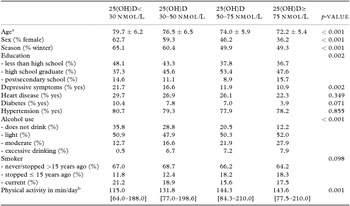
Baseline characteristics are presented in Table 1. Persons having lower serum 25(OH)D levels were significantly older and more often female as compared with persons having higher serum 25(OH)D levels. Furthermore, their blood was sampled more often in winter, they had lower education, more often depressive symptoms, and they were less active. Finally, there were significant differences with regard to alcohol use with more persons not consuming alcohol and less excessive drinkers at lower 25(OH)D levels.
Baseline characteristics of the study sample

Differences in mean were tested using One-Way ANOVA, differences in median were tested using Kruskal–Wallis H Test, and differences in frequencies were tested using Pearson χ2 Test. Persons with valid serum 25(OH)D measurements and values on the confounders were selected (n = 1,256).
aMean ± standard deviation are presented.
bMedian [interquartile range] is presented.
In the total population, mean serum 25(OH)D levels were 53.7 nmol/L (SD = 24.2). In total, 17.5% of the participants had a serum 25(OH)D level < 30 nmol/L; 30.9% between 30–50 nmol/L; 34.0% between 50–75 nmol/L, and 17.6% ≥ 75 nmol/L. The MMSE ranged between 5 and 30 with a median level [and interquartile range] of 28 [26–29].
When comparing persons without MMSE score on follow-up (n = 207) with persons having complete data on baseline and follow-up (n = 1,046), persons who dropped out had lower MMSE scores (p < 0.001), were significantly older (p < 0.001), and less often female (p = 0.002). They had more often elementary school or less or higher education (p = 0.001), more often depressive symptoms (p = 0.043), cardiac disease (p = 0.027) and diabetes (p = 0.017), and they were less active (p < 0.001). Non-response analyses regarding the RCPM, CT and AVLT largely pointed into the same direction (data not shown). For the latter cognitive tests, also significantly higher percentages of non-alcohol users and excessive drinkers were observed in persons who dropped out.
Sex was a statistically significant effect modifier in the cross-sectional association between serum 25(OH)D and learning ability (p = 0.046 for serum 25(OH)D 50–75 nmol/L vs. ≥75 nmol/L). Therefore, further analyses on learning ability were stratified for sex. For the other cognitive functions, no statistically significant interaction effects were observed (p ≥0.163).
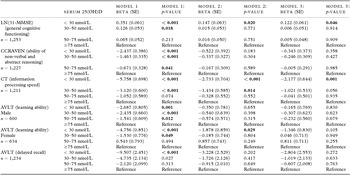
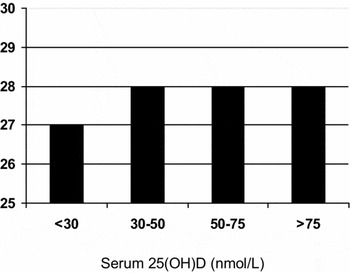
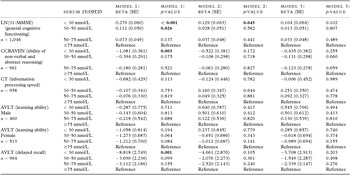
In Table 2, the cross-sectional analyses are presented. In the unadjusted analyses, a serum 25(OH)D level < 30 nmol/L was associated with lower delayed recall scores; 25(OH)D levels up to 50 nmol/L were associated with lower general cognitive functioning, slower information processing speed, and lower learning ability in women; 25(OH)D levels up to 75 nmol/L were associated with lower ability of non-verbal and abstract reasoning, and lower learning ability in men. In Figure 1, the untransformed median scores of the MMSE (general cognitive functioning) are presented with lower MMSE scores at lower serum 25(OH)D levels. In the fully adjusted model, a serum 25(OH)D < 30 nmol/L was associated with lower general cognitive functioning (Beta of LN(31-MMSE) = 0.122, p = 0.046) and slower information processing speed (Beta = −2.177; p = 0.001).
Cross-sectional associations between serum 25(OH)D and cognitive functioning

25(OH)D: 25-hydroxyvitamin D; MMSE: Mini-Mental State Examination; RCPM: Raven's Colored Progressive Matrices; CT: Coding Task; AVLT: Auditory Verbal Learning Test.
Linear regression analyses were performed. Model 1: unadjusted model; Model 2: adjusted for age, sex (if no effect modifier) and season of blood collection; Model 3: additionally adjusted for education, depressive symptoms, self-report cardiovascular disease, self-reported diabetes, hypertension, alcohol use, smoking, and physical activity.
Median MMSE scores at baseline for different serum 25(OH)D categories.

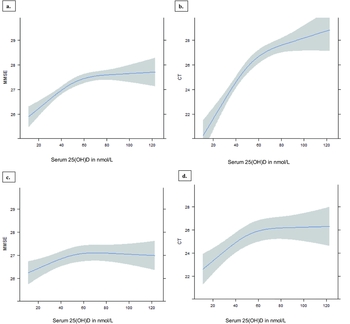
In Figure 2, the cross-sectional associations between serum 25(OH)D and general cognitive functioning and information processing speed are presented. For both outcomes, the models using four knots were not significantly better than the models using three knots in the univariable analyses (difference in −2 LL is 2.48 for general cognitive functioning and 0.09 for information processing speed) and multivariable analyses (difference in −2 LL is 2.30 for general cognitive functioning and 0.28 for information processing speed). In the univariable analyses, the spline plots showed a higher general cognitive functioning and faster information processing speed up till a serum 25(OH)D level of about 60 nmol/L after which the associations show a less-steep increase. It should be noted that the confidence interval becomes wider at the lower and higher end of the spline plot, due to lower numbers of persons having very low or very high 25(OH)D levels. In the multivariable analyses, both associations were less steep and flattened after the cut-off of 60 nmol/L.
Cross-sectional associations between serum 25(OH)D and general cognitive function (a = unadjusted and c = adjusted) and information processing speed (b = unadjusted; d = adjusted) General cognitive functioning was assessed by the MMSE; Information processing speed was assessed by the CT. Grey line represents 95% confidence interval.

In Table 3, the longitudinal analyses are presented. In the analyses adjusted for baseline cognitive functioning, a serum 25(OH)D level < 30 nmol/L was associated with lower ability of non-verbal and abstract reasoning and lower delayed recall; and serum 25(OH)D levels up to 50 nmol/L were associated with lower general cognitive functioning. In the fully adjusted models, none of the observed associations remained statistically significant related to cognitive functioning at three years.
Longitudinal associations between serum 25(OH)D and cognitive functioning

25(OH)D: 25-hydroxyvitamin D; MMSE: Mini-Mental State Examination; RCPM: Raven's Colored Progressive Matrices; CT: Coding Task; AVLT: Auditory Verbal Learning Test.
Linear regression analyses were performed. Model 1: adjusted for baseline cognitive functioning; Model 2: additionally adjusted for age, sex (if no effect modifier) and season of blood collection; Model 3: additionally adjusted for education, depressive symptoms, self-report cardiovascular disease, self-reported diabetes, hypertension, alcohol use, smoking and physical activity.
In a sensitivity analysis, persons with low cognitive functioning at baseline (below 1.5 standard deviation) were excluded. Serum 25(OH)D < 30 nmol/L was no longer significantly related to general cognitive functioning in model 2 (Beta (se) = 0.102 (0.065), p = 0.117). In addition, serum 25(OH)D between 30–50 was no longer significantly related to general cognitive functioning in model 1 (Beta (se) = 0.078 (0.052), p = 0.136). Furthermore, no changes in significance levels were observed and all significant results pointed in the same direction (data not shown).
Discussion
In this study, the relationship between serum 25(OH)D and five different measures of cognitive functioning was examined. In the cross-sectional, multivariable analyses, a serum 25(OH)D < 30 nmol/L was associated with lower general cognitive functioning and slower information processing speed. The optimal cut-off point for both outcomes was about 60 nmol/L. In the longitudinal analyses, statistically significant associations were not observed in the fully adjusted models.
When looking at the literature, a majority of cross-sectional studies in community-dwelling older persons show that lower serum 25(OH)D is associated with lower cognitive function (e.g. (Llewellyn et al., Reference Llewellyn, Lang, Langa and Melzer2011; Slinin et al., Reference Slinin2012)). Although different tests are used in different studies, several studies included the MMSE. When looking at this test, a meta-analysis showed lower MMSE scores in participants having serum 25(OH)D<50 nmol/L as compared with >50 nmol/L (Balion et al., Reference Balion2012). The results of longitudinal studies in community-dwelling older persons are contradictory. To our knowledge, six longitudinal studies have been published up till now, some reporting statistically significant associations between serum 25(OH)D and cognitive decline (Llewellyn et al., Reference Llewellyn2010; Annweiler et al., Reference Annweiler, Rolland, Schott, Blain, Vellas and Beauchet2011; Slinin et al., Reference Slinin2012; Perna et al., Reference Perna, Mons, Kliegel and Brenner2014), and others not (Slinin et al., Reference Slinin2010; Breitling et al., Reference Breitling, Perna, Muller, Raum, Kliegel and Brenner2012). Our results are in agreement with the studies showing no statistically significant longitudinal associations. In a sensitivity analysis, persons with low cognitive functioning at baseline were excluded to assess whether the results were different when studying incident cognitive impairment. The results of this analysis were similar to the main analyses presented in this paper.
However, when looking at genetic studies and animal research, there is compelling evidence for a role of vitamin D in the brain. The VDR is expressed in brain neurons and glial cells, as is the enzyme 1α-hydroxylase, which is responsible for the hydroxylation from 25(OH)D3 into 1,25-(OH)2D3, the active form of vitamin D (Zehnder et al., Reference Zehnder2001; Eyles et al., Reference Eyles, Smith, Kinobe, Hewison and McGrath2005). VDR knockout mice show behavioral changes, such as increased anxiety and different grooming behavior (Kalueff et al., Reference Kalueff, Lou, Laaksi and Tuohimaa2004a; Reference Kalueff, Lou, Laaksi and Tuohimaa2004b). However, in another study, no impairments in cognition as indicated by exploration, working memory or anxiety were observed in VDR knockout mice (Burne et al., Reference Burne, McGrath, Eyles and Mackay-Sim2005). Furthermore, there is growing evidence for a role of vitamin D in maintaining calcium balance and signaling, regulating neurotrophic factors, providing neuroprotection, modulating neurotransmission, and contributing to synaptic plasticity, which was summarized in a recent review (Groves et al., Reference Groves, McGrath and Burne2014).
Strengths of the current study are that LASA is a representative sample of the Dutch older population. The interdisciplinary character of LASA enabled us to examine five different measures of cognitive functioning in one cohort and to take many different covariables into account. Weaknesses include the fact that reverse causation cannot be excluded based on our study. Only general cognitive functioning and information processing speed remained statistically significant, and these findings were only observed in the cross-sectional analyses. It may be that older people with low cognitive performance are less active and have lower sunshine exposure, and therefore lower vitamin D synthesis in the skin. In our analyses, we adjusted for physical activity levels. However, we do not have a sunlight exposure variable. Another possibility is that low vitamin D status is a marker for frailty and not causally related to cognitive functioning (e.g. (Puts et al., Reference Puts, Visser, Twisk, Deeg and Lips2005)). Finally, persons who dropped out from the study performed significantly worse on the different cognition tests at baseline, were older, and were less healthy. Therefore, the longitudinal associations may have been underestimated.
Based on the evidence up till now, with on the one hand genetic studies and animal research showing many different clues for a role of vitamin D in the brain, and on the other hand observational studies showing contrasting results, it should be mentioned that true causality can only be assessed in well-designed randomized controlled trials. In the largest trial up till now, i.e. the Women's Health Initiative, supplementation with 400 IU/daily in combination with calcium did not show a statistically significant effect on incident dementia, mild cognitive impairment, global or domain-specific cognitive function (Rossom et al., Reference Rossom2012). Possibly higher doses of vitamin D are necessary to show effects on cognitive function. In our study, we estimated that the optimal serum 25(OH)D level is about 60 nmol/L. From an earlier study, it can be estimated that a dose around 1,200 IU/day is sufficient to get levels above 60 nmol/L for the majority of people (Gallagher et al., Reference Gallagher, Sai, Templin and Smith2012). However, future studies are needed to replicate the cut-off point of 60 nmol/L that was observed in our study. Furthermore, it would be interesting to replicate our findings in samples with more persons having low serum 25(OH)D levels and low cognitive functioning in order to see what happens at the lower end of the spline curve. Finally, well-designed trials are needed to examine the effects of vitamin D supplementation on cognitive functioning. When performing such RCTs, general cognitive functioning and information processing speed appear to be the most promising outcomes.
In conclusion, low serum 25(OH)D was associated with poorer general cognitive functioning and information processing speed, but not with a faster rate of cognitive decline. Our results do not support causality, but true causality can only be examined in a well-designed randomized controlled trial.
Conflict of interest
None.
Description of authors’ roles
N.M. van Schoor was responsible for the statistical design of the study, performed the statistical analyses, and was responsible for drafting the paper. All authors are responsible for the design of the study, interpretation of the data and critical revision of the paper. All authors approved the final version of the paper.
Acknowledgments
The LASA is largely supported by a grant from the Netherlands Ministry of Health Welfare and Sports, Directorate of Long-Term Care.