Since the late 1990s, thousands of parents in Uganda have written family histories and their own life stories for their children in the form of “memory books.” The writers of these unique workbooks are predominantly widowed mothers living with HIV, who have agrarian backgrounds and limited schooling. They participated in community workshops that supported their writing, which were aimed at helping them shed their self-stigma, disclose their HIV status to their children, and plan with the children for their future absence, using the memory book as an essential tool for empowerment and family communication.
Generally, in Africa, lifewritings penned by common people, especially under-privileged women, have been rare. Encyclopedia of Life Writing (Jolly Reference Jolly2001) mentions mostly book-length publications written by authors from the educated elite (see also Moore-Gilbert Reference Moore-Gilbert2009); the few exceptions include memoirs by Mau Mau insurgents and anti-apartheid South African unionists. Lifewritings of non-activist, non-unionist, “lay” women, such as town-dwelling workers or subsistence farming mothers, are unusual, and most of these were written not by the women themselves but by researchers, based on the women’s oral narratives (with the exception of Nthunya Reference Nthunya and Limakatso Kendall1997). FEMRITE (Uganda Women Writers’ Association) projects have elicited creative non-fiction lifewriting by skilled writers (e.g., Kiguli & Barungi Reference Kiguli and Barungi2007) who “vocaliz[e] the lived experience of nonliterate women” (Hunsu Reference Hunsu2017:320); however, the risk of appropriation of “researcher scripted autobiographical texts” (Coullie Reference Coullie1997:133) cannot be underestimated.Footnote 1
The AIDS epidemic has proved generative for African autobiographical writings, as seen in examples such as the Openly Positive Project (Mpongo et al. Reference Mpongo2011), Namibian Women Writing Project (IKhaxas Reference IKhaxas2005, Reference IKhaxas2008), and various memory book projects. The last have been extensive, involving thousands of writers and integrating into major nongovernmental organization (NGO) activities in several countries over decades. Despite the potential of memory books as literary tools for common people, reports and evaluations of memory projects have instead focused on their psychosocial effects for the beneficiaries—the projects’ overt aim—based on interviews and questionnaires.Footnote 2 This article examines memory projects from a literary perspective and offers a literary analysis of one memory book to understand memory books’ potential as a new genre of lifewriting and illness writing for people in Africa. Writing a memory book can help writers reflect upon and redraw a map of their life, especially regarding HIV, and reading such a book can help not only the writers’ children, but also other readers to imagine the writers’ lifeworlds from their perspectives.
My literary approach to people’s lives is organized differently than Hanne Overgaard Mogensen’s “narrative ethnography” (Reference Mogensen2020:xi). Mogensen’s work considers the life of an HIV-positive single mother (1971–2004) from eastern Uganda with four years of schooling, enmeshing her life story in her multilayered kinship network and including multiple perspectives from her relatives; the work testifies to Mogensen’s ethical dilemma as both a scholar and a field-working sojourner involved in the lives of the people she studies. My textual analysis of narrativization in memory writing by Aguga Christine,Footnote 3 an HIV-positive widowed schoolteacher (1968–2000) from eastern Uganda, may not reveal the writer’s life in such delicate layers of interactions, but will instead lead readers directly into the writer’s lifeworld, represented in her own words and from her own perspective.
During my six field visits to Uganda (mostly Tororo district, eastern Uganda) between 2008 and 2016, I read over forty memory books and conducted interviews with writers, their family members, NGO workers, and community group leaders. Plan Uganda, the project organizer, facilitated my first three visits, and Community Vision, the local implementing NGO, the rest. The NGO staff introduced me to the writers as a researcher who wanted to read their memory books; the writers were open and willingly gave me permission to use their books for academic and educational purposes and to share their stories with the world. All interviews were conducted in Tororo unless otherwise stated. Throughout this article, writers are referred to with their real names, following their preference (or in Christine’s case, whose book is the focus here, her parents’ preference), while the names of other people and places referred to in the excerpts are kept anonymous for privacy reasons. Minor grammatical errors in the excerpts are unmarked, unless they are problematic.
The article consists of two parts. It first introduces memory book projects as a literary activity—their history, content, objectives, readers, writers, and process—before examining their narrative characteristics concerning HIV. As I did not attend the workshops or writing sessions, the discussion is based on a review of related papers, my interviews, and memory book texts. The article then gives a close textual analysis of one of the most eloquent memory books I read, focusing on its powerful representation of the late writer’s experience of HIV. Focusing on textual analysis but also using the limited background information available, I examine the book’s aesthetic representation of Christine’s lifeworld as an HIV-positive schoolteacher in rural Uganda before antiretroviral HIV treatment (ARV) became available. The two-part discussion in this article will show the potentiality of memory books as a new genre of lifewriting in Africa.
Background and History of Memory Books
Uganda is known for its reduction of HIV prevalence in the 1990s through grassroots initiatives and a policy of openness, which was actively supported by senior leaders. The National AIDS Control Programme, established in 1986, was the first such program in Africa (Kinsman Reference Kinsman2010:71); it was scaled up to a Uganda AIDS Commission in 1992. The government’s progressive, open policy facilitated interventions at national, district, institutional, and community levels, supported by international and bilateral donor agencies (Kirumira Reference Kirumira, Follér and Thörn2008:89). “Ugandans themselves identified problems, generated solutions, and integrated these into close-knit networks of mutual support that brought to bear the concerned action of society at large,” which was “relatively rare in Africa, or anywhere in the world” as an HIV response (Thornton Reference Thornton2008:85; see also Epstein Reference Epstein2007:167 on “the intimate, personalized nature of Uganda’s early campaigns”).
Both national and localized campaigns addressing HIV utilized the life stories of people living with HIV. One notable example was Philly Lutaaya, an openly positive pop singer, who initiated awareness campaign concerts supported by WHO and the International Red Cross; the 1990 posthumous documentary film about his struggle was shown on TV and toured nationwide (Marion Frank Reference Frank1995:152–55; Zaritsky Reference Zaritsky, Barz and Cohen2011). The AIDS Support Organization (TASO), founded in 1987 as one of the first local support groups in Africa, formed their first drama group with their clients in 1990 (TASO 2006:1); drama groups across TASO centers have continued to perform in clinics and surrounding local communities using message songs, educational short dramas, folk dances, and performers’ personal testimonials (Cohen Reference Cohen, Barz and Cohen2011). Numerous community groups established sensitization programs following the TASO style (Barz Reference Barz2006, Reference Barz, Barz and Cohen2011) and “[by 2004] drama groups had become a prominent part of the AIDS-related landscape” (Cohen Reference Cohen, Barz and Cohen2011:312). In all these programs, “the practice of ‘witnessing’” played a vital role; “HIV-positive people spoke about their disease at meetings, in schools, and in churches. Their stories served as warnings to avoid infection and as attempts to counteract discrimination” (Whyte Reference Whyte2014:13–14).
The National Community of Women Living with HIV/AIDS (NACWOLA) began as one such local organization in 1992, and the members of this group also engaged in outreach activities. One problem NACWOLA members faced as HIV-positive mothers was how to disclose their HIV status to their own children, especially the young ones. Annet Biryetega, the former national coordinator of NACWOLA, recounts how “community members [traumatized the children, saying] ‘your mother is going to die with AIDS!’ or ‘your mother has AIDS, the sickness of prostitutes’” (Reference Biryetega2005:30).
Thus in 1998, NACWOLA established a memory book project, a therapeutic tool that had originated in the UK in 1991 for HIV-affected families of African origin (Lindsay-Smith Reference Lindsay Smith2005). The project was built on “four pillars, namely: improving communication between HIV-positive parents and their children; disclosing HIV status and other important information; succession planning; and writing important family history in a memory book” (Biryetega Reference Biryetega2005:30).
After initial success in Kampala, with the help of Save the Children UK, the project spread to other districts and major NGOs such as Plan Uganda, TASO, and World Vision (Witter Reference Witter2004:910). Memory book projects sprang up in Ethiopia, Kenya, Tanzania, and Zimbabwe, supported by Healthlink UK (Dunn & Ward Reference Dunn and Ward2009), and inspired oral and visual memory work in South Africa (Denis Reference Denis2005; Morgan & Bambanani Reference Morgan2003; Grünkemeier Reference Grünkemeier2013:180–84).
Precisely estimating the number of memory books written in Uganda is difficult because they were distributed across various organizations, with different levels of support and completion rates. Community Vision (2004) counted 1,213 participants in their memory workshops as of 2004, although not all the participants actually wrote books. Witter reported that 386 books had been completed in NACWOLA projects as of 2004 (75% completion rate, 2004:10). Overall, perhaps thousands of books have been written in Uganda since the late 1990s.
In Uganda, memory book projects were commonplace in the 2000s, although at least two recent (2018) case reports are found online (Memory Book). The decline of memory writing in the 2010s was attributed by Charles Lubega, a project manager for Community Vision, to an HIV funding shift from psychosocial support to medical service provision.Footnote 4
Message to the Child and the World: Contents and Writing Purposes
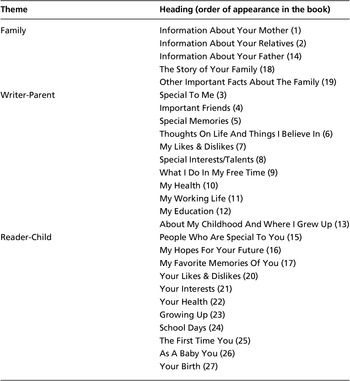
Memory books in Uganda are usually workbooks with approximately thirty blank pages and pre-printed headings. I took the twenty-seven headings shown in Table 1 from Christine’s memory book and categorized them into three themes.
List of Headings of Christine’s Memory Book.

As the list shows, although HIV is a central topic, the memory book tells more than an HIV story. Its loose format accommodates a variety of writing styles and focuses. Some writers detail family customs, profiles of family members, family history dating back to colonial times, and a precise record of family property. Others express intimate personal sentiments toward the addressee child and thank friends and NGOs for support. Some describe their daily life of farming, social gatherings, workshops, and churchgoing, while others state their life philosophy, especially in terms of living with HIV. Some write about their illness—symptoms, testing, and medical treatments. In short, memory books can perform many functions, including family chronology, letter, journal, essay, life story, and illness record.
These hybrid, multifaceted workbooks record a personal message from the writing parent to the addressee child, with the intention of providing resources in the parent’s absence. Nyachwo Betty Owino, a facilitator and writer, explained: “memory book is so important because it is a book that contains all the family history, the background, the origin of the family, the relatives. And it also acts as a guiding tool when you are no longer there to help your children” (interview, August 19, 2010).
That being said, some writers apparently hoped for a wider readership than their family circle. Writers in Tororo often expressed a preference for writing in English, so that “visitors can read” their stories. One facilitator, Raymond Ekwaro, explained that facilitators sometimes encouraged English writing, because ‘“English can go far”’ (interview, August 23, 2014). One writer, Ayoo Rose, made her book a quasi-official publication by adding a table of contents and acknowledgements, ending the latter page with a strong activist message to society: “We the clients of Tororo District programe fully welcome ARVs-services to our district as a means of increasing household health and as per our recommandation. My the struggle continues. By Ayoo Rose client reprensentative A and B sub counties. [Signature].” Outside readers were also expected by local-language writers to some degree. In Luweero, one Ganda-language writer told me that her son had received financial assistance from a school visitor after the boy showed the memory book to the visitor; she said this encouraged memory writing in her community (interview, Luweero, August 14, 2008). In short, although they are primarily intended for the writers’ children, memory books can travel and be shared with anybody willing to read, and the writers were aware of the potential for their personal narratives to serve as a global HIV discourse.
Writing in Group
Most writers I met in Tororo were widowed mothers with HIV, living on subsistence farming, with several years of primary education or more. Male participants in NACWOLA projects are estimated at 20 percent (Witter Reference Witter2004:28), and my field experience supports this rate.Footnote 5 Sophie Witter and Beatrice Were (Reference Witter and Were2004:142) describe the participants as mostly widowed mothers, “generally poor and not in formal employment” and explain that “people who were better off had less time to spare and more to lose by being open about their status.”
For participants, memory book writing was often challenging. Upon completing the five-day, often residential workshop, where they learned about memory book writing, family communication, and disclosure (see Healthlink 2005 for workshop structure), participants completed the workbooks provided. The main hindrance, according to Witter and Were, was “illiteracy,” followed by “poverty, ill-health, fear of stigma, problems accessing information (especially concerning one’s in-laws), lack of confidence and lack of time” (Reference Witter2004:141–42).
Although some writers preferred English, many books were written in the language of communication between writer-parent and reader-child, if their local language was a literary one, as I observed among Ganda-language writers in Luweero. In Tororo, according to support group leader and writer Beatrice Oyuki Acheinga, both local languages and English were used in writing, but the completed books were mostly written in English (interview, August 22, 2014). As a literary critic, I believe in writing in one’s own language; but ironically, as I am illiterate in local languages, I could only read the English-language memory books. I appreciated these writers’ effort to cater to a wider readership and felt responsible for helping their stories reach other readers.
To facilitate writing, the organizing NGO, Plan, experimented with various forms of follow-up, such as checking back and hosting writing classes at community meetings.Footnote 6 As less literate writers often dictated their stories to more literate relatives, counselors, friends, and/or NGO workers, Plan organized a shorter workshop to teach writers’ relatives how to act as writing assistants (group interview, August 23, 2011).
As family members were often involved as information sources as well as writing assistants, memory books could be family projects. For example, two writers, Yodita Akello and Ngire Federence, were related, and so were their chosen writing assistants. Since the writing assistants helped each other, the memory books shared several passages. The writers did not mind this overlap, because “we are family and we share the same types of problems” (group interview, August 23, 2011). Nayanzi Betty Kyolaba’s memory book, written for her daughter (who is also HIV-positive), contained little information about her husband; her daughter was then motivated to write a memory book for herself with more information about her father, with another to follow for her HIV-negative younger sister (Nayanzi Betty, interview, Kampala, August 27, 2013). In some memory books, writing was seen in several hands, showing that several people had contributed to each book. For instance, Amase Margret wrote to her stepson and asked the uncle of her late co-wife (the boy’s biological mother) to fill in the pages concerning the boy’s mother (interview, May 5, 2016).
Narratives Concerning HIV
Having clarified the literary features of memory books, we must map the books’ narratives concerning HIV to position Christine’s book, the subject of our textual analysis, and clarify why we choose to present it here.
Although each memory book has its unique way of addressing HIV, the narratives can be roughly grouped into three categories by their period of writing: pre-ARV, early post-ARV, and ARV-normalized. In Tororo, voluntary HIV tests with systematic social and medical support became available after 1998, while free ARV services were present around 2003.
The early post-ARV period was the prime period for memory book writing. Among the forty-four books I obtained in Tororo, most were written during this period (2004–2006; sixteen in 2004, six in 2005, and six in 2006). Five of the forty-four were originally begun in 2002, but the writing of four of them continued into 2004 and beyond. The writers began to “miraculously” recover with ARV; they began to hope for survival but continued to experience fear and uncertainty. The dominant narrative mode concerning HIV in these books can be called the “survival narrative”: how one became weak, lost one’s spouse, tested positive, suffered from a series of health problems until ARV saved one’s life, and the writer is now living positively with HIV. Although the focuses vary from detailing symptoms to emphasizing positive living, one commonality is the writers’ determination to project hope onto the page.
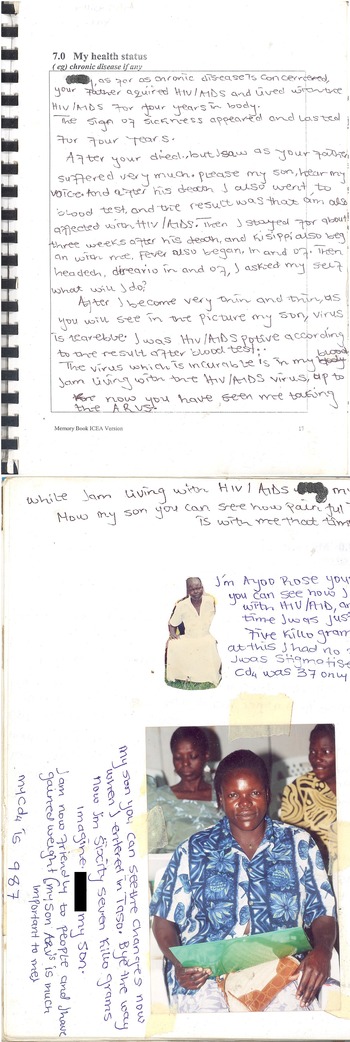
For example, Ayoo Rose, a 1973-born farmer with six years of education, included two contrasting photos of herself on the page headed “My health status” and its reverse page (Figure 1). Kisippi is a local name for herpes zoster (shingles). Her powerful words and evocative photos dramatically affix the story of Rose’s survival in these pages. On the first page, she traces her journey, starting with her husband’s death, her positive test result, and a series of symptoms. On the next page, using contrasting pre- and post-ARV photos, she emphasizes her recovery from a stigmatized, lonely figure weighing 25 kg, to her smiling, confident present-day self, weighing 67 kg and surrounded by friends.
“My health status,” Ayoo Rose’s memory book in 2004, provided to the author by courtesy of Plan Uganda and Ayoo Rose

I have come across only four books written after 2010, in the ARV-normalized period—one in 2010 and three in 2013. None of these books is very long, probably due to the lack of systematic writing support. While these books too basically follow the survival narrative, the HIV issue is not highlighted, but rather integrated in the life story.
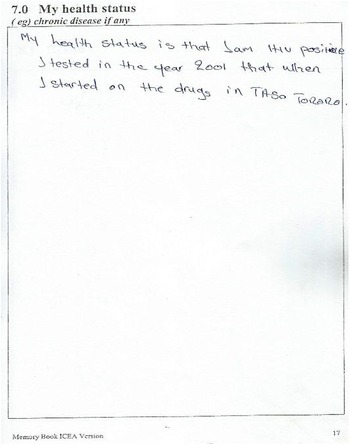
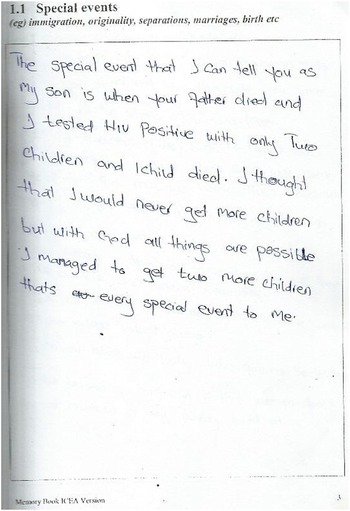
For example, let us consider two passages concerning HIV from a 2013 book written by Akoth Mary Clare, a 1973-born farmer with six years of education, assisted by a fellow writer. First, her passage in “My health status” is quite brief (Figure 2); she had been on ARV for a decade, and therefore, HIV would not have been novel to her, nor did it require elaboration. Next, her passage in “Special events” integrates HIV as a significant life event for her (Figure 3). A survival narrative is discernible, although subtler, with less direct focus on HIV, than in books written in the early post-ARV period. Childbearing among HIV-positive women on ARV is not uncommon in Uganda (Whyte, Kyaddondo, & Meineart Reference Whyte, Kyaddondo, Meineart and Whyte2014:156–58). Mary Clare was thirty-four when she lost her daughter to a cause not recorded in her book, which left her with only one child. These two passages show that the writer endured suffering due to HIV, but that it was controlled with ARV; HIV had become a part of her life, just one episode in her life story. In the words of Susan Reynolds Whyte, Hanne O. Mogensen, and Lotte Meinert, for writers in the ARV-normalized period, “HIV is shifting from the text to the context of their life stories” (Reference Whyte, Mogensen, Meinert and Whyte2014:280–81).
“My health status,” Akoth Mary Clare’s memory book in 2013, provided to the author by courtesy of Community Vision and Akoth Mary Clare

“Special events,” Akoth Mary Clare’s memory book in 2013, provided to the author by courtesy of Community Vision and Akoth Mary Clare

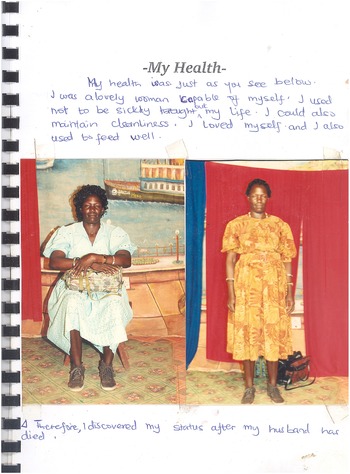
Books written in the pre-ARV period do not adhere to the survival narrative. I have come across only three books (including Christine’s) written exclusively within that period, and they vary greatly. Akoth Veronika, a 1961-born farmer with six years of education, wrote her book in 2002 with assistance from her relative Nyachwo Betty, a facilitator. She rarely mentions her own HIV experience; her page “My Health” shows how healthy she was before HIV (Figure 4).
“My Health,” Akoth Veronika’s memory book in 2002, provided to the author by courtesy of Plan Uganda and Akoth Veronika

Wori Esther, a 1965-born famer with seven years of education, began her first book in 2000 with assistance from her uncle, but she never finished it; she began a new book for the same child in 2004 while she was on ARV, this time assisted by her counselor. Two passages she wrote show contrasting narrative modes in pre- and post-ARV periods. According to her books, Esther suspected her status was positive at the birth of her last child in 1991, and her positive status was confirmed by her first test in 1994. She lost her husband in 1998 and started ARV in 2003. The first passage was written in 2000 and the second in 2005, both under the heading “My Health.”
My health since 1994 April has not been good and most of the time I would wonder what was wrong until I went for blood test-Hiv testing. Then I realized the cause of the poor health I had. My health generally has been poor and at times it is very bad because I can take most of my time being sick. (First passage, 2000)
I Esther Wori, never had many problems since my childhood concerning sickness. I used to have malaria off and on and possibly with headaches when I was at worst. After getting married, was when my husband was affected.
Not until 1994 in April when I started having frequent malaria and in 1995 was when they found out that I had STD and I was treated for that. 1997 was when they tasted [tested] for TB and was got with me. So since then I was put in ARV 2003 in November. But now because of the nice and strong treatment I get, has made me push life up to day 2005. And even less work I do keeps me normal. I have left even thinking so much for I would like my kids to read and grow, than me wearing a weary face or worn up face. (Second passage, 2005)
[a family photo is attached]
(The parts that were apparently added later are italicized by me.)
The first passage emphasizes the deterioration of Esther’s health in the present tense, although with few details. The second passage contains details such as years and names of diseases, with updates or revisions, serving as a health record. The latter passage follows the survival narrative, delineating Esther’s natural health, HIV infection through marriage, a series of HIV-related symptoms, and then ARV as a savior. After thus “re-collecting” her illness memories for the past decade into a chronological story, using linking words such as “when,” “after,” “until,” and “since,” she triumphantly reaches her present life: “But now because of the nice and strong treatment I get, has made me push life up to day 2005.” The concluding sentences sensitively represent her current situation of “positive living” with HIV, experiencing ongoing difficulty but perpetually finding a way to fight it; she voices her determination not to fret, as if to exorcise that worry.
In short, I saw few memory books in Tororo that witness the severe HIV-related trauma of the pre-ARV period as it was being experienced, instead of looking back on it from the safer vantage of the post-ARV period. One can only imagine how Esther would have written her painful HIV experience in pre-ARV days as an ongoing process: watching her newborn daughter suffer, knowing her status before community support was available, and fighting the virus for a decade without any prospect of rescue. However, writing about one’s terminal illness while in increasingly poor health would not have been easy, either psychologically or physically. According to Beatrice Oyuki, all the early workshop participants from her group passed away without completing their memory books, as the organizing NGO recruited those in the poorest health, considering them to be in most urgent need of leaving memory books behind (interview, August 22, 2014). Among the writers whose books I have read, only three were able to write their life story while facing imminent death: Nyachwo Betty, a 1972-born facilitator and shopkeeper with eleven years of education, who wrote in 2001 and after; Achipa Joyce, a 1966-born primary schoolteacher and HIV activist with fourteen years of education, who wrote in 2002 and after; and Aguga Christine, whose book this article will now analyze in detail.
Christine’s Memory Book
Aguga Christine (1968–2000) wrote her book in 2000. When I asked Plan for an English-language memory book, after finding only Ganda-language books in Luweero, they gave me a copy of Christine’s book (although Christine herself was from Tororo) as one of the best memory books. Henning Mankell (Reference Mankell, Reichel and Hillgruber2004) also included the whole of her book in his writing on memory books.Footnote 7
What makes Christine’s book special is her intense records regarding HIV. While pre-ARV books scarcely reveal the writers’ HIV experience, post-ARV books largely subsume their HIV trauma and anxiety under the survival narrative. The introspective style and emotionally evocative wording of Christine’s book plunges readers into her traumatic experience of living with and dying of HIV. The dense, subtle texturing of deep emotions in Christine’s book can be primarily ascribed to her individual qualities as a writer and thinker, but also to her educational background and literate mode of self-reflection, as she was a secondary schoolteacher with a two-year post-secondary diploma. Another influential factor was probably Christine’s solitary circumstances as she was writing. She learned of her HIV-positive status early, in 1993. She wrote her memory book in 2000, completing it only a few months before her death; she had lost her husband to HIV in 1998. She had hidden her HIV status for years for fear of discrimination and wrote her book independently while critically ill. According to her father (interview, August 18, 2010), her family knew she was writing something, but they were prohibited from reading it until she presented them with her completed memory book. Christine’s HIV experience may be similar in some ways to Esther’s, as Esther tested positive in 1994, lost her husband in 1998, attended the same workshop as Christine, and wrote her first book in 2000. However, while Esther barely wrote of her ongoing pain in her uncompleted book, the isolation and desperation Christine experienced while suffering and writing are intimately shared in her book, making it a unique and painful soliloquy, testifying to her profound HIV-related trauma. Her book stands as a testament of living with and dying of HIV on behalf of the many others who have left us, or whom we have left, with their stories unheard.
By conducting a literary textual analysis of Christine’s memory book, this article shows how one rural Ugandan schoolteacher experienced HIV in the pre-ARV period and how writing a memory book helped her process these experiences. After briefly introducing Christine’s biography and the structure of her memory book, the article first analyzes the section “My Health” (10), the longest and most detailed and carefully written section in her book. Then, it turns to “My Hopes For Your Future” (16) and analyzes what it meant for Christine to write a testimony of her experience of HIV. I hope that my literary analysis can reveal the writer’s struggles, sentiments, and experiences of HIV, and explore the potential of memory books, not only as a psychosocial support tool, but also as a literary tool which enables people to write their life stories in their own words and be heard.
Christine’s Biography
Born in 1968 in the Tororo district, Christine was fifth among the eleven children of a popular Anglican bishop.Footnote 8 Christine exhibited early intelligence, and after thirteen years of primary and secondary education, she expected to continue her studies at a college of commerce in Tororo. However, in 1987, a relative married her off secretly, without her parents’ consent, to a wealthy man twelve years her senior who already had a wife in Kampala. She later referred to this as “a marriage with somebody I had never been in love with at all,” a “hijack” of her life. Despite this forced marriage, she soon started college, but had to quit after less than two months due to an unplanned pregnancy. After giving birth to three daughters, in 1988, 1990, and 1991, she resumed her studies, this time in a teacher training college in Tororo in 1992. After graduation, she secured a senior secondary teaching position in 1995.
While Christine was in college in Tororo in 1993, her husband’s first wife passed away. In apprehension, she and her husband took HIV tests and learned that they were HIV-positive. The couple hid their HIV status, but eventually their visible symptoms betrayed them. After her husband passed away at age forty-two in 1998, Christine stayed with her parents and her daughters while continuing to work as a schoolteacher. She started to write her memory book on January 27, 2000, for her nine-year-old second daughter. She passed away on July 9, 2000, at age thirty-two.Footnote 9
Difficult Narrativization of HIV Experience: “My Health”
Christine’s memory book has twenty-seven sections. The first thirteen are mostly about the writer herself, and the last eight about the addressee child, while the six sections in between are about her husband, the guardian figures for the child, her hopes for and memories of the child, and the family history (mainly on her husband’s side, to which the addressee belongs, according to their ethnic kinship system). The sections about the child are mostly filled with bare facts, for example, a list of immunizations in “Your Health” (22) and a series of residential locations in “Growing Up” (23), perhaps because Christine’s health and energy were deteriorating at the time of writing. In contrast, the passages about herself in the early sections are rich and sometimes continued on extra sheets of paper.
“My Health” has six pages—less than two about her kidney disease and more than four about her HIV. The whole part on HIV is quoted below in seven separate passages.
As explained earlier, HIV first appeared in Christine’s life in 1993. At that time, she was staying with her parents in Tororo as a college student, 230 km from her husband in Kampala, “because I wanted to complete my course successfully before rejoining my husband for fear of getting another child soon” (“My Health”). However, when she was in Kampala temporarily for her kidney operation, her husband insisted on her staying with him; he had lost his first wife six months previously. She suspected that the first wife had died of HIV and demanded both she and her husband get tested.
By this time, since I was not well [due to the kidney operation], he insisted that I should rejoin him instead of bothering my parents. This was the beginning of trouble! Early around Easter 1993, we buried your step mother whom I mentioned earlier on that was such a reckeless woman. She was said to have died of “cancer of the uterus” but roumours from reliable sources said it was HIV/AIDS.
In connection to rejoining as a family, I had no objection but there was only one condition I gave your father, that we should go for an HIV/AIDS test and the result of this was to be the determinant whether we were to rejoin or continue as separate parents. At this time I had high hopes of being HIV negative since I had stayed alone at my father’s home for long. I had hoped that this disaster probably came in during my absence!!
Christine forthrightly delineates the sensitive negotiations between the couple. Although this disclosure may embarrass the nine-year-old addressee, Christine implies that there were no sexual relations between her and the child’s father at the time and reveals her secret expectation that she would be HIV negative and her firm intention to continue to stay separately from him if their status proved discordant. Talking about personal sexual matters in memory books is quite rare, as the books are addressed to the writers’ children; Christine’s exceptional honesty and openness may have been influenced by her knowledge that this would be her last and only chance to tell her daughter in detail about her life’s tragedy, including uncomfortable matters such as sex.
The next passage concerns the HIV test. Christine’s vivid description of the scene re-presents and re-calls to her writing mind the fear, shock, denial, and desperation she went through:
Your father was greatly in disagreement with this suggestion but had no alternative since I had seriously stuck to my principle of knowing our HIV status. The nearest place by then was “C” in Kampala where these tests could be done. At last we came to agreement and went to take the test, but in fear however, what would the results be??
There were so many people who had come there for the same purpose and also counselling services. Our blood samples were taken for test and the results were to be released after two weeks.
I therefore came back to D [her home village in Tororo] and later on went back to Kampala for the results after two weeks. We went together, but the greatest shock of my life came when we were shown results and by the worst of luck both of us were declared HIV positive!! Did I believe my ears?? I could not believe it and only insisted that blood be taken again for another test! This we did before we left “C” hoping for the results again after two weeks.
We moved back to “E” where he was working but I almost failed to walk the distance. I was walking carelessly that even some car could come and knock me dead to be registered as having died of a motor accident!! Poor me!!
When the two weeks ended we went to “C” but I consoled myself saying the machines could even be faulty!! To my surprise, the result was the same! We made our way back but I was not myself. All my hopes had gone. I even did not see the use of going back to college for my second year!! Who could I tell or share with this disastrous condition of my health?? Of course no body!
Christine was tested seven years prior to the time of writing, but the scene is represented here with fresh pain. The reason for Christine’s evocative representation of the occasion may be her need to revisit and relive her first encounter with HIV, to situate it at the beginning of her story of living with and dying of HIV. Most writers in the post-ARV period have peer support and exhibit a clearer view of HIV’s meaning in their lives and how to deal with it than Christine does. Without such medical and psychosocial support, her situation seems to have been incomprehensible to her. Thus, to counteract the dark mass of negative feelings—fear, confusion, anxiety, regret—she decided to face and define HIV in her memory book by going through her traumatic past: her memories of learning her status and then denying, evading, negotiating, living with, and dying of HIV. The intricate evocation of the first encounter represents her determination to make sense of her experiences, through re-membering (as opposed to dismembering), re-minding, and re-calling how she lived with HIV—gathering lost or buried pieces of her life and making a story of them.
The deep introspection in Christine’s writing resonates with her personal and emotional solitude in real life, for instance, in getting the HIV test. In contrast to her precise description of her own HIV experience, she scarcely talks about her husband, who went through the test with her; it is as if she received her own verdict and faced her own reality alone, without sharing anything with him. Although she believes that he infected her with the virus, it is not him or his actions but simply her own illness that torments her. Her husband remains in the background, and her focus remains on her own situation, both at the time of the test and at the time of writing.
Christine’s solitude and isolation grow sharper when she finds it impossible to share her agony with her parents. After learning of her HIV status, Christine, as quoted below, talks about her post-test family relations and conflicts. She anxiously monitored the development of her youngest daughter, then a one-year-old, but did not get her a test. The most painful part of all, however, is how little her loving and caring parents understood her agony and solitude. Note that during that time, the early to mid-1990s, “discrimination, stigmatization, and denial were still very serious problems” in Uganda (Monico et al Reference Monico, Tanga and Nuwagaba2001:8).
However, I later on picked courage and continued to the second year of my course, but still staying with my parents together with my children [in Tororo]. My next worry was whether my last born was safe from this scourge!! I kept watching her grow but got encouraged since her health was generally good. I later felt like disclosing this disaster to my mother but being a pressure case I knew I was shortening her life. Definitely I had no one to tell and shortly before I finished my course there came a misunderstanding between me and my parents when T [her husband] requested that I be allowed to spend christmas with him together with the children [in Kampala]. My parents did not want to hear anything of the sort [about resuming her relationship with her husband.]
Unfortunately, some of the utterances that were made were in connection with the death of your step mother. I felt so much depressed and I felt the only solution was to travel to Kampala and organise with T [her husband] to pick away our children [from Tororo] after all, we knew what our fate was and felt we need not bother people with our children. This was on 25th/December/1993, and the next day we hired a vehicle from Kampala to D [her home village in Tororo], picked the children and stealthly disappeared when my parents were away.
Christine’s parents had always supported and protected her, even from her husband, through actions such as taking care of her children while she was in college. Here too, it seems implied that they wanted to protect her from her husband, whom they suspected was HIV-positive (presumably judging from the death of his first wife). What they did not know, and Christine could not share, was that she had already been infected with HIV. “So much depressed,” she seemingly gave in to her “fate”—dying of HIV—and isolated herself from her parents. An irony is that now she could open up only to her husband, whom she believed had infected her.
In the next excerpt, Christine talks in an emotionally flat reporting tone about her school graduation and her teaching appointments.
In July 1994 I finished my course and by then the children were in Kampala with their father but under the care of a house girl. I joined the family and continued on until early in 1995 when some problem cropped up in “E” [the workplace of her husband] and we were forced to come back to Tororo and rented a house in town but could check on the village home once in a while.
By this time I had not got employed yet, but there was a small family car that helped to support the family. I later got a vacancy in F senior secondary school and later got transferred to G College. By this time my health was still okey and none could suspect anything and therefore I got some peace of mind here.
No sense of achievement is perceptible in the words here. Graduation was the fruit of Christine’s determination against her husband, as described in “My Education” (12) in four pages. Over two pages in “My Working Life” (11), she details her struggles, once more in opposition to her husband, to obtain teaching appointments. Represented here in “My Health,” in contrast, is “peace,” as “none could suspect” her infection, and behind it there was anxiety, as everyone would know once she developed symptoms. Now that the couple had returned from Kampala to Tororo, where they were better known, this fear and pressure must have been acutely felt. With the possible public exposure of their HIV status always lurking in Christine’s mind, her life story was drained of its joy.
Finally, as related in the next cited passage, Christine’s husband developed symptoms, and her secret fear of exposure and resultant stigma became a reality.
It was only later when T (your father) began having frequent attacks especially when he could not continue working in H where he had been re-employed. At one time he had a very serious attack and I hired a vehicle to take him to Tororo hospital but to my consolation the diagnosis was “pleurisy” which is connected with inflammation in the lungs. He was treated and advised to stop smoking and drinking and later discharged. I for one knew the hidden sickness.
All people who heard of this in G [Christine’s working place] were sympathetic and advised that he better takes the doctor’s advice. He stopped for sometime but later resumed both smoking and drinking and his health became poorer and poorer. Some people now became suspicious and to make it worse he had persistent malaria all the time with serious weight loss and these increased suspicion worsened by skin rash and black spots on his body.
Her husband’s precipitating symptoms besieged Christine and destroyed her peace of mind. The first paragraph starts with the worsening of her husband’s health. To her “consolation,” his diagnosis did not refer to HIV, but her fear of future exposure intensified, as “I for one knew the hidden sickness.” Indeed, where at first her co-workers did not connect the illness to HIV, as “his health became poorer and poorer,” some “now became suspicious.” The series of symptoms are mentioned one after another in one sentence with repeated expressions such as “suspicious” and “suspicion,” “worse” and “worsened,” representing Christine’s increasingly heightened anxiety and fear.
Later, Christine and her husband finally gave up hiding their status. Due to the health hazards of their condition, the couple joined a local branch of TASO, which meant that their positive status would be known.
However, before he became very weak I suggested that we both join (TASO) Tororo and he accepted. We got some medical and social support from there for some time under our counsellor V (the late). In the process I also needed to be sure of the HIV status of W (the last born). We took her there and her blood test revealed that she was negative. I got consoled again and thanked God greatly for this miracle!!
When your father died in June 1998, following his suffering, the previous roumours were now confirmed. By this time, we had only shared it with your grandmother (yogo) who had also already been suspicious. Shortly before he died, I also picked courage and told my parents about our fate which had been a secret since September 1993. They were not so shocked since they had also been suspicious.
After your father’s burial, I took all of you with me to D [her home village] and later to G [her workplace] to resume duty and studies. This is when people began roumouring around but I consoled myself I knew there were so many people living with (HIV/AIDS), so I was not the first nor the last!
At TASO, Christine received healthcare and psychological support, and started to accept her HIV status. First, she had her youngest daughter tested and found her to be negative. She then disclosed her own positive status to her parents. She became more able to bear people “roumouring around” after her husband’s death and was “consoled” that “there were so many people living with HIV/AIDS, so I was not the first nor the last!” Her positive attitude breaks the narrative tension, and the subdued mood brings relief to us as readers.
From a literary-analytical viewpoint, however, this passage and the following one (together, they constitute the last page of “My Health”) sound unfocused and languid, without the intensity of the previous entries. For example, Christine’s representation of the death of her husband sounds anticlimactic compared to the preceding anxious, dramatic representation of his quick deterioration. Witnessing her husband develop visible symptoms, suffer from severe pain, and succumb to an ugly death must have shaken Christine’s security and changed her way of living, especially around HIV. Indeed, just before his death, she disclosed her status to her parents, and after his death, people started gossiping about her own status. His death perhaps had the potential to provide a turning point in her life plot, but she does not “emplot” it as such—for example, as the start of a new chapter of positive living, as in many HIV stories.
Indeed, throughout, Christine strictly abstains from the narrativization or dramatization of her life experience, although it could have been emplotted quite dramatically: accepting her HIV, losing her husband, starting to live openly with HIV, and in the next passage, facing her impending death. She could have resorted to a narrative frame, for example, of survival and rebirth—if not physical, then mental or spiritual (as suggested by one of her church friends below)—a frame in which one conquers one’s stigma and fear regarding HIV and gains a new heightened sense of the value of one’s life, suggesting that one can still lead a meaningful life in spite of HIV. In cases where the disease is terminal, this recognition that the impending loss of one’s life can lead to an appreciation of its every precious moment is common, elevating one to a new level of fulfilment in life. Christine, however, rejects the temptation to dramatize her life into such a transcendental survival narrative. She seems to agree with Arthur Frank (Reference Frank2013:135), who warns about the risk of using “the Phoenix metaphor,” which “can present the burning process as too clean and the transformation as too complete, and…implicitly deprecate those who fail to rise out of their own ashes.” Instead, she prosaically describes her days as a suspension period before death, without reaching for any transcendental vantage from which she could impose a meta-narrative to give any significance to her life with and death due to HIV.
In the last passage from “My Health,” Christine has also developed symptoms, but receives support from some of her church members. She must have been expecting her death to be near, and in fact, she was to pass away within six months of starting her memory book.
Since then, I have always had some malaria attacks but the worst is skin rash leaving black spots on my body. This has now made many people confirm what they thought. I have shared it with a few trusted friends especially those I fellowship with at church particularly my brother in-christ X who saw a vision about my life and my husband’s death and whom God has given a task of praying for my divine healing.
All in all, the Lord is still sustaining me and the support that my parents, brothers, sisters and friends are giving me has always given me hope and courage that my three children (Y, Z, and W) will remain in safe hands.
Christine describes her own symptoms for the first time in this section, including the ugly, visible rashes. Some readers, as they become familiar with Christine’s masterful writing, may expect her to explore the deep agony she experiences while going through these bodily changes, but she does not do so. At this time, she was writing her own end-of-life experience as she was living it, serving as both the author and protagonist. Pains, symptoms, stigma, and rumors, as Arthur Frank (Reference Frank2013:139) notes, mount up in “excess” of any narrative frame: “Too many events happen too fast to be fitted into appropriate frames, and some events simply do not fit even when reflective space is available for the fitting.” Christine’s ongoing experience of both living with and dying from HIV refuses to be narrated into any meaningful telic chronology or narrative.
Christine mentions a spiritual narrative about HIV offered by one of her church members. Her “brother in-christ” tells a spiritual story of rebirth—he “saw a vision about my life and my husband’s death”—and says, “God has given [him] a task of praying for my divine healing.” The elated tone of the church member, in almost ironic contrast to Christine’s detached tone reporting the news, seems to show that she has received the story with indifferent gratitude, and that she herself will not use such a framework of spiritual sublimation or “divine healing” to narrate her HIV experience into one of spiritual triumph and eternity. Such a story of survival and conquest of HIV with the power of prayer and submission to God would have been a compelling explanatory narrative in those pre-ARV days, especially for someone in Christine’s circumstances;Footnote 10 but devoted Christian though she is, Christine refuses to resort to such a story of salvation through deus ex machina.
One may wonder if Christine would have written a survival narrative had ARV been available. ARV might have afforded her a vantage point to examine the meaning of her illness and narrate it into a meaningful life story. Indeed, early post-ARV memory books, imbued with public health discourse, usually include a strong message of positive living and the mantra: get tested, know your status, get on treatment, and you will survive. In Christine’s circumstances, however, with no viable treatment, she was true to herself to merely exist, without trying to force a plot or meaning on her life. Her memory book conveys a sober existentialism, with no attempt at a transcendental story of awareness or recognition of “death [understood as] the final stage of growth” (Kübler-Ross Reference Kübler-Ross1986).
The last paragraph of Christine’s HIV section abruptly wraps up with a forcible phrase, “all in all.” The paragraph reads almost as a short prayer said at the end of her writing. She thanks God for sustaining her, expresses her gratitude for the support received from people around her, and states her hopes for her children’s future. The atmosphere is light and bright. However, note that the “hope and courage” that the people around her provide do not work for Christine herself, although she hopes that they will for her daughters in her absence. In this last sentence, after mentioning “hope and courage,” she extends the same clause to a future when she is no more, and thus draws her narrative on HIV to a close with the image of her future death, peacefully and beautifully embedded in “hope and courage.”
Writing a Memory Book: “My Hopes For Your Future”
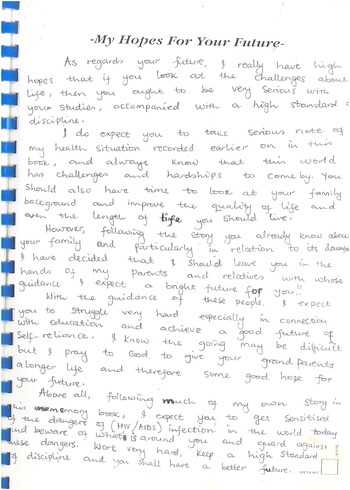
Christine does not seek to narrate her life with HIV into a story of survival or healing. However, in the memory book she leaves behind, her HIV testimony survives her and makes meaning in her readers’ minds and lives: she puts her own life into words and hands them down in a memory book to the addressee, her daughter, and to others, to be read, interpreted, learned from, and lived, along with the lessons and inspiration her story provides. To borrow Paul Ricœur’s words, Christine does not emplot her life in “My Health” into a concordant and unified story of survival; instead, she invites readers to follow and interpret her text and live it (Reference Ricœur and Wood1991:25–27). This is true of any person who leaves memory books behind, and indeed, this explicitly dialogical “inter-subjectivity” (Jackson Reference Jackson2013) is where memory books differ from other autobiographical lifewritings and is what motivates parents to write. Christine, however, differs from other memory writers in that she gives her daughter—and ultimately everybody who will read her book—a clear parting instruction to read and live her memory book, in the sense above, in “My Hopes For Your Future” (16; Figure 5). This last message to her child makes this section exceptional.
“My Hopes For Your Future,” Aguga Christine’s memory book in 2000, provided to the author by courtesy of Plan Uganda and the father of Aguga Christine

In this section, with the repeated phrase “I expect you to,” Christine sends several messages, which can largely be summarized in one phrase: “read my memory book.” That is to say, “take serious note of my health situation recorded earlier on in this book,” “have time to look at your family background,” and live safely “following the story you already know about your family and particularly in relation to its downfall,” as well as “following much of my own story in this memory book.”
In her memory book, instead of adopting a formulaic narrative of positive living or overcoming HIV, Christine dives deep into her unfulfilled life and confronts the frustration and desperation tormenting her, which are at the core of her HIV experience. She spent her last months filling the pages of her book, while sensing her weakening body, hearing people whispering about her and pitying her, and fearing her imminent death. Writing about HIV while dying was a solitary venture, retracing with honesty and bravery her life and regrets as an ongoing, open-ended journey. Her efforts have proved rewarding: her life is given words and form in her memory book to be read, and she survives in her reader’s mind, thereby making meaning.
Conclusion: Memory Book as an Emerging Genre of Lifewriting
Christine’s book has an exceptional, evocative power to represent her HIV trauma in words. While narratives of other pre-ARV books seem to falter as if stunned with a sense of imminent death, most memory narratives in the post-ARV period seem to subsume the writers’ anxiety and pains under the survival stories. Nevertheless, those seemingly reserved books without strong voices of their own have different ways of representing the writers’ HIV experience, from an orality-based style (Oike Reference Oike2020), to a collaboration between the writers and their children (Oike Reference Oike2023), or indirectly through textual gaps created by words and photos across sections (Oike Reference Oike2021). The value of Christine’s memory book might be easier for readers trained in the Euro-American style of narrativization to recognize, because its self-reflective, introspective HIV narrative, seeking the meaning of one’s life and death, conforms with the Euro-American illness “quest narrative” presented by Arthur Frank. Frank would likely classify the post-ARV survival narrative as a “restitution narrative” and the frustrated pre-ARV narrative as a “chaos narrative,” both of which are thought not to “afford the ill person a voice as teller of her own story” (Reference Frank2013:115). However, privileging Christine’s narrativization of HIV over others’ and overemphasizing its exceptionality is misleading, for Christine’s HIV narrative, like any memory book narrative, is inherently open-ended and dialogical: written while being lived and handed down to her family and other readers, to be read and remembered.
This article has tentatively outlined a map of HIV narratives in memory books in terms of the periods of ARV availability and, based on the Euro-American illness narrative model, discussed how memory books other than Christine’s “failed” to explore the writers’ HIV trauma. A further analysis of how other memory books addressed the writers’ experience of HIV, their hardships and hopes—how the writers’ memories of HIV and other important issues are given form as experience, placed in their life story, and shared—will show us these writers’ lifeways and lifeworlds, and reveal memory books’ full potential as a medium for the marginalized to write their stories in their own words and for readers to imagine the worlds the writers live in.
To revitalize memory book projects, I suggest redesigning them as lifewriting projects for people in Africa, irrespective of the writers’ HIV status. Such a historiographical approach will interest people in Africa, where people treasure their family and clan history but where family members have less time for story-sharing nowadays, since the younger generations are dispersed and busy with their own business, as the memory writers often deplored. The writers emphasized that memory books were not only for people with HIV but for everybody. Raymond Ekwaro (the facilitator mentioned earlier) further noted that memory books could spread further if they were not pigeonholed as a HIV-specific tool and associated with HIV stigma (Interview, August 25, 2014). It will be especially fruitful for conflict survivors to write their stories, in Uganda and elsewhere—particularly those survivors from ethnic minorities, who may be less literate and whose stories are less frequently recorded in official archives.
Memory books are written to be read and remembered, not only by the family addressees, but by anybody (anywhere, anytime) who wishes to read them. Read together, multiple memory books combine to reveal the life stories, memories, and wisdom that writers collectively want the world to remember as their stories. The present article has analyzed only one such book; analyses of other memory books, including those written in local languages, are needed to understand their full potential as a medium for African lifewriting, with their unique manner of signification—personal yet family-focused, private but public, open-ended, and dialogical—serving to draw the readers in. Appreciating the unique memory book narratives will require a new (more collectivistic, more orality-informed) hermeneutics, cross-disciplinarily combined with deep interviews and daily observations to fill textual gaps with adequate knowledge of the writers and their families and communities.
Acknowledgements
I would like to express my profound gratitude to all the memory book writers—especially Christine, whose powerful book led me to other memory books and enlightened me as to their possibilities as literature—and to all those who have supported me both within and outside of the field.