Introduction
The walrus family evolved in the Pacific Ocean around 20 million ago, and spread to the Atlantic Ocean before the closure of the Isthmus of Panama. The modern walrus (Odobenus rosmarus (L.)) evolved in the late Cenozoic, following declining temperatures in the north (Born Reference Born, Duguy and Robineau1992)
The present geographical range of the walrus (Odobenus rosmarus) is disjunct, with populations in the north Atlantic and in the north Pacific. During the last glacial stage, the geographical range of the walrus was displaced to the south, as is shown by fossil finds from the North Sea (Møhl Reference Møhl1985), California (Harington and Beard Reference Harington and Beard1992) and New Jersey in eastern USA (Dyke and others Reference Dyke, Hooper, Harington and Savelle1999). During the late glacial, from around 14,700 to 11,700 calendar years BP, a number of Arctic marine invertebrates and vertebrates occurred in the Kattegat and Skagerak in southern Scandinavia. Arctic marine mammal species such as ringed seal (Pusa hispida), harp seal (Phoca groenlandicus), bearded seal (Erignatus barbatus), polar bear (Ursus maritimus), Greenland right whale (Balaena mysticetus) and white whale (Delphinapterus laucas) have been documented (Fredén Reference Fredén1986). Strangely, however, there appears to be no reports of walrus remains from the late glacial time period in northwest Europe. A few late-glacial finds have been reported from southeast Canada (Dyke and others Reference Dyke, Hooper, Harington and Savelle1999).
Some mid and late Holocene finds have been reported from northwest Europe (Møhl Reference Møhl1974; R. Sommer, personal communication, 2004). These probably represent rare stragglers, such as have also visited western Europe over the past centuries (Born Reference Born, Duguy and Robineau1992).
The walrus has been exploited eagerly during the past millennia. After the introduction of modern weapons the species was exterminated in some parts of Greenland. Around one hundred years ago the species used a number of haul-out sites on islands and on the mainland around the entrance to Nordre Strømfjord, in Disko Bugt and further north in west Greenland, but large numbers were hunted, and the species were extirpated from these areas (Born and others Reference Born, Heide Jørgensen and Davis1994).
In northeast Greenland, the species was locally common, but hunting by European sealers and trappers from 1889 to 1955 and by Greenlanders after 1925 led to a severe decline during the last century. Some recovery has taken place in the northern part of east Greenland over the last few decades, following protection of the species in the national park in northeast Greenland (Born and others Reference Born, Dietz, Heide Jørgensen and Knutsen1997). In west Greenland, the walrus population is declining due to high unsustainable catches.
Little is known about the history of the walrus in Greenland, even though it is one of the most conspicuous members of the mammal fauna. This paper presents 11 radiocarbon age determinations on geological finds and 21 dates on finds from archaeological sites. Fourteen of the dates have not been published previously. One of the objects of this study was to try to push the temporal range of the walrus in Greenland back in time, by dating geological finds. Radiocarbon dates of geological finds of walrus remains in Greenland have formerly been published by Weidick (Reference Weidick1992) and Bennike (Reference Bennike1997).
Methods
The presented dates were performed on the collagen fraction of the bones or tusks. Age determinations marked K were performed in Copenhagen, and those marked Lu in Lund, both using conventional radiocarbon dating. Age determinations marked AAR and Ua were made at Aarhus University and Uppsala University respectively, both using accelerator mass spectrometry (AMS). The two age determinations marked Ka were also made at Aarhus University using AMS, but the samples were prepared in Copenhagen. The date marked CAMS was prepared at the Archaeometry Laboratory of Simon Fraser University in Canada and was measured at the AMS laboratory at the Lawrence Livermore National Laboratory, Lawrence, California.
Most of the dates have been corrected for isotopic fractionation, but some of them have been normalised to a (δ13C value of −25‰ PDB (Lu, AAR, Ua, CAMS), whereas others (K, Ka) have been normalised to 0‰ PDB (Bennike Reference Bennike1997). Correction for the sea water reservoir age follows Bennike (Reference Bennike1997). The applied correction factor is not well established, since only a single modern day walrus from Greenland has been dated (Tauber Reference Tauber, Berger and Suess1979). This specimen was collected near Thule in 1932, and the apparent age was 190 ± 50 14C years BP (K-347). Calibration to calendar years is according to the INTCAL04 data set (Reimer and others Reference Reimer, Baillie, Bard, Bayliss, Beck, Bertrand, Blackwell, Buck, Burr, Cutler, Damon, Edwards, Fairbanks, Friedrich, Guilderson, Hogg, Hughen, Kromer, McCormac, Manning, Bronk Ramsey, Reimer, Remmele, Southon, Stuiver, Talamo, Taylor, van der Plicht and Weyhenmeyer2004), using the calibration programme OxCal version 3.10 (Bronk Ramsey Reference Bronk Ramsey2001).
Notes on the finds
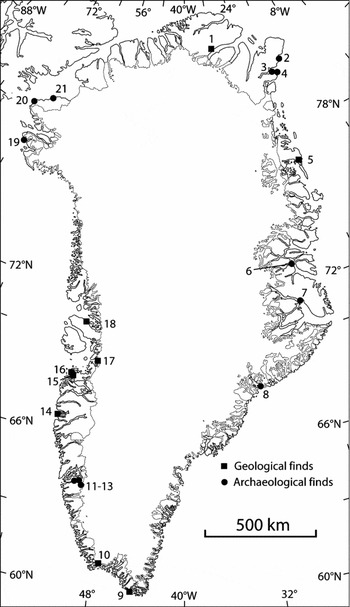
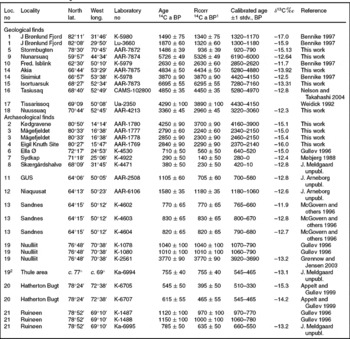
Here are presented some brief notes on selected finds. Unfortunately, little information is available about the context of the dated geological finds, but it is assumed that most of them were found on the surface of raised littoral or marine sediments. A list of the dates is presented in Table 1 and the locations of the dated finds appear in Fig. 1.
Map of Greenland showing the location of the dated finds presented in Table 1.

Radiocarbon age determinations of walrus remains from Greenland

1Sea water reservoir corrected dates, following Bennike (Reference Bennike1997). 2The exact locality is unknown, but the specimen comes from the Thule district.
AAR-7872 (location 5) is a skull fragment from the collections in the Zoological Museum of Copenhagen (ZMK 3/1987). The bone was collected by Knud Fischer in 1986 at Stormbugten near Danmarkshavn. The bone yielded an age of 920–790 calendar years BP. The specimen is the only geological find from northeast Greenland that has been dated, and the late Holocene age does not push back the history of the species in the region, because the oldest finds from archaeological sites are dated to around 4500–4000 calendar years BP (Andreasen Reference Andreasen and Gulløv2004: Table 1).
AAR-7874 (location 9: ZMK 2/1978) is a fragment of a lower jaw that was found by Adolph Dal in 1957 north of ‘Nunorsuik’ in south Greenland. The place name Nunorsuik is probably the same that is currently spelled Nunarsuaq. The find was dated to 6190–6000 calendar years BP.
AAR-7875 (location 14: ZMK 137/1989) is a fragment of a shinbone that was collected by Finn Erik Kramer in 1989 on the island of Akia south of Sisimiut. The bone yielded an age of 5280–4880 cal. years BP, and it is the second oldest walrus find from western Greenland.
AAR-7873 (location 15: ZMK 44/1960) is a fragment of a lower jaw that was collected by A. Schwærter before 1960 at Isortuarsuk south of Aasiat. The specimen gave an age of 7280–7160 cal. years BP, which is the oldest dated walrus remain from Greenland.
CAMS-102800 (location 16) is a date of a very large tusk that was found by the Greenlandic hunter Adam Glasen buried in sand and gravel layers in the early 1960s, north of Tasiusaq, about 5 km south of Aasiat. The length of the tusk is 49.5 cm, and it is dark brown and weathered. The tusk is privately owned (Nelson and Takahashi Reference Nelson and Takahashi2004).
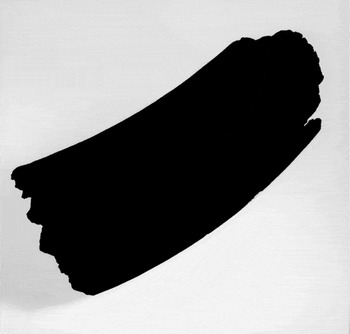
AAR-4213 (location 18) is a tusk fragment (Fig. 2) that was found in connection with the construction of the airstrip on northern Nuussuaq, at 10–15 m above sea level. The find is kept in the Uummannaq Museum in Greenland. The tusk was dated to 3220–3060 cal. years BP.
Tusk fragment of a walrus from Nuussuaq in west Greenland dated to 3030–3210 calendar years BP (AAR-4213). The tusk fragment represents a very large walrus tusk, with a diameter of 8.5 cm. Only the part that was hidden within the skull is preserved.

The δ13C values range between −17.0 and −11.7‰ on the PDB scale. These are normal values for bone collagen of marine mammals (Schoeninger and others Reference Schoeninger, DeNiro and Tauber1983).
Discussion
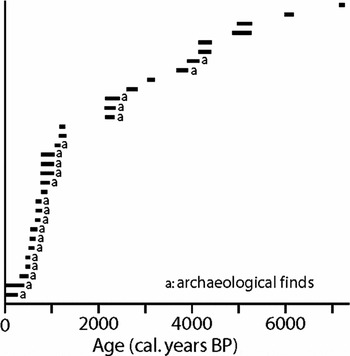
The dated walrus remains come from a large part of Greenland. However, there are no records of live or fossil walruses from central north Greenland, which is characterised by perennial sea ice (Bennike and others Reference Bennike, Higgins and Kelly1989). In contrast, a rather large walrus population is found in northwest Greenland, where the animal is a main prey for the local people (Born and others Reference Born, Heide Jørgensen and Davis1994). In the summer, some walrus occur as far north as southwest Washington Land. Walrus remains are common at archaeological sites in northwest Greenland (Gulløv Reference Gulløv2004), and some of these finds have been dated (Table 1, Fig. 3). In east Greenland, the species is found up to Nordostrundingen, where Nordøstvandet (the northeast water) is an important wintering polynya (Born and others Reference Born, Dietz, Heide Jørgensen and Knutsen1997).
Temporal distribution of dated walrus finds from Greenland. (Source: Table 1)

Four of the dated finds come from archaeological sites adjacent to Nordøstvandet. One of these gave an Independence I age (K-2561), and two of them gave ages corresponding to the Greenlandic Dorset (K-1078, K-1080); earlier called Independence II (Table 1). Two finds from Jørgen Brønlund Fjord (K-5980, Lu-3660) are outside the normal range of the walrus, but the species may probably stray this far north in summers with little sea ice.
Two of the dated geological finds come from south Greenland, where the species is today only a rare straggler (Born and others Reference Born, Heide Jørgensen and Davis1994). Sea ice is transported to south Greenland from the Arctic Ocean by the East Greenland Current, and pack ice is usually present in south Greenland in the spring and early summer. The finds indicate that south Greenland supported a walrus population in the mid to late Holocene, which could reflect that a large population was found in the Gulf of St Lawrence into historic times, until extirpated by sports hunting (Dyke and others Reference Dyke, Hooper, Harington and Savelle1999).
Little information is available about the context of the dated geological finds. One specimen comes from a gravel pit, and another specimen was found buried in sediments below the marine limit.
Three of the ten dated geological finds represent tusk fragments, which are the most common walrus remains reported from Arctic Canada. The other finds are fragments of lower jaws or of limb bones.
The earliest age determination on walrus remains is on a specimen from central west Greenland. It gave an age of 7280–7160 calendar years BP (AAR-7873).
A large number of walrus finds from Arctic Canada have been dated, and several of them gave early Holocene ages. These specimens represent animals that arrived shortly after the last deglaciation. We have no early Holocene dated finds from Greenland so far, but an early Holocene arrival at least to west Greenland would seen likely, because the west Greenland population is linked with the population in eastern Canadian Arctic, and because a rich fauna of marine bivalves was established shortly after the last deglaciation in the early Holocene (Bennike and Björck Reference Bennike and Björck2002).
The situation in eastern Greenland might be different, because this population may be connected with the walrus stocks in Svalbard and northern Russia. The authors are only aware of a few dated fossil finds of walrus from the latter regions. Three walrus skeletons, found at high elevation sites on Svalbard were dated to the late Holocene, and represent animals that wandered inland (Lauritsen and others Reference Lauritsen, Salvigsen and Winsnes1980; Dyke and others Reference Dyke, Hooper, Harington and Savelle1999).
All the different cultures that have inhabited Greenland have hunted walrus, as testified by walrus remains from ruins from Independence I, Saqqaq, Greenlandic Dorset, Late Dorset, Thule and Norse (Gulløv Reference Gulløv2004). It is interesting to note that Independence I ruins at the Eigil Knuth Site at Nordøstvandet are fairly rich in walrus bones (Gulløv Reference Gulløv, Grønnow and Pind2004). In Canada, there is little evidence to suggest that early Palaeoeskimos hunted walrus (Dyke and others Reference Dyke, Hooper, Harington and Savelle1999).
The Late Dorset people that inhabited northwest Greenland between 1300 and 700 calendar years BP specialised in walrus hunting. Also the Thule people hunted walrus eagerly in the Nordvandet (north water) polynya off the Thule area and Inglefield Land and in the Nordøstvandet polynya off northernmost east Greenland. The Thule Eskimo abandoned north and northeast Greenland about 400 to 200 years ago, probably due to declining mammal populations during the Little Ice Age. The effect of the Little Ice Age on walrus populations is unknown, but it may be speculated that more severe sea ice conditions led to declining walrus populations.
To the Norse people, walrus hide and walrus tusks were important trade items. Walrus were probably mainly hunted at the outer coast in the region south of Disko Bugt, but hunting expeditions were also undertaken farther north.
Most of the dated archaeological finds are bone or tusk fragments, but a few are artefacts made of walrus tusk. AAR-2508 is an age determination of a spike with Thule ornamentation and a Dorset-type bore hole, which was found in the Norse ruin the Farm Beneath the Sand (GUS) in the Western Settlement. It is depicted by Gulløv (Reference Gulløv, Grønnow and Pind2004: 317). Ka-6994 and Ka-6995 (also numbered AAR-4360 and AAR-4361) are age determinations of human figures referred to the Late Dorset. They are depicted by Gulløv (Reference Gulløv, Grønnow and Pind2004: 182) and by Holtved (Reference Holtved1944: 281, plate 40:2). The Late Dorset in Greenland ended at around AD 1300 according to Gulløv (Reference Gulløv, Grønnow and Pind2004), so the dates are somewhat younger than expected.
Conclusions
The dated specimens indicate that walrus has been a member of the west Greenland fauna continuously since circa 7200 calendar years BP. However, the number of dated non-archaeological specimens is too small to show when walrus first arrived in Greenland waters. We suggest that west Greenland waters were invaded shortly after the last deglaciation in the early Holocene. In east Greenland, the oldest known walrus remains are around 4500–4000 calendar years BP and come from archaeological sites.
Two south Greenland geological finds dated to 6190–6000 and 2850–2620 calendar years BP may indicate that walrus populated this part of Greenland in pre-historic time.
Acknowledgements
Kim Aaris-Sørensen, Jeppe Møhl and Knud Rosenlund kindly provided access to the collections of the Zoological Museum in Copenhagen, and took out samples for dating. The new radiocarbon age determinations were carried out under the supervision of Jan Heinemeier, Aarhus University, Denmark. Hans Christian Gulløv and Jette Arneborg kindly provided us with information about unpublished dates and gave us permission to include them in the date list.