1. Introduction
The relationship between environmental regulation and emission is a frequently debated topic among economics scholars. Most research addresses perfectly enforceable policy measures, but some papers also consider that firms have an incentive to circumvent the regulation, possibly with the support of corrupt officials. This study addresses this aspect of environmental policy, which should be highly relevant in many developing countries. In many of these countries, fighting corruption is high on the agenda. Despite significant efforts, curbing corruption is a long and tedious process. Even with a successful anti-corruption policy, the levels of corruption will often remain far above those levels of benchmark countries such as Denmark or Norway. Several influential studies (e.g., Koyuncu and Yilmaz, Reference Koyuncu and Yilmaz2009 or Oliva, Reference Oliva2015) have demonstrated that corruption is used to circumvent environmental regulation. This raises the question of how second-best policies should be designed that account for the current extent of corruption. For instance, how must environmental policy be adjusted when some firms can circumvent regulations with the help of corrupt officials? In particular, we examine the tradeoffs for a welfare-maximizing government that wants to set environmental standards but is hampered by corrupt officials who allow firms to emit beyond the permissible levels when they are paid a bribe.
We consider an industry where the production of goods causes environmental pollution, e.g., by emitting hazardous vapors in the air or by discharging poisonous liquids into the water. The government wants to curb the amount of pollution by regulating the maximum allowable emission level. Any emission exceeding the permissible level must be abated, and the producing firms must bear the cost. The permissible level of emission is determined endogenously by maximizing the level of welfare that incorporates profits in the industry, the costs of abatement and the environmental damages from pollution.
In a world with perfect monitoring and without corruption, a benevolent government would set the environmental standard so that the marginal environmental benefit from a tighter standard equaled the marginal foregone profits of the firms. If monitoring is incomplete and if the bureaucracy, which is supposed to monitor the firms’ abatement, is characterized by corruption, then the establishment of environmental standards becomes slightly more complicated. The environmental regulations offer firms an incentive to circumvent the costly abatement by bribing corrupt officials. Tighter regulations make conducting business legally more expensive, increasing the incentives to pay bribes.
In contrast to previous studies on corruption in environmental agencies, we not only consider a given set of firms but also allow for an endogenous entry of firms. This entry effect is important. In a world without corruption, the entry option allows the government to tighten regulation. This will force the marginal firm to leave the market without having to pay the higher abatement costs. Without the exit option, the marginal firm must bear the higher cost. Thus, from the government's perspective, the marginal social cost of abatement is lower when non-profitable firms can exit. However, with corruption, the effect of entry on optimal regulation is ambiguous. Corruption allows some firms to circumvent environmental regulation and therefore facilitates the market entry of polluting firms. From an environmental perspective, the additional entry should lead to a tighter environmental regulation. From a more comprehensive welfare perspective, corruption increases the costs of environmental protection. Corruption drives a wedge between the private and the social benefits of market entry. We show that the government may find it optimal to exchange some environmental protection for a marginally higher market entry if corruption is widespread. The model also illustrates that strong distributional concern where the government discounts bribe incomes in its welfare measure, ceteris paribus, leads to tighter regulation.
Our paper is closely related to three strands of the literature: (1) endogenous standard setting under incomplete compliance; (2) environmental policy and market entry; and (3) corruption.
First, we contribute to the literature on endogenous standard setting under incomplete compliance. A body of the literature on environmental regulation focuses on the incomplete compliance of firms. For instance, Harford (Reference Harford1978) discusses how firms react to tighter environmental standards and higher Pigouvian taxes when enforcement is imperfect. A comparable exercise for tradable discharge permits is conducted by Malik (Reference Malik1990) and Van Egteren and Weber (Reference Van Egteren and Weber1996). Keeler (Reference Keeler1991) extends Malik's analysis to a comparison of tradable permits and standards when regulatory authorities cannot enforce full compliance. Malik (Reference Malik2002) demonstrates that some non-compliance may even be socially optimal as it can partially offset the distortions caused by market power in the market for tradable permits. In these papers, the environmental policy of the government is exogenous in the sense that the government does not strategically adjust the environmental policy to potential non-compliant behavior. Some (more recent) studies, therefore, endogenize environmental policy and attempt to provide guidance to a policy maker who must design monitoring and enforcement policies. Stranlund and Dhanda (Reference Stranlund and Dhanda1999) analyze the optimal allocation of resources on monitoring and enforcement in a system of tradable permits with incomplete enforcement. The design of optimal standards and penalties in a principal-agent framework is discussed by Arguedas (Reference Arguedas2008). Arguedas and Rousseau (Reference Arguedas and Rousseau2015) introduce a hierarchical setting where national and local environmental agencies differ with respect to their objective functions and the available information about the compliance costs of local firms. In our model, the central government sets a uniform emission standard, the local agencies are in charge of enforcement, and the single firm decides on whether to comply with the regulation. When setting the uniform emission standard, the government takes into account the firms’ and the local agencies’ reaction to this standard.Footnote 1
Secondly, a key feature of our model of environmental regulation is the market entry or exit of firms. A number of papers have addressed the question of optimal Pigouvian taxes when market entry is endogenous and the market equilibrium is determined in Cournot competition. The endogeneity of market entry may force the regulator to set a Pigouvian tax above the marginal external damage (Katsoulacos and Xepapadeas, Reference Katsoulacos and Xepapadeas1995). Lee (Reference Lee1999) shows that this rule has to be modified when demand is non-linear. Depending on the curvature of market demand, the pollution tax may be higher or lower than the marginal external damage. Instead of environmental taxation, we focus on environmental standards as the tool for the regulator.
The third relevant strand of literature concerns corruption in environmental agencies or other monitoring bodies.Footnote 2 When a firm tries to circumvent environmental regulations, it faces the risk of detection and subsequent punishment. If some of the monitoring officials are corrupt, firms may choose to avoid punishment by paying a bribe. Both the compliance behavior of the firm and the bribes of the official will react to changes in environmental policy and thus make the implementation of an optimal regulation more challenging. Few research papers have combined enforcement and corruption in environmental regulation. Ivanova Reference Ivanova2011 distinguishes between actual and reported emissions when auditors are corrupt. An increase in the effectiveness of auditing (or a reduction in corruption) reduces total emissions but has an ambiguous effect on reported emissions. Her model also discusses the optimal Pigouvian tax rate of a welfare-maximizing government, but the government's tradeoff between tax revenues, environmental damages and auditing costs is only briefly addressed. Polinsky and Shavell Reference Polinsky and Shavell2001, who do not address environmental policy specifically, distinguish between bribery and extortion. Corrupt officials are not only paid for their support in circumventing regulation but can also threaten innocent people in order to extort money from them. Polinsky and Shavell derive the optimal penalty structure for the different types of corruption. Several empirical studies address the direct and indirect effects of corruption on pollution (Welsch, Reference Welsch2004; Cole, Reference Cole2007; Biswas et al., Reference Biswas, Farzanegan and Thum2012). Corruption can increase pollution directly by allowing firms to ignore regulations or by forcing them into the unregulated shadow economy. However, corruption may also have an indirect negative effect as it reduces overall economic activity.Footnote 3 Hubbard (Reference Hubbard1998) and Oliva (Reference Oliva2015) study the licensing of vehicle inspection centers and show that corruption significantly reduces the effectiveness of vehicular emission controls. Deforestation as a consequence of corruption is analyzed by Koyuncu and Yilmaz (Reference Koyuncu and Yilmaz2009) in a cross-country study.
The studies most similar to our approach are Damania (Reference Damania2002) and Stathopoulou and Varvarigos (Reference Stathopoulou and Varvarigos2013). Damania analyzes the implications of corruption for the design of a welfare-maximizing environmental policy. His focus is primarily on the design of prosecution rates, monitoring and fines; we, on the other hand, are interested in the interaction of regulation, corruption and market entry. Stathopoulou and Varvarigos endogenize the market entry of firms and stress that there are multiple equilibria where pollution and corruption can be either high or low. In contrast to our paper, they focus on the equilibrium outcome and do not consider the welfare-maximizing policy choices of the government.
2. A simple model of corruption and environmental regulation
We employ a simple model to analyze the effect of corruption on optimal environmental standards. Each firm in the market earns a revenue, P, which is independent of the number of market entrants.Footnote
4
To enter the market, a firm must bear the fixed cost of entry, K. In the absence of regulation, each firm would generate an emission level,
 $\bar e$
. The government sets the environmental standards, which permit a maximum emission level of
 $\underline{e} (\underline{e}\le \bar{e}$
). Firms are supposed to abate the excessive emissions,
 $\bar{e}-\underline{e}$
, which is costly. The costs are linear in abatement, and firms differ in terms of the cost parameter. The abatement cost is denoted by
 $c\cdot (\bar{e}-\underline{e})$
. We assume that cost parameter c is uniformly distributed on interval
 $c\in [0,\bar{c}]$
. Some firms can meet the government regulation at almost no cost, whereas others will face high abatement costs. Because all firms have the same revenue and the same cost of entry, the abatement cost will ultimately drive their decisions as to whether to enter the market.
In contrast to the firms, which are interested only in their profits, the government must also account for the environmental damages from pollution. The government sets emission standard
 $\underline{e}$
to maximize society's welfare. Let E denote the total level of emissions, which is simply the sum of emissions from all firms, and D(E) is the damage from pollution. We assume that the damage is a convex function of emissions, E, i.e., D′, D″≥0 and
 $D(0) = D'(0) = 0$
.
The regulatory decision is hampered by the fact that some of the bureaucrats responsible for monitoring the firms’ abatement are dishonest.Footnote 5 These firms have the option to disregard the regulatory requirement in exchange for a bribe, b. For firms with high abatement costs, bribing the corrupt official will be more attractive than adjusting pollution levels. Corrupt officials know the distribution of abatement costs but cannot observe the abatement cost of the individual firm. Hence, the (representative) corrupt official must establish a uniform bribe, b, that maximizes his own profit.Footnote 6 The share of corrupt officials is denoted by ρ.Footnote 7
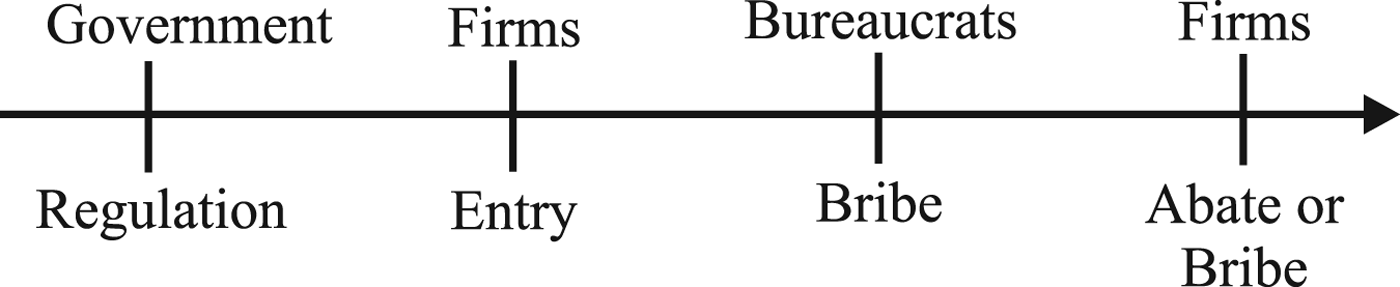
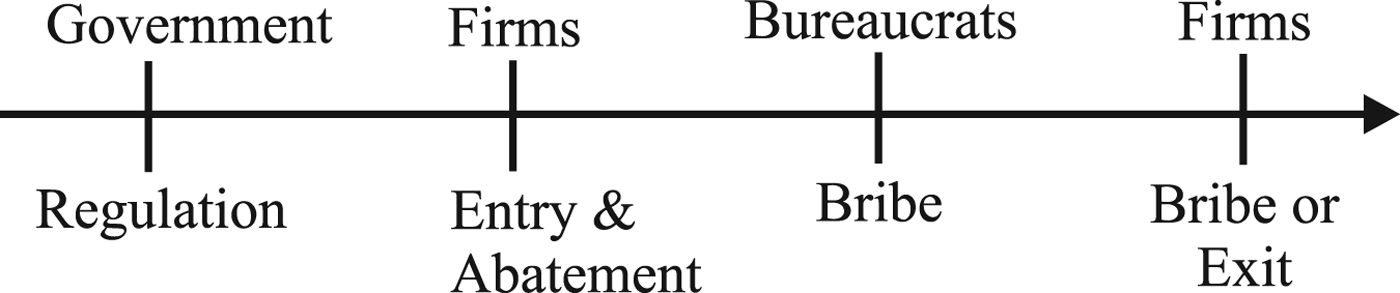
The game has four stages (see figure 1). In stage 1, the government sets the allowable emission level. Then, the firms decide about market entry (stage 2). In stage 3, the corrupt official sets the cost of the profit-maximizing bribe. This sequence of moves reflects the long-term nature of market entry. The corrupt official will be able to condition the bribe demand on market entry, but he cannot make a credible commitment to a certain bribe level before entry has occurred. In stage 4, firms that have encountered a corrupt official decide whether to pay the bribe or abate. All firms meeting an honest official must comply with the environmental regulation and incur the abatement costs. By the end, all payoffs are realized. As usual, we solve the game using the backward induction method.
Sequence of moves

2.1. Abatement versus bribe
When a firm meets a corrupt official, it has a choice between paying the bribe and abating. A profit-maximizing firm chooses the alternative with the lowest costs. The cost of abatement is
 $c\cdot (\bar{e}-\underline{e})$
, and the bribe amounts to b. Therefore, the marginal firm that is indifferent about bribing or abating has a cost parameter of
 $$c_{AB} = {{b}\over{(\bar{e}-\underline{e})}}.$$
All firms with abatement costs c∈(0, c
AB
) will go for the abatement. The bribe is preferred by firms with costs
 $c\in (c_{AB},\hat{c})$
, where ĉ denotes the highest abatement costs among all firms that have entered the market.
2.2. Profit-maximizing bribe
Each corrupt official is assigned to a random sample of firms. Therefore, each corrupt official faces the same distribution of abatement costs as the entire population of firms in the market. We assume that firms cannot switch to another monitoring official. Thus, a corrupt official acts as a monopolist when setting the profit-maximizing bribe. We analyze the decision problem of a representative bureaucrat. The total bribe revenue amounts to
 $$B=b\cdot {{\hat{c}-c_{AB}}\over{\bar{c}}}.$$
 $1/\bar{c}$
is the density of abatement costs, and
 $(\hat{c}-c_{AB})/\bar{c}$
is the proportion of firms willing to pay bribe b. Using (1) and taking the derivative of the bribe revenue with respect to b, we obtain the profit-maximizing bribe
 $$b^\ast ={{\hat{c}}\over{2}}(\bar{e}-\underline{e}).$$
Equations (1) and (3) imply that the marginal firm that is indifferent between abating and bribing has a cost parameter of
 $c_{AB}^{\ast} = {{\hat{c}}\over{2}}$
. Therefore, among all firms entering the market, exactly half will abate, and the other half of the same industry will not comply and will pay the bribe. This simple rule is due to our assumption of a uniform distribution. However, our main point is independent of this specific assumption and also holds for a general distribution of cost types: the endogenous choice of bribe payments will always allow some firms to circumvent the environmental regulation.
2.3. Market entry
Now we turn to the firms’ entry decision. Before entering the market, each firm knows that it will meet a corrupt bureaucrat with probability ρ, the proportion of dishonest officials. When meeting a corrupt official, a firm can choose between bribing and complying. It will choose whatever minimizes its cost. Therefore, the expected profit from market entry amounts to
 $$E\pi = P-K-\lsqb \rho \cdot \min \lsqb b^\ast,c\lpar \bar{e}-\underline{e}\rpar \rsqb + (1-\rho)c\lpar \bar{e}-\underline{e}\rpar \rsqb .$$
Solving for the marginal firm is slightly complicated by the fact that market entry depends on the bribe, and the bribe depends on marginal firm ĉ. According to the results from the previous section, marginal firm ĉ will always prefer to pay the bribe. In equilibrium, the marginal firm with cost ĉ anticipates future bribe b* and earns an expected profit of zero
 $[E\pi (\hat{c})=0]$
. Solving for ĉ yields
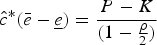
 $$\hat{c}^* = {{P-K}\over{\left(1 -{{\rho}\over{2}}\right)\lpar \bar{e}-\underline{e}\rpar }}.$$
If market entry pays off for the marginal firm with cost ĉ*, it will be profitable for the infra-marginal firms
 $c<\hat{c}^{\ast}$
a fortiori.Footnote
8
The equilibrium bribe amounts to
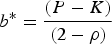 $b^{\ast} ={{(P-K)}\over{(2-\rho)}}$
. All firms with abatement costs
 $c\in [0,\hat{c}^{\ast}]$
enter the market. When confronted with a corrupt official, those with costs
 $c\in \left[0,{{\hat{c}^{\ast}}\over{2}} \right]$
prefer to abate; all other firms
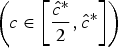 $\left(c\in \left[{{\hat{c}^{\ast}}\over{2}},\hat{c}^{\ast}\right]\right)$
pay the bribe and pollute.
The comparative statics with regard to the share of corrupt officials lead to our first result.
Proposition 1
An increase in the share of corrupt officials: (a) induces more firms to enter the market; (b) drives up the bribe rate; and, therefore, (c) increases the number of abating firms.
Proof: Taking the derivatives with respect to the share of corrupt officials ρ immediately yields
 ${{\partial \hat{c}^*}\over{\partial\rho}} = {{2(P-K)}\over{(\bar{e}-\underline{e})(2-\rho)^{2}}} \gt 0, {{\partial c_{AB}^{\ast}}\over{\partial \rho}} \gt 0$
and
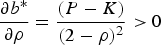 ${{\partial b^{\ast}}\over{\partial\rho}} = {{(P-K)}\over{(2-\rho)^{2}}} \gt 0$
. □
When the number of corrupt officials increases, this change facilitates the market entry of high-cost firms. As the chances increase that they can produce without any abatement by paying a bribe, market entry becomes more attractive. This market-entry effect is straightforward. The change in the bribe and the division into bribing and abating firms are less straightforward. The additional entry brings in firms that have high abatement costs and, therefore, have a high willingness to pay for circumventing the regulation. This makes it profitable for the corrupt official to increase the bribe slightly. Those firms that were previously indifferent between bribing and abating will now prefer to comply with the regulations. However, the additional bribe revenue from the firms with a high willingness to pay overcompensates the losses from those firms shifting to abatement.
Let us briefly note the effects of changes in the regulation on market entry because this idea will be an important channel in the subsequent analysis. The government determines the level of permissible emissions, e. An increase in e implies a more lenient environmental regulation. Taking the derivative of (5) with respect to e yields
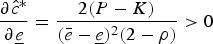 ${{\partial \hat{c}^{\ast}}\over{\partial\underline{e}}} = {{2(P-K)}\over{(\bar{e}-\underline{e})^{2} (2-\rho)}} \gt 0$
. Unsurprisingly, a more lenient regulation lowers the firms’ costs and leads to more market entry. Due to two countervailing effects, the bribe is not affected by changes in the regulation
 $\left({{\partial b^{\ast}}\over{\partial \underline{e}}}=0\right)$
. On the one hand, a more lenient regulation per se reduces the willingness to pay for circumventing the regulation (see equation (3)). On the other hand, however, the more lenient regulation also brings in additional firms with high abatement costs, which raises the bribe demand, ceteris paribus. As equations (3) and (5) show, these two effects offset one another. Hence, the lower costs also induce some firms to shift from bribing to abatement
 $\left({{\partial c_{AB}^{\ast} }\over{\partial \underline{e}}}>0 \right)$
.Footnote
9
Thus, a more lenient regulation leads not only to more (polluting) firms in the market but also to a shift towards cleaner production for some firms.
2.4. Environmental quality
Before turning to the welfare analysis, we will first discuss the effect of corruption on environmental quality. Put differently, we ask how a government that wants to achieve a certain environmental quality must adjust the environmental regulation when corruption increases.
First, we calculate the total emissions for a given environmental regulation. The emission level depends on the abatement cost. Firms whose costs are given by
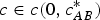 $c \in c(0,c_{AB}^{\ast})$
will comply with the governmental emission regulation and hence emit the permitted level of emissions, e. Share ρ of the firms with cost structure
 $c \in c(c_{AB}^{\ast},\hat{c}^{\ast})$
, however, will not comply, pay the bribe and emit an amount of
 $\bar{e}$
. Therefore, total emissions amount to
 $$E = {{1}\over{\bar{c}}}\cdot \left[c_{AB}^\ast \underline{e} + \rho \lpar \hat{c}^\ast - c_{AB}^\ast \rpar \bar{e} + \big(1-\rho\big)\lpar \hat{c}^\ast - c_{AB}^\ast\rpar \underline{e}\right].$$
Using (5), this can be simplified to
 $$E = {{1}\over{\bar{c}}}\cdot {{P-K}\over{1-{{\rho}\over{2}}}}\left[{{\underline{e}}\over{\bar{e}-\underline{e}}} +{{\rho }\over{2}}\right].$$
An increase in the share of corrupt officials leads to higher emissions
 $\left({{\partial E}\over{\partial \rho}}>0\right)$
for two reasons: first, a larger share of firms meets corrupt officials and can avoid any type of abatement; and secondly, the increase in corruption makes the entry of polluting firms more attractive at the margin
 $\left({{\partial \hat{c}^{\ast}}\over{\partial \rho}}\gt 0\right)$
.
A government that wants to keep total emissions, E, constant must react with tighter regulations when corruption increases. The total differentiation of (7) yields
 $$\left.{d \underline{e} \over d\rho}\right\vert_{E}= -{\bar{e}-\underline{e} \over 2-\rho} \lt 0.$$
Corruption allows some firms to circumvent the regulation. Without countermeasures, pollution will go up. The government can offset the effect by forcing the complying firms to abate more. We have introduced this intermediate step to contrast the environmentalist view with the welfare aspect. The optimal reaction of the government is not so obvious when we take welfare maximization as a government objective and allow for endogenous market entry.
2.5. Regulation and welfare
Here, we introduce the government's optimization problem. We focus on a benevolent government that wants to maximize social welfare. Welfare is defined as the sum of all profits generated by the firms minus the environmental damages from emissions
 $D\lpar E \rpar $
. It is not straightforward as to how a benevolent government takes into account bribe payments in its welfare considerations. If the government is only interested in total rents and does not care about the distribution of rents or the source of income, bribe payments will not show up in the welfare function. Here, bribes are simply a transfer from the non-complying firms to the corrupt officials. The government suffers from corruption because it affects entry and environmental damages but not from the illegal activity per se. However, the government may very well care about the distributional dimension. The income from bribes may be less valuable in terms of welfare than entrepreneurial income. To allow for both types of welfare functions, we subtract share δ of bribe income from welfare. For δ=0, the government shows no distributional concerns and is interested only in maximizing total rents. For δ=1, all illegally received income from corruption is lost in terms of welfare. Welfare (W) can be written as
 $$\eqalign{W &= \int_0^{c_{AB}^\ast} {{1}\over{\bar{c}}}\lpar P-K-c\lpar \bar{e}-\underline{e}\rpar \rpar dc \cr & \quad + \int_{c_{AB}^\ast}^{\hat{c}^\ast}{{1}\over{\bar{c}}}\lpar P-K-\big(1-\rho\big) c\big(\bar{e}-\underline{e}\big)\rpar dc - D(E) - \delta \cdot B,}$$
where B denotes the income from bribes.
 $$B \equiv \rho\cdot b^\ast\cdot {{\hat{c}^\ast}\over{2{\cdot}\bar{c}}} = {{\rho{\cdot}(P-K)^2}\over{4{\cdot}\bar{c}{\cdot}\left(1 - {{\rho }\over{2}}\right)^2 \cdot \lpar \bar{e}-\underline{e}\rpar }}.$$
Note that the income from bribes decreases with tightness of regulation
 $\lpar \bar{e}-\underline{e}\rpar $
and increases with the share of corrupt officials ρ. We can rewrite the welfare in (9) as
 $$\eqalign{W &= {{1}\over{\bar{c}}}\left\{(P-K)\hat{c}^\ast - {{\hat{c}^{\ast 2}}\over{2}}\lpar \bar{e}-\underline{e}\rpar \left[1-{{3\rho}\over{4}}\right]\right\}\cr & \quad - D\left({{\hat{c}^\ast}\over{\bar{c}}}\cdot \left\{\underline{e}+ {{\rho }\over{2}}\lpar \bar{e}-\underline{e}\rpar \right\}\right) - \delta \cdot \rho \cdot {{\hat{c}^{\ast2}}\over{4{\cdot}\bar{c}}}\cdot \lpar \bar{e}-\underline{e}\rpar }$$
where P−K is the output per firm; the second term captures the abatement costs, the third term describes the environmental damages, and the fourth term measures the welfare costs when income flows to corrupt officials. For didactic purposes, we first analyze the case with fixed market entry, i.e., with a given ĉ*, before we turn to the case of endogenous market entry.
2.5.1. Fixed market entry
Suppose that the government decides on the restrictiveness of the regulation when market-entry decisions have already been made. All firms with abatement costs
 $c\le \hat{c}^{\ast}$
have entered the market. Taking the derivative with respect to the permissible emission level e yields
 $$\left.{{\partial W}\over{\partial \underline{e}}}\right\vert_{\hat{c}^\ast} = {{1}\over{\bar{c}}}{{\hat{c}^{\ast 2}}\over{2}}\left[1 - {{3\rho}\over{4}}\right] - D'(E)\cdot {{\hat{c}^\ast}\over{\bar{c}}}\cdot \left(1-{{\rho}\over{2}}\right) + \delta\cdot \rho\cdot {{\hat{c}^{\ast 2}}\over{4{\cdot}\bar{c}}} = 0$$
When distributional issues are irrelevant for welfare (δ=0), the welfare-maximizing regulation
 $\underline{e}^{\ast}$
is characterized by equalizing marginal abatement costs and marginal environmental damages. If redistribution towards corrupt officials is considered as detrimental to welfare (δ>0), a slight easing of environmental regulation has the additional benefit of reducing bribe incomes; this effect is captured by the third term in (11). We are now interested in how optimal regulation changes when corruption increases:
 $$\left.{{d\underline{e}^\ast}\over{d\rho}}\right\vert_{\hat{c}^\ast} \matrix{ > \cr < }0 \Leftrightarrow {\partial \left(\left.{{\partial W}\over{\partial \underline{e}}}\right \vert_{\hat{c}^\ast}\right)\over {\partial \rho}} \matrix{ > \cr < }0.$$
Taking the derivative of (11) with respect to ρ and replacing D′(E) with the first-order condition yields
 $${\partial \left(\left.{{\partial W}\over{\partial \underline{e}}}\right \vert_{\hat{c}^\ast}\right)\over {\partial \rho}}= - {{\hat{c}^{\ast2}\over{4}}}{{1-2\delta}\over{2-\rho}}-D''{{\hat{c}^{\ast 2}\over{2\bar{c}}}} \lpar \bar{e}-\underline{e}\rpar \left(1-{{\rho }\over{2}}\right).$$
If distributional concerns are not too strong (δ<1/2), the government will tighten the regulations when corruption increases, i.e., expression (13) is negative.Footnote 10 The logic is straightforward. If the share of corrupt officials increases, more firms can circumvent environmental regulations. For a given number of firms, pollution increases. Therefore, the increase in the marginal environmental damage makes it optimal for the government to choose a lower permissible emission level. Firms adhering to environmental regulations pay the price of increased corruption.
2.5.2. Endogenous market entry
In the next step, we consider that the environmental regulations also affect the number of firms entering the market. If the government chooses a more lenient environmental regulation, more firms will enter the market
 $\left({\partial\hat{c}^{\ast}\over{\partial \underline{e}}} > 0\right)$
. The welfare-maximizing environmental regulation is now implicitly given by
 $$\eqalign{{{\partial W}\over{\partial \underline{e}}} &= {{1}\over{\bar{c}}}\cdot \left\{(P-K)-\hat{c}^\ast \cdot \lpar \bar{e}-\underline{e}\rpar \cdot \left(1-{{3}\over{4}}\rho \right) - D'(E)\cdot \left(\underline{e}+{{\rho }\over{2}}\lpar \bar{e}-\underline{e}\rpar \right)\right.\cr & \quad \left. \left. -\delta \cdot \rho \cdot {{\hat{c}^\ast}\over{2}}\cdot \lpar \bar{e}-\underline{e}\rpar \right\} \cdot {{\partial\hat{c}^\ast}\over{\partial \underline{e}}} + {{\partial W}\over{\partial \underline{e}}}\right\vert_{\hat{c}^\ast} = 0.}$$
To understand how the market-entry effect changes the environmental policy, we analyze the marginal welfare change at the permissible pollution,
 $\underline{e}^{\ast}$
, that was optimal for a given market entry for firms (see equation (11)), as
 $\left.{{\partial W}\over{\partial \underline{e}}}\right\vert_{\hat{c}^{\ast}}=0$
by definition. Because the welfare function (10) is concave in e at the optimum, the sign of the term in curly brackets indicates whether the entry effect leads to a tougher or more lenient regulatory policy. If the term in brackets is positive, then a small increase in e will improve welfare. Substituting D′(E) from the first-order condition (11) and using
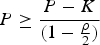
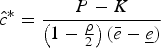 $\hat{c}^{\ast} = {{P-K}\over{\left(1-{{\rho }\over{2}}\right)\lpar \bar{e}-\underline{e}\rpar }}$
yields (after some simplifications):
 $$\eqalign{{{\partial W}\over{\partial \underline{e}}}\lpar \underline{e}^\ast\rpar &= {{1}\over{\bar{c}}}\cdot {{P-K}\over 2{\cdot}\left(1-{{\rho }\over{2}}\right)}\left\{ 1-{{\rho}\over{4}}-{{\bar{e}}\over{\bar{e}-\underline{e}}}\cdot {{1-{{3}\over{4}}\rho}\over{1-{{\rho}\over{2}}}} \right. \cr & \quad \left. - \delta \cdot {{\rho }\over{2}}\cdot \left(1+{{\bar{e}}\over{\bar{e}-\underline{e}}}\cdot {{1}\over {1-{{\rho}\over{2}}}}\right)\right\}\cdot {{\partial \hat{c}^\ast}\over{\partial \underline{e}}}.}$$
In a world without corruption (ρ=0), we can clearly sign the entry effect.
Proposition 2
Without corruption, market entry makes a tighter environmental regulation optimal (compared to the case without market entry).
Proof For ρ=0, equation (15) simplifies to
 ${{\partial W}\over{\partial \underline{e}}}\lpar \underline{e}^{\ast}\rpar = {{1}\over{\bar{c}}}\cdot {{P-K}\over{2}}\left\{-{{\underline{e}}\over{\bar{e}-\underline{e}}}\right\}\cdot {{\partial \hat{c}^{\ast}}\over{\partial \underline{e}}}$
. Because the term in curly brackets is negative and
 ${{\partial \hat{c}^{\ast}}\over{\partial\underline{e}}}>0$
, we obtain
 ${{\partial W}\over{\partial \underline{e}}}(\underline{e}^{\ast})<0$
. At the optimal environmental regulation without entry (
 $\underline{e}^{\ast})$
, the marginal effect on welfare is negative. Therefore, having a tighter regulation is optimal when market entry becomes endogenous. □
The following logic applies for this result: when the government tightens regulations (i.e., lowers e), the marginal firm will leave the market without having to pay the higher abatement costs. However, without the exit option, the marginal firm must bear the higher cost. Thus, from the government's perspective, the marginal social cost of abatement is lower when non-profitable firms can exit. This effect makes it optimal for the government to choose a tighter regulation in case of endogenous entry. A similar result has been found in oligopolistic markets. Katsoulacos and Xepapadeas (Reference Katsoulacos and Xepapadeas1995) show that the optimal tax can exceed the marginal environmental damage when market structure is endogenous. Compared to the case with a fixed number of firms, environmental policy is stricter with endogenous market entry.Footnote 11
How does corruption influence this entry effect? We analyze the welfare effect of a marginal increase of e for ρ>0. Our reference point is still the optimal regulation
 $\underline{e}^{\ast}$
that would have been chosen with exogenous market entry.
Proposition 3
With corruption, market entry has an ambiguous effect on optimal environmental regulation (compared to the case of without market entry). For high levels of corruption, market entry can force the government to choose an even more lenient environmental policy if distributional issues are a minor concern. Distributional considerations make the tightening of environmental policy more likely.
Proof: The inspection of equation (15) immediately indicates that the curly bracket cannot be signed unambiguously. For ρ→0, the term in curly brackets in (15) is negative; the entry effect leads to a tighter regulation. With (a) no distributional concerns (δ = 0), the term in curly brackets is increasing in
 $\rho:{{\partial}\over{\partial \rho}} = {{1}\over{4}}\cdot \left({{\bar{e}}\over{\bar{e}-\underline{e}}}\cdot {{1}\over{\left(1-{{\rho}\over{2}}\right)^{2}}}-1\right) > 0$
. Therefore, the term may become positive for a sufficiently large ρ; the entry effect can lead to a more lenient regulation when corruption is widespread. (b) Distributional concerns (δ>0) have a countervailing effect:
 ${{\partial}\over{\partial \rho}} = {{1}\over{4}}\cdot \left({\bar{e}\over \lpar \bar{e}-\underline{e}\rpar } \cdot {1 \over \left(1-{\rho \over 2 }\right)^{2}}- 1 \right) - {\delta \over{2}}\cdot \left({\bar{e}\over \lpar \bar{e}-\underline{e}\rpar } \cdot {1 \over \left(1-{\rho \over 2 }\right)^{2}}+ 1 \right)$
Strong distributional concerns make it more likely that the government will tighten the environmental regulation.
For a better understanding of the mechanism at work, we focus on the case δ=0: corruption facilitates the market entry of polluting firms, thus making a tighter regulation worthwhile. Conversely, an increasing share of corrupt officials also drives up the bribe rate (see proposition 1), which leads to an increasing divergence between the expected private and social costs of market entry. Bribes are private costs, but for δ=0, they are pure transfers from non-abating firms to corrupt officials from a social perspective. With an environmental regulation that equates marginal abatement costs and marginal environmental damages for a given number of firms (see equation (11)), entry may be too low from a social perspective. Therefore, the government may prefer a more lenient policy.
Proposition 3 demonstrates that the tradeoff for a welfare-maximizing government may change when corruption is a factor. From an environmental perspective, an increase in corruption should always lead to a tighter environmental regulation. The situation may be different from a welfare perspective. Protecting the environment becomes costlier due to corruption. Corruption drives a wedge between the private and the social benefits of market entry. Thus, when corruption increases, it becomes optimal for the government to exchange some environmental protection for a marginally higher market entry.Footnote 12 This result can be achieved by relaxing the regulatory requirements.
This mechanism may also help explain why many developing countries seem to focus more on growth and market entry rather than on environmental protection.Footnote 13 From the perspective of a corruption-free society, this policy choice might seem suboptimal. However, in a society where corruption is prevalent, a welfare-maximizing government might find it worthwhile to relinquish the rather futile efforts of environmental protection and focus instead on expanding productive (but environmentally destructive) activities.
3. Possible extensions of the model
We now turn to alternative variants and extensions of the model. First, we discuss a variant of the model where entry occurs before the decision on environmental regulation. Then we turn to the question of how our findings are affected when the decision on abatement has to be made before inspections are made.
3.1. Alternative scenario I: entry before choice of regulation
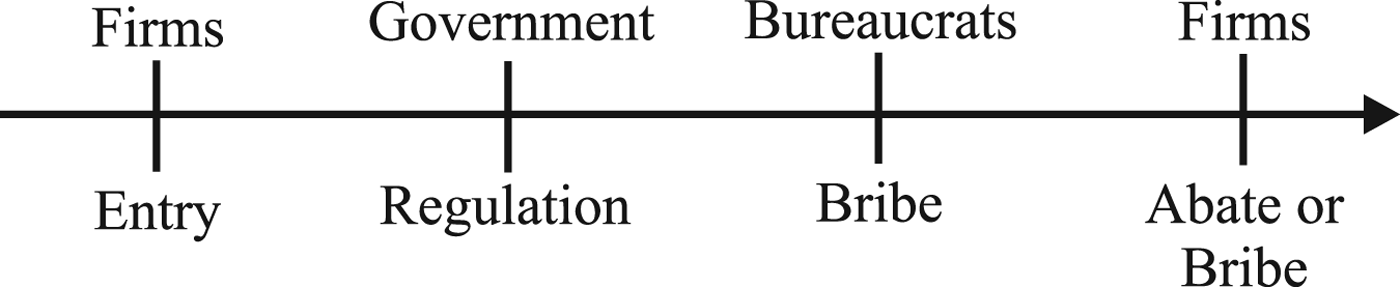
Suppose that the government decides on the tightness of environmental regulation after firms have made their entry decision. This alternative sequence of moves may reflect the long-term nature of market entry and the ability of the government to react to this market entry. The alternative sequence of moves is depicted in figure 2.
Sequence of moves in Alternative scenario I

Because the last two stages are identical to our baseline model, the outcomes must also be the same. The critical cost where a firm is indifferent between abatement and bribe is given by (1), and the profit-maximizing bribe is described by (3). In stage 2, the government maximizes welfare (9), where environmental quality is defined in (6). The only difference is that entry ĉ* is given for the government and is no longer a function of environmental regulation. Taking the derivative of (9) with regard to environmental regulation e yields, after some simplifications,
 $${\partial W \over \partial \underline{e}} = {{1}\over{\bar{c}}} {{\hat{c}^{\ast 2}}\over{2}} \left[1 - {{3\rho}\over{4}}\right] - D'(E)\cdot {{\hat{c}^\ast}\over{\bar{c}}} \cdot \left(1-{\rho \over{2}}\right) + \delta \cdot \rho \cdot {\hat{c}^\ast\over{4{\cdot}\bar{c}}} = 0.$$
Comparison of (11) and (11′ ) shows that the government chooses the same level of environmental regulation whether the firms decide on entry before or after regulation. Hence, what matters for our key results is that firms have a choice of entry but not the timing of choices. This neutrality result is clearly due to the atomistic firms and the uniform distribution of costs. Things would be different if firms could behave strategically, e.g., by investing at different levels.
3.2. Alternative scenario II: abatement decision before inspection
What happens when the firms have to make their abatement decision before any inspection takes place? In the baseline model, firms operated with abatement when monitored by an honest official and circumvented the regulation when cooperating with a corrupt official. Therefore, firms could adjust their abatement according to the orders of the supervisory agency. An alternative view is that firms make an abatement choice before any inspection takes place. This could be particularly relevant when firms make long-term technology choices when entering a market. Therefore, we assume in the following time sequence (see figure 3) that firms simultaneously decide on entry and abatement before the administration inspects the production site. A corrupt official who inspects a non-compliant firm will ask for a bribe. Non-compliant firms that are not willing to pay the bribe or that are monitored by honest officials are closed down; i.e., firms exit the market again.
Sequence of moves in Alternative scenario II

We briefly sketch the solution of this game. As the government's degree of control is crucial here, we assume that only a fraction γ of firms is monitored at all.Footnote
14
In stage 4, all non-compliant firms that are monitored by corrupt officials compare bribe b with benefit P of staying in the market. Hence, corrupt officials will extract all rents from these firms by charging b=P in stage 3. In stage 2, each firm has three options: stay out of the market, or enter with abatement (e) or without abatement (
 $\bar{e}$
). Entering with compliant abatement yields a profit of
 $E\pi_{A} =P-c\cdot \lpar \bar{e}-\underline{e}\rpar -K$
; the firm earns a revenue of P but has to shoulder abatement and entry costs. Because the firm violates no regulations, neither the probability of inspection nor the share of corrupt officials matters for the determination of profits. For firms that do not comply, the expected profit amounts to
 $E\pi_{0} =(1-\gamma)\cdot P+\gamma \cdot [\rho \cdot 0+(1-\rho)\cdot 0]-K=(1-\gamma)\cdot P-K$
. With probability (1−γ), firms are not inspected at all and earn P. Net earnings become zero. If the official is honest, the firm is forced to close down; if the official is corrupt, the entire revenue is transferred via bribe payments to the corrupt official. To focus on the interesting case, we assume that
 $(1-\gamma)\cdot P-K>0$
; i.e., the monitoring rate is sufficiently low that firms consider entering without sufficient abatement.Footnote
15
Comparison of Eπ
A
and Eπ0 immediately shows that all firms with abatement costs
 $c\le {{\gamma \cdot P}\over{(\bar{e}-\underline{e})}}$
prefer entering with a compliant strategy; all other firms take the risk of being detected and of having to exit the market. Obviously, corruption has no effect on entry in this scenario because corrupt and honest officials generate the same net revenue for detected firms. Of course, corruption is not neutral with regard to the distribution of rents or the level of total emissions. Whereas honest officials force non-compliant firms to exit the market, corrupt officials allow firms to continue production with high emissions.Footnote
16
If firms have to decide on abatement before being monitored, there is no feedback effect of corruption on market entry. Hence, the tradeoff between environmental quality and entry vanishes in this case.
4. Conclusion
We have developed a simple model to study the welfare-maximizing environmental regulation when market entry is endogenous and when firms can circumvent regulation by bribing corrupt officials. Corruption changes the tradeoff in environmental policy. Corruption leads a greater number of polluting firms to enter the market, which suggests a tighter environmental regulation. Conversely, corruption also makes it optimal for the government to exchange some environmental protection for a marginally higher market entry. This study also highlights the differences between the environmentalist view and the welfare perspective. From an environmental perspective, regulations must become tighter when corruption compromises the emission objectives. The law-abiding firms must meet higher environmental standards to compensate for the environmental damages caused by those firms that circumvent the regulation with the help of corrupt officials. From a welfare perspective, corruption increases the costs of environmental protection. Therefore, exchanging some environmental protection for market entry can be optimal. In other words, low environmental standards may not only be the outcome of a political process where interest groups and self-serving politicians take precedence over the public interest. Low environmental standards can also be a welfare-maximizing choice when the administrative monitoring of environmental standards is characterized by corruption.
Our model is admittedly simple, and several extensions are conceivable. First, one may want to generalize the distribution of abatement costs. Deviating from the assumption of a uniform distribution would introduce an additional mechanism for determining how corruption affects the allocation of abating and polluting firms. Secondly, we could introduce an informal or shadow economy parallel to the registered firms. In the present model, firms are registered but hide the actual emission amounts by bribing the monitors. In an alternative scenario, the shadow economy could serve as a costly exit option where polluting firms escape both the government regulation and the corrupt bureaucracy.