Introduction
Acute hospitalization is a dangerous event for the elderly, with deleterious consequences, including functional decline, institutionalization, and even mortality (Covinsky et al., Reference Covinsky, Pierluissi and Johnston2011; Zisberg et al., Reference Zisberg, Shadmi, Gur-Yaish, Tonkikh and Sinoff2015). Post-hospitalization is also recognized as a period of greater risk for falls, as the rate of falls a month after discharge is twice as high as that in the population not recently hospitalized (Mahoney et al., Reference Mahoney2000). Despite the greater likelihood of falls after acute hospitalization, they are rarely investigated and research still mostly focuses on hospitalization as an outcome of falls rather than as a predictor (Chu et al., Reference Chu, Chiu and Chi2008). A few earlier studies examined potential risk factors for post-hospitalization falls and found an association between Activities of Daily Living (ADL) dependency, previous hospitalizations and previous falls with future falls (Mahoney et al., Reference Mahoney, Sager, Dunham and Johnson1994; Reference Mahoney2000; Deandrea et al., Reference Deandrea, Lucenteforte, Bravi, Foschi, Vecchia and Negri2010). However, generalizability of these findings is limited because the focus of these studies was on the effect of falls occurring during hospitalization on a population of vulnerable older adults and included small sample sizes (Mahoney et al., Reference Mahoney, Sager, Dunham and Johnson1994; Davenport et al., Reference Davenport2009). Moreover, several important risk factors for falls such as functional decline, mood disorders, pain, and cognitive status (Hull et al., Reference Hull, Kneebone and Farquharson2013; Stubbs et al., Reference Stubbs, Binnekade, Soundy, Schofield, Huijnen and Eggermont2013; Reference Stubbs, Binnekade, Eggermont, Sepehry, Patchay and Schofield2014) were ignored.
One of the major risk factors for falls is a fearful or anxious feeling, either non-specific or directly associated with falling. Fear of falling and anxiety symptoms are sometimes used interchangeably; however, they are distinct concepts and the association between them is unclear (Denkinger et al., Reference Denkinger, Lukas, Nikolaus and Hauer2015). Fear of falling is strongly associated with previous falls and a balance disorder (Jang et al., Reference Jang, Cho, Oh, Lee and Baik2007; Hull et al., Reference Hull, Kneebone and Farquharson2013; Hughes et al., Reference Hughes, Kneebone, Jones and Brady2015), while anxiety is a more comprehensive concept, defined as subjective feelings of stress and fear, accompanied by somatic symptoms (Sinoff et al., Reference Sinoff, Ore, Zlotogorsky and Tamir1999). Previous studies have extensively examined the association between fear of falling and falls (Scheffer et al., Reference Scheffer, Schuurmans, Van Dijk, Van der Hooft and De Rooij2008; Ambrose et al., Reference Ambrose, Paul and Hausdorff2013); yet, the association between anxiety symptoms and falls was rarely investigated.
Recently Hadjistavropoulos et al. (Reference Hadjistavropoulos, Delbaere and Fitzgerald2011) reviewed a large body of literature and offered a theoretical explanation for the relationship between anxiety and falls. According to their model, the association between anxiety and falls is mediated by activity avoidance, which leads to deconditioning. Activity avoidance may lead to decreases in muscle strength, joint mobility and cardio-respiratory function. The lack of practice of certain activities increases the likelihood of unsafe and unstable performance of those activities (Zijlstra et al., Reference Zijlstra, Van Haastregt, Van Eijk, van Rossum, Stalenhoef and Kempen2007). This trend might be expressed first as decline in ADL, which in turn leads to future falls.
Despite the high prevalence of anxiety (up to 14% among the elderly), it is severely under-diagnosed (Wolitzky Taylor et al., Reference Wolitzky Taylor, Castriotta, Lenze, Stanley and Craske2010). The hospitalization period might provide an opportunity to diagnose anxiety and evaluate its association with future falls. However, whether anxiety symptoms identified within the hospital are related to post-discharge falls is yet to be evaluated.
Thus, the aims of this study were twofold: (1) To determine the association between anxiety symptoms during hospitalization and falls one month after discharge, and (2) to assess whether the association between anxiety symptoms and falls is mediated by in-hospital functional decline.
Methods
Participants
The present study is based on data from a larger, prospective, observational study. The Hospitalization Process Effects on Functional Outcomes and Recovery study assessed hospitalization care processes and diverse health outcomes in acutely ill, hospitalized adults, age 70 and older (Zisberg et al., Reference Zisberg, Shadmi, Gur-Yaish, Tonkikh and Sinoff2015). Briefly, from 2009 through 2011, participants admitted for an acute non-disabling diagnosis to internal medicine departments of two medical centers in Northern Israel were recruited. Surgical, Intensive Care Unit (ICU) and completely disabled patients were excluded from the sample. Among 1,032 consenting participants, 58 died during the hospitalization or follow-up period, 199 discontinued their participation, and 102 were excluded due to in-hospital attrition or missing data on the main variables. The recruitment process, participants’ attrition and exclusion criteria are elaborated in previous report (Zisberg et al., Reference Zisberg, Shadmi, Gur-Yaish, Tonkikh and Sinoff2015). An additional 117 participants for whom data was collected by proxy were also excluded from the present study, leaving a final sample of 556 patients. The protocol was approved by the ethical review boards of both medical centers and the Israel Ministry of Health. All participants provided written informed consent.
Falls
Falls were defined as any event that resulted in a person coming to rest inadvertently on a lower level (Zecevic et al., Reference Zecevic, Salmoni, Speechley and Vandervoort2006). Information regarding the number of falls during the month after discharge was collected retrospectively by telephone interview.
Anxiety symptoms
Participants completed a screening instrument for anxiety symptoms in the elderly. The Short Anxiety Screening Test (SAST) (Sinoff et al., Reference Sinoff, Ore, Zlotogorsky and Tamir1999; the questioner validated into Hebrew) is a 10-item, Likert scale questionnaire that conforms to the criteria for anxiety described in the DSM-5. Anxiety symptoms were assessed 48 hours after admission. The score was dichotomized into positive and negative according to a cut-off point of 24 or above on the 40-point scale, with higher scores indicating more anxiety. The instrument has a sensitivity of 75% and specificity of 79%, with a Cronbach's α of 0.70 (Sinoff et al., Reference Sinoff, Ore, Zlotogorsky and Tamir1999).
Covariates
FS was assessed using the modified Barthel Index (MBI), based on patient self-reports about their level of independence in performing basic ADL. Data were collected at admission regarding premorbid function during the 2-week period prior to admission, and at discharge regarding their current level of independence. MBI scores range from 0 to 100, with lower scores indicating a lower level of function.
FS decline was defined as decrease in MBI score, calculated by calculating the difference between premorbid and discharge ADL assessments. The score was dichotomized as decline versus stability or recovery to premorbid FS.
Cognitive status was assessed at the time of admission using Pfeiffer's Short Portable Mental Status Questionnaire (SPMSQ). In this 10-item, scale, higher scores indicate better cognition (Pfeiffer, Reference Pfeiffer1975). Patients with moderate to severe cognitive impairment (score of 5 or less), were not included in the current analysis due to the limited validation of the SAST to detect anxiety among this population (Sinoff et al., Reference Sinoff, Ore, Zlotogorsky and Tamir1999).
Depression was measured using Tucker's short interviewer-assisted Depression Rating Scale (called the Tucker's short Zung) (Tucker et al., Reference Tucker, Ogle, Davison and Eilenberg1987). The 10-item Likert scale has been used to detect depression, and has previously been validated in Hebrew for use with older Israeli adults (Sinoff et al., Reference Sinoff, Ore, Zlotogorsky and Tamir2002). A score above 70 is considered an indicator of depression. Assessment of depression was performed at admission and the score was dichotomized into positive versus negative depression score.
The level of physical activity during the month before admission was evaluated using the mobility subscale from Yale Physical Activity Survey (YPAS) (Dipietro et al., Reference Dipietro, Caspersen, Ostfeld and Nadel1993). Participants reported how much time (frequency and duration) they spent on vigorous, leisurely walking, moving, standing, and sitting activities during a typical week. An index score for each category is computed as a product of frequency, duration, and a weighting factor related to the intensity of physical activity for that category, reflecting the total physical activity performed by an individual during a typical week. Total score ranges from 0 to 136 points.
Chronic health condition was assessed by the Charlson's Comorbidity Index weighting 19 chronic health conditions based on their severity. Predictive validity of this index was high based on correlations with other established predictive systems and measures (Charlson et al., Reference Charlson, Pompei, Ales and MacKenzie1987).
Severity of acute health condition was measured by the Acute Physiology and Chronic Health Evaluation (APACHE II) and is considered a reliable and valid assessment of severity of illness in acute conditions. APACHE II scores are based on the initial values of 12 routine physiologic measurements, age and previous health status to provide a general measure of severity of disease (range 0 to 71) (Knaus et al., Reference Knaus, Draper, Wagner and Zimmerman1985).
Pre-hospitalization anxiety diagnosis, length of stay (LOS) and previous hospitalizations were also retrieved from the medical records. Demographic data regarding age, gender, education, marital status, and living arrangements were collected at admission interview.
Statistical analyses
The characteristics of study participants were described for the entire sample and for subsamples of fallers and non-fallers. Independent correlates of falls and anxiety symptoms that might confound the association between anxiety symptoms score and falls were examined, including demographics, functional and cognitive status, acute and chronic morbidity, LOS, functional decline at time of hospitalization, current depression, and pre-hospital anxiety symptoms. Univariate analyses were performed using T-tests for continuous data and χ2 tests for categorical data. Logistic regression was performed to estimate the association between the independent variables and one-month post-discharge falls. To test whether the association between anxiety symptoms and falls is mediated by functional decline during acute illness and hospitalization, we first applied the descriptive method utilized by Humphreys et al. (Reference Humphreys, Mankowski, Moos and Finney1999). This approach allowed us to examine the percent of change in the anxiety symptoms coefficient when functional decline was included versus not included in the analysis. We also used Sobel's test of mediation to assess whether that change was statistically significant (Baron and Kenny, Reference Baron and Kenny1986).
As depression and anxiety symptoms are highly correlated (Wolitzky Taylor et al., Reference Wolitzky Taylor, Castriotta, Lenze, Stanley and Craske2010), we performed sensitivity analysis to test the independent relationship between depression and falls using logistic regression, adjusted for age, gender, and baseline FS. Additionally, as previous falls (Ambrose et al., Reference Ambrose, Paul and Hausdorff2013) and pain (Stubbs et al., Reference Stubbs, Binnekade, Soundy, Schofield, Huijnen and Eggermont2013; Reference Stubbs, Binnekade, Eggermont, Sepehry, Patchay and Schofield2014) are strong predictors of future falls, we analyzed the association between these variables and falls in two sub-samples: (1) A sub-sample of 150 participants for whom information on self-reported falls, one year prior to hospitalization, was available. (2) A sub-sample of 381 patients for whom information regarding pain level at discharge (using the Visual Analog Scale from 0–10) was available.
Statistical analyses were performed using Statistical Package for the Social Sciences (SPSS for Windows version 19.0, 2008, SPSS Inc., Chicago, IL, USA). Differences were considered significant at the p < 0.05 level.
Results
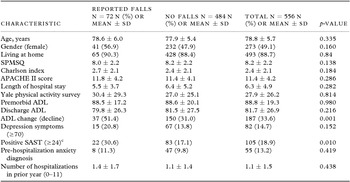
A total of 72/556 (12.9%) participants reported falling within a month after discharge, with 13/72 (18.1%) reporting more than one fall. Characteristics of the study sample are shown in Table 1.
Descriptive statistics of total sample and by fall status one month after hospital discharge

List of abbreviations: SPMSQ: short portable mental status questionnaire; SAST: short anxiety screening test; ADL: activity of daily living; APACHE: acute physiology and chronic health evaluation.
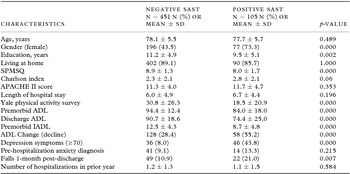
Based on medical records, 55 participants had a history of anxiety (9.9%). Only 14/55 (25.5%) had a positive SAST score at the time of hospitalization. The total study sample showed a prevalence of 18.7% (105/556) anxiety symptoms at the time of hospitalization, most 91/105 (86.7%) with unknown anxiety prior to admission. Accordingly, comparing the subgroups of those with and without hospital-detected anxiety symptoms, the group with anxiety symptoms was predominately female (73.3% compared to 43.5%; p < 0.001), had a poorer pre-morbid function (mean MBI 84.0/100 (±18.0) compared to 94.4 (±12.4); p < 0.001), and had higher rates of co-morbid depression (43.8% compared to 8.0%; p < 0.001) (Table 2).
Characteristics of participants according to anxiety symptoms

List of abbreviations: SPMSQ: short portable mental status questionnaire; SAST: short anxiety screening test; ADL: activity of daily living; IADL: instrumental activity of daily living; APACHE: acute physiology and chronic health evaluation.
There were no differences in age, gender, acute/chronic health status, pre-morbid mobility and function, pre-admission diagnosis of anxiety symptoms, and presence of depression between fallers and non-fallers. The only significant differences were in functional decline during hospitalization and presence of anxiety symptoms. The percentage of prior-to-discharge functional decline in fallers was significantly higher than in non-fallers (51.4% compared to 31.0%; p-value = 0.001), and similarly higher percentage of fallers were detected with anxiety during hospitalization (30.6% compared to 17.1%; p-value = 0.01) (Table 1).
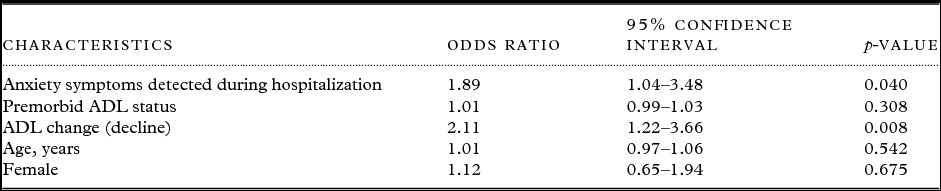
In the logistic regression model adjusted for age, gender, and baseline FS, both functional decline from baseline to discharge and in-hospital anxiety symptoms were statistically significant predictors (Table 3). The odds of falling were almost twice as high among patients with anxiety (OR = 1.89, 95% CI = 1.04–3.48; p = 0.04) compared to patients who screened negative for anxiety. In addition, the odds of falling were more than twice as high among participants who experienced functional decline (OR = 2.11, 95% CI = 1.22–3.66; p = 0.008). Age, gender, and baseline function were not significantly associated with falls in the multivariate analysis.
Multivariable logistic regression analysis of factors associated with incidence of falls one month after hospital discharge

List of abbreviation: ADL: activity of daily living.
The sensitivity analysis examining the independent relationship between depression and falls one month post-hospitalization, showed that depression was not associated (OR = 1.48, 95% CI = 0.76–2.88; p = 0.25) with falls one month post-hospitalization. Moreover, χ2 test was performed among a subsample of 150 patients for whom information on prior falls was available, indicating that self-reported falls one year prior to hospitalization were not associated with post-hospitalization falls (p = 0.21). In addition, a t-test was performed among a subsample of 381 patients for whom information on pain at discharge was documented, indicating that pain level reported at discharge was not associated with post-hospitalization falls (p = 0.93).
To test the hypothesis that the association between anxiety symptoms and falls is mediated by functional decline, we examined the change in OR after introducing functional decline into the regression (Table 4). When accounting for functional decline, the relationship between anxiety symptoms and falls was decreased by 11% (from OR = 2.13 to OR = 1.89). Sobel's test of mediation yielded significant p-values, supporting the partial mediation effect (Sobel = 5.705; SE = 0.025; p < 0.002).
Pre-hospital to discharge ADL decline as mediator of the relationship between anxiety symptoms and falls one month after discharge

Controlling for premorbid basic ADL status, gender, and age.
Sobel = 5.705; SE = 0.025; p < 0.001.
List of abbreviation: ADL: activity of daily living.
Discussion
This study showed that older adults hospitalized in internal medicine wards for a non-disabling condition, who screened positive for anxiety symptoms during the acute hospitalization are almost twice as likely to experience a fall during the first month after discharge, even after controlling for potential confounding variables, such as age, gender, baseline function and in-hospital functional decline. Moreover, diagnosis of anxiety before hospitalization was not associated with future falls. This relationship was partially explained by functional decline related to acute hospitalization. Thus, the findings of the present study suggesting that anxiety symptoms detected during an acute hospitalization can serve as a marker for identifying individuals at increased risk for falls and have important clinical implications.
The association between anxiety symptoms and post-hospitalization falls is partially explained by deterioration in ADL during hospitalization (leading to a 11% decrease in the OR between anxiety symptoms and falls). In fact, ADL and falls might share a common mechanism that acts both directly, explaining the association between anxiety symptoms and falls and indirectly, involving ADL deterioration as a mediator. It is possible that fall-related anxiety symptoms (Hull et al., Reference Hull, Kneebone and Farquharson2013) lead to activity avoidance and consequently to deconditioning, such as muscle atrophy, reduction in joint mobility and impaired gait, which in turn could increase the risk for falls (Hadjistavropoulos et al., Reference Hadjistavropoulos, Delbaere and Fitzgerald2011; Denkinger et al., Reference Denkinger, Lukas, Nikolaus and Hauer2015). Moreover, previous studies demonstrated an association between deterioration in ADL and falls (Stenhagen et al., Reference Stenhagen, Ekström, Nordell and Elmståhl2014). One mechanism might be that anxiety symptoms could cause an alteration of the original protective mechanism of the ankle joint, which could affect postural adjustment (Carpenter et al., Reference Carpenter, Frank, Adkin, Paton and Allum2004). Anxiety symptoms also have been associated with gait speed deterioration, as well as shorter step length (Delbaere et al., Reference Delbaere, Sturnieks, Crombez and Lord2009). Several neural circuits share pathways related to autonomic control, vestibulo-autonomic interaction and anxiety symptoms (Balaban et al., Reference Balaban, Jacob and Furman2011). The parabrachial nucleus network is one of the dominant pathways. These pathways modulate both anxiety symptoms and balance control (Nagaratnam et al., Reference Nagaratnam, Ip and Bou-Haidar2005; Balaban et al., Reference Balaban, Jacob and Furman2011), which may be expressed as an ADL deterioration followed by a fall.
As mentioned, anxiety symptoms are severely under-diagnosed among the elderly (Wolitzky Taylor et al., Reference Wolitzky Taylor, Castriotta, Lenze, Stanley and Craske2010). Since fall prevention among this population group is a major public health goal (American Geriatrics Society, Geriatrics Society, American Academy Of Orthopaedic Surgeons Panel On Falls and Prevention, Reference Prevention and Panel2001; Heinrich et al., Reference Heinrich, Rapp, Rissmann, Becker and König2010), addressing risk factors is a top priority (Ambrose et al., Reference Ambrose, Paul and Hausdorff2013). As anxiety symptoms double the risk of falls among hospitalized elderly, acute hospitalization might be an opportune time for screening, as well as for implementing more efficient prevention strategies. Thus, fall prevention strategies should consider including screening for anxiety.
The results presented here should be interpreted cautiously, in light of study limitations. One significant limitation is that this study did not account for previous falls in the entire sample. We partially overcame this shortfall by controlling for previous ADL, as well as using a validated instrument of physical activity level to represent postural control and the relative risk for falls. Moreover, a sensitivity analysis for a subsample of participants did not find even a trend for association between pre-hospitalization self-report of falls in the previous year and post-discharge falls. Additionally, data regarding fall incidence was collected retrospectively and thus it is prone to recall bias. Indeed collecting data about recurrent falls is of utmost priority for fall prevention (Prevention and Panel, Reference Prevention and Panel2001). In the current study only 13/72 reported more than one fall in one month post-hospitalization, restricting our ability to draw a definite conclusion regarding the difference between those who reported a single fall compared to those who reported more than one fall. Moreover, although pain is a well-documented fall risk factor among community older adults, in the current study we did not find significant association between pain at discharge and one month post hospitalization falls. These findings may be attributed to the fact that pain was effectively managed during the hospitalization period. The duration of this longitudinal study was relatively short and the design did not allow us to infer causality. Despite these limitations, controlling for basic ADL, as shown in this study supports a unilateral direction between ADL and falls. The association between anxiety symptoms, ADL deterioration and falls may be even more robust with the existence of the “Hospitalization Effect”, which is defined as allostatic and physiological stress during the hospitalization period and includes ADL deterioration (Krumholz, Reference Krumholz2013). However, this remains to be tested. Future studies should examine this relationship in larger samples and over longer periods, as well as conduct high-level, randomized, clinical interventions to better explain the nature of the relationship between anxiety symptoms and falls and its underlying mechanism.
In conclusion, the findings suggest an association between anxiety symptoms and falls one month after hospital discharge that is partially mediated by ADL deterioration, even after controlling for several relevant confounders. The findings add to the empirical understanding of the association between anxiety symptoms and falls, and are important to clinical practice in terms of anxiety detection and fall prevention strategies. Clinicians assessing fall risk should routinely screen for anxiety symptoms given the relationship between the two and the under-diagnosis of anxiety in this population.
Conflict of interest declaration
None.
Description of author's roles
M. Agmon, designed the current study, was responsible for the analytic design, for performing the statistical analysis and for writing the paper. A. Zisberg, designed the study, was responsible for the analytic design and for carrying out the statistical analysis, and for writing the paper. O. Tonkikh was responsible for the statistical analysis and assisted with writing the manuscript. G. Sinoff critically reviewed the paper and contributed to the interpretation of the results. E. Shadmi design the study contributed to the analytic design, critically reviewed the paper and contributed to the interpretation of the results.