Introduction
Numerous ossiculoplasty materials are available today. These include high-density polyethylene sponge (Plastipore™), hydroxyapatite, titanium, autogenous cartilage and autogenous ossicles. However, the extrusion of artificial prostheses remains one of the main problems, resulting in post-operative hearing loss. Plastipore extrusion rates range from 0.89 to 6.30 per cent,Reference Slater, Rizer, Schuring and Lippy1–Reference Felek, Celik, Islam, Elham, Demirci and Samim5 and hydroxyapatite extrusion rates range from 5 to 14 per cent.Reference House and Teufert3, Reference Goldenberg and Drive6–Reference Kobayashi, Gyo, Shinohara and Yanagihara9 Titanium ossicular prostheses have been presented as being easily shaped, trimmable, lightweight implants that theoretically transmit sound better through lower impedance; however, extrusion is still a problemReference Ho, Battista and Wiet10 unless cartilage is interposed between the prosthesis and the tympanic membrane.Reference Kim and Wiet11
In this paper, we review the outcome of ossiculoplasty using autogenous mastoid cortical bone, which has been utilised as a reconstructive material at our institution since 2005. The main advantages of this material for ossiculoplasty are stable post-operative hearing, a reduced risk of extrusion and no requirement for the insertion of cartilage between the prosthesis and the tympanic membrane.
Materials and methods
Patients and indications
From January 2005 to January 2008, 61 ears of 57 in-patients with chronic otitis media, with or without cholesteatoma, underwent type III tympanoplasty using autogenous mastoid cortical bone as the prosthetic material. The follow-up period was 3 to 6 years (average of 4.2 years).
The patients consisted of 30 females (33 ears) and 27 males (28 ears), aged 15 to 61 years (average age of 37.5 years). Pre-surgery, there was no evidence of obstruction of the eustachian tube, as revealed by the Valsalva manoeuvre. There were no records of any surgical treatment for any of the patients. All patients had intact and mobile stapes as evidenced during surgery. High-resolution computed tomography (CT) scans were acquired for all patients.
The protocol was approved by the Institutional Committee of the Beijing Institute of Otolaryngology.
Surgical technique
A traditional postauricular skin incision was performed. Bone columella was harvested by drilling the mastoid cortical bone and was put aside for use as the ossiculoplasty material. Canal wall up mastoidectomy (including mastoidectomy with reconstruction of the lateral attic wallReference Yu, Yang, Wang, Han and Zhang12) or canal wall down mastoidectomy procedures were carried out. Pathological conditions around the ossicles were carefully removed, as was the damaged incus and/or head of malleus. The handle of malleus was kept in place as much as possible. The stapes were confirmed as being intact and mobile.
The prosthetic sculpturing was performed as follows. A 1 mm diamond burr was used to create a groove on one end of the bone columella, which would accommodate the stapes capitulum; the groove was approximately 0.5–1.0 mm deep, so that its edge did not touch the fallopian canal or the promontory. A facet with a slight slant on the other end of the bone columella was fashioned, which would contact the tympanic membrane. The middle part of the bone columella was trimmed to decrease the weight of the prosthesis (Figure 1). The length of the prosthesis was about 1.75–2.50 mm. This sculpting process took about 5–10 minutes.
Photograph of a partial ossicular replacement prosthesis sculpted from autogenous mastoid cortical bone (a) and a line drawing of the prosthesis (b).

The prosthesis was then placed to bridge the head of the stapes and the new tympanic membrane (temporalis fascia graft). In order to reproduce a sharp tympanomeatal angle and avoid lateralisation of the graft, it was very important to keep the anterior tympanomeatal skin flap intact when elevated. The skin flap would overlay the reflected part of the temporalis fascia graft and keep the graft in place for total drum replacement. For the cases with attic cholesteatomas, in which the pars tensa was intact, a modified underlay technique was used to repair pars flaccida defects. The canal or opened mastoid cavity was packed with Gelfoam® soaked in hydrocortisone and cotton wicks soaked with antibiotic ointment.
The packing was removed 14 days later. The condition of the canal walls (in canal wall up cases), the mastoid cavities (in canal wall down cases) and the new tympanic membranes were observed by electric otoscope or otoendoscope. The follow-up period ranged from 3 to 6 years (average of 4.2 years) and the follow-up rate was 52 per cent. Those patients with inadequate follow up were excluded from the study.
Second-look surgery was performed in those cases where: a suspicious cholesteatoma recurred, the prosthesis was dislocated, or any other conditions resulting in significant conductive hearing loss occurred. All such conditions occurred within three years in our consecutive patients.
Audiometric evaluation
For the pre- and post-operative assessments of hearing level, pure tone averages (PTAs) for thresholds at 0.5, 1, 2 and 3 kHz were calculated. The PTA for 3 kHz hearing was calculated as the average of 2 and 4 kHz hearing, because this frequency (3 kHz) is not usually measured in China.
Standard conventional audiometry was carried out one to two weeks before surgery to assess pre-operative hearing. For the post-operative hearing assessment, the latest audiometry results were used in the data analysis.
Statistical analysis was performed using the SPSS® statistics (version 17.0) package (paired t-test or independent-sample t-test), and p values of less than 0.05 were regarded as significant.
Results
During the first two years after surgery, recurrence or residue of cholesteatomas presented in five ears. Perforation of the eardrum occurred in one ear, lateralisation of the graft was evident in two ears and displacement of the prosthesis was apparent in two ears, with significant air–bone gaps (ABGs). Revision surgery was performed in these cases. Two ears with cholesteatoma residue were subsequently incorporated into the canal wall down group. The follow-up time was calculated from the time of revision surgery.
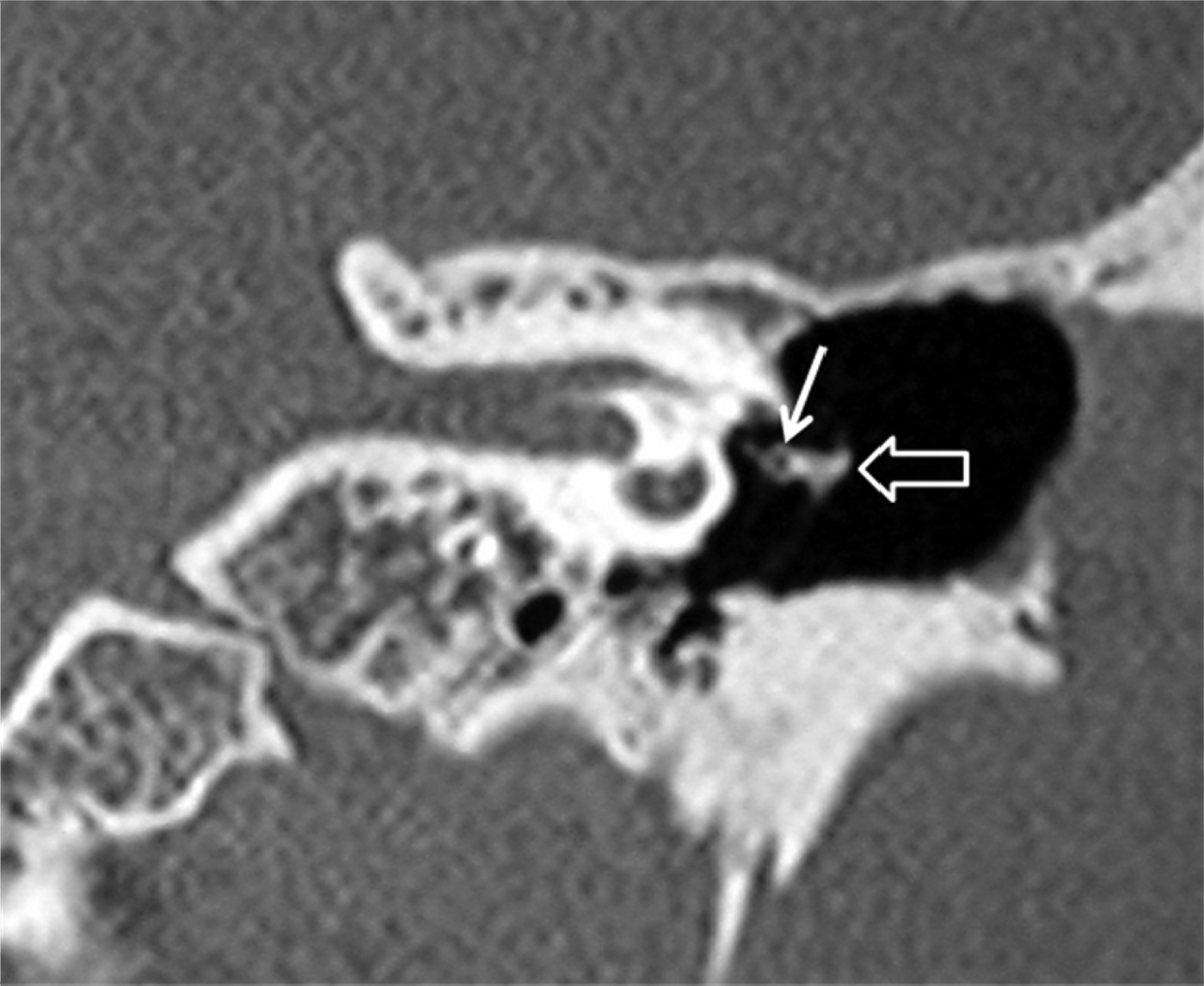
During our later follow up (three to six years after surgery), four canal wall up ears presented with self-cleaning mesotympanic retraction, which remained self-cleaning and stable; a ‘wait-and-see’ policy was adopted. Slight lateralisation of the graft, or tympanomeatal angle blunting, with an ABG of less than 30 dB, recurred in three ears, with no further deterioration over time. The patients were unwilling to undergo further revision surgery. There were no major complications (such as facial paralysis) in any of the patients. In addition, there were no cases of prosthesis extrusion, necrosis or resorption. A distinct incudostapedial joint and good aeration in the tympanic cavity could be seen on CT images, even at six years after the operation (Figure 2).
Coronal computed tomography image showing a partial ossicular replacement prosthesis (hollow arrow) in good condition six years after ossiculoplasty (white arrow indicates the incudostapedial joint).
According to the Wullstein classification of tympanoplasty, ossiculoplasty between the stapes head and eardrum is classed as a type III tympanoplasty. All patients in this study underwent type III tympanoplasty.
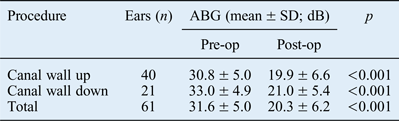
The pre-operative mean ABG of 31.6 dB was reduced to 20.3 dB post-operatively (61 ears) (a change of 11.3 dB); this difference was statistically significant (p < 0.05, paired t-test). A closure of the ABG to 20 dB or lower was evident in 70.5 per cent of ears, whereas closure to 10 dB or lower was achieved in 13.1 per cent of ears. An ABG closure of between 21 dB and 30 dB was evident in 26.2 per cent of cases, and a closure of over 31 dB was evident in 3.3 per cent.
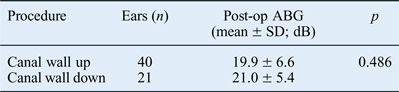
For the 40 canal wall up ears, a pre-operative mean ABG of 30.8 dB was reduced to 19.9 dB post-operatively (p < 0.05, paired t-test). For the 21 canal wall down ears, mean ABG was reduced from 33.0 dB to 21.0 dB (p < 0.05, paired t-test). Table I shows the significant differences between pre- and post-operative mean ABG values for canal wall up and canal wall down cases. However, there was no significant difference between canal wall up and canal wall down cases in terms of the post-operative mean ABG values (independent-sample t-test, p > 0.05) (Table II).
Differences between pre- and post-operative mean ABG values*

* For patients who underwent type III tympanoplasty. ABG = air–bone gap; SD = standard deviation; pre-op = pre-operative; post-op = post-operative
Group differences in post-operative mean ABG values*
* For patients who underwent type III tympanoplasty. ABG = air–bone gap; post-op = post-operative; SD = standard deviation
Discussion
The most frequent ossicular chain defect that the otological surgeon encounters is a defect or absence of the incus.Reference Babu and Seidman13 Hence, the most common reconstruction model for an ossicular defect is a type III tympanoplasty.Reference O'Reilly, Cass, Hirsch, Kamerer, Bernat and Poznanovic14, Reference Iurato, Marioni and Onofri15 In this type of tympanoplasty, whether the stapes is movable or fixed is a crucial factor in obtaining improved hearing results. For patients with mobile stapes, hearing results have been shown to be significantly better than for those with fixed stapes.Reference Tsuzuki, Yanagihara, Hinohira and Sakagami16 The cause of poor hearing results in fixed stapes patients may be the refixation of the stapes, rather than the failure of the reconstruction between the stapes head and the malleus handle.Reference Felek, Celik, Islam, Elham, Demirci and Samim5 In order to observe the long-term outcome of ossiculoplasty using a prosthesis formed from autogenous mastoid cortical bone and to exclude the effect of stapes fixation, we reviewed only those cases with an intact and mobile stapes (as observed during type III tympanoplasty).
Besides the condition of the stapes, many factors, such as disease severity, follow-up period, eustachian tube function and surgical technique, affect the outcome of ossiculoplasty.Reference Kartush17, Reference Mishiro, Sakagami, Kitahara, Kondoh and Kubo18 The treatment of different pathological conditions is beyond the scope of this article; rather, we discuss those patients for whom ossiculoplasty was necessary to improve hearing and review their long-term outcomes.
In most previous studies of ossiculoplasty, which report findings based on short-term, medium-term or a mixture of follow-up periods, the rates of ABG closure to within 20 dB have been reported to range from 60 to 97 per cent.Reference Slater, Rizer, Schuring and Lippy1, Reference Felek, Celik, Islam, Elham, Demirci and Samim5, Reference Iurato, Marioni and Onofri15, Reference Krueger, Feghali, Shelton, Green, Beatty and Wilson19–Reference Silverstain, McDaniel and Lichtenstein22 Long-term follow up requires commitment and resources that can be difficult to achieve. To our knowledge, reports on the long-term follow up for type III tympanoplasty are rare; the rates of post-operative ABG closure to within 20 dB range from 48 to 81.3 per cent.Reference Malafronte, Filosa and Mercone23–Reference Berenholz, Burkey and Lippy27 Our results are within this range.
The post-operative condition of the artificial prosthesis (e.g. extrusion) also undoubtedly affects the outcome of ossiculoplasty. Similar hearing results have been obtained using prostheses composed of different materials, including titanium, hydroxyapatite and autografts.Reference Goldenberg and Drive6, Reference Iurato, Marioni and Onofri15, Reference Krueger, Feghali, Shelton, Green, Beatty and Wilson19, Reference Yung and Vowler26 However, the relatively high extrusion rate of titanium and hydroxyapatite remains one of the main problems (leading to post-operative hearing loss), unless cartilage is interposed between the prosthesis and the tympanic membrane.Reference Kim and Wiet11 Compared with those artificial prosthesis materials, autogenous mastoid cortical bone has good biocompatibility. There were no cases of prosthesis extrusion during the follow-up period in our study, even in those cases of tympanic membrane retraction or atelectasis. Certainly, middle-ear ventilation dysfunction remains a problem. In addition, maintaining an intact anterior tympanomeatal skin flap and reproducing a sharp tympanomeatal angle can be helpful in avoiding lateralisation of the graft and achieving good hearing over a long period.
• Type III tympanoplasty is the most common reconstruction model for an ossicular defect
• Numerous materials for ossiculoplasty are available, but these have their drawbacks
• A prosthesis made of autogenous mastoid cortical bone exhibited no extrusion, necrosis or resorption
• Furthermore, a significant hearing improvement was achieved, which remained stable for a long time
• Autogenous mastoid cortical bone remains one of the best available materials for ossiculoplasty
Previous reports,Reference Merchant, Rosowski and McKenna28–Reference Merchant and Nadol30 and the findings of this study, have shown that autologous grafts for minor columellae (partial ossicular replacement prostheses) maintain their morphological contours, size, shape and physical integrity for long periods, sometimes longer than 20 years.Reference Merchant, Rosowski and McKenna28–Reference Merchant and Nadol30 They do not trigger the formation of new bone or undergo resorption in the absence of infection. They have an extremely low incidence of extrusion, even in cases of chronic tubal dysfunction and tympanic membrane atelectasis.Reference Merchant, Rosowski and McKenna28 These features, combined with their low cost, and the lack of a need for cartilage insertion between the prosthesis and the tympanic membrane, lead us to prefer autogenous mastoid cortical bone as the first choice of material for minor columellar reconstruction (type III tympanoplasty). Although autogenous ossicles can be used as the reconstruction material, in cases with cholesteatoma the ossicles may sometimes be missing, or the ossicles may have been involved in the cholesteatoma, in which case there is a risk that the disease will be implanted.Reference Mishiro, Sakagami, Kitahara, Kondoh and Kubo18 Auricular cartilage may sometimes be very thin in small women and children,Reference Mishiro, Sakagami, Kitahara, Kondoh and Kubo18 and the potential for resorptionReference Goode and Nishihara31 and extra trauma occur simultaneously.
Certainly, longer-term observations and larger sample sizes, or comparison with other prosthesis materials, are necessary; all of these further studies are currently underway.
Conclusion
During our follow up of ossiculoplasty cases, there was no evidence of extrusion, necrosis or resorption of the autogenous mastoid cortical bone prostheses. A significant hearing improvement was obtained in the majority of cases and this remained stable over time. Furthermore, the cost of the prosthesis is negligible. Although the use of sculpted autogenous bone has declined, autogenous mastoid cortical bone remains one of the best available materials for ossiculoplasty.
Acknowledgments
This work was supported by the Special Fund of Sanitation Elite Reconstruction of Beijing (grant numbers 2009-3-35, 2009-2-04, 2009-1-04 and 2009-2-007), awarded to ZY, DH and LZ.