Implications
Surgical castration without anaesthesia causes pain to animals. The different alternatives to this common practice discussed in this paper raise animal welfare of piglets significantly. The costs inherent to these alternative practices are not prohibitive and do not compromise the competitiveness of European pig production. This economic evaluation of alternatives to surgical castration without anaesthesia may facilitate the policy debate on this subject, as the relevant improvement of animal welfare requested by society can be obtained without a significant burden for economic actors of the pork supply chain.
Introduction
Surgical castration without anaesthesia is increasingly perceived as a practice to be banned in the near future within the European Union (EU) as it is considered painful. Several animal welfare NGOs and other stakeholder groups are opposing surgical castration without anaesthesia and in some countries like Norway, the Netherlands and Switzerland these stakeholder groups have gained general consensus among citizens and consumers. In these three countries, either national legislation or market-driven initiatives run by major retail companies have banned this practice (Bonneau et al., Reference Bonneau, Ouedraogo, Prunier, Courboulay, Fredriksen and Oliver2009). Several alternatives to surgical castration without anaesthesia have been proposed on the market and some of these have been introduced in countries with a ban on castration without anaesthesia or are used on an experimental basis. Surgical castration with anaesthesia will generate extra costs on pig farms, but some other alternatives such as immunocastration and the raising of entire males also offer benefits in terms of a better feed conversion rate of pigs during fattening. As at EU level a decision on this subject might be expected, it is important to know which are the costs and benefits of the different alternatives at farm level.
Methodology
Basis for the cost analysis is the Interpig pig production costs database of the British Pig Executive, a network of research institutes involved in the analysis of production costs of pig meat in the EU, the US, Canada and Brazil, coordinated by the British Pig Executive (BPEX, 2007). The advantage of this database is that the production costs have been calculated with one common agreed methodology. The nine EU countries participating in the Interpig network represent 75% of the pig population of the EU-27.
The full production costs in this database reflect the actual situation in each of the participating countries where surgical castration without anaesthesia is a common practice. In order to know the cost impact of the alternative practices, data have been collected in the existing literature containing information about the additional workload of farmers and veterinarians as well as the costs of vaccines and equipment related to these alternatives. Eventual benefits expressed through an improvement of feed conversion rates of pigs have accounted for as a reduction of feed costs. Four alternatives have been assessed:
1. surgical castration with local anaesthesia through injections;
2. surgical castration with general anaesthesia through inhalation;
3. immunocastration;
4. raising entire males.
Nine EU countries have been taken into account in the analysis. Although the UK and Ireland are part of the Interpig database, they have been excluded from the analysis as in these two countries male pigs are not castrated due to the younger age at which they are slaughtered.
Figure 1 illustrates the method of analysis followed in this paper.
Schematic representation of the method of analysis.

The average total extra costs of each of the alternative practices emerging from the relevant literature have been added to the pig production costs of the nine countries under investigation. A weighted average of the production cost increase has been calculated using the number of pigs slaughtered per country as weighing criterion.
Results
Surgical castration with local anaesthesia
The estimates of workload and additional costs of castration with local anaesthesia and analgesia were evaluated in a recent research project carried out in the Netherlands (Animal Sciences Group (ASG), 2007). The calculation of workload was performed, where either veterinarians or farmers applied anaesthetics (lidocaine) and analgesics (meloxicam). The term of comparison is the time required by castration without anaesthesia as is practised normally today in most European countries:
• If the lidocaine dose was applied by the veterinarian, the average increase in labour demand was about 0.47 min per piglet (2.82 min per litter). In this case, the workload of the farmer alone has been charged with 0.22 min per piglet.
• When anaesthesia was performed by stockmen, the workload required was a bit lower, corresponding to 0.43 min per piglet (2.56 min per litter), while it increased up to 0.58 min (3.48) with the administration of analgesic after castration.
• The administration of only analgesics is a less time-consuming option, entailing an extra labour demand corresponding to 0.28 min per piglet (1.75 min per litter).
Moreover, on farms with more than 200 sows two stockmen were needed for castration in order to avoid waiting periods of more than 20 min between anaesthesia and castration. Total costs differ according to these different options and are also affected by the herd size and by the frequency of castration.
According to the findings of the research, if castration is practised (i) once a week (ii) with the support of veterinarian and (iii) without analgesic treatment, the estimated additional costs per male piglet range from around €0.78 on farms with more than 400 sows up to €2.99 on farms with less than 100 sows.
When castration is performed twice a week, the other conditions being the same, additional castration costs increase by 30% up to 75%, depending on farm size. On the other hand, castrating pigs once in every 2 weeks entails significant cost savings that range from more than 50% in the smallest farm class to 14% on the largest pig farms.
Castrating piglets using both anaesthesia and analgesia (meloxicam) is more expensive compared to using only anaesthesia. It entails, on average, a 15% castration cost increase in small and medium farms, and a 23% rise in farms over 400 sows. The difference is due to the increased cost for the purchase of pharmaceuticals, which rises from €0.10 to €0.18 per piglet, and to the higher workload for farmers who have to apply analgesia, which generates a cost increase from €0.09 to €0.21 per piglet.
For each alternative option, visiting fees and labour costs of the veterinarian represent at least 80% of total additional costs. Only the first cost item (veterinarian visiting fees) is subject to economies of scale, while both costs for drugs and total labour cost per piglet depend neither on farm size nor on castration frequency. This means that if anaesthesia and analgesia or both could be administered by the farmer, total cost per piglet would drop drastically to an average of €0.30 per piglet.
A similar research project was carried out on seven organic pig farms in Norway (Eijck et al., Reference Eijck, van der Peet-Schwering, Kiezebrink and Vink2007), where anaesthesia in piglet castration became mandatory in 2002. The study was specifically aimed at analysing the costs of the veterinarian and the physical workload of anaesthetising piglets before surgical castration compared to castration without anaesthesia. The method used was local anaesthesia by mean of lidocaine injection into the testicle, currently the most practised in Norway. During the trials, anaesthetic treatment and castration took on average 81 and 142 s per litter of five male piglets, corresponding to 3.71 min per litter and to 0.74 min per piglet.
Based on these measurements, it was calculated that the costs of veterinarian time, excluding the call-out fee, are €1.73 per litter, equal to €0.35 per piglet, which is similar to the results of the Dutch research project. The costs of lidocaine are €0.25 per litter, corresponding to €0.05 per piglet.
At this stage of the analysis it is interesting to know the impact that the costs of local anaesthesia may have on the production costs of pig meat. The average total cost increase related to the costs of local anaesthesia carried out by the farmers (workload plus vaccines) have been used in order to adjust the Interpig production costs database to this alternative practice of castration (see previous section ‘Methodology’) The extra labour input of the farmers and the anaesthetic costs have been accounted for in this first simulation, which is reported in Table 1.
Additional costs of castration with local anaesthesia carried out by the farmer (€/kg carcass weight, 2006)
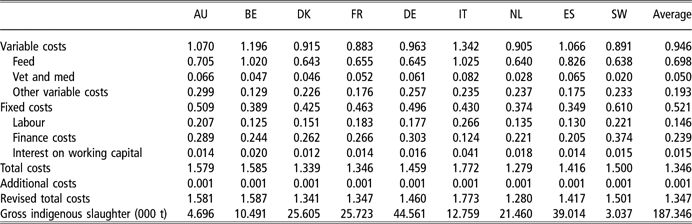
As castration is only a minor cost item in the total costs of production of a pig farm, it might have been expected that the cost increase due to this practice is very small and in most countries equals 0.1 €ct per kg of carcass weight at slaughtering. The overall weighted average of pig production costs increases from €1.346 to €1.347 per kg.
In many countries, local anaesthesia by injection has to be carried out by a veterinarian. It is therefore relevant to know what will be the cost impact of local anaesthesia when the veterinarian has to be called for doing this work. Again this has been simulated using the average results of the cost increase related to this practice, adding to the additional costs of the previous practice the labour costs of the veterinarian and his visiting fees. The results are shown in Table 2. Of course the additional costs with respect to the first alternative rise significantly, but the share in total production costs remains limited and these do not exceed 1 €ct per kg. The overall weighted average of pig production costs increases from €1.346 to €1.354 per kg.
Additional costs of castration with local anaesthesia carried out by the veterinarian (€/kg carcass weight, 2006)

Surgical castration with general anaesthesia
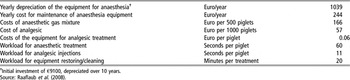
The costs of general anaesthesia administered by inhalation and by injection have been calculated in a very recent research conducted in Switzerland (Raaflaub et al., Reference Raaflaub, Genoni and Kampf2008). In the first scenario, general anaesthesia is performed with inhalation of Isoflurane in oxygen and castration is followed by injection of Meloxican as analgesic (Walker et al., Reference Walker, Jaggin, Doherr and Schatzmann2004). The additional cost per piglet is evaluated considering both variable costs (anaesthetic gas mixture and labour) and the depreciation of the equipment used, which is assumed to require an initial investment of €9100. The average increase in labour demand is about 1 min per piglet for anaesthesia, while time needed for the analgesic treatment is around 10 to 12 s for each animal. Maintenance of the equipment and time spent for cleaning it at the end of the operations are also considered in the simulation. The economic parameters used for the cost calculation are summarised in Table 3.
Cost parameters of castration with general anaesthesia administered by inhalation

†Initial investment of €9100, depreciated over 10 years.
Source: Raaflaub et al. (Reference Raaflaub, Genoni and Kampf2008).
Additional costs per male piglet range from around €1.34 in farms with more than 250 sows up to €5.97 in farms with 25 sows, since scale economies affect the average costs of maintenance of the equipment and its depreciation cost. In smaller farms, depreciation and maintenance represent 75% of total costs, while for larger farms their share is around 20%. Only the cost of anaesthetics/analgesics, equal to €0.46 per piglet, as well as the average cost of labour needed to perform the treatment (€0.36 per piglet) does not depend on the number of piglets castrated. Average time spent for cleaning facilities decrease with an increase of the number of piglets, because this operation must be carried out only once for all the groups of animals castrated during the day.
The second scenario considered in the study is general anaesthesia performed with an injection of Ketamin in combination with Midazolan and the administration of an antagonist (Sarmazenil) to recover the piglets. Both treatments are assumed to take around 10 to 12 s respectively. The cost of this option has been estimated as €1.46 per piglet independently from the size of the farms, since no investment in specialised equipment is required.
According to the findings of the research, general anaesthesia applied by injection entails lower costs for farms with less than 175 to 200 sows. On the contrary, on larger farms anaesthesia administered by inhalation is cheaper than this second option because of the possibility to exploit the economies of scale on the depreciation and management costs of the specialised anaesthesia equipment.
In Germany, a similar analysis on the economic implication of general anaesthesia with Ketamin has been carried out, looking at the animal welfare and economic aspects of the practice (Lahrmann et al., Reference Lahrmann, Kmiec and Stecher2006). According to this study, the cost of this operation is definitely lower than the general anaesthesia with halothane, but only if the farmers carry out the work. Under this scenario the cost per piglet would be about €1 per piglet, but if the veterinarian has to be called to anaesthetise the piglets the costs would rise to €2 per piglet. Presently, German legislation does not allow pig farmers to perform general anaesthesia on the farm and, with this constraint, this practice at a cost of €2 per piglet is considered not economically feasible.
The economic and practical aspects of general anaesthesia with halothane have been evaluated in a study carried out by Wenger et al. (Reference Wenger, Jäggin, Doherr and Schatzmann2002) in Switzerland. A sample of 1054 piglets were anaesthetised with a mask with halothane (5%) mixed with oxygen and the time required per piglet castration as well as total costs involved were compared with a control group of piglet castrated without anaesthesia. Piglet castration with halothane took in average 2.3 min per piglet and, compared to castration without anaesthesia, the workload increase was around 1 min per piglet. Including time and equipment depreciation, the additional cost per piglet has been estimated as €1.67 if anaesthesia is performed by a farm employee, but if anaesthesia is administered by the veterinarian the difference in costs rises to €5.85 per piglet. The costs refer here to a farm size of about 100 sows.
In the Netherlands, a method of general anesthesia with a mixture of CO2/O2 gas has been developed and implemented in 2008 (Kluivers-Poodt et al., Reference Kluivers-Poodt, Gerritzen, Hindle, Smolders and Kuijken2008). Pig farmers got the permission from national government to perform general anaesthesia with this method after a training programme. The total investment costs for the equipment, training and quality audits on pig farms are estimated at €1000 per farm (W. Baltussen, personal communication). Retail organisations compensate farmers for their investments by a central fund. The additional variable costs are estimated at 34 €ct per male piglet. This amount can be divided in 8 €ct for the painkiller, 6 €ct for the CO2/O2 gas mixture and 20 €ct for additional labour costs of the farmer. In this way the costs are independent of the farm size.
Having analysed the different literature sources on the costs of castration with anaesthesia in Table 4, the main outcomes have been summarised. The workload and the costs reported in the table always refer to the additional time and the additional costs inherent to anaesthetise the piglets.
Summary table of additional workload and additional costs related to castration with anaesthesia and/or analgesia

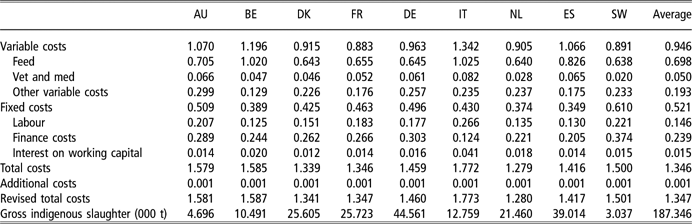
At this stage of the analysis, it is possible to simulate the cost impact of anaesthesia by means of inhalation. The additional costs have to account for the extra workload of the farmer and veterinarian, the depreciation costs of the inhalation equipment and the anaesthetic costs. From Table 5, average figures have been calculated in order to assess the impact of this practice on the production costs of pig meat. The cost impact of this practice is higher than castration with local anaesthesia but remains limited, as it represents approximately 1 €ct per kg pig meat. The overall weighted average of pig production costs increases from €1.346 to €1.354 per kg.
Additional costs of castration with general anaesthesia by inhalation (€/kg carcass weight, 2006)

Immunocastration
As far as the cost burdens at farm level are concerned, the vaccination treatment with Improvac®, the GnRH commercial vaccine commonly used in Australia, entails a cost ranging from €3 up to €3.3 per pig, including the costs of the vaccine and the labour cost for double injection. However the overall cost of immunocastration, including the cost of the work load for the farmer, has to be evaluated considering the potential benefits coming from higher daily weight gain and feed efficiency of the pig during the period prior to second vaccination when it performs as an entire male.
Compared to surgical castration, drawbacks entailed by immunocastration are:
• Difficulties and time-consuming activity of vaccinating pigs twice during the finishing phase.
• Costs related to the screening on slaughter line, for detecting those subjects in which the vaccination may not have been effective.
• The vaccine may be active for humans in case of accidental self-injection. All the operators who are in charge of vaccinating the pigs should be adequately trained in procedures for the use of the products to reduce the risks of self-injections. Furthermore, specific equipment and facilities would be needed for making this procedure safe and manageable at a large scale.
• Perceptions/reactions of (European) consumers to such a practice have not yet been investigated in depth. It cannot be excluded that this kind of treatment could be considered controversial by consumers from a food safety point of view, and affects the price or acceptability of pigmeat.
Immunocastration has been evaluated in Switzerland (Raaflaub et al., Reference Raaflaub, Genoni and Kampf2008). A significant improvement of feed efficiency in comparison with surgical castrates (2.42 v. 2.54 kg/kg) generates a benefit of €4.44 per slaughter pig. The total cost of vaccinating the pigs twice has been estimated as €3.65 per pig. However a lower yield at slaughtering has to be accounted for (€1.70 per pig), as has the extra cost of cutting off the testicles (€0.30 per pig). Overall, therefore, immunocastration generates an extra cost of €1.40 per pig in comparison to the traditional surgical castration. It has been assumed that the presence of boar taint in immunocastrated slaughter pigs is the same as the percentage of boar taint registered among castrated slaughter pigs (about 0.4%), therefore, no extra costs have been charged in this study for boar taint detection in the slaughter line.
In arriving at an economic evaluation of immunocastration, it is important to correctly estimate the consequences for production performance. Several experiments have been carried out in recent years in order to analyse the advantages of immunocastration by means of Improvac® (Dunshea et al., Reference Dunshea, Colantoni, Howard, McCauley, Jackson, Long, Lopaticki, Nugent, Simons, Walker and Hennessy2001; Zeng et al., Reference Zeng, Turkstra, Jongbloed, van Diepen, Meloen, Oonk, Guo and van de Wiel2002; Cronin et al., Reference Cronin, Dunshea, Butler, McCauley, Barnett and Hemsworth2003; Jaros et al., Reference Jaros, Burgi, Stark, Claus, Hennessy and Thun2005), or other vaccines (Turkstra et al., Reference Turkstra, Zeng, van Diepen, Jongbloed, Oonk, van de Wiel and Meloen2002), compared to surgical castration. In all these tests, efficacy of the immunisation was over 97% of the treated pigs and, in most cases, immunised pigs were generally found to have a higher growth rate and better feed efficiency.
In a study comparing early and late immunocastrated pigs with surgical castrates, with a total of 300 animals (Dunshea et al., Reference Dunshea, Colantoni, Howard, McCauley, Jackson, Long, Lopaticki, Nugent, Simons, Walker and Hennessy2001), pigs treated with Improvac® at 18 and 22 weeks and slaughtered at the age of 26 weeks showed a daily weight gain that – measured over the last 4 weeks prior to slaughter – was 32% higher than the average of surgically castrated animals (slaughtered at the same age). In the case of the ‘early treated’ group the difference was lower (+7%), but in both age groups the feed conversion rate was better than that of surgical castrates. Furthermore, back fat thickness was significantly lower in the two samples of immunocastrates.
Another set of data indicates the growth performance differences between surgical and immunological castration over a complete weaning to slaughter period, which in this case went from 3 to 22 weeks of age. Immunocastrated pigs were vaccinated at 13 and 18 weeks of age. Compared to surgically castrated pigs, no differences were found in final carcass weight, but feed intake as well as feed conversion ratio was 8% better. Furthermore, lean meat yield for immunological castrates was 10% higher.
Not all studies have compared immunocastrates with castrates, as much of the work has been conducted in markets where castration is not currently carried out (i.e. Australia) and comparisons have been made with entire males. An experiment conducted by Oliver et al. (Reference Oliver, McCauley, Harrell, Suster, Kerton and Dunshea2003) gives interesting indications concerning the performance of immunocastrates and entire males, although its aim was to determine the consequence of the use of Improvac® combined with daily injections of porcine somatropin.
Over the 4-week experimental period, Improvac® treatment alone increased feed intake and daily gain by 13% and 9% respectively compared with untreated entire males, without any significant effect on feed efficiency. The authors conclude that a better growth performance in grouped-housed immunocastrated boars compared to entire males is in part due to reducing sexual and aggressive behaviour.
In a field study of Jaros et al. (Reference Jaros, Burgi, Stark, Claus, Hennessy and Thun2005), using 270 pigs immunised with Improvac® and 263 surgical castrates, the androstenone concentrations between both groups were not significantly different. Also no significant differences were registered for daily growth rate. In this study, no information is reported concerning the eventual change in feed efficiency. Of interest is anyhow that the average lean meat yield of immunocastrates was significantly improved when compared to surgical castrates (54.50% of immunocastrates against 53.76% of surgical castrates).
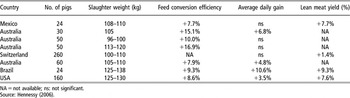
Hennessy (Reference Hennessy2006) has summarised the results of a set of studies focused on the production traits of immunological castrates compared with surgical castrates. Table 6 shows the key production data reported by these studies, which in most cases confirm the advantage of immunocastration in allowing a growth pattern much closer to that seen in entire males. In the seven trials assessing the differences in feed efficiency, immunocastrated pigs show a statistically significant improvement compared to surgical castrates which ranges from 7.7% to 16.9%. The immunocastrates have a lower feed consumption to reach the same final weight, and consequently a reduction of feed costs. In more than half of these studies, immunocastrates also showed a statistical improvement in average daily gain, with a difference ranging between 3.5% and 10.6%. When the lean meat yield or back fat was measured, in several studies immunocastrated pigs have a significantly higher lean meat percentage and a lower back fat compared to surgical castrates.
Differences in % between castrates and immunocastrates in growth performance and carcass quality

NA = not available; ns: not significant.
Source: Hennessy (Reference Hennessy2006).
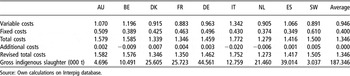
The average results of these literature studies have been used to simulate the impact of immunocastration on the production costs of pig meat (Table 7). In this simulation, we have taken account of the costs of the vaccine and the extra labour input to carry out the work in the pens, but at the same time we consider the increase in feed conversion efficiency. In the following calculations, 7.6% increase in feed efficiency has been assumed, vaccine cost of €3.30 per pig, 1% reduction of killing out rate and 50 s labour time per pig. The benefits related to a higher lean meat percentage of immunocastrates have not been evaluated as this would have implied modelling of the different payment schemes in the nine EU countries, which was not feasible within the framework of this study.
Impact of immunocastration on the production costs of pig meat (€/kg carcass weight, 2006)

Source: Own calculations on Interpig database.
Under these assumptions, the benefits from the improvement in feed efficiency compensate for the extra costs of immunocastration. Especially in Italy, where the feed conversion rate is high due to the high slaughter weight of the pigs, the increase of feed efficiency causes a reduction of production costs that is much higher than the extra costs of vaccination. Danish pig farms, on the other hand, already have a high feed efficiency and therefore a further improvement is not sufficient to account for the increase in vaccination costs. Finally, the analysis shows that the overall weighted average of production costs of the nine EU countries does not change due to immunocastration. It should however be remembered that a limited amount of extra labour costs have to be accounted for in the slaughterhouse, which have not been counted here, as the Interpig data refer to production costs at farm level.
Raising entire males
Limitations of raising entire males are mainly linked to pork quality and welfare issues. The most important is the higher incidence of boar taint, in particular in countries where pigs are slaughtered at medium to high weights. The problem is less perceived in those countries where pigs are slaughtered at a low weight and before sexual maturity (i.e. Great Britain, Ireland and Spain), or where consumers are less sensitive to tainted meat. Furthermore, entire males may show higher aggressive and sexual activities than castrates, and this can generate either negative welfare issues (EFSA (European Food Safety Authority), 2004) or economic consequences for farmers if such behaviours cause injuries or reduced efficiency. Aggressive behaviours increase the risks of carcass damage and/or skin lesions, which also imply financial losses for farmers due to the meat depreciation. Apart from the improvement of animal welfare, the advantages linked to raising entire males are higher efficiency of feed conversion, better growth rate and higher leanness of meat.
In literature, better feed efficiency of entire males compared with castrates is widely reported. An exhaustive literature review on performance, carcass and meat quality advantages of entire males over surgical castrates have been presented by Xue et al. (Reference Xue, Dial and Pettigrew1997). Considering the findings on feed efficiency, expressed by the feed/gain ratio, the improvements in boars ranges from 3% to 20% under different rearing conditions with a saving of 2 to 28 kg of feed during the growing and finishing period compared to barrows.
The comparison between growth rate of entire males and barrows gives rise to different results: some research results indicate that entire pigs grow faster, but others did not reveal differences in average daily gain and in some cases castrates were found to have higher growth rate than boars. The inconsistency of findings is due, in part, to the several factors that can influence growth rate including the protein level in the diet, energy intake, age at castration and slaughter weight.
Summarising the results of different trials, the authors underline the relation found between these factors and the level of average gain. In particular, entire males were found to demonstrate higher growth rate when fed with high-protein diets, under restricted feeding systems (not ad libitum) and up to relatively high slaughter weights (110 to 130 kg). Furthermore, floor space available per pig may influence average daily growth in boars as high density increases their aggressive behaviour.
As far as the carcass composition is concerned, all reviewed research focused on this aspect indicates a higher lean meat percentage in entire males.
The European Food Safety Authority (EFSA) report on the castration of piglets (EFSA, 2004) includes a literature review that refers to the works of several authors on the production traits of entire boars compared with castrates. The report states that these trials all conclude that entire boars grow faster, eat less feed or convert feed to live-weight gain more efficiently and produce leaner carcasses than castrates.
The advantages to boars over castrates can be summarised as follows:
• Superior growth rate of boars up to 13%;
• Entire males may eat up to 9% less feed;
• Feed conversion (to live-weight) up to 14% more efficient;
• Entire males are generally leaner than castrates by up to 20% (with an exceptional difference of 40% being recorded in one trial).
The size of differences in the findings of each of the trials is due to the differences in factors that have an influence on growth performance (breed, feeding system, diet, weight at slaughter, etc). For example, in the trial conducted by MLC (Meat and Livestock Commission), boars showed a 4.5% higher average gain than castrates when fed ad libitum, but they grew 11.3% faster in a restricted feeding system.
The costs and benefits of raising entire males nation-wide have been estimated in a recent study in the Netherlands (Baltussen et al., Reference Baltussen, Backus and Hennen2008). The assumption is that unilaterally the whole country will have to raise only entire males, whereas in the rest of Europe castration will continue to be carried out. The following changes of revenues for the pig sector have been foreseen:
1. A lower meat production per slaughterhouse as males will be slaughtered at a lower weight whereas the total number of pigs slaughtered will not change.
2. Lower revenues due to the lower prices of the meat cuts of entire males, as some high value cuts (hams) will be lower priced.
3. Lower revenues for the pig farms as less meat will be delivered to the slaughterhouse.
4. Higher revenues due to an increase of exports of live animals as the assumed separate fattening of entire males allows more fattening cycles per pig place, but as the slaughter capacity in the country does not change more males will be available for export.
The balance of these three presumed changes in revenues of the pig sector has been estimated at €200 million, which means a reduction of total revenues of 3.9%.
Contemporarily, changes in costs of the pig sector have been calculated.
5. Lower feed costs both because the males are slaughtered at a lower weight and because of better feed efficiency of entire males with respect to castrates (€80 million).
6. Lower costs of manure removal, as the reduction of feed input reduces the excess of minerals like phosphate and nitrogen (€10 million).
7. Higher costs for the purchase of weaners as 1.2 million extra pigs will be fattened in the country (€50 million).
8. Extra transport costs and extra costs for controlling carcasses on boar taint (€30 million).
9. Reduction of labour costs (€2 million) as surgical castration will not be performed anymore.
The total costs of the pig sector will decline by €110 million because of the above-listed positive effects.
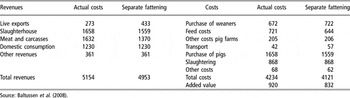
Table 8 summarises the costs and benefits for the Dutch pig sector of raising entire males.
Input out table of the Dutch pig sector at actual revenues and costs compared to the separate fattening of entire males (millions of euros)

Source: Baltussen et al. (Reference Baltussen, Backus and Hennen2008).
The calculation results show that the gross added value for the pig sector will decline by almost 90 million euro a year, as a result of stopping castration and the separate fattening of entire males. The research has been carried out with two chain models simulating the slaughter payment schemes and the flows of the different pig categories and meat cuts on the market. It is concluded that the estimate can have a bandwidth in the range of tenths of millions euro. It can be considered as an interesting analysis of simulating an alternative to surgical castration for all actors of the chains.
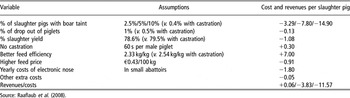
The raising of entire males has also been evaluated in the recent ProSchwein research in Switzerland (Raaflaub et al., Reference Raaflaub, Genoni and Kampf2008) (Table 9). The authors have excluded the option to reduce slaughter weight, as it is not sure if the market would accept smaller pork cuts. Obviously it will then be necessary to invest in electronic nose equipment in the slaughterhouse in order to detect boar taint. In large abattoirs, the yearly costs of an electronic nose have been estimated between €0.80 and €1.15 per boar, whereas these costs may rise up to €1.80 per boar in small abattoirs. Benefits of the raising of entire males are the significant improvement of the feed conversion rate and the elimination of the costs of castration. However, the raising of entire males can only be profitable if the percentage of pigs with boar taint does not exceed 2.5%. Actually the percentage of pigs with boar taint in Switzerland is 0.4%.
Costs and benefits of raising entire males v. castrated pigs

Source: Raaflaub et al. (Reference Raaflaub, Genoni and Kampf2008).
Conclusions
Very different alternatives to the classical surgical castration without anaesthesia are being proposed on the market. From the economic point of view, castration with local anaesthesia carried out by the farmer would have the lowest cost impact for farmers. This solution might not be feasible, as many countries would not allow anaesthesia without the intervention of a veterinarian. When general anaesthesia would be foreseen, large farmers would suffer a lower cost increase than small farmers as the anaesthesia equipment and the intervention of the veterinarian can be depreciated on a larger number of pigs. Immunocastration has the advantage that better feed conversion rate of the immunocastrates can compensate for the costs of the vaccination. For this practice a lot will depend on the costs of the vaccine, but also on the consumers’ acceptance of this practice in the EU. Finally, the raising of entire males can be an interesting option for many countries, except for countries (Italy) and production systems (Iberian pigs) with a high age at slaughtering. The costs and benefits of this alternative will depend on the percentage of males with boar taint at slaughtering. Undoubtedly the better feed conversion rate of the entire males and the elimination of the costs related to surgical castration, next to the improved welfare of entire males are important positive aspects of this practice, which may place this alternative in a favourable position for the future.