Introduction
Assisted living (AL) has become the fastest growing residential long-term care alternative to nursing homes (NHs) for older individuals who are not able to live independently. Between 1990 and 2002, the number of AL beds in the United States increased by 97% compared to a 7% increase in NH beds (Spillman and Black, Reference Spillman and Black2006). AL is based on a person-centered philosophy and typically provides personal care services, meals, health-related services, and 24-hour supervision in the least restrictive and more homelike setting (American Health Care Association National Center for Assisted Living et al., 2009).
Dementia and related neuropsychiatric symptoms are very common in AL and are often under-recognized and inadequately treated (Rosenblatt et al., Reference Rosenblatt2004; Magsi and Malloy, Reference Magsi and Malloy2005; Maust et al., Reference Maust2006; Samus et al., Reference Samus2013). They are also associated with a number of adverse outcomes in AL such as increased disability (Burdick et al., Reference Burdick2005; Samus et al., Reference Samus2009), lower quality of life (Samus et al., Reference Samus2005), increased facility resource use (Rosenblatt et al., Reference Rosenblatt2004), and risk of earlier discharge (Watson et al., Reference Watson2006; Lyketsos et al., Reference Lyketsos2007). Observational studies have supported the importance of dementia management in AL. For instance, treatment of dementia, as rated by an expert consensus panel, significantly decreased risk of discharge among AL residents with dementia (Lyketsos et al., Reference Lyketsos2007), as did cholinesterase inhibitor therapy among residents with Alzheimer's disease (Rosenblatt et al., Reference Rosenblatt2008).
The ability of AL to meet the mental healthcare needs of residents remains under scrutiny. Regulatory oversight of AL is performed at the state-level, as opposed to the federal-level as with NHs. As of 2012, virtually all states (48 states) had adopted specific policies/requirements related to dementia (National Center for Assisted Living, 2012), up from 28 states in 2000 (Mollica et al., Reference Mollica, Johnson-Lamarche and O’Keeffe2005). Overall, these policies have focused on strengthening dementia and mental health training requirements for staff, use of assessment tools, increasing staff-to-resident ratios, and providing more transparency about admission/discharge policies related to behavior and function. Most states also require that written programming and policy disclosures be available to consumers (residents and families) for ALs that represent themselves as providing specialized memory or dementia care (e.g. “Alzheimer's care program” or “Memory Care Community”; National Center for Assisted Living, 2012).
Relevant to this issue, Maryland instituted dementia-related AL policy amendments in 2003 that added items to the resident assessment and level of care tool to more adequately assess and monitor memory and behavioral problems and the corresponding level of care needed, as well as added a service disclosure requirement for facilities offering specialized dementia programs (Mollica et al., Reference Mollica, Johnson-Lamarche and O’Keeffe2005). The assessment tool is required for all new admissions, and then reassessed on a semi-annual basis, or immediately following any “significant change in condition.” It is filled out by a healthcare practitioner and the AL manager or the manager's designee (e.g. the delegating nurse) and uses state-derived criteria to determine the level of care required for the resident, given his/her medical history, function, cognition, and behavior issues (1 = low care needs, 2 = moderate care needs, 3 = high care needs).
Despite the state-level regulatory activity intended to improve dementia care in AL and face validity of the policy changes that are being implemented, there is a dearth of objective empirical information available on the impact of such policies, like revisions of assessment tools, on dementia recognition and care. Taking advantage of a natural experiment that occurred in the context of an observational study, we present the first analyses to examine cohort differences in dementia recognition and treatment indicators between two cohorts of AL residents with dementia, evaluated prior to and following Maryland's 2003 dementia-related policy modification to more adequately assess memory and behavioral problems. Specifically, using direct physician-based assessments, we examine cohort differences on dementia recognition, workup, and treatment. We also assess the relationship between cohort membership and other hypothesis-driven factors (demographics, cognition, function, and behavior) on recognition and care variables. We hypothesized that revision of the mandatory resident assessment tool used to evaluate the presence of memory and behavioral problems would yield better dementia recognition and treatment rates in Cohort 2 compared to Cohort 1.
Methods
This is a secondary analysis of data collected in the Maryland Assisted Living studies (MDAL Phase I and Phase II). The primary aims of the original studies were to estimate the prevalence, incidence, detection, treatment, and consequences of dementia and other mental health conditions in a random sample of AL residents living in Maryland. Details of the design and implementation of both phases are described in prior work (Rosenblatt et al., Reference Rosenblatt2004; Samus et al., Reference Samus2013) and the procedures used in these evaluations were virtually identical. In Phase I (2001–2003), 198 residents (Cohort 1) residing in one of the 22 randomly selected AL facilities in the Central Maryland region were assessed in a single, cross-sectional evaluation. Phase II (2004–2006) consisted of a longitudinal, three-year study of 203 recently admitted residents (Cohort 2) from one of the 26 randomly selected AL facilities from the same region in Maryland. Facilities participating in Phase I were invited to join Phase II and six new facilities in the region were randomly selected to take part. Cohort 2 participants were permanent stay AL residents who had been admitted to AL for less than one year prior to their assessment. The analyses presented here compare the initial evaluation of 134 (of 198) Cohort 1 and 114 (of 203) Cohort 2 participants who met DSM-IV-TR criteria for dementia as described below and who were from one of the 28 AL facilities. The overall MDAL participation rate of those who were contacted and eligible for the study was 68% (428/629). Reasons for non-participation included resident choice (44%), family refusal on resident's behalf (30%), severe medical illness/hospice (11%), or severe mental illness (5%). All participants and/or their legally authorized representatives provided informed consent, and the study protocol was reviewed and approved by the Johns Hopkins School of Medicine Institutional Review Board.
Procedures and measures
Participants received an in-person clinical evaluation by a geriatric psychiatrist, research nurse, and psychometric technician/research assistant. This included a one-hour neuropsychological battery; a narrative history; review of the AL medical chart (i.e. medications, diagnoses, non-pharmacological interventions in place); standardized quantitative measures on health, function, and behavior; and a mental status, neurological examination, and Structured Clinical Interview for DSM-IV (SCID; First et al., Reference First, Spitzer, Gibbon and Williams1995) by the geriatric psychiatrist with input from the resident, a responsible family member, and a direct care staff who knew the resident well. A multidisciplinary panel of clinical experts representing the disciplines of psychiatry, neuropsychology, geriatric medicine, and nursing used the information listed above to render psychiatric diagnoses using DSM-IV-TR criteria (American Psychological Association, 2000), and followed a set of a priori consensus panel guidelines established in MDAL Phase I to adjudicate the “completeness” of dementia workup and treatment (i.e. complete vs. partial or none; Rosenblatt et al., Reference Rosenblatt2004; Samus et al., Reference Samus2013). Consensus panel treatment ratings explicitly considered both non-pharmacological and pharmacological treatment options. Panel consensus ratings of “complete” treatment indicated that all appropriate steps were in place to address the condition and/or associated symptoms and the potential benefits of the interventions had been maximized to the extent possible for that individual. A rating of “complete” did not necessarily imply pharmacological or medical treatment, or a successful outcome. For example, if a resident with dementia was receiving appropriate supervision and a behavioral plan was in place to prevent falls or wandering, a rating of complete treatment would be rendered. A rating of at least partial treatment was almost always given if the participant's problems were recognized and some form of care plan was in place (Rosenblatt et al., Reference Rosenblatt2004).
Family and staff recognition of dementia was assessed by asking: “Does (name of the participant) have dementia? By that we mean, does (name of the participant) have trouble with his or her memory, concentration, or problem-solving bad enough to interfere with day-to-day activities?” Limited data were also collected on the facility demographics and staffing. Staff-to-resident ratio for the day shift was calculated by summing the total daytime AL resident care workers at each facility and dividing by the number of residents.
Standardized quantitative measures included the following:
1. Cornell Scale for Depression in Dementia (CSDD; Alexopoulos et al., Reference Alexopoulos, Abrams, Young and Shamoian1988) to assess depressive symptoms.
2. Psychogeriatric Dependency Rating Scale – Physical Functioning (PGDRS-P; Wilkinson and Graham-White, Reference Wilkinson and Graham-White1980) for rating activities of daily living, with scores ranging from 0 (not at all impaired) to 39 (severely impaired).
3. General Medical Health Rating (GMHR; Lyketsos et al., Reference Lyketsos1999), a global rating of medical comorbidity with scores ranging from 4 (excellent health) to 1 (poor health).
4. Mini-Mental State Examination (MMSE; Folstein et al., Reference Folstein, Folstein and McHugh1975), a measure of global cognitive functioning with scores ranging from 0 to 30 (higher scores indicating higher cognitive functioning).
5. Neuropsychiatric Inventory (NPI; Cummings et al., Reference Cummings, Mega, Gray, Rosenberg-hompson, Carusi and Gornbein1994) to assess 12 neuropsychiatric domains with scores ranging from 0 (no symptoms) to 144 (frequent and severe symptoms for all domains) and from 0 (no distress) to 60 (high distress resulting from all domains).
Data analyses
Descriptive statistics for cohort demographics were compiled. Cohort differences were tested using two-tailed independent t-test and Pearson's χ 2 methods. A sensitivity analysis (limited to only AL residents admitted to AL for less than one year prior to the initial assessment in both cohorts) was performed to check for the possibility that duration of stay in AL may confound the comparison of dementia recognition and treatment (e.g. longer exposure to AL setting, longer exposure to AL direct care staff) rates. Univariate logistic regression models were used to estimate the impact of cohort membership, resident and facility demographic variables, and other hypothesis-driven assessment variables (GMHR, PGDRS, NPI, CSDD) on staff and family dementia recognition (i.e. yes = 1 vs. no = 0), dementia workup (complete = 1 vs. partial/none = 0), and dementia treatment (complete = 1 vs. partial/none = 0). Marginal correlates of outcome variables (p < 0.10) were included in multivariate logistic regression models to isolate the effect of cohort membership after accounting for the influences of significant covariates, in addition to being adjusted by a standard set of covariates (duration of stay, residence in a dementia unit, and MMSE). Collinearity of predictor variables in the multivariate models was assessed with a correlation matrix. To assess whether cohort moderated the relationship between cognitive impairment or neuropsychiatric symptoms and the dementia recognition, workup, or treatment (outcomes), we tested two interactions (Cohort X MMSE and Cohort X NPI) in a series of logistic regression models. MMSE and NPI were chosen specifically since the revisions in Maryland's resident assessment tool focused on improved assessment of these domains.
Results
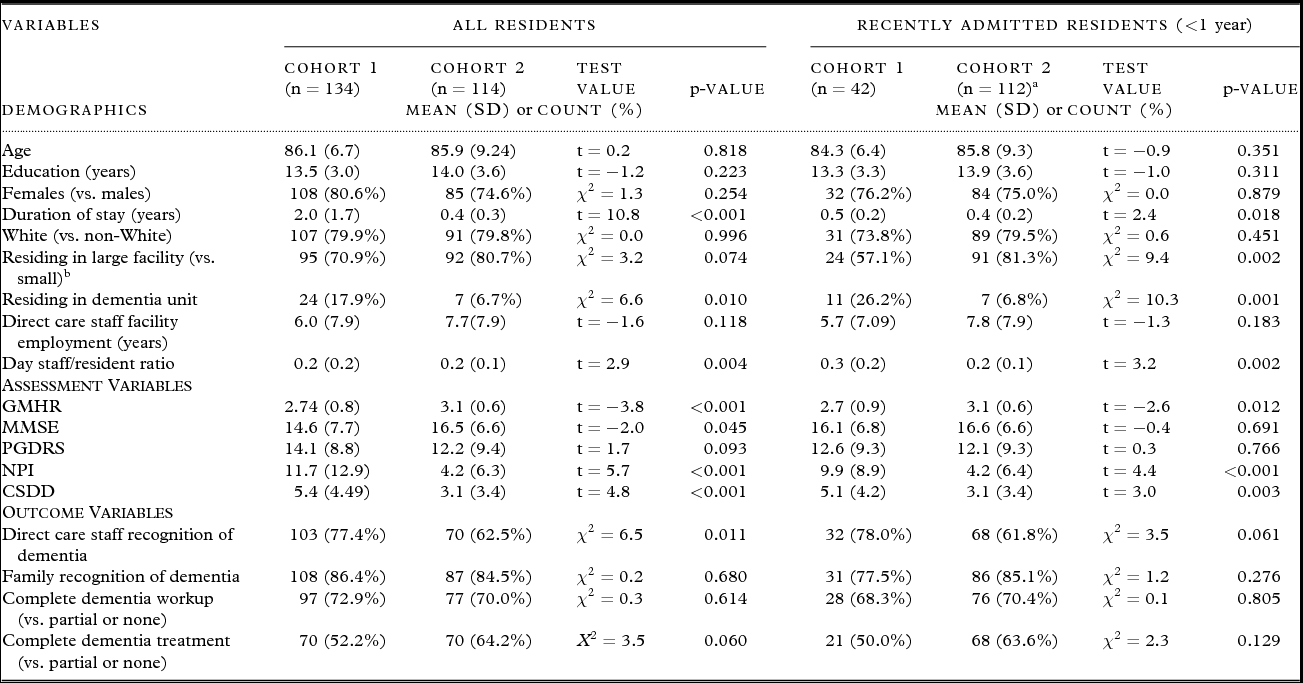
Table 1 presents cohort comparisons of demographics, facility assessment, and outcome variables. Among all the residents with dementia in both phases of the MDAL study, 78% were females, 80% were Caucasian, and 72% were widowed. The average age was 86 years (SD 8.0) and the mean years of formal education was 13 (SD 3.3). Eighteen percent of Cohort 1 participants were reported in dementia-specific units, compared to 7% of Cohort 2 participants (p = 0.010), while day staff-to-resident ratio was greater for Cohort 1 members (p = 0.004). The average duration of stay prior to time of assessment for Cohort 1 was approximately four times longer than Cohort 2 (2.00 years vs. 0.42 years; p < 0.001). Cohort 1 had lower general health ratings (p < 0.001), more impaired cognitive function (MMSE; p = 0.045), greater neuropsychiatric symptoms (NPI; p < 0.001), and higher levels of depressive symptoms (CSDD; p < 0.001). Cohort comparisons among the subgroups of residents with dementia admitted <1 year at the time of initial evaluation are also presented in Table 1 and showed similar contrasts between cohorts as analyses of the full group.
Comparisons of demographic and assessment variables among cohorts of AL residents with dementia

Notes: Staff to resident ratio (day) = sum of daytime AL resident care workers/number of residents; GMHR: General Medical Health Rating; MMSE: Mini-Mental State Examination; PGDRS: Psychogeriatric Dependency Rating Scale; NPI: Neuropsychiatric Inventory; CSDD: Cornell Scale for Depression in Dementia.
an = 112, two participants enrolled in Cohort 2 had admission dates >1 year prior to assessment.
bLarge facility defined as ≥15 beds.
Overall, staff and families correctly recognized dementia in 70% (n = 173/245, missing data n = 3) and 85% (n = 195/228; missing data n = 20) of individuals, respectively, who met criteria for dementia in the MDAL study (n = 248), with corresponding false negative rates (i.e. missed cases) of 30% (n = 72) and 15% (n = 33), respectively. Collectively, 28% of the residents with dementia had an incomplete workup and 42% were not receiving complete treatment. Staff recognition of dementia was better in Cohort 1 (77% vs. 63%, p = 0.011), with no significant differences in family recognition (86% vs. 85%, p = 0.680), or complete dementia workup (73% vs. 70%; p = 0.614). Although cohort differences did not reach statistical significance, there was a trend toward Cohort 2 having a greater proportion of complete treatment ratings compared to Cohort 1 (64% vs. 52%, p = 0.060). In comparisons restricted to those admitted <1 year (mean length of stay prior to admission = 4 months), no statistically significant cohort differences were found in staff or family dementia recognition rates, nor in whether complete dementia workup or complete dementia treatment was received.
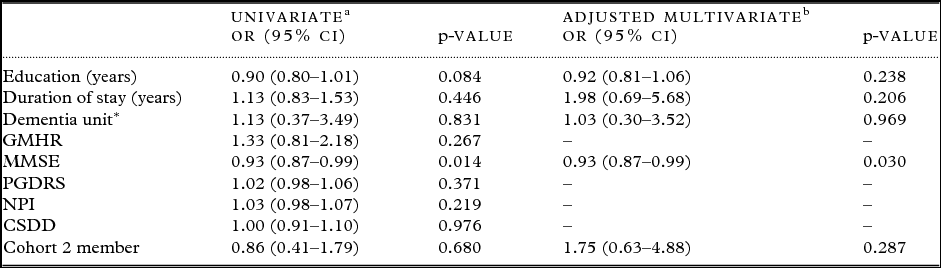
Table 2 presents univariate and multivariate logistic regression results for family recognition of dementia. Being a member of Cohort 2 did not have any significant main effect on family recognition. MMSE was the only factor significantly associated with odds of family recognition of dementia in univariate and multivariate models. Estimates suggest that a 5-point increase in MMSE would correspond to 32% (0.935 = 0.696; p = 0.014) decrease in the odds of family member recognition of dementia. We also found a significant interaction between cohort and NPI (interaction term, odds ratio (OR) = 1.70, p = 0.019) in the model testing whether cohort moderated the effect between NPI and family recognition.
Odds ratios (OR) for family recognition of dementia
Notes: Staff to resident ratio (day) = sum of daytime AL resident care workers/number of residents; GMHR: General Medical Health Rating; MMSE: Mini-Mental State Examination; PGDRS: Psychogeriatric Dependency Rating Scale; NPI: Neuropsychiatric Inventory; CSDD: Cornell Scale for Depression in Dementia; CI: Confidence Interval.
aAge, sex, race, facility size, years direct care staff is employed at facility, and day staff/resident ratio did not reach statistical significance in univariate models.
bAll multivariate models are adjusted for duration of stay, residing in a dementia unit, and MMSE.
*Dementia unit: Residence in area or facility that provides specialized dementia programming.
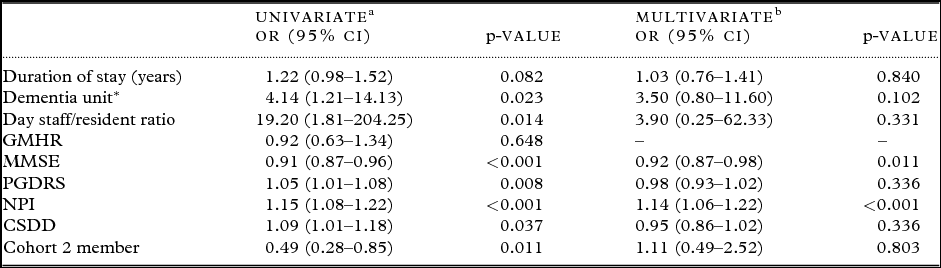
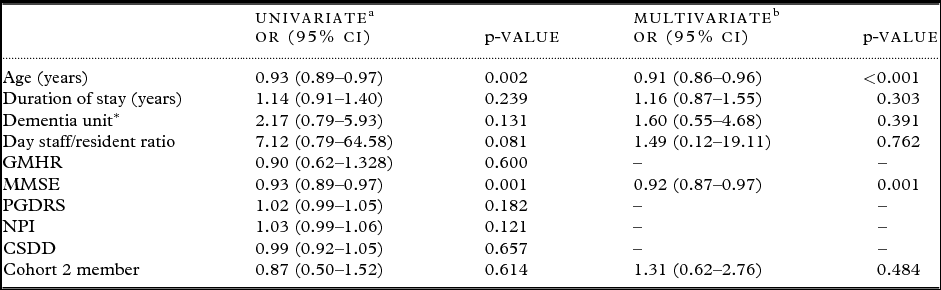
Likelihood of direct care staff recognition (Table 3) of dementia was reduced for Cohort 2 members in the univariate logistic models. However, in adjusted multiple logistic regression, only MMSE and NPI scores remained significant predictors of direct care staff recognition of dementia after including cohort and other variables. A 5-point increase in NPI (1.145 = 1.925) would correspond to an estimated two-fold increase in the odds of caregiver recognition. Again, we found a significant interaction between cohort and NPI (interaction term OR = 1.51, p = 0.001) in the model testing whether cohort moderated the effect between NPI and staff recognition. Table 4 shows the correlates of having a complete dementia workup. The odds of having a complete workup for dementia was reduced in persons who were older and those with higher MMSE scores in univariate analyses, but cohort membership was not a significant univariate predictor (p = 0.614). After including cohort and other covariates in the multivariate model, age and MMSE were still significant predictors of having a complete dementia workup. A five-year increase in age (0.915 = 0.624; p = 0.001) was associated with an estimated 38% decreased likelihood of having a complete dementia workup. Although there seemed to be a trend toward higher likelihood of workup in facilities with greater staff-to-resident ratios, this did not meet statistical significance. No interactions were significant for this outcome.
Odds ratios (OR) for direct care staff recognition of dementia
Notes: Staff to resident ratio (day) = sum of daytime AL resident care workers/number of residents; GMHR: General Medical Health Rating; MMSE: Mini-Mental State Examination; PGDRS: Psychogeriatric Dependency Rating Scale; NPI: Neuropsychiatric Inventory; CSDD: Cornell Scale for Depression in Dementia; CI: Confidence Interval.
aAge, education, sex, race, and years caregiver is employed at facility did not reach statistical significance in univariate models.
bAll multivariate models are adjusted for duration of stay, residing in a dementia unit, and MMSE.
*Dementia unit: Residence in area or facility that provides specialized dementia programming.
Odds ratios (OR) for complete dementia workup
Notes: Staff to resident ratio (day) = sum of daytime AL resident care workers/number of residents; GMHR: General Medical Health Rating; MMSE: Mini-Mental State Examination; PGDRS: Psychogeriatric Dependency Rating Scale; NPI: Neuropsychiatric Inventory; CSDD: Cornell Scale for Depression in Dementia; CI: Confidence Interval.
aEducation, sex, race, and years staff is employed at the facility did not reach statistical significance in univariate models.
bAll multivariate models are adjusted for duration of stay, residing in a dementia unit, and MMSE.
*Dementia unit: Residence in area or facility that provides specialized dementia programming.
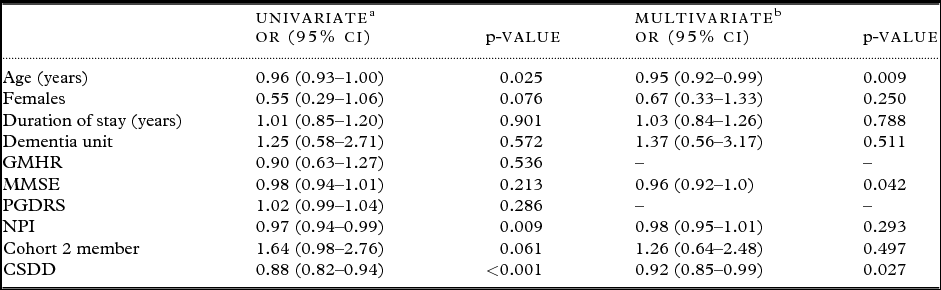
The odds of complete dementia treatment (Table 5) were not significantly associated with facility variables. Being older decreased the odds of having a complete dementia treatment rating. Being a member of Cohort 2 tended to be associated with increased odds of having a complete dementia treatment rating in the univariate model; however, this did not reach statistical significance (p = 0.061). In multivariate analysis, increased age, MMSE, and depression levels were found to be significantly correlated with the lack of treatment after entering cohort and other covariates. No interactions were significant for this outcome.
Odds ratios (OR) for complete dementia treatment
Notes: Staff to resident ratio (day) = sum of daytime AL resident care workers/number of residents; GMHR: General Medical Health Rating; MMSE: Mini-Mental State Examination; PGDRS: Psychogeriatric Dependency Rating Scale; NPI: Neuropsychiatric Inventory; CSDD: Cornell Scale for Depression in Dementia; CI: Confidence Interval.
aEducation, race, years staff employed at facility, and day staff/resident ratio did not reach statistical significance in univariate models.
bAll multivariate models are adjusted for duration of stay, residing in a dementia unit, and MMSE.
Discussion
This was the first study to objectively evaluate differences in detection and treatment of dementia in AL using physician-based examinations between two successive cohorts of AL residents in the context of interim statewide regulatory changes relevant to improving dementia care quality (i.e. revision to resident assessment tool to better detect and monitor cognitive and behavioral indicators). Direct care staff recognition of dementia was lower among Cohort 2 residents compared to Cohort 1, but this was no longer significant once confounding variables such as dementia severity and duration of stay were considered. We did find in exploratory moderation analyses that for Cohort 2, the probability of staff and family detection of dementia was significantly greater as NPI score increased compared to Cohort 1, suggesting that Cohort 2 families and staff may have been more aware that behavioral problems indicated dementia. The finding that in general there were few cohort differences in dementia care indicators, after accounting for covariates, was counter to our hypothesis that revision of the mandatory resident assessment tool would yield improved dementia detection and treatment for Cohort 2, especially direct care staff detection. While it is possible that had we measured dementia recognition among AL nurse managers or those staff responsible for completion of the assessment tool, we may have observed improved recognition, the lack of change in recognition rates between cohorts still underscores the fact that critical information about residents’ memory and behavioral problems captured on resident assessment forms may not be getting communicated adequately or accessed by the front line staff who provide the day-to-day hands-on care to residents.
In line with prior analyses limited to Cohort 1 (Maust et al., Reference Maust2006), lower cognitive scores and greater neuropsychiatric symptoms resulted in increased odds of staff recognition of dementia, which is not unexpected considering that these symptoms likely demand greater care intensity and time from the staff. Higher staff-to-resident ratios was also associated with improved recognition. In terms of overall dementia workup, we found little evidence of cohort differences, with a complete dementia workup lacking in roughly one-third of dementia patients for either cohort. A slight trend toward improved dementia treatment rates in Cohort 2 compared to Cohort 1 (64% vs. 52%, p = 0.06) was observed, but this association was mitigated after accounting for dementia severity and duration of stay. Therefore, we were unable to detect a clear effect of the 2004 assessment tool modifications on improving rates of complete workup or treatment in this AL resident sample.
Having more symptoms of depression was associated with incomplete dementia treatment ratings. This suggests that the consensus panel felt that these dementia-related depressive symptoms might have been more adequately managed, either by initiation of available non-pharmacological interventions, behavioral therapies, and/or pharmacological approaches or by maximizing the interventions already in place to the extent possible for that individual. Further, we also found that older residents were less likely to receive complete dementia workup and treatment ratings. This may reflect broader societal stigma and misconceptions that symptoms of dementia are aspects of the normal aging process and therefore receive less attention than the same symptoms in younger individuals. It is also possible that other factors not measured here, such as frailty or poly-pharmacy, may have complicated pharmacological dementia treatment in the older individuals; however, this would not preclude the lack of first-line non-pharmacological interventions (Ruckdeschel and Katz, Reference Ruckdeschel and Katz2004).
These data are limited by potential sources of bias. First, this study focused on Maryland and thus the results may not be generalizable, given the national variation in AL and regulatory policies related to dementia care. However, this sample is quite similar demographically to data reported from national studies of AL residents (Hawes et al., Reference Hawes, Phillips, Rose and Mollica2000). Second, this was a secondary analysis that took advantage of a natural experiment, and thus was not a randomized design or powered specifically to examine differences in cohorts of dementia detection and treatment. As such, there were important differences between the cohorts on duration of stay and dementia severity, which are known to be associated with the outcome variables. We addressed this by performing a sensitivity analysis (limiting both cohorts to those admitted <1 year prior to the evaluation) and also by examining the effect of cohort membership in multiple logistic regressions, which statistically adjusted for these variables. These observed cohort differences on key explanatory variables, particularly those showing that Cohort 2 residents were less cognitively impaired and behaviorally symptomatic than Cohort 1 residents even when restricting the comparisons to those admitted <1 year prior to evaluation, may suggest the increasing popularity of AL and that people are entering AL earlier in the disease trajectory than before. This hypothesis implies that routine dementia screening and monitoring may be even more important than in the past. Also, the measures examined were mainly resident-level variables rather than facility-level or primary care provider level. Therefore, there are likely other factors not included here, such as the frequency and type of AL staff dementia care training received, AL facility's compliance with Maryland's regulations, and primary care provider diagnostic and treatment, which play a role in dementia detection and treatment. Finally, this was a comparison of two cross-sectional cohorts, and while this data may provide information about general trends, it does not provide information about the individual's dementia detection and care over time within the AL setting.
In conclusion, we noted few cohort differences in dementia recognition and treatment rates after accounting for covariates, and conclude that rates of dementia recognition and treatment did not appear to change between residents assessed prior to and after Maryland's 2003 policy changes. While it was counter to our hypothesis, this is not surprising since the 2003 changes to the resident assessment tool items and disclosure statement requirements were only one step in a long-term approach to improve AL care quality in Maryland. In 2007, after completion of enrollment for the Maryland Assisted Living study, Maryland implemented major revisions to strengthen AL staff dementia and mental healthcare training requirements. Based on the findings from this study and others, it is our belief that dementia policies have to be multifaceted to impact on dementia care. Ideally, this would include the parallel use of initial and ongoing dementia screenings, person-centric dementia care needs assessments and care planning, greater involvement of mental health clinicians and family members in care, increased dementia competencies for frontline staff, and improved efficiency in communication of key medical and behavioral information between AL staff, families, and health providers. We suggest that the effects of dementia-related policies should bear continued investigation, perhaps by employing a similar epidemiological approach, to evaluate changes in trends of dementia care indicators over time. Attention should also be given to empirical evaluation of the effectiveness of AL staff dementia care training programs, since the content and quality of staff dementia care training can vary widely (Teri et al., Reference Teri2010).
Conflict of interest
None
Description of authors’ roles
Drs. McNabney and Brandt participated in the acquisition of data and preparation of the paper. Drs. Rosenblatt and Lyketsos participated in concept and design, acquisition of data, and preparation of the manuscript. Dr. Mayer participated in concept and design, data analysis, and preparation of the paper. Ms. Vavilikolanu participated in data analysis and preparation of the manuscript. Dr. Samus participated in concept and design, acquisition of data, analysis of data, and preparation of the manuscript.
Acknowledgments
This project was supported by Grants R01MH60626 and K01MH085142 from the National Institute of Mental Health (NIMH) and the National Institute on Aging (NIA). We are grateful to the MDAL study team for their fieldwork in evaluating the participants. We wish to thank study participants, their families, and the management and staff of the participating AL facilities for their dedication and assistance in the development and implementation of the study.