Introduction
The great increase in wireless services such as cellular mobile communication, satellite, sonar, and radar in recent years has made it necessary to use the existing frequency spectrum efficiently. Since the desired radiation patterns cannot be obtained with a single antenna, antenna arrays capable of effective and directed radiation are formed by combining multiple antennas. Antenna arrays must be designed optimally and accurately in order to have features such as high directivity and signal gain with an extended coverage. The positions, amplitudes, and phase angles of the elements should be determined in order to increase the properties of the radiation patterns of antenna arrays in the far-field. The region in the direction of maximum radiation is named as the main beam lobe. Side lobes other than the main lobe need to be eliminated. However, in practical applications, they can only be suppressed as much as possible [Reference Balanis1]. The main purpose of creating a radiation model with a lower maximum side lobe level (MSL) is to prevent interference from other communication systems operating in the same frequency band. Half-power beam width (HPBW) is the angle at which the main beam decreases 50% or 3 dB from its peak value. In addition, a radiation pattern with a narrow HPBW shall be needed to provide the high directivity required to communicate with long distances. However, it is very difficult to design an antenna array with both narrower HPBW and lower MSL values. Because while improving HPBW value, MSL value gets worse. Of course, the opposite is also true, which means that it is very difficult to obtain narrower HPBW while lowering the MSL value. Therefore, despite the increase in electromagnetic pollution, it has become possible to design an antenna array with low MSL and narrow HPBW with the help of metaheuristic algorithms [Reference Mailloux2].
Antenna arrays can take different names according to their geometric features such as linear, circular, and elliptical. Linear antenna arrays (LAAs) have a structure where elements are positioned along a linear line and are one of the most preferred geometries in the literature due to their simplicity. In the last decade, several studies have been done on LAA synthesis, an important electromagnetic problem. Plant growth simulation algorithm was used for the pattern nulling of LAA by amplitude control [Reference Guney, Durmus and Basbug3]. Dib proposed a symbiotic organisms search (SOS) method for the design of linear array patterns with low MSL [Reference Dib4]. The biogeography-based optimization (BBO) method is utilized to synthesize linear and elliptical antenna arrays [Reference Sharaqa and Dib5]. Khodier and Al-Aqeel proposed a particle swarm optimization (PSO) algorithm to adjust the amplitude, phase and location of linear and circular array elements for optimum radiation patterns [Reference Khodier and Al-Aqeel6]. Taguchi's optimization method and self-adaptive differential evolution algorithms are implemented to suppress the MSL and perform null steering for LAA by controlling different parameters of the array elements [Reference Dib, Goudos and Muhsen7]. Das et al. adopted moth flame optimization (MFO) to design linear and circular antenna array (CAA) for side lobe reduction [Reference Das, Mandal, Ghoshal and Kar8]. Runner-root algorithm (RRA) is used to reduce MSL and null depths in LAAs [Reference Subhashini9]. Prabhakar and Satyanarayana proposed a hybrid salp swarm whale optimization algorithm and experimented on typical benchmark functions and cylindrical conformal antenna array synthesis [Reference Prabhakar and Satyanarayana10]. Adaptive flower pollination algorithm (AFPA) is used to optimize linear array elements in order to obtain minimum MSL [Reference Salgotra, Singh, Saha and Nagar11]. Almagboul et al. implemented atom search optimization algorithm to suppress MSL and steering the null in the radiation pattern of LAAs [Reference Almagboul, Shu, Qian, Zhou, Wang and Hu12].
In addition, with the rapid developments in communication systems, the optimum design of antenna arrays with complex geometries such as CAAs has become an important requirement in the literature. Panduro et al. proposed a genetic algorithm (GA) to design non-uniform CAAs for side lobe reduction [Reference Panduro, Mendez, Dominguez and Romero13]. PSO is used to synthesize non-uniform CAAs to obtain minimum MSL [Reference Shihab, Najjar and Khodier14]. Rattan et al. proposed a simulated annealing (SA) method for the optimization of CAAs of isotropic radiators [Reference Rattan, Patterh and Sohi15]. Khodier and Al-Aqeel implemented cuckoo search (CS) algorithm to minimize MSL with and without null steering in the design of CAAs [Reference Khodier16]. BBO is employed to determine the amplitude and position of the CAA elements to provide a radiation pattern with a reduced MSL [Reference Singh and Kamal17]. Sharaqa and Dib applied firefly algorithm (FA) to design CCA and concentric CAA (CCAA) by adjusting the amplitude and positions of the elements to reduce MSL [Reference Sharaqa and Dib18]. Parallel implementation of seeker optimization algorithm (SOA) is proposed to design CAA and CCAA with the low MSL at a fixed beam width [Reference Guney and Basbug19]. Ram et al. proposed a cat swarm optimization (CSO) for CAA and CCAA synthesis by adjusting current excitation weights and inter-element separations [Reference Ram, Mandal, Kar and Ghoshal20]. Taguchi method is applied to design CAA for reduced MSL [Reference Babayigit and Senyigit21]. Improved chicken swarm optimization is proposed to suppress the MSL of LAA, CAA, and random antenna arrays [Reference Sun, Zhao, Liang, Liu, Zhou and Zhang22]. Zheng et al. adopted improved invasive weed optimization with random mutation and Lévy flight algorithm to design LAAs and CAAs with lower MSL and narrower main lobe beam [Reference Zheng, Liu, Sun, Zhang, Liang, Wang and Zhou23].
Different number of array elements are used to synthesize LAA and CAA in various studies. In order to compare the proposed method consistently with most of the existing studies in the literature, the number of elements of the antenna arrays is specifically determined in our article. In this study, first, 10-element, 16-element, and 24-element LAA synthesis is performed. The amplitudes of the antenna array elements are determined by using equilibrium optimization algorithm (EOA) [Reference Faramarzi, Heidarinejad, Stephens and Mirjalili24]. EOA, a very recent metaheuristic algorithm, is used for the first time in LAA and CAA synthesis in this study. The results achieved with EOA are compared with the outcomes of other algorithms in the literature for LAA design. In addition, the position (inter-element spacing) and the phase values of the array elements are λ/2 and zero, respectively. Second, the position and amplitude values of the eight-element, 10-element and 12-element non-uniform CAAs are determined using EOA. The MSL and HPBW values achieved with the proposed method EOA are compared with the results of the well-known algorithm in the literature for non-uniform CAA. The aim of this study is to obtain radiation patterns with lower MSL and narrower HPBW for linear and CAA design by using EOA. The EOA is inspired by the models of the control volume mass balance used to predict equilibrium as well as dynamic states. EOA is an algorithm that functions on the volume of control according to the effect of dynamic mass balance. In this algorithm, a mass balance equation is used to measure the number of mass inputs. In order to find the equilibrium of the system, the most suitable one among the volumes generated is determined. The EOA algorithm has many advantages such as having an easy and flexible application structure, differentiation of possible solutions (individuals) in the search space, creating a good balance between exploration and exploitation operators [Reference Faramarzi, Heidarinejad, Stephens and Mirjalili24]. Extensive experiments show that EOA has superior performance in designing optimal LAA than SOS, BBO, PSO, Taguchi, and MFO methods. Moreover, the results achieved by EOA for designing optimal CAA are significantly better than GA, PSO, SA, BBO, FA, SOA, CSO, Taguchi, and MFO methods. The numerical results show that EOA has better results than existing methods in terms of obtaining lower MSL and narrower HPBW.
The rest of this paper is organized as follows: EOA is briefly described in section “Equilibrium optimization algorithm”. In section “Design of antenna optimization problems”, the design of LAA and CAA is examined. Numerical results obtained with EOA are given in comparison with the results of other optimization algorithms in section “Numerical results”. Finally, section “Conclusions” concludes the paper.
Equilibrium optimization algorithm
Meta-heuristic algorithms are used to search the domain globally to find optimal solutions and have many applications in various fields [Reference Kurban, Civicioglu, Kurban and Besdok25]. EOA, proposed by Faramarzi et al., is inspired by the models of volume regulation mass balance which are used to approximate dynamic as well as equilibrium states [Reference Faramarzi, Heidarinejad, Stephens and Mirjalili24]. Each particle in EOA, referred as a possible solution, works as a search agent with its concentration or position. Such agents change their concentration correlated with best-so-far solutions, referred as equilibrium candidates, arbitrarily to achieve the state of equilibrium or the optimal result. The phrase “generation rate” changes the behavior of exploration and exploitation. EOA differs from the comparison algorithms used in this paper with its unique elitism operator. In [Reference Faramarzi, Heidarinejad, Stephens and Mirjalili24], it is statistically proved that EOA is better than GA, PSO; grey wolf optimizer, gravitational search algorithm, and salp swarm algorithm; evolution strategy with covariance matrix adaptation (CMA-ES), success history-based parameter adaptation differential evolution (SHADE), SHADE with linear population size reduction hybridized with semi-parameter adaptation of CMA-ES on numerous unimodal, multimodal, and composition functions and engineering application problems.
Initialization phase
In EOA, an initial concentration population is created with uniform randomization, based on the number of particles and dimensions in equation 1. Generation of the initial population in EOA method is important because it affects the search space of iterations.

$C_i^{initial}$ is the initial position vector of ith particle, C min and C max are the dimension boundary limits, rand i is a randomized variable within the range of [0,1], and n is the population size of particles. Every population particle is evaluated sequentially, and the fitness values are determined.
Equilibrium candidates
Equilibrium state is the global optimum of the problem and C eq is the final state of the convergence. In EOA, as given in equation 2, there are four best-so-far particles and plus another calculated particle, that is, the average of four particles is identified as equilibrium candidates. Equation 2 is significant because the first four candidates help EOA for better exploration ability while the averaged one helps in exploitation:

All the particles update their concentration by selecting randomly one among the candidates.
Exponential term
Concentration updating is realized by the exponential term (F) to ensure the EOA has a reasonable balance between exploration and exploitation by using equations 3 and 4.


where t is a function of iteration, a 1 and a 1 are constant values used to manage the ability of exploration and exploitation, sign is the direction, r and λ are random vectors, respectively. Recommended values for a 1 and a 1 are equal to 2 and 1, respectively.
Generation rate
Equations 5–7 calculate the generation rate term which provides the exact solution by improving the exploitation phase:


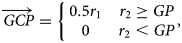
where $\vec{G}_0$ is the initial value, r 2 and r 1 are random numbers between 0 and 1, GCP is the generation rate control parameter, GP is the generation probability. A good equilibrium is reached by using GP = 0.5, between exploration and exploitation.
At final, the updating rule of EOA is given in equation 8.

where V is the unit. The significance of equation 8 can be summed up as follows:
• The first term is a global optimum candidate, the second and the third terms are control combinations.
• Second term contributes more to the exploration by taking advantage of the direct difference between a sample particle and an equilibrium candidate.
• Third term contributes more to exploitation from small variations in concentration.
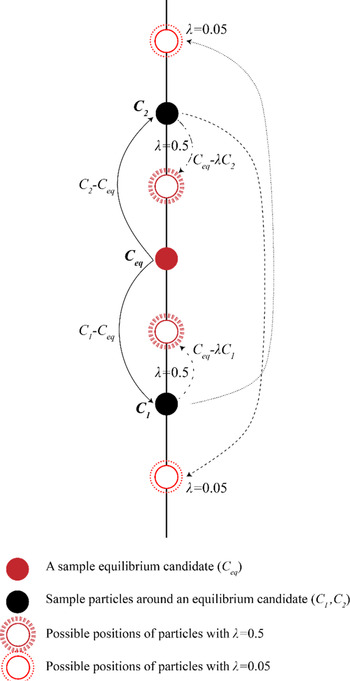
Figure 1 shows a 1D visualization of working mechanism of the main equation terms. C 1 − C eq represents the second term of the final equation and C eq − λC 1 represents the third term of the updating rule of EOA.
One-dimensional visualization of population modifying their positions.

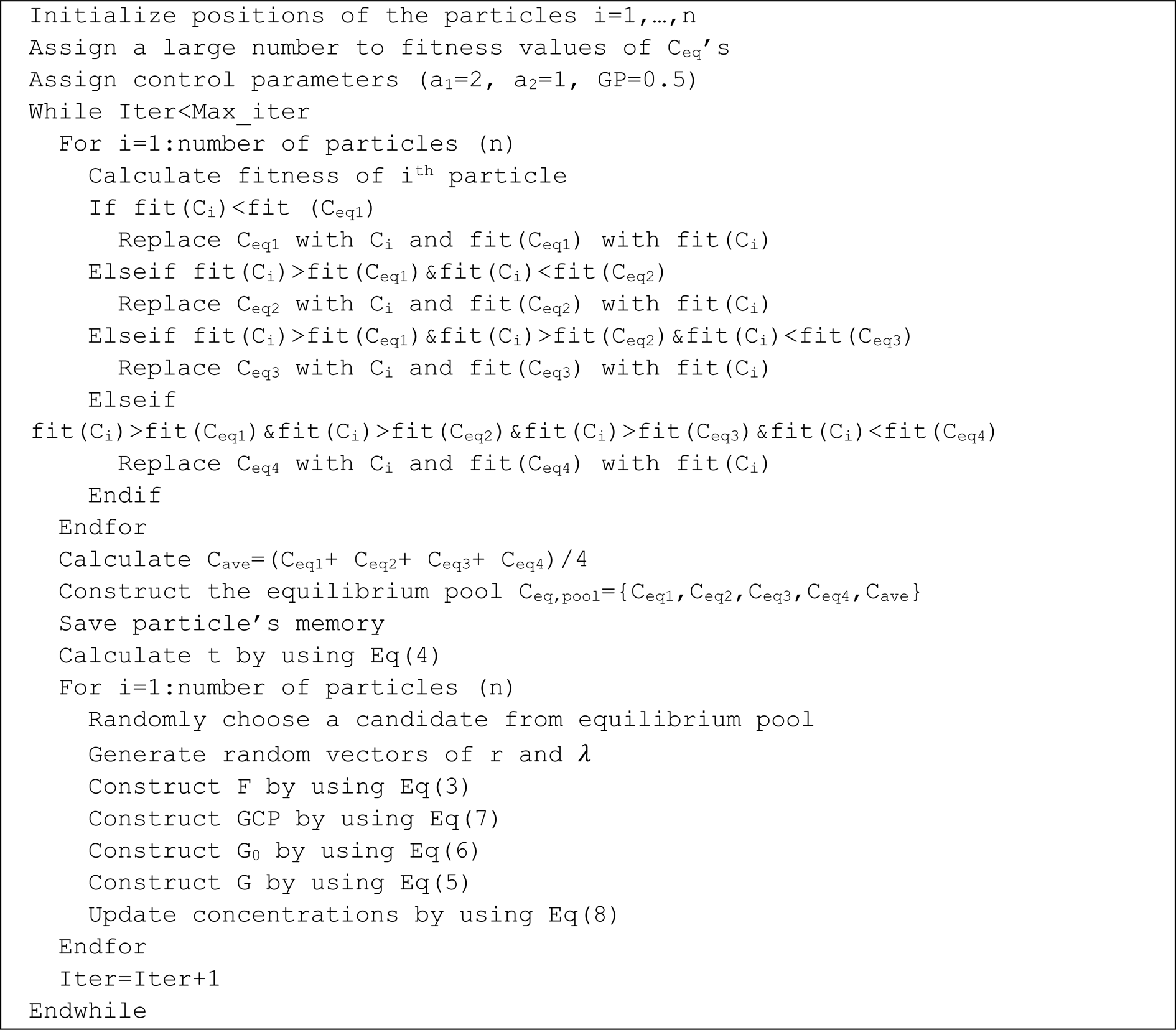
EOA has a memory-saving technique to help every particle keep track of its location in space with its fitness value. This technique adds to the potential of exploitation; however, it can raise the risk of being trapped into a local minimum. Detailed pseudo code of EOA is given in Fig. 2.
Pseudo code of EOA.

Design of antenna optimization problems
Linear antenna array
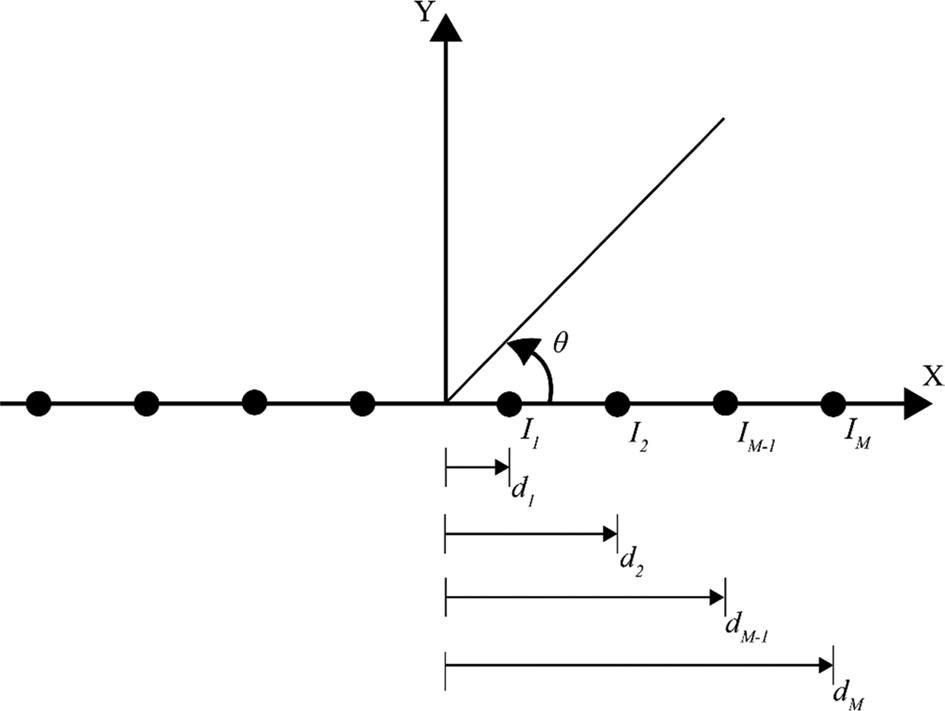
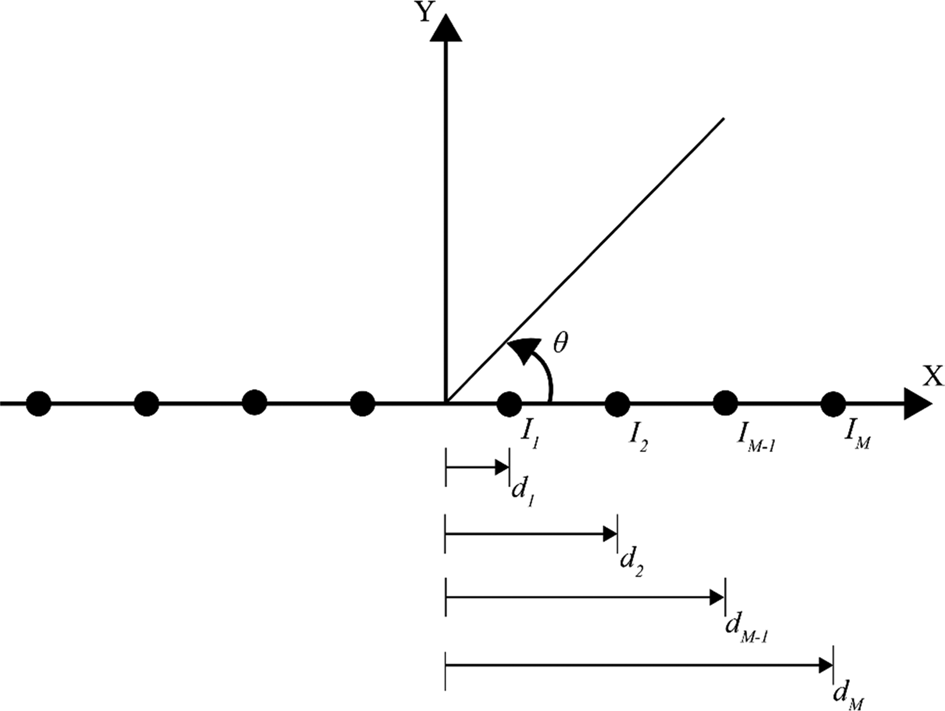
The LAA with the 2M isotropic array element is positioned symmetrically in two sections along the x-axis with M elements as illustrated in Fig. 3. The distance between the elements in this array is determined as λ/2. The all-phase excitation weights are set to zero in the antenna array.
M-element linear antenna array.
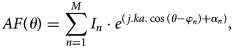
The antenna array factor, given in equation 9, was obtained by assuming that the amplitude coefficients of the array elements are symmetrical around the origin [Reference Balanis1].

where I n and υn are the amplitude and phase excitation weight of nth element in the array, respectively. The wave number is k and spacing between the array elements is d. θ is the angle of scanning. The M value here is half the total number of elements in the LAA.
Circular antenna array
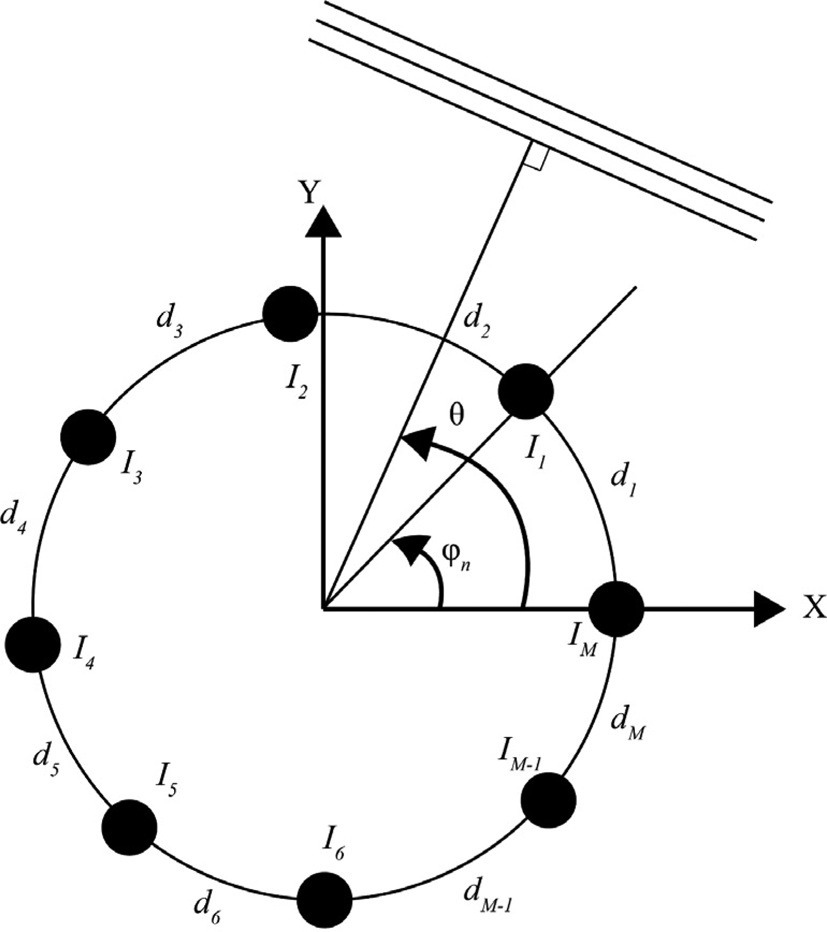
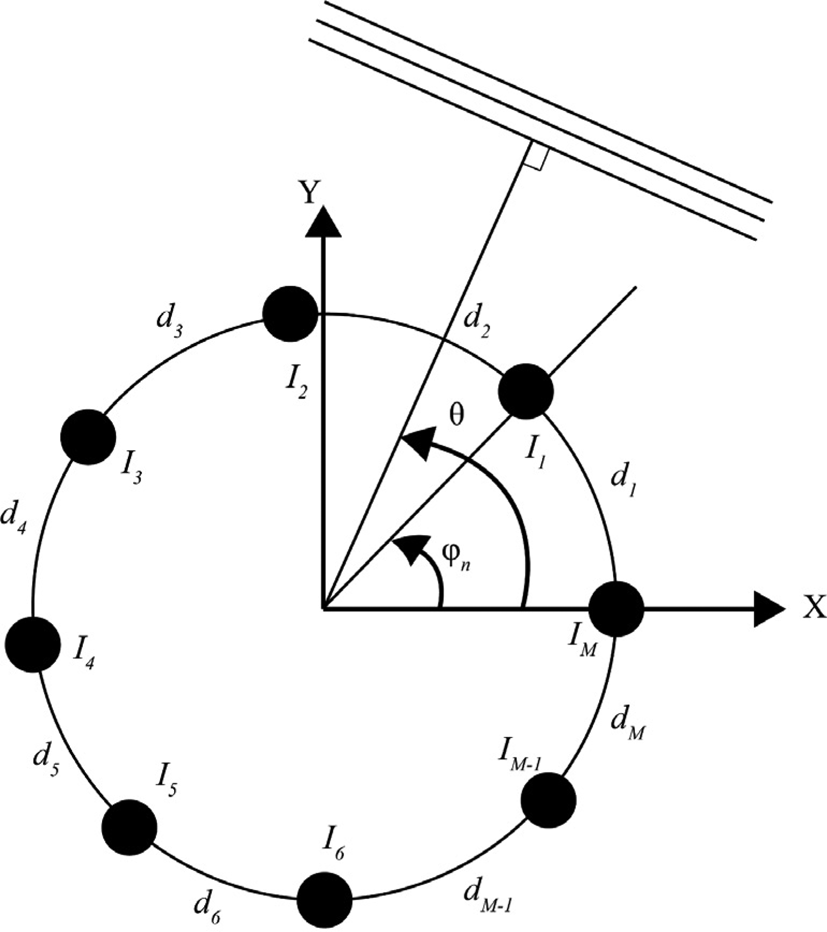
Figure 4 illustrates the structure of CAA with M isotropic elements placed non-uniformly on a circle. The radius of the circle placed in the x-y plane is a, and all elements in this structure exhibit similar radiation properties (isotropic source).
M-element circular antenna array.
The array pattern of CAA can be defined by its array factor. The CAA's array factor (AF) can be described as in equations 10–13 [Reference Balanis1].

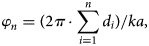

where α n and In are the phase and excitation amplitude of the nth array element, respectively. d i is the distance between the two antenna array elements. The number of waves is denoted by k. The nth array element angular position in the x-y plane is denoted by φ n. The M value indicates the total number of elements of the CAA on the ring.
Cost function formulation
The most important element in antenna array design is the creation of antenna structures that communicate with long distances and are not affected by interference from other communication systems operating in the same frequency band. In order to achieve this, it is necessary to design antenna arrays to obtain radiation patterns with lower MSL and narrower HPBW values. In addition, another important parameter in the application of the antenna design is the physical size of the antenna and this value is desired to be low in designs. The purpose of this article is to determine the position and amplitude values of the array elements by the EOA to obtain the radiation diagram with the lowest MSL and the narrowest HPBW values in order to make optimum antenna design. In order to achieve the optimum antenna synthesis, it is important to design an appropriate cost function to reduce MSL and HPBW. The desired radiation pattern can be obtained by using the cost function given in equation 14.

where F MSL and F HPBW are the weight factors. M MSL and M HPBW are the functions used to decrease HPBW and suppress the MSL values, respectively. The F MSL function can be formulated as in equation 15.

where φ n1 and φ n2 are the two angles at the first nulls on each side of the main beam. μ MSL(φ) can be given in equation 16.

where MSL d is the desired value of MSL. ɛ 0(φ) is the array factor in dB. The function M HPBW can be formulated as in equation 17.

where M HPBWmax and M o are the desired maximum HPBW and the value of HPBW obtained by EOA, respectively.
Numerical results
In this study, the analysis of antenna arrays with two different geometries, linear and circular, is performed. In the first group of examples, the amplitude values of the LAA elements with 10, 16, and 24 elements are optimally determined by EOA. In the second group of examples, EOA is used to optimize the amplitude and position values of the CAA having 8, 10, and 12 elements. The aim of all simulation examples is to achieve the radiation patterns with narrower HPBW and lower MSL values. All the results in this paper are obtained using a computer with 16 GB RAM and 2.6 GHz i7 processor in MATLAB. In all simulation examples, the population number of the EOA method is fixed to 40.
Optimum design of LAA
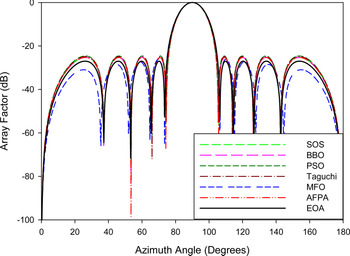
In the first example, the amplitudes of the 10-element symmetric LAA are determined by using the EOA method to perform the optimum design. Figure 5 shows the radiation patterns obtained with EOA and other optimization algorithms. The reduced MSL and HPBW values achieved by using EOA, SOS [Reference Dib4], BBO [Reference Sharaqa and Dib5], PSO [Reference Khodier and Al-Aqeel6], Taguchi [Reference Dib, Goudos and Muhsen7], MFO [Reference Das, Mandal, Ghoshal and Kar8], and AFPA [Reference Salgotra, Singh, Saha and Nagar11] are listed in Table 1.
Array pattern for 10-element LAA design.

Comparative results in terms of MSL and HPBW values for 10-element LAA design

The MSL and HPBW values of the array pattern achieved with EOA are −27.01 dB and 12.49°, respectively. As can be clearly seen from Table 1 and Fig. 5, the MSL value of the radiation pattern with EOA is better than the results of other compared algorithms. The HPBW value of EOA is better than MFO and it is very close to the HPBW value of other optimization algorithms.
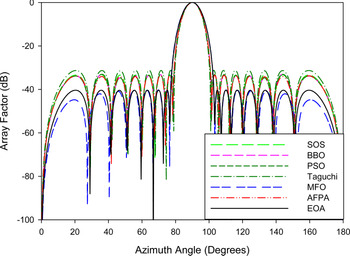
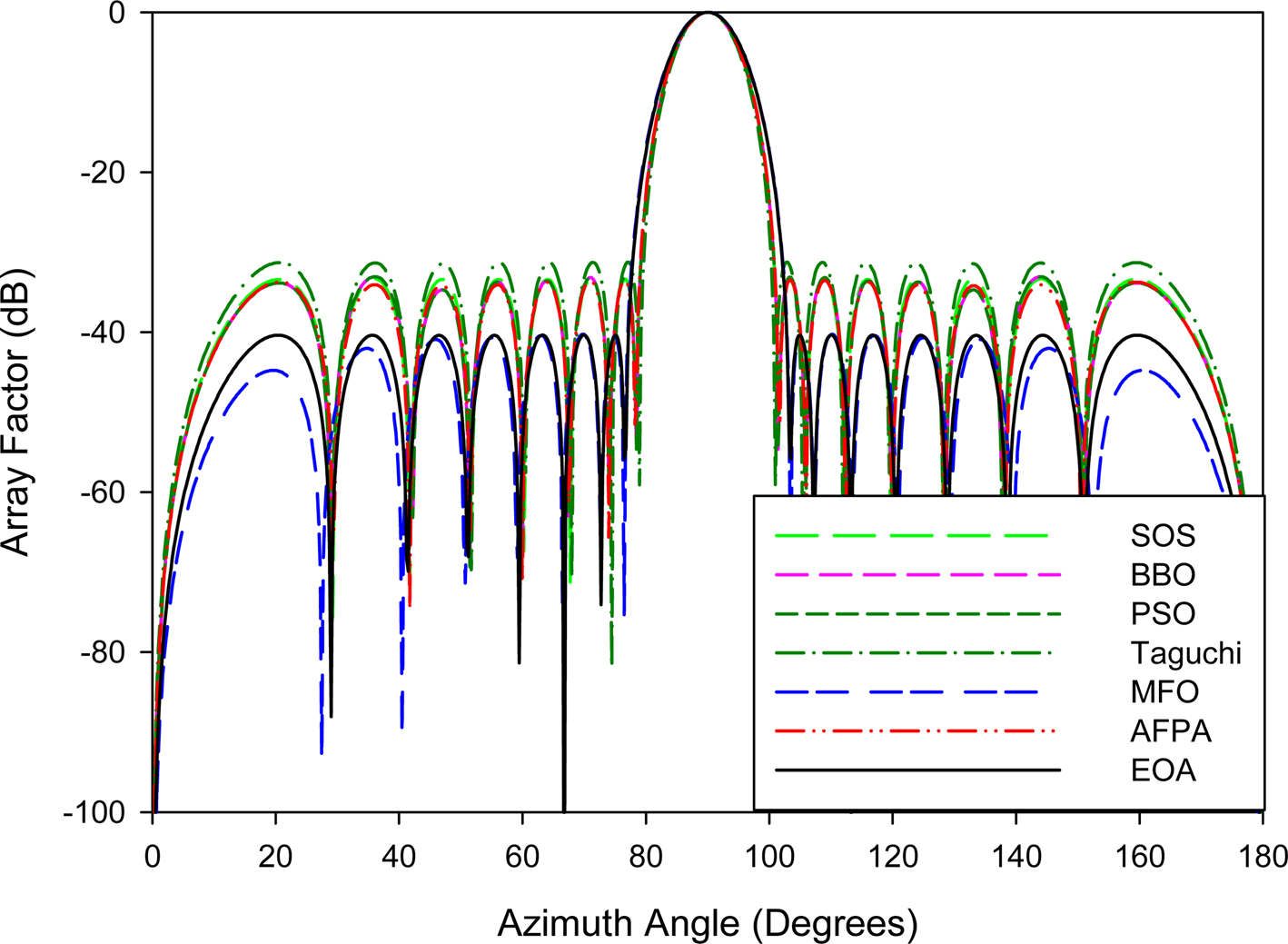
The number of elements of the LAA is determined as 16 in the second example. The radiation patterns achieved by using EOA, SOS [Reference Dib4], BBO [Reference Sharaqa and Dib5], PSO [Reference Khodier and Al-Aqeel6], Taguchi [Reference Dib, Goudos and Muhsen7], MFO [Reference Das, Mandal, Ghoshal and Kar8], and AFPA [Reference Salgotra, Singh, Saha and Nagar11] are illustrated in Fig. 6. MSL and HPBW values of 16-element LAAs are given in Table 2 comparatively.
Array pattern for 16-element LAA design.
Comparative results in terms of MSL and HPBW values for 16-element LAA design

It is apparent from Fig. 6 and Table 2, it can be seen that MSL values of radiation pattern obtained by using EOA are better than those of SOS [Reference Dib4], BBO [Reference Sharaqa and Dib5], PSO [Reference Khodier and Al-Aqeel6], Taguchi [Reference Dib, Goudos and Muhsen7], MFO [Reference Das, Mandal, Ghoshal and Kar8], and AFPA [Reference Salgotra, Singh, Saha and Nagar11]. All side lobe levels of the radiation pattern achieved with EOA are lower than −40.35 dB. The HPBW value of EOA method is 8.99°. The results of HPBW values achieved by SOS [Reference Dib4], BBO [Reference Sharaqa and Dib5], PSO [Reference Khodier and Al-Aqeel6], Taguchi [Reference Dib, Goudos and Muhsen7], MFO [Reference Das, Mandal, Ghoshal and Kar8], and AFPA [Reference Salgotra, Singh, Saha and Nagar11] are 8.28°, 8.28°, 8.00°, 8.28°, 9.00°, 8.38°, respectively.
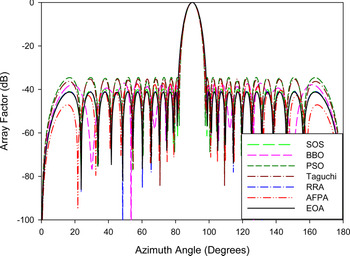
The number of elements chosen is 24 for LAA synthesis in the third example. The array patterns achieved by using EOA, SOS [Reference Dib4], BBO [Reference Sharaqa and Dib5], PSO [Reference Khodier and Al-Aqeel6], Taguchi [Reference Dib, Goudos and Muhsen7], RRA [Reference Subhashini9], and AFPA [Reference Salgotra, Singh, Saha and Nagar11] are plotted in Fig. 7. It is shown in Table 3 that the side lobe levels obtained by the EOA method are suppressed to −41.21 dB and the HPBW is 6°. The results of the SOS [Reference Dib4], BBO [Reference Sharaqa and Dib5], PSO [Reference Khodier and Al-Aqeel6], Taguchi [Reference Dib, Goudos and Muhsen7], RRA [Reference Subhashini9], and AFPA [Reference Salgotra, Singh, Saha and Nagar11] method show the MSL values of −39.37, −37.14, −34.46, 35.02, −41.08, and −37.19 dB, respectively, whereas the HPBW values are 6° for all the cases.
Array pattern for 24-element LAA design.

Comparative results in terms of MSL and HPBW values for 24-element LAA design

The amplitude values of elements optimally determined by using EOA for the synthesis of LAA with 10, 16, and 24 elements are listed in Table 4.
The amplitude values of LAA elements using EOA method

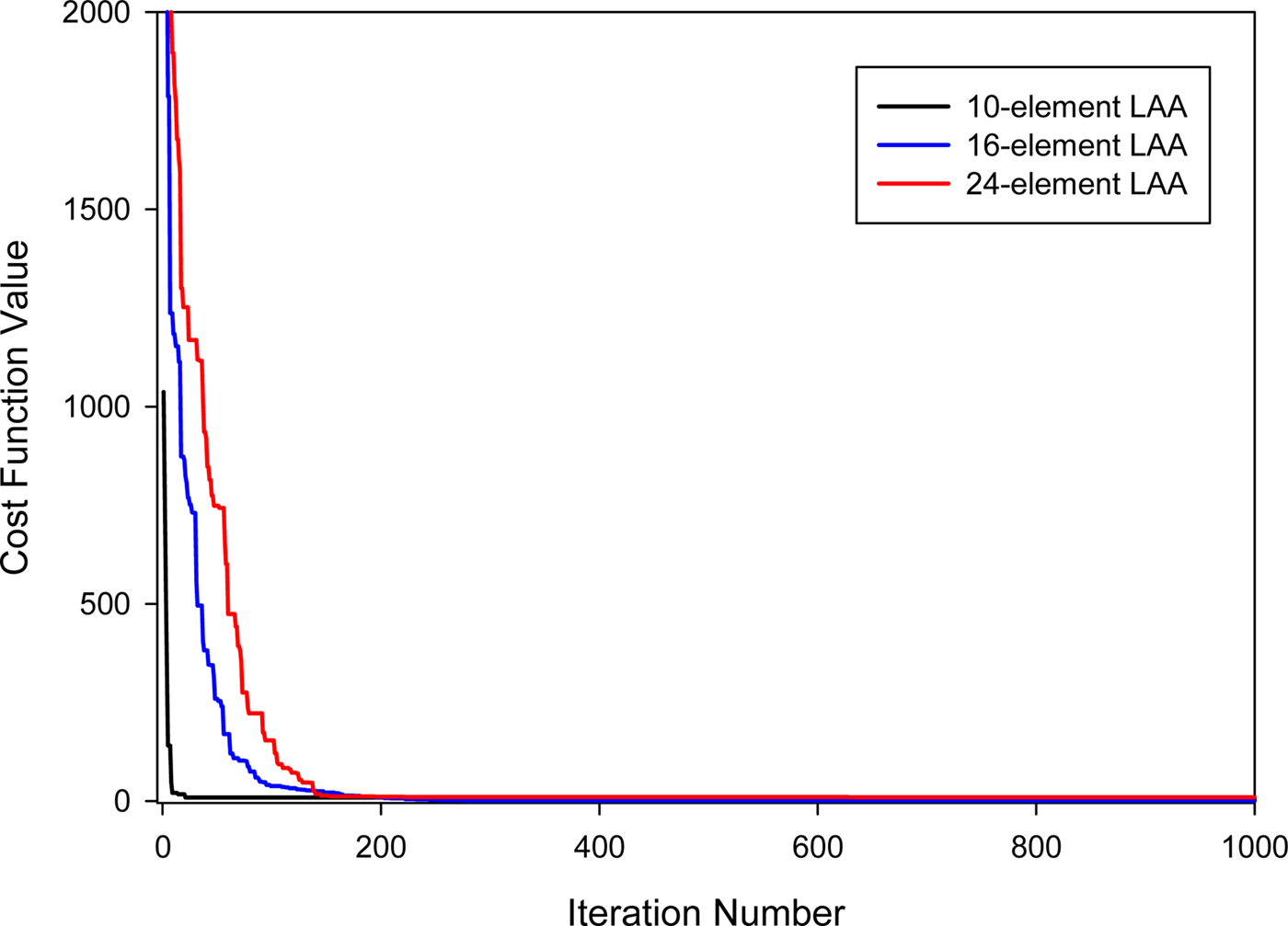
Figure 8 shows the converge curve of the LAA with 10, 16, and 24 elements by using EOA. As shown in Fig. 8, 10-element LAA problem converges earlier than those of others due to its low complexity.
Converge curve of LAA with 10, 16, 24 elements.

Optimum design of circular antenna array
In the optimum design of circular arrays, suppression of MSL plays an important role in preventing undesired interference. In the practical designs of circular arrays, the physical size of the antenna (di) is an important parameter and this value is desired to be very small. In addition, it also needs a narrower HPBW value for the circular array to have higher directionality.
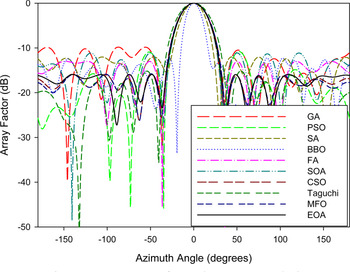
In the second group of examples, first, eight-element CAA synthesis is performed. The radiation pattern obtained by using the EOA method is shown in Fig. 9. For comparison purposes, array patterns obtained by using GA [Reference Panduro, Mendez, Dominguez and Romero13], PSO [Reference Shihab, Najjar and Khodier14], SA [Reference Rattan, Patterh and Sohi15], BBO [Reference Singh and Kamal17], FA [Reference Sharaqa and Dib18], SOA [Reference Guney and Basbug19], CSO [Reference Ram, Mandal, Kar and Ghoshal20], Taguchi [Reference Babayigit and Senyigit21], and MFO [Reference Das, Mandal, Ghoshal and Kar8] are also illustrated in Fig. 9. It is apparent from Fig. 9 and Table 5 that the results achieved by EOA are better than those of GA, PSO, FA, SOA, CSO, Taguchi, and MFO in terms of MSL and HPBW. Although the best values of HPBW are obtained by using SA and BBO, MSL values obtained by these algorithms are quite high for optimum design. The physical size of the antenna is the same in all algorithms except the value of BBO is quite large, which is undesirable for design.
Array pattern for 8-element CAA design.

Comparative results in terms of MSL, di, and HPBW values for 8-element CAA design

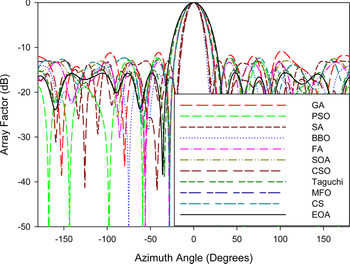
The optimum design problem of the 10-element CAAs is examined in the second example. The array patterns obtained with EOA and different meta-heuristic optimization algorithms are plotted in Fig. 10. In Table 6, the HPBW, di, and MSL values of array pattern achieved by EOA, GA [Reference Panduro, Mendez, Dominguez and Romero13], PSO [Reference Shihab, Najjar and Khodier14], SA [Reference Rattan, Patterh and Sohi15], BBO [Reference Singh and Kamal17], FA [Reference Sharaqa and Dib18], SOA [Reference Guney and Basbug19], CSO [Reference Ram, Mandal, Kar and Ghoshal20], Taguchi [Reference Babayigit and Senyigit21], MFO [Reference Das, Mandal, Ghoshal and Kar8], and CS [Reference Khodier16] are tabulated.
Array pattern for 10-element CAA design.

Comparative results in terms of MSL, di, and HPBW values for 10-element CAA design

As can be clearly seen from Table 6 and Fig. 10, MSL and di values achieved by the EOA technique are better than the result of other optimization algorithms. The HPBW value achieved by EOA is better than the values found using the MFO methods. The HPBW values of the compared algorithms are less than the value of the proposed method, but if we look in terms of MSL values, it is unacceptably high for an optimum antenna design.
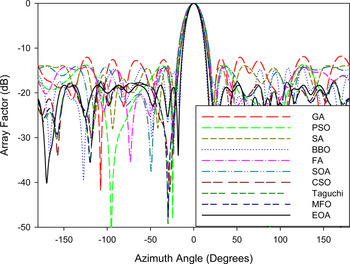
In the last example, the number of elements of the CAA is selected as 12. The array pattern of EOA is compared with those of GA [Reference Panduro, Mendez, Dominguez and Romero13], PSO [Reference Shihab, Najjar and Khodier14], SA [Reference Rattan, Patterh and Sohi15], BBO [Reference Singh and Kamal17], FA [Reference Sharaqa and Dib18], SOA [Reference Guney and Basbug19], CSO [Reference Ram, Mandal, Kar and Ghoshal20], Taguchi [Reference Babayigit and Senyigit21], and MFO [Reference Das, Mandal, Ghoshal and Kar8] in Fig. 11. Table 7 listed the HPBW, di, and MSL values of array patterns achieved by EOA and those of GA [Reference Panduro, Mendez, Dominguez and Romero13], PSO [Reference Shihab, Najjar and Khodier14], SA [Reference Rattan, Patterh and Sohi15], BBO [Reference Singh and Kamal17], FA [Reference Sharaqa and Dib18], SOA [Reference Guney and Basbug19], CSO [Reference Ram, Mandal, Kar and Ghoshal20], Taguchi [Reference Babayigit and Senyigit21], and MFO [Reference Das, Mandal, Ghoshal and Kar8].
Comparative results in terms of MSL, di, and HPBW values for 12-element CAA design

Array pattern for 12-element CAA design.
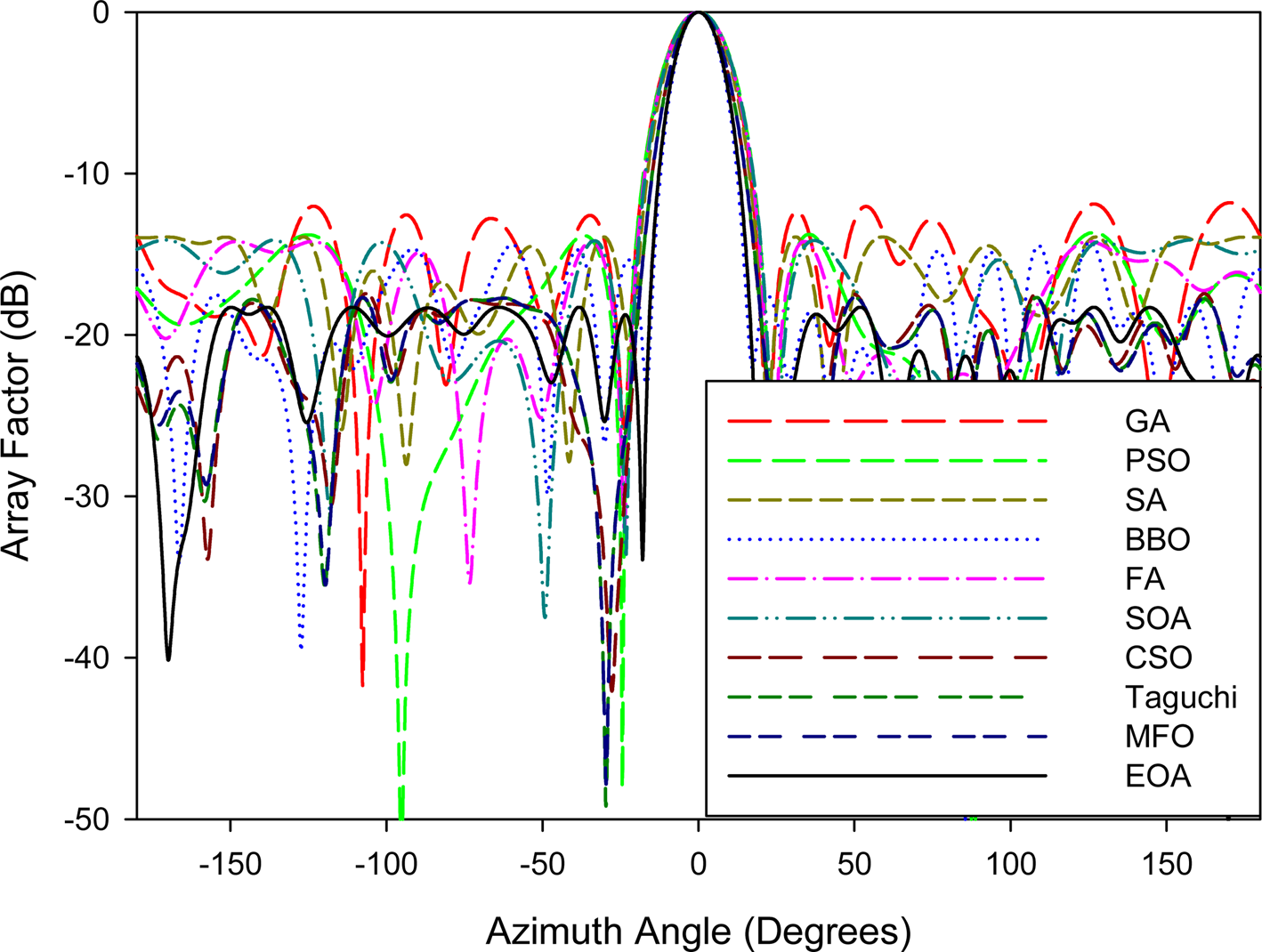
From Table 7 and Fig. 11, it is shown that the HPBW and MSL results achieved by EOA are better than the other compared algorithms. If we examine the physical dimensions of the antennas, the antenna obtained with EOA is smaller than the antenna designed with CSO, Taguchi, and MFO.
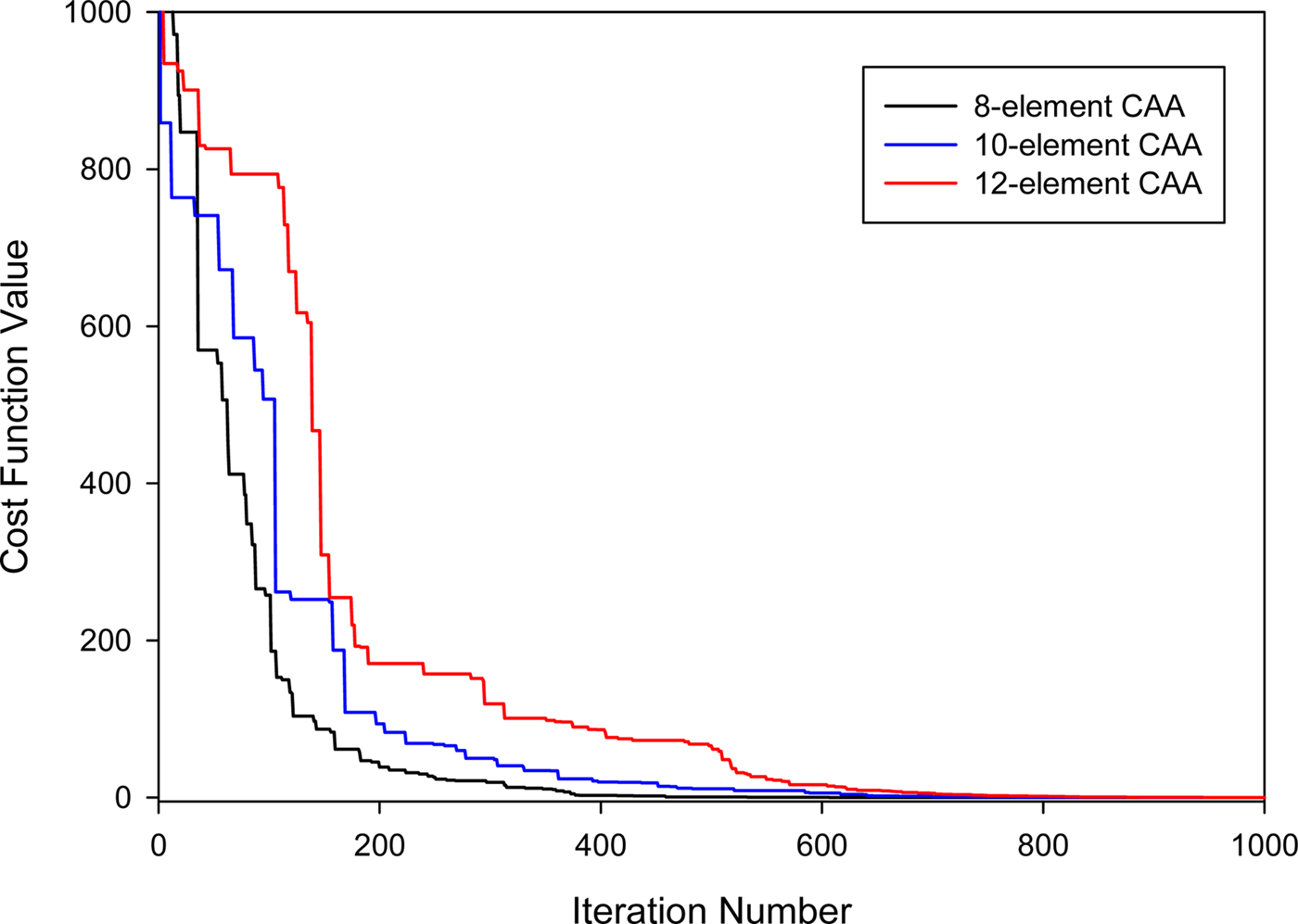
The position and amplitude values of the elements determined by using EOA for the radiation patterns in Figs 9–11 are tabulated in Table 8. Figure 12 shows the converge curve of the CAA with 8, 10, and 12 elements by using EOA. As shown in Fig. 12, an eight-element CAA problem converges earlier than those of others due to its low complexity.
The amplitude and position values of CAA elements using EOA method

Converge curve of CAA.

The results described in Figs 5–7 and 9–11 illustrate that the proposed method EOA can accurately achieve the optimum radiation patterns of linear and CAAs with lower MSL and equal or narrow HPBW. The HPBW and MSL values of the array patterns obtained with EOA are quite good. The physical size of CAA obtained by EOA is generally better than the other compared optimization algorithms. It can be concluded that EOA can be used as a good alternative to other optimization methods for antenna array synthesis.
Conclusions
In this paper, the optimum design of linear and CAAs with a different number of elements is carried out with a novel optimization method known as EOA. The position and amplitude values of the antenna array elements are determined for the first time by EOA technique to obtain radiation patterns with the lowest MSL and narrower HPBW values. Linear and CAA examples with different numbers of elements are examined and EOA results are compared with the results of other optimization algorithms in the literature. The results obtained by using EOA are very competitive in reducing the MSL compared to other optimization algorithms such as SOS [Reference Dib4], RRA[Reference Subhashini9], GA [Reference Panduro, Mendez, Dominguez and Romero13], PSO [Reference Khodier and Al-Aqeel6, Reference Shihab, Najjar and Khodier14], SA [Reference Rattan, Patterh and Sohi15], BBO [Reference Sharaqa and Dib5, Reference Singh and Kamal17], FA [Reference Sharaqa and Dib18], SOA [Reference Guney and Basbug19], CSO [Reference Ram, Mandal, Kar and Ghoshal20], Taguchi [Reference Dib, Goudos and Muhsen7, Reference Babayigit and Senyigit21], and MFO [Reference Das, Mandal, Ghoshal and Kar8]. The radiation patterns achieved by using EOA are generally better than well-known optimization methods compared in terms of HPBW and physical size. With the EOA method, antenna arrays with different geometric structures such as elliptical, concentric circular can be synthesized in future studies. Furthermore, the width, length, and height of microstrip patch antennas can also be determined with EOA effectively.
 Ali Durmus received the B.Sc., M.Sc., and Ph.D. degrees in Electrical and Electronics Engineering, from Erciyes University, Kayseri Turkey in 2003, 2005, and 2016, respectively. He served as a lecturer at the Department of Electricity and Energy, Erciyes University from 2010 to 2018. Currently, he is an assistant professor at the Department of Electricity and Energy, Kayseri University. His research interests are smart grids, antennas, antenna arrays, meta-heuristic algorithms, and computational electromagnetics.
 Rifat Kurban received the B.Sc., M.Sc., and Ph.D. degrees in Computer Engineering, from Erciyes University, Kayseri Turkey in 2004, 2006, and 2012, respectively. At the Department of Computer Engineering, Erciyes University, he served as a research assistant from 2005 to 2012, and an assistant professor from 2012 to 2019. He worked as a visiting post-doctoral researcher at the Department of Electrical and Computer Engineering, University of Tennessee, Knoxville, USA from 2015 to 2016. Currently, he is an assistant professor at the Department of Computer Technologies, Kayseri University. His research interests are image fusion, meta-heuristic algorithms, and internet of things (IoT) applications in water management.