I. THE PHILIPPINES: A SECULAR STATE
The separation of church and state has long been adopted in the Philippines,Footnote 1 entrenched in legal doctrine but compromised in practice. After 350 years under Spanish rule, during which Catholicism was the state religion, the Philippines was ceded to the United States of America (US) through the Treaty of Paris of 1898 (1898 Treaty) which guaranteed the free exercise of religion.Footnote 2 All subsequent Philippine constitutions, from those in the American era up to the current 1987 Constitution of the Republic of the Philippines (1987 Constitution), would preserve the non-establishmentFootnote 3 and free exerciseFootnote 4 doctrines of America’s First Amendment.Footnote 5
The doctrine of separation seeks to guarantee that the ‘government neither engage in nor compel religious practices’, ‘effect no favoritism’, and ‘work deterrence of no religious belief’.Footnote 6 But note the ultimate irony: though the wall of separation was intended in American constitutional tradition to keep the realms of God and Caesar apart, in the Philippines it is used to carry out God’s will with Caesar’s sword. This is most evident in the legal institution of marriage, which is characterized by the unabashed commingling of canon and civil law. Indeed, apart from the Vatican, the Philippines is the only state in the world that does not allow for absolute divorce.Footnote 7
Notwithstanding its common law origin, religious freedoms have evolved differently in the Philippine legal system. While American constitutional law erects the colloquial ‘Jeffersonian wall’Footnote 8 of strict separation Footnote 9 to shield the state from the church,Footnote 10 the Philippines does the opposite: it adopts the principle of benevolent neutrality to protect the church from the state.Footnote 11 Like a one-way mirror, the wall of separation in the Philippines is thus only relatively impermeable; adverse to government action, yet pervious to creed. This is most evident in the legal institution of marriage, which has historically morphed ecclesiastic marital presumptions into legal doctrine – a major obstacle for the marriage equality movement.
The purpose of this article is to study this shared principle of religious freedom as used in the US and the Philippine jurisdictions in relation to two cases on marriage equality: Obergefell v Hodges Footnote 12 (Obergefell) decided by the US Supreme Court, and Falcis v Civil Registrar-General Footnote 13 (Falcis Petition) pending before the Philippine Supreme Court. By framing religious freedoms as the backdrop of the Philippines’ marriage equality movement, this article seeks to establish how the demands of same-sex unions and church-state separation are tightly intertwined.
II. SAME CONSTITUTIONAL DOCTRINE, DIFFERENT HISTORICAL CONTEXT
The Philippine legal system may be founded on American political tradition, yet it continues to grapple with severing deeply inculcated influences of Spanish civil law. As a colony of Spain from the mid-1500s to June 1898, the Philippines adopted ‘the union of church (Roman Catholicism) and state in the Philippine archipelago’.Footnote 14 It was only in light of the 1898 Treaty and ‘the defeat of the [Philippine] independence movement, [that] the United States Congress adopted the Philippine Bill of 1902 which extended the ‘free exercise’ and ‘establishment’ clauses for Filipinos’.Footnote 15
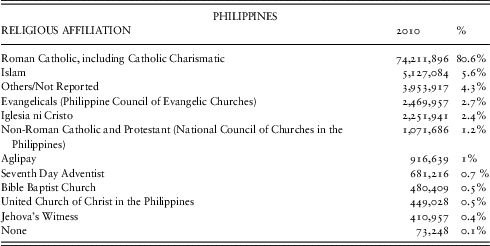
Notwithstanding its common law etymology, Philippine free exercise rights have since deviated from its US counterpart in light of varying socio-political contexts. Indeed, while the Jeffersonian wall of separation is applied to a pluralist community in the US, the Philippine religious profile remains unequivocally majoritarian.Footnote 16 In a 2010 census, respondents reported over forty distinct religious affiliations, none of which have a mandate constituting a majority of the US population.Footnote 17 In contrast, Philippine society is predominantly Roman Catholic.Footnote 18
Religious Demography

While the principle of separation may have been lifted in language and doctrine from American constitutional law, it is clearly applied in a fundamentally different context.Footnote 19 The purpose of this article is to study the principle of religious freedom vis-à-vis marriage equality in the Philippine legal system and determine where along the way its path diverged from the US doctrine whence it came.
A. The Marriage Equality Petition: Obergefell v Hodges
On 28 April 2015, petitioners ranging from a toddler adopted by a married same-sex couple to same-sex married parents and grieving widowersFootnote 20 appeared before the US Supreme Court to fight for the right of homosexual couples to lawfully enter into marriage.Footnote 21 Barely three weeks later, Jesus Falcis, ‘as an open and self-identified homosexual’, likewise filed his Petition for Certiorari and Prohibition before the Philippine Supreme Court seeking a declaration that ‘the provisions of the Family Code disallowing same-sex marriage’ are unconstitutional.
In both the Philippines and the US, the institution of marriage has been historically celebrated as a union between two persons of the opposite sex.Footnote 22 The respondents in Obergefell claimed that it should remain as such, alleging that same-sex marriages would ‘demean a timeless institution’ which by ‘its nature [is] a gender-differentiated union of man and woman’.Footnote 23 The petitioners acknowledged the historical basis for marriage, but argued that the debate should not end with it.Footnote 24
The US Supreme Court, in a 5–4 decision, ruled that the right of same-sex couples to marry is part of the liberty promised under the due process and equal protection clauses of the Fourteenth Amendment.Footnote 25 Detaching ecclesiastic interests from the marriage equality petition before it, the court characterized marriage as a mere ‘voluntary contract’.Footnote 26 Indeed, in the body of the decision, religion came to the fore merely to recognize the antiquated, and purportedly abandoned, theological underpinnings of the marital bond.Footnote 27 Religious liberties, on the other hand, were addressed only to ‘emphasize that religions, and those who adhere to religious doctrines, may continue to advocate… by divine precepts, [that] same-sex marriage should not be condoned’.Footnote 28
Further, state-sanctioned same-sex unions were not found to violate First Amendment rights.Footnote 29 The US Supreme Court opined that to advocate for or against same-sex marriage whether by reason of religious conviction or secular belief is a right protected under the US constitution. What is not constitutionally permissible is ‘to bar same-sex couples from marriage on the same terms as accorded to couples of the opposite sex’.Footnote 30
B. What Would Jesus Do?: The Case of Falcis v Civil Registrar-General
On 18 May 2015, Falcis filed his Petition for Certiorari and Prohibition as an ‘open and self-identified homosexual…interested in the unconstitutionality of the provisions of the Family Code disallowing same-sex marriage’.Footnote 31 Disregarding the doctrine of hierarchy of courts,Footnote 32 Falcis dispensed with the courts of first instance (ie the Regional Trial Court) and directly filed his petition with the Supreme Court – ‘the court of last resort’.Footnote 33
The petition sought: (1) a declaration that Articles 1,Footnote 34 2,Footnote 35 46(4),Footnote 36 and 55(6)Footnote 37 of the Family Code of the Philippines (Family Code) are unconstitutional on the ground that Congress gravely abused its discretion in ‘defining and limiting marriage as between man and woman’;Footnote 38 and (2) an order ‘prohibit[ing] the civil registrar-general from enforcing the portions of Articles 1 and 2 of the Family Code in processing applications for and in issuing marriage licenses against homosexual couples’.Footnote 39
Similar to Obergefell, Falcis claimed that ‘homosexuals are deprived of their right of due process, equal protection, [and] the right to decisional and marital privacy’.Footnote 40 But the Falcis Petition likewise reaches beyond its US counterpart – it grounds the legitimacy of same-sex marriages on religious freedoms.
The prefatory statements of the Falcis Petition cited Ang Ladlad LGBT Party v Commission on Elections to frame the debate, ie, that Philippine democracy prohibits the exclusion of values of other members of society by reason of religious or moral views.Footnote 41 But despite emphatically opening with the separation of church and state, the doctrine of non-establishment is not once forwarded in the body of the petition. Rather, religious freedoms would only be substantively discussed in the final paragraphs of the thirty-one-page pleadingFootnote 42 through the right to free exercise of religion enshrined in Section 3(1), Article XV of the 1987 Constitution, which mandates the state to defend ‘the right of spouses to found a family in accordance with their religious convictions’.
Falcis claimed that the challenged provisions of the Family Code effectively prohibit same-sex couples from founding a family through the vehicle of marriage in line with their faith.Footnote 43 In other words, by reserving the legal institution of marriage to heterosexual couples alone, gay Christian Filipinos belonging to pro-LGBT religious denominations, such as the members of the Metropolitan Community ChurchFootnote 44 (MCC) and the Lesbian Gay Bisexual Transgender and Straight Christian Church IncFootnote 45 (LCCI) – a breakaway group of the MCCFootnote 46 – are ‘denied […] the right to found a family in accordance with their religious convictions’.Footnote 47
On 29 March 2016, the Office of the Solicitor General (OSG) opposed the court petition – allegedly not to hamper the marriage equality movement, but to defend it.Footnote 48 Avoiding the merits of the case altogether, the OSG forwarded in its Comment (Ad Cautelam) that the petition was ‘so intrinsically [procedurally] flawed that it is incumbent upon the honourable court to summarily dismiss the case’.Footnote 49 Notably, the OSG opposed the petition’s form and not its cause.
The Falcis Petition is indeed riddled with remedial lapses. The OSG points out that the mere fact that Falcis ‘comes before the honourable court as an “open and self-identified homosexual… interested in the unconstitutionality of the provisions of the Family Code disallowing same-sex marriage” does not confer him legal standing’.Footnote 50 Likening the Falcis Petition to an open invitation to ‘coffee-shop conversation’ rather than ‘constitutional litigation’, the OSG submitted that a judicial decision on the matter would be nothing more than ‘an advisory opinion, without binding effect on real parties that were not impleaded’.Footnote 51
The OSG’s comment gives a laundry list of procedural missteps that warrant the petition’s dismissal. These include Falcis’ lack of ‘injury in fact’ from the operation of the Family Code – an essential element in establishing legal standing;Footnote 52 the error in impleading the civil registrar-general, who ‘merely exercises technical supervision over local civil registrars’;Footnote 53 the failure to implead an indispensable party, the Philippine Congress;Footnote 54 and the advisory nature of the inquiry.Footnote 55
The OSG further asserted that there was also an error in the relief sought.Footnote 56 The petitioner argued that his ‘ability to find and enter into long-term monogamous same-sex relationships is impaired because of the absence of a legal incentive for gay individuals to seek such a relationship’.Footnote 57 The OSG responded that ‘the grant of the reliefs sought in the petition [would] not lead to the establishment of a legal incentive for gay individuals to seek [same-sex] relationships’ with Falcis per se.Footnote 58
Finally, citing Obergefell, the OSG distinguished the Falcis Petition from its western counterpart. The US decision was ‘rendered in view of [n]umerous cases about same-sex marriage’.Footnote 59 The Philippines, however, does not enjoy that same luxury. The Supreme Court has neither jurisprudence nor factual findings ‘mixed in the judicial cauldron that would help it explain … the constitutional status of same-sex marriage in the Philippines. To decide … would be to brew with missing ingredients’.Footnote 60
Obergefell is celebrated as the product of a collective effort, yet the Falcis Petition is criticized as the making of an individual’s caprice.Footnote 61 While years of litigation, political advocacy and debates, as well as coalition-building paved the way for the Obergefell doctrine, Falcis – ‘all by himself, unassisted – puts on the line the future of a social movement and gambles the right of homosexuals’.Footnote 62
Falcis boldly claimed that religious freedoms reinforce his petition for marriage equality. The following sections will look at the prospect of his gambit.
III. MARRIAGE: THE UNION OF CANON AND CIVIL LAW
Both American and Philippine case law recognize the marital union as a relationship of transcendental importance.Footnote 63 Although both jurisdictions acknowledge marriage as a pillar of social order, the two diverge on the role religion plays in that bond. In Obergefell, the US Supreme Court upheld the right of same-sex couples to enter into marriage on the grounds of due process and equal protection, free expression, and marital privacy, among others.Footnote 64 Through Obergefell’s main opinion, Justice Kennedy explains that marriage, though once viewed as a religious concern, is contemporarily ‘understood to be a voluntary contract’.Footnote 65 The Falcis Petition likewise raises the issue before the Philippine Supreme Court. However, unlike in Obergefell, Philippine courts have historically integrated religious tradition into the country’s marriage laws. Indeed, the Family Code – the lex generalis on marriage – is openly recognized to have been shaped by the position of the Catholic majority and its clergy.
A. De Facto Divorce: The Marriage of Canon and Civil Law
The Philippines is the outlier nation that does not grant divorce decrees in its general law. Instead, the Family Code allows only for ‘relative divorce’Footnote 66 by way of legal separationFootnote 67 – a disunion a mensa et thoro Footnote 68 where the marital bond subsists notwithstanding the suspension of common marital life.Footnote 69 This ‘involves nothing more than the bed-and-board separation of the spouses’.Footnote 70
The Philippines also provides for de facto divorceFootnote 71 through Article 36 of the Family Code,Footnote 72 which allows for a declaration of nullity of marriage on the obscure and sweeping basisFootnote 73 of ‘psychological incapacit[y]… to comply with essential obligations of marriage’.Footnote 74 Justice Sempio-Diy, a luminary on Philippine family law, explains that the Canon Law concept of psychological incapacity was adopted by the Family Code for three reasons: (1) it was intended to be a substitute for divorce; (2) it was viewed as a solution to church-annulled marriages; and (3) it served as an additional remedy for problematic marriages not falling under the Family Code provisions on void or voidable marriages.Footnote 75
A fourth reason was identified by the Philippine Supreme Court, which has historically recognized the scriptural bases of this proviso. As echoed through Philippine case law, Article 36 was adopted as an ‘acceptable alternative to divorce’ to avoid ‘the strong opposition that any provision on absolute divorce would encounter from the Catholic Church’.Footnote 76
In Santos v Bedia-Santos, the Philippine Supreme Court explained that Article 36 of the Family Code was a compromise to avoid the strong opposition of ‘the Catholic sector … to whom the great majority of [the] people belong’.Footnote 77 Hence, in the determination of a marriage’s invalidity, the Court ‘must be guided by decisions of church tribunals which, although not binding on the civil courts, may be given persuasive effect since [Article 36] was taken from Canon Law’.Footnote 78
In Republic v Molina, the Philippine Supreme Court unabashedly called for ‘great respect’ for the interpretations of the National Appellate Matrimonial Tribunal of the Catholic Church in the Philippines, as Article 36 was derived from Canon 1095 of the New Code of Canon Law.Footnote 79 The Court ruled that because the legislative intent was to ‘harmonize our civil laws with the religious faith of our people … great persuasive weight should be given to decisions of such appellate tribunal’.Footnote 80 Thus, according to the Court, ‘what is decreed as canonically invalid should also be decreed civilly void’.Footnote 81
Further eroding the wall of separation, the Philippine Court in Antonio v Reyes pronounced that when a marriage had already been annulled by the Catholic Church, the courts should ‘take [this] into consideration’; otherwise, ‘the rulings of the Catholic Church on this matter would have diminished persuasive value’.Footnote 82 Through Malilin v Jamesolamin, the Court confessed how Article 36 envisages ‘the second paragraph of Canon 1095[,] which refers to those who suffer from grave lack of discretion of judgment concerning essential matrimonial rights and obligations’.Footnote 83
B. Exceptions for the Minority Faith
The breach of the Jeffersonian wall of separation is not limited to Catholicism alone. The Code of Muslim Personal Laws (CMPL) was enacted as Philippine law in 1977 via Presidential Decree No 1083. Unlike the Family Code, the CMPL allows for divorce as a right of both husband and wife where both spouses are Muslim, or where the husband is Muslim and the couple was married under Islamic rites.Footnote 84
The CMPL deviates from the lex generalis in many ways. While the Family Code sets the minimum age of consent for marriage at eighteen for both men and women,Footnote 85 the CMPL lowers the age requirement, depending on one’s gender. For men to marry, they must be at least fifteen years old.Footnote 86 For Muslim women, capacity to marry is attained upon reaching puberty – which is statutorily presumed to be attained at the age of fifteen.Footnote 87 The CMPL also allows females who have attained puberty, and less than fifteen but not below twelve years of age, to marry upon a petition by a wali (guardian).Footnote 88 The betrothal of a minor below the prescribed ages, provided it has been arranged by the wali, is also permitted. It may be subsequently annulled by either party provided, inter alia, no voluntary cohabitation had taken place.Footnote 89
Significantly, the CMPL’s provisions contemplates ‘voluntary cohabitation’ with a child below twelve years old – a situation penalized under the Revised Penal Code of the Philippines 1930 (Revised Penal Code) as statutory rape.Footnote 90 While the CMPL expressly states that the crime of bigamy does not apply to persons married in accordance with its provisions,Footnote 91 it does not provide a blanket exemption of criminal liability.
Thus, contrary to the characterization in Obergefell, the institution of marriage in both Philippine lex generalis and lex specialis remains religious. The Family Code has unapologetically entwined Christian theology in its general law, the single exception to which is codified through the CMPL – a legal classification evidently based on Islamic creed. While either institution of marriage is distinct, they are united by a common thread: religious influence.
IV. FREEDOM OF RELIGION: THE EXCEPTION TO THE GENERAL RULE
The Philippines is the only country in the Association of South East Asian Nations (ASEAN) that explicitly provides for the separation of church and state in its constitution.Footnote 92 Yet in that same breath, the 1987 Constitution unapologetically affords religion a privileged status through tax exemptionsFootnote 93 and an optional religious education clause for public academic institutions.Footnote 94 Further, Philippine constitutions have historically implored the ‘aid of Divine Providence’Footnote 95 or of the ‘Almighty God’,Footnote 96 which ‘manifest the State’s respect and recognition of the collective spirituality of the Filipino’.Footnote 97 The Philippine Supreme Court itself has transmuted religious influences into legal fiat under the auspices of benevolent neutrality. The following section will look at how that purported neutrality has been wielded with impunity by the courts to breach the wall of separation, and with it, the constitutionally mandated secularity of the state.
A. Religious Exceptions to the General Rule
In Goldman v Weinberger, the US Supreme Court held that in the absence of a government regulation based solely on religious motivations, prohibiting a member of the Jewish faith from wearing a yarmulke while on duty in the Air Force did not violate the First Amendment.Footnote 98 Similarly, as held in Employment Division Department of Human Resources of Oregon v Smith, religious freedoms do not relieve an individual from complying with the incidental effects of a generally applicable and otherwise valid government regulation.Footnote 99 In gist, if regulating the free exercise of religion is but an accidental effect of law, there is no undue derogation of religious freedoms.Footnote 100
In Smith, respondents Alfred Leo Smith and Galen Black had their employment terminated for ingesting peyote, a hallucinogenic drug, at a ceremony of the Native American Church. Having been dismissed for work-related misconduct, Smith and Black were denied unemployment benefits, allegedly, in violation of their free exercise rights. The Court, however, rejected their contentionFootnote 101 on the basis that free exercise rights do not exempt a person from complying with a valid and neutral law of general applicability. The Court warned that to hold otherwise would render religious doctrine ‘superior to the law of the land, and in effect, to permit every citizen to become a law unto himself’.Footnote 102
The Philippine approach to the interplay of lex generalis and religious freedoms is greatly different from that in the US. In contrast with Goldman and Smith, the Philippine case of Victoriano v Elizalde Rope Workers’ Union pronounced that ‘when general laws conflict with scruples of conscience, exemptions ought to be granted’.Footnote 103 Similarly, in Ebralinag v Superintendent,Footnote 104 the Philippine Supreme Court ruled that the State cannot by lawFootnote 105 compel students to participate in flag-salute ceremonies when doing so would contravene their religious beliefs. Ruel Ebralinag, a member of the Jehovah’s Witnesses, claimed that to salute the flag was to adore it, hence in violation of his religious creed: ‘Thou shalt have no other gods before me.’Footnote 106
The Court ruled for Ebralinag on the rationale that ‘[l]egitimate ends cannot be pursued by methods which violate fundamental [religious] freedoms’.Footnote 107 While US jurisprudence has a similar flag-salute doctrine embodied in West Virginia State Board of Education v Barnette, it is worth noting that it was grounded on the freedom of speech clause of the First Amendment,Footnote 108 distinct from the free exercise basis of the Ebralinag ruling.
The ecclesiastic exception to the general rule is most evident in Estrada v Escritor, where the Philippine Supreme Court refrained from administratively disciplining Soledad Escritor, a court interpreter and a member of the Jehovah’s Witnesses, for having allegedly engaged in ‘disgraceful and immoral conduct’ in violation of the Revised Administrative Code.Footnote 109 Escritor sought exemption, claiming that her conjugal arrangement – a twenty-year extra-marital union with a man with whom she had borne a child – was not ‘immoral’ but in conformity with a ‘Declaration of Pledging Faithfulness’ – a religious ceremony equivalent to a wedding sanctioned by the Jehovah’s Witnesses, particularly in countries where divorce is not recognized.Footnote 110
The Court ruled that Escritor could not be disciplined absent a showing that the State and the judiciary would be undermined if she were given an exemption.Footnote 111 Effectively, Estrada condoned Escritor’s adulterous relationship – an act that would otherwise give rise to administrative,Footnote 112 civil,Footnote 113 or criminal liabilityFootnote 114 – on the ground of religious belief.
B. Religious Accommodations in Public Institutions
As held by the US Supreme Court in Abington School District v Schempp Footnote 115 and Lee v Weisman,Footnote 116 prayers hosted by public academic institutions transgress the principle of separation. The same cannot be said for the Philippine legal system. In Estrada,Footnote 117 the Philippine judiciary observed that the Constitution expressly permits forms of religious entanglement in allowing religion to be taught to children in public schools, so long as it is without additional cost to the government. However, in Arias v University of the Philippines,Footnote 118 a law student challenged his professor’s practice of performing an ecumenical prayer in class. The Quezon City Regional Trial Court denounced the professor’s practice as a breach of the wall of separation.
Religious entanglement in public institutions is no novel issue in the Philippines. The Philippine Supreme Court itself abides by a religious practice in prescribing, pursuant to its constitutionally enshrined rule-making power,Footnote 119 a ‘Centennial Prayer for the Courts’.Footnote 120 The purportedly ecumenical orison is read by judges in open court, expressly implores an ‘Almighty God’,Footnote 121 and is often commenced and proceeded by the signum crucis (the sign of the cross).
In the recent case of Re: Letter of Tony Q Valenciano,Footnote 122 in an 11-1 ruling, the Philippine Supreme Court validated the use of government buildings – for instance, the basement of the Hall of Justice of Quezon City – as a Roman Catholic chapel, complete with an offertory table, images of Catholic religious icons, a canopy, and an electric organ. Tony Q Valenciano wrote a series of letters to the then Chief Justice Reynato S Puno protesting the practice as a violation of the principle of non-establishment and the constitutional prohibition against the appropriation of public money or property for the benefit of a sect, church, denomination, or any other system of religion.Footnote 123 He further averred that the holding of masses at the basement of the Hall of Justice showed that it tended to favour Catholic litigants.
In categorically rejecting Valenciano’s contention, the Court ruled that the holding of masses within the courts did not violate the separation of church and state. On the contrary, the collaboration of the church and the court was in fact ‘necessary to ensure that there would be no excessive entanglement’ to begin with.Footnote 124 The free exercise of religion having mandated an ‘unconditional tolerance’ of all religions, one denomination ‘cannot ask for tolerance when [it] refuses to do the same for others’.Footnote 125
The Philippine Supreme Court ignored the constitutional mandate of separation through the logical but callous rationale that religious tolerance abets tolerance. But what is even more striking is that instead of showing disapproval at a clear case of state entanglement with religion, the court justified it. The Supreme Court opined that prohibiting the use of government property for religious purposes would, first, be in itself a form of excessive entanglement, and second, espouse ‘[s]trict separation, rather than benevolent neutrality/accommodation, [as] the norm’.Footnote 126
C. Government Endorsed Religious Holidays
According to County of Allegheny v American Civil Liberties Union,Footnote 127 which was decided by the US Supreme Court, religion cannot be the basis of public, state-proclaimed, holidays. In a complex and fragmented decision, the majority held that while the government may acknowledge Christmas as a cultural phenomenon, it may not celebrate it as a Christian holy day.Footnote 128 Historical practice may not legitimize the use of crèche or Christmas displays, which would evidence state fidelity to a particular religion.Footnote 129 Justice O’Connor, in a concurrence joined in part by Justices Brennan and Stevens, stated that these signs merely recognize Christmas as part of the winter holiday season that had attained a secular status in society.Footnote 130 In a partial concurrence and dissent by Justice Kennedy, it was said that mere passive and symbolic recognition by the government was unlikely to present a realistic risk of establishmentFootnote 131 – a ratio adopted in the earlier cases of Lynch v Donnelly,Footnote 132 regarding a crèche holiday display, and Marsch v Chambers,Footnote 133 concerning the employment of a legislative chaplain.
Philippine courts have consistently subscribed to the reasoning in the Allegheny minority opinions. Similar to Re: Letter of Tony Q Valenciano discussed above, the Supreme Court pronounced in Garces v Estenzo Footnote 134 that the use of government-raised funds for the purchase of a wooden image of Valencia’s patron saint, San Vicente Ferrer, for the local barrio fiesta violated neither the principle of non-establishment nor the constitutional prohibition on the appropriation of public money ‘directly or indirectly, for the use, benefit, or support of any sect, church, denomination, sectarian institution, or system of religion’.Footnote 135 The effigy having been purchased to celebrate the barrio fiesta honouring the patron saint (instead of favouring any particular religion nor interfering with religious matters), the use of public funds could not be barred.Footnote 136 For the Court, the celebration was a socio-religious affair – an ingrained tradition in rural communities.
In doing so, Garces attempts to recast religious celebration in secular light. This ratio is comparable to the European Court of Human Rights’ reasoning in Lautsi v Italy,Footnote 137 which recognized that ‘in countries of Christian tradition, Christianity enjoys a special social legitimacy’.Footnote 138 Hence, as in the Philippines, ‘Christian symbols may legitimately relish greater visibility in government institutions’.Footnote 139
D. Religious Expression as a Highly Protected Speech
The Philippines’ adoption of American constitutional tradition is not isolated to religious freedoms alone. While under Spanish rule the right of freedom of expression remained a foreign notion, it was after the Philippines was ceded to the US that the right to free speech was guaranteed through President McKinley’s Instruction to the second Philippine Commission.Footnote 140 The doctrine of free expression was ‘lifted bodily from the Federal Constitution of the United States’Footnote 141 and reproduced in all Philippine constitutions, including the current 1987 Constitution.Footnote 142
The rights to free expression and religion encompass proselytization. In Cantwell v Connecticut,Footnote 143 the US Supreme Court ruled that absent a statute narrowly drawn to punish specific conduct as a clear and present danger, religious communication fell within the realm of protected speech. In Cohen v California, the court ruled that even words which invoke tumult, discord, and offence are protected, these being ‘but necessary side effects’ of free speech.Footnote 144 Indeed, the right of free expression espouses ‘the principle of free thought – not free thought for those who agree with us, but freedom for the thought that we hate’.Footnote 145
The Philippines adopts the Holmesian model of free expression, albeit inconsistently. In the case of Iglesia ni Cristo (INC) v Court of Appeals, Board of Review for Motion Pictures and Television (now MTRCB) and Mendez,Footnote 146 the Philippine Supreme Court allowed the airing of televangelist episodes containing controversial statements aimed against the Catholic Church. The Court opined that the ‘bedrock of freedom of religion is freedom of thought … [hence] the marketplace of ideas demands that speech should be met by more speech’.Footnote 147 With the establishment clause of the Constitution having prohibited any bias towards or against religion, the State enjoys no option but neutrality. The MTRCB cannot thus ‘squelch’ the speech of the INC ‘simply because it attacks other religions’, even if said religion happens to be the pre-dominant faith in the country.Footnote 148
The constitutional guarantee of free expression notwithstanding, the Philippines criminalizes acts against religious worship.Footnote 149 It is also prohibited under Article 133 of the Revised Penal Code for ‘anyone who, in a place devoted to religious worship or during the celebration of any religious ceremony [to] perform acts notoriously offensive to the feelings of the faithful’.Footnote 150 Pursuant to this law, ridicule of religious dogma or ritual is a ground for criminal liability.Footnote 151 Simple remarks on certain beliefs as anti-Christ or that the Pope is the commander of Satan are notoriously offensive to the feelings of the faithful and are deemed criminal acts under Philippine law.Footnote 152
In People v Celdran,Footnote 153 the defendant, a celebrity tour-guide and media personality, was prosecuted under Article 133 for staging a protest inside the Manila Cathedral against the church’s meddling in government affairs. During the ecumenical prayer, Celdran, while dressed as the Filipino national hero Jose Rizal, paraded a placard with the word ‘DAMASO’ before the attending Cardinal and bishops. The sign referred to ‘Padre Damaso’, the antagonist Catholic priest in Jose Rizal’s novel, Noli Me Tangere Footnote 154 – a celebrated and familiar reference for students enrolled in Philippine academic institutions.Footnote 155 Ultimately, the Court found Celdran guilty beyond reasonable doubt of offending religious feelings and subsequently sentenced him to a maximum prison sentence of a year, a month, and eleven days.Footnote 156
Professor Florin T Hilbay, former Solicitor General of the Philippines, has criticized Article 133 as ‘patently unconstitutional because it smacks of viewpoint discrimination’.Footnote 157 Likening the law to lèse-majesté – a ‘set of criminal offenses meant to sanction disrespect toward the crown or its agents’Footnote 158 – Hilbay opposes government use of the criminal justice system to silence public criticism against certain institutions, ideas, and practices, which would violate constitutional guarantees of free expression and secularism.Footnote 159
The contrast between Celdran and Iglesia ni Cristo evidences the dichotomy between the right of free expression in general and the right of religious expression per se, with the latter enjoying greater protection. In Iglesia ni Cristo, the congregation’s ‘attacks’ on another religion were justified on principles of free thought – that ‘the ultimate good desired is better reached by the free trade in ideas’,Footnote 160 that ‘the remedy against bad theology is better theology’, and that ‘speech should be met by more speech’.Footnote 161 On the other hand, in Celdran, which concerned the crime of offending religious feelings, the marketplace of ideas was promptly abandoned. While the content-neutral considerations of Article 133 should not be arbitrarily dispensed with,Footnote 162 the legal dichotomy is made clear: while offensive utterances are recognized as part and parcel of a free and robust debate,Footnote 163 they are actionable when made against religious feelings.
E. Juridical Personality of Majority and Minority Faiths
In the US, the church’s corporate status is a mere concession of the state. It is not recognized as an independent society established by divine law.Footnote 164 On the other hand, Philippine courts have declared as early as 1907 that the Catholic Church has both a moral and juridical status.Footnote 165 Furthermore, in Long v Basa, the Philippine Supreme Court ruled that a corporation sole – a religious corporate bodyFootnote 166 – was of a peculiar nature and based on common religious or spiritual belief.Footnote 167
The recognition given to the corporation sole is no trivial matter. In the case of Register of Deeds v Ung Siu Si Temple,Footnote 168 involving an unincorporated Buddhist organization composed of foreign nationals, the Court ruled that constitutional prohibitions on foreign landholdingFootnote 169 applied to the Ung Siu Si Temple because ‘the spirit of the Constitution demands that in the absence of capital stock, the controlling membership should be composed of Filipino citizens’.Footnote 170 However, in Roman Catholic Apostolic Administrator of Davao, Inc v Register of Deeds, which concerned a Catholic corporation sole comprising only Msgr Thibault, a Canadian citizen, the Court ruled that constitutional mandates against foreign landholdings were inapplicable because Msgr Thibault was a mere ‘administrator of the “temporalities” or properties titled in [the Sole’s] name’, and that the constitutional provisions ‘could not have intended to curtail the Roman Catholic faith’.Footnote 171
The aforementioned cases show that although religion is generally given a privileged status in the Philippines, not all religions are treated similarly. While the Supreme Court liberally construed constitutional mandates in Roman Catholic Apostolic Administrator of Davao, a case involving the pre-dominant religion, a strict construction was adopted in Ung Siu Si Temple, which concerned a minority faith.
V. Union, Dissolution, Consummation: Turning of the Tide?
Philippine law has historically breached the wall of separation. It may be argued, however, that the disentanglement of canon and civil law slowly ensues. Recently, it appears that the Philippines has mustered a newfound courage in taking positions contrary to those of pre-dominant Christian theology. This can be observed in three separate yet intertwined issues: same-sex relations by way of civil partnerships, marriage dissolution, and reproductive health.
A. Civil Partnerships: Separate but Equal
Pending before the Philippine Congress are House Bill No (HB) 6595 (An Act Recognizing the Civil Partnership of Couples Providing for their Rights and Obligations) and HB 3179 (An Act Governing Property Ownership of Couples of Same Sex Living Together). HB 6595 seeks to remedy the Philippines, failure to provide ‘some of the most basic civil rights to couples who are not eligible for marriage under the law[,] [a] large part of [whom are members of] the Lesbian [,] Gay, Bisexual and Transgender (LGBT) community’ who ‘by reason of their sexual orientation and who they love… are excluded from entering into legally recognized and protected unions’.Footnote 172 Deviating from religious tradition, the bill proposes to allow couples, regardless of sex, to enter into civil partnerships enjoying the same rights, benefits, and responsibilities of marriage.Footnote 173
On the other hand, HB 3179 seeks to offer legal recognition and protection to the property relations of same-sex partners. Similar to HB 6595, the novelty of HB 3179 is found in its departure from the religious sentiment reflected in existing Philippine family law.Footnote 174 While the proposed statutes are undoubtedly progressive efforts worth celebrating, they have done little to quell the marriage equality debate. Rather than serving as a panacea to the Philippines’ social ills, these bills are merely ‘band-aid’ solutions to the Filipinos’ repudiation of the LGBT community.
HB 3179’s principal author, Representative Edcel B Lagman, explains that because the church holds a degree of influence in state affairs, gay marriage has yet to find a place in the Philippine legal system. Thus, rather than providing for a right to marriage, HB 3179 proposes a sui generis property regime for two persons of the same sex cohabiting with each other. Representative Lagman concludes: ‘after all, they should also be treated equally’.Footnote 175
Representative Lagman echoes the reality embedded in law and jurisprudence: notwithstanding the constitutionally mandated separation of church and state, ‘religion has transcended mere rubric and has permeated into every sphere of human undertaking’.Footnote 176 Congress thus seeks to circumvent religious considerations altogether by providing the same bundle of rights that come with marriage for a separate and distinct institution – the civil partnership. On its face, these bills deserve scant criticism. If the same rights of marriage are afforded to extra-marital same-sex relations, then the difference between the legal status of heterosexual and same-sex couples would lie in terminology rather than substantive right. After all, what’s in a name?
In the author’s opinion: everything. The issues entrenched in the marriage equality debate go beyond legal niceties and into the value ‘We the People’ give to same-sex relations, ie, ‘whether same-sex unions are worthy of honour and recognition by the community – whether they fulfil the purpose of the social institution of marriage’.Footnote 177 Determining the rights of same-sex couples to legally enter into marriage is ultimately about the equal status of their person and the validity of their claim.Footnote 178
But the issue of same-sex unions is not solely about de jure recognition, but also de facto equality. This the Philippines fails to address. HBs 3179 and 6595 profess to level the playing field by granting the rights of marriage to those who do not enjoy the right to marriage. The bills purport to treat heterosexual and same-sex couples as ‘separate but equal’Footnote 179 creatures. But upon closer scrutiny, contrary to securing equality in law, they reinforce secular biases. The bills restate religious dogma: same-sex couples are unworthy of the legal institution of marriage. They are ‘separate’ because they are ‘unequal’.
That inequality is inherent to the institution of civil partnerships as illustrated by HB 6595 itself. While the bill seeks to afford same-sex couples ‘[a]ll benefits and protections as are granted to spouses in a marriage under existing laws’,Footnote 180 it demands more from aspiring civil partners than from heterosexual spouses-to-be. For example, Section 5(b) of the proposed legislation provides for a residency requirement before the applicant same-sex couple may avail of the bill’s benefits. The civil partnership would be valid only if the parties have shared ‘a common domicile for a minimum of two (2) uninterrupted years at the time when the civil partnership license is applied for, as supported by competent evidence’.Footnote 181 Further, the relationship must be ‘publicly known’.Footnote 182
Traditional marriage under the Family Code is not subjected to these pre-requisites. Article 2 of the Family Code but requires ‘a man and a woman’Footnote 183 who have obtained a valid marriage licenseFootnote 184 to have the legal capacity to enter into marriageFootnote 185 and to freely consent thereto in the presence of a duly authorizedFootnote 186 solemnizing officerFootnote 187 and at least two witnesses of legal age.Footnote 188
While HBs 3179 and 6595 seek to afford same-sex couples the same rights of marriage, it restricts the right to marriage to its legal, traditional, and religious definition: as a bond between a man and a woman.Footnote 189 What is more, they impose upon same-sex couples stricter pre-requisites than heterosexual partners for the enjoyment of the same rights. The legal recognition of same-sex partnerships is thus not the abandonment of canon law; rather, it is ratification.
B. Marriage Dissolution, Church Annulments: Divorce in Sheep’s Clothing
The Philippines is the only state in the world apart from the Vatican that does not allow for absolute divorce.Footnote 190 Instead, the Family Code only allows for relative divorce by way of legal separationFootnote 191 and for de facto divorce through Article 36 of the Family Code.Footnote 192 The Philippine Supreme Court has openly recognized the scriptural bases of the latter proviso, Article 36 having been adopted to avoid the ‘strong opposition that any provision on absolute divorce would encounter from the Catholic Church’.Footnote 193
One might argue, however, that a divorce-free Philippines may soon be a thing of the past. In a landmark effort, members of Congress have proposed three house bills – HB 1062, HB 1629, and HB 6027.Footnote 194 But like Article 36 of the Family Code, none of these bills seek to directly incorporate divorce per se within Philippine jurisdiction. Rather, the bills attempt to juridify a ‘disguised divorce’ under the auspices of ‘marriage annulment’ or ‘marriage dissolution’.Footnote 195
While HBs 1062 and 6027 invoke grounds of public policy,Footnote 196 HB 1629 openly adopts religious rationale by attempting to effect ‘divorce’ by legally recognizing church-ordained annulments and dissolutions. Section 1 of HB 1629 provides that marriages ‘legally solemnized by a priest, minister, imam, rabbi, or presiding elder of an established church or religion in the Philippines’ may be subsequently ‘annulled’ or ‘dissolved’ by ‘said church or religion’ and ‘be given full force and effect in the Philippines’. The bill’s principal sponsor Gweondolyn F Garcia explains:
… if the marriage, insofar as the contracting parties are concerned, is validated by the laws of the Church, then it necessarily follows that by the same laws, such marriage can also be invalidated or annulled.
The law recognizes as valid a marriage solemnized in accordance with the laws of the church. In other words, the State respects the laws of the church. To give full force and effect to this principle of State recognition of the law of the church, it is but proper, if not logical that the state must also respect the annulment of a marriage that results from application of church laws.Footnote 197
As observed in an expert opinion by the University of the Philippines Institute of Human Rights, ‘giving automatic recognition to an annulment decree issued by [any] one church will violate the doctrine of separation of church and state’.Footnote 198 Distinct from the divorce laws of foreign nations, HB 1629 does not attempt to legalize absolute divorce – it hopes to give legal effect to canonical marital dissolutions. Likewise, similar to Article 36 of the Family Code, HBs 1062 and 6027 reflect religious considerationFootnote 199 by proposing a divorce in sheep’s clothing – an adamant refusal to call a spade a spade.Footnote 200 Thus, in its attempt to modernize the Family Code, Congress does not break away from the religious underpinning of Philippine law. On the contrary, it embraces it.
C. The Secular State of Reproductive Health
After fourteen years of debates and delays due to resistance by the Catholic clergy, the Philippine Congress passed the Reproductive Health Act of 2012 (RH Law).Footnote 201 Catholic clergy and conservative legislators campaigned against its passing on the ground that the use of artificial methods of contraception was a ‘direct assault and violation of [Philippine] religious belief’.Footnote 202 Ironically, the law’s naysayers claimed that Congress could not ‘quibble or trifle with matters of faith… against the fundamental Catholic doctrines, [and] the strong beliefs of the majority of Filipinos born and raised in a Catholic environment’.Footnote 203
The RH Law was immediately challenged before the Supreme Court in Imbong v Ochoa.Footnote 204 After long and agonizing debates, the Court eventually affirmed the law’s constitutionality, recognizing that the ‘jurisdiction of the Court extend[s] only to public and secular morality’ and not ‘one’s dogma or belief … ecclesiastical matters [falling] outside the province of the civil courts’.Footnote 205
The foregoing illustrates a rejuvenation of the non-establishment doctrine in the Philippines. Yet, notwithstanding Imbong’s secular approach to the intimate matter of reproductive health in the marital bed, jurisprudence has yet to take a similar stance regarding the institution of marriage. Likewise, even Congress’ attempts to modernize Philippine family laws through the incorporation of ‘marriage dissolution’ remain rooted in religious considerations. In similar vein, civil partnerships do not amount to the abandonment of canon law. Rather, the proposal would carve out a separate and distinct legal relationship, leaving the traditional religious institution unscathed.
Given the seminal role religion plays in Philippine society, particularly on the subject of marriage as a legal institution, the compatibility of Obergefell’s secular notion of marriage with the Philippine socio-political landscape remains to be seen. The Falcis Petition thus faces an uphill battle against decades of jurisprudence kowtowing to the clergy and a majoritarian society that fails to distinguish between popular religious opinion and secular culture.
VI. RECASTING RELIGIOUS FREEDOMS FOR MARRIAGE EQUALITY: REVISITING THE FALCIS PETITION
A comparison of Philippine and US case law reveals that while both jurisdictions adhere to religious freedoms through the doctrine of separation, the two diverge as to the degree of separation required. Philippine law has strayed from the wall of strict separation, and instead abides by the principle of benevolent neutrality which allows government support of religion so long as it does not discriminate for or against other faiths. In doing so, however, the Philippines has struggled to distinguish neutral government action from excessive state entanglement.
The doctrinal nuances of these jurisdictions are created and reinforced by factual disparities. First, unlike US paradigms, the Philippines operates under a hybrid common law-civil law systemFootnote 206 – the latter quality systemically reflecting deeply ingrained Christian values.Footnote 207 Second, the all-pervasive presence of the Catholic Church with a membership of more than 80 per cent of the Philippine population has conflated majoritarian religious belief with secular Philippine culture – a consideration absent in the pluralist US context. Third, the ‘excessive entanglement’ proscribed in US law is inevitable in the Philippines. The church and the state have reached beyond their traditional domains of temple and courtroom, and are now both deeply embedded in the social sphere. The functions of the state have also expanded beyond their usual responsibilities such as fire prevention and policing,Footnote 208 and now extend to basic social needs like health and education.Footnote 209 On the other hand, religious congregations remain a powerful social and political force.Footnote 210 The Roman Catholic Church, through the late Manila Archbishop Jaime Cardinal Sin, played a pivotal role in the People Power uprisings of 1986 and 2001. Non-Catholic groups, such as the Iglesia ni Cristo and El Shaddai, have as well flexed their political muscle by adopting official electoral candidates and delivering a solid ‘bloc vote’.Footnote 211
Notwithstanding an equal opportunity to breach the wall of separation, this does not necessarily mean that religious sectors in the Philippines are treated equally. As a comparison of Roman Catholic Apostolic Administrator of Davao with Ung Siu Si Temple reveals, a more liberal interpretation of the law was used when dealing with a Christian organization as compared to a minority faith. But, as seen through the CMPL, the state has likewise protected the minority Islamic faith by disregarding the non-establishment clause and codifying it into law. Effectively, what was originally contemplated to be a wall of separation is now one of relative impermeability – prohibiting state interference in religious matters, but permitting religious influences to seep through the cracks of the Jeffersonian Wall under the veneer of Philippine culture.Footnote 212
Considerations of religious freedom bear heavy implications for the marriage equality movement. Obergefell secularized marriage by accepting its religious character as an antiquated notion. The US Supreme Court acknowledged that although marriage remains ‘sacred to those who live by their religions’, it likewise ‘offers unique fulfilment to those who find meaning in the secular realm’.Footnote 213
The ‘history of marriage is one of both continuity and change’Footnote 214 in the US, but the same cannot be said for the Philippines. In both its lex generalis and lex specialis, Philippine law continues to recognize the institution of marriage as a religious bond. Indeed, while the former has been shaped by Roman Catholicism, the latter unapologetically codifies Islamic precepts through the CMPL.
Though religious freedoms in the Philippines have departed from American doctrine, this is not to say that the two respective states’ approaches are categorically distinct. Given a choice between maintaining the principle of separation at the expense of religious freedoms on one hand or ruling in favour of religion at the cost of breaching the Jeffersonian wall on the other, both jurisdictions choose to err on the side of individual freedoms.Footnote 215 Philippine courts have taken – at best – a cautious approach to religion, reluctant to take a stance contrary to religious opinion purportedly out of deference to the free exercise of religion.Footnote 216
The Falcis Petition attempts to use this approach, albeit on the eleventh-hour, by pointing to MCC and LCCI members as examples of ‘individuals belonging to religious denominations that believe in same-sex marriage’ and are therefore ‘denied of the right to found a family in accordance with their religious convictions’.Footnote 217 Though innovative, the petition is found wanting for both procedural and substantive reasons.
A. Procedural Errors: Religious Freedoms for Whom?
Falcis fails to establish a factual foundation that would trigger the Free Exercise Clause of the constitution. Of the sects expressly listed in the Philippine census of 2010,Footnote 218 not one congregation officially celebrates or recognizes same-sex marriages.Footnote 219 Arguing that the veracity of faith does not hinge upon numbers, Falcis points to the practice of two minority religions of a generous estimate of 150 followersFootnote 220 – a membership of about 0.00000163 per cent of the Philippine populationFootnote 221 – to establish a free exercise claim for same-sex marriages. But this only leads to a greater faux pas: Falcis claims a personal injury.
Assuming, for the purpose of argument, that the Court were to recognize that individuals belonging to the MCC and LCCI creeds are ‘denied of the right to found a family in accordance with their religious convictions’,Footnote 222 Falcis established the prospect of neither perk nor prejudice from a court ruling on the ground of religious freedoms. After all, his claims to legal standing stem from a ‘personal stake’ in the case because his chances to enter long-term monogamous same-sex relationships is impaired.Footnote 223 Nowhere in the pleading does Falcis claim to be a member of these congregations, yet as a last ditch effort, he conveniently invokes the rights of ‘individuals belonging to religious denominations that believe in same-sex marriage’ for his benefit.Footnote 224 Falcis – an alleged atheistFootnote 225 – thus attempts to free-ride on the religious beliefs of others.
This glaring error casts serious doubt on Falcis’ cause. Again, Falcis does not seek to represent the group of members who may be injured by the absence of law recognizing same-sex marriages in a class suit;Footnote 226 he merely hopes to vindicate a phantom injury – the alleged impairment of his ability to enter into long-term monogamous same-sex relationships.Footnote 227 As observed by the OSG, Falcis’ claim to standing is a non sequitur devoid of any evidence of an ‘injury in fact’, and ‘demeans’ the very people Falcis purports to protect.Footnote 228
B. Substantive Mischaracterization: A Lack of Deprivation
Setting these procedural lapses aside, the Falcis Petition encounters its greatest substantive hurdle: it fails to establish how the free exercise rights of MCC and LCCI members were deprivedFootnote 229 by the contested provisions of the Family Code. Falcis claims that reserving state-sanctioned marriages to heterosexual couples alone is contrary to Section 3(1) Article XV of the 1987 Constitution because it ‘prohibits same-sex couples from founding a family through the vehicle of marriage in accordance with their religious convictions’.Footnote 230 This claim is highly questionable for failing to consider: (1) the proper subject of the right claimed; and (2) the concomitant duty borne by the state.
As to the former, a plain reading of the Constitution shows that the right ‘to found a family in accordance with their religious convictions’ belongs to a particular subject – the ‘spouses’.Footnote 231 Notice the paradox: Falcis claims that by withholding the legal status from same-sex marriages, members of the MCC and LCCI are denied the constitutional right to raise a family in accordance with their religious convictions. Yet that is a right that, in the first place, belongs to spouses, a term which has historically and legally referred to a relationship ‘between a man and a woman’.Footnote 232 Effectively, Falcis places the cart before the horse. He seeks a legal status for same-sex marriages, but in that same breath, he attempts to found that claim on a right hinged on the very status that is sought.
But perhaps it may be argued that as far as the MCC and LCCI are concerned, the marriage celebrators are indeed spouses, albeit from a religious perspective rather than its traditional legal sense. Even if through some form of legal gymnastics, the unqualifiedFootnote 233 use of the word ‘spouse’ in Section 3(1) Article XV of the 1987 Constitution could and should be stretched to include all marriages, whether civil or otherwise, the Falcis Petition still does not withstand legal scrutiny.
Again, the petitioner claims that individuals whose religious denominations approve of same-sex marriage are denied the right to found a family in accordance with their religious beliefs.Footnote 234 However, even assuming that said right was enjoyed by spousal relations recognized by the MCC or LCCI, Falcis fails to establish how that right was indeed violated. On the contrary, these religious sects are cited in the petition precisely because they successfully celebrated same-sex marriages.
Absent any form of state action depriving their respective congregations of religious freedoms, the Falcis Petition is its own rebuttal. It must be emphasized that Philippine jurisprudence subscribes to state action-only liability.Footnote 235 As in the US legal system,Footnote 236 the Philippine Constitution presumes ‘[o]ne’s liberty, not to mention one’s dignity, was something to be shielded from – not provided by – the State’.Footnote 237 The state being bound by negative obligation alone,Footnote 238 a mere failure to afford the same state-sanctioned status of heterosexual marriages to ecclesiastically ordained same-sex marriages would not constitute a deprivation of religious freedoms per se.
The foregoing discussion is crafted neither to decide on the legitimacy nor moral propriety of same-sex marriages. It is instead about the potential of the Falcis Petition to withstand judicial scrutiny when subjected to constitutional tests. Unfortunately for Falcis, the petition’s prospects of success are in doubt. Contrary to Obergefell, neither the Philippine legislature nor judiciary is poised to open the door to marriage equality. As Article 36 of the Family Code and the CMPL show, the legislative and judiciary alike have abandoned state secularity in favour of sectarianism, content with infusing religious convictions into the Philippine legal system.
But all is not lost for the Falcis Petition. While the views of mainstream churches cannot be ignored, jurisprudence has consistently treated religious freedoms as lex specialis vis-à-vis laws of general application; the judiciary eager to condone even patently prohibited acts when couched in terms of religious freedoms.Footnote 239 Ironically, it thus appears that the very remedy against religious encroachments by the state is the invocation of religion itself. In this light, the following strategies are offered for the more effective use of religious freedoms in the march towards marriage equality.
C. Recasting the Debate: Neutrality as a Duty to Accommodate
It is said that the Constitution was crafted to allow the government to control the governed, but in that same breath, to oblige it to control itself.Footnote 240 Contrary to the tripartite duties to respect, protect, and fulfil human rights recognized in international human rights law,Footnote 241 the Philippine Bill of Rights is simply ‘a list of those which the state may not do … not a list of those which the state must do’.Footnote 242 That principle is known as the state action doctrine (as distinguished from state inaction liability), pursuant to which the government is bound by a single obligation: the duty to respect.Footnote 243
But as already established, religion is the exception to the general rule. In the language of religious freedoms, the duty of the state is fulfilled through the doctrine of benevolent neutrality:
The benevolent neutrality theory believes that with respect to these governmental actions, accommodation of religion may be allowed, not to promote the governments favoured form of religion, but to allow individuals and groups to exercise their religion without hindrance… Thus, what is sought under the theory of accommodation is not a declaration of unconstitutionality of a facially neutral law, but an exemption from its application or its burdensome effect, whether by the legislature or the court … [The Philippine] Constitution adheres to the benevolent neutrality approach that gives room for accommodation of religious exercises as required by the Free Exercise Clause.Footnote 244
Under the orthodox view, the state need only refrain from interfering with individual rights; it is not obligated to take positive steps to protect those rights.Footnote 245 Notice, however, how the language of benevolent neutrality modifies the duty to respect, which is a negative obligation, into a positive duty to accommodate. In Estrada v Escritor, the Philippine Supreme Court applied that doctrine by exempting Escritor’s ‘disgraceful and immoral conduct’ from administrative liability.Footnote 246 But that notion has recently been further expanded. In Valmores v Achacoso, the Philippine Supreme Court construed benevolent neutrality as an affirmative duty to protect and preserve religious freedoms.Footnote 247
Denmark S Valmores, a Seventh Day Adventist Church (SDAC) devotee and medical student at the Mindanao State University College of Medicine (MSUCM) – a public academic institutionFootnote 248 – strictly observed the Sabbath as a sacred day for worship. He thus refrained from non-religious undertakings from sunset on Friday to sunset on Saturday. Hoping to avoid any potential conflict between his academic schedule and his church’s Saturday worship, Valmores wrote to his professor, respondent Achacoso, requesting to be excused from attending Saturday classes. He likewise expressed his willingness to take make-up exams whenever necessary. Valmores’ request fell on deaf ears. No accommodation having been given to him, he received a failing grade for Achacoso’s class and was considered ineligible to retake the exam.
Before the Supreme Court, Achacoso argued inter alia that membership to the SDAC was not a valid excuse to exempt Valmores from complying with academic standards. Valmores, however, claimed that his professor’s refusal to accommodate his request, in contravention of his religious freedoms, violated a 2010 Commission on Higher Education (CHED) Memorandum.Footnote 249 The memorandum provides that, in light of the Free Exercise Clause enshrined in the Philippine Constitution, all higher education institutions are ordered to excuse students, faculty, personnel, and staff from school attendance if such conflicts with the exercise of their religious duties. Instead, the affected individual ‘may be allowed to do remedial work to compensate for absences … without their grades being affected, or with no diminution in their salaries’.Footnote 250
The Supreme Court ruled for Valmores. In a unanimous decision, the Court held that because the Bill of Rights guaranteed the free exercise of religion, the state is ‘duty-bound to protect and preserve’ Valmores’ religious freedom.Footnote 251 As representatives of the State, educational institutions should thus restrict their own academic liberties if they collide with the constitutionally preferred right of religion.
The following observations were made: First, neither public healthFootnote 252 nor academic freedomFootnote 253 were at issue. As to the latter, the court insouciantly pronounced that the ‘respondents never even asserted, much less mentioned, their right to academic freedom in any of their submissions’. In contrast with the secular nature of the doctrines laid down in Schempp Footnote 254 and Weisman,Footnote 255 Valmores conceded that ‘religion has transcended mere rubric and has permeated into every sphere of human undertaking’.Footnote 256 Public education, therefore, is not detached from religious considerations.
Second, the separation of church and state was wholly ignored. Rather than invoking the doctrine of non-establishment, the Supreme Court espoused religious entanglement as the status quo, with religion having already become so deeply entrenched in Philippine culture. For the Court, therefore, religion is at the heart of the Philippine legal system. All Philippine constitutions have acknowledged and recognized the significance of religion in the country’s social and political history. This is manifested in various benevolent provisions, as well as in the present constitution’s Preamble (‘imploring the aid of Almighty God’). Ironically, the Court further expounded on how the recognition is also embodied in Section 5, Article III of the Constitution – the very same provision which expressly mandates that ‘[n]o law shall be made respecting an establishment of religion’.
Last and most importantly, while the Court has historically packaged its preference for religion in passive language, the doctrine of benevolent neutrality now manifests as an affirmative duty to safeguard religion. Departing from earlier case law recognizing state action-only liability,Footnote 257 Valmores interpreted ‘neutrality’ as a duty to protect and preserve. As in the case of MSUCM, a refusal to accommodate religious beliefs and practices of same-sex marriages (ie, a failure to protect) would violate religious freedoms.
Freedom of religion is more than an exception to general law; it is an exception to the very paradigm on which the Bill of Rights is founded. Benevolent neutrality mandates the state to go beyond the duty to respect – it is obligated to protect religion. Such an interpretation is consistent with Section 3(1), Article XV of the Constitution, which compels the state to defend the right to found a family in accordance with one’s religious convictions.Footnote 258 Through Valmores, sects such as the MCC and LCCI are effectively given a narrow but opportune opening to argue for the accommodation of their religious beliefs and practice of same-sex marriage. The criticism to Falcis’ use of religious freedoms is therefore not one of impropriety, but one of misapplication. In addition to the procedural lapses riddling his petition, Falcis fails to capitalize on substantive law in advocating for judicial protection of the religious beliefs of the MCC and LCCI.
Falcis insists that Articles 1 and 2 of the Family Code proscribe same-sex couples from founding a family in accordance with their religious convictions.Footnote 259 This claim is problematic, considering that the questioned articles are merely permissive and are neither mandatory nor prohibitory (ie, they allow, but neither prescribe nor proscribe, conduct).Footnote 260 These provisions do not forbid same-sex unions in the same way that they do not compel heterosexual marriages. Rather, they merely fail to confer on the former the same statutorily created status of marriage enjoyed by the latter. However, as I have argued earlier, under Philippine constitutional tradition, the state is bound only by a negative obligation. There is thus no constitutionally mandated duty to ‘give’ that legal status of marriage.Footnote 261 As far as the Bill of Rights is concerned, the members of the MCC and LCCI cannot be ‘deprived without due process of law’ of what they did not have in the first place.
However, this criticism only attacks the orthodox view of the Falcis Petition: Falcis can still avail himself of a better argument. What Falcis should have done was to recast the debate not as a prohibition on religious freedoms (ie, as a deprivation of the constitutional right of spouses to found a family in accordance with their religious convictions) but rather as a failure to accommodate religious freedoms, particularly that of the MCC and LCCI. Recall that Valmores interpreted benevolent neutrality as a duty of the state to protect and preserve. Pursuant to this paradigm, the ‘refusal to accommodate’ religious belief would violate the constitutionally enshrined right to the free exercise of religion.Footnote 262 Concomitantly, a failure to accommodate the MCC’s and LCCI’s religious views of marriage cannot be countenanced. As a matter of duty, the state must ensure that religious freedoms are unconstrained.Footnote 263
If religious freedoms will indeed be used in the march towards marriage equality, the task remains: (1) to cure the procedural flaws of the Falcis Petition by either finding an appropriate party suffering from a personal injuryFootnote 264 or by bringing a case in a representative capacity;Footnote 265 and (2) to re-frame the claim as one of accommodation of religion rather than its prohibition or deprivation.
With these elements present, unbeknownst to the Philippines Supreme Court, their breach of the Jeffersonian wall may have very well set the stage for marriage equality – ironically, through the vehicle of religion.
VII. CONCLUSION
The Philippine Constitution mandates a separation between church and state, yet its statutes and case law contemplate a different paradigm – one reflective of a Christian faith deeply entrenched after centuries under Spanish rule. US doctrine assumed religious pluralism and an open market of competing faiths, yet it is imported into a vastly different context. There is no fragmentation in the Philippines’ religious market. A single religion dominates; lording it over with its own lord.
There remains a gap between grand constitutional doctrines on one hand, and legislation, court decisions, and workaday practices, on the other. The Bill of Rights may have been crafted to place religious freedom beyond the reach of political majorities,Footnote 266 but it clashes with the republican democracy likewise enshrined in the Philippine Constitution. Elected legislators thus treat the Establishment Clause as a curtailment of their ‘sacred duty’Footnote 267 to their sovereign electors. They evade constitutionally enshrined limits by invoking their own constitutionally mandated duty.Footnote 268
Congress makes a legitimate point. The essence of republicanism is indeed representation.Footnote 269 The true error thus lies elsewhere – not with the political institution, but the professed counter-majoritarian court. By deciding ‘cases and controversies [in ways that] reflect the wisdom and justice of the people as expressed through their representatives in the executive and legislative departments of the government’,Footnote 270 the judiciary disclaims its apolitical mandate. In interpreting constitutional limits in light of majoritarian views rather than in spite of them, the Supreme Court betrays the very minoritarian basis of constitutional guarantees. Instead of protecting religious faiths such as the MCC and LCCI, the court leaves them at the mercy of the predominant faith acting through their elected representatives in Congress, flexing political muscle under the guise of democracy.
The constitution never purported to ‘establish and divide fields of black and white’.Footnote 271 The extent of constitutionally enshrined limits varies gradually from one extreme to the other.Footnote 272 In the Philippines, that relativism extends beyond church-state relations and into the epistemological line between religion and secular culture. Religion thus serves as that ‘hydraulic pressure … before which even well settled principles of law will bend’.Footnote 273 But while the Jeffersonian wall may have been compromised and debased at every turn, the fact that it has been consistently constitutionalized since the Philippines’ 1899 Independence Constitution means it has a place in the Filipinos’ public life. That the people prefer to tinker, tweak, and trivialize it in daily life means that the separation of church and state is likewise so normatively entrenched in Philippine society that it can only be confronted in episodic compromises that erode, but not erase it.
The constitutional wall of separation mandates that the Filipino people ‘[r]ender to Caesar the things that are Caesar’s, and to God the things that are God’s’.Footnote 274 The Constitution asks for too much. Religious values are so deeply embedded in secular culture that it is impossible to draw the line where God’s realm ends and Caesar’s begins. That the Philippines is a civil law country makes it even worse, because the moral values of the religious majority are unapologetically legislated into all-encompassing codes. The Falcis Petition hopes to be the Philippines’ Obergefell, praying that the Supreme Court pave the way for same-sex unions by concluding for church-state separation. Yet in a nation where the Jeffersonian wall is routinely breached historically in favour of free exercise, the more compelling approach for marriage equality is not to excise the Philippines’ religious bias, but to exploit it.Footnote 275
Contrary to Obergefell, neither the Philippine legislature nor courts are poised to open the door to marriage equality. Until the Philippine legal system distinguishes popular religious belief from secular culture, foreign notions of absolute divorce and same-sex marriages are unlikely to be given legal recognition within its jurisdiction. It thus appears that Falcis should do more than petition before the gods of Padre FauraFootnote 276 – he must petition the heavens. But indeed a man’s reach should exceed his grasp, or what is a heaven for?Footnote 277