INTRODUCTION
Date palm (Phoenix dactylifera L.) is an essential component of farming systems in arid and semi-arid regions of the world. Estimates differ about the total number of the date palm cultivars (1,500–5,000) in more than 40 countries where it is grown (Jaradat and Zaid, Reference Jaradat and Zaid2004). The species occupies almost 3% of the total cultivated area on the globe, with an annual production of about 7 million tons (FAO, 2014). Pakistan is an ideal place for the cultivation of date palm given the prevalence of sandy loamy sedimentary soils and a semi-arid climate. There date palm production and area has been increasing from 566,400 t on 90,100 ha in 2008 to 600,000 t on 95,000 ha in 2012 (FAO, 2014). Baluchistan and Sindh provinces are the country's largest date producers, followed by Punjab and KPK provinces (Quraishi et al., Reference Quraishi, Hussain, Ahmed and Latif1997).
Date palm is a perennial and dioecious monocotyledon of the Arecaceae family with a life span of more than 100 years (Wrigley, Reference Wrigley, Smartt and Simmonds1995). The adult palm has a crown of up to 100–125 glabrous and greyish green leaves (fronds) which are 3–6 m long and have a life span of 3–7 years (Chao and Krueger, Reference Chao and Krueger2007). Date fruits are typically cylindrical and fleshy with a colour ranging from pale yellow to dark red, depending upon the variety and growth conditions (Sakr et al., Reference Sakr, Abu Zeid, Hassan, Baz and Hassan2010). The number of fruit bunches varies from 3–10 with an average weight of 5–20 kg (Munier, Reference Munier1973). Seeds are stony, mostly acute at the apex, and longitudinally grooved from one side. The morphology of spines, leaves and fruit is important in identifying cultivars. Vegetative parameters determine 28% of the total morphological variation among different date palm cultivars, while spathe and fruit morphology accounts for about 41% and 31%, respectively (Mohamed et al., Reference Mohamed, Abd-Allah and Mostafa2004). However, these features are fully displayed only in mature palms and are sensitive to environmental factors and pollen (metaxenial effects, Sedra et al., Reference Sedra, El Filali and Frira1993). Clear morphological descriptors for the characterisation and identification of date palm cultivars are still lacking.
There are five internationally accepted date fruit developmental stages: hababouk (immature and pea size after fertilisation), kimri (green, hard and containing 80% moisture), khalal (colour stage, crunchy and contains up to 50–60% moisture), rutab (ripe stage, crisp to succulent, soft texture and 35–40% moisture) and tamar (full ripe, dry flesh and <20% moisture; Al-Shahib and Marshall, Reference Al-Shahib and Marshall2003; Fadel et al., Reference Fadel, Kurmestegy, Rashed and Rashed2006). Fruit size, weight, diameter, length and seed weight increase from kimri to khalal stage followed by a slow decline at tamar stage. Total soluble sugars (TSS) increase progressively from kimri to khalal and tamar stage. At the khalal stage 80–85% of the sugar is sucrose and it is hydrolysed into reduced sugars (glucose and fructose) during rutab and tamar stages of ripening (Ahmed et al., Reference Ahmed, Ahmed and Robinson1995; Vandercook et al., Reference Vandercook, Hasegawa, Maier, Nagy and Shaw1980). Dates are also rich in vitamins and minerals; 15 dates can provide >80% of daily body requirement of magnesium, 70% of sulfur, 25% of potassium, 20% of calcium and substantial amounts of iron, manganese, zinc and copper (Underwood, Reference Underwood1977).
Ripe dates can be classified into soft, semi-dry and dry on the basis of their texture, associated water and sugar contents whereby some cultivars may fall into more than one class (Glasner et al., Reference Glasner, Botes, Zaid, Emmens and Zaid2002). About 80% of a date´s dry matter consists of invert sugars (mixture of equal parts of glucose and fructose) in soft dates, 40% in semi-dry dates, and 20–40% in dry dates (Bender and Bender, Reference Bender and Bender2005). Different ripening times in different date palm cultivars can lead to changes in the fruit's physico-chemical (carbohydrate, moisture, dietary fibre, small amounts of protein, fat, ash, polyphenol, ascorbic acid, tannins, β-carotene, total phenolics, total flavonoids and carotenoids) and organoleptic (smell, taste and sight) properties (Odeh et al., Reference Odeh, Al-Rimawi, Abbadi, Obeyat, Qabbajeh and Hroub2014).
Date palm has been closely associated with the survival and well-being of people in hot and desert climates, and sometimes constitutes the only available food for inhabitants during periods of food shortage (Ali et al., Reference Ali, Alhadji, Tchiegang and Saïdou2010). It can withstand air temperatures of up to 50 °C for short periods and low air humidity for fruiting as long as water is available in the subsoil (Qureshi and Barrett-Lennard, Reference Qureshi and Barrett-Lennard1998). Preferred soil conditions for date palm are sandy to clay loamy soils while it is moderately tolerant to alkaline soils, and needs good aeration and drainage (Chao and Krueger, Reference Chao and Krueger2007). Date palm can tolerate soil salt concentrations of up to 4.0 dS m−1 (Ayers and Westcot, Reference Ayers and Westcot1985) but an electrical conductivity of 17.9 dS m−1 in soil and 12.0 dS m−1 in water reduces yields up to 50%. Fruit production usually stops at about 15.6 dS m−1 (Marcar et al., Reference Marcar, Crawford, Leppart, Jovanvic, Floyl and Farrow1995), whereas tolerance to salinity depends on the genetic potential of the date palm variety, the climate, as well as soil drainage and texture (Maas, Reference Maas1986).
In Pakistan, date palm cultivation has a long cultivation history. Although during the last three decades, significant efforts have been made in date palm research and development, there are still knowledge gaps which need to be addressed to improve the quality of dates in order to allow Pakistani dates to compete with internationally traded elite cultivars. Low quality of dates in many date palm growing areas of Pakistan is partly due to the prevalence of germplasm that is sensitive to rain and high air humidity (Abul-Soad, Reference Abul-Soad2010).
In view of the above, the present study aimed at investigating the effects of date palm germplasm and selected soil physico-chemical properties in different regions of Pakistan on the nutritional properties of dates. To this end, different date cultivars from major date producing areas in four provinces of Pakistan were studied.
MATERIALS AND METHODS
Study area
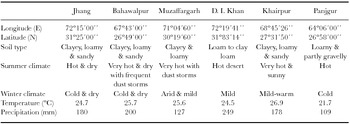
The study was conducted in the six districts with the largest area under date palm cultivation across four provinces of Pakistan: Jhang, Muzaffargarh and Bahawalpur (Punjab), D. I. Khan (KPK), Khairpur (Sindh) and Panjgur (Baluchistan; Table 1, Supplementary figure S1, available online at http://dx.doi.org/10.1017/S0014479716000399).
Main climatic characteristics of the six date palm growing districts in the sub-tropical desert climate zone of Pakistan.

Sources: Table adapted from Beinroth et al., Reference Beinroth, Khan, Nizami, Syal, Ahmad, Akram, Baig, Javed and Amin1985 with the addition of recent climate data from the PMD, Pakistan Meteorological Department www.namc.pmd.gov.pk/agromet-bulletins.php# (accessed on 12 February 2015).
Nutritional analysis of dates
For nutritional analysis at tamar stage 20 dates were directly harvested from each sampled date palm, without any preference to size (Nadeem et al., Reference Nadeem, Rehman, Anjum and Bhatti2011). Fruit samples were cleaned with a cotton cloth followed by seed removal for the preparation of date juice. Date flesh was cut into pieces and dried at 70 °C in an oven until weight constancy. After grinding with a mortar and pestle 40 g of the dried flesh was soaked overnight in 120 ml distilled water and homogenized in a blender followed by filtration with a Whatman® No. 1 filter paper. Filtrates were stored in plastic bottles at 6 °C until analysed (Ismail et al., Reference Ismail, Haffar, Baalbaki, Mechref and Henry2006). TSS in the date juice was measured using a hand-held refractometer and acidity was determined using 10 ml of juice, titrated against sodium hydroxide (NaOH), with phenolphthalein as an indicator. A pH meter was used to check the neutrality point.
Fruit firmness (kg) was measured at three different points using a penetrometer (plunger size = 2 mm) at 25 °C (Harker et al., Reference Harker, Maindonald and Jackson1996). The mineral profile (calcium, Ca and magnesium, Mg in mg g−1) of the date juice was analysed following standard procedures with a flame atomic absorption spectrometer (Hitachi 170–50, Hitachi Ltd. Co, Tokyo, Japan).
Soil analysis
Comprising the date palm's main root zone soil samples were collected at 0.9 m depth, air dried for one week and passed through a 2 mm sieve. Chemical analyses were performed using the standard analytical methods described by the U.S. Salinity Laboratory 1954. All calculations were made on the basis of oven dry soil weight. A saturated soil paste was prepared to more closely mimic the water content of the soil under field conditions. Saturation percentage was determined by drying the paste in an oven at 105 °C to constant weight and soil pH of the saturated paste was determined using a pH meter. Saturated soil extracts were obtained by a vacuum pump. The electrical conductivity (EC in dS m−1) of the saturation extract was measured using a conductivity meter (Type 197i, WTW GmbH, Weilheim, Germany) after calibrating the instrument with 0.01 N KCl. Calcium carbonate (CaCO3) was calculated by the calcimetric method using a 6 N HCl solution. Five grammes (g) of soil were treated with 1:1 HCl and the volume of CO2 liberated from CaCO3 present in the soil was noted (Moodie et al., Reference Moodie, Smith and McCreery1959). CaCO3 was determined according to the following formula:
 $$\begin{equation*}
{\rm{CaC}}{{\rm{O}}_3}{\rm{\ }}\left( {\rm{\% }} \right) = \frac{{{\rm{C}}{{\rm{O}}_2}{\rm{\ released\ }}\left( {{\rm{mL}}} \right){\rm{\ }} \times {\rm{\ }}\left( {0.00399} \right)}}{{{\rm{weight\ of\ soil\ sample\ taken\ }}\left( {\rm{g}} \right)}}.
\end{equation*}$$
Soil organic carbon (SOC) was determined by titrating samples containing potassium dichromate (K2Cr2O7), and sulphuric acid (H2SO4) using a ferroin indicator.
Olsen's method was used to calculate plant available soil phosphorus (P) content using sodium bicarbonate (NaHCO3) solution as an extractant (Chapman and Pratt, Reference Chapman and Pratt1961).
To determine cation exchange capacity (CEC), 5 g soil were saturated with 1 N sodium acetate (CH3COONa) buffered to pH 8.2. Sodium in the extract was determined using a flame photometer (Jenway PFP-7) while keeping the Na+ filter in place. CEC was calculated according to:
 $$\begin{equation*}
{\rm{CEC\ }}\left( {\frac{{{\rm{meq}}}}{{100{\rm{\ g\ soil}}}}} \right) = \frac{{{\rm{N}}{{\rm{a}}^ + }\left( {\frac{{{\rm{meq}}}}{{\rm{L}}}} \right) \times {\rm{\ }}10000}}{{1000{\rm{\ }} \times {\rm{\ weight\ of\ soil\ }}\left( {\rm{g}} \right){\rm{\ used}}}}.
\end{equation*}$$
Phosphorous (P) in the soil was measured using a spectrophotometer, and total P was calculated using:
 $$\begin{eqnarray*}
{\rm{Total\ P\ }}\left( {{\rm{mg\ k}}{{\rm{g}}^{ - 1}}} \right) &=& {\rm{mg\ kg}}{{\rm{\ }}^{ - 1}}{\rm{P\ }}\left( {{\rm{from\ calibration\ curve}}} \right)\\
&&\quad\times \frac{{{\rm{Perchloric\ Acid\ }}60{\rm{\% }} \times 50}}{{{\rm{weight}} \times {\rm{volume}}}}.
\end{eqnarray*}$$
Soil bulk density (BD) was determined by the core method (Shakir et al., Reference Shakir, Hassan and Razzaq2002) and soil hydraulic conductivity (HC) was measured in soils according to Ritzema (Reference Ritzema1994). HC was calculated according to:
 $$\begin{equation*}
{\rm{K}} = {\rm{C}}\frac{{{{\rm{H}}_{\rm{o}}} - {{\rm{H}}_{\rm{t}}}}}{{\rm{t}}}.
\end{equation*}$$
where
K = hydraulic conductivity (cm hr−1)
C = a geometric factor of the soil
t = time elapsed since the 1st reading of the level of the rising water in the hole (sec)
Ho = Ht when t is equal to zero
Ht = depth of water level in the hole below the reference level at time t (cm).
Morphological analysis
Vernacular names of all cultivars were recorded in the fields of growers and their fronds were cut to measure their length and width. Date palm fruits were collected at tamar stage. Fruit and seed parameters were determined at the Institute of Horticultural Sciences, University of Agriculture Faisalabad, Pakistan.
At dates harvest length and width of fronds, fruits and seeds were determined to the nearest mm using a measuring tape. Fruit and seed weight were recorded using a digital balance (accuracy of ±0.5 mg). To identify cultivars particularly attractive for marketing, with a high fruit size and high flesh content, ratios of length, width and weight of fruit and seed were measured.
Statistical analysis
All data were tabulated and coded into numerical values before descriptive statistical analyses were conducted in Microsoft Excel. Prior to analysis, variables were tested for normality of residuals using the Kolmogorov–Smirnov test (Latifian et al., Reference Latifian, Rahnama and Sharifnezhad2012); residuals of data were found to be non-normally distributed and thus non-parametric tests were used. Date palm cultivars with sample size ≥6 were used for further statistical analyses. Relationships between independent variables (cultivar type and location) and dependent variables (nutritional properties: TSS, acidity, calcium, magnesium and firmness; morphological parameters: leaf length, leaf width, fruit length, fruit width, fruit weight, seed length, seed width and seed weight; soil properties: pH, EC, CaCO3, organic matter (OM), available P, total P, CEC, BD and HC) were thus explored using the Kruskal–Wallis test (Montagna et al., Reference Montagna, Chouaia, Mazza, Prosdocimi, Crotti, Mereghetti, Vacchini, Giorgi, Biase, Longo, Cervo, Lozzia, Alma, Bandi and Daffonchio2015) in SPSS 17.0 (SPSS Inc., Chicago, USA). For all analyses the significance level was set to p < 0.05.
A Canonical Correspondence Analysis (CCA) was employed to investigate the effects of morphological properties of 12 date palm cultivars with sample size ≥6 and soil parameters on the nutritional properties of dates using the MVSP software (Orabi et al., Reference Orabi, Semida, Abdel-Dayem, Sharaf and Zalat2011). CCA is a direct gradient analysis or ordination technique (ter Braak and Prentice, Reference ter Braak and Prentice2004) that performs well with unimodal and non-linear species to environmental relationships (ter Braak, Reference ter Braak1986) and is relatively insensitive to data transformation protocols (Jackson, Reference Jackson1993; Reference Jackson1997). In the resulting CCA biplot, the length and direction of arrows indicate the relative importance and relationship between environmental variables and nutritional fruit characteristics. All environmental variables (leaf length, leaf width, fruit length, fruit width, fruit weight, seed length, seed width, seed weight, pH, EC, CaCO3, OM, available P, total P, CEC, BD and HC) were included into the initial CCA. In addition, study sites (districts) were added as dummy variables to identify their possible effect on nutrition of dates. Short vectors (seed width, total phosphorous and OM contents) were not included in the final CCA bi-plot because of their low effect on fruit nutritional properties.
Species richness and biodiversity indices are frequently used measures to determine taxa compositional differences among sites. As diversity indices such as Shannon's diversity index and Shannon's evenness also account for abundance of one taxonomic group, both indices provide more information with respect to composition than simply richness (number of cultivars). Though comparatively less employed, Shannon indices were used for banana cultivars across several villages in Uganda by Smale (Reference Smale2005). In our study, Shannon diversity index and Shannon's evenness of all date palm cultivars were calculated with the Microsoft Excel based Diversity Add-In Calculator (SSC, Reading, UK).
RESULTS
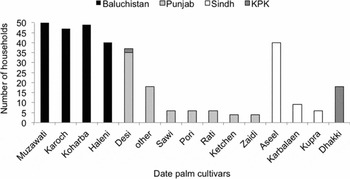
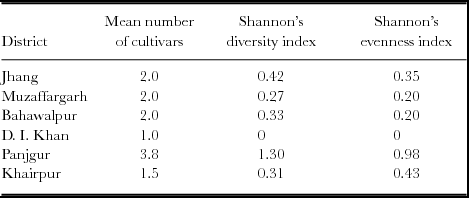
In the study region, 39 different date palm cultivars were grown by the surveyed farmers. In the district Jhang (Punjab), seven different cultivars were identified; most of the HHs were growing Desi date palms. Desi date palm was also very popular in Bahawalpur (Punjab) while other prominent varieties of the area were Sundri, Sufaida, Pathri, Daanda and Ketchen. Date palm growers of the Muzaffargarh (Punjab) had the greatest diversity of date palms and eleven cultivars were identified. Half of the date palm growers had the Desi cultivar in their groves, whereas the remaining farmers grew other cultivars. The majority of HHs in D. I. Khan (KPK) cultivated Dhakki cultivar. Aseel cultivar dominated in the groves of >60% farmers in Khairpur (Sindh) followed by the Karbalaen cultivar. Farmers in Panjgur (Baluchistan) produced six different cultivars among which Muzawati (50%) was most frequent (Figure 1). The number of cultivars and Shannon's diversity was highest in Panjgur, whereas date palm cultivars grown in this district were more even as compared with other studied districts (Table 2).
Number of surveyed households in the four provinces of Pakistan growing different date palm cultivars in 2012–2013 (Others = Ajwa, Akhrot, Amber, Angoor, Barni, Basra, Berehmi, Begum Jhangi, Chohara, Daanda, Dandari, Doki, Halawi, Khudrawi, Kalma, Kobra, Meeri, Pathri, Patal, Sundri, Shershai, Sabzo, Shamran, Sufaida and Zeerin cultivars which had sample size ≤3).

Mean number of cultivars, Shannon's diversity index and Shannon's evenness index per household in six date palm growing districts of Pakistan during 2012–2013.

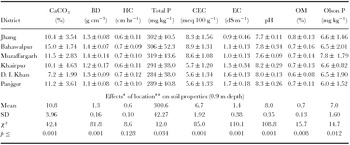
There were significant location-specific differences in soil CaCO3, BD, CEC, EC, pH, OM, total P and Olson P, but not in HC. Soil CaCO3 and CEC were highest in Bahawalpur and lowest in D. I. Khan and Panjgur. Sampled soils of Bahawalpur and Muzaffargarh district had the largest BD, while HC was highest in Bahawalpur, Muzaffargarh, D. I. Khan and Panjgur. Total soil P was very high in the soil of Muzaffargarh while Olson P was highest in soil samples of D. I. Khan. EC and pH were highest in the soils of Panjgur and lowest in those of Jhang and Muzaffargarh. The soil samples of Jhang district had the highest OM contents (Table 3).
Means (±SD) of soil characteristics (BD= Bulk Density, HC= Hydraulic Conductivity, CEC= Cation Exchange Capacity, EC= Electric Conductivity, OM= Organic Matter) of date palm groves in four provinces of Pakistan during 2012–2013.

Degrees of freedom (df) = 5.
*Kruskal–Wallis test; as residuals of data were not normally distributed.
**For locations see Figure S1.
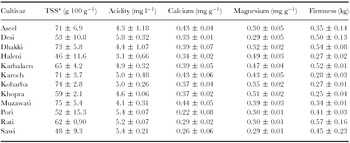
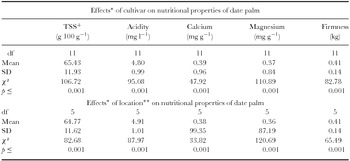
Dates from palm cultivars grown in the different regions of the country had very diverse nutritional properties (Table S1 in Supplementary Material available online at http://dx.doi.org/10.1017/S0014479716000399). TSS was highest in cultivar Muzawati followed by Koharba and Dhakki while Haleni had smallest concentrations of TSS. Cultivar Haleni, Muzawati and Aseel had lower acidity values compared with the other cultivars. Across sites cultivar Muzawati, Karoch and Aseel had the highest Ca concentrations among all studied cultivars. Magnesium concentration was highest in cultivar Haleni followed by Karbalaen and Karoch whereas the Sawi and Desi cultivar were poor in Mg (Table S1). The Rati and Dhakki cultivars had firmest dates (Table 4). Location also had significant effects on the nutritional parameters (TSS, acidity, calcium, magnesium and firmness) of the fruits (Tables 5 and S1).
Means (±SD) of different nutritional properties of 12 date palm cultivars (individual number per cultivar ≥6) grown in four provinces of Pakistan during 2012–2013.

* TSS = Total Soluble Solids.
Effects of cultivars and locations on nutritional properties of 12 date palm cultivars (individual number per cultivar ≥6) grown in four provinces of Pakistan during 2012–2013.

†TSS = Total Soluble Solids.
*Kruskal–Wallis test.
**For placement of locations see Fig. S1.
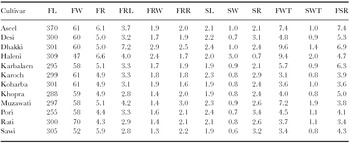
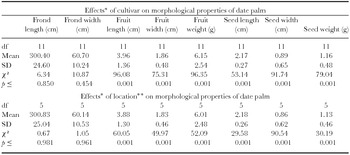
Among the studied date cultivars frond, fruit, and seed morphological data were very diverse (Table S2). The frond´s length-to-width ratio was highest in the Haleni cultivar and lowest in Rati. The fruit´s length-to-width ratio was larger in the Muzawati and Dhakki cultivar and smaller in Koharba and Haleni cultivars. Length-to-width ratio of seed was higher in cultivars grown in Punjab (Pori and Sawi) than in the cultivars of Baluchistan (Haleni) and Sindh (Aseel and Karbalaen). Aseel, Dhakki and Karbalaen showed the highest fruit weight-to-seed weight ratio among all cultivars (Table 6). Location and cultivar significantly affected fruit size (length, width) and weight as well as seed size (length, width) and weight, but not necessarily frond length, and width (Table 7 and S2–S4)
Means of assessed parameters and calculated ratios of different morphological characteristics: FL (frond length, cm), FW (frond width, cm), FR (frond length-to-frond width ratio), FRL (fruit length, cm), FRW (fruit width, cm), FRR (fruit length-to-fruit width ratio), SL (seed length, cm), SW (seed width, cm), SR (seed length-to-seed width ratio), FWT (fruit weight, g), SWT (seed weight, g), FSR (fruit weight-to-seed weight ratio) of 12 date palm cultivars (individual number per cultivar ≥6) in four provinces of Pakistan during 2012–2013.

Effects of cultivars and locations on morphological properties of 12 date palm cultivars (individual number per cultivar ≥6) grown in four provinces of Pakistan during 2012–2013.

*Kruskal–Wallis test.
**For placement of locations see Fig. S1.
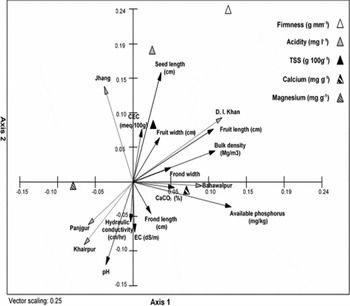
Axis 1 and axis 2 explained 23% and 4% of the variation, respectively. All variables were analysed, but only those that were statistically significant were retained. Across the six districts BD tended to be weakly positively correlated to axis 1 while Olson P had a strong positive correlation to axis 1 and pH showed a strong negative correlation to axis 2 (Figure 2). Among morphological properties of dates fruit length and seed length showed a strong positive correlation to axis 1 and axis 2, respectively. CCA indicated that the nutritional properties of the studied date palm cultivars correlated well with seed length and fruit length of dates and BD, available P, and pH of the soil (Figure 2). Calcium concentration seemed to be more affected by the concentration of CaCO3 and available P of the soil. TSS was positively affected by soil BD and CEC and fruit length and width, and seed length and was negatively affected by soil pH. Fruit acidity was more related to seed length. There was no relationship between any soil or morphological properties of fruit and frond on firmness of dates. Across cultivars, dates grown in D. I. Khan had a larger fruit length and width and were also high in TSS, Ca and acidity (Figure 2).
Canonical Correspondence Analysis (CCA) used to determine the importance of location, soil or fruit and seed morphological factors of date palm on nutritional characteristics of the dates. Dotted line arrows show soil factors, black arrows show morphological factors, grey arrows show districts and triangles show nutritional properties of 12 date palm cultivars (individual number per cultivar ≥6) grown in four provinces of Pakistan during 2012–2013.

DISCUSSION
Across our study area, the chemical and physical soil properties varied widely. OM ranged from 0.6–0.8%, which is within the range typical for date palm cultivation. Reilly and Reilly (Reference Reilly and Reilly2012) recommended OM of 0.3–1.2% across a wide range of textures. Significant effects of OM on fruit length, weight, flesh weight and TSS as well as non-significant effects on CA and Mg were observed previously for Zaghloul dates in Egypt (Marzouk and Kassem, Reference Marzouk and Kassem2010), but it is unknown to which degree those may be due to metaxenia. Based on the results of the CCA, surprisingly OM did not seem to have a major effect on the nutritional properties of dates from the studied cultivars.
The effect of macro-nutrients (N, P, Mg, Ca and K) on growth and yield of date palm have been reported in previous studies (Dialami and Mohebi, Reference Dialami and Mohebi2010; Khayyat et al., Reference Khayyat, Tafazoli, Eshghi and Rajaee2007). In our study, available soil P seemed to affect Ca contents, but had little effect on date firmness which is, however, hard to explain physiologically. In contrast, Faust (Reference Faust1989) reported a strong correlation of soil P with firmness of apple (Malus domestica Borkh.). Furthermore, Stiles and Reid (Reference Stiles and Reid1991) described that size, acidity, and colour of the fruit were positively correlated with the application of P to soils during the early growing season of apple and pear (Pyrus communis L.) fruits. Poll et al. (Reference Poll, Petersen and Nielsen2003) suggested that tart cherry (Prunus cerasus L.) production and fruit quality (titratable acidity, soluble solids contents and colour) can be improved by increasing soil P.
Low and high soil BD can affect nutrient uptake due to the soil's low or high HC and poor root to soil contact (Arvidsson, Reference Arvidsson1999). In our study soil BD affected the Ca concentrations and TSS of dates. There are no reports available describing the direct effects of soil BD on date Ca and TSS. The average BD of Panjgur soils was similar as reported for the soil of Sra Ghurgai, Quetta, Baluchistan (1.08 t m−3; Saeed et al., Reference Saeed, Barozai, Ahmad and Shah2014).
The TSS concentrations in the investigated dates ranged from 60–75 g 100 g−1, which is similar to the 60–84 g 100 g−1 reported by Pareek (Reference Pareek and Bose1985) for date palm in India. The Ca concentrations in the studied dates ranged from 0.22–0.44 mg g−1, with the majority of cultivars containing >0.30 mg g−1 which is similar to the 0.25 mg g−1 reported by Jamil et al. (Reference Jamil, Nadeem, Hanif, Ali and Akhtar2010) for Burkavi dates. According to the findings of Al-Hooti et al. (Reference Al-Hooti, Sidhu and Qabazard1997), mineral concentrations of dates reflects the soil fertility status which is also indicated by our CCA. It is well known that root Ca uptake from the soil and its translocation to different parts of the plant, especially to the fruit is controlled by mass flow of water in response to the negative water potentials developed in leaves and fruits triggered by transpiration and growth (De Freitas et al., Reference De Freitas, Shackel and Mitcham2011). The factors controlling this mechanism include available soil Ca, root growth, root Ca uptake, competition of Ca with other nutrients in the root but also fruit and leaf competition for the available Ca in the xylem sap (De Freitas and Mitcham, Reference De Freitas, Mitcham and Jules2012; Taylor and Locascio, Reference Taylor and Locascio2004).
In the current study, all soils were alkaline (pH range: 7.6–8.3) and did not show strong effects on nutritional properties of dates. The soils of Jhang, Muzaffargarh and Bahawalpur were slightly alkaline and those of Khairpur, D. I. Khan and Panjgur were moderately alkaline. The pH range of Khairpur, D. I. Khan and Panjgur soils was similar to the pH values reported in previous studies by Anwar and Chandio (Reference Anwar and Chandio2012) for soils of Kamber Taluka (Sindh), by Wasiullah et al. (Reference Wasiullah, Bhatti, Khan and Akmal2010) for the soils of Kohat (KPK) and by Naseem et al. (Reference Naseem, Bashir, Shireen and Shafiq2009) for soils in Wadh (Baluchistan) ranging between pH 7.5-8.3.
The EC of all studied soils indicated only low constraints (0.9–1.7 dS m−1) for palm growth and is therefore unlikely to have any noticeable effect on the nutritional properties of dates. According to the findings of Tripler et al. (Reference Tripler, Shani, Mualem and Ben-Gal2011), date palm is tolerant to low salinity and responds to low EC (1.8 dS m−1) with increased growth and 35–50% higher fruit production compared with higher EC (4 dS m−1). However, there are also reports describing date palm as tolerant to higher EC (4 dS m−1) and suggesting a yield reduction of 3.6% for every 1 dS m−1 increase in soil EC (Furr and Ream, Reference Furr and Ream1968; Furr et al., Reference Furr, Ream and Ballard1966). Tripler et al. (Reference Tripler, Ben-Gal and Shani2007) reported a 10% reduction in yield for every 1 dS m−1 increase in EC which is greater than that reported previously. In any case, there is evidence that salinity tolerance in date palm is cultivar specific (Djibril et al., Reference Djibril, Mohamed, Diaga, Diegane, Abaye, Maurice and Alain2005). Average CEC of the studied soils was low (7.1 meq 100 g−1) and apparently had only a minor effect on the dates’ TSS in our study.
Dhakki, Muzawati, Aseel and Karbalaen were the most important cultivars grown in KPK, Baluchistan and Sindh. The cultivars Aseel, Dhakki, Karoch and Muzawati had the firmest fruits and high TSS, Ca and Mg. Firmness in dates is strongly correlated with fibre and carbohydrates (El Hadrami and Al-Khayri, Reference El Hadrami and Al-Khayri2012). Ismail et al. (Reference Ismail, Haffar, Baalbaki, Mechref and Henry2006) reported that physical and chemical characteristics of the fruits can influence their rheological and mechanical properties, which determines their firmness and ultimately quality. Jamil et al. (Reference Jamil, Nadeem, Hanif, Ali and Akhtar2010) reported Mg concentrations of Aseel (0.271 mg g−1) and Dhakki (0.206 mg g−1) cultivars that were lower than those observed in our study, indicating the presence of dates with relatively high concentrations of these human nutritionally important minerals in the studied date germplasm of Pakistan.
It is well known that a crop nutrient uptake strongly affects fruit quality and economic outcome of production (Lipiec and Stepniewski, Reference Lipiec and Stepniewski1995) and it has been documented earlier that soil nutrients can strongly affect the physical properties of dates namely their length, weight and diameter (Hussein and Hussein, Reference Hussein and Hussein1982). Morphological characteristics, specifically frond length and width can also be used to characterize date palm cultivars in addition to their nutritional properties (Asif et al., Reference Asif, Al-Ghamdi, Al-Tahir and Latif1986). In the present study, a great variation in frond morphology was recorded among the studied cultivars. Frond length of date palm cultivars was in range of 280–370 cm, which is comparable to the three Saudi Arabian date palm varieties grown in the district Khairpur, Sindh (Abul-Soad et al., Reference Abul-Soad, Jatoi and Markhand2013). There is no reported evidence of any relationship between frond size and nutritional values of dates. High variability in fruit attributes such as length, width and weight has been reported by several researchers in previous studies (Al-Doss et al., Reference Al-Doss, Aly and Bacha2001; Mehana, Reference Mehana1999; Rizk and El-Sharabasy, Reference Rizk and El-Sharabasy2007). Most of the studied date palm cultivars carried small sized dates (2.8–3.5 cm) and their size was similar to those of dates reported in a previous study on 85 date palm varieties grown in Pakistan (Markhand et al., Reference Markhand, Abul-Soad, Mirbahar and Kanhar2010). We observed that across locations fruit length and fruit weight was highest in the Dhakki cultivar, making it visually more attractive for customers in addition to its good nutritional properties. Nadeem et al. (Reference Nadeem, Rehman, Anjum and Bhatti2011) also reported similar findings about the texture profile and phenol concentration of dates in 21 varieties of dates grown in the Date Palm Reserach Station, Jhang. Many integrated factors play a role in determining colour and size of fruit; one is metaxenia and exerted by the type of pollen grain and timing of pollination (Iqbal et al., Reference Iqbal, Ghaffoor and Rehman2004), others are irrigation, fertilisation operations and date palm head treatments (Markhand et al., Reference Markhand, Abul-Soad, Mirbahar and Kanhar2010). According to Iqbal et al. (Reference Iqbal, Imranullah, Munir and Niamatullah2011), larger fruit size and high weight in Dhakki cultivar can be attributed to genetic determination. Muzawati and Haleni cultivars also had large fruits, which were also high in TSS, Ca and Mg concentrations.
The seed weight of the studied cultivars ranged from 0.7–2.0 g, while seeds of the Desi cultivar were largest, making fruits of this cultivar less attractive for marketing. In the current study, it was observed that, date palm cultivars with big seeds had low nutritional properties, as compared with those with small seeds. Nadeem et al. (Reference Nadeem, Rehman, Anjum and Bhatti2011) also reported that Desi dates have large and heavy seeds. In the current study, all popular date palm cultivars had lower seed weight and good nutritional values than others. Such fruit and seed characteristics are important not only for the identification of cultivars (Eissa et al., Reference Eissa, Al-Razek, El-Sharabasy and Rizk2009), but also for commercial grading, which is mostly based on the physical characters and general appearance of fruits (Sakr et al., Reference Sakr, Abu Zeid, Hassan, Baz and Hassan2010).
The outcome of the CCA conducted to study possible effects of soil and morphological parameters of date palm on fruit nutritional properties was unsatisfactory as only 27% of the total variability was captured. One possible reason can be a too small sample size. Stevens (Reference Stevens1986) recommended at least 20 times more samples than variables for such an analysis. Nevertheless, our data showed that soil properties can affect nutritional properties of dates, but differences in morphological and nutrition parameters of dates may certainly also be the result of variations in climate, irrigation, temperature, day length and post-harvest handling (drying) of fruits (Nadeem et al., Reference Nadeem, Rehman, Anjum and Bhatti2011). Since dates undergo several internal and external changes during their ripening process (Vandercook et al., Reference Vandercook, Hasegawa and Maier1977) their nutritional composition is also affected by timing of collection and measurement.
CONCLUSIONS
The date cultivars Aseel, Karoch, Dhakki and Muzawati had superior nutritional properties and hence may have good potential for marketing. Across sites soil OM, BD, CaCO3 and available P affected the nutritional properties of dates, as well as fruit and seed length and weight. Further studies are needed in order to better understand the effect of soil properties on nutritional properties of dates. In view of increasing opportunities for (inter-) national marketing of dates, farmers may be well advised on growing commercial date palm cultivars which contain smaller seeds and have more pronounced expression of desirable nutritional traits. This seems particularly important for groves in Punjab where Desi date palm cultivars produced very big seeds and had low flesh of low nutritional quality. Rheological properties of elite cultivars of Pakistani dates merit further study to better understand the relationship between texture, structure and changes induced by processing which will help in quality control of dates.
Acknowledgements
We gratefully acknowledge financial support of this study through the International Center for Development and Decent Work (ICDD) at University of Kassel (www.icdd.uni-kassel.de), funded through the German Academic Exchange Service (DAAD) and the Federal Ministry for Economic Cooperation and Development (BMZ) in the framework of the “Exceed” program. We are thankful to the date palm growers of Pakistan who voluntarily participated in this study and to Dr Alexandra zum Felde, Dr Shafique Maqsood, Dr Katja Brinkmann and Dr Eva Schlecht for their critical help in revising this manuscript.
SUPPLEMENTARY MATERIALS
For supplementary material for this article, please visit http://dx.doi.org/10.1017/S0014479716000399