Introduction
The Conyza genus comprises approximately 60 species (Neson Reference Neson1990), among which horseweed [Conyza canadensis (L.) Cronquist], hairy fleabane [Conyza bonariensis (L.) Cronquist], and Sumatran fleabane [Conyza sumatrensis (Retz.) E. Walker] are considered important weeds in grain crops, orchards, and pastures (Schneider et al. Reference Schneider, Rizzardi, Grando, Ceccon, Nunes and Didone2020). The occurrence of Conyza spp. as a crop weed has increased worldwide, mainly because of the evolution of resistance to herbicides with different mechanisms of action, including glyphosate (Ge et al. Reference Ge, d’Avignon, Ackerman and Sammons2014; Moretti et al. Reference Moretti, Alárcon-Reverte, Pearce, Morran and Hanson2017a). One of the alternatives for controlling glyphosate-resistant biotypes has been the herbicide 2,4-D alone or in combination with other herbicides (Leal et al. Reference Leal, Borella, Souza, Oliveira, Langaro and Pinho2021). The mechanism of action of 2,4-D involves the auxin-dependent degradation of members of a family of transcription regulators, the Aux/IAA family (Tan et al. Reference Tan, Calderon-villalobos, Sharon, Zheng, Robinson and Estelle2007). At low auxin concentrations, these repressor proteins bind to auxin response factors (ARFs) preventing their association to auxin-responsive genes. After the spraying of auxinic herbicides, the level of auxins increases in the cells, inducing the selective proteolysis of Aux/IAA and releasing ARFs. ARFs induce the auxin-responsive genes, and the plant develops the characteristic symptoms of epinasty, stem swelling, and leaf senescence, which results in plant death (Song Reference Song2014). The selectivity of auxinic herbicides is caused by differential metabolization. In the tolerant monocots, the herbicide is hydroxylated and then conjugated with glucose; in sensitive dicots, the conjugation occurs with amino acids, but this process is quickly reversed (Figueiredo et al. Reference Figueiredo, Leibhart, Reicher, Tranel, Nissen, Westra, Bernards, Kruger, Gaines and Jugulam2018; Wu et al. Reference Wu, Wang, Song, Xu, Wang and Xiong2016).
About 27 cases of weed resistance to 2,4-D have been reported (Heap Reference Heap2021), most of them associated with the lack of epinasty as the resistant phenotype (Dang et al. Reference Dang, Malone, Boutsalis, Krishnan, Gill and Preston2018; Figueiredo et al. Reference Figueiredo, Leibhart, Reicher, Tranel, Nissen, Westra, Bernards, Kruger, Gaines and Jugulam2018; Goggin et al. Reference Goggin, Kaur, Owen and Powles2018; Rey-Caballero et al. Reference Rey-Caballero, Menendez, Gine-Bordonaba, Salas, Alcantara and Torra2016). In 2015, accessions of C. sumatrensis displaying the rapid necrosis phenotype after 2,4-D treatment were identified in the northwest region of Paraná, Brazil (Queiroz et al. Reference Queiroz, Delatorre, Lucio, Rossi and Zobiole2020). Similar symptomatology had been reported for giant ragweed (Ambrosia trifida L.) after glyphosate spraying in Ontario, Canada, and Indiana, USA (Brabham et al. Reference Brabham, Gerber and Johnson2011; Van Horn et al. Reference Van Horn, Moretti, Robertson, Segobye, Weller, Young, Johnson, Schulz, Green, Jeffery, Lespérance, Tardif, Sikkema, Hall and McLean2017). However, until recently, there were no reports of this phenotype in response to auxinic herbicides. Queiroz et al. (Reference Queiroz, Delatorre, Lucio, Rossi and Zobiole2020), in the first study about C. sumatrensis resistant to 2,4-D with rapid necrosis, reported symptoms beginning about 2 h after herbicide application and a resistance factor of 18.6 calculated based on the herbicide efficiency control resulting from LD50 values of 1,133 and 61 g ha−1 in the resistant and susceptible accessions, respectively. This study also noted that the symptoms decreased at low light and that cross-resistance occurred to MCPA, which is also a phenoxy herbicide, but not to other auxinic compounds. The mechanism of resistance was not investigated.
None of the well-studied cases of resistance to 2,4-D are associated with the occurrence of rapid necrosis. The mechanisms of resistance to 2,4-D identified up to now are related to reduced translocation in corn poppy (Papaver rhoeas L.) (Rey-Caballero et al. Reference Rey-Caballero, Menendez, Gine-Bordonaba, Salas, Alcantara and Torra2016) and oriental mustard (Sisymbrium orientale L.) (Dang et al. Reference Dang, Malone, Boutsalis, Krishnan, Gill and Preston2018), ATP-binding cassette class B (ABCB) transporters in wild radish (Raphanus raphanistrum L.) (Goggin et al. Reference Goggin, Cawthray and Powles2016), and changes in the receptor complex SKP-Cullin-F-Box-Transport Inhibitor-Response 1/Auxin F-Box (SCFTIR1/AFB) in Arabidopsis thaliana (Gleason et al. Reference Gleason, Foley and Singh2011) and in auxin/indole-3-acetic acid (AUX/IAA) repressors in kochia [Bassia scoparia (L.) A.J. Scott] (LeClere et al. Reference LeClere, Wu, Westra and Sammons2018). Besides that, rapid detoxification of 2,4-D in waterhemp [Amaranthus tuberculatus (Moq.) Sauer var. rudis (Sauer) Costea and Tardif] has been reported (Figueiredo et al. Reference Figueiredo, Leibhart, Reicher, Tranel, Nissen, Westra, Bernards, Kruger, Gaines and Jugulam2018). Participation of mitogen-activated protein kinases (MAPKs; EC 2.7.11.24) in R. raphanistrum (Goggin et al. Reference Goggin, Kaur, Owen and Powles2018) and of chalcone synthase (EC 2.3.1.74) in B. scoparia (Pettinga et al. Reference Pettinga, Ou, Patterson, Jugulam, Westra and Gaines2018) in the resistance mechanism has also been suggested. The use of inhibitors has been useful for mechanism identification. For example, inhibitors of auxin-efflux transporters and ABCB transporters in 2,4-D–susceptible plants mimicked the resistant biotypes of R. raphanistrum, suggesting a plasma membrane ABCB transporter is associated with the resistance (Goggin et al. Reference Goggin, Cawthray and Powles2016). Also, the insecticide malathion, an inhibitor of cytochrome P450 monooxygenases, reduced 2,4-D resistance in A. tuberculatus (Figueiredo et al. Reference Figueiredo, Leibhart, Reicher, Tranel, Nissen, Westra, Bernards, Kruger, Gaines and Jugulam2018).
The accession of C. sumatrensis with rapid necrosis to 2,4-D might have a resistance mechanism of fast and continuous production of hydrogen peroxide (H2O2) (Queiroz et al. Reference Queiroz, Delatorre, Lucio, Rossi and Zobiole2020), similar to the hypersensitive response found in plants in response to pathogens (Aviv et al. Reference Aviv, Rustérucci, Ill, Dietrich, Parker and Dangl2002). This mechanism is known to involve MAPKs, NADPH oxidases, and mainly, LESION SIMULATING DISEASE 1 (LSD1) associated with programmed cell death and hypersensitive response (Aviv et al. Reference Aviv, Rustérucci, Ill, Dietrich, Parker and Dangl2002; Coll et al. Reference Coll, Epple and Dangl2011; Karpiński et al. Reference Karpiński, Szechyńska-Hebda, Wituszyńska and Burdiak2013). LSD1 positively regulates the expression of antioxidant enzymes, such as superoxide dismutase (SOD; EC 1.15.1.1) and catalase (CAT; EC 1.11.1.6), and proteins related to pathogenesis (Karpiński et al. Reference Karpiński, Szechyńska-Hebda, Wituszyńska and Burdiak2013). Its inactivation leads to derepression of EDS1 (ENHANCED DISEASE SUSCEPTIBILITY 1)/PAD4 (PHYTOALEXIN DEFICIENT 4) and consequently represses genes for antioxidative enzymes (Aviv et al. Reference Aviv, Rustérucci, Ill, Dietrich, Parker and Dangl2002; Karpiński et al. Reference Karpiński, Szechyńska-Hebda, Wituszyńska and Burdiak2013). Because of similarities in phenotypic response among these cases and the rapid necrosis caused by 2,4-D, the genes producing the hypersensitive response were investigated in the present study. The aim of the study was to identify the possible mechanism involved in the resistance to 2,4-D by rapid necrosis. Therefore, we evaluated gene expression and the effects of inhibitors of auxin transport, PINs (PIN-FORMED) and ABC transporters, and of antioxidative enzymes on accessions of C. sumatrensis with the occurrence of rapid necrosis caused by 2,4-D.
Materials and Methods
Plant Material
The accessions were collected in crop fields located in the Paraná State, Brazil in 2016. The resistant accession was Marpr9-rn collected in the city of Maripá, PR, Brazil (24.5472°S, 53.7239°W). The susceptible accession was Londs4-s collected in Londrina, PR, Brazil (23.3286°S, 51.2119°W). Both accessions were collected in crop fields and are the same as the accessions used in the first study of rapid necrosis caused by 2,4-D (Queiroz et al. Reference Queiroz, Delatorre, Lucio, Rossi and Zobiole2020). Plants of the resistant accession were bagged and selfed for two generations after selection with 804 g ae ha−1 2,4-D (DMA® 806 BR SL, Dow AgroSciences Industrial, São Paulo, SP, Brazil) in a greenhouse to produce the seeds used in this study, as described in Queiroz et al. (Reference Queiroz, Delatorre, Lucio, Rossi and Zobiole2020). Approximately 50 plants of the putative susceptible accessions were treated with 2,4-D as described above. The symptom of rapid necrosis was not identified, and all plants died. Untreated plants from the same seed source were used for seed multiplication. Plants of the second generation were treated with 2,4-D, and the susceptibility was confirmed. The plants were maintained in a greenhouse at 25 ± 5 C and irrigated daily.
Inhibitors’ Effects
Experiments in the Greenhouse
The experiments were carried out twice in a completely randomized design with a bifactorial arrangement and four replicates. Factor A consisted of the 2,4-D–resistant accession with rapid necrosis Marpr9-rn and of the susceptible accession Londs4-s. Factor B was 2,4-D (402 g ae ha−1) alone and mixed with the inhibitors, the inhibitors alone, and a non-treated control. The inhibitors were malathion, 4-chloro-7-nitrobenzofurazan, rutin, sodium azide, and imidazole, as described in Table 1. Plants were 7- to 12-cm tall (7 to 10 leaves) when treated using a track sprayer (Generation III Research Sprayer, DeVries Manufacturing, Hollandale, MN, USA) calibrated at 262 kPa delivered by an 80.02E nozzle, resulting in an output volume equivalent to 200 L ha−1. Plant visual injury at percentage scale was evaluated for the occurrence of rapid necrosis in the resistant accession Marpr9-rn and for epinasty in the susceptible accession Londs4-s at 1, 14, and 28 d after treatment (DAT) with 2,4-D and previous spraying of inhibitors of detoxifying and transporter enzymes, as described in Table 1. Shoot fresh matter was measured at 49 DAT.
Treatments used in spraying and leaf-disk experiments. a

a Abbreviations: NBD-Cl, 4-chloro-7-nitrobenzofurazan; NPA, 1-N-naphythylphthalamic acid; PIN, PIN-FORMED; TBH, timing before 2,4-D spraying or incubation; TIBA, triiodobenzoic acid.
b Dose: g ae or ai ha−1.
c Dow AgroSciences Industrial Ltda, São Paulo, SP, Brazil; https://www.corteva.br.
d Cheminova Brasil Ltda, São Paulo, SP, Brazil.
e Sigma-Aldrich-Merck, Schnelldorf, BY, Germany; https://www.sigmaaldrich.com.
Leaf Disk Experiments
Two preliminary experiments were conducted in a completely randomized design with a bifactorial arrangement and four replicates. Factor A was plants from resistant (Marpr9-rn) and susceptible (Londs4-s) accessions. Factor B for the first experiment was 2,4-D doses of 0, 9.09, 909, and 9,090 μM, and for the second experiment was incubation time of 1, 2, and 4 h. Three 12-mm-diameter leaf disks collected from mature leaves were used for each replicate. The disks were placed in 6-well cell culture plates containing 10 ml of incubation solution. The plates were kept in a growth chamber (Percival Scientific, Perry, IA, USA) at 23 ± 3 C and 300 μmol m−2 s−1 of light intensity. Based on these experiments, the minimum time of 2 h of incubation and the 2,4-D concentration of 9,090 μM were established for the occurrence of rapid necrosis symptoms and H2O2 accumulation.
A third experiment was carried out twice in a completely randomized design with four independent biological replicates. Leaf disks of 12-mm diameter were collected from untreated plants and incubated in a solution with the inhibitors as described in Table 1. The disks were then transferred to a 9.090 μM solution of 2,4-D and incubated for 2 h. H2O2 presence was determined by the 3,3′-diaminobenzidine (DAB) staining method (Thordal-Christensen et al. Reference Thordal-Christensen, Zhang, Wei and Collinge1997). Controls were leaf disks incubated only with 2,4-D, only with the inhibitor, and only with water. Leaf disks were infiltrated with DAB (1 mg ml−1, pH 3.8) and incubated at room temperature overnight. Samples were then decolorized by being boiled in 90% ethanol for 10 min to remove chlorophyll before being photographed. The presence of H2O2 was visualized by color change (brown) caused by DAB polymerization and values estimated based on pixel color intensity using Image J (National Institutes of Health, Bethesda, MD, USA).
Gene Expression Analysis
Plant Material and RNA Extraction
Plants from Marpr9-rn and Londs4-s were grown in a greenhouse as described previously. Plants at the rosette stage with 7 to 10 leaves were sprayed at 12:50 PM with 2,4-D 804 g ha−1 as described earlier. The experiment was carried out in a completely randomized design with four biological and four technical replicates. Factor A was the Marpr9-rn and Londs4-s accessions; factor B was the 2,4-D treated and untreated plants; and factor C was the sampling timing of 15 and 60 min after treatment. Leaf tissue (100 mg) was collected from the fourth leaf (from the base to the top) and immediately stored in liquid nitrogen. RNA was extracted by maceration in liquid nitrogen and 500 µl of Concert™ reagent (Invitrogen, Thermo Fisher Scientific, Carlsbad, CA, USA) following the manufacturer’s protocol. The concentration and quality of RNA was evaluated by spectrophotometer (Genesys 2®, Thermo Electron, Madison, WI, USA) and agarose gel at 1%. cDNA was synthesized following the manufacturer’s instructions using Moloney murine leukemia reverse transcriptase. Samples were considered adequate when the 260/280 absorbance ratio was above 1.8 and the typical mRNA smear in agarose gel was observed.
Selection and Validation of Reference and Target Genes
Six reference genes used in studies with the 2,4-D herbicide in different species and with other herbicides in C. bonariensis and C. canadensis (Moretti et al. Reference Moretti, Alárcon-Reverte, Pearce, Morran and Hanson2017a; Peng et al. Reference Peng, Abercrombie, Yuan, Riggins, Sammons, Tranel and Stewart2010; Scarabel et al. Reference Scarabel, Milani, Panozzo and Rasori2017; Wu et al. Reference Wu, Wang, Song, Xu, Wang and Xiong2016) were tested. The coding DNA sequence of those genes annotated in NCBI and the genome of C. canadensis were used for BLASTN analysis and comparison using BioEdit (v. 7.0.5, https://bioedit.software.informer.com/7.2/). Homologous regions in C. canadensis were used for primer design (Table 2) using Primer3Plus (https://www.bioinformatics.nl/cgi-bin/primer3plus/primer3plus.cgi).
Target genes used for qRT-PCR analysis.

a Gene name according to the annotation in the reference species.
b Genome identification of the sequence used for BLASTN.
c Sequence number of the C. canadensis sequence with higher similarity.
d Identity of C. canadensis sequence and reference sequenced by BLASTN.
f Moretti et al. (Reference Moretti, Alárcon-Reverte, Pearce, Morran and Hanson2017a).
The sequences were amplified in conventional PCR and visualized in 2% agarose gel (Nunes et al. Reference Nunes, Markus, Delatorre and Merotto2015). To define the cDNA concentration for RT-PCR, we analyzed the dissociation peaks in four dilutions (1:200; 1:100; 1:50; and 1:25). Primer efficiency (Ef) was calculated using the software LinReg (v. 12) (Ruijter et al. Reference Ruijter, Ramakers, Hoogaars, Karlen, Bakker, van den Hoff and Moorman2009). Primer sequences, efficiency, and melting temperatures are shown in Table 3.
Sequence, amplicon size (AS), melting temperature (TM) and primer efficiency (Ef) of target and reference genes.

a HEAT SHOCK PROTEIN 70-4.
b GLYCERALDEHYDE-3-PHOSPHATE DEHYDROGENASE.
c CYCLOPHILIN 5.
d LESION SIMULATING DISEASE 1.
e TRANSPORT INHIBITOR RESPONSE 1.
f ABC-C FAMILY MRP10.
g CATIONIC AMINO ACID TRANSPORTER 4.
h CALLOSE SYNTHASE 1.
Reference gene stability was performed with three biological and three technical replicates for samples collected at 60 min after herbicide treatment. qRT-PCR conditions were: 95 C for 2 min, 35 cycles of 95 C for 30 s, 60 C for 30 s, 72 C for 2 min, followed by a dissociation stage at 95 C for 15 s, 60 C for 1 min, 95 C for 15 s, and 60 C for 15 s (Moretti et al. Reference Moretti, Alárcon-Reverte, Pearce, Morran and Hanson2017a). The baseline was manually adjusted when required. Average Ct and efficiency of the technical replicates were used to calculate ∆Ct = Ct average – Ct smallest average sample and 2−∆Ct(1+Ef). These values were used to evaluate gene stability in the software NormFinder v. 5, 2015 (Andersen et al. Reference Andersen, Jensen and Orntoft2004). The two most stable genes were selected as reference genes.
Expression Analysis of Target Genes
Real-time PCR analysis was performed in the 7300 Real-Time PCR System® (Applied Biosystems, Foster City, CA, USA). Reaction volume was 20 µl consisting of 3.2 µl sterile ultrapure water, 2 µl PCR buffer 10X (Invitrogen, Thermo Fisher Scientific); 0.5 µl dNTP Mix (10 mM); 2 µl SYBER Green 1X (Invitrogen, Thermo Fisher Scientific); 1.2 µl MgCl2 (50 mM); 0.1 µl Taq Platinum (5 units µl−1) (Invitrogen, Thermo Fisher Scientific); 0.2 µl ROX (Invitrogen, Thermo Fisher Scientific); 0.4 µl primers (10 µM) forward and reverse; and 10 µl cDNA diluted four times (1:25). Reaction conditions were 5 min at 95 C followed by 40 cycles of: 15 s at 95 C; 15 s at 60 C or 63 C, and 30 s at 72 C, and a dissociation stage at 95 C for 15 s, 60 C for 1 min, 95 C for 15 s, and 60 C for 15 s.
ACTIN and 18S were used as reference genes based on the ranking of stability analysis calculated by the software miRDeepFinder (Xie et al. Reference Xie, Xiao, Chen, Xu and Zhang2012) (Table 3). Relative expression was determined based on each reference gene using the formula Ef(−∆∆Ct) (Livak and Schmittgen Reference Livak and Schmittgen2001), and the average and confidence interval were calculated. Control was considered as the mean ∆Ct of untreated resistant and susceptible accessions.
Statistical Analysis
All data were subjected to Shapiro-Wilk and Bartlett tests and histogram analysis, followed by ANOVA (P ≤ 0.05). Confidence intervals were defined, and means were further compared by Tukey test (P ≤ 0.05) or t-test (P < 0.05).
Results and Discussion
Effect of Inhibitors of Detoxifying Enzymes and Transporters on Rapid Necrosis Phenotype
The injury observed in the evaluation at 1 DAT in the susceptible accession Londs4-s is related to the epinasty effect of 2,4-D and in the resistant accessions Marpr9-rn is associated with rapid necrosis (Table 4). In subsequent evaluations, epinasty symptoms increased and resulted in plant death in the susceptible accession. In the resistant accession, plants continued producing new leaves that showed no rapid necrosis symptom. At 28 DAT, Marpr9-rn injury was associated with necrosis on the older leaves, whereas Londs4-s injury was above 90% in all treatments. Plant fresh matter at 49 DAT demonstrated resistance to 2,4-D in the resistant accession Marpr9-rn in comparison with the susceptible accession Londs4-s (Table 4). No consistent effect on decreasing plant injury was found for the inhibitors sprayed before 2,4-D in the resistant accession Marpr9-rn, that is, no reversion or limitation in the phenotype was observed (Table 4). No difference among inhibitors and 2,4-D alone occurred for the fresh matter at 49 DAT. The spraying of the inhibitors in the whole-plant assay may limit its effect due to difficulties for absorption, translocation, and interaction with the plant’s metabolism. Studies with other weeds resistant to auxinic herbicides did not identify inhibitor effects or detoxification as the main mechanism of resistance (Goggin et al. Reference Goggin, Kaur, Owen and Powles2018), except by one study, in which the inhibitors malathion and piperonyl butoxide reduced the level of resistance to 2,4-D in A. tuberculatus with a symptom not associated with rapid necrosis (Figueiredo et al. Reference Figueiredo, Leibhart, Reicher, Tranel, Nissen, Westra, Bernards, Kruger, Gaines and Jugulam2018).
Injury related to rapid necrosis on the resistant accession Marpr9-rn and to epinasty on the susceptible accession Londs4-s at 1, 14 and 28 days after treatment (DAT) and fresh matter after 2,4-D (402 g ae ha−1) and previous spraying of inhibitors of detoxifying and transporter enzymes as described in Table 1.

a An asterisk (*) indicates difference in comparison with 2,4-D treatment (Dunnett test, 5% probability).
b NBD-Cl, 4-chloro-7-nitrobenzofurazan.
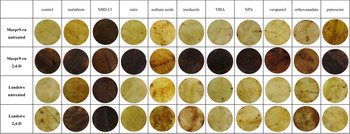
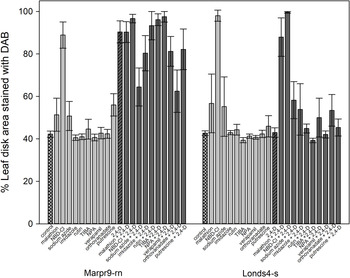
In the leaf disk experiments, pretreatment with orthovanadate and sodium azide reduced the H2O2 accumulation in leaf disks from Marpr9-rn treated with 2,4-D (Figures 1 and 2). ABC proteins establish a tight complex with nucleoside diphosphates; orthovanadate, a metastable analogue of orthophosphate, arrests the catalytic cycle by substituting the phosphate and trapping ADP in the nucleotide-binding site (Urbatsch et al. Reference Urbatsch, Sankaran, Weber and Senior1995). Therefore, orthovanadate may reduce auxin transport by inhibition of ABC transporters (Geisler and Murphy Reference Geisler and Murphy2005). The efflux of 2,4-D out of the cell may be reduced by orthovanadate, limiting translocation of the herbicide and the number of cells affected by 2,4-D, and consequently restricting the area damaged by rapid necrosis. Auxin transport may also be reduced by sodium azide (Petersson et al. Reference Petersson, Johansson, Kowalczyk, Makoveychuk, Wang, Moritz, Grebe, Benfey, Sandberg and Ljung2009), which, as an inhibitor of ATPase, may limit the energy available for ABC transporter action. Restriction of available energy may also be the reason for rapid necrosis suppression under low light. Verapamil is also a general ABC transporter inhibitor and also shows a subtle effect in the leaf disk image (Figure 1), but the H2O2 staining with DAB was similar to the 2,4-D alone (Figure 2).
Hydrogen peroxide presence in leaf disks of Conyza sumatrensis susceptible Londs4-s and 2,4-D–resistant by rapid necrosis Marpr9-rn stained with 3,3′-diaminobenzidine (DAB) after treatment with different inhibitors and 2 h of incubation in 2,4-D solution (9,090 μM). Abbreviations: NBD-Cl, 4-chloro-7-nitrobenzofurazan; NPA, 1-N-naphythylphthalamic acid; TIBA, triiodobenzoic acid.

Hydrogen peroxide proportion in leaf disks of Conyza sumatrensis susceptible Londs4-s and 2,4-D–resistant by rapid necrosis Marpr9-rn stained with 3,3′-diaminobenzidine (DAB) after treatment with different inhibitors and 2 h of incubation in 2,4-D solution (9,090 μM). Bars represent means, and the confidence intervals are added. N = 8. Abbreviations: NBD-Cl, 4-chloro-7-nitrobenzofurazan; NPA, 1-N-naphythylphthalamic acid; TIBA, triiodobenzoic acid.

High levels of H2O2 were observed in leaf disks of the susceptible Londs4-s accession when malathion was applied as a pretreatment; the levels were twice those found for 2,4-D alone and mimicked the oxidative stress observed for Marpr9-rn (Figures 1 and 2). Malathion may induce oxidative stress by itself (Srivastava and Singh Reference Srivastava and Singh2020) or by interfering with cellular response to 2,4-D. NBD-Cl caused high levels of H2O2 in both accessions regardless of 2,4-D, probably because it required dissolution in acetone. No visual difference in Marpr9-rn leaf disks was identified for the remaining inhibitors in comparison to 2,4-D alone (Figure 1). The leaf disk area stained by DAB in the susceptible accession treated with 2,4-D and the inhibitors malathion, imidazole, NPA, and orthovanadate was slightly higher than in the untreated control, but no statistical difference was found among them (Figures 1 and 2).
Expression Analysis of Candidate Genes Related to 2,4-D Resistance by Rapid Necrosis
Previously we described the occurrence of 2,4-D resistance by rapid necrosis in C. sumatrensis, which involves rapid production of H2O2 (Queiroz et al. Reference Queiroz, Delatorre, Lucio, Rossi and Zobiole2020). Based on that, we hypothesized the involvement of genes associated with hypersensitive response to pathogens in the resistance mechanism, because the induction of oxidative stress is a common response to biotic stress. Genes coding for auxin receptors and transporters were also evaluated (Table 2). The similarity of RN caused by 2,4-D and the hypersensitive response induced by pathogens may be related to the consequences of both processes but not with the original causes. The hypersensitive response induced by pathogens is dependent on a gene-for-gene interaction between the pathogen and the plant as the trigger of the symptom (Thordal-Christensen et al. Reference Thordal-Christensen, Zhang, Wei and Collinge1997), but this interaction cannot be associated directly with the herbicide’s effect. There is no evidence in the literature of 2,4-D being able to elicit the gene-for-gene interaction. But the plant–pathogen interaction, depending on the genotypes, may cause a burst of reactive species of oxygen (ROS) and programmed cell death. It is known that auxins may increase ROS production and programmed cell death, causing cell death via ROS in normal development of lace leaves (Denbigh et al. Reference Denbigh, Dauphinee, Fraser, Lacroix and Gunawardena2020). A defect in a downstream gene in the hypersensitive response may cause the plant to overreact to 2,4-D or not induce a quenching response, causing the fast ROS burst, cell death, and rapid necrosis similar to hypersensitive symptoms.
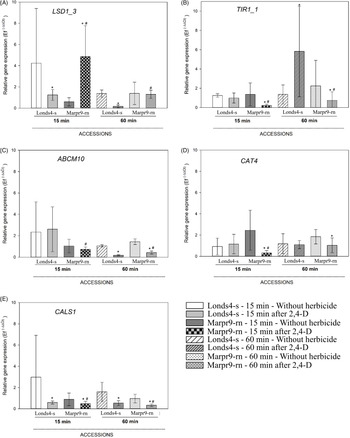
The LSD1 gene has been reported as a negative transcription regulator for genes involved in the process of programmed cell death (Aviv et al. Reference Aviv, Rustérucci, Ill, Dietrich, Parker and Dangl2002). Lack of its expression accelerates H2O2 production because of PAD and EDS1 action, which promotes repression of genes coding antioxidant enzymes, such as SOD, CAT, and ascorbate peroxidase (Karpiński et al. Reference Karpiński, Szechyńska-Hebda, Wituszyńska and Burdiak2013). lsd1 mutants express the rapid necrosis phenotype if exposed to low temperature (Huang et al. Reference Huang, Li, Zhang, Zuo and Yang2010), pathogens (Guo et al. Reference Guo, Bai, Yang, Liu, Wang, Huang and Kang2013), drought, or UV light (Wituszyńska et al. Reference Wituszyńska, Szechyńska-Hebda, Sobczak, Rusaczonek, Kozlowska-Makulska, Witoń and Karpiński2015). In leaves of the resistant Marpr9-rn, there was higher expression of the putative gene LSD1_3 in comparison to the leaves of the susceptible Londs4-s after 15 min of 2,4-D treatment (Figure 3A). This result apparently contradicts our original hypothesis that rapid necrosis was due to the absence or low expression of this gene. However, a highly conserved paralogue of LSD1, named LSD-ONE-LIKE 1 (LOL1) acts as a positive regulator of cell death (Epple et al. Reference Epple, Mack, Morris and Dangl2003). Arabidopsis thaliana lsd1 mutants overexpressing LOL1 displayed leaf necrosis in response to pathogens, a phenotype not observed in lsd1/lol1 mutants. We cannot rule out the possibility that the putative LSD1_3 gene evaluated here might correspond to LOL1 because there is no information about functionality of those genes in C. sumatrensis.
Relative Expression of selected genes in response to 2,4-D in Conyza sumatrensis Marpr9-rn (RN) and Londs4-s (S). (A) LSD1_3, (B) TIR1_1, (C) ABCM10, (D) CAT4, and (E) CALS1 were quantified by qRT-PCR at 15 and 60 min after 2,4-D spraying. Data are presented in relation to the reference genes Actin and 18S using the efficiency method (−∆∆Ct). *Significant by t-test (P < 0.05) in comparison with the control (non-treated). # Significant by t-test (P < 0.05) in comparison between 2,4-D–resistant (Marpr9-rn) and susceptible (Londs4-s). Bars indicate standard deviation (n = 3).

The auxin receptor Transport Inhibitor Response 1 (TIR1_1) gene had reduced transcription in leaves of the RN accession in response to 2,4-D relative to the susceptible accession (Figure 3B), it may cause lower sensitivity to auxins due to smaller amounts of this receptor. The auxin receptor TIR1 together with AFB is part of the ubiquitin complex SCFTIR1/AFB (ubiquitin protein ligase E3 type) that acts on the ubiquitin transfer in the enzymatic activation and conjugation processes. Auxins (such as 2,4-D) act as a molecular glue that links the TIR1/AFBSCF complex with the Aux/IAA repressor; this contact leads to degradation of the repressor and release of ARFs. This entire cascade of ARF release leads to the activation of auxin-induced genes and the characteristic symptoms of epinasty (Song Reference Song2014), which were observed in the susceptible accession’s plants exposed to auxinic herbicides but were absent in those with RN symptoms. Arabidopsis thaliana tir1-1 mutants are resistant to the auxinic herbicides 2,4-D and dicamba but do not display the RN symptoms. Reduction of TIR1_1 in Marpr9-rn might be caused by changes in hormone balances due to increases in ethylene, jasmonate, and methyl-salicylate after 2,4-D application (Xin et al. Reference Xin, Yu, Erb, Turlings, Wang, Qi, Liu and Lou2012); for example, some studies report the interaction of salicylic acid (SA) and TIR1 in response to pathogens (Wang et al. Reference Wang, Pajerowska-Mukhtar, Culler, Dong and Carolina2007). In A. thaliana, SA causes the repression of genes related to auxins, including the TIR1 receptor gene, that results in the stabilization of Aux/IAA repressor proteins and the inhibition of auxin response (Wang et al. Reference Wang, Pajerowska-Mukhtar, Culler, Dong and Carolina2007). In the hypersensitivity response or rapid necrosis to pathogens, SA is the starting point in the cell death process. Lesion mimic mutants (lmm) mutants, which show rapid necrosis in response to stress, also express higher levels of SA (Lorrain et al. Reference Lorrain, Vailleau, Balagué and Roby2003). In plants of A. thaliana inoculated with Pseudomonas syringae pv. tomato, the spraying of 2,4-D increased disease symptoms (Navarro et al. Reference Navarro, Dunoyer, Jay, Arnold, Dharmasiri, Estelle, Voinnet and Jones2006). Further investigation of SA interaction with 2,4-D could indicate the importance of TIR1_1 for rapid necrosis in C. sumatrensis.
An important class of proteins involved in the transport of auxinic herbicides is the ABC transporter family. The putative ABC-type B transporter ABCM10 gene reduced its expression after 2,4-D application in Marpr9-rn (Figure 3C). In the literature, increased expression of this transporter is associated with vacuolar sequestration of glyphosate in accessions of C. canadensis and C. bonariensis resistant to this herbicide (Moretti et al. Reference Moretti, Alárcon-Reverte, Pearce, Morran and Hanson2017a; Peng et al. Reference Peng, Abercrombie, Yuan, Riggins, Sammons, Tranel and Stewart2010). Evidence of the action of ABC transporters in 2,4-D tolerance were found in R. raphanistrum (Goggin et al. Reference Goggin, Cawthray and Powles2016) when [14C]2,4-D translocation was evaluated in plants treated with auxin transporter inhibitors, namely, valspodar, verapamil, and NPA. It has been suggested that the transporters ABCB1, ABCB4, ABCB19 (Kubeš et al. Reference Kubeš, Yang, Richter, Cheng, Młodzińska, Wang, Blakeslee, Carraro, Petrášek, Zažímalová, Hoyerová, Peer and Murphy2012), and ABCB21 (Goggin et al. Reference Goggin, Cawthray and Powles2016) are involved in 2,4-D transport in plants. In the present study, the ABC transporters might be involved in the mechanism of rapid necrosis, given that ABC transporter inhibitors have caused reduction in H2O2 accumulation in response to 2,4-D in the RN accession (Figures 1 and 2).
The reduction in the levels of CAT4 transcripts found in the RN plants after 15 min of treatment with 2,4-D (Figure 3D) suggests less activity of this amino acid transporter in response to the herbicide. CAT4 is located in the tonoplast and belongs to the amino acid polyamine choline family (Yang et al. Reference Yang, Krebs, Stierhof and Ludewig2014). This carrier is associated with C. canadensis resistance to the herbicide paraquat (Jóri et al. Reference Jóri, Soós, Szego, Páldi, Szigeti, Rácz and Lásztity2007). There are no reports of CAT4 activity in auxin transport. However, the CAT4 gene has cis elements responsive to auxins in its promoter, which indicates that its expression could be regulated by auxins (Liu and Bush Reference Liu and Bush2006).
The biosynthesis and degradation of (1,3)-β-glycan callose in plasmodesmata-adjacent regions help to regulate symplastic transport during biotic and abiotic stresses. In general, infection by pathogens induces genes involved in callose biosynthesis (Ellinger and Voigt Reference Ellinger and Voigt2014). Our analysis indicated reduction in the levels of transcripts of the putative CALS1 gene after 2,4-D treatment regardless the accession (Figure 3E). This inhibitory effect on CALS1 induced by 2,4-D remains elusive, and the similarity of responses in the two accessions denotes that CALS1 is probably not involved in the mechanism of rapid necrosis in response to 2,4-D.
In summary, the results obtained in the studies with inhibitors suggest that the mechanism of resistance would not be related to detoxification by enzymes of the cytochrome P450 monooxygenase family or glutathione-S-transferase (GST). Still, it is possible that it involves detoxification enzymes not affected by the inhibitors used. Complementary analysis of herbicide quantification could be used to clarify this process. In the expression analysis, reduction in the level of TIR1 transcripts (auxin receptor) were detected in the RN plants after treatment with 2,4-D. However, it has not yet been clarified whether this change would be sufficient to cause the resistance to 2,4-D by rapid necrosis. The mechanism of rapid necrosis to 2,4-D in C. sumatrensis may involve the integration of auxin perception pathways (TIR1) and pathways involved in the hypersensitivity response to pathogens leading to ROS production and cell death. Despite this, the importance of the participation of auxin transporters in this mechanism must be considered. The lack of inhibitory effect in whole plants may be due to uptake or concentration limitations.
According to what was observed in our previous study, the symptoms and characteristics of occurrence are similar to the hypersensitivity response to pathogens, in relation to time of occurrence, symptoms, response to light, and increased production of H2O2 (Queiroz et al. Reference Queiroz, Delatorre, Lucio, Rossi and Zobiole2020). The central question of this mechanism refers to the perception of the herbicide 2,4-D as a pathogenic elicitor. Analysis of the transcriptome of these accessions by RNAseq may help to elucidate whether transmembrane receptors related to the perception of pathogens are involved. In addition, the specific gene expression results of the present study could be used for indicating the sampling time for whole-genome expression studies.
As stated before, rapid necrosis has been described in A. trifida after glyphosate application; it was associated with lipid peroxidation and oxidative stress, which are more likely consequences of rapid cell death (Harre et al. Reference Harre, Nie, Jiang and Young2018; Moretti et al. Reference Moretti, Van Horn, Robertson, Segobye, Weller, Young, Johnson, Douglas Sammons, Wang, Ge, d’Avignon, Gaines, Westra, Green and Jeffery2017b), but the mechanism of resistance is still unknown. Here, a similar symptom of rapid necrosis in C. sumatrensis in response to 2,4-D was investigated, but despite our efforts the mechanism remains unclear. The non-parallel mechanisms of action and cell uptake of 2,4-D and glyphosate indicate that different phenomena are the cause of resistance and that the rapid necrosis phenotype is only a common symptom in these cases. Together, the studies about these two cases represent small pieces in this intriguing case of herbicide resistance that is currently referred to as rapid necrosis.
Acknowledgments
The authors are grateful to the National Council for Scientific and Technological Development (CNPq) for a scholarship granted to ARSdQ and fellowships awarded to CAD and AMJ. Funding was provided by CNPq and Dow AgroSciences Industrial Ltda. The authors declare that there is no conflict of interest.