


Overwhelming post-splenectomy infection (OPSI) is a serious complication of asplenia, and associated with significant morbidity and mortality [Reference Di Sabatino, Carsetti and Corazza1]. Although variously defined, patients with asplenia are at particular risk of infection with encapsulated organisms, most commonly Streptococcus pneumoniae, but also Haemophilus influenzae and Neisseria meningitidis. A number of measures are recommended to reduce the risk of OPSI, including patient education, vaccination against encapsulated organisms, prophylactic antibiotics and the provision of an infection action plan including the ready availability of emergency antibiotics [Reference Jones2, Reference Spelman3]. However, many studies have found that adherence to preventative measures is generally poor [Reference El-Alfy and El-Sayed4].
The Victorian Spleen Registry (VSR) has operated since 2003, and enrols patients who are asplenic or hyposplenic in the state of Victoria, Australia. The VSR aims to increase the awareness of post-splenectomy infection in asplenic patients by education of patients and their healthcare providers, and to disseminate up-to-date recommendations to prevent infection [Reference Wang5]. Patients are routinely asked about their experience with infection requiring hospitalization at the time of registration. All cases of infection requiring ICU admission were confirmed by review of the hospital discharge summary. On registration, each patient's GP is contacted to confirm key details including details of splenectomy. Additionally, the registry maintain contact with patients via periodic newsletters and surveys, as well as ad hoc clinical queries from patients and providers. The registry is sent hospital discharge summaries for non-ICU admissions, but this is not systematically performed. In this study, we aimed to describe the rate of overwhelming post-splenectomy sepsis in patients with asplenia and hyposplenia.
For this retrospective cohort study, we reviewed data collected on infections at the time of registration to the VSR. We defined post-splenectomy infection as an episode of suspected or confirmed infection treated as a hospital inpatient with intravenous antibiotics. We defined a subset of these infections to be OPSI that required admission to intensive care, which were categorized as being caused due to encapsulated organisms (S. pneumoniae, H. influenza, N. meningitidis), due to other organisms, and those which were culture negative. We excluded patients who were registered within 1 month of splenectomy, as we believed that infections in this period would be more likely to reflect post-operative complications. Consistent with accepted terminology, we refer to infection associated with medical hyposplenia as OPSI, with the date of ‘splenectomy’ being the date of diagnosis of hyposplenia. Similarly, we excluded patients who were registered within 1 month of the diagnosis of hyposplenism to reduce the possibility that they were registered because of an episode of infection.
We calculated the cumulative proportion of patients who had experienced post-splenectomy infection or OPSI prior to registration with the VSR. We excluded patients who did not reside in Victoria, and patients who had infection before or within 1 month of splenectomy. We maintain data on severe infection following registration based on passive surveillance via patients and clinician networks, but the completeness of ascertainment is unclear. The cumulative incidence of infection was defined as the number of patients experiencing at least one episode of infection divided by the patients at risk prior to registration or after registration. The relative rate of infection was calculated with confidence intervals assuming the Poisson distribution. We constructed a multivariate model for OPSI using a Poisson regression with age group and reason for splenectomy as dependent variables, accounting for time at risk. Statistical analyses were performed using Stata v. 13 for Windows (StataCorp., USA).
Ethical permission to review these data was granted by the Human Research Ethics Committee at Alfred Health and Monash University.
At March 2014, there were 3274 VSR registrants, of whom 221 (6·7%) had died. Of these patients, the median age at splenectomy was 38 years (interquartile range 22–58 years) and the mean time since splenectomy was 11 years. There were 1767 (54%) registered within 6 months of splenectomy.
At least one episode of asplenia- or hyposplenia-associated infection prior to registration was reported in 492 patients. This proportion rose from 9% in the 1670 patients registered within the last 3 years, to 22% in the 1577 patients registered more than 3 years since splenectomy (Table 1).
Rates of OPSI prior to registration on the Victorian Spleen Registry
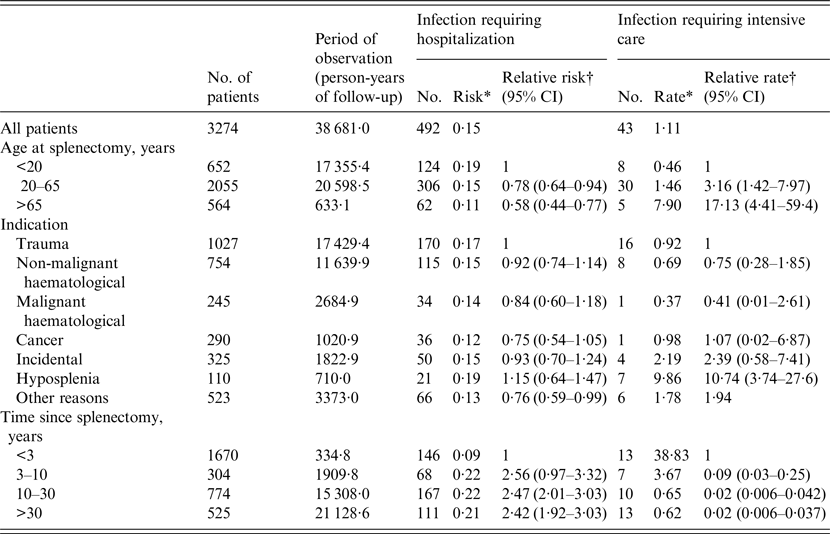
OPSI, Overwhelming post-splenectomy infection, CI, confidence interval.
* We were unable to determine if patients had more than one non-severe infection, so infection requiring hospitalization was reported as a cumulative risk, but patients with severe infection was reported as a rate per 1000 patient-years.
† Univariate analysis.
There were 47 episodes of OPSI recorded in the 3274 patients prior to registration. Of these, 17 infections were due to encapsulated bacteria (pneumococcus n = 16, H. influenzae n = 1), 15 due to other bacteria (Aspergillus spp. n = 1; coagulase-negative staphylococcus n = 1, Escherichia coli n = 2, group B streptococcus n = 1, H. influenzae (non-sterile site) n = 2, Klebsiella spp. n = 2, Serratia spp. n = 2; Staphylococcus aureus n = 2, Streptococcus bovis n = 1) and 15 presented with culture-negative severe infection. The risk of severe infection was highest for the first 3 years after splenectomy and lower thereafter.
In a multivariate model taking into account the varying time at risk, which was greater for younger patients, the incidence rate of severe infection was higher in patients who had splenectomy at an older age (age at splenectomy >65 years [relative rate (RR) 5·03, 95% (CI) 1·88–13·47], <20 years (RR 0·30, 95% CI 0·14–0·67) vs. 20–64 years). The relative rate of severe infection (compared to those with traumatic splenectomy) was similar for non-malignant haematological conditions (RR 0·71, 95% CI 0·30–1·66), malignant haematological conditions (RR 0·30, 95% CI 0·04–2·24), other cancer (RR 0·59, 95% CI 0·08–4·56), incidental splenectomy (RR 1·26 95% CI 0·40–3·96) but higher for those with medical hyposplenia (RR 10·12, 95% CI 4·15–24·64).
The 47 OPSI cases recorded in the 38 681 patient-years prior to registration compared to four identified OPSI cases in the 12 370 patient-years following registration, giving a relative rate of OPSI following registration of 0·29 (95% CI 0·076–0·80, P = 0·003)
The risk of OPSI in patients with asplenia is difficult to determine from published studies, due to differences in patient populations and definitions of OPSI used. In a review of 28 studies including 6942 patients with a median follow-up of 6·9 years, Bisharat and colleagues estimated that the cumulative incidence of invasive infection was around 3% [Reference Bisharat6]. However, different studies have used various definitions of post-splenectomy infection, including any hospitalization with an infectious diagnosis [Reference Thomsen7, Reference Dendle8], invasive pneumococcal disease [Reference Foss9], pneumonia, meningitis or septicaemia [Reference Cullingford10], ‘overwhelming’ infection [Reference Cullingford10, Reference Kyaw11] and infection requiring ICU admission [Reference Theilacker12]. We found that our patient group had a similar cumulative incidence of infection compared to studies where a broader definition was used (patient self-report of infection requiring hospitalization for intravenous antibiotics); for example, a Victorian study using hospital administrative data found that 26% of patients with surgical splenectomies had a subsequent readmission with an infectious diagnosis [Reference Dendle8]. The incidence of infection when defined by criteria that reflect severe sepsis (e.g. ‘fulminant’ infection) appears to be much lower [Reference Cullingford10, Reference Kyaw11].
We were surprised to find that there were few severe infections following splenectomy due to haematological malignancies and a particularly high rate in patients with medical hyposplenia. Previous studies have found higher rates of infection were associated with non-malignant haematological conditions (particularly sickle cell disease and thalassaemia), but similar rates of infection in patients with trauma [Reference Bisharat6]. Previous studies have suggested that younger age at splenectomy is associated with a higher risk of OPSI. Although we had no splenectomized patients aged <2 years, we found an increasing OPSI rate with age once the time at risk was accounted for, similar to the findings in a Scottish population-based study [Reference Kyaw11]. Although we excluded episodes of infection in hyposplenic patients within 1 month of diagnosis to reduce the possibility that they may have been registered due to an episode of infection, the estimated incidence of severe infection should be interpreted with caution in this group.
While we were not able to establish the timing of infection relative to splenectomy, the varying durations of time between splenectomy and registration do provide us with an indirect measure of risk over time. We found that the proportion with reported post-splenectomy infections increased over the first 3 years then were stable thereafter. This is consistent with previous data suggesting an increased risk of infection early after splenectomy [Reference Kyaw11].
There are several limitations to our study. Because our method of ascertainment of infection relies on patient self-report at the time of registration, we may have underestimated the true incidence of severe infection, as patients who die may not come to our attention. Alternatively, it is also possible that patients with OPSI might be more likely to seek health advice and register with the VSR. The wording on the survey question did not enumerate the episodes of infection, so we were unable to determine if patients had more than one (non-severe) infection. Our results therefore indicate a cumulative risk rather a true incidence. Although we actively sought discharge summaries in patients who had severe infections, clinical details were not consistently available for non-severe infections. Data regarding episodes of post-splenectomy sepsis following registration should be viewed with caution as under-ascertainment is possible.
This study reinforces the view that post-splenectomy infection is a clinically significant but uncommon complication, and that fulminant infection requiring intensive care represents a minority of all infections. Several studies elsewhere have shown that adherence to measures to prevent infection in this group are poor [Reference Coignard-Biehler13–Reference O'Donnell16]. The VSR improves adherence to these measures by providing patient and healthcare provider education, updates and disseminates recommendations on vaccine and other preventive measures and facilitates research into asplenia [Reference Wang5]. Further evaluation regarding the effectiveness of the registry via linkage with notifiable disease databases and additional prospective studies would be informative.
ACKNOWLEDGEMENTS
We thank Stacey Rowe and Nicola Stephens at the Victorian Department of Health for their support. The VSR is funded by Alfred Health and the Victorian Department of Health and Human Services. A.C. is supported by a National Health and Medical Council Career Development Fellowship. The funders had no role in the conduct of this study.
DECLARATION OF INTEREST
None.



