1. Introduction
In her state-of-the-art summaries of SLA research, Lightbown (Reference Lightbown1985, Reference Lightbown2000, Reference Lightbown2003) made ten generalizations, including the following:
For most adult learners, acquisition stops – ‘fossilizes’ – before the learner has achieved native-like mastery of the target language. (1985: 179)
Fossilization, an interlanguage-unique phenomenon in which a semi-developed linguistic form or construction shows permanent resistance to environmental influence and thus fails to progress towards the target, is one of the most popular concepts among researchers and teachers. In fact, it was the empirical motivation for the inception of the field of study that we know today as second language acquisition (SLA) (Long Reference Long, Doughty and Long2003; Han & Selinker Reference Han, Selinker and Hinkel2005; Selinker Reference Selinker2011).
Exactly forty years ago, in one of the field's founding and seminal texts, Selinker (Reference Selinker1972) hypothesized that fossilization is a signature character of SLA, tied to a unique cognitive mechanism called the latent psychological structure (LPS), ‘an already formulated arrangement in the brain’ (p. 229), which putatively prevents the learner from acquiring the target language norms in a permanent way. Selinker further predicted that a lack of complete mastery of the target language is typical and inevitable among L2 learners.
This hypothesis, referred to hereafter as the fossilization hypothesis, immediately captured the interest of both L2 researchers and practitioners, sparking much empirical research and an abundance of speculation. In the evolution of SLA research, however, research on fossilization has not advanced at a steady rate; rather, it has ebbed and flowed, as the field experienced paradigmatic shifts and became increasingly interdisciplinary. Nonetheless, the concept of fossilization has not only remained viable (e.g., Lardiere Reference Lardiere2007), but has substantially developed, as has the methodology for empirical research (Han Reference Han2004, Reference Han, Gass and Mackey2011).
Given the theoretical importance of the construct in understanding SLA, several reviews of the research on fossilization have appeared in the L2 literature in recent years, among them Long's (Reference Long, Doughty and Long2003) critical analysis of the methodology and Han's (Reference Han2004, Reference Han, Gass and Mackey2011) syntheses of theoretical and empirical research. Thus, the intent of this paper is not to provide yet another review but to update the Fossilization Hypothesis, a theoretical undertaking that seems particularly opportune in 2012, which marks the fortieth anniversary of the introduction of the concept (Selinker Reference Selinker1972).
This paper is organized as follows: first, I will review the Fossilization Hypothesis (Selinker Reference Selinker1972), noting its strengths and weaknesses. After that, I will update the hypothesis by (a) revisiting a suite of questions introduced in Selinker & Lamendella (Reference Selinker and Lamendella1978) in the light of our current understanding, (b) presenting an alternative hypothesis known as the Selective Fossilization Hypothesis (SFH, Han Reference Han, Cook and Wei2009), and (c) using the SFH as a framework for evaluating a selection of fossilizable structures from the recent SLA literature, with a view to shedding further light on the nature of fossilization. I will conclude with a recap of the highlights of this discussion and a brief outlook for the future of fossilization research.
2. The Fossilization Hypothesis
The centerpiece of the Fossilization Hypothesis (Selinker Reference Selinker1972)Footnote 1 is that SLA inevitably falls short of complete attainment, with certain deviances from the target language norms remaining permanent in the L2 system (widely known as ‘interlanguage’). Specifically, the hypothesis points to linguistic features – ‘items, rules, and subsystems’ – that ‘speakers of a particular [native language] will tend to keep in their (interlanguage) relative to a particular [target language]’, a tendency that obtains regardless of ‘the age of the learner or amount of explanation and instruction he receives in the (target language)’ (p. 215). In its original formulation, the hypothesis sees fossilization in not only phenomenological but also epistemological terms: in other words, as both a physical entity and a cognitive mechanism.
The fossilization mechanism, it is hypothesized, exists in a latent psychological structure (LPS), which, in turn, is genetically determined in the brain (Selinker Reference Selinker1972). Putatively distinct from the latent language structureFootnote 2 (Lenneberg Reference Lenneberg1967) that drives the uniform success of first language (L1) acquisition, the LPS comprises five central processes: language transfer, transfer of training, learning strategies, communication strategies, and overgeneralization. Selinker wrote:
I would like to hypothesize that these five processes are processes which are central to second-language learning, and that each process forces fossilizable material upon surface [interlanguage] utterances, controlling to a very large extent the surface structures of these utterances. (p. 217; emphasis in the original)
Selinker further noted that ‘combinations of these processes produce what we might term entirely fossilized competences’ (p. 217), hence suggesting that when the five processes interact, their impact will be much stronger on interlanguage than would be that of a single underlying process, and may result in fossilized competence. The hallmark of the latter is that the entire interlanguage system exhibits little syntactic growth, though vocabulary continues to expand.
Crucially, Selinker continued, the fossilization mechanism is set in motion whenever the learner attempts to express his own meanings in the L2 (Selinker & Lamendella Reference Selinker and Lamendella1978). This limits the main empirical domain of fossilization to spontaneous L2 production, or, more precisely, to the surface linguistic structures produced by the learner when attempting meaningful production in the L2, and, in particular, when his attention is ‘focused upon new and difficult intellectual subject matter or when he is in a state of anxiety or other excitement, and strangely enough, when he is in a state of extreme relaxation’ (p. 215). The emphasis on ‘meaningful performance’, as opposed to ‘performance of drills’ (Selinker Reference Selinker1972), has proven essential in uncovering the reality of fossilization, a point to which I will return.
Another tenet of the hypothesis is that fossilization is not only to be expected in individual learners but also in ‘whole groups of individuals’, given long-term interaction in an interlingual context, ‘resulting in the emergence of a new dialect’ (p. 217), a contentious point of view that was to be rejected by others (e.g. Kachru & Nelson Reference Kachru, Nelson, McKay and Hornberger1996; Siegel Reference Siegel, Doughty and Long2003).
With the hypothesis framed in this way, Selinker foresaw several difficulties in conducting fossilization research. One challenge concerns unambiguously identifying any of the central processes claimed to be responsible for fossilization. Another relates to identifying interlingual situations in which predictions can be made about what will be fossilized. Thus, right from the start, there was an emphasis on the need to predict and explain fossilization, accompanied by an awareness that ‘the task of prediction may prove to be impossible’ (Selinker Reference Selinker1972: 222). A third difficulty relates to identifying units of fossilization. Selinker spoke simultaneously of units of the LPS (comprising the five central processes) and of interlingual or ‘realizational’ units corresponding to interlanguage structural elements – ‘items, rules, and subsystems’ – pertinent to syntax, morphology, phonology, and so on. The interlingual units, it was argued, are latent in the LPS, and are activated only when learners attempt to express their own meaning in the target language (TL). This line of reasoning thus ties together the neuro-cognitive mechanism, the realizational unit, and the socio-psychological condition of fossilization.
The linguistic units of fossilization, Selinker noted consistently, should involve ‘parallel data in the three systems [native language (NL), interlanguage (IL), and TL]’ (p. 224), and should therefore be ‘interlingual’. This amounts to saying that underlying the linguistic units of fossilization is an interaction between the NL, the IL, and the TL. Stressing their uniqueness, Selinker made the critical point that existing linguistic theories, based largely on norms abstracted from monolingual native speakers, are ill-suited either as a heuristic or a descriptor for fossilization (or interlanguage, for that matter). There is not always a one-to-one correspondence between a unit of fossilization and a unit of the target language; for example, an interlingual unit may be not a word but a ‘syntactic string’.
To sum up, the Fossilization Hypothesis treats fossilization both in an abstract sense, as an explanation for an overall lack of success of L2 learning, and in a more concrete sense, as a neuro-cognitive mechanism and a behavioral artifact.
2.1 Issues with the Fossilization Hypothesis
In hindsight, the original Fossilization Hypothesis is both broad and loose, and is right in some respects but wrong in others. A brief appraisal follows.
In its broadest construal, the term ‘fossilization’ refers to unsuccessful L2 learning, with success defined as ‘productive performance in the TL by the L2 learner which is identical to that produced by the native speaker of that TL’ (Selinker Reference Selinker1972: 223).Footnote 3 The term is also broad in that it spans the macro-to-micro spectrum: at the macro end is the notion that the vast majority of L2 learners are destined to fail to master a second language, while at the micro end are two specific behavioral events, backsliding and regression, both indicative of deterioration in L2 performance. Additionally, the hypothesis is broad because it considers fossilization both phylogenic, that is, affecting a given interlingual community, and ontogenetic, that is, idiosyncratic.
The hypothesis is loosely framed to the extent that it effectively conflates a process, a product, and a mechanism in a single term, ‘fossilization’. There is, therefore, much confusion surrounding the term (cf. Long Reference Long, Doughty and Long2003). Consider the following quote from Selinker (Reference Selinker1972: 221):
What seems to be most promising for study is the observation concerning fossilization. Many IL linguistic structures are never really eradicated for most second-language learners; manifestations of these structures regularly reappear in IL productive performance, especially under conditions of anxiety, shifting attention, and second-language performance on subject matter which is new to the learner. It is this observation which allows us to claim that these psycholinguistic structures, even when seemingly eradicated, are still somehow present in the brain, stored by a fossilization mechanism (primarily through one of these five processes) in an IL. (emphasis in the original)
Here the polysemous nature of the term ‘fossilization’ cannot be clearer. First, fossilization denotes a defective linguistic structure that is never really eradicated, implying a process, a product, and irreversibility. Second, fossilization is found in most l2 learners, children and adults alike, suggesting pervasiveness. Third, fossilization is driven by a mechanism stored in the brain, pointing to its neuro-cognitive nature. Fossilization is therefore a catch-all term (Birdsong Reference Birdsong, Davies and Elder2003, Reference Birdsong, Han and Odlin2006), and as a theoretical construct, the term is ambiguous (Han Reference Han1998, Reference Han2004, Reference Han, Gass and Mackey2011; Long Reference Long, Doughty and Long2003).
Consequently, notwithstanding the original intent that the hypothesis should serve as a heuristic to guide ‘the discovery, description, and experimental testing of fossilizable items, rules, and subsystems in interlanguage and the relating of these to the [five central] processes’ (Selinker Reference Selinker1972: 221), the ensuing research was not particularly productive. Instead of focusing on ‘discovery, description, and experimental testing’, most studies went little beyond speculating about what causes fossilization as an abstract or concrete entity, the latter often featuring idiosyncratic associations with an array of learning artifacts such as back-sliding (R. Ellis Reference Ellis1985), persistent non-targetlike performance (Mukattash Reference Mukattash1986), low proficiency (Thep-Ackrapong Reference Thep-Ackrapong1990), learning plateaus (Flynn & O'Neil Reference Flynn and O'Neil1988), structural persistence (Schouten Reference Schouten, Kellerman, Weltens and Bongaerts1996), typical errors (Kellerman Reference Kellerman, Hyltenstam and Obler1989), and stabilized errors (Schumann Reference Schumann1978), to name but a few. Researchers gradually went their separate ways in search of evidence for the five central processes, independently of, rather than in relation to, fossilization. Those who did stay on topic sought to examine individual learners’ errors over a year or less, resulting in databases that were primarily descriptive and that lacked credibility because of their methodological weaknesses and conceptual incongruence (for reviews, see Han Reference Han1998, Reference Han2004, Reference Han, Gass and Mackey2011; Long Reference Long, Doughty and Long2003).
Despite its looseness, the Fossilization Hypothesis made a number of accurate predictions. First, fossilization, defined as an absence of progression towards the target in spite of conditions conducive to learning, such as adequate motivation to learn, abundant exposure to the target language, and plentiful opportunity for communicative practice (Han Reference Han2004), is a pervasive and yet largely idiosyncratic phenomenon among L2 learners (Bley-Vroman Reference Bley-Vroman, Gass and Schachter1989). Second, fossilization is most evident when L2 learners are attempting to use the target language to express their own meanings and, in particular, when they are in a psychologically unguarded mode (Tarone Reference Tarone1988). Third, native language influence is the major shaping force in fossilizable speech behavior and, when combined with other factors, solidifies fossilization.
These on-the-mark predictions are, however, offset by several off-the-mark ones. First and foremost is the claim that the interlanguage system can fossilize in its entirety, resulting in what may be called ‘global fossilization’. Both past and current research has consistently converged on the finding that fossilization is local, not global. In other words, fossilization hits the subsystems of interlanguage only selectively, rather than its gestalt. Based on the aggregate evidence, Han & Odlin (Reference Han, Han and Odlin2006a: 8) concluded that ‘L2 acquisition will never have a global end state; rather, it will have fossilization, namely, permanent local cessation of development’.
Another assertion, also defying empirical support, is that fossilization stems from any or all of the five central processes of the LPS. To date, research from environmental, cognitive, psychological, neuro-biological, and socio-affective perspectives has identified numerous factors (Han Reference Han2004), and, although not all of them are on target due to the researchers’ idiosyncratic perceptions of fossilization, the scope of the putative factors is sufficient to suggest that the LPS alone cannot be the only driver of fossilization. This research has debunked the long-held myth that L2 learning is a linear process, from NL through IL to TL, thereby calling into question Selinker's (Reference Selinker1972: 229) assertion that ‘the relevant data of the psychology of second-language learning are . . . parallel utterances in three linguistic systems (NL, IL, and TL),’ or that ‘the psychologically-relevant data of L2 learning are utterances in TL by native speakers, and in NL and IL by second-language learners’.
Furthermore, the emphasis of the hypothesis on surface deviance from TL norms implies that fossilization involves, at its core, a lack of grasp of ‘surface linguistic materials’ of the TL or some of its grammatical rules. This emphasis ignores the fact that forms are but vehicles of, and hence inseparable from, meanings (cf. Larsen-Freeman Reference Larsen-Freeman, Han and Odlin2006). Four decades of SLA research have increasingly brought the awareness that learning an L2 entails more than wrestling with the surface forms of a new language; it requires the learner to develop the ability to map form–meaning–function (FMF) relations and to do so in real-time spontaneous communication (Lee & Valdman Reference Lee and Valdman2000; VanPatten et al. Reference VanPatten, Williams, Rott and Overstreet2004), clearly a daunting task. From Saporta's (Reference Saporta and Valdman1966) ‘paradox of second language learning’ to Krashen's (Reference Krashen1982) non-interface position, researchers have long noted a disjunction between form and meaning in L2 learners. The apparent and persistent challenge derives from acquiring target-like meaning, not form, and more profoundly, from acquiring target-like conceptualization of experience. A case in point: while the English articles the/a present a universal challenge to learners from the various L1 backgrounds lacking such features, research has pinned the difficulty down to discourse constraints on the use of the forms (Master Reference Master1997; Ekiert Reference Ekiert, Han and Cadierno2010). Studies have revealed that the ability to restructure L1-based conceptualization and articulation is something that can permanently evade L2 learners, whatever the learning conditions (Han Reference Han and Han2008a, Reference Han, Han and Cadierno2010).
In sum, four decades of SLA research have yielded a substantially better understanding of fossilization. This will be discussed further as we revisit a suite of questions arising from the Fossilization Hypothesis.
3. Updating the Fossilization Hypothesis
Selinker (Reference Selinker1972) posited three overarching questions to guide further exploration of fossilization as a physical entity:
a. How can we systematize the notion fossilization so that from the basis of theoretical constructs, we can predict which items in which interlingual situations will be fossilized?
b. How do [we] recognize fossilizable structures in advance?
c. Why do some things fossilize and others do not? (p. 222)
In an attempt to tackle these questions and, in particular, to ‘systematize the notion of fossilization’, Selinker & Lamendella (Reference Selinker and Lamendella1978) went on to propose seven sets of questions relating to (a) the nature of fossilization; (b) its source; (c) its objects; (d) the manner of fossilization; (e) the point at which it begins; (f) its persistence; and (g) candidates for fossilization. These questions are discussed below, in the light of our current understanding.
3.1 Nature of fossilization
Selinker & Lamendella (Reference Selinker and Lamendella1978) asked:
1. Is fossilization a phenomenon peculiar to non-primary language acquisition, or is it a more general condition also relevant to primary language acquisition, or perhaps also to more general cognitive learning phenomena?
2. Is stability over time of a linguistic feature all that is at issue in understanding fossilization, or is there a sense in which fossilization involves more than this?
3. Is fossilization a positive process which acts to halt further development of the IL, or is it a way of looking at the absence of some positive force which when lost would tend to result in the cessation of further learning? (p. 149)
Fossilization is generally considered ‘a developmental pitfall’ (Adjemian 1982; Higgs Reference Higgs1982; Coppieters Reference Coppieters1987) pertinent only to L2 learners and is, therefore, a negative, rather than a positive, process. It is a defining characteristic of (adult) SLA, according to the Fundamental Difference Hypothesis (Bley-Vroman Reference Bley-Vroman, Gass and Schachter1989). Stability in the sense of absence of change is the hallmark of fossilization (Long Reference Long, Doughty and Long2003), yet this does not preclude stabilized variability (Han Reference Han2004, Reference Han, Han and Cadierno2010; Lardiere Reference Lardiere2007). In other words, variability, another prominent feature of interlanguage (Tarone Reference Tarone1983), can stabilize and potentially fossilize (Schachter Reference Schachter, Brown, Malmkjaer and Williams1996). What prompts fossilization is a complex issue, which cannot simply be attributed to the absence of ‘some positive force’, such as corrective feedback, as early researchers had conceived (Vigil & Oller Reference Vigil and Oller1976).
3.2 Source of fossilization
Selinker & Lamendella (Reference Selinker and Lamendella1978) further asked:
4. Will the basic explanatory domain in terms of which fossilization can be described most appropriately be (a) factors external to the individual learner? (b) factors internal to the individual? (c) external factors filtered through the current information processing systems of the individual? (d) some combination?
5. For a given learner, what are the relative contributions of cognitive, affective, social, communicative, neuromaturational, and genetic factors in determining what will be fossilized, when fossilization will occur, how it will occur, how long it will last, and under which conditions it might be surmounted and progress in IL learning resumed? (p. 149)
Question 4 has inspired numerous proposals over the past forty years (for a review, see Han Reference Han2004). Early examples include those of Vigil & Oller (Reference Vigil and Oller1976), which views the nature of pedagogical feedback as a source of fossilization, Schumann (Reference Schumann1975), which identifies acculturation as a cause of a temporary plateau in learning, and Scovel (Reference Scovel1969), which associates fossilization with a loss of brain plasticity with advancing age. More recent proposals involve, for example, Universal Grammar, maturational constraints, working memory capacity and nature of the input, concerning almost every variable in all denominations, environmental, cognitive, neural, psychological, or social: exactly those identified as contributing to acquisition. There is thus an emerging convergence of explanations for both acquisition and fossilization (N. Ellis Reference Ellis2006a, Reference Ellisb), or for success and failure, as some would call them. AcquisitionFootnote 4 and fossilization are increasingly seen as two sides of a coin, equally fraught with complexity. Such conceptual confluence is encouraging from a theoretical vantage point, because the growing consensus foreshadows the appearance of a comprehensive theory of SLA that will eventually replace all other existing fragments (Han Reference Han and Banks2012). Importantly, where fossilization is concerned, both past and current research has come to the same conclusion, namely that fossilization is a product of multiple factors working together (Selinker & Lakshmanan Reference Selinker, Lakshmanan, Gass and Selinker1992).
Early research noted that fossilization was largely an idiosyncratic process; a point of view maintained in current research. This idiosyncrasy has several facets: first, fossilization occurs in learners under different circumstances (Bruzzese Reference Bruzzese and Henning1977; Schumann Reference Schumann1978; Shapira Reference Shapira and Hatch1978; Stauble Reference Stauble, Scarcella and Krashen1978; Lardiere Reference Lardiere1998, Reference Lardiere2007; Han Reference Han2000, Reference Han, Han and Odlin2006, Reference Han, Han and Cadierno2010; White Reference White2003a). Second, fossilization varies in its target and scope from individual to individual. Third, for individual learners, the factors contributing to fossilization are not always the same. Fourth, the timing of fossilization differs both across and within individual learners. Fifth, fossilization may affect the interlanguage systems of learners differently, under conditions that are otherwise similar. From research on fossilization over the past four decades, all these variables have coalesced into two, selectivity and variability (Han Reference Han, Cook and Wei2009), which I will return to in the next section.
Despite such idiosyncratic variation, fossilization consistently displays certain features. For example, research, both past and current, has recognized two factors as broadly predisposing learners across the board to fossilization: bio-cognitive maturity and L1 influence (for discussion, see Han Reference Han2004). Even when it comes to targets of fossilization, where idiosyncrasies are arguably the most frequent, learners from typologically similar L1 backgrounds tend to fossilize around the same linguistic elements, such as English articles for learners from L1s lacking such grammatical elements (Trenkic Reference Trenkic, Hawkins and Mayo2009) or English verbs of causative alternation for learners whose L1s show marked differences (Balcom Reference Balcom1997; Oshita Reference Oshita2001).
Fossilization is permanent, and thus, by definition, cannot be reversed, unlike stabilization, a term often mistakenly treated as synonymous with fossilization in the SLA literature. In Han (Reference Han2004, Reference Han, Gass and Mackey2011), three types of stabilization are distinguished, only one of which is considered as a possible prelude to fossilization, as will be explained shortly.
3.3 Objects of fossilization
Selinker & Lamendella (Reference Selinker and Lamendella1978) went on to ask:
6. Which aspects of a learner's IL are susceptible to fossilization? Single surface items? Particular rules? Subsystems? The entire IL?
7. Are some linguistic features more susceptible to premature stabilization than others? In particular, is phonology in adults especially liable to fossilize before TL norms are attained?
8. Is it reasonable to view linguistic features which are ‘correct’ (relative to the TL) as being susceptible to fossilization, or is it only ‘incorrect’ features which should be considered fossilizable?
9. Can communicative competence in TL interactions fossilize independently of the linguistic form of the IL? Can linguistic form fossilize independently of communicative competence? (p. 149)
Research over the years has firmly established that fossilization is local, not global. That is, fossilization never affects the entire interlanguage system, only its subsystems. Phonology is susceptible to fossilization, but so are morpho-syntax and semantics. Current research has isolated two types of morpho-syntactic features as prone to fossilization, both interfacing closely with discourse pragmatics (for discussion, see Han Reference Han, Cook and Wei2009). The first type includes grammatical functors (Goldschneider & DeKeyser Reference Goldschneider and DeKeyser2001; Clahsen & Felser Reference Clahsen and Felser2006; Han Reference Han, Han and Cadierno2010) such as English plurals and Chinese classifiers. The second type involves ‘soft syntax’ that interfaces with semantics and discourse pragmatics, such as the Spanish imperfect/preterite distinction and overt subject marking in Italian. Sorace (Reference Sorace, Cornips and Corrigan2005), drawing on Jakubowicz's (Reference Jakubowicz and Lasser2002) conception of syntactic complexity, proposed a distinction between soft and hard syntactic structures, on the grounds that the use of soft structures requires the integration of syntactic knowledge and knowledge from other domains, so they are more complex than hard structures, the use of which calls for syntactic knowledge only. In a similar vein, White (Reference White, Bhatia and Ritchie2009) made a useful distinction between externally interfacing structures and internally interfacing structures, the implication of which is that structures involving external interfaces, such as that between syntax and discourse, are harder to acquire and hence more susceptible to fossilization than those involving internal interfaces, such as that between syntax and semantics. For our purposes, it is relevant to note that soft structures are context-dependent, subject to crosslinguistic difference, and appear late in developmental terms (Sorace & Keller Reference Sorace and Keller2005).
However, current linguistic research does not take a uniform view of the status of grammatical morphemes and functors. While the generative linguistic perspective treats them as hard rather than soft, assigning them to a grammar-internal interface (White Reference White, Bhatia and Ritchie2009), a cognitive linguistic perspective takes the opposite view, seeing them as soft rather than hard, and thus susceptible to fossilization (Han Reference Han and Han2008a, Reference Han, Han and Cadierno2010). Speaking from the latter point of view, Han (Reference Han, Gass and Mackey2011: 180) noted:
What seems to distinguish the grammatical functors from the syntactic (external) interface features is that L2 acquisition of the former is, to a greater extent, contingent upon restructuring of an L1-based conceptual and semantic system than the latter, in particular, L1-based thinking for speaking or writing (Slobin Reference Slobin1987). What, however, appears to unite their fossilizability is that they both involve complex form-meaning-function mappings, the hardest task of all in L2 acquisition (Seliger Reference Seliger, Dechert and Raupach1989; Terrell Reference Terrell1991; Han & Lew Reference Han, Lew, Szmrecsanyi and Kortmann2012).
Fossilization is local and selective. Consider the following utterances produced by Patty, the subject of Lardiere's (Reference Lardiere1998, Reference Lardiere2007) longitudinal study.
a. China also send a lot of boat to the refugee who want to go back to China
b. So there is seven #seven opera you can only listen to
c. There are book club in Hawaii you may like to join
These utterances systematically show that Patty had fossilized grammatical functors such as articlesFootnote 5 and plurals, but had acquired the complex syntax of relative clauses. The three utterances above each contains a different type of relative clause, of which Patty demonstrated target-like command.
As is becoming increasingly apparent, current research departs drastically from early research in its view on what constitutes the basic unit of fossilization, a question that posed a serious challenge to early research. On the current view, meaning and, to a greater extent, usage present a greater challenge for L2 learners than does form (for discussion, see Han Reference Han2004, Reference Han and Han2008a; Hopp Reference Hopp2004; Han & Lew Reference Han, Lew, Szmrecsanyi and Kortmann2012). The unit of fossilization is therefore not a decontextualized or isolated form or phrase, as conceived in the early research, but a contextualized, discourse-level linguistic expression.
Similarly, the notion of ‘correct’ versus ‘incorrect’ has evolved over the years. While fossilization is still isomorphic with deviance from the intended target, formal accuracy is considered as just one facet of conformity – or lack of it. What is considered more pertinent to acquisition is the learner's ability to align with the target on semantic and pragmatic levels (Seliger Reference Seliger, Dechert and Raupach1989; Terrell Reference Terrell1991; Larsen-Freeman Reference Larsen-Freeman and Celce-Murcia2001, Reference Larsen-Freeman, Han and Odlin2006). In this light, acquisition cannot be determined solely on the basis of accuracy of surface forms, be they phonological or morpho-syntactic; instead, the ultimate arbiter is appropriate and accurate spontaneous language use. Accordingly, fossilization should be most evident when learners are engaged in a task where ‘they primarily attend to meaning and make use of their own linguistic resources’ (R. Ellis Reference Ellis2003: 16).
3.4 Manner of fossilization
Selinker & Lamendella (Reference Selinker and Lamendella1978) asked:
10. Are there particular sequences in which given linguistic features fossilize? Which of any such sequences are universal, language specific versus learner specific?
11. Is fossilization an abrupt event which happens suddenly? Is it a gradual process occurring over a span of weeks, months, or years?
12. Does fossilization occur differentially for Foreign Language Learning in classroom settings versus Secondary Language Acquisition in naturalistic settings? (p. 150)
In addressing these questions, research has not yet identified any sequences for fossilization, a failing mainly due to the idiosyncratic nature of fossilization. Yet the two types of fossilizable structures mentioned above, grammatical functors and syntactic interface structures, have been universally recognized. An example of the latter is the unaccusative construction in English, which involves interface properties (Balcom Reference Balcom1997; Oshita Reference Oshita2000, Reference Oshita2001): learners from various L1 backgrounds were found to have a similar tendency to overpassivize unaccusatives (e.g.,*The accident was happened to collect insurance).
Fossilization is a process as well as a product, both of which can only be understood through longitudinal research, as attempted by most current studies. However, research has not yet been able to provide a more nuanced view of what actually transpires during the process. Achieving such an understanding demands an eclectic methodological approach, combining a variety of techniques for examining processing, representation and real-time usage; operating, crucially, over the long term.
In the current understanding, fossilization can be validated only in circumstances where optimal learning conditions along the lines of learner motivation, exposure to input, and opportunity for communicative practice are present and measurable. Consequently, it cannot be adequately studied in a foreign language environment where such learning conditions typically fall short (Han Reference Han2007). Thus far, most of the studies have been properly conducted in an L2 environment, typically with learners who have had extended immersion in the target language.
3.5 Point at which fossilization begins
Selinker & Lamendella (Reference Selinker and Lamendella1978) asked:
13. When, along the learning process, will fossilization ‘set in’ for a given aspect of the learner's IL?
14. Is there any absolute lower bound on when fossilization could possibly first occur?
15. Is there any absolute upper bound by which fossilization necessarily occurs, or does the learner's interlanguage continue to be indefinitely permeable? (p. 150)
With regard to the questions above, early research sought to identify a definite onset of fossilization, and, correspondingly, lower and higher bounds on fossilization. With regard to the lower bound, for instance, Vigil & Oller (Reference Vigil and Oller1976) suggested extrinsic feedback as the source of fossilization, pointing, in particular, to the extrinsic feedback that is cognitively and affectively positive as capable of breeding fossilization. Selinker & Lamendella (Reference Selinker and Lamendella1978) took issue with Vigil & Oller, positing ontological factors as a potential source of fossilization and arguing that ‘the interactive needs of particular learners constitute the most direct source of fossilization and may be considered to provide the fundamental lower bound on fossilization’ (p. 158; cf. Corder Reference Corder1967).
Rather than speculating about a single factor, current research places emphasis on the evidence base for fossilization. Researchers follow a set of procedures in their attempts to document fossilization, including principled selection of participants, collection of data, whether natural or in an artificial setting, and data interpretation. What consistently emerges is that L1 transfer is a central factor. According to the Multiple Effects Principle (Selinker & Lakshmanan Reference Selinker, Lakshmanan, Gass and Selinker1992), language transfer not only sets the lower bound on fossilization but the upper bound, too, in conjunction with other factors such as the learner's desire to maintain structural symmetry (Kellerman Reference Kellerman, Hyltenstam and Obler1989; Schouten Reference Schouten, Kellerman, Weltens and Bongaerts1996).
Given its highly contingent nature, fossilization can take place at any point in the course of L2 development: at its beginning, middle, or end.
3.6 Persistence of fossilization
Selinker & Lamendella (Reference Selinker and Lamendella1978) asked:
16. Can it be determined for a given learner whether fossilization is merely a temporary plateau or a permanent condition?
17. What conditions before, during, and after the period of fossilization would be necessary for a given individual to ‘defossilize’ at some point?
18. If there (sic) a defossilization attempt made, or if the general conditions under which the learner operates change drastically, does it matter how long the learner had remained fossilized? Does the learner's age at the time of the defossilization attempt matter? (p. 150)
A hallmark of early fossilization research is that it conflates stabilization and fossilization. Current research, however, puts a premium on differentiating the two. Stabilization, although exhibiting some surface attributes of fossilization, is different from fossilization: overt stabilization can be tied at an underlying level to at least three processes: (1) a natural slowdown in learning, (2) covert restructuring of mental representation, and (3) a prelude to fossilization (Han Reference Han2004, Reference Han, Gass and Mackey2011). Thus, only (3) entails fossilization. Additionally, Long (Reference Long, Doughty and Long2003) insightfully pointed out that stabilization allows variation, while fossilization defies it. In this light, ‘defossilization’ is a misnomer (e.g., Wenk Reference Wenk1979), and one should think instead of destabilization.
3.7 Candidates for fossilization
Selinker & Lamendella (Reference Selinker and Lamendella1978) asked:
19. Which learners may be identified in advance as likely candidates for premature fossilization at some great distance from TL norms?
20. Why do some second language learners appear to fossilize while others do not? Why do some adults fossilize at a greater distance from TL norms than others?
21. What are the relative contributions of variables such as age, sex, motivation, intelligence, ‘foreign language aptitude’, opportunity to learn and to practice in determining which learners will fossilize when? (p. 151)
Early research tended to associate fossilization with persistent errors, regardless of their etiology. As noted above, current research emphasizes the use of screening criteria for participant sampling. These include adequate motivation to learn, rich exposure to TL input, and abundant opportunity for communicative practice: conditions presumed to be conducive to learning. In other words, current fossilization research assumes that these preconditions apply. The implication is, therefore, that learners in a foreign language classroom, where the three conditions typically do not apply, should not serve as participants in fossilization research (Han Reference Han2008b).
Furthermore, current research relies on longitudinal evidence for determining fossilization (e.g., Lardiere Reference Lardiere1998, Reference Lardiere2007), rather than labeling learners as fossilized or not at the outset, as in earlier research (e.g., Tarone, Frauenfelder & Selinker Reference Tarone, Frauenfelder and Selinker1976). To present-day researchers, there are no fossilized learners as such, but fossilization occurs in most L2 learners, albeit to varying extents.
From the current perspective, fossilization is fundamentally the result of interaction between exogenous and endogenous factors. Just as factor complexes can differ between learners, so can the extent of fossilization. Current and past research alike has nevertheless come to the conclusion that fossilization occurs more extensively in adult than in child learners.
To summarize, forty years of SLA research has cast light on many of the early questions about fossilization, owing to the strides made in defining the construct, emphasizing the empirical basis, and improving methodological rigor. The important gain from this improved understanding of fossilization is an emerging ability to predict and explain the phenomenon. Recent SLA literature has seen several hypotheses, including the Interface Hypothesis (Sorace & Filiaci Reference Sorace and Filiaci2006) and the Selective Fossilization Hypothesis (Han Reference Han, Cook and Wei2009). The Interface Hypothesis is framed within a generative linguistic framework, and is therefore highly specialized and technical. The Selective Fossilization Hypothesis (SFH), on the other hand, is based on general SLA research and, as a result, has a broader scope, is more inclusive, and last but not least, less technical. Thus, in the remainder of this paper, I will introduce and discuss the SFH, bringing it to bear on the recent SLA literature, including that on the Interface Hypothesis.
4. The Selective Fossilization Hypothesis (SFH)
A central concern in both past and current research has been why fossilization is selective within a given learner and, relatedly, why it is variable across learners. Focusing on these questions, the Selective Fossilization Hypothesis (Han Reference Han, Cook and Wei2009) set out to explain and predict intra-learner selectivity and inter-learner variability. The two key variables, L1 influence and L2 input, are widely taken to be the core drivers of (adult) L2 acquisitional outcome, so the hypothesis posits an intersection of two variables, L1 markedness and L2 input robustness, each, in turn, derived from the interaction of two sub-variables: frequency and variability. The frequency variable captures the quantitative property of a given usage either in the L1 or the TL, and the variability variable the inherent relationship between the linguistic form, its semantics and pragmatics, or, simply, form–meaning–function mapping (FMF) in a given linguistic usage. Thus, depending on these two variables, a given usage in the L1 falls somewhere on a markedness continuum between marked (infrequent, variable)Footnote 6 and unmarked (frequent, invariable). Similarly, a given TL usage falls somewhere on an input robustness continuum, with robust (frequent, invariable) at one end and non- robust (infrequent, variable) at the other.
Figure 1 shows how the two key variables, L1 markedness and L2 input robustness, intersect to demarcate four zones, including an acquisition zone (II) and a fossilization zone (IV). The remaining two zones (I and III) can be liable to either acquisition or fossilization, as individual differences such as sensitivity and working memory may affect the L1 and TL variables. The concentric circles here mean ‘degree of’, with values increasing from the centre outwards.
The Selective Fossilization Hypothesis (Han Reference Han, Cook and Wei2009)

According to this hypothesis, fossilization is largely a function of the interaction of an unmarked usage in the L1 and a piece of non-robust input providing weak evidence for some TL usage. As a result, a number of predictions can be made about what fossilization is likely to occur, and when. First, certain TL usages are by default susceptible to fossilization because the input received by the learner is never going to be strong, because of their rarity and the intrinsically variable relationship between form, meaning, and function. Second, learners of the same TL with the same L1 background are inclined to fossilize the same set of TL constructions, because of the shared unmarked usages in the L1 and exposure to similar non-robust input from the TL. Third, for certain TL constructions, individual learners may break free from or fall prey to fossilization as a result of their accidental exposure to robust or non-robust input. Fourth, a learner may fossilize in a particular way because of the accidental nature of input exposure. Fifth, evidence of fossilization is most reliably found in learners’ natural and spontaneous output; the learner attempts to express his/her own meaning in an L2 and is most likely to fall back on his/her L1 as the conceptual basis for articulation (Han Reference Han, Han and Cadierno2010; Han & Lew Reference Han, Lew, Szmrecsanyi and Kortmann2012). In sum, the SFH predicts that fossilization, overall, is both inevitable and contingent.
Likewise, the SFH allows predictions to be made about acquisition. As indicated in Figure 1, when the input for a given TL construction is robust, and when the corresponding L1 usage is marked, acquisition will occur. Individual differences, as implied in the hypothesis, only serve to modulate the extent of acquisition, as they do for fossilization.
Although the SFH has yet to be empirically validated, validation, in principle, could be provided in two ways: (a) by retroactively examining what has been documented as fossilizable, and (b) making and testing concrete predictions as to what features are fossilizable (and, for that matter, what are acquirable). With regard to the latter, the biggest challenge is clearly that of documenting the input to which the learner in question has been exposed, since input exposure tends to be a moving target and its dynamic (and accidental) nature can elude adequate and reliable description. There may, however, be a viable alternative, namely, corpus analysis of natural use of the target language that approximates the type of input to which the learner may have been exposed. Future research is expected to take up this challenge.
However, it would be much easier to validate the explanatory capacity of the hypothesis by pursuing option (a). In the next section, I will attempt just this, with a view to further revealing the current understanding of fossilization. To increase the generalizability of the analysis, the structures sampled represent an array of target languages, including Spanish, Greek, Italian, German, Chinese, and English.
5. The nature of fossilizable structures
5.1 L2 Spanish
In discussing incomplete acquisition as a common feature of early bilingualism and L2 acquisition, Montrul (Reference Montrul, Slabakova, Montrul and Prévost2006) cited ample evidence of similarity between early bilinguals (heritage speakers of Spanish with English as their dominant language) and late L2 learners with respect to not only their incomplete acquisition but also their selective attainment. For example, early bilinguals and adult advanced L2 learners of Spanish who participated in Montrul's (Reference Montrul, Schmid, Köpke, Keijzer and Weilemar2004a) study differed significantly from the Spanish monolingual controls, hence there was incomplete acquisition. Participants were tested using a sentence conjunction judgment task and a truth value judgment task targeting the semantic entailments and meaning contrasts between the preterite and imperfect aspectual markers (e.g., Pedro corría la maratón de Barcelona ‘Pedro ran-IMPF the Barcelona marathon’ vs. Pedro corrió la maratón de Barcelona ‘Pedro ran-PRET the Barcelona marathon’) with different predicates, including accomplishments, activities, and states. The learners appeared to have acquired some areas of the associated semantic interpretations, such as the preterite–imperfect contrast, but failed in others, such as stative verbs in the preterite. The [-perfective] feature of Spanish was reported to be ‘a vulnerable domain, and a candidate for incomplete acquisition, in these bilingual L1 and L2 grammars’ (p. 345). The lack of acquisition was, in turn, tied to the lack of such a feature in the dominant language or L1, English.
An SFH-based account would, however, point to another fact in addition to the reportedly persistent crosslinguistic influence, namely, that [-perfective] is a complex feature with intricate, discourse-determined form–meaning mappings (Montrul Reference Montrul, Slabakova, Montrul and Prévost2006: 343–345). The relevant input, if any, may therefore be non-robust, lacking in frequency and consistency. Due, then, to the combined effects of crosslinguistic influence and lack of robust input, fossilization is expected in both early bilinguals and late L2 learners for the syntax–discourse interface. While this has been partially borne out by Montrul's analysis and her subsequent claims about incompleteness, further research is required, ideally including both interpretation and spontaneous production, and importantly, focusing on individuals, to see if the feature actually fossilizes. As Montrul pointed out, there is a difference between incompleteness and fossilization, one being a temporary state and the other permanent.
In another study, Montrul (Reference Montrul2005) investigated speakers’ semantic and syntactic knowledge of Spanish unaccusativity (e.g., Han pasado camiones ‘Trucks have passed by’ vs. *Han dormido animales ‘Animals have slept’) of early bilinguals and late L2 (English-speaking) learners of intermediate or advanced proficiency in Spanish. Unaccusativity in Spanish is a complex phenomenon, straddling lexical semantic, syntactic, and discourse-pragmatic domains. In her study, Montrul examined mostly syntactic but also lexical semantic constraints as manifested in constructions containing unaccusative versus unergative verbs. Results from a grammaticality judgment test indicated that ‘bilingual speakers and L2 learners differed quantitatively from monolingual speakers and from each other, but did not differ qualitatively’ (p. 348). In terms of syntactic knowledge and sentence-level semantic discrimination, both the early bilinguals and the late L2 learners reportedly exhibited robustness, in spite of the quantitative difference.
Because the study did not examine spontaneous production, we do not know how the learners would have fared when it came to the discourse-level expression of unaccusativity. When the target construction entails a complex FMF mapping, the corresponding input is likely to be non-robust. This, coupled with the fact that English and Spanish differ markedly in their syntactic and discourse realization of unaccusativity, would render Spanish unaccusative constructions vulnerable to fossilization.
Evidence in support of this line of analysis comes from several other studies conducted by Montrul and her associates. Montrul (Reference Montrul2004b, Reference Montrulc) and Montrul & Rodríguez Louro (Reference Montrul, Slabakova, Montrul and Prévost2006) investigated subject expression (e.g., Hoy no fui a trabajar. Pepe pensó que estaba enferma. ‘Today I did not go to work. Pepe thought I was sick’), another interface phenomenon in Spanish involving complex FMF relations (Montrul Reference Montrul, Slabakova, Montrul and Prévost2006: 348–351). Taking a finer-grained approach this time, the researchers grouped the participants (early bilingual speakers and English-speaking learners of Spanish) according to their proficiency levels. Together, the studies led to findings suggesting (a) selective attainment, (b) an advantage held by early bilingual heritage speakers over L2 learners in their knowledge of interface structures, and (c) the fossilizability of the target construction, subject expression. With regard to (b), intermediate L2 learners produced more agreement errors than their counterpart heritage speakers (12.55% vs. 2.55%), no postverbal subjects (0% vs. 24.3%), and significantly more errors in the pragmatic distribution of null and overt subjects. With respect to (c), it was found that even advanced L2 and bilingual heritage speakers, to different extents, tended to overproduce overt subjects in same referent contexts and ‘also overproduced null subjects in switch reference contexts’ (Montrul Reference Montrul, Slabakova, Montrul and Prévost2006: 351). This evidence of overproduction, whether of null or overt subjects, is important for our purposes: it suggests a lack of command of the distributional properties of the target construction, and, in turn, that discourse might be a prime arena of fossilization, where form interfaces with meaning and function (pragmatics).
From the SFH perspective, the fossilizability of subject marking (overt realization of subjects) can, again, be explained in terms of crosslinguistic influence and input. Spanish and English differ on the ‘null-subject parameter’: English requires overt expression of the subject of a sentence, whereas Spanish allows both null and overt subjects, depending on discourse pragmatics. As regards input, given the variable nature of subject marking in Spanish, it is likely that the input is, on the whole, non-robust, that is, infrequent and inconsistent (Paradis & Navarro Reference Paradis and Navarro2003; Hopp Reference Hopp2004). We may be able to account for the relative fossilizability of subject marking for late L2 learners versus early bilingual heritage speakers by looking at the timing and nature of input exposure. As Montrul (Reference Montrul, Slabakova, Montrul and Prévost2006: 353) noted, ‘Early bilingual heritage speakers hear Spanish since birth and in a naturalistic setting, whereas L2 learners do not typically receive exposure in this language until early adolescence and in an instructed setting’. This difference may imply different modes of learning, with bilingual heritage speakers largely resorting to implicit learning, and L2 learners to explicit learning. It may be the case, then, that TL interface or variable structures are more amenable to implicit than explicit learning. Montrul (Reference Montrul, Slabakova, Montrul and Prévost2006), alluding to the fact that subject marking is typically acquired by the age of four in normal L1 acquisition of Spanish, speculated that early bilingual heritage speakers may ‘possess implicit knowledge which emerged back in childhood, but remained unchanged or was not particularly influenced by the development of English literacy skills in the school years’ (p. 353).
Research on object expression, like subject expression a variable structure of Spanish, has yielded evidence of selective attainment: while Spanish heritage speakers appeared in some studies to have robust control of accusative and dative object clitics (Silva-Corvalán Reference Silva-Corvalán1994; Montrul Reference Montrul, Schmid, Köpke, Keijzer and Weilemar2004a), they were found to have problems with semantic constraints on topicalization or clitic left dislocation in other studies (Zapata, Sánchez & Toribio Reference Zapata, Sánchez and Toribio2005), and to omit differential object/case marking (the marking of animate and specific direct objects with the preposition a) and, in yet other studies, to avoid structures with inherent dative case, such as inalienable possession (e.g., Montrul Reference Montrul, Schmid, Köpke, Keijzer and Weilemar2004a). Here, again, it appears that purely formal properties are acquirable but interface properties are not.
Differential object marking (DOM) (e.g., Marina busca ala mujer ‘Marina looks for the woman’ vs. Marina busca una mujer ‘Marina looks for a woman’) is a particularly interesting case for fossilization study, and has indeed received much attention from researchers in recent years. According to Montrul & Bowles (Reference Bowles, Montrul, Leow, Campos and Lardiere2009), DOM is highly variable, subject to syntactic, semantic, and discourse pragmatic constraints, with a great deal of apparent fuzziness:
The exact semantic, syntactic and pragmatic conditions regulating when accusative objects should be marked with the dative preposition a are quite complex and not entirely clear in the linguistics literature . . . [D]efiniteness, specificity, aspect, topicality, agentivity, and affectedness, in addition to other pragmatic notions, determine when objects are marked in Spanish. (p. 365)
Given the complex FMF of DOM, its input is likely to be typically non-robust, and indeed, Montrul & Bowles (Reference Bowles, Montrul, Leow, Campos and Lardiere2009) noted that DOM presents ‘a poverty of stimulus problem for its acquisition since there is significant variability in this system, and learners need to figure out how to extract the precise syntactic, semantic, and discourse pragmatic constraints that regulate DOM’ (p. 367). They further pointed out that ‘learners have to acquire the structural differences between the dative preposition in DOM and the dative preposition in other contexts, such as in indirect object constructions and dative experiencer constructions’ (ibid.).
This imbalance between the quality of input and the required scope and depth of acquisition, when compounded by crosslinguistic influence, will render DOM fossilizable, from the perspective of the SFH. Indeed, research on the acquisition of DOM in the L1 has provided some evidence for this prediction. Rodríguez-Mondoñedo (Reference Rodríguez-Mondoñedo2008), for example, showed that one of the three child participants in their study, a bilingual child speaking Catalan (a language that allows DOM with personal pronouns but not with NPs), experienced a delay in acquiring the object marker a, relative to the two other monolingual children.
In late L2 acquisition of Spanish by native speakers of English, DOM is harder still to acquire, since English does not mark animate objects overtly with morphology; this is borne out in a number of studies (VanPatten & Cadierno Reference VanPatten and Cadierno1993; Farley & McCollam Reference Farley and McCollam2004; Guijarro-Fuentes & Marinis Reference Guijarro-Fuentes and Marinis2007; Bowles & Montrul Reference Bowles, Montrul, Leow, Campos and Lardiere2009). Though involving heritage speakers, not L2 learners, Montrul & Bowles’ (Reference Montrul and Bowles2009) study showed that even advanced heritage speakers still incorrectly accepted *DOM, indicating that ‘for these speakers marking DOM morphologically with inherent case is problematic’ (p. 371). These speakers exhibited overuse of DOM, extending a-marking to inanimate direct objects. As mentioned earlier, overuse is indicative of a lack of command of the underlying FMF constraints.
From the SFH perspective, the lack of acquisition of DOM is surprising, given its input frequency. According to Montrul & Bowles (Reference Bowles, Montrul, Leow, Campos and Lardiere2009: 378), DOM ‘is highly frequent in both written and oral input, since every time a transitive sentence with an animate and specific direct object is uttered, the object must be marked with the preposition a’. At first blush, this seems to run counter to the prediction of the SFH, which states that lack of input robustness is one of the main drivers of fossilization. However, it is worth keeping in mind that according to the SFH, input robustness has two facets: frequency and variability. As far as variability, which addresses FMF relations, is concerned, the inputFootnote 7 relating to DOM might be both variable and ‘unreliable’ (Hulstijn & de Graaff Reference Hulstijn and de Graaff1994), given linguistic facts such as the following:
1. a performs multiple grammatical functions, beyond DOM.
2. The distribution of DOM is semantically and pragmatically constrained.
3. a-marking is obligatory in some cases but not necessary in many others.
4. a-marking is obligatory in all instances of dative case.
(Montrul & Bowles Reference Montrul and Bowles2009: 379)
All of these may combine to offset the effect of the surface frequency of a, rendering DOM vulnerable to fossilization.
Interestingly, yet not too surprisingly, the variable nature of DOM highlights a stark contrast between adult early bilinguals and monolingual Spanish-speaking children, who were reportedly able to mark DOM with 98% accuracy as early as the age of 2;8 (Rodríguez-Mondoñedo Reference Rodríguez-Mondoñedo2008). The key question is, therefore, why child L1 acquirers succeed in spite of the poverty of the stimulus and why adult early bilinguals fail, despite pedagogical efforts (Bowles & Montrul Reference Bowles, Montrul, Leow, Campos and Lardiere2009). Montrul & Bowles (Reference Bowles, Montrul, Leow, Campos and Lardiere2009) made an insightful observation about their data, namely that reduced input exposure to Spanish, which is what the heritage speakers may have encountered, ‘appears to be sufficient to trigger the selection of core functional projections, including the basic transitive and ditransitive structures’, yet it seems to ‘negatively affect the acquisition of semantically-based non-core categories’, which, in their view, cannot fully develop ‘without environmental conditions’ (p. 379). Thus, once again, semantic and discourse pragmatic constraints or FMF mappings are highlighted as potentially liable to fossilization. Moreover, exposure to robust (frequent and consistent) input is, it is suggested, critical to their acquisition.
The ‘reduced input’ explanation is, however, insufficient, according to SFH, and must be supplemented by a consideration of the contribution of crosslinguistic influence. It is highly likely that for adult early bilinguals (and, for that matter, adult L2 learners), the ‘semantically-based non-core categories’, or, simply, the FMF constraints on DOM, are particularly vulnerable to crosslinguistic interference. Unlike child L1 acquirers, in whom knowledge of FMF relations develops without interference, adult early bilinguals (and, again, adult L2 learners) may find themselves struggling with two (competing) systems of FMF. When crosslinguistic interference kicks in, it serves to delay learning (Zobl Reference Zobl1980a, Reference Zoblb).
The DOM case underlines the fact that pure formal properties are not difficult to learn, but interface properties or FMF relations are, and are thus fossilizable. According to Montrul & Bowles (Reference Bowles, Montrul, Leow, Campos and Lardiere2009), structures at both the grammar-internal (e.g., syntax–semantics) and grammar-external (e.g., syntax–discourse) interfaces are fossilizable (Sorace & Serratrice Reference Sorace and Serratrice2009; see, however, Sorace Reference Sorace2011). Thus, fossilization is, once again, implicated as ‘localized and selective, since it does not affect the entire grammar’ (p. 381). In the case of DOM, it appears that the inherent case is affected, but not the structural case.
Further support for the alleged fossilizability of DOM comes from an interventional study conducted by Bowles & Montrul (Reference Montrul and Bowles2009). Intermediate English-speaking learners of Spanish were subjected to explicit instruction (rule explanation and corrective feedback) and were tested before and after the treatment with a grammaticality judgment test (GJT) and an oral production task. Although changes on the posttests were significant, there was non-negligible evidence that participants, who had received intensive instruction, overproduced DOM in the oral production task, suggesting, again, the lack of acquisition of the semantic and discourse pragmatic constraints. Moreover, there was clear evidence that ‘instructed L2 learners’ posttest GJT ratings and production rates for DOM sentences were still significantly different from those of the native speakers’ (pp. 207–208). These findings, taken together, reveal the limitations of pedagogical intervention vis-à-vis fossilizable structures.
In summary, the line of research pursued by Montrul and her colleagues comparing early bilingual heritage speakers and late L2 learners lends support to the Selective Fossilization Hypothesis. In particular, it sheds light on the selective and local nature of fossilization and demonstrates that interface syntactic structures are strong candidates for fossilization because of their vulnerability to crosslinguistic interference and a lack of input in both quantity and quality. Furthermore, the research helps to make the hypothesis more concrete, by identifying the specific aspects of the interface features that are susceptible to fossilization. According to this research, formal properties are learnable; but it is the relation of those formal properties to semantics and discourse pragmatics that is prone to fossilization (Han Reference Han, Gass and Mackey2011; Han & Lew Reference Han, Lew, Szmrecsanyi and Kortmann2012).
5.2 L2 Greek
The above insights are corroborated by Tsimpli & Sorace (Reference Sorace and Serratrice2006), who claim, on the basis of their analyses of advanced Russian–Greek interlanguage data, that TL syntax–discourse features are more vulnerable to fossilization than syntax–semantics features (cf. Slabakova & Ivanov Reference Slabakova and Ivanov2011). They argue that ‘the syntax–discourse interface is a “higher” level of language use, integrating properties of language and pragmatic processing, whereas syntax–semantics involve formal properties of the language system alone’ (Tsimpli & Sorace Reference Tsimpli, Sorace, Bamman, Magnitskaia and Zaller2006: 653; cf. Schaeffer Reference Schaeffer2000; Hopp Reference Hopp2004). They also suggest that syntax–discourse features are highly susceptible to crosslinguistic interference.
In their study, Tsimpli & Sorace examined overt subject realization, a syntax–discourse interface, in Russian–Greek interlanguage. Greek is a null-subject language in which overt subject marking is regulated by discourse factors. Russian, on the other hand, features a combination of properties of null and non-null subject languages in which overt subject marking is not marked and not regulated by discourse factors. For comparative purposes, Tsimpli & Sorace also examined focusing, a syntax–semantics interface present in Greek but absent in Russian. Cross-sectional data (k = 3) sampled from oral interviews with learners who had had differential length of residence in a TL environment (3.4 years for Group 1, 7.1 years for Group 2, and 10.5 years for Group 3) revealed (a) that ‘neither focusing nor use of overt subject pronouns show a developmental trend’, which suggests an overall lack of effect of length of residence on the acquisition of either structure, but (b) that ‘focusing appears to be used target-like even by learners of Group 1, whereas overuse of subject pronouns is attested in all groups’ (p. 662). The findings, therefore, implied that selective fossilization might occur.
A closer inspection of the reported data in relation to the latter finding, (b), yields two interesting observations. First, learners across the groups appeared to show a clear preference for null subjects; that is, they did not seem to transfer the L1 (Russian) unmarked option of overt subject marking. This might suggest that L2 input frequency may have exerted a greater effect on the interlanguage than the L1. Second, transfer nevertheless did occur in the participants’ overuse of subject pronouns, as seen in the fact that ‘1st/2nd overt subject pronouns show more non-native uses than 3rd person pronoun’ (p. 659). According to Tsimpli & Sorace, this asymmetry may be indirectly linked to the fact that L1-Russian differentiates between the demonstrative and the personal pronoun, unlike L2-Greek, in which the use of the third person pronoun can be ambiguous between the deictic and the pronominal reading, since it is identical in form with the demonstrative. Taking these results together, it appears that where the L2 input is robust, it could override the influence of the L1, but where the L2 input is non-robust (i.e., ambiguous), it may induce L1 transfer, an insight that resonates in other studies.
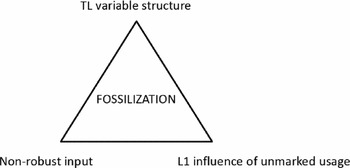
The Tsimpli & Sorace study, in sum, highlights the nature of the target structure as a variable. By implication, this variable can interact with L2 input to determine its robustness and with L1 to determine if transfer will occur. The putative three-way interaction is schematized in Figure 2.
Three competing yet interactive variables that may lead to fossilization

If this line of reasoning is on the right track, as it appears to be (Zobl Reference Zobl1980a),Footnote 8 it would also follow that if the target structure entails variable mappings of FMF, the L2 input is likely to be variable, and hence non-robust. Meanwhile, if the target structure, with all its attendant FMF constraints, differs markedly from how the corresponding meaning is habitually encoded and expressed in L1 discourse, negative transfer is likely to occur. As the SFH predicts, it is precisely this combination of non-robust input and the unmarked nature of the corresponding L1 expression that may lead to fossilization.
5.3 L2 Italian
Evidence in support of this understanding can be gleaned from a number of studies undertaken by Sorace and her colleagues, focusing on the ‘end-state grammar’ of near-native speakers of L2 Italian. Among the structures the researchers reported as fossilized in native speakers of English are the expression of unaccusativity (Sorace Reference Sorace1993) and the realization of subject pronouns (Sorace Reference Sorace, Doughty and Long2003), both of which are interface structures encoding variable FMF relations. In a study on anaphoric resolution of subject pronouns, Sorace & Filiaci (Reference Sorace and Filiaci2006) subjected English-speaking near-native and native speakers of Italian to a picture verification task that involved matching a set of pictures to a set of complex sentences (i.e. sentences with a matrix clause and a subordinate clause). The sentences were manipulated so that they demonstrated the conditions, for null subject pronouns, for both forward anaphora (e.g., Mentre leik/lproi si mette il cappotto, la mammai dà un bacio alla figliak ‘While she/pro is wearing her coat, the mother kisses her daughter’) and backward anaphora (e.g., La mamma dà un bacio alla figliak mentre lek/l/proi si mette il cappotto ‘The mother kisses her daughter, while she/pro is wearing her coat’). Italian and English are diametrically opposed to each other with regard to null subject pronouns, by virtue of the fact that Italian is a null subject language and English a non-null subject language. In Italian, null subjects are syntactically licensed but are pragmatically determined in their discourse distribution. Results from the study showed selective fossilization: the near-native speakers displayed full command of the syntactic constraints on pronominal subjects yet ‘residual indeterminacy’ in interpreting pronominal forms (i.e., overt versus null). They consistently misinterpreted anaphoric overt pronouns as referring to the subject of the main clause. According to Sorace & Filiaci (Reference Sorace and Filiaci2006), similar findings were reported in Filiaci (Reference Filiaci2003) and Belletti, Bennati & Sorace (Reference Sorace, Cornips and Corrigan2005) – importantly and complementarily, through examinations of naturalistic and production data.
Studies of this nature – focusing on end-state grammar – have mostly provided for the generalization that:
[G]rammatical aspects that involve an interface between syntax and other cognitive systems often present residual L1 (L1) effects, indeterminacy or optionality (Sorace Reference Sorace2000, Reference Sorace, Doughty and Long2003, Reference Sorace, Cornips and Corrigan2005). In contrast, there is currently no evidence of optionality in near-native grammars with respect to syntactic properties in a narrow sense. (Sorace & Serratrice Reference Sorace and Serratrice2006: 340)
This understanding is, in turn, extended into a hypothesis known as the Interface Hypothesis, which stipulates that ‘narrow syntactic properties are completely acquirable in a L2, even though they may exhibit significant developmental delays, whereas interface properties involving syntax and another cognitive domain may not be fully acquirable’ (ibid.). The Interface Hypothesis has undergone several iterations, the most recent version identifying syntax–discourse interface properties as the most vulnerable to ‘residual optionality’Footnote 9 or fossilization (Sorace & Serratrice Reference Sorace and Serratrice2009; Sorace Reference Sorace2011; see, however, Montrul Reference Montrul2011; White Reference White2011).
It is worth noting that the Interface Hypothesis is predictive but not explanatory. In other words, it predicts what is acquirable and what is not, but it does not provide an explanation for either. Indeed, Sorace and her colleagues have sought multiple explanations not only for the ‘residual indeterminacy’ noted above, but also for an intriguing yet converging finding of an asymmetry in the interpretation and production of subject pronouns in language contact situations involving a null subject language and a non-null subject language. Studies on bilingual L1 acquisition (Müller, Cantone, Kupisch & Schmitz Reference Müller, Cantone, Kupisch and Schmitz2002; Paradis & Navarro Reference Paradis and Navarro2003; Hacohen & Schaeffer Reference Hacohen and Schaeffer2005), on late L2 acquisition (Filiaci Reference Filiaci2003; Belletti et al. Reference Belletti, Bennati and Sorace2005; Montrul Reference Montrul, Slabakova, Montrul and Prévost2006), and on L1 attrition (Helland Reference Helland2004; Montrul Reference Montrul, Schmid, Köpke, Keijzer and Weilemar2004a; Tsimpli et al. Reference Tsimpli, Sorace, Heycock and Filiaci2004) have all observed that the crosslinguistic influence is exclusively unidirectional, that is, from a non-null subject language (e.g., English) to a null subject language (e.g., Italian), and is thus asymmetric. Explanations for this are sought in, for example, the lack of processing resources for coordinating interfaces, crosslinguistic influence, the use of a default processing strategy which chooses the most ‘economic’ system that does not involve syntax–discourse conditions, or a combination of ‘sub-optimal processing resources and crosslinguistic influence’ (Sorace & Serratrice Reference Sorace and Serratrice2006: 346). A problem with invoking multiple explanations for a single phenomenon is that it suggests not only uncertainty but also fragmentary understanding.
The problem is resolved in the SFH, however, as this allows a unifying explanation for asymmetric phenomena. First, in the case of bilingual L1 acquisition, the non-null subject language, in which an overt subject is always present, is stronger than the null subject language, in which overt subject pronouns may or may not be present. In other words, the input from the non-null subject language is probably more robust than that from the null subject language. Second, similarly (though not identically), in the case of late L2 acquisition, the input from the null subject language (TL) is probably non-robust, and also competes with an unmarked feature (viz., the consistent presence of overt subjects) of the non-null subject language (L1), leading to greater influence of the latter than the former and hence to fossilization of overuse of overt subject pronouns in the interlanguage. Third, in the case of L1 attrition, as a result of prolonged experience with the L2, a non-null subject language, the robust input from the L2 becomes dominant, thereby exerting an influence back on the L1, leading to its attrition (the overuse of overt subjects where pragmatically inappropriate).
However, the Interface Hypothesis and the SFH are mutually compatible, rather than in conflict. Both predict that variable FMFs play a key role in leading to fossilization. But the SFH clearly has a wider scope, crucially being able to both predict and explain acquisition as well as fossilization.
The discussion so far has allowed us to further the line of thinking as delineated in Figure 2. What is depicted there is now crystallized into the interplay between three concrete forces underlying fossilization: (a) the variable nature of the target structure, (b) non-robust input, and (c) crosslinguistic influence from an L1 unmarked usage. This is illustrated in Figure 3; further examples will be given in the remainder of this section.
Three interacting factors and fossilization

5.4 L2 German
Hopp (Reference Hopp2005) suggested for L2 German that scrambling – the optional reordering of arguments (e.g., Ich glaube, dass [den Wagen zu reparieren]1 Peter schon t1 versucht hat Lit. ‘I think that the car to repair Peter already tried has/I think that Peter already tried to repair the car’) – may be fossilizable in English–German interlanguage. The participants in Hopp's study were English and Japanese speakers of advanced proficiency in German. They were tested via a bimodal (visual and auditory) grammaticality judgment test on optional word orders in German, including scrambling, topicalization (e.g., [Den Wagen zu reparieren]1 hat Peter schon t1 versucht Lit. ‘The car to repair has Peter already tried/The car, Peter already tried to repair’) and remnant movement (e.g., [t1 Zu reparieren]2 hat Peter [den Wagen]1 schon t2 versucht Lit. ‘To repair has Peter the car already tried/Peter already tried to repair the car’). These are interface constructions, subject to syntactic, semantic, and discourse pragmatic constraints (Haider & Rosengren Reference Haider and Rosengren1998). Take scrambling as an example. According to Hopp (Reference Hopp2004), scrambling typically involves ‘given’ constituents, which therefore have the discourse status of ‘non-new’. Semantically, there are interpretational differences associated with scrambled definite NPs and indefinite NPs. In addition, the constituents involved in scrambling are typically unfocussed and unstressed. As suggested earlier, variable structures are often accompanied by non-robust input. The target constructions here are no exception in that regard. Hopp assigned them to the ‘poverty of the stimulus’ type, on the grounds that ‘evidence of the range and restrictions of word-order variation is likely to be sparse and ambiguous in the input’ (Hopp Reference Hopp2005: 40). The study, which had a generative linguistic orientation, focused only on probing participants’ knowledge of syntactic constraints governing what and where different types of movement are allowed (or not). Thus, the learners’ task was assumed to include learning (a) that German allows scrambling; (b) that German allows remnant movement; and (c) that there are constraints on remnant movement. Results showed that, notwithstanding the input deficiency, both English and Japanese speakers exhibited target-like knowledge of grammaticality contrasts. However, it was also noted that English speakers and Japanese speakers, while statistically indistinguishable in their judgments of the grammaticality of topicalization constructions, differed in their performance on scrambling, with Japanese speakers performing at a significantly more target-like level than the English speakers (p<0.05). This difference was attributed to L1 background: English and Japanese differ with respect to word order freedom in that English (which does not allow scrambling) is typologically distant from German, whereas Japanese (which allows scrambling) is typologically similar. In Hopp's words, ‘the observed interaction effect between acceptance of scrambling and L1 can thus be logically related to typologically distinct initial states of IL development (Schwartz & Sprouse Reference Schwartz and Sprouse1996)’ (Hopp Reference Hopp2005: 62). In the terms of the SFH, the L1 influence (lack of scrambling) had interacted with the poverty of the stimulus or lack of input, leading to the observed difficulties, and, indeed, to ‘protracted difficulties identifying the target-like mapping between discourse function and the syntax of scrambling’ (p. 68).
Hopp (Reference Hopp2004), analyzing the same dataset as Hopp (Reference Hopp2005), concluded that:
L2 learners have robust knowledge of underdetermined UG-specified syntax, but that they manifest non-target-like behavior in interpretative interface aspects . . . This disjunction between syntax and its interfaces reflects persistent L1 transfer effects at the interfaces, but does not point to any representational deficits. (p. 68)
Findings such as these serve to confirm two conclusions that emerge from the present discussion, namely (a) that variable constructions are likely candidates for fossilization because of their vulnerability to crosslinguistic influence from the L1, and (b) that (even in variable structures) formal properties are acquirable, but interface properties may not be (see also Coppieters Reference Coppieters1987; Ioup et al. Reference Ioup, Boustagui, El Tigi and Moselle1994). It follows that when researching fossilization it is not sufficient to address only syntactic knowledge, since fossilization is more likely to occur where the interface between formal properties and other cognitive domains such as discourse pragmatics is involved (in other words, in FMF mappings), and should therefore be easiest to detect in contextual interlanguage use.
Another point made by Hopp (Reference Hopp2004) that is worth highlighting here is that when it comes to the acquisition of interface properties or so-called interpretive properties (as opposed to pure syntactic properties), the L1 fills in where input fails (cf. Schwartz & Sprouse Reference Schwartz and Sprouse1996). This implies that a lack of robust input can induce transfer, a point which will be discussed further below.
5.5 L2 Chinese
A variable structure that has been established as a candidate for fossilization in the L2 Chinese of Palestinian Arabic speakers is that of resumptive pronouns in relative clauses. A few crosslinguistic facts are noteworthy in this respect. First of all, in Chinese, the relative clause is NP-final (e.g., Zhangsan kan guo de na fu hua Lit. ‘Zhangsan see ASP DE that CL picture/the picture that Zhangsan has seen’), while in Arabic it is NP-initial (e.g., Al bint illi A'ataitu Al-Folous ‘the girl that you gave the money/the girl to whom you gave the money’). Second, Chinese allows gaps in matrix subject, direct object, indirect object, and genitive positions, while Palestinian Arabic allows extraction only in the matrix subject position. Third, Chinese allows alternation of gaps and resumptive pronouns in the indirect object and genitive positions, hence it is variable, whereas Palestinian Arabic allows only resumptive pronouns in direct object, indirect object, and genitive positions. Thus, in terms of their permissibility of resumptive pronouns, Chinese and Arabic form a subset–superset relation. In other words, Palestinian Arabic allows a wider scope in the use of resumptive pronouns, hence the superset, than Chinese, the subset. These crosslinguistic facts have implications for L2 acquisition of Chinese relative clauses by Palestinian Arabic speakers. In the first place, as a result of the partial similarity between the two languages in, broadly, allowing both gaps and resumptive pronouns, Palestinian speakers are likely to overgeneralize when using resumptive pronouns in their L2 Chinese relative clauses, and this, coupled with a lack of robust input, can lead to fossilization. This has indeed been borne out in empirical L2 research. A study by Yuan & Zhao (Reference Yuan and Zhao2005) administered a grammaticality judgment test, manipulating various syntactic conditions for gaps and resumptive pronouns, to a group of Palestinian Arabic speakers, who were reportedly advanced learners of Chinese, with over five years of residence in China, and simultaneously to a group of native speakers of Chinese. The study showed that the Palestinian Arabic speakers not only accepted resumptive pronouns in indirect and genitive positions, as did native speakers of Chinese, but also in subject and object positions, unlike the native speakers.
According to Yuan & Zhao, the distribution of resumptive pronouns in Chinese creates a learnability problem for Palestinian Arabic speakers. Specifically, while there is positive evidence in the communicative input that resumptive pronouns are allowed in the target language in some positions, there is no such evidence against their occurrence in other positions. In this case, the lack of robust input is, arguably, L1-motivated, because it is the partial similarity between the L1 and the TL that induces ‘interlingual identifications’ (Weinreich Reference Weinreich1953), a learning strategy that misidentifies what is otherwise non-identical, which, in turn, renders the input inadequate. As Yuan & Zhao noted, ‘The superset and the lack of informative evidence in the input data can make the incorrect alternation of gaps and [resumptive pronouns] in subject and object positions of Chinese relative clauses a candidate for fossilization in Palestinian learners’ L2 Chinese’ (p. 234). In the terms of the SFH, it was the combination of lack of robust input and L1 influence that resulted in the persistence of overextension of resumptive pronouns.
There is, however, a methodological limitation in the Yuan & Zhao study (and, for that matter, most generative studies on L2 acquisition) that is worth noting for its relevance to the present discussion. By virtue of using a grammaticality judgment test as the only measure of acquisition, the study treated resumptive pronouns as exclusively a syntactic phenomenon, thereby overlooking the nature of alternations between gaps and resumptive pronouns in indirect object and genitive positions in Chinese that are determined pragmatically as well as syntactically. Empirical studies setting out to investigate pragmatic conditions would require the collection of discourse interpretation and production data.
Another documented instance of selective fossilization in L2 Chinese is found in Shan & Yuan's (Reference Shan, Yuan, Roberts, Florence and David2008) cross-sectional study probing English speakers’ grammaticality judgments of unaccusatives in Chinese. The researchers reported that their participants across the proficiency spectrum had target-like judgments of unaccusatives that resemble English unaccusatives without transitive counterparts (e.g., Na tiao chuan chen le ‘That ship sank’), but that even the near-native speakers showed indeterminate judgments when it came to the Chinese unaccusatives that are dissonant – the change-of-state unaccusatives that do not have a transitive counterpart in Chinese (e.g., Yi kuai bolii po le ti ‘A piece of glass broke’). Shan & Yuan attributed this selective fossilization to two factors acting in tandem, the input and the L1 influence, stating that ‘The L1 transfer is persistent because there is no positive evidence in the L2 Chinese input data which can tell English speakers of L2 Chinese that unaccusatives of change of state like po “to break” do not have causative counterparts and therefore cannot undergo passivization, leading to the persistence of L1 influence and the phenomenon of optionality’ (p. 183; emphasis in original). This explanation is in line with the SFH.
5.6 L2 English
Several recent longitudinal studies have converged on the finding that grammatical morphemes are prime candidates for fossilization in the interlanguage of L2 learners of English whose L1s are morphologically impoverished (Lardiere Reference Lardiere1998; White Reference White2003a; Han Reference Han, Han and Cadierno2010). Like the studies on other target languages, these studies found fossilization to be selective. For example, Han (Reference Han, Han and Cadierno2010), examining a longitudinal dataset comprising naturally produced and ‘clinically elicited’ (Ellis & Barkhuizen Reference Ellis and Barkhuizen2005) L2 English data from a native speaker of Chinese, showed that the participant's plural marking of quantified NPs (e.g., three books) was consistently more accurate than of non-quantified NPs (e.g., books), and, similarly, that his use of the indefinite article a/an was consistently more accurate than his use of the definite article the. Significantly, these patterns of usage, despite the participant's prolonged residence in the United States, were strikingly similar to his L1 usage patterns. To explain the source of these interlanguage behaviors, Han invoked Slobin's (Reference Slobin1987,Reference Slobin, Gumperz and Levinson1996, Reference Slobin, Gentner and Goldin-Meadow2003) Thinking-for-Speaking Hypothesis (TFS), noting that the participant's mind was still largely L1-relativized. ‘The persistent intra-learner variability, manifested as overuse, underuse, and target-like use vis-à-vis the same grammatical form, suggests that conceptual restructuring had barely occurred . . .’ (Han Reference Han, Han and Cadierno2010: 177–178).
The Thinking-for-Speaking Hypothesis, a modern form of the theory of linguistic relativism, suggests that verbal expression of one's experience involves a special form of thought, which is mobilized for and during communication and which is filtered through and constrained by one's existing language. TFS predicts, for SLA, that:
The grammaticized categories that are most susceptible to [crosslinguistic] influence have something important in common: they cannot be experienced directly in our perceptual, sensorimotor, and practical dealings with the world.. . .
Distinctions of aspect, definiteness, voice, and the like, are, par excellence, distinctions that can only be learned through language, and have no other use except to be expressed in language . . . Once our minds have been trained in taking particular points of view for the purpose of speaking, it is exceptionally difficult for us to be retrained. (Slobin Reference Slobin, Gumperz and Levinson1996: 91)
In terms of the TFS hypothesis, grammatical morphemes are not simply formal properties; they tie closely to abstract concepts such as definiteness and number and, in turn, to particular sets of conceptualizations of the world (Lucy Reference Lucy1992). It follows that acquisition of grammatical morphemes hinges on conceptual restructuring, something that does not happen easily, if at all. As has been repeatedly attested in longitudinal studies of advanced L2 speakers, an L1-relativized mind continues to bias the learner's noticing and processing of input relating to grammatical morphemes, even following extended exposure to the target language (cf. Jiang Reference Jiang2004). For the participant reported in Han (Reference Han, Han and Cadierno2010), there was longitudinal evidence that, in spite of his 12 years of immersion in the target language environment, the participant had learned how to mark definiteness, indefiniteness, and number, but only partially what to mark, and only marginally when to mark it. In other words, the participant knew the forms (i.e., the definite and indefinite articles and plural -s), but consistently failed to demonstrate an ability to employ their proper FMFs in natural communicative discourse. It thus seems that input robustness can be compromised by an L1-attuned mind and processor (DeKeyser Reference DeKeyser2005; N. Ellis Reference Ellis2006a; Jiang et al. Reference Jiang, Novokshanova, Masuda and Wang2011).
Support for the SFH's interactive notion of L2 input robustness and L1 markedness comes also from a meta-analysis of grammatical morpheme order studies conducted by Goldschneider & DeKeyser (Reference Goldschneider and DeKeyser2001). The study identified five variables as responsible for the putative developmental order (Dulay & Burt Reference Dulay and Burt1974): perceptual salience, semantic complexity, morpho-phonological regularity, syntactic category, and frequency. The researchers nevertheless posited that salience, a composite of all five variables, accounts for the lion's share of the variation (r = .71). This finding suggests that input robustness is not just a physical attribute (e.g., frequency), but one that integrates several elements: environmental (e.g., frequency and regularity), target language inherent FMF (i.e., syntactic category and semantic complexity), and crosslinguistic (i.e., perceptual salience). As such, input robustness is also relative rather than absolute; that is, the same input may appear to be robust to one L1 group but not to another. Relating this to Hopp's (Reference Hopp2005) study, discussed earlier, while the input for the target construction of scrambling is generally impoverished, it may have been differentially salient to English speakers and Japanese speakers, because of its interplay with the different L1s.
Another notable candidate for fossilization in the context of L2 acquisition of English is passivization of unaccusatives (e.g., The accident was happened yesterday). Research has found this to be a pervasive phenomenon even in advanced L2 learners of English who are speakers of a variety of L1s such as Chinese, Japanese, and Korean (Hiragawa Reference Hiragawa1995; Yip Reference Yip1995; Balcom Reference Balcom1997; Ju Reference Ju2000; Oshita Reference Oshita2000; Han Reference Han, Han and Odlin2006). Han's (Reference Han, Han and Odlin2006) longitudinal case study, focusing on two advanced Chinese speakers of L2 English and examining their naturally-occurring and elicited data over time, revealed that the passivized unaccusatives, which come in two types – passivized unaccusative verbs with or without a transitive counterpart (e.g., happen vs. break) – endured, despite environmental influence. Nevertheless, at the same time there was evidence that one of the participants refrained from passivizing unaccusatives without a transitive counterpart, while persisting in passivizing unaccusatives with transitive counterparts, which suggests selectivity of fossilization even in this narrow domain of syntax.
If viewed in isolation, overpassivization appears to be a universal phenomenon (Hawkins Reference Hawkins2001; Oshita Reference Oshita2001; White Reference White2003b), since it has been attested in learners from different L1 backgrounds learning different L2s, as noted above. However, when examined longitudinally and in conjunction with other interlanguage subsystems, the overpassivization observed appears to have as much to do with L1-specific influence as with L2 input robustness (Han Reference Han2000, Reference Han2002, Reference Han, Han and Cadierno2010; cf. Shan & Yuan Reference Shan, Yuan, Roberts, Florence and David2008). In her studies, Han observed that the overpassivization produced by her participants patterned with a form of underpassivization, thus creating an interesting paradox (cf. Balcom Reference Balcom1997). The underpassivization relates to a construction known as the ‘pseudo-passive’ (e.g., The car must keep inside), first reported in Schachter & Rutherford (Reference Schachter, Rutherford, Robinett and Schachter1979) for native speakers of Chinese and Japanese and later explored by Yip (Reference Yip1995) and Yip & Matthews (Reference Yip1995), among others. Han (Reference Han2000), upon a close examination of the pseudo-passives compared with a subset of real passives (e.g., Your letter was received) in the longitudinal data from the same two participants as in Han (Reference Han, Han and Odlin2006), concluded that both were traceable to the influence of the L1 topic–comment syntactic and discourse structure. Furthermore, when the pseudo-passives (underpassivization) were inspected along with the passivized unaccusatives (overpassivization), they, too, both seemed to stem from the same influence (Han Reference Han2002).Footnote 10 These seemingly disparate phenomena can ultimately be unified under the TFS hypothesis (Slobin Reference Slobin1987; Reference Slobin, Gumperz and Levinson1996). Han (Reference Han, Han and Cadierno2010: 180) argued that:
The thinking-for-speaking hypothesis appears to provide an adequate explanation not only for the persistence of the grammatical morpheme problem but also for that of other seemingly unrelated problems in [the participant's] L2. . . . They were driven by a common underlying force, namely, L1 thinking for speaking. . . . it is the way one would say it in Chinese, so to speak, that gives rise to these expressions.
Corroborating the same line of reasoning as outlined in Figures 2 and 3, the L1 influence in the case of over- and under-passivization appears to act in tandem with a lack of input robustness. Shan & Yuan (2010) pointed out that the unaccusative verbs pose a learnability problem for L2 learners. The striking similarity in the syntactic mechanism of the unaccusative and the passive – both involving NP-movement of an internal argument – may confuse L2 learners who might have been led to believe that the English passive morphology is a way to indicate the NP-movement of a thematic argument from the direct object position to the subject position. This, coupled with the fact that the passive morphology is prevalent in the TL input (Oshita Reference Oshita2000, Reference Oshita2001), may have induced the learner to reject the use of the grammatical NP-V unaccusative construction, and to overpassivize.
In essence, the paradoxical occurrence of overpassivization of some verbs but underpassivization of others is an indication of a lack of acquisition of FMF mappings for unaccusatives and passives. According to Balcom (Reference Balcom1997), learners have yet to learn (a) that detransitivization, as seen in the pseudo-passives, is restricted to verbs whose action can occur without the intervention of a volitional agent; and (b) that for the passive rule to apply, logical objects must be affected. Ultimately, though, they must learn the relevant FMFs, that is, how the form–meaning mappings play out in natural discourse.
From the fossilizable constructions discussed in this section, it is clear that the interaction between input and L1 can occur in at least two ways, as illustrated in Figure 4. First, input may induce interlingual identifications (Paradis & Navarro Reference Paradis and Navarro2003). This idea is more or less encapsulated in the Transfer to Somewhere Principle (Andersen Reference Andersen, Gass and Selinker1983: 192):
Two modes of interaction between input and L1 influence

A grammatical form or structure will occur consistently and to a significant extent in the interlanguage as a result of transfer if and only if (1) natural acquisitional principles are consistent with the L1 structure or (2) there already exists within the L2 input the potential for (mis)generalization from the input to produce the same form or structure. (emphasis in the original)
The principle recognizes that transfer or crosslinguistic influence can be induced both by the input and the developmental need for acquiring a target structure, leading to the creation and stabilization of an interlanguage construction. The two conditions imply (a) that the input contains attributes with perceivable resemblance to aspects of the L1, and (b) that the acquisitional target is complex. On this account, L1 is resorted to as a solution to a problem (cf. Kellerman Reference Kellerman1995).
A second way in which input comes into an interaction with L1 is that an L1-relativized mind may bias the processing of L2 input. This idea has largely been encoded in the Transfer to Nowhere Principle (Kellerman Reference Kellerman1995), according to which there are ‘ways that the first language can influence the second at a level where cognition and language touch’ (p. 143). As Kellerman explained, ‘Andersen's transfer to somewhere principle is about the acquisition of the means of linguistic expression. Transfer to nowhere is about the conceptualization that fuels the drive towards discovering those means’ (ibid., emphasis added). Thus the two modes of input and L1 interaction are potentially linked, with one (transfer to nowhere) subserving the other (transfer to somewhere). Transfer to nowhere can manifest itself as L1 thinking for L2 speaking (Han & Lew Reference Han, Lew, Szmrecsanyi and Kortmann2012) and, conceivably, for L2 listening, reading, and writing as well (Slobin Reference Slobin, Gumperz and Levinson1996).
The two modes of interaction between input and crosslinguistic influence are illustrated in Figure 4. Thus, the interaction between input and L1 can be initiated either by input or by L1. In the former case, as implied in the Transfer to Somewhere Principle, the interaction is largely a conscious process, according to Kellerman (Reference Kellerman1995). In the latter, the interaction is largely unconscious. The two ways of interaction need not be mutually exclusive, however. Indeed, as Kellerman (Reference Kellerman1995) has suggested, it is most likely to be Transfer to Nowhere (i.e., cognitive transfer) that fuels the drive for Transfer to Somewhere (i.e., linguistic transfer).
Of course, it is not unreasonable to expect the impact of Transfer to Nowhere to be weaker, less apparent, and less persistent on L2 input processing, in which comprehension plays an important part, than on output production. This supposition is backed by another of Lightbown's ten generalizations (Reference Lightbown1985, Reference Lightbown2000, Reference Lightbown2003), namely that ‘A learner's ability to understand language in a meaningful context exceeds his/her ability to comprehend decontextualized language and to produce language of comparable complexity and accuracy’ (Lightbown Reference Lightbown1985: 179). Lightbown went on to write (2000: 450):
There is plenty of evidence that learners are able to get the meaning from the language they hear, even if they do not understand all of the linguistic features which contribute to making the meaning. They do this by using contextual cues and world knowledge.
Aside from the use of extra-linguistic information to help with decoding of the input, the asymmetric relation between comprehension and production may be due to a number of other factors, not least the fact that during input processing, which requires an understanding of the relationship between form and meaning, the meaning comes from outside the learner; in contrast, during communicative output, meaning is generated from within the learner. As a result, what can happen in L2 communicative production is l1 thinking for l2 speaking (Han & Lew Reference Han, Lew, Szmrecsanyi and Kortmann2012). Figure 5, adapted from Levelt's (Reference Levelt1989) model of speech production, schematizes this idea.
L1 thinking for L2 speaking (Han & Lew Reference Han and Banks2012)

In this account, in L2 production, meaning is generated by the learner and framed in the L1. Two important corollaries follow from this. First, L2 learners may possess a production system largely (though not completely) independent of the system for comprehension (and, for that matter, for input processing). Second, fossilization affects the production system more than the comprehension system, primarily because the former is directly responsible for spontaneous communicative production and is bolstered by L1 thinking for L2 speaking (Scarcella Reference Scarcella, Gass and Selinker1983; Han & Lew Reference Han, Lew, Szmrecsanyi and Kortmann2012).Footnote 11 A case in point is when L2 learners from different L1 backgrounds are asked to describe motion events in a given L2, to which I now turn.
6. L1 thinking for L2 production
The past decade of SLA research has seen a growing interest in validating Slobin's TFS hypothesis by applying it to learners from a variety of L1 backgrounds (for a recent collection of studies, see Han & Cadierno Reference Han and Cadierno2010). One strand of this research has focused on how learners express motion, a spatial concept, in an L2 that is typologically similar to or different from their L1, leading to abundant evidence of L1 thinking for L2 speaking. Stam (2010) is particularly suitable for our present purposes.
Stam (2010) reports on a nine-year longitudinal case study of an adult Spanish speaker's L2 linguistic and gestural expressions of motion in English. Spanish and English are typologically different in this connection: Spanish is described as a verb-framed language in which manner is encoded in the adverbial or gerund with path indicated in the motion verb (e.g., La botella salió de la cueva flotando ‘The bottle left the cave floating’), while English is a satellite-framed language in which manner is encoded in the verb with path expressed through a prepositional phrase (e.g., The bottle floated out of the cave). Spanish and English thus have different ways of lexicalizing the expression of motion. The study focused on changes or lack thereof over time in the participant's expressions of path and manner in her two languages. The participant was a female Mexican-Spanish-speaking learner of English, reportedly with advanced proficiency. She was subject to the same set of data elicitation procedures in 1997 and 2006: she was shown a Sylvester and Tweety Bird cartoon, Canary Row (Freleng Reference Freleng1950), in two segments, and asked to narrate each segment in Spanish and English respectively to a Spanish-speaking and English-speaking listener. The narrations (i.e., spontaneous production) were video-taped, transcribed, and analyzed. The results indicated that, with respect to her L2 English, the learner's linguistic and gestural expressions of path changed – she consistently used path expressions in 2006 but not in 1997 – but her linguistic and gestural expressions of manner stayed the same over nine years – she continued to express manner within a Spanish thinking-for-speaking frame. In a nutshell, her expression of path became more target-like over time, while her expression of manner fossilized as Spanish-like. What, then, would account for the selective fossilization? Stam's explanation was largely in keeping with the SFH. She wrote:
Although manner is an important aspect of English verbs, it is path that is the most salient element in a motion event: something has to move somewhere (Slobin Reference Slobin, Evans, Bergen and Zinken2007). Also, formal learners of English are explicitly taught two-word verbs and prepositions. They are not exposed to manner to the same extent that native-English-speaking children are . . . Therefore, exposure could be a factor in L2 learners’ acquiring path and not acquiring manner thinking-for-speaking patterns. (Stam 2010: 81–82)
Thus input is suggested as a possible factor. But, as shown, it is not just the lack of input, but L1 influence too, that may have led to the fossilization. We may need to add the fact that, with regard to input, in the TL English, there is plenty of evidence that manner is not encoded in the verb, but rather with an adverbial (e.g., He was walking gingerly around the floor furnace in the hall), as in Spanish. Going back to the Transfer-to-Somewhere Principle (Andersen Reference Andersen, Gass and Selinker1983) discussed earlier, when the input shows evidence that overlaps with the L1, there is a greater chance of L1 transfer. Müller & Hulk (Reference Müller and Hulk2001) summarized this tendency well, when they noted that the likelihood of crosslinguistic influence is enhanced when (a) the two languages overlap with respect to a given grammatical property, and (b) this property involves the interface between syntax and pragmatics. Similarly, Zobl (Reference Zobl1980a: 43) asserted that ‘a language will accept only those external influences that correspond to its own structural tendencies and systematic biases’. Especially pertinent in this respect is Zobl's (Reference Zobl1980b) argument that transfer errors may retard subsequent restructuring. The lack of restructuring seems especially clear when the learner engages in spontaneous production – a process dominated by L1 thinking for L2 speaking, as attested in Stam's study, among others.
7. Conclusions
A key construct in SLA research, fossilization inspired the formation of the discipline, and has since continued to spur considerable direct and indirect empirical research, as reported in the literature. As a result, the field has taken strides towards a sophisticated understanding of both the construct itself and of SLA as a whole.
In this paper, I started out by revisiting the Fossilization Hypothesis as proposed in Selinker (Reference Selinker1972), highlighting the original dual perspective on fossilization as a cognitive mechanism and as a behavioral artifact in L2 learning. I then identified and discussed a number of issues with the hypothesis. I noted that the original hypothesis was both broad and loose, with the result that it projects both a phylogenic and an ontogenic perspective and conflates process, product, and mechanism. As a result, early research on fossilization was not particularly productive: theory and research alternated, and explanations outstripped descriptions (Han Reference Han2004, Reference Han, Gass and Mackey2011; Han & Odlin Reference Han, Han and Odlin2006a). Despite its lack of restrictiveness, the Fossilization Hypothesis has made several accurate predictions: that fossilization is pervasive yet idiosyncratic, is most evident when learners rely on themselves to communicate their own meaning, and is based on L1 influence (Selinker & Lakshmanan Reference Selinker, Lakshmanan, Gass and Selinker1992). The hypothesis, however, also makes several problematic predictions, especially that the interlanguage system can fossilize entirely, and that fossilization arises from a lack of command of surface linguistic materials in the target language.
Following my brief appraisal, I provided an update on the hypothesis in the light of current understanding, based on seven sets of questions developed by Selinker & Lamendella (Reference Selinker and Lamendella1978) regarding the nature of fossilization, its source, its objects, the way it operates, the point at which it begins, its persistence, and candidates for fossilization. With the aim of further updating the hypothesis, I introduced the Selective Fossilization Hypothesis (Han Reference Han, Cook and Wei2009) and followed up with an analytic account of a number of fossilizable structures, selected from the recent L2 literature to represent a range of target languages and to increase the generalizability of this discussion. Not only did the analysis shed light on the validity of the SFH; it also enabled a more nuanced understanding of a three-way interaction between the target construction, L2 input, and L1 influence. Importantly, the analysis led to four generalizations:
1. Fossilization is selective.
2. Fossilization affects the acquisition of TL structures encoding variable form, meaning, and function (discourse pragmatics) relations.
3. Fossilization is inspired by an L1-relativized mind, induced or reinforced by L2 input attributes.
4. Fossilization is most evident in spontaneous production in which the learner engages in manufacturing his own meaning and linguistic expression.
It would, however, be a mistake to view fossilization out of the context of other, related processes. An emerging, and potentially more profound, insight from the recent literature is that fossilization is probably better understood in conjunction with acquisition. In fact, Han (Reference Han, Cook and Wei2009, Reference Han, Gass and Mackey2011) argued that fossilization and acquisition should share the same mechanism. In the present context, this amounts to saying that the same variables – L2 input and L1 influence – can account for acquisition as well as fossilization. Indeed, the SFH predicts that greater input robustness and reduced L1 influence will lead to acquisition (see Zone II in Figure 1). Nevertheless, warnings have repeatedly been made that L2 input cannot be equated with the TL (Han Reference Han, Cook and Wei2009, Reference Han, Gass and Mackey2011; Han & Lew Reference Han, Lew, Szmrecsanyi and Kortmann2012); instead, a dynamic view on L2 input is supported at the expense of the static, yet still prevalent view on TL in SLA research that dates back to the Contrastive Analysis Hypothesis (Lado Reference Lado1957). Distinguishing as it does between L2 input and TL, the SFH indicates a need for empirical investigations of L2 input – a major gap in SLA research. To date, input has mostly been assumed rather than established in SLA studies.
Given the current understanding of fossilization, further research, longitudinal as well as cross-sectional, should take an integrative approach to the interaction between specific TL construction(s), L2 input, and L1 influence. This approach, which may be challenging both in terms of conceptualization and implementation, should result in a broader database comprising not only samples of learner language but also the input to which the learner has been exposed. Such an integrative approach should inspire a deeper analysis of the data, by virtue of its consideration of at least four variables: the target construction, the L2 input, the L1, and the learner language. Future research that involves sampling learner language must adopt a method that goes beyond the sentence-level manipulations used at present; it needs to include contextualized, preferably natural, discourse data. To achieve both of these goals would be challenging, requiring individual researchers to break out of their comfort zone into unknown territory. But unless such steps are taken, SLA research will remain – even fossilize – in its present position.
Ultimately, SLA research must give up its normally fragmentary approach, and, instead, take a more inclusive point of view that transcends theoretical paradigms and idiosyncratic prejudices, promoting studies of representation, processing, and use in cooperation, and not in separation or conflict (cf. Han & Lew Reference Han, Lew, Szmrecsanyi and Kortmann2012).
While SLA researchers continue to wrestle with fossilization and its consequences for acquisition as a whole, it is important that teachers tune in to these discussions. In doing so they will not only improve their understanding of the nature of L2 learning (for a more detailed discussion, see Han Reference Han2004, Reference Han, Gass and Mackey2011), but would, in turn, enable them to make more effective changes to their practice and achieve better learning outcomes – the goal of L2 education.
Acknowledgements
I would like to thank the editor for the opportunity to contribute this article to Language Teaching, and the four anonymous reviewers for their insightful comments and useful suggestions on an earlier version of the manuscript. Any errors that remain are exclusively my own.
ZhaoHong Han is Professor of Language and Education at Teachers College, Columbia University, where she teaches graduate courses in TESOL and Applied Linguistics. Her research interests are broadly in L2 learnability, L2 teachability, and their interface. Her work on fossilization, corrective feedback, L1 thinking for L2 speaking, L2 reading and reading instruction, and L2 ab initio input processing has appeared in a variety of journals and edited volumes. She is the recipient of the 2003 TESOL International Heinle & Heinle Distinguished Research Award, and the author of Fossilization in adult second language acquisition (2004, Multilingual Matters).