Hope is considered to be a bi-dimensional concept composed by the thoughts that one directs to a goal, on which: (a) The protagonist perceives him/herself as capable of creating pathways toward accomplishing such goal (Pathway Thoughts); (b) one has the motivation to start and remain in such adopted pathways (Agency Thoughts) (Snyder, Reference Snyder2000). The sport context promotes innumerable challenges, along with barriers to succeed in them. In this sense, high levels of hope can be considered as a personal resource which can assist in the athlete’s accomplishments by aiding in the behaviors adopted in face of their problems and barriers, as well as their willingness to remain engaged in their tasks (Curry & Snyder, Reference Curry, Snyder and Snyder2000). Therefore, hope in sports can greatly contribute for a better performance (Curry, Snyder, Cook, Ruby, & Rehm, Reference Curry, Snyder, Cook, Ruby and Rehm1997), improved rehabilitation and athlete’s wellbeing after an injury (Lu & Hsu, Reference Lu and Hsu2013), and is also an important characteristic for Olympic athletes (Gould, Dieffenbach, & Moffett, Reference Gould, Dieffenbach and Moffett2002).
Properly assessing hope in sports context is a necessity for the understanding of the entirety of hope’s importance, development of strategies and interventions to promote such characteristic, and to better utilize it in favor of both the athlete’s performance and overall wellbeing. With the purpose of adequately evaluating hope, the Dispositional Hope Scale (DHS) (Snyder et al., Reference Snyder, Harris, Anderson, Holleran, Irving, Sigmon and Harney1991) was developed. The instrument aimed to assess hope for individuals in general, however, the sporting context is a highly competitive, and both physically and mentally high-demanding environment, which shapes the athlete’s personality accordingly. Therefore, it is not certain whether the original instrument would behave, in such context, as expected.
Although the scale has been presenting applicability in a variety of contexts, such as work, school, and injury rehabilitation (Creamer et al., Reference Creamer, O’Donnell, Carboon, Lewis, Densley, McFarlane and Bryant2009; Pacico et al., Reference Pacico, Bastianello, Zanon and Hutz2013; Snyder, Lopez, Shorey, Rand, & Feldman, Reference Snyder, López, Shorey, Rand and Feldman2003), it is still necessary to properly investigate the instrument’s psychometric proprieties in the context of sport. This instrument has been consistently used to evaluate hope in athletes (e.g., Curry et al., Reference Curry, Snyder, Cook, Ruby and Rehm1997; Gould et al., Reference Gould, Dieffenbach and Moffett2002; Lu & Hsu, Reference Lu and Hsu2013), but so far only one study (Gustafsson, Skoog, Podlog, Lundqvist, & Wagnsson, Reference Gustafsson, Skoog, Podlog, Lundqvist and Wagnsson2013) has aimed to assess the scale’s psychometric proprieties in such setting. However, the study mentioned had only assessed the reliability of an adaptation from English to a Swedish version of the scale, which was as a small part of the study, and not its main goal. Therefore, the lack of in depth evaluations of the Hope Scale’s psychometric proprieties in sports can be considered a gap, which the present investigation intends to address.
Besides the differences in contexts, the differences in cultural aspects could also play a role in the scale’s reliability when used to assess Brazilian athletes. Being originally developed and validated in the United States, the DHS has been the object of transcultural adaptations in many countries, such as Japan (Kato & Snyder, Reference Kato and Snyder2005), Poland (Łaguna, TrzebińSki, & Zięba, Reference Łaguna, TrzebińSki and Zięba2005), Portugal (Ribeiro, Pedro, & Marques, Reference Ribeiro, Pedro, Marques, Leal, Pais-Ribeiro and Neves2006), Kuwait (Abdel-Khalek & Snyder, Reference Abdel-Khalek and Snyder2007), Germany (Brouwer, Meijer, Weekers, & Baneke, Reference Brouwer, Meijer, Weekers and Baneke2008), China (Sun, Ng, & Wang, Reference Sun, Ng and Wang2012), Turkey (Kemer & Atik, Reference Kemer and Atik2012), France (Gana, Daigre, & Ledrich, Reference Gana, Daigre and Ledrich2013), Spain (Galiana, Oliver, Sancho, & Tomás, Reference Galiana, Oliver, Sancho and Tomás2015) and Brazil (Pacico et al., Reference Pacico, Bastianello, Zanon and Hutz2013). Even though the scale has been successfully validated to many cultures, along with a Brazilian validation performed with adolescents, it is still important to further test the instrument within the Brazilian population, as a way to guarantee its applicability.
Furthermore, divergent results have been found in the scale’s structure across transcultural adaptation studies. These studies had shown better fit indices for both a bi-factorial model (Agency and Pathways) (Babyak, Snyder, & Yoshinobu, Reference Babyak, Snyder and Yoshinobu1993; Creamer et al., Reference Creamer, O’Donnell, Carboon, Lewis, Densley, McFarlane and Bryant2009; Roesch & Vaughn, Reference Roesch and Vaughn2006) and a single-factor model (Brouwer et al., Reference Brouwer, Meijer, Weekers and Baneke2008; Pacico et al., Reference Pacico, Bastianello, Zanon and Hutz2013). Therefore, more research addressing the DHS’ factorial structure is still needed, especially in the context of Brazilian sports, where no psychometric evidences have been found.
In order to fill this literature gap, the present study has aimed to investigate the DHS psychometric proprieties for the Brazilian sports context, more specifically evaluating the scale’s internal consistency, construct, internal and external reliability and temporal stability. With the purpose of better detailing the procedures, the work is presented in three steps: (1) Internal consistency and construct reliability; (2) internal reliability; and (3) external reliability and temporal stability. By validating and checking the trustworthiness of this instrument, this investigation will enable the development of quantity and quality of hope research in Brazil, therefore having the potential to contribute to the work of coaches and sport psychologists in understanding their athletes’ ability to overcome adversity and reach their goals, and thereby enabling better specific work in sports.
Step 1 – Internal consistency and construct reliability
Method
Participants and data collection
The initial sample was composed by 490 athletes participating in the 2015 Paraná Open Games final phase, a competition that gathers athletes from several other Brazilian states across the competing teams. Due to inadequately answering the scale, 16 subjects had to be withdrawn from the study, resulting in a final sample of 474 athletes (23.07 ± 5.70 years old) being 232 females and 242 males, from a variety of different sports: Futsal (101), soccer (55), handball (57), basketball (35), rugby (53), volleyball (84), beach volleyball (22), karate (23), badminton (18), swimming (7), field tennis (10), table tennis (4), rhythmic gymnastics (4), and cycling (1).
Sample size was determined based on the recommendations of Hair, Black, Babin, Anderson, & Tatham (Reference Hair, Black, Babin, Anderson and Tatham2009), which suggests a minimum of ten individuals for each questionnaire item. Being classified for the final phase of the competition was used as the main inclusion criteria in order to represent the teams and athletes with higher competitive levels. All athletes had read and signed an Informed Consent Term.
Instruments and procedures
The instrument used was the Dispositional Hope Scale (Snyder et al., Reference Snyder, Harris, Anderson, Holleran, Irving, Sigmon and Harney1991), which assesses the subject’s perception of its own hope. It is composed by 12 items, and is composed by two subscales: Agency Thoughts, representing the cognitive capacity and motivation to initiate and maintain oneself in the process of achieving goals (Items 2, 9, 10, 12), i.e. “I energetically pursue my goals”; and Pathway Thoughts, the capacity to elaborate routes to overcome challenges and barriers to the completion of a goal (Items 1, 4, 6, 8), e.g. “I can think of many ways to get out of a jam”; also having four distracting elements (Items 3, 5, 7, 11).
Answers are given in a five-point Likert-type scale (01 = totally false to 05 = totally true). Each subscale result is calculated by the sum of its respective items, ranging from 04 to 20 possible points. A global score can be obtained from the sum of both subscales’ items, then ranging from 08 to 40 (Snyder, Reference Snyder2000). Since we opted to use the already-adapted scale version from Pacico et al. (Reference Pacico, Bastianello, Zanon and Hutz2013), the process of transcultural adaptation and content reliability was not performed. Thus, failure to reach adequate reliability indices could indicate the need for a further adaptation to the context of sports.
The present study was approved by the Ethics Committee in Human Research from the State University of Maringá (Opinion number 1.324.411). Initially, the Paraná Sports Secretary was contacted, in order to obtain authorization to perform the study during the competition. Then, the Informed Consent Term was sent to the athletes from teams that accepted the participation, and the DHS was answered in the accommodations on which the athletes were staying. The competition took place during the second semester of 2015, in one city from the state of Paraná-Brazil.
Data analysis
Data was analyzed using SPSS (v22.0) and AMOS (v18.0) software. Sample characteristics were descriptively analyzed, adopting mean and standard deviation for continuous variables, and frequency distribution (%) for categorical data.
Considering that the DHS can be as a single factor model (Global Hope) as well as with two-factors (Agency and Pathways) (Snyder, Reference Snyder2002), and due to the fact that other psychometric studies had presented differences in the scale’s structure for different contexts, it was opted to address the construct reliability first with exploratory methods, to verify the theoretical dimensionality of its Portuguese-translated version in sports. Correlation matrixes were calculated in order to evaluate the association between items and their hypothetical factors. The exploratory factor analysis (EFA) was performed by the Unweighted Least Squares method, with Direct Oblimin Rotation. Initially, the Kaiser-Meyer-Olkin (KMO) test and Bartlett indices were performed. Furthermore, the auto-values’ analysis was performed through the Kaiser Criteria (<1), Cattell criteria (scree plot) and parallel analysis, which suggest the amount of factors to be retained. The theoretical definitions related to the constructs and semantic contents of the DHS were used to define the most adequate factorial solution. The sample adequacy measurement of each item was obtained through anti-image matrix (MAS > .70/r < .09). Considering the representative sample from the present study, items with factor loadings higher than .35 were kept in the model, an acceptable value for large samples (Hair et al., Reference Hair, Black, Babin, Anderson and Tatham2009).
For the confirmatory factor analysis (CFA), the existence of outliers was assessed by the Mahalanobis square distance (D2), since the inexistence of such cases is a requirement for further analysis (Byrne, Reference Byrne2010). Normality of data distribution was also verified, testing the univariate distribution through skewness and kurtosis (ISkI < 3.0 and IKuI < 1.0), and multivariate distribution through the Mardia’s coefficient for multivariate kurtosis (Kline, Reference Kline2012).
Since the data had present non-parametric distribution, the Bollen-Stine Bootstrap was performed in order to obtain a fixed chi-square value of the estimated coefficients for the Maximum Likelihood estimation method (Marôco, Reference Marôco2010). It was opted to define factor loadings over .50 as acceptable, as suggested by different psychometry researchers (Brown, Reference Brown2012; Kline, Reference Kline2012), especially since this is the first empirical evaluation of the DHS in the Brazilian sports context. Furthermore, a bootstrapping technique was utilized to verify the significance level of each item with its respective factor (MacCallum et al., Reference MacCallum, Browne and Sugawara1996).
The final DHS model was then tested through the following fitness indexes: Chi-Square (χ2 and p-value), Goodness of fit index (GFI > .90), Root Mean Square Error of Approximation (RMSEA < .08, 90% CI), Normalized Fitness Index (NFI > .90), Tucker-Lewis Index (TLI > .90), Adjusted Goodness of Fit Index (AGFI > .90), Normalized Chi-Square (χ2/degrees of freedom, recommended range between 1.0 to 3.0), and Comparative Fitness Index (CFI > .90), as suggested by Byrne (Reference Byrne2010) and Hair et al. (Reference Hair, Black, Babin, Anderson and Tatham2009).
To assess the convergent validity, the Average Variance Extracted (AVE) was used, with values ≥ .50 accepted as adequate. The Composite Reliability (CR) was calculated from the CFA’s results, once such measure provides the reliability index of each dimension of the instrument, through their respective items’ factor loadings, with values ≥ .70 considered as indicators of adequate CR (Hair et al., Reference Hair, Black, Babin, Anderson and Tatham2009).
Results
Descriptive statistics and internal consistency
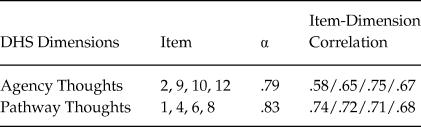
The descriptive analysis of the results had shown that the athletes presented relatively high levels of hope, Agency = 16.98 ± 2.25; Pathways = 17.44 ± 2.6; Global Hope = 34.42 ± 3.98. The general internal consistency index of the DHS was .75. A satisfactory Cronbach’s Alpha was found for both dimensions, as seen in Table 1 (Agency α = .79 and Pathways α = .83).
Internal Consistency of the DHS’ Dimensions and Item-Dimension Correlation

Item-dimension correlations were also found, with r values varying from .58 to .75, which indicates a moderate correlation between dimensions and their respective items.
Exploratory Factor Analysis
The EFA was performed in order to verify if the Brazilian version of the DHS would maintain its structure for the sports setting (Snyder et al., Reference Snyder, Harris, Anderson, Holleran, Irving, Sigmon and Harney1991), and how the scales’ items would behave in their respective dimensions. When analyzing the correlation patterns between items and dimensions, we found consistency within the DHS’ structure, since no correlation higher than .40 has been presented between Pathways and Agency items.
Adequate KMO (.82) and Bartlett (p = .001) values were found through EFA. Kaiser Criteria, as well as the Catell criteria and Parallel Analysis, suggested maintaining the two-factor structure, with an explained variance of 5.14% for the second factor. As the literature indicates that the DHS’ model might behave as both single-factor and two-factors, solutions were tested for both models.
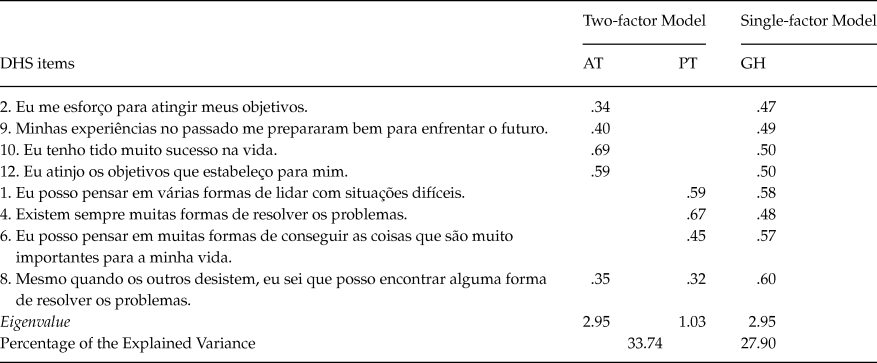
Initially, a model extracting two factors was tested (Table 2). The communalities varied between .22 to .41, with the Item 2 presenting a factor loading bellow the cut point (FL = .34), however, close to the minimum limit adopted by the study. A satisfactory factorial structure was found when analyzing such model, since every item had saturated its respective factors, with the exception of Item 8, which presented cross-loaded factors. Such inconsistency also indicates the importance of testing a single-factor model.
Single and Two-Factor EFA Models of the DHS Brazilian Version for the Sports Context

Note: AT = Agency Thoughts; PT = Pathway Thoughts; GH = Global Hope. Items are shown in Portuguese, as they were translated for the validated version.
The single-factor solution presented communalities ranging from .22 and .36, and factor loads between .47 and .60. Such model (Table 2), named Global Hope, presented an explained variance of 28%, a value considered to be partially acceptable. Therefore, the single-factor, as well as the two-factors models, were acceptable for further testing through CFA.
Confirmatory Factor Analysis
In this step, no outliers were found, allowing to proceed with CFA. No variables presented indicators of normal distribution violation (Skewness and Kurtosis). The model tested through CFA was similar to the instrument’s original version, having two dimensions (M1). However, another two models were also tested: a second order model with two factors (M2) and a single-factor model (M3).
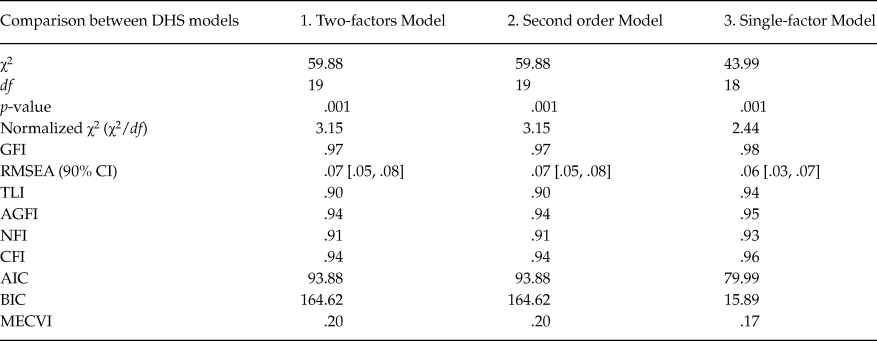
Assessing items’ individual reliability, it was verified that in M1, all the 8 items had saturated their respective factors with magnitude higher than .50 (p < .001), indicating acceptable fit for the model (Table 3). When testing the two-factor model (M2), fit indices were identical to those found for M1 (Table 3), which supports the hierarchical model. All factors’ saturation (λ) presented either moderate or strong values (M1 and M2), ranging between .50 and .62. Bootstrap replications (p < .001) and Confidence Interval (95% CI) also indicated the model stability and factorial estimations.
Fitness Index of the DHS’ Model for the Validation Study Sample

Note: χ2 = Chi-Square; df = degrees of freedom; χ2/df = Normalized chi-square; GFI = Goodness of Fit Index; RMSEA = Root Mean Square Error of Approximation; TLI = Tucker-Lewis Index; NFI = Normalized Fitness Index; AGFI = Adjusted Goodness of Fit Index; CFI = Comparative Fitness Index; AIC = Akaike Information Criteria; BIC = Bayesian Information Criteria; MECVI = Multiple Expected Cross Validation Index.
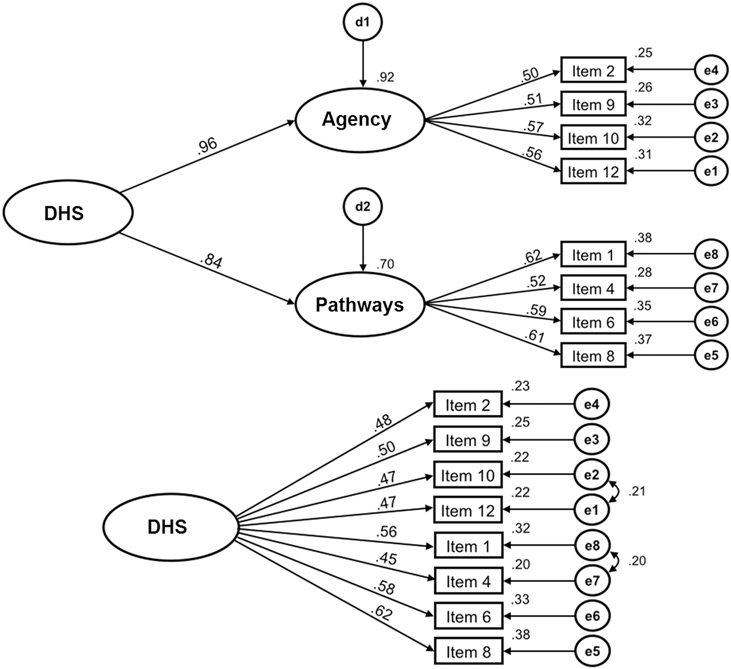
The factor loads of first and second order factors (Dispositional Hope) were also high (Agency = .96; Pathways = .84) and significant (p < .001) (Figure 1). Furthermore, a single-factor model was also tested (M3), as the Brazilian validation study (Pacico et al., Reference Pacico, Bastianello, Zanon and Hutz2013) found relevance to such model. The testing of this model (Figure 1) resulted in acceptable fitness indices, however, with lower factor loads compared to the other two models (M1 and M2).
Bootstrap Replications’ Standard Coefficient and Associated Errors for Each Item in the Second Order, Two-Factor (M2) and Single-Factor (M3) DHS’ Models.
Note: DHS = Dispositional Hope Scale.

The average variances extracted from the first order factors were the following: Agency = .29, Pathways = .35, and DHS = .81. Since both dimensions assess similar constructs, AVE values < 0.50 were already expected, however, the global scale presented a satisfactory value (.81). Assessing Composite Reliability, first order dimensions have not reached the cut point of .70, but presented very close values (Agency = .62, Pathways = .68), while the overall scale had an adequate CR (DHS = .90). Therefore, we chose to accept such structure.
Conclusions
This step presented the internal consistency and construct reliability of the Dispositional Hope Scale in Brazilian sport context. In general, the DHS had satisfactory construct reliability scores, and support for the second-order factor internal consistency. These results indicate that not only the items measure the same construct that they intend to, the scale itself also seems to be measuring what is claimed. Thus, the Brazilian version of the DHS for sports adopted the following distribution: Agency (Items 2, 9, 10, 12); Pathways (Items 1, 4, 6, 8); Distractors (Items 3, 5, 7, 11). The following step will evaluate the scale’s internal reliability with an independent sample.
Step 2 – Internal validity
Method
Participants and data collection
Following the DHS construct validity verification in sports, a new data collection was performed with an independent sample, in order to assess the DHS’ internal validity. For this step, subjects were 101 athletes (22.09 ± 4.37 years old; 48 women and 53 men) from different sports: Futsal (24), handball (19), rugby (17), karate (14), basketball (8), beach volleyball (8), swimming (7), badminton (3), and volleyball (1), who represented the city of Maringá in state and national level competitions. All athletes were required to read and sign an Informed Consent Term.
Instruments and Procedures
The DHS (Pacico et al., Reference Pacico, Bastianello, Zanon and Hutz2013) was used, as described in the Step 1. Initially, the researchers contacted the Maringá City Sports Secretariat, in order to obtain approval to conduct the study. Then, an Informed Consent Term was sent to the athletes from the teams that agreed to participate, and data collection took place at each team’s training facility, during the second semester of 2015.
Data analysis
For internal validity, a new CFA, as described in the Step 1, was replicated in this sample.
Results
Internal Validity
The CFA for the second order model confirmed the construct validity found in Step 1. All items presented factor loads > .50 and the model had adequate global fitness, χ2/df = 1.57; CFI = .94; GFI = .93; TLI = .91; RMSEA = .07 CI [.05, .08].
Conclusion
Results indicated that the scale had a reliable structure and adequate internal validity. Following the acceptable scores presented by the DHS in Steps 1 and 2, the present instrument still needed to be tested for its external validity and temporal stability.
Step 3 – External Validity and Temporal Stability
Method
Participants and data collection
Fort this third step, athletes were selected through non-probabilistic sampling technique, resulting in a sample of 81 athletes (18.50 ± 3.56 years old) from the state of Paraná, who agreed to participate in the study. These athletes represented a variety of different sports: Beach volleyball (18), volleyball (17), track and filed (15), swimming (14), rugby (11) and judo (6). Secondly, 55 (68%) of these athletes answered the DHS as a retest, seven days after the initial assessment (Marôco, Reference Marôco2010). All athletes were required to read and sign the Informed Consent Term in order to participate.
Instruments and procedures
Besides the DHS (described in Step 1), athletes were asked to answer the Rosenberg’s Self-esteem Scale (1965), in its validated version by Hutz & Zanon (Reference Hutz and Zanon2011). Self-esteem was selected for being a construct that shares positive relations with hope (Çelik, Çetin, & Tutkun, Reference Çelik, Çetin and Tutkun2015; Curry et al., Reference Curry, Snyder, Cook, Ruby and Rehm1997; Pacico et al., Reference Pacico, Bastianello, Zanon and Hutz2013). This scale has the goal to assess an individual’s perception of its own self-esteem and is composed by 10 statements (i.e. “ I have a positive attitude toward myself”) answered in a 4-point Likert-type scale (1 = totally disagree to 4 = totally agree). Final result is obtained by the sum of all answers, being able to vary between 10 and 40. The higher the value, higher is the athlete’s self-esteem perception. The instruments were answered at the athletes training facilities, during the second semester of 2015.
Data analysis
The Spearman correlation coefficient was used for the external reliability analysis, verifying the relationship between hope and self-esteem (p < .05). Temporal stability was tested by the intra-class correlation coefficient (ICC), verifying the instrument’s test-retest reliability, with minimum satisfactory values adopted at .70 (Nunnally & Berstein, Reference Nunnally and Berstein1994).
Results
External Validity and Temporal Stability
Hope dimensions were moderate and positively correlated with athletes self-esteem (Global Hope, r = .62; Agency, r = .56; Pathways, r = .51; p < .01), supporting the external validity of the DHS in a sports setting.
The ICC provided evidences to confirm the temporal stability of the scale. Most of the items presented values higher than the recommended (r > .70), with the exception of Items 4 (.65) and 8 (.63), which had scores close to adequate. After grouping all 8 items, an average ICC value of .73 was obtained. The ICC for each dimension was: Agency = .83, Pathways = .83, and Global Hope = .88, therefore, indicating strong test-retest reliability.
Conclusions
Following the results support for external validity and temporal stability of the instrument, it was possible to conclude in favor of the present instrument’s adequacy for its use within the Brazilian sportive settings. After performing all three steps of analysis, the scale seemed to be an appropriate instrument to evaluate the construct of hope within athletes. Highlights and inconsistencies from the analysis, as well as applications and suggestions, are further discussed ahead.
Discussion
This is the first study to analyze the DHS psychometric proprieties for the Brazilian sports context. The scale presented adequate scores for the construct validity and temporal stability analysis, supporting the reliability of the instrument, in its original 8-item structure, with two dimensions (Agency and Pathways) along with the general Global Hope score. However, it is important to highlight that this version had some limitations regarding the values obtained through AVE and the divergences presented by the Item 8.
It is known that, for psychological measurements like Hope, a diversity of methodological approaches must be applied for psychometric propriety analysis (DeVellis, Reference DeVellis2003). Therefore, several samples in three different steps were used, in addition to different methods and approaches. Evidences obtained through EFA and CFA on models structured as the original instrument along with composite reliability and temporal stability analysis, supported the DHS’ validity for the Brazilian sports context.
In general, the Brazilian version of the DHS for sports presented satisfactory indicators of internal consistency and construct validity (exploratory and confirmatory). For that matter, three latent models were assessed in order to reduce past and present studies divergences. Thus, the final version for sport in Brazil remained similar to the original, as adequate fitness values were found for the second order two-factor model (Agency; Pathways; General Hope).
The internal consistency criterion (α) was reached, adopted at values higher than .70. The reliability coefficients found in our study were similar to those found in the original scale’s (Snyder et al., Reference Snyder, Harris, Anderson, Holleran, Irving, Sigmon and Harney1991), as well as in the Brazilian version (Pacico et al., Reference Pacico, Bastianello, Zanon and Hutz2013). The item-dimension correlations, an indicative that the items in fact evaluate what they were intended to, had reached satisfactory values (Nunnally & Berstein, Reference Nunnally and Berstein1994).
The EFA identified small inconsistencies within the DHS for the sports context. A two-factor extraction model was performed to assess the scale’s proprieties, identifying a low explained variance percentage (5.14%) for the second factor of this model. Therefore, a single-factor structure was also tested, since the scale had already been presented with such structure in other studies (Galiana et al., Reference Galiana, Oliver, Sancho and Tomás2015; Pacico et al., Reference Pacico, Bastianello, Zanon and Hutz2013), as well as suggested by the Hope Theory (Snyder, Reference Snyder2002). This model has presented partially satisfactory scores and signs for its further assessment through CFA.
Another inconsistency found through EFA was the Item 8, which in the two-factor structure model presented a cross-loaded factor. This is not a new finding, since other studies had also found similar issues with this specific item (Brouwer et al., Reference Brouwer, Meijer, Weekers and Baneke2008; Ribeiro et al., Reference Ribeiro, Pedro, Marques, Leal, Pais-Ribeiro and Neves2006). In these studies, besides inconsistencies with Item 8, low factor load values for items were also present within the two-factor model, and in both studies the best fit for the instrument was considered to be the single-factor model. This indicates the importance of testing both models, even when presenting partially satisfactory values.
Therefore, three models were tested through CFA (Table 3), identifying a best fit for the second order hierarchical model (M2). Such model presented higher factor loadings than the others, suggesting it to be the most adequate structure for the DHS in the sport context, as it is in the original scale (Snyder et al., Reference Snyder, Harris, Anderson, Holleran, Irving, Sigmon and Harney1991) and different other contexts (Babyak et al., Reference Babyak, Snyder and Yoshinobu1993; Creamer et al., Reference Creamer, O’Donnell, Carboon, Lewis, Densley, McFarlane and Bryant2009; Roesch & Vaughn, Reference Roesch and Vaughn2006). Under the Hope Theory’s perspective, hope can only successfully occur when Agency and Pathways, different although extremely connected to each other, act together in order to reach a goal (Snyder, Reference Snyder2002), therefore, such relationship has remained present in the final structure of the DHS proposed here.
The single-factor model had shown to also be a possibility for practical usage, however, with lower factor loadings when compared to the second order model. Therefore, the second order model is the most adequate to be utilized in the Brazilian sports context, differing from the initial validation study developed in Brazil, which verified a better adjust for the model with only one factor (Pacico et al., Reference Pacico, Bastianello, Zanon and Hutz2013). This finding highlights the mentioned importance of performing a context-specific validation for the scale.
In the CR analysis, values either close or higher than required were found, supporting the internal consistency of the second order factor (Hope). These results indicate that the DHS has enough evidences to support its use as in the second order model (Byrne, Reference Byrne2010; Kline, Reference Kline2012). It was also verified that, although the two first order factors (Agency and Pathways) presented low AVE values (< .50), an adequate score was found for the scale’s global value (> .50), showing its convergent validity. This result might be due to the fact that these two dimensions evaluate a similar construct (Snyder et al., Reference Snyder, Harris, Anderson, Holleran, Irving, Sigmon and Harney1991). However, such findings need to be further tested and analysed in order to proper address this issue.
When the internal validity was tested in a different independent sample, the CFA as performed in the first step of the study had once again was confirmed the consistency of the DHS’ second order structure, agreeing with the Hope Theory model (Snyder, Reference Snyder2000; Reference Snyder2002) and the original instrument (Snyder et al., Reference Snyder, Harris, Anderson, Holleran, Irving, Sigmon and Harney1991). This is an important step to verify the psychometric proprieties of a scale, since it tests how the instrument behaves in different samples within the same context (Hair et al., Reference Hair, Black, Babin, Anderson and Tatham2009).
Assessing the external validity, moderate and positive correlation values (r > .50) of hope dimensions and self-esteem were found. This result is in agreement with past studies (Pacico et al., Reference Pacico, Bastianello, Zanon and Hutz2013; Roesch & Vaughn, Reference Roesch and Vaughn2006; Snyder et al., Reference Snyder, Harris, Anderson, Holleran, Irving, Sigmon and Harney1991), reinforcing adequacy of the scale and how positive of a characteristic hope can be for an athlete’s life. This can also be found in other studies (Gould et al., Reference Gould, Dieffenbach and Moffett2002; Guillén & Laborde, Reference Guillén and Laborde2014; Kavussano, Dewar, & Boardley, Reference Kavussano, Dewar and Boardley2014), that show positive relations between hope and a variety of other positive psychological variables.
All DHS’ dimensions were satisfactorily correlated with their own retest, and no negative correlations were found between items and dimensions (Nunnally & Berstein, Reference Nunnally and Berstein1994). Although two items presented values lower than recommended by the literature, such values were very close to adequate, being assumed to not be low enough to compromise the scale’s temporal stability. However, it is still recommended to further analyze this instrument’s temporal stability in other athletic samples, since present comparisons of these findings are very limited. This can be considered another contribution for the DHS’ psychometric evidences.
Findings hereby presented have limitations that require caution when being interpreted. The first one is referred to the sample’s geographic distribution. Although the athletes were representing a single state, those same athletes are native from different regions of the country. Furthermore, the model confirmed through CFA was retested in an independent athletic sample, which reassured its construct validity. Future studies should address the crossed validation in other athletic samples, since the present study was the first to do so, in the Brazilian sports context. Another limitation is related to the Scale’s Item number 8, for presenting divergences during the EFA. Despite our efforts testing different factorial structures, new studies should take a deeper look in to this item within the scale, since it has already presented such results in past studies. Lastly, the low AVE values had shown a possible weakened relationship that items might have while evaluating their dimensions. However, adequate values were found when looking in to the general scale’s AVE, indicating that such instability should also be taken in consideration for future studies.
Besides all the work and considerations regarding the psychometric proprieties of the scale, it is also here encouraged that future studies develop interventions to promote hope in athletes, with the intention of improving their ability to overcome barriers and achieve goals in sport. Such interventions could be based on the study from Snyder (Reference Snyder2005), which proposes five steps to improve hope. These five steps can be adapted for a sportive setting by the coach: (a) spending time and caring about their athletes; (b) setting realistic goals which are clear and cooperative for the athletes; (c) developing routes for athletes to learn and interact within a group; (d) contributing for athletes be motivated in learning activities/abilities; and (e) promoting a positive environment where athletes are concerned with their welfare as well and their peers’. In the sense of such integrative work between coach and athletes, the present instrument could be used to assess possible improvements in hope following the intervention, which would also provide longitudinal evidences for the scale’s psychometric proprieties.
In conclusion, the present version of the DHS had shown to be a reliable and valid measurement for hope in the Brazilian sports context. These results advance in the literature providing evidences for this instrument’s practical application, which can provide relevant information for the Sport Psychology professionals and coaches. This instrument can be used to evaluate and improve interventions promoting better hope perception in athletes, contributing to their sport performance and self-perception in face of difficulties in their sports and during their lives. The usage of the present instrument may favor the design and development of behaviors and interventions to foster hope in athletes, providing experiences that capacitate the creation of pathways towards goals, as well directing the athletes’ use of such paths in the sports context.