Introduction
Mosquito-borne diseases cause havoc in developing countries, both in urban and rural population; and loss, in terms of human lives, is irreversible (ICMR Bulletin, 2007). The World Health Organization (WHO) has declared the mosquito ‘public enemy number one’ (World Health Organization, 1996). In India, Culex quinquefasciatus is one of the most prevalent mosquitoes and is the primary vector of diseases like encephalitis and elephantiasis. The development of resistance in Cx. quinquefasciatus against various insecticides is posing a serious threat to human beings (World Health Organization, 1992).
The assessment of biological characteristics of populations resistant to insecticides can be very important in the management of resistance (Campanhola et al., Reference Campanhola, McCutchen, Baehrecke and Plapp1991), but very few studies have been undertaken to compare reproductive fitness components between field and resistant strains of Cx. quinquefasciatus. The insecticide resistance has been reported due to the changes in the genetic constitution that, in turn, results in the changes in the biochemical and physiological properties (Hemingway et al., Reference Hemingway, Hawkes, Prapanthadara, Jayawardenal and Ranson1998; Andreev et al., Reference Andreev, Kreitman, Phillips, Beeman and Ffrench-Constant1999). It is generally considered that a trade-off between fitness and insecticide resistance may result from the pleiotropic effects of genes involved in resistance (McKenzie & Batterham, Reference McKenzie and Batterham1994; Arnaud et al., Reference Arnaud, Brostaux, Assie, Gaspar and Haubruge2002). However, in some cases, the strains may differ in fitness for reasons independent of resistance (Roush & McKenzie, Reference Roush and McKenzie1987). It has been observed that resistant and susceptible strains of insects frequently differ in fitness components, including longevity, fecundity and fertility (Arnaud et al., Reference Arnaud, Brostaux, Assie, Gaspar and Haubruge2002). In the absence of insecticide pressure, in general, resistant strains exhibit a reproductive disadvantage (Roush & Plapp, Reference Roush and Plapp1982; Kono, Reference Kono1987; Argentine et al., Reference Argentine, Clarke and Ferro1989; Li et al., Reference Li, Ma, Sun and Zhu2002; Kumar et al., Reference Kumar, Thomas, Samuel, Sahgal, Verma and Pillai2009), reducing the frequency of resistant individuals over time (Roush & McKenzie, Reference Roush and McKenzie1987; Arnaud & Haubruge, Reference Arnaud and Haubruge2002). However, in certain cases, the resistant strains may have a fitness advantage with stable frequency (Arnaud et al., Reference Arnaud, Brostaux, Assie, Gaspar and Haubruge2002), or the resistance may not lead to any loss of fitness (Okoye et al., Reference Okoye, Brooke, Hunt and Coetzee2007).
The efficacy of deltamethrin as one of the most potent insecticides against the life stages of Cx. quinquefasciatus has been well documented (Sahgal & Pillai, Reference Sahgal and Pillai1993; Kumar et al., Reference Kumar, Thomas, Sahgal, Verma, Samuel and Pillai2002). The deltamethrin-resistant population of a Chinese strain of Cx. quinquefasciatus has been reported to exhibit reduced fecundity and fertility as compared to their susceptible counterparts (Li et al., Reference Li, Ma, Sun and Zhu2002). Keeping this in view, preliminary laboratory studies were carried out on the field-collected and insecticide-selected Indian strains of Cx. quinquefasciatus to study the sub-lethal effects of deltamethrin resistance on their reproductive fitness and the possible correlation between them. The investigations included the study of duration of gonotrophic cycles, fecundity and egg hatchability in the field-selected parent and deltamethrin-selected strains of Cx. quinquefasciatus. Knowledge of correlation between reproductive fitness of resistant individuals and deltamethrin resistance levels could facilitate in planning and implementing the vector control programs.
Materials and methods
Mosquito population
The present investigations employ the larvae and adults of Cx. quinquefasciatus originated from field-collected engorged female adults from Delhi. The colony was maintained in an insectary without any insecticide exposure at 28±1°C, 80+5% RH and 14L:10D photoperiod (Kumar et al., Reference Kumar, Thomas, Sahgal, Verma, Samuel and Pillai2002). Adults were supplied with soaked deseeded raisins, while larvae were fed upon a mixture of yeast powder and ground dog biscuits. Periodic blood meals were provided to female mosquitoes by keeping albino rats in the cages.
Chemicals
Technical grade deltamethrin with a purity of 98.8% and piperonyl butoxide (PBO) were obtained from Roussel Uclaf, India. The use and efficacy of PBO as a synergist and its role in the reversion of deltamethrin resistance in mosquitoes is well documented (Kumar et al., Reference Kumar, Thomas, Sahgal, Verma, Samuel and Pillai2002, Reference Kumar, Thomas, Sahgal, Verma, Samuel and Pillai2004). The present investigations involve the use of PBO as a synergist of deltamethrin in the selection studies to reverse the deltamethrin resistance in the resistant strains and then study the correlation between the levels of deltamethrin resistance and the reproductive fitness in these strains.
Insecticide-impregnated papers of deltamethrin (0.025%) were procured from WHO, Geneva. The papers were stored at 4°C and were used for a maximum of three times.
Larval susceptibility and selection studies
The larval bioassay was performed on the early fourth instar larvae in accordance with the WHO method for mosquito larvae (World Health Organization, 1981a). The larvae, in groups of 25, were treated for 24 h with 1 ml ethanolic solution of the insecticide in 249 ml of water taken in glass jars. Controls were exposed to ethanol alone; and control mortality, if any, was corrected using Abbott's formula (Abbott, Reference Abbott1925). The data were subjected to regression analysis, and LC50 and LC90 values were calculated in each bioassay.
Selection studies were carried out by exposing several batches of 400–500 larvae for 24 h in glass jars containing 249 ml of water and 1 ml of the appropriate insecticide solution in ethanol. In each selection, the concentration of insecticide was adjusted to the LC90 level. The surviving larvae were reared to adults. The larvae of the next generation were subjected to the susceptibility tests and selected with the same insecticide at the LC90 level. These selection studies were continued for successive generations, and separate larval studies were performed.
Adult susceptibility and selection studies
The adult susceptibility studies were carried out by the WHO procedure using standard WHO kits (World Health Organization, 1981b). Freshly blood-fed 3-day-old female adults were exposed in batches to 0.025% deltamethrin-impregnated papers and mortalities were recorded. For selection studies, several batches of 20–25 fully blood-fed, mated females were exposed to deltamethrin so as to induce 90% mortality in the adults. The surviving females were used to obtain the next generation, which was further exposed to the deltamethrin selection pressure.
Strains used in present studies
The present study involves the following strains obtained in the laboratory by performing selection studies.
1. SS-Line: SS Strain (parental strain); field-collected strain with LC50 to deltamethrin=0.000121 ppm
2. RR-Line:
(i) RDL strain; deltamethrin larval-selected strain:
a. RDL20 strain: SS strain selected with deltamethrin at larval stage for 20 generations. LC50 to deltamethrin=0.016581 ppm; resistance ratio=137.0
b. RDL40 strain: RDL20 strain selected with deltamethrin till 40 generations at larval stage. LC50 to deltamethrin=0.175350 ppm; resistance ratio=1449.2
(ii) RDP strain; deltamethrin+PBO (1:5) larval-selected strain:
a. RDP20 strain: SS strain selected with synergized deltamethrin at larval stage for 20 generations. LC50 to deltamethrin=0.005124 ppm; resistance ratio=51.2
b. RDP40 strain: RDL24 strain subjected to selection pressure of synergized deltamethrin at larval stage till 40 generations. LC50 to deltamethrin=0.023737 ppm; resistance ratio=196.2
(iii) RDA strain; deltamethrin adult-selected strain:
a. RDA20 strain: SS strain exposed to deltamethrin at adult stage for 20 generations. LT50 to deltamethrin=15.5 min; resistance ratio=2.7
b. RDA40 strain: RDA20 strain subjected to deltamethrin exposure at adult stage for next 20 generations. LT50 to deltamethrin=24.7 min; resistance ratio=4.3
Reproductive potential studies
Batches of freshly emerged 100 mosquitoes, 50 males and 50 females of each strain, were released in the separate cages and fed on soaked deseeded raisins. Female adults were provided with a blood meal three days after emergence, marking the beginning of the first gonotrophic cycle. After the blood meal, unfed females and dead mosquitoes were removed from the cages, and the surviving blood-fed females were counted and allowed to lay eggs in dechlorinated water kept in enamel bowls. After the completion of the first round of oviposition, surviving females were counted and provided with a second blood meal after 24 h of starvation. The period from the beginning of one blood meal to the beginning of the next blood meal was recorded as one gonotrophic cycle (Kumar et al., Reference Kumar, Thomas, Samuel, Sahgal, Verma and Pillai2009). The surviving blood-fed females were recorded again and were allowed to lay eggs. The surviving females were provided with another blood meal after the completion of a second round of oviposition and the observations were repeated. The duration of three consecutive cycles was accounted in all the strains of Cx. quinquefasciatus.
The reproductive potential of the mosquito was estimated by keeping count of the fecundity and hatchability during three consecutive gonotrophic cycles. A fresh ovitrap was kept in the cage each day for egg laying. The eggs laid were collected and counted using a dissecting microscope at a magnification of 40X. The eggs were counted every day after each blood meal, for at least 48 h, until no further eggs were laid. The daily records were documented separately. For each gonotrophic cycle, fecundity rate per female was calculated based on the number of females present in each cycle. The fecundity of the SS strain was compared with the fecundity of the RR strains. The fecundity of each strain during three cycles was also compared. The results obtained were analyzed using Student's t-test with statistical significance considered for P⩽0.05.
The eggs collected during each gonotrophic cycle were submerged in a tray filled with dechlorinated water and were allowed to hatch separately. The hatched larvae were counted carefully, and the percent hatch was calculated in each instance by taking a ratio of the number of hatched larvae to the number of eggs laid. The percent hatch of the SS strain was compared with the percent hatch of the RR strains. The total duration of oviposition in each gonotrophic cycle was also recorded. The results obtained were analyzed using Student's t-test with statistical significance considered for P⩽0.05.
Results
In the RR-line, the RDL40 strain had the highest levels of resistance (1449.2-fold) followed by RDP40 strain (196.2-fold), whereas RDA strains exhibited almost negligible levels of resistance to deltamethrin (2.7- to 4.3-fold).
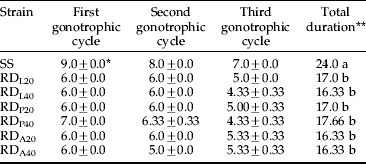
Our investigations on the reproductive potential of Cx. quinquefasciatus revealed that the RR strains exhibited a significant reduction of 68–74% (P<0.05; 0.003–0.007) in the duration of three consecutive gonotrophic cycles as compared to the SS strain (table 1). The RDL40 and RDA strains exhibited the gonotrophic cycles of shortest duration as compared to other resistant strains; though the difference in the duration was not significant (P>0.05). Nevertheless, the duration of each gonotrophic cycle was partly imposed by the blood-feeding regime, as the successive blood meals were only offered after a 24-h starvation period.
Duration (in days) of the three consecutive gonotrophic cycles of parent and insecticide-selected strains of Cx. Quinquefasciatus.

* Mean±SEM of three replicates.
** Figures in the column followed by the same letter are not significantly different at P=0.05 (Student's t-test).
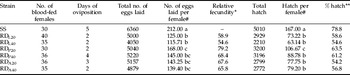
The present studies clearly demonstrated significant reduction in fecundity of RDL strains during first gonotrophic cycle (table 2). The most drastic and significant effect was evident in the RDL40 strain with 45.4% (P=0.001) and RDL20 strain with 41.1% reduced fecundity (P=0.02). This suggests that 7.4-fold increased levels of deltamethrin resistance; from 196-fold to 1449-fold; resulted in 4% decreased fecundity in the RDL strains of Cx. quinquefasciatus. In other insecticide-selected RR strains, the decrease in fecundity ranged from 20.8–34.2% (table 2). These results indicate that deltamethrin resistance may have resulted in reproductive disadvantage in the selected strains.
Effect of deltamethrin and synergized deltamethrin selections on the fecundity and hatchability of Cx. quinquefasciatus in the first gonotrophic cycle.

* Fecundity calculated as percentage of the number of eggs laid per female of the SS strain.
** Calculated by dividing total hatch from the total number of eggs laid.
# Figures in each column followed by the same letter are not significantly different at P=0.05 (Student's t-test).
The studies on the hatchability during the first gonotrophic cycle confirm the fact that the females of all the RR strains were significantly less fertile (63–107 hatched eggs per female) in comparison to the parent strain, with 167 hatched eggs (P<0.05) (table 2). The eggs of the RDL40 and RDA20 strains showed only 54–55% hatching, against 79% hatching in the SS strain (P=0.005 and P=0.006, respectively) exhibiting 24–25% reduced egg hatchability, while other strains showed 15–22% decreased hatchability in contrast to the parent strain.
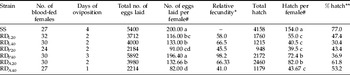
The second gonotrophic cycle displayed further reduced fecundity rates in most of the strains of Cx. quinquefasciatus when compared to these strains in the first cycle, except in the RDP40 and RDL40 strains with 35% and 15% increase in egg production, respectively (table 3). It was further interesting to note that in contrast to the first cycle, the adult-selected RDA40 strain exhibited the maximum and significant reduced fecundity of 41% (P=0.0003), compared to the fecundity of the SS strain, followed by the PBO-selected RDP20 strain with 46% reduction (P=0.0001).
Effect of deltamethrin and synergized deltamethrin selections on the fecundity and hatchability of Cx. quinquefasciatus in the second gonotrophic cycle.

* Fecundity calculated as percentage of the number of eggs laid per female of the SS strain.
** Calculated by dividing total hatch from the total number of eggs laid.
# Figures in each column followed by the same letter are not significantly different at P=0.05 (Student's t-test).
In contrast to fecundity rates, however, the hatchability rates of the second gonotrophic cycle revealed a different pattern. The RDL40 strain appeared to be the least fertile, with only 30.4% larval hatch and 34% reduced hatchability, compared to the SS strain. Other selected strains also showed an appreciable reduction in the percent hatch, displaying 14–28% lower hatchability potential (P<0.05) (table 3). Again, the SS strain had a longer oviposition period than the selected strains, though not significantly different (P>0.05).
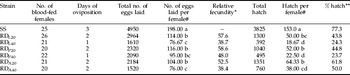
Further reduction in the egg-laying capacity was noticed in the third consecutive gonotrophic cycle in all the strains of Cx. quinquefasciatus, with the exception of the RDP20 strain, which exhibited a drastic increase of 27% eggs laid. The maximum reduced fecundity was observed in the RDP40 and RDL40 strains, which laid 51% and 42% less eggs, respectively, compared to the second cycle (table 4). The deltamethrin-larval selected RDL20 strain once again did not show significant reduction in the fecundity compared to the earlier cycle (P>0.05). Both the RDA40 and RDL40 strains showed 38% reduced fecundity compared to the SS strain (P=0.002).
Effect of deltamethrin and synergized deltamethrin selections on the fecundity and hatchability of Cx. quinquefasciatus in the third gonotrophic cycle.

* Fecundity calculated as percentage of the number of eggs laid per female of the SS strain.
** Calculated by dividing total hatch from the total number of eggs laid.
# Figures in each column followed by the same letter are not significantly different at P=0.05 (Student's t-test).
A similar trend was recorded in the hatchability rates of various strains with the percent hatch decreasing to an appreciable level in RDP40 and RDL40 strains in comparison to that in the earlier cycles. Moreover, these strains proved to be the least fertile (24%) among all the RR strains studied. Other RR strains exhibited reduced larval hatch ranging from 44% to 62% (table 4). Also, No marked difference in the oviposition durations was seen in third cycle (P>0.05).
Discussion
Deltamethrin is known to have very high insecticidal efficacy against various species of mosquitoes (Kumar et al., Reference Kumar, Thomas, Sahgal, Verma, Samuel and Pillai2002, Reference Kumar, Thomas, Sahgal, Verma, Samuel and Pillai2004). The present studies also confirmed the high efficacy of deltamethrin against the field-collected strain of Cx. quinquefasciatus, though the successive selection of a susceptible strain with deltamethrin alone or synergized deltamethrin caused the development of high levels of resistance to deltamethrin. It was further observed that the present selection studies caused changes in the reproductive potential, in general with an appreciable negative impact, of Cx. quinquefasciatus. The studies suggest that high levels of resistance to deltamethrin reduce the reproductive fitness of Cx. quinquefasciatus, resulting in reproductive disadvantage which would probably decrease the resistant individuals in the fields over time.
Our investigations revealed the duration of the successive gonotrophic cycles to be higher in the SS strain compared to the RR strains of Cx. quinquefasciatus. Similar results have been reported by Kumar et al. (Reference Kumar, Thomas, Samuel, Sahgal, Verma and Pillai2009) in an Indian strain of deltamethrin-resistant Ae. aegypti obtained after selection with deltamethrin for forty successive generations. On the contrary, in an Indian strain of An. stephensi, Priyalakshmi et al. (Reference Priyalakshmi, Rajashree, Ghosh and Shetty1999) recorded a longer life cycle in the strains treated with deltamethrin as compared to the control strain.
The studies also proved that deltamethrin-resistant RDL40 (1449-fold resistant), RDP40 (196-fold resistant) and RDA40 (5-fold resistant) strains of Cx. quinquefasciatus possess much lower fecundity as compared to the SS strain. The larval-selected strains with high levels of deltamethrin exhibited significantly greater reproductive disadvantage compared to those with low levels of resistance. These results indicate that there may be a negative correlation between the levels of deltamethrin larval resistance and the reproductive potential of Cx. quinquefasciatus. In a Chinese strain of Cx. pipiens pallens with 617-fold deltamethrin resistance, Li et al. (Reference Li, Ma, Sun and Zhu2002) reported 44.8% reduced fecundity after 12 generations of deltamethrin selection. Mohapatra et al. (Reference Mohapatra, Ranjit and Dash1999) had reported significant decrease in the fecundity rates of Cx. quinquefasciatus, Ae. aegypti and An. stephensi after treatments with cyfluthrin and fenfluthrin. Earlier, Verma (Reference Verma1986) also recorded reduced fecundity of 67.2%, 43.3% and 40.6% after selection pressures of pyrethroids in Cx. quinquefasciatus, Ae. aegypti and An. stephensi, respectively. Our results are comparable with those reported in an Indian strain of Ae. aegypti, which exhibited 36.7% reduced fecundity when selected with deltamethrin for 40 generations at larval stage and 23.5% reduced egg production, when selected at adult stage (Kumar et al., Reference Kumar, Thomas, Samuel, Sahgal, Verma and Pillai2009). In an Indian strain of An. stephensi, Priyalakshmi et al. (Reference Priyalakshmi, Rajashree, Ghosh and Shetty1999) also reported a 32–40% decrease in fecundity rates when treated with sublethal doses of deltamethrin at the larval stage.
The interesting observation in our investigations was the decrease in the fecundity of RDL20 and RDP20 strains in the first gonotrophic cycle, which was regained in the later cycles, though the RDL20 strain exhibited reduced fecundity again in the third cycle. The RDA20 strain with almost negligible levels of deltamethrin resistance did not show any remarkable change in the fecundity, which again proved that there may be a correlation between the reproductive fitness and the levels of deltamethrin resistance. One probable reason for the reduced fecundity, in the selected strains as compared to the parent strains, may be the penetration of insecticides into the ova, imparting toxic effects on the egg follicle growth, which possibly caused the inhibition of synthesis and transport of egg yolk proteins. The decrease and, then, regain of the reduced fecundity in successive gonotrophic cycles remained unclear and needs further explorations.
Our studies also reveal that in the successive gonotrophic cycles, the parental population exhibited maximum hatch in contrast to the insecticide-selected strains, further reducing gradually in later cycles. The RDL40 strain proved to be the least fertile, exhibiting the lowest percent hatch. In an Indian strain of Ae. aegypti, Kumar et al. (Reference Kumar, Thomas, Samuel, Sahgal, Verma and Pillai2009) reported the least fertility in the F40 deltamethrin-larval-selected strain for the first two gonotrophic cycles; whereas, in third cycle, the least fertile strain reported was the F40-synergized deltamethrin larval-selected strain. Priyalakshmi et al. (Reference Priyalakshmi, Rajashree, Ghosh and Shetty1999) found a 24% decrease in the fertility rates of an Indian strain of An. stephensi when treated with sub-lethal doses of deltamethrin at the larval stage. Significant reduction in the fertility rates of Indian strains of Cx. quinquefasciatus, Ae. aegypti and An. stephensi were recorded after exposure to cyfluthrin and fenfluthrin (Mohapatra et al., Reference Mohapatra, Ranjit and Dash1999). On the contrary, in an African strain of An. funestus, Okoye et al. (Reference Okoye, Brooke, Hunt and Coetzee2007) reported 81.5% larval hatch from the eggs laid by the females of the pyrethroid-resistant strain, as compared to 66.9% hatch recorded in the susceptible strain.
The lowest fertility in the RDL40 strain with the highest level of larval deltamethrin resistance (1449-fold) again indicates a negative correlation between the level of insecticide resistance and hatchability rate of Cx. quinquefasciatus. The possible cause may be the selection pressure of insecticides at higher dosage compared to the dosage subjected to the less-resistant strains, as deltamethrin has been reported to have delayed ovicidal effects in Cx. quinquefasciatus (Sahgal & Pillai, Reference Sahgal and Pillai1993), leading to the penetration of insecticides in the ova and reduced egg hatchability.
Our studies show that the RDA40 strain of Cx. quinquefasciatus does not develop resistance to deltamethrin even after forty generations of deltamethrin selection at the adult stage, but showed reduced fecundity and fertility, though not as much as in the case of the RDL40 strain. It proves that, although the development of deltamethrin resistance in Cx. quinquefasciatus is stage-specific, the reduction in reproductive fitness is irrespective of its stage. This is an important and valuable observation as the efficacy of deltamethrin as an adulticide, the failure of adult selections to induce the development of deltamethrin resistance in the adults yet to cause reproductive disadvantage in the surviving adults suggest the long-term and efficient use of deltamethrin against filarial vector.
The larval selection of Cx. quinquefasciatus with synergized deltamethrin in the present studies confirmed the low reproductive fitness in RDP strains. It suggests that the selections with synergized deltamethrin not only retard or reverse the deltamethrin resistance, but it also provides reproductive disadvantage to the strain and reduces its reproductive fitness. This may help in reducing the frequency of resistant individuals with time. These observations could be useful in planning and implementing strategies for mosquito control.
Our investigations emphasize the fact that deltamethrin is an effective insecticide against the control of filarial mosquito. Despite causing the development of significant levels of larval resistance to deltamethrin after continuous subjection of selection pressure in Cx. quinquefasciatus, deltamethrin holds great promise as a control agent because of the negative correlation of deltamethrin resistance levels with reproductive fitness. Further, its efficacy as an adulticide and ability to reduce reproductive potential of adult mosquito to almost half suggest that use of deltamethrin as an adulticide rather than as a larvicide is a more effective strategy from a resistance-management perspective against Cx. quinquefasciatus. The results clearly suggest that the reduced reproductive fitness of resistant genotypes in the population can eliminate heterozygotes and resistant homozygotes by implementing different resistance-management strategies against Cx. quinquefasciatus.
Acknowledgements
The authors are highly grateful to the Roussel Uclaf for providing deltamethrin and PBO for the undertaken studies.