INTRODUCTION
As is widely acknowledged by scientific and professional organizations such as the American Speech-Language-Hearing Association, the accurate assessment of the language skills of children from different cultural backgrounds, and those who speak non-mainstream dialects, is problematic (see ASHA, 1983; also see Oetting, Reference Oetting and Ball2005). Child language assessment instruments are almost exclusively designed for and standardized on speakers of mainstream dialects, and are generally administered by adult speakers of such dialects. The result is that for many language groups, especially minority groups, there are very few standardized assessment instruments available, and those that are available often lack cross-cultural validity (Craig & Washington, Reference Craig and Washington2000: 366). This dearth of appropriate assessment instruments and the lack of child language specialists who are both from a non-mainstream cultural group and speak a non-mainstream dialect often lead to inaccurate assessment of the language skills of children who are from such cultural groups and/or speak non-mainstream dialects. In the South African context, problems with accurate and fair child language assessment (to be discussed below) are exacerbated by the number of languages and the number of non-mainstream dialects of these languages, as well as by the cultural and socioeconomic diversity of the population.
Three language assessment instruments have been developed for use with Afrikaans-speaking South African children, and all three are appropriate for use with young as well as older children: the Toets vir Mondelinge Taalproduksie (‘Test for Oral Language Production’; Vorster, Reference Vorster1980) can be administered to children from 4 ; 6 to 10 ; 5; the Afrikaanse Semantiese Taalevalueringsmedium (‘Afrikaans Semantic Language Evaluation Medium’; Pretorius, Reference Pretorius1989) from 3 ; 0 to 11 ; 11; and the Afrikaanse Reseptiewe Woordeskattoets (‘Afrikaans Receptive Vocabulary Test’; Buitendag, Reference Buitendag1994) from 2 ; 0 to 12 ; 11. Because of poor test–retest reliability, lack of theoretical underpinning, lengthy administration time, and obtained results which do not inform the required remediation programme, these three instruments are not routinely administered by speech-language therapists, not with younger and also not with older children. Rather, it is common practice among South African speech-language therapists to administer (mostly non-standardized) Afrikaans translations of American or British English-medium tests to Afrikaans-speaking children. This is especially, but not exclusively, the case when morphological and syntactic abilities are evaluated, as none of the three available Afrikaans-medium tests evaluates these abilities (apart from one subtest of the Afrikaanse Semantiese Taalevalueringsmedium which focuses on passive relations). The norms obtained for the English-speaking population for which these tests were originally developed are then used to determine the language skills of Afrikaans-speaking children, which is a highly questionable practice. In brief, as for all other South African languages, there is a need for culturally fair and linguistically appropriate Afrikaans-medium assessment instruments, as those currently in use do not necessarily differentiate reliably between typical mainstream language development, different but typical language development, language delay, and language disorder.
In the South African context, underdiagnosis and overdiagnosis of children due to inter alia inappropriate assessment instruments often has more than merely clinical or educational implications. Such misdiagnosis has ethnopolitical implications as well, as different dialects are often associated with specific ethnic groups. To incorrectly diagnose the language of child speakers of a particular ethnic group as deviant is patently discriminatory. Here, Kaaps is a case in point. The latter is a non-standard dialect of Afrikaans (cf. McCormick, Reference McCormick2002) predominantly spoken by the Coloured working and lower middle classes. (In South Africa, the term ‘Coloured’ is widely used to refer to persons of ‘mixed race’. The term is contentious when used as an identifying epithet. Although not a preferred term, no suitable alternative has thus far been proposed; therefore the term is used here, with due caution.) Neither the language tests developed for Afrikaans-speaking children nor the American and British language tests have been developed for use with speakers of Kaaps and none has been standardized on such speakers. This could result in typically developing Coloured children from the lower socioeconomic group often being incorrectly diagnosed as language disordered by these tests.
The Diagnostic Evaluation of Language Variation
A test which has the proven capability to distinguish between language difference and language disorder in the domain of American dialects of English is the Diagnostic Evaluation of Language Variation (DELV), developed by Seymour et al. (Reference Seymour, Roeper, de Villiers and Villiers2005a). This instrument was designed to “assess aspects of language that are common to all varieties of [American – FS] English and critical to the development of language competence … regardless of the variety of English the child speaks” (Seymour, Roeper & de Villiers, Reference Seymour, Roeper and de Villiers2005b: 1). The DELV targets fundamental structures that follow principles of Universal Grammar and which therefore occur in all dialects of English, in order to avoid different outcomes of language assessment when testing children who speak non-mainstream dialects of English, such as African American English or Latino English. The DELV is based on the contrastive/non-contrastive model of Seymour and Seymour (Reference Seymour and Seymour1977), which identifies language structures shared by dialects (i.e. non-contrastive structures) as potential markers of language disorder, and language structures not shared by dialects (i.e. contrastive structures) as potential markers of language difference. Because so-called ‘deep knowledge’ (i.e. knowledge which is non-contrastive across dialects) is assessed, this test should, theoretically, also be able to differentiate between language delay, language disorder, and mere language difference in child speakers of other varieties of English, such as South African English. By the same token, a translation of the DELV should be able to form the basis of a language assessment instrument for child speakers of Afrikaans (which, like English, is a West Germanic language), as the DELV avoids ‘surface’ characteristics of a language and focuses on deeper, underlying aspects of linguistic knowledge.
Language competence and proficiency are central to educational success (Snow, Burns & Griffin, Reference Snow, Burns and Griffin1998; Vernon-Feagans, Reference Vernon-Feagans1996; Vernon-Feagans, Scheffner Hammer, Miccio & Manlove, Reference Vernon-Feagans, Scheffner Hammer, Miccio, Manlove, Neuman and Dickinson2002), and these involve more than the ability to communicate in everyday conversational contexts; language competence and proficiency also pertain to language for academic purposes (Van Rooyen & Jordaan, Reference Van Rooyen and Jordaan2009: 271). In this regard, Westby (Reference Westby, Haynes and Shulman1994: 341) states: “In the pre-school years, children learn to talk but as they move into school they talk to learn.” One of the reasons why the DELV is an appropriate instrument for use with older children is that it focuses on those language skills necessary for educational success, such as distinguishing between definite and indefinite articles, fast-mapping new words, comprehending double wh-questions, and producing wh-questions to obtain required information (as discussed below). As regards the latter two, Heath (Reference Heath and Spindler1982: 236) demonstrated that for children from families with low socioeconomic status there is often little positive transfer from what has been learned in the home environment to what is required in the classroom. For instance, upon entering school, children from some communities would not have learned that certain utterances that have an interrogative form are actually directives; how to respond to teachers' questions which require them to give information known to the teachers; and how to answer questions which expect a display of skills acquired primarily from “a familiarity with books and ways of talking about them” (Romaine, Reference Romaine1984: 174–75).
Recall that there is a challenge for South African clinicians to develop culturally appropriate language tests which will distinguish those children in need of intervention from others. However, considering South Africa's current socioeconomic climate, many regard the translation of existing tests as a more viable option than the development of new tests for the linguistically and culturally diverse population. For this reason, and because the DELV is claimed to test universal linguistic knowledge, the research team at Stellenbosch University, South Africa decided to translate the DELV into Afrikaans rather than to devise a new Afrikaans-medium language test (see Southwood & Van Dulm, Reference Southwood and Van Dulm2009; Van Dulm & Southwood, Reference Van Dulm and Southwood2008). This also entailed adaptation of the original test items, in order to ensure that the Afrikaans-medium DELV (Afr-DELV) still assesses what the original DELV intended to assess. Adaptations were furthermore made to the test book, to render all picture material appropriate for use in the South African context (see Southwood & Van Dulm, Reference Southwood and Van Dulm2009; Van Dulm & Southwood, Reference Van Dulm and Southwood2008).
After translating and adapting the American version of the DELV, the Afrikaans version was then initially administered to typically developing child speakers of so-called Standard Afrikaans. Hereafter, problem items were replaced by more appropriate ones, and speech-language therapists who are mother tongue speakers of Kaaps were consulted to ensure that the items in the Afr-DELV are indeed appropriate for use with child speakers of this non-standard dialect that frequently occurs in the Western Cape Province of South Africa. The Afr-DELV was then administered to White and Coloured speakers of Afrikaans – both middle and lower class. From mere visual inspection of the obtained data, it appears that speakers of Kaaps are still faring poorly on the adapted versions of the Afr-DELV, as are child speakers of Standard Afrikaans who are from socioeconomically deprived backgrounds. As will be discussed next, this is a commonly observed pattern for children of other languages as well.
The language skills of children from low socioeconomic backgrounds
Research persistently shows a link between language skills and socioeconomic status. There has been a long-standing interest in this link; see, e.g., the overview in Dale (Reference Dale1976: 316–21) of empirical studies conducted in the 1950s and 1960s. The general findings of older studies appear to be that vocabulary development is less advanced in children from families with low socioeconomic status, but not necessarily syntactic development. It is, however, difficult to draw general conclusions on syntactic development from these studies, as the structures which they investigated were generally not complex, i.e. later developing, ones. It could thus be that children's comprehension and production of simple syntax is unaffected by their socioeconomic status but that school-aged poverty-situated children have more difficulty than middle-class peers in understanding those complex syntactic structures necessary for success in the classroom.
More recent studies have also shown children with low socioeconomic backgrounds to have restricted vocabularies when compared to those of their middle-class peers (Raizada, Richards Meltzoff & Kuhl, Reference Raizada, Richards, Meltzoff and Kuhl2008), with one study (Hart & Risley, Reference Hart and Risley1995) finding that kindergarten children from middle-class homes have listening vocabularies that are almost seven times larger than those of their peers from low-income homes. This limited vocabulary size is seen to be directly related to the environments in which poverty-situated children are raised. These children: (i) generally do not experience a “rich and rewarding culture of talk” (Sinatra, Reference Sinatra2008: 173), with parents often not conversing about everyday matters and during routine tasks (Wright, Diener & Kay, Reference Wright, Diener and Kay2000); (ii) have limited access to books (Neuman & Celano, Reference Neuman and Celano2001) and are not often read to (Adams, Reference Adams1990: 85); and (iii) thus have limited opportunities to learn vocabulary items (Manzo, Manzo & Thomas, Reference Manzo, Manzo and Thomas2006).
Furthermore, poor children appear to develop general language skills more slowly than do middle-class children (Hart & Risley, Reference Hart and Risley1995). Such children are also highly likely to be exposed to disorganization in their environments (caused by a high density of people in their places of living, with accompanying high noise levels and other distractions) and have been shown to be at risk for developing a poor understanding and representation of temporal order (Flores, Reference Flores2004). This results in these children's understanding of the temporal order of events being altered. Indeed, Flores (Reference Flores2004) has shown that poor children produced fewer temporal references (which pertain to sequence, location and frequency terms) than did their middle-class peers when asked to relay seemingly common events such as dinner time, going to a restaurant or attending a birthday party.
Various measures have thus shown poverty-situated children to demonstrate less developed language skills than their middle-class peers. Like children with language learning problems, children from families with low socioeconomic status often fall behind as they progress through school grades, with the gap between poor and middle-class children ever widening (Cunningham & Stanovich, Reference Cunningham and Stanovich1997).
Parental level of education and presence of a father figure as indicators of socioeconomic status
When assessing the possible impact of socioeconomic status on children's language skills, parental level of education is often preferred as an indicator of socioeconomic status over total family income. Several studies (e.g. Black, Dubowitz & Starr, Reference Black, Dubowitz and Starr1999; Tomblin, Hardy & Hein, Reference Tomblin, Hardy and Hein1991) have shown parental level of education to be correlated with children's language skills. As stated by Raizada et al. (Reference Raizada, Richards, Meltzoff and Kuhl2008: 1398), language development is strongly affected by the richness of the linguistic environment in which a child is raised: a higher level of parental education is a predictor of richer parental vocabulary and syntax (see Hoff, Reference Hoff2003), of more books and general printed matter in the home, and of more parental assistance with reading (Noble, McCandliss & Farah, Reference Noble, McCandliss and Farah2007; Walker, Greenwood, Hart & Carta, Reference Walker, Greenwood, Hart and Carta1994). Parental involvement in general correlates with greater achievement by children in both language and mathematics as well as with academic persistence (Christenson, Rounds & Gorney, Reference Christenson, Rounds and Gorney1992; Fantuzzo, Davis & Ginsburg, Reference Fantuzzo, Davis and Ginsburg1995; Reynolds, Reference Reynolds1992).
Other studies have shown the presence of specifically a father (or father figure) to affect language development and/or school performance in a positive manner. Black et al. (Reference Black, Dubowitz and Starr1999), for instance, report that children whose fathers are involved in their upbringing (i.e. who contribute financially and are nurturing during play activities) have better receptive language skills than children with absent fathers. In a 1978 survey of twenty-eight studies, Shinn (Reference Shinn1978) found that sixteen reported detrimental effects of father absence on cognitive development (which in some studies included measurements of verbal abilities), whereas only nine reported no significant effects and three reported positive or mixed positive and negative effects.
Aims of the present study
The present study aimed to ascertain whether the impression that children from poor families fare worse on the Afr-DELV, which is putatively dialect neutral and culturally fair, than did children from middle-class families is indeed correct. As it is known that socioeconomic status can correlate with language development and performance on language tests, the American DELV does make provision for the adaptation of test results according to parental education level (which is taken to be an indication of socioeconomic status; see Seymour et al., Reference Seymour, Roeper and de Villiers2005b: 49). The Examiner's Manual of the American DELV states that parental education level can be broken down into four bands, namely PEL 1 (11 or less years of schooling completed), PEL 2 (12 years completed), PEL 3 (13–15 years completed), and PEL 4 (16 or more years completed). In South Africa, however, 71 percent of adults of twenty years or older have not completed all twelve years of schooling (Statistics South Africa, 2003). In fact, many exit school before or upon completion of their primary education (at the end of grade 7, thus after seven years of formal schooling), or at the end of grades 8 or 10, or any time in between. Furthermore, few South Africans would be classified as PEL 3 or 4, seeing that comparatively few (8·4%; Statistics South Africa, Reference Seymour, Roeper and de Villiers2003) have postschool education.
The main concern regarding the Afr-DELV is that, despite culturally fair and dialect-neutral test items, misdiagnosis might still occur due to the manner in which obtained test scores are currently adapted for socioeconomic status: the lowest band of parental education level (PEL 1) perhaps differentiates insufficiently in the South African context, because children of parents who have had, say, seven years of formal education are being grouped together with children of parents who have completed almost all twelve years of primary and secondary school. The question arises as to whether this is fair or whether, when the test is standardized in the future, the recommendation should be made that the adjusted score be based on a greater differentiation between various parental levels of education. This latter system of differentiation may be necessary in order to ensure greater fairness in the interpretation of test results for children from the lower band of the group with low socioeconomic status. This question as to finer distinctions based on levels of education, in order to ensure fairness in test result interpretation, is one which this study investigated, together with the effect of absent father figures on language test performance of their children.
The following hypotheses were formulated based on the above:
Hypothesis 1: There is a significant positive correlation between maternal level of education and performance on the Afr-DELV.
Hypothesis 2: The absence of a father figure has a significant negative impact on a child's performance on the Afr-DELV.
Hypothesis 3: The current lowest band of parental education level specified by the DELV (i.e. the 11 years or less band) is too undifferentiated for the South African context: a finer classification of parental education and/or employment within that band is correlated with child performance.
METHODOLOGY
General procedures
Permission to administer the Afr-DELV to children in a number of schools in the Western Cape Province of South Africa was obtained from the Western Cape Education Department, and from the respective head teachers. In addition to children in these schools, further participants were accessed via private daycare centres and via neighbourhood networks. Information and consent letters were sent to parents of all four- to nine-year-olds in these institutions. The consenting parents of potential participants were requested to complete a case history questionnaire about their child's development and family structure. These questionnaires were screened to ensure that the children met the selection criteria (see below). Those who met the criteria then underwent hearing screening, according to the guidelines of the American Speech-Language-Hearing Association (ASHA, 2007–2010), and all of those who passed this screening acted as participants.
The raw scores which the participants received on the Afr-DELV were converted into scaled scores (unadjusted for parental level of education) and percentile ranks, for the test as a whole (composite score) and also for the syntax, pragmatics and semantics domains separately. These percentiles were then correlated with (i) the reported highest level of education of the primary female caregiver, and (ii) the presence or absence of a father figure, both for the test as a whole and for each of the above-mentioned domains separately.
Participant identity was protected throughout, and all results were treated as confidential. Throughout the study, the guidelines for ethical research conduct of the Alexander von Humboldt Foundation and the National Research Foundation of South Africa were adhered to.
Participants
Children had to be older than 3 ; 11 but younger than 10 ; 0, mother-tongue speakers of Afrikaans and from Afrikaans-speaking homes in order to qualify for participation. They further had to have normal physical and language development according to their parents; no history of speech, language or hearing problems, and no referral to a speech-language therapist; and no visible signs of neurological impairment such as cerebral palsy, brain injury or Attention Deficit Disorder. This selection process ensured participants who were typically developing in all respects according to their parents and thus according to the norms of their respective communities. Potential participants also had to exhibit hearing sensitivity and immittance audiology results which were within normal limits bilaterally.
In total, 231 children (44% of them females) between the ages of 4 ; 0 and 9 ; 11 participated (mean age 7 ; 7, median 8 ; 7). There was representation from three daycare centres or neighbourhood groupings (predominantly for the four-year-olds) and nineteen schools. These included three urban, two periurban and seventeen rural institutions. One of the schools was a private school; the remaining eighteen covered the full range of National Quintiles, which is the South African Department of Education measure of the socioeconomic status of the community in which the school is situated. This poverty measure determines the amount of government funding given to schools (the funding formula being pro-poor) and which schools may charge school fees; seven of the schools were classified as fee-free. The participants were from eight different towns in the Western and Eastern Cape Provinces. Towns differed in size (two had approximately 10,000 inhabitants, two 65,000, one 120,000 and two 200,000, and one was a small suburb of a metropole with 2·9 million inhabitants) and in distance from the provinces' main metropole. No town was uniform in terms of socioeconomic status, there being representation of the whole socioeconomic spectrum in each town. For instance, in one town of approximately 65,000 inhabitants, two participating schools had a National Quintile of 1 (schools in the poorest surroundings), three had a National Quintile of 4 and one was the private school mentioned above. Towns and the educational institutions or neighbourhood groups in each town were those with which the author and her research assistants had a prior working relationship. In each school, children were from a range of classrooms in an attempt to avoid any bias from possible performance grouping within the school.
The Afr-DELV
After passing a hearing screening test, the Afr-DELV was administered to each participant individually. The DELV is a comprehensive test which has eleven subtests organized into four domains: syntax, pragmatics, semantics and phonology. The items of the original, American English DELV are based on extensive research on those language skills that differentiate between typically developing and language impaired children, without differentiating between typically developing child speakers of different dialects of English. The DELV provides a rich assessment of the strengths and weaknesses of a child's language skills, without bias towards speakers of a non-standard dialect. The following discussion of the DELV draws from Van Dulm and Southwood (Reference Van Dulm and Southwood2008) .
The syntax domain of the DELV focuses on fundamental grammar features that are used for building a complete understanding of language (Seymour, Roeper & de Villiers, Reference de Villiers2004). This domain includes comprehension of wh-questions, comprehension of passives, and production of definite and indefinite articles. As the author's agreement with the publishers of the DELV prohibits the reprinting of items, example items similar to the relevant DELV items, but no actual DELV items, will be presented here. A typical item for testing the comprehension of wh-questions would be the following: the child is told a short story while shown accompanying pictures, e.g. “This grandma knitted a special jersey for her grandson. The grandson saw her sewing the parts together and asked, ‘Gran, what did you make?’ Because she wanted to keep it a surprise, she said, ‘Just some socks for your sister’.” The child is asked, “What did the grandma say she knitted?” Comprehension of passives is assessed via picture selection: the child is shown three pictures (one being a foil) and asked to point to the one matching the stimulus, e.g. “The chicken got eaten”. Production of articles is tested by asking the child a question which requires a determiner phrase as answer, for example, “What do you take off an orange before you eat it?” (the peel) or “I reckon there is something growing in your garden at home. What is it?” (a flower/tree/shrub).
The pragmatic assessment in the DELV focuses on aspects which are dialect- and culture-neutral, namely communicative role-taking, asking the correct question, identifying the correct referent, linking events together in a narrative and understanding the mental state of each of the characters in a narrative (Seymour et al., Reference Seymour, Roeper and de Villiers2005b: 98). Across languages and dialects in story telling, there is a common developmental sequence towards coherence (logical order and consistency) and cohesion (unity of links between words in spoken discourse). There is also strong developmental growth in performance on question asking tasks and no significant difference in the results of different dialect speakers (De Villiers, Reference de Villiers2004: 61). For these reasons, the DELV makes use of narratives (told with the aid of pictures) and question asking when assessing pragmatic skills. Also included is a subtest on communicative role-taking. The latter is assessed by asking the child what a character would say or ask in a certain situation. For instance, the child is shown a picture of a boy spotting a burst water pipe. In the next picture, the boy is depicted talking to his father while pointing in the direction of the pipe. The child is then asked, “What is the boy telling his father?” The ability to ask the correct question is tested by showing the child a picture with a blank part and then requesting the child to ask the right question to see the blank filled in. For instance, the child is shown a picture of a cow with parts of its front legs blotted out and told, “This cow eats grass in some or other way. Ask me the right question and I'll show you the answer.” If the child asks, “How does the cow eat grass?”, the child is shown the same picture, with the cow now being depicted holding a knife and fork.
In the semantics domain of the DELV, the focus is on basic processing and organization of information, rather than on specific semantic fields or on the size of the child's vocabulary (Seymour et al., Reference Seymour, Roeper and de Villiers2004: 113). Specifically, this domain assesses fast mapping of real and new (i.e. nonsense) words, verb contrasts, preposition contrasts, and knowledge of quantifiers. When assessing fast mapping, the child is shown three pictures depicting a single event (such as a boy using a stick and a piece of elastic to pass an orange to a woman who stands next to a tree. In the right-hand margin, there will be four small pictures: one each of a girl, a woman, an orange, and a tree, the last being a foil. The child is then told, “The boy is zeffing the orange to the woman. Now show me here (pointing to the four small pictures in succession) which one was the zeffer/which one zeffed/which one was zeffed/etc.” Verb and preposition contrasts are assessed by means of a sentence completion task accompanied by a picture. For instance, the child is shown a picture of a baby girl walking into a shop and told, “The baby is not crawling; she's …” and “She's not coming out of the shop; she's …”. For the assessment of quantifiers, the child either has to answer a question based on a picture, for example, “Is every dog chasing his tail?” or has to select the correct picture out of a set of two highly similar ones: “The boy sees every horse. He is drinking water” (where the boy is drinking water in the one picture and the horses are in the other).
When assessing phonology, the original DELV avoids those aspects which differ amongst the dialects of American English (Seymour et al., Reference Seymour, Roeper and de Villiers2005b). Only consonants are tested, as the pronunciation of vowels varies greatly among dialects. Also, only consonant clusters are assessed, and these occur only in the initial and medial position in test items, not in the final position, as reduction of word-final consonant clusters occurs under certain conditions in African American English. A similar approach was taken when deciding on items for the phonology domain of the Afr-DELV: only clusters were tested, and word-final clusters as well as word-internal [r] clusters were avoided, as both of these are often reduced by speakers of Kaaps.
In summary, then, the Afr-DELV, like the original version of this test, assesses syntax (comprehension of wh-questions and passive constructions, and correct use of articles), pragmatics (communicative role-taking, linking events together in a narrative and understanding the mental state of characters in a narrative, and asking appropriate questions), semantics (fast mapping of real and new words, producing verb contrasts and preposition contrasts, and knowledge of quantifiers), and phonology (production of consonant clusters in word-initial and word-medial positions). All participants had to perform all tasks for each domain. There were no baseline or ceiling scores; the whole test was administered to each child, regardless of the child's age or gender.
For the purposes of this study, a decision was made to disregard the scores for the phonology domain, because only 18 of the 231 participants obtained a score lower than 23 out of a possible 25 for this domain. For each of the other domains, the raw scores were converted into scaled scores and then into percentile ranks. The sum of the scaled scores were then converted into composite scaled scores and their concomitant percentile ranks, following the instructions in the Examiner's Manual of the DELV (Seymour et al., Reference Seymour, Roeper and de Villiers2005b) throughout. All scores were left unadjusted for parental level of education.
The case-history questionnaire
The case-history questionnaire served three main purposes. The first and second were to obtain background information on the children in order to determine whether they met the selection criteria and information on the children's families, specifically on the parental levels of education and the presence or absence of caregivers. As such, the questionnaire contained items on: (i) the child (details on siblings, languages spoken, medical and general developmental history, as well as on language development and hearing status; and questions on access to books and story-tellings); (ii) the child's household (number of children and adults in the home and the age, gender and mother-tongue of each household member; and languages spoken by child and adult members of the household to and amongst each other); and (iii) the child's main caregivers, male and female separately (the relation to the child, e.g. mother, grandfather, guardian, foster father; whether the person lives in the same house as the child; marital status; highest school grade and postschool qualification successfully completed; occupation; and whether the person was employed at the time of completion of the questionnaire). The third purpose was to obtain contact details of the person completing the questionnaire so that a report on the findings could be sent to the parents or guardians.
Analyses
Because of the non-normality of the distributions, the non-parametric Spearman correlation coefficient was employed to analyze the correlation between the highest level of education of the primary female caregiver and the child's percentile ranks for the Afr-DELV, for the test as a whole as well as for the three domains separately. This was done in order to test Hypothesis 1, namely that there is a significant positive correlation between maternal level of education and performance on the Afr-DELV.
To test Hypothesis 2, analysis of variance (ANOVA) as well as the Mann–Whitney U test were performed in order to ascertain whether there is a significant difference between the percentile ranks of the participants with and those without a primary male caregiver. The latter test is again non-parametric, which makes it suitable for use with a non-homogenic population such as the one in this study.
Hypothesis 3, namely that the lowest band of parental education level specified by the DELV is inappropriately undifferentiated for the South African context, was evaluated by classification and regression trees (CART) analysis (see Lewis, Reference Lewis2000). This statistical procedure is a non-parametric technique similar in purpose to discriminant analysis, in that it looks for predictable differences within a group. The CART analysis, a non-parametric technique, draws decision trees by deriving rules from values of certain variables in the so-called modelling set. In this case, rules were selected on how well they could split participants into groups, based on their language test results, which differentiate between number of years of education of primary caregivers. On the CART analysis, once a rule is selected and used to split the data set in two, the subsets are recursively split based on further rules as derived from the data. The splitting only stops once CART detects that further splitting will not render any further gain. It is a technique that is exploratory in nature and, as such, does not formally test any specific hypotheses. Exploratory results were then verified on a hold test set.
RESULTS AND DISCUSSION
Parental level of education
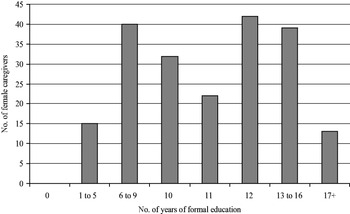
For 220 participants, the presence of a primary female caregiver was indicated as such on the case-history questionnaire. Information on educational level was provided for 193 of these caregivers. Approximately half (94/193) of the primary female caregivers had completed all twelve years of school. Of these, fifty (i.e. 26% of the 193 for which education data were available) had postschool training, including two who held doctorates. The number of years of education completed by the 193 primary female caregivers is indicated in Figure 1. Of the 196 mothers who did answer the question as to whether or not they were employed at the time of completing the questionnaire, 126 (64%) indicated that they were.
Number of years of formal education successfully completed by primary female caregivers.

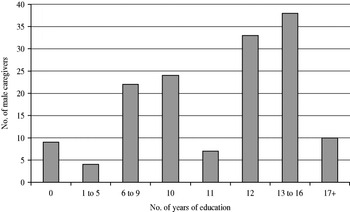
As regards the education level of the primary male caregivers (of which there were 184), this was indicated on the case-history questionnaire in 146 cases. Of these 146, eighty-one (55%) completed all twelve years of school. Figure 2 shows the number of years of education completed by the primary male caregivers. Forty-seven male caregivers (32% of the 146 for which education data were available) had postschool qualifications; of these, five had doctoral degrees. Eighty-two percent of the 161 male caregivers who answered the questions regarding employment were employed at the time of the study. There were thus higher school and postschool education levels as well as higher levels of employment amongst the father figures than amongst the primary female caregivers, presumably because only the details of the men who were somehow involved in their children's lives were considered.
Number of years of formal education successfully completed by primary male caregivers.

Presence of caregivers
In the majority of cases, the mother acted as primary female caregiver. Of the 220 participants for whom the presence of such a caregiver was indicated, eleven were cared for by their grandmothers, eight by a female guardian (without specifying whether or not this female is also a relative), five by a foster mother, three (siblings) by a female who was specifically indicated as being the stepmother, two by a sister, and one each by a grandmother and foster mother and by a biological mother and foster mother.
Of the 184 participants for whom the question regarding the involvement of a male caregiver was answered, most (132) had a father as a primary male caregiver. Twelve participants were cared for by their grandfathers, five by male guardians, four by boyfriends of the mothers, two (not siblings) by men specified to be the stepfather, and one by an uncle. Twenty-eight participants (12%) had no primary male caregiver, and for another forty-seven the female caregiver chose not to answer the question regarding the presence or absence of a male caregiver.
Afr-DELV percentile ranks
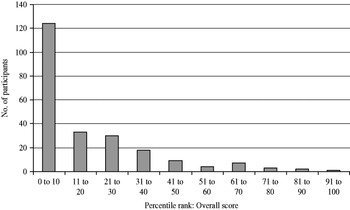
As regards the percentile ranks achieved for the test as a whole, less than half (89) of the 231 participants fell at the 16th or above. Percentiles below 16 are more than 1 SD from the norm, and were taken to be the cut-off value for normal test performance (following Botting, Faragher, Simkin, Knox and Conti-Ramsden, Reference Botting, Faragher, Simkin, Knox and Conti-Ramsden2001: 1015). The distribution of percentile ranks for the three DELV domains together is depicted in Figure 3.
Percentile ranks for the composite Afr-DELV score.

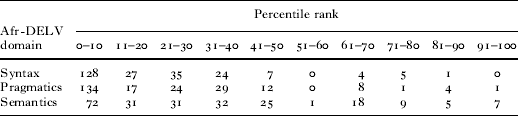
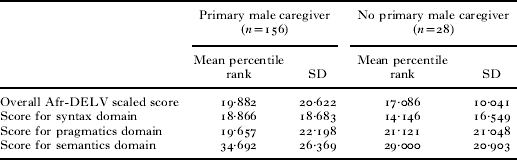
A similar pattern presented itself for the syntax and pragmatics domains, where 102 and 96 participants, respectively, fell at or above the 16th percentile. Participants as a group fared comparatively better in the semantics domain, with 158 participants falling at or above the 16th percentile. The distribution of the participants across percentile bands for these three domains is depicted in Table 1.
Percentile ranks for the syntax, pragmatics and semantic domains of the Afr-DELV
One would have expected scores to be distributed along a bell-shaped curve, with only a limited number of participants falling below the 16th percentile. As these results indicate, however, between 30% and 60% of the participants would be regarded as showing atypical language development for their age (recall, however, that all participants were typically developing according to the norms of their communities) and would therefore be in need of language intervention. These results concur with those of Locke, Ginsborg and Peers (Reference Locke, Ginsborg and Peers2002), who found that more than half of the nursery school children from disadvantaged socioeconomic backgrounds who participated in their study presented with delayed language development.
Correlation between highest education level of primary female caregiver and language test performance
There was a significant positive correlation between level of education of the primary female caregiver and the percentile rank of (1) the overall total scaled score (r = 0·55, p < 0·01); (2) the score for the syntax domain (r = 0·49, p < 0·01); (3) the score for the pragmatics domain (r = 0·34, p < 0·01); and (4) the score for the semantics domain (r = 0·52, p < 0·01). Hypothesis 1, which predicted that there would be a significant positive correlation between maternal level of education and performance on the Afr-DELV, was thus borne out by the data. This concurs with results of other researchers (e.g. Hart & Risley, Reference Hart and Risley1995) who found a positive correlation between socioeconomic status (of which maternal level of education is taken as a measure here) and language skills.
Language test scores of participants with versus without a primary male caregiver
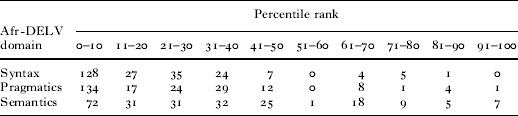
There was no statistically significant difference between those participants with versus those without a primary male caregiver, for (1) the Afr-DELV as a whole (Mann–Whitney p = 0·56); (2) the syntax domain (Mann–Whitney p = 0·24); (3) the pragmatics domain (Mann–Whitney p = 0·80); and (4) the semantics domain (Mann–Whitney p = 0·42). The relevant descriptive statistics are presented in Table 2.
Descriptive statistics for language test scores of participants with versus without a primary male caregiver
These results disconfirm Hypothesis 2 but should be interpreted with caution, due to the skewed sample (156 present vs. 28 absent primary male caregivers). However, when no answer to the question as to whether or not there is a present male caregiver (thus where information is provided on the presence or absence of a female caregiver but not a male one) was taken as an indication of the absence of such a male caregiver, there was a significant difference between the two groups, for the the Afr-DELV as a whole as well as for each domain separately.
Summary: level of education and employment status of caregivers
Regression analyses were performed in order to ascertain the collective correlation between four variables, which could all be seen to be related to socioeconomic status, and a dependent variable, the latter being the percentile ranks for the overall scaled scores on the Afr-DELV. The four variables were level of education of the primary female and male caregivers and the employment status of these two caregivers.
A best subsets regression selected three of the four variables (R 2 = 0·358); all but the employment status of the primary female caregiver. Of these three, however, only the level of education of the two caregivers made a significant unique contribution (p < 0·01). It appears then that even the best predictors are not good predictors, as only 35·8% of the variance in the percentile ranks can be explained by the collective effect of the primary caregivers' level of education and employment status. Although children of mothers with high levels of education fared better on the Afr-DELV, the regression results indicate that this is not the only factor influencing the children's language test performance and that, indeed, there are other influencing variables that have not yet been identified.
Dividing the lowest parental level of education of the original DELV into sublevels
Hypothesis 3 predicted that the lowest parental level of education specified in the original DELV (namely 11 years or less) is not differentiated enough for the South African context. The results of CART analysis disconfirmed this hypothesis. Note that before the CART analysis was done, the data were randomly divided into a training set (70%) and a test set (30%). The CART model was derived from the training set, and then applied to the test set. Results reported below are from the test set, which reduces the risk of reporting merely random patterns detected by the CART analysis. The analysis divided the data into two groups: Group 1 contained those participants (n = 61) whose primary male caregivers had completed 14·5 or less years of formal schooling. The average percentile rank for the overall Afr-DELV score of this group was approximately 13, which indicates a need for language intervention. Group 2 comprised those twenty-nine participants whose primary male caregivers had completed more than 14·5 years of formal schooling. This group's average percentile rank was approximately 42, i.e. unlike the group whose fathers had 14·5 or less years of schooling, the average percentile of Group 2 was above 16, which means that they can be seen to be towards the lower end of typical development and not necessarily in need of language intervention. Although children's scores could thus be grouped according to the level of education of their primary male caregivers, the distinction was between more or less than 14·5 years of schooling and did thus not fall within the lowest band of education specified by the DELV, viz. eleven years.
From the above results, it appears as if it is the level of education of the male caregiver rather than that of the female caregiver that is important. It should be noted that when no answer to the question as to whether or not there is a present male caregiver was taken as an indication of the absence of such a male caregiver, three groups emerged: (1) participants whose primary female caregivers completed less than 11·5 years of formal schooling (average percentile rank of approximately 8 for the overall Afr-DELV score); (2) participants whose primary female caregivers completed more than 11·5 years of formal schooling and whose primary male caregivers had less than 14·5 years of formal education (average percentile rank approximately 19); and (3) participants whose primary female caregivers completed more than 11·5 years and whose primary male caregivers more than 14·5 years of formal education (average percentile rank of approximately 42). Again, children's scores could be grouped according to the level of education of their caregivers, but the distinctions did not fall within the DELV's lowest (11 years of less) band of education.
The CART analysis becomes more accurate when the set of observations increases in size. The number of participants in this study is too limited to draw final conclusions based on the CART analysis only. Nevertheless, it does appear as if subdividing the current lowest parental level of education of the DELV (set at 11 years) is not warranted, despite the fact that the majority of South African adults have not completed all twelve years of primary and secondary school. The question, however, arises as to whether any adjustments to the scores obtained by South African children should be made based on parental education level. The reason for the score adjustment would be to avoid overdiagnosis of language disorder in groups with lower socioeconomic status. One could argue that the study should not have investigated the appropriacy of the lowest band of parental education used by the American version of the DELV, but rather whether the proportion of children classified as language disordered (i.e. those below the 16th percentile) is indeed significantly higher when the scores are left unadjusted compared to when the scores are adjusted. The number of participants in this study is too limited to allow a statistically reliable comparison of such a kind; this is to be investigated once data of more children are available.
CONCLUSIONS
Although no direct, causal relationship exists between socioeconomic status and language skills, children from low socioeconomic backgrounds are more likely than their middle-class peers to have had low birth weight, to experience teenage parenting and maltreatment, and to exit from high school early (Brooks-Gunn, Duncan, Klebanov & Sealand, Reference Brooks-Gunn, Duncan, Klebanov and Sealand1993; Sampson, Morenoff & Gannon-Rowley, Reference Sampson, Morenoff and Gannon-Rowley2002). These and other factors – such as fewer learning opportunities, poorer quality of home environment, limited access to good schooling and printed matter, and low parental literacy levels – contribute to poor language development. In this study, children's language skills were shown to be positively correlated to their mothers' level of education. A low parental level of education – as for the factors mentioned above – places children at risk for delayed language development with concomitant problems in developing reading and writing skills. As stated by Sinatra (Reference Sinatra2008: 174):
Because children of poverty are often reared in homes and environments that ill prepare them for the language and vocabulary usage of early through advanced schooling, they find themselves in a catch-up, at-risk, school lifestyle. They are held to low expectations, disproportionately placed in special education settings, retained, assigned to remedial classes, segregated into the lowest quartile, and provided with unchallenging coursework …
As a group, the language of children from low socioeconomic backgrounds is qualitatively different from those of children with true language impairment: the first group's language usually demonstrates delayed development (somewhat resembling children with mild mental retardation; Whitehurst, Reference Whitehurst, Adamson and Romski1997) whereas the latter can demonstrate both delay and deviance. However, given the negative effects that even delayed language skills can have on educational progress, and thus in order to prevent the series of events listed above by Sinatra (Reference Sinatra2008), early identification of at-risk children and early language intervention for such children are indicated.
This study showed that Afrikaans-speaking children from low socioeconomic backgrounds fare poorly on a language test deemed to be dialect-neutral and culturally fair. It appears that further improvements to the Afr-DELV will not necessarily render different results with the population in question. Rather, these children are in need of deliberate exposure to literacy practices and conversational language of the type that will prepare them, while they are in their preschool year, for the kind of language that they will meet from Grade 1 onwards. Children who upon such exposure fail to make significant progress in language development are arguably those with true language learning problems and are therefore those in need of speech-language therapy as opposed to language stimulation only.
Several programmes have as one of their aims the improvement of preschool children's language – such as the Head Start programme (which has recently been reported to make almost no difference, by Grade 1, to the skills of those children attending it when compared to the skills of similar children who either stayed at home or did not attend a Head Start preschool facility; see US Department of Health and Human Services, Administration for Children and Families, January 2010), HighScope and Sure Start. The challenge is to ascertain which of the programmes have proven success (1) with children from low-income families where the parents have low literacy levels and there is little access to books and story-telling and (2) where children typically attend a maximum of one year of preschool before entering Grade 1, and which would be suitable for the linguistically and culturally diverse South African child population.