Introduction and background
The term ‘rural’ lacks a precise definition but rural areas are generally characterised by low population densities, small communities and physical remoteness (Congdon and Magilvy Reference Congdon and Magilvy2001). Rurality has been described as a continuum with small towns or remote areas at one end and large cities or metropolitan areas at the other end (Beshiri et al. Reference Beshiri, Bollman, Clemenson, Morgan and McDermott2000). According to the Organisation of Economic Co-operation and Development (OECD) (1994), which created international comparative definitions of ‘rural regions’ and ‘rural communities’, a predominantly rural region was defined as having more than 50% of the population living in rural communities, with a ‘rural community’ defined as having a population density less than 150 persons per square kilometre (km2). However, Williams and Cutchin (Reference Williams and Cutchin2002) acknowledged that there is tremendous diversity from one rural place to another even within state/province/regional boundaries.
Lowe and Speakman (Reference Lowe and Speakman2006) acknowledged that until recently, there was little consensus in the United Kingdom (UK) on definitions of rural and urban and such uncertainly was problematic for the equitable distribution of health- and social-care services. In 2004, the Office for National Statistics (ONS) published a new definition of rural areas covering England and Wales. Areas with a population exceeding 10,000 are considered urban and the rest are considered rural. Rural areas are classified depending on the population size and may be considered ‘sparse’ or ‘less sparse’ according to the average number of households at three geographic scales (i.e. 10, 20 and 30 km) around any location. Rural areas can be further classified according to the type of settlement in which the majority of the population lives, for example, ‘rural town and fringe’, ‘village’, or ‘hamlet/dispersed. The ONS acknowledges that the classification may need to be updated on a five-yearly basis but recognises the new classification as a useful tool for rural analysis.
At a general level, ageing in rural areas has received less attention in the literature than current demographic trends might suggest. The first Global Rural Ageing Conference was held in West Virginia in June 2000. Although more than half of the world's older people live in rural areas (Shucksmith Reference Shucksmith, Shucksmith and Murphy1999), gerontology has been slow to focus on this aspect of ageing. This is supported by Wenger (Reference Wenger2001) who noted that, despite rural populations being generally older than their urban counterparts, studies of older rural inhabitants are sparse in the UK.
Care-giving in rural areas
In a programme of nursing research involving three ethnographic studies in rural Colorado, Congdon and Magilvy (Reference Congdon and Magilvy2001) noted a distinction between two circles of care: the circle of formal care and the circle of informal care. Professional health and social services provided to home-care patients and their families comprised the circle of formal care. This circle was strengthened by the loyal commitment of rural home-care nurses to their patients and families. An informal circle of care was extended to both healthy and frail older adults by family, community members, church groups, friends and neighbours. This informal circle provided friendship, personal care, meals and transportation in addition to facilitating independence and engagement in rural life.
Others studies have supported the finding that older people in rural areas depend heavily on family and friends, especially during times of acute illness or frailty (Stoller and Lee Reference Stoller, Lee, Coward, Bull, Kukulka and Galliher1994; Weinert and Burman Reference Weinert and Burman1994; Wenger Reference Wenger2001). Consistent with rural culture, health-care providers such as nurses were part of both circles because they lived, shopped, worshipped and worked with patients who were also their neighbours. Congdon and Magilvy (Reference Congdon and Magilvy2001) concluded that a strong sense of connection and community existed within rural cultures. Older people tolerated minor health problems as long as they remained independent and able to stay at home. However, in keeping with other studies on family care-giving and entry to care (Davies Reference Davies2001; Dellasega and Mastrian Reference Dellasega and Mastrian1995; Kellett Reference Kellett1999; Nolan and Dellasega Reference Nolan and Dellasega2000), many participants had not anticipated acute or chronic illnesses and tended to remain at home until a crisis point was reached.
A rural perspective on entry to care
There is evidence that older people in rural communities have fewer long-term care options compared to their urban counterparts (Coburn and Bolda Reference Coburn, Bolda and Ricketts1999; Penrod Reference Penrod2001). Congdon and Magilvy (Reference Congdon and Magilvy2001) reported that nursing homes were used as an alternative housing option when few alternatives such as sheltered housing existed. The use of nursing homes as a housing option supports previous research that rural nursing homes have developed in different ways, often providing the equivalent of assisted living for some residents who might have had other options had they lived in more urban areas (Rowles and High Reference Rowles and High1996). Wenger (Reference Wenger1999) suggested that entry to residential care may take place at lower levels of dependency in rural areas because of the high unit costs of domiciliary support. However, this was refuted in an American study by Penrod (Reference Penrod2001) who examined functional disability at nursing home admission in a comparative sample involving rural and urban cohorts in Nebraska and concluded that rural older people were not at higher risk of admission at lower levels of functional disability than their urban counterparts.
In Northern Ireland, Heenan (Reference Heenan2000) conducted in-depth interviews with 13 farming wives responsible for the care of older relatives. Findings suggested that there was a strong expectation that care for older relatives would take place almost entirely within the family setting. Contrary to the findings of other studies in Northern Ireland (Evason Reference Evason and Baldwin1998; Evason, Whittington and Knowles Reference Evason, Whittington and Knowles1993; Ryan and Scullion Reference Ryan and Scullion2000), where care-giving was described as burdensome and difficult, family care-giving arrangements in farming families were described as beneficial for everyone. The findings showed that there was an unquestioned, intrinsic assumption that care would take place entirely within the family. Residential care was heavily stigmatised. These findings were supported by McGibbon (Reference McGibbon1995) who reported that in rural areas, institutional care, both long-term and temporary, was associated with negative images and surrounded by apprehension and mistrust.
Design and method
Although admission to care homes has been the subject of considerable research, little is known about entry to care from a rural perspective. A grounded theory approach broadly consistent with the work of Strauss and Corbin (Reference Strauss and Corbin1990, Reference Strauss and Corbin1998) was therefore chosen as it facilitated the development of a new perspective on the everyday phenomenon of entry to care. Grounded theory as a methodology contends that theoretical concepts and hypotheses must emerge from the data, its main purpose being the exploration of social psychological processes for the purpose of developing substantive theories (Glaser and Strauss Reference Glaser and Strauss1967).
The broad aim of the study was to explore rural family carers’ experiences of the nursing home placement of an older relative. It was conducted in a large Health and Social Care Trust in Northern Ireland with a population of approximately 118,000 people spread across 2,590 km2. The trust served two large counties, which included some of Northern Ireland's most isolated and deprived rural areas. One of the counties had a population of 57,600, of which 70 per cent lived in rural areas, and a population density of 31 persons per km2. The other county had a population of just over 50,000, of which approximately 50 per cent lived in rural areas, and a population density of 44 persons per km2. Both counties were been described as predominantly rural regions on their respective District Council websites.
Although data collection and analysis using constant comparisons was an ongoing process, most of the data were collected between October 2003 and October 2006. Semi-structured interviews were used to ascertain family carers' experiences of the nursing home placement of an older relative. Purposive sampling was adopted in the initial phases of data collection, thereafter theoretical sampling was employed. Glaser's (Reference Glaser1998) position in relation to theoretical sampling was that events and sites are selected after data collection has commenced in order to develop the emergent theory. In contrast, Strauss and Corbin (Reference Strauss and Corbin1990, Reference Strauss and Corbin1998) argued that some sites and events may be selected in advance of data collection through purposive sampling. As the proposal for the current study was submitted to funding bodies and to ethics committees, it was necessary to provide some indication of the proposed sample. The initial sample included homes that differed in size, location and ownership arrangements. However, as data collection proceeded and the basis of a theory began to emerge, it became necessary to theoretically sample more non-family-owned homes as tentative findings seemed to suggest something different about the experience of relatives in family and non-family-owned homes. Similarly, preliminary analysis suggested a difference in the care-giving trajectory of male and female carers and again, this was further explored by the inclusion of more men in the study.
Carers were recruited in a number of ways through newspaper advertisements, notices in nursing homes and through direct contact with nursing home managers who agreed to administer information packs about the study to relatives of residents who were placed in the home within the previous 18 months. Full ethical approval to conduct the study was granted by the University Research Ethical Committee and by the Trust where the study was carried out. The interviews were conducted at a time and place convenient for participants and theoretical sampling continued until the emerging concepts and categories reached saturation.
Data analysis
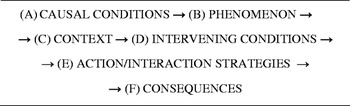
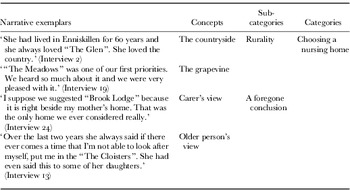
All interviews were audio recorded and transcribed with the consent of participants. This facilitated note taking and the initial coding process. The software package QSR NVivo (Richards Reference Richards1999) was used to assist with coding, storing, managing and retrieving data. Data were analysed using the paradigm model devised by Strauss and Corbin (Reference Strauss and Corbin1990, Reference Strauss and Corbin1998) and were therefore subject to three types of coding. Open coding was the process through which concepts were identified and their properties and dimensions rediscovered in the data. In axial coding, categories were related to their subcategories, to form more precise and complete explanations about phenomena. The final stage of coding, selective coding, was the process of integrating and refining categories and it was at this point that categories were organised around a central explanatory concept or key category (Strauss and Corbin Reference Strauss and Corbin1998). Because of the subtlety of the linkages among categories, Strauss and Corbin (Reference Strauss and Corbin1998) recommended the use of an organisational scheme or paradigm to systematically gather and order data in such a way that structure and process are integrated (Figure 1). Although the focus of this paper does not permit a detailed description of the analytical process, Table 1 provides an example of the coding exemplars that were used to link concepts, categories and sub-categories to each other and to the different components of the paradigm model.
Paradigm model.

Actions/interactions: choosing a home

Ensuring rigour
A number of different strategies were used to maximise the rigour of the study. During the open and axial coding stages, two colleagues independently viewed a selection of original uncoded manuscripts and provided feedback. After the selective coding process, both colleagues were furnished with copies of the paradigm model, coding exemplars and the original transcripts from which these were drawn. Consistent with the views of Barbour (Reference Barbour2001), the degree of concordance between researchers was not the issue. Rather what was ultimately of value was the ensuing discussion that led to a refinement of the paradigm model. The limitations of this approach have been highlighted by researchers (Munhall and Boyd Reference Munhall and Boyd1993; Schutz Reference Schutz1994), who stated that it is unlikely that two people will interpret data in the same way because the production of themes and categories depends upon the unique creative processes between the researcher and the data. However, Barbour refuted this in her counter-argument that the process of verification encourages: ‘thoroughness, both in interrogating the data at hand and in providing an account of how an analysis was developed’ (2001: 1116).
Although Strauss and Corbin's paradigm model has been the subject of much criticism, it was effective in enhancing the credibility of the study's findings. The constant comparison of emerging data facilitated the verification of findings and minimised the likelihood of personal bias. Therefore, data emerging inductively were confirmed deductively by further theoretically sampled data (including literature). Concepts and categories that emerged time and time again until saturation was reached were considered to have high levels of both truth and value. Likewise, concepts and categories that were not verified by subsequent data were considered to be lacking in truth and consistency and therefore were not included in the theoretical framework that emerged. Theoretical sensitivity was maximised in the study through the use of two research journals, one containing field notes and the other theoretical memos. These research journals were used to record notes about the decision-making process throughout the research including sampling and analytical decisions. Reflections about the interview process and context including non-verbal responses and post tape or off record discussions in the research setting were also recorded in field notes for analysis later.
Findings
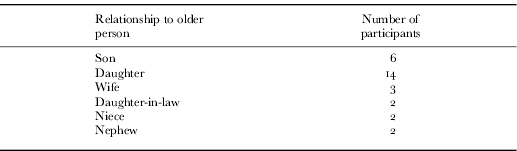
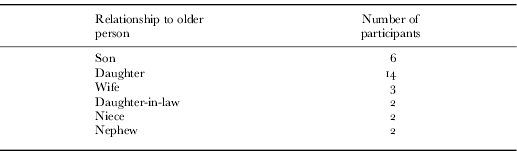
A total of 29 carers were interviewed (Table 2). Most placements resulted from transfers from acute hospitals (N=18) with the remaining from home (N=8) or from other care facilities (N=3). Stroke, dementia and immobility were the main health problems experienced by the older people. Spouses were full-time carers but adult children were in either part-time or full-time employment outside their care-giving role. With the exception of two carers, all others resided close to their older relative's nursing home.
Relationship of the carer to the older person
The factors that led to the nursing home placement of an older person (phenomenon) fell into two main categories; an increase in the health-care needs of the older person and a reduction in the carer's ability to cope (causal conditions). However, other factors impacted on both of these conditions. These included thoughts and feelings about the placement, support with caring and the nature of the care-giving relationship (contextual and intervening conditions). Once carers made the decision about entry to care, this set in motion a series of events which included validating the decision, choosing a nursing home, and planning and making the move (actions/interactions). All actions or interactions have consequences and when the transition to the nursing home occurred, this impacted on the older person, the carer, the carer–relative relationship and the extended family (consequences). All but two carers had a very strong sense of familiarity with nursing homes in their area. This familiarity was influenced by the rural or relatively rural communities in which respondents resided and by an efficient ‘grapevine’, which appeared to thrive in these small communities. This paper will focus on selected findings specific to entry to care from a rural perspective.
No place like home
When asked about their relative's thoughts and feelings about the move, with one exception, carers openly admitted that that their older relative was reluctant to move to a nursing home. In some cases this was related to the stigma associated with nursing homes and the links with workhouses of famine times where ‘you were put in there and you were forgotten about’ (R21). However, as the following quotations from two daughters suggested, most of the older people simply wanted to stay at home:
She wanted to be at home. She would never have had wanted to be in any of those places. I remember trying asking her once and she wouldn't give an answer. People just don't want to think of these things. (R22)
She always wanted to be at home. I would love her to stay at home but who is going to look after her. There is nobody. (R10)
One daughter described her father's plans to try to move back to his own house and the sense of importance he attached to this lifeline:
I think he wants to give it one last shot. He wants to say that he has tried it but if it doesn't work out that he'll close that chapter. Being so mentally alert it is very difficult being in a nursing home. (R17)
Carer advocate
As the condition of the older person deteriorated, the amount of health- and social-care interventions increased and carers had a lot of contact with social workers, district nurses and general practitioners (GPs). Because this study took place in a predominantly rural community, there was a considerable degree of familiarity between carers and health-care practitioners. This bond appeared to reassure carers that health-care practitioners genuinely had their best interest at heart and assumed a role of carer advocate. This advocacy role was highlighted in the following quotation from a wife:
He got a bit ill and the doctor came up. He said to me Kate it's going to get worse. He said it had to come to an end. I said I would be alright. He said to me that I wasn't too well. It was getting to me but I wasn't giving in to them. He said that it was going to kill me. The social workers and the doctor encouraged me all the time what to do. I didn't think I would take a heart attack out of it. (R11)
In the absence of family support and even in situations where family support was forthcoming, the support of nurses and GPs was valued highly by carers. They felt vindicated in their decision to opt for nursing home care, as one son explained:
My doctor said to me that the rest of the family would be blamed for that because they walked away from it. I remember one time going to the doctor and asked for a tonic. I said I felt my patience and my nerves were totally shredded and she questioned me about it and said that it was totally unacceptable and that I couldn't go on. She didn't say it in so many words but I think she was saying that I would be heading for a nervous breakdown. (R18)
Choosing a home: a foregone conclusion
Because the study was conducted in a predominantly rural area, carers appeared to have had residual knowledge about nursing homes and when a decision had to be made, they usually indicated a preference for a particular home. The only exceptions to this were two carers who lived elsewhere and did not appear to have any real connections to their older relative's community.
The choice of nursing home was therefore a foregone conclusion for most of the carers in this study. Carers took comfort in the knowledge that the home was recommended by friends and acquaintances. They rarely needed to consult any formal channels for advice on the choice of home but the local grapevine appeared to work well and this helped the decision-making process. This view was echoed in the following quotations:
I came down to see Jolene who is the Manager and she took me round the whole place. Before I got to that stage it already had been recommended by several people. (R8)
I had known of ‘The Everglades’ from being in the hospital and I had heard lots of reports about it. You know the way word gets round. I heard a lot of positive reports plus I knew a lot of the staff who worked here. (R5)
In a minority of cases (N=5), this was further influenced by the expressed wishes of the older relative. One daughter explained:
My sister and I had actually chatted about that and mum had said one time to my sister that if she went to a nursing home she would like to go to the ‘Elms’. In that respect it left it a little a bit easier for us in that we knew that if she was going to a nursing home that is where she had said. (R3)
The two carers who lived away from home presented a different picture and experienced difficulty with the choice of care home. One carer was an only son and the other an only daughter whose two brothers had died some years ago. Both carers bore sole responsibility for their older relative and their overall experiences of the transition were not positive. In the following extract, the daughter talked about her involvement in the choice of nursing home for her mother:
Researcher: How did you decide on ‘The Everglades’ nursing home?
Interviewee: There was no decision. I was just told that my mum can't look after herself and that they would have to find her somewhere to go.
Researcher: Did you have an opportunity to think about where she might go?
Interviewee: No. These nursing homes are a sort of a new thing around here because years ago they didn't have nursing homes so people did stay in their own homes and they were looked after by their relatives. But nowadays people don't have relatives or they are all abroad and these nursing homes have taken over. I didn't know where the nursing homes were or anything about them. I hadn't a clue. (R10)
Rurality
Rurality appeared to be a factor influencing carers' choice of a nursing home. The counties where the study was conducted are two of the most rural and isolated counties in Northern Ireland with large farming populations. This close relationship with the countryside had a bearing on carers' choice of home. The importance of maintaining links with the countryside was illustrated in the following quotation where a daughter-in-law explained the rationale behind their choice of a home located in the countryside:
A lot of people love the country and they see the silage being made up and the cows down the field. The girls bring them out for a walk in their wheelchairs or whatever when the weather is warmer. (R13)
A similar view was expressed by a son who stated the following about his mother's nursing home:
It is very much orientated towards country people. That is the report I have heard about it. (R14)
Because carers were part of a small community they appeared to possess knowledge of people and places and they viewed this in a positive light:
As a rural community things are different. Obviously I would know people. In Belfast etc. nobody knows anybody whereas in the rural community you always know somebody. (R25)
Additionally, this local knowledge also seemed to serve as a way of assisting the community to police itself and carers seemed to feel that they would soon know if there was a problem with a home. This view was captured in the following words of a nephew:
In that situation you can't get away with it because you are being watched closely. In a local area we have local staff and local people in it. It shouldn't go wrong and if it does go wrong it is soon put right. Local people own the place. (R23)
Familiarity
The significance of familiarity appeared to be related to the community's familiarity with the needs of the older person and the status of the nursing home as an integral part of this community. The belief that their needs and the needs of their older relatives were being met appeared to be the key factor influencing carers' experience of the nursing home placement and this belief was inextricably linked to familiarity with local health- and social-care professionals, nursing home staff and residents and the wider rural community. This familiarity also extended to carers' knowledge of other residents and the comfort they took from feeling that their relative would have something in common with the other residents because ‘they were all locals’ (R18). One daughter explained this as follows:
When my mother was admitted and I looked round and I seen five people she would have known as residents who were in that home. I knew one of the nurses that I worked with previously in the hospital … it was a big help. (R27)
Even though carers may not have known the residents or staff particularly well, familiar faces were welcome and although not explicitly stated by the carers, they appeared to believe implicitly that their older relative would be looked after. This view was captured in the following words of a daughter:
You would have watched television and you often heard about the cruelty in nursing homes especially in England and you would think that you wouldn't like your mum and dad in there and that to happen to them. But I think when you go in and see faces that you know, even if you knew them from the town, it makes a difference. (R19)
Discussion
In this study, rural family carers were asked to talk about their experiences of the nursing home placement of an older relative. The finding that older people wanted to stay at home is supported by other studies (Efraimsson, Hoglund and Sandman Reference Efraimsson, Hoglund and Sandman2001; McCann, Ryan and McKenna Reference McCann, Ryan and McKenna2005). For older people in this study, there was simply ‘no place like home’. This is an important finding as it suggests that for the older people in this study, their reluctance to move to a nursing home was not related to negative views about the home per se but rather to their overwhelming desire to stay at home. It is acknowledged that in the absence of primary data from the older relatives, it is not possible to judge the extent to which the findings reported here, particularly carers' perception of their older relatives' feelings about the placement, are shared by both parties. It could be argued that health- and social-care practitioners, in exercising their role as carer advocate, may not have given full consideration to the needs and wishes of the older person. However, it must be remembered that carers in this study acknowledged the deep attachments that their older relatives had to their homes and decisions about entry to care were not taken lightly.
The findings of this study resonate with those of other rural studies (Congdon and Magilvy Reference Congdon and Magilvy2001; Glover Reference Glover2001; Roberts et al. Reference Roberts, Battaglia, Smithpeter and Epstein1999) as carers had long-lasting relationships of trust with their health- and social-care practitioners and knew many of them outside their professional roles. Rosenthal (Reference Rosenthal, Lee and Winters2005) used the term ‘Contextual Knowledge of Patients’ to describe the ways in which rural nurses know their patients and their families in great detail. Glover (Reference Glover2001) argued that because rural care providers have more knowledge and consequently more at stake than urban care providers, a lack of support not only lets the profession down but perhaps more importantly lets the community down as well. This view was expressed by carers in this study who referred to the ‘grapevine’ as an effective means of conveying information about the quality of nursing homes in the area.
Although a literature search on social capital and entry to care revealed little of note, this was not surprising as the more specific application of social capital theory is a relatively new phenomenon (Cohen and Prusak Reference Cohen and Prusak2001; Gold et al. Reference Gold, Kennedy, Connell and Kawachi2002; Kawachi, Subramanian and Kim Reference Kawachi, Subramanian and Kim2008; Putnam Reference Putnam2000). However, it may explain why most of the carers in this study experienced a relatively stable transition around their relatives' entry to care. In the main, carers in this study were drawn from a fairly small close-knit community. The community in question appeared to be rich in social capital. The strength of social capital observed in this study was evidenced by the way in which carers felt connected to one another and to their health- and social-care practitioners, whose knowledge of the care-giving situation enabled them to play a key advocacy and supportive role in the decision-making process. Close personal relationships and network ties have been shown to have a positive impact on health and wellbeing (Gold et al. Reference Gold, Kennedy, Connell and Kawachi2002; Halpern Reference Halpern2008). This appears to have been the case for the carers in this study whose network ties enabled them to have access to information and support. It is possible that this access may have been denied to them were they not so rich in social capital. This viewpoint is supported in the finding that two carers who did not experience a satisfactory transition were living outside the locality and, consequently, were not as rich in social capital as other carers. It was not just that they lived outside the community but rather the consequences of this, vis-à-vis, their relationship (or lack of) with the community, which may go some way towards explaining their perception of a lack of support in decision making about entry to care.
‘Ageing in place’ is a broad term for a concept which recognises the deep attachments that older people have to their homes. The importance of place has become more recognised with the development of environmental gerontology as a research area (Gurney and Means Reference Gurney, Means, Arber and Evandrou1993; Reed, Payton and Bond Reference Reed, Payton and Bond1998; Reed et al. Reference Reed, Cook, Sullivan and Burridge2003). Wahl (Reference Wahl, Birren and Schaie2001) argued that the development of environmental gerontology offers a way of conceptualising and investigating ageing in the context of histories and aspirations for living in particular places with all of the associated social, emotional and physical factors.
Qualitative studies have investigated the more individual and personal dimensions of place and, in particular, the meaning of home (Gurney and Means Reference Gurney, Means, Arber and Evandrou1993; Reed, Payton and Bond Reference Reed, Payton and Bond1998). Home, for many older people, is a powerful symbol of autonomy and independence whereas institutions are associated symbolically with the loss of autonomy and independence (Andrews et al. Reference Andrews, Holmes, Poland, Lehoux, Miller, Pringle and McGilton2005; Reed et al. Reference Reed, Cook, Sullivan and Burridge2003; Wiles Reference Wiles2005). Wenger (Reference Wenger1990) discussed the ways in which older people establish a network of friends and neighbours around their homes to provide support and a sense of social identity. Reed, Payton and Bond (Reference Reed, Payton and Bond1998) argued that the definition of home extends beyond the confines of the domestic dwelling into the general locality in which the person lives. Rowles (Reference Rowles1981) supported this assertion in his reference to the ‘surveillance zone’, that is, the space which people can see from their homes.
This study confirms the importance of ‘home’ for older people and their carers. The findings suggest that as circumstances change, the definition of ‘home’ becomes rather fluid. This was particularly evident where home was not just the place of residence but also the wider extended community where the older person resided. Most respondents in this study were drawn from family-owned homes and the owners lived within the same community as residents, relatives and staff. Perhaps because of this, these homes appeared to be perceived as extensions of the community, a sub-culture within a culture or as described by Reed and Payton (Reference Reed and Payton1996: 547) ‘small and active communities within the wider community context’.
Recognising the importance of ageing in place, the findings of this study suggest that families should give careful consideration to the long-term care of their older relatives. Changes in family size and structure and an increasingly migrant population mean that families often encourage an older relative to relocate close to them so that they can visit on a regular basis. While it is easy to understand why adult children would recommend such a move, it is difficult to reconcile this practice with the importance of ageing in place.
The relationship between place of residence and sense of self can explain some of the findings in this and other studies on entry to care. If one's sense of self is inextricably linked to one's place of residence then it follows that entry to care will be a huge upheaval for older people. This is borne out in this and other studies (Keefe and Fancey Reference Keefe and Fancey2000; McCann, Ryan and McKenna Reference McCann, Ryan and McKenna2005; Nay Reference Nay1995) by the fact that virtually all the older people wished to remain at home and by their profound sense of loss at not being able to do so. When this was no longer an option, the choice of nursing home became a crucial decision and it appears that the choices that were made reflected the importance to carers and their older relatives of ‘ageing in place’. Therefore, even though older people were not able to remain in their own homes, the right choice of nursing home enabled them to remain part of their own community. The surroundings may have been different but there was a perception that the people would be essentially the same. This is supported by other studies (Kearns Reference Kearns1993; Poland et al. Reference Poland, Lehoux, Holmes and Andrews2005) which argued that the experience of health and medicine cannot be detached from the places in which care is received.
At a policy level, this study raises questions about the geographical distribution of care homes. The proportion of older people in local populations is higher in rural areas than in urban areas in most countries in the world (Shucksmith Reference Shucksmith, Shucksmith and Murphy1999; Wenger Reference Wenger2001). A need for a rural model of health- and social-care services is required. Recognising this and the importance of ageing in place, it is recommended that care homes, albeit smaller in size, are located in these rural communities and that this social policy stance is reflected in government agendas. Therefore, rather than clustering homes in certain areas, a wider distribution would facilitate people to maintain their community connections and to ‘age in place’. Policy makers need to think more carefully about the social consequences of the locations of care homes and the impact of their location on older people and their families. Although this issue may appear to be of little relevance in an increasingly peripatetic culture, for older people in rural areas, it can be very significant.
Limitations of the study
Most of the sample was recruited as a result of direct contact with nursing home managers. It is of course possible that nursing home managers may have deliberately selected carers who they felt would portray their homes in a positive light. It is also possible that the carers who volunteered were biased in some way. However, the range of responses suggests that while carers may have been hesitant in the initial stages of the interviews, by the end, they appeared to speak openly and frankly about their overall experience. In the course of the interviews, carers were questioned about their older relatives' thoughts and feelings about the placement. In the absence of interviews with these older relatives, it was not possible to verify these accounts and this may be perceived as a weakness of the study. The limitations of proxy data are acknowledged and it is possible that carers may have painted a much rosier picture than that which their relatives had actually experienced. The findings suggest that the two carers who lived at a distance had a different experience from those who lived in the locality. Although, efforts were made to include more distant care-givers in the sample, this was not successful and only resulted in the recruitment of one additional carer who later withdrew because of ill health.
Concluding comments
The context of rural care provision is both complex and challenging. Therefore, in dealing with rural places and populations it is important to try to understand the holistic ‘ecology of health’ that ties rural residents to their environments and societies. As ‘ageing in place’ and the out-migration of young persons occur, rural areas have a high percentage of older residents. Changes in the health-care system, such as the closure of rural hospitals, often exacerbate existing access problems for rural populations and put additional stress on these communities. Rural life and rural care should therefore be considered in terms of their cultural components and health-care providers and policy makers need to understand the uniqueness of rural environments and be sensitive to local resources and cultures.
The study adds to a new but growing body of literature, which recognises the importance of continuity in the delivery of health and social care to older people. It also challenges traditional views about quality indicators and provides evidence to suggest that while entry to care may be a reluctant move for most older people, it is possible to make it better. Although conducted in a rural part of Northern Ireland, the findings have relevance at a national and international level. The results suggest that the experience of family care-giving and entry to care is influenced by cultural and geographical variables. It is therefore contended that issues such as rurality and familiarity warrant a more detailed exploration in future research on entry to care.
Acknowledgements
The authors wish to acknowledge the National Board for Nursing, Midwifery and Health Visiting, Northern Ireland and An Bord Altranais for an All-Ireland Research Fellowship which assisted with the completion of the study.