


Across the USA, after-school programmes (ASP; 15.00–18.00 hours) serve over 8·4 million youth an average of 8·1 h/week, with the majority of youth attending being of elementary-school age (5–12 years) and from low-income schools(1). ASP are those that provide adult supervision for students immediately after school and incorporate snacks, homework help, recreational activities and cultural enrichment activities. Programmes can be offered either by a school or by a community partner (e.g. YMCA, Boys and Girls Club). ASP that focus solely on a single activity (e.g. music lessons, Pilates)(Reference Jago, Jonker and Missaghian2) or are designed specifically to promote physical activity such as clubs (e.g. Girls on the Run) or sports teams (e.g. intra- and inter-murals)(Reference Weintraub, Tirumalai and Haydel3–Reference Vizcaino, Aguilar and Gutierrez6) are not considered within this definition. The snacks provided during an ASP represent an important time in a child's daily nutrient intake – between lunch at school and before dinner at home(7). Dietary studies suggest snacks can contribute up to a quarter of a child's total daily energy intake(Reference Jahns, Siega-Riz and Popkin8). Hence, snacks play a critical role in the dietary intake of children.
Almost half of the daily energy intake of children and adolescents in the USA is characterized by the consumption of empty-calorie foods(Reference Reedy and Krebs-Smith9). Information regarding the nutritional quality of snacks served in ASP, albeit limited, suggests snacks served in this setting contribute to this pattern. On average, ASP snacks contain more than the recommended total energy (calories) for snacks(Reference Mozaffarian, Wiecha and Roth10, Reference Cassady, Vogt and Oto-Kent11). Snacks served are typically characterized as low in nutrient density, with over three-quarters of the snacks served in ASP containing added sugars (e.g. cookies, cereal bars, granola bars) or categorized as salty snacks (e.g. chips, pretzels, snack mixes)(Reference Mozaffarian, Wiecha and Roth10). Conversely, fruits and vegetables are served infrequently, with fruits offered as a snack option less than 1 serving/d(Reference Mozaffarian, Wiecha and Roth10–Reference Coleman, Geller and Rosenkranz12) and vegetables almost entirely absent from snack menus(Reference Mozaffarian, Wiecha and Roth10, Reference Cassady, Vogt and Oto-Kent11).
To address these unhealthy trends, state- and national-level organizations have developed policies and/or standards designed to improve the nutritional quality of the snacks served in ASP. However, the success of policies in galvanizing desired changes appears to have fallen short(Reference Mozaffarian, Wiecha and Roth10–Reference Coleman, Geller and Rosenkranz12). A possible reason for the apparent low impact of current policies is that they may lack cohesion or the common direction needed to help organizations set clear and achievable goals. Without widely recognized, adopted and implemented policies, ASP may depend too heavily on localized understandings of best practices or simply serve snacks that ‘fit’ within budgetary restraints. Likewise, the advent of numerous snack policies, each containing its own individualized recommendations, makes it difficult for local ASP providers to determine exactly what types of snack they should be offering. The consolidation of existing recommendations, such as a comprehensive set of guidelines for the selection of nutritious snacks, might assist ASP in meeting policy-driven change initiatives in more informed and systematic ways.
At present, no information exists on the extent to which existing policies share any uniformity or reflect common goals. It is essential to identify the scope of existing policies so that their common and unique strengths can be highlighted and drawn upon to develop wide-scale recommendations with greater potential for effective adoption and adaptation. The purpose of the present study, therefore, was to systematically review existing policies regarding the nutritional quality of snacks served in the ASP setting. The compilation of this information can provide both practitioners and policy makers with a resource on the extent and nature of policies that currently exist. Additionally, such information can be used to inform the discourse on developing nationally recognized policies for ASP.
Methods
The following methodology was adopted from a recent review of physical activity policies in the ASP setting(Reference Beets, Wallner and Beighle13). Policy was defined as a formal statement that defines priorities for action, goals and/or strategies, as well as accountabilities of involved actors(Reference Schmid, Pratt and Witmer14). The policies targeted in the current review were written policies that outline the nutritional quality of snacks that should be (in the case where mandatory participation is expected, e.g. the Child and Adult Care Food Program) or are suggested to be (in the case where voluntary adoption is preferred) served. These include all written documents that pertain to suggested number of servings, types of food recommended (e.g. fruits and vegetables), the types of foods to limit (e.g. sugar-sweetened beverages), and total energy and percentage of fat and sugar from foods.
A three-stage process was used to identify all relevant documentation. Stage 1 consisted of identifying all state-level after-school organizations from existing registries of state after-school networks (www.afterschoolalliance.com and www.statewideafterschoolnetworks.net). These organizations are national leaders in the advocacy of policies to improve the ASP environment and therefore represent one of the largest networks of ASP. Additional web-based searches were conducted by using a combination of ‘after school’, ‘afterschool’ and each state's name. Reviews of national ASP organizations’ websites and the US Department of Agriculture's (USDA) website were also performed to identify documentation related to policies for the nutritional quality of snacks served in ASP. Stage 2 consisted of keyword searches on all state and national organizations’ websites identified in Stage 1. Keywords used were ‘snacks’, ‘food’, ‘diet’, ‘fruit’, ‘vegetable’, ‘beverage’, ‘drink’, ‘fat’ and ‘sugar’. Additional keywords for ‘policy’, ‘standards’, ‘guidelines’, ‘recommendations’ and/or ‘quality’ were used. Finally, the keyword ‘obesity’ was used given the link between dietary intake and unhealthy weight gains. All relevant documentation was retrieved and reserved for the final stage. Stage 3 consisted of systematically reviewing the documents retrieved from Stage 2. All relevant information regarding nutritional standards was extracted into standardized forms. Information was extracted and compiled by two of the authors (F.T. and Y.K.).
Results
A total of seventeen state and/or national organizations were identified that had documentation related to specifying the nutritional quality of snacks to be served in the ASP setting (see Table 1). Of these, the majority (thirteen organizations) endorsed the nutritional guidelines as outlined by the USDA National School Lunch Program/Child and Adult Care Food Program (NSLP/CACFP). This resulted in a total of five unique policies (four organizations and the USDA, see Table 2). Common food and beverage items and the specific policy phrasing across the five policies are presented in Table 2. A total of thirteen major categories were represented across the five policies. These categories were: (i) sugar-sweetened beverages; (ii) milk/dairy; (iii) water; (iv) fruit/vegetables; (v) vegetables; (vii) meats and meat alternatives; (vii) breads/grains; (viii) energy content; (ix) high-sugar/fat/salt foods; (x) mixed products (e.g. trail mix); (xi) caffeine; (xii) dried fruit; and (xiii) frying. The most comprehensive policy was from the Institute of Medicine (IOM) Nutrition Standards for Foods in School Tier 1 with eight major categories represented, followed by the California Department of Education Standards for Snacks in Afterschool Programs (seven categories), and the Harvard School of Public Health Prevention Research Center: Youth Nutrition and Physical Activity Guidelines for Out-of-School Time Programs, the Alliance for a Healthier Generation and the USDA NSLP/CACFP (six categories).
Identified after-school organizations/programmes and after-school snack policy guidelines
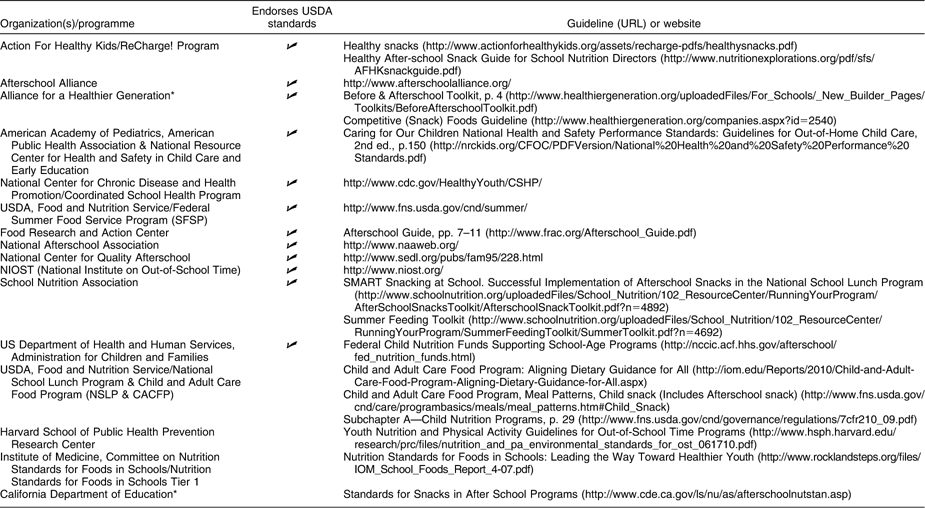
USDA, US Department of Agriculture.
*Developed additional guidelines added to the USDA guidelines (see Table 2).
Nutrition standards across five national and state organizations providing after-school programmes

USDA, US Department of Agriculture; NSLP, National School Lunch Program; CACFP, Child and Adult Care Food Program.
*Snacks will provide two different food components in a serving size tailored to the age group's needs over the course of a 5-day week, the food components provided will include two servings of fruit, one serving of an orange vegetable, one serving of a non-starchy vegetable, two servings of grain/bread, two servings of lean meat or meat alternative, and two servings of low-fat or non-fat milk; must meet daily and weekly patterns to provide flexibility,
†The standards do not apply to individually packaged portions of nuts, nut butters, seeds, eggs, individually packaged cheese, fruit, vegetables that have not been deep fried, and legumes.
‡A food item is cooked by total submersion in oil or fat.
§A food item is fried to reach an internal temperature of 70°C (160°F) then is cooled to room temperature so that it may be refrigerated or frozen for future frying.
∥A food item is quickly fried on both sides in oil with a temperature of 204°C (400°F) or higher.
The most common recommendation was for serving dairy (low-fat or 2 % fat milk) and serving fruits/vegetables (five out of five policies included each), followed by information related to the selection of or serving breads/grains, energy limits and reducing high-fat and sugar-added foods (four out of five policies). The majority of recommendations were written as a guide to the selection of a given food/beverage item, with no requirements for frequency of servings. The new CACFP guidelines called for 2 servings of a given food item weekly with all food items served at least twice over a 5-day week. Only four recommendations were present that explicitly called for either the removal (i.e. do not serve) or serving of a food/beverage item daily. The Harvard guidelines indicated that sugar-sweetened beverages (e.g. soda, pop, fruitaides, sweetened iced tea, sports drinks) should not be served and that fruits and vegetables should be served daily. The IOM suggests all foods/beverages should be caffeine-free, while the California guidelines call for no fried foods. Of the guidelines that specified the energy content of snacks, total energy ranged from 628 kJ (150 kcal) for elementary-school children to no more than 1046 kJ (250 kcal) for middle- and high-school children.
Discussion
ASP snacks represent an important contribution to a child's daily dietary intake. However, the majority of snacks served in this setting are of low nutritional value(Reference Mozaffarian, Wiecha and Roth10–Reference Coleman, Geller and Rosenkranz12) and contribute to the consumption of empty calories(Reference Reedy and Krebs-Smith9). The adoption and compliance with the identified nutrition policies should lead to creating healthier after-school environments that promote and support good nutritional habits. A number of policies and standards have been developed to guide the nutritional content of snacks served in ASP. The food/beverage guidelines in the policies ranged considerably, with the majority of the differences resting on the wording of the recommendation rather than whether to recommend or not recommend a specific food/beverage. Despite these differences a set of common items was represented across policies (e.g. milk/dairy, fruits and vegetables) and these can be viewed as core nutritional guidelines for ASP. Through an iterative process consisting of input from community practitioners and leaders in the field of after-school programming, a set of general food/beverage guidelines were proposed. These general guidelines are highlighted in Table 2.
The specific wordings were taken directly from one or more of the existing guidelines identified in the review and, where necessary, modified to include the new recommendations for the CACFP snack reimbursement programme. Moreover, the guidelines selected for inclusion in the general guidelines were determined by the clarity of the original guideline along with the ability to easily operationalize the guideline to determine compliance. This set of guidelines can serve as a basis for all ASP, with the understanding that these recommendations potentially represent a consensus among state and national organizations on the nutritional content of snacks served during ASP. Importantly, the proposed guidelines maintain compliance with the USDA CACFP reimbursement programme, which calls for the serving of two of the following five foods a minimum of twice weekly: fruits/fruit juice, vegetables, cereals/grains/breads, lean meats and meat alternatives, and low-fat/fat-free milk.
Unfortunately, the review was unable to identify how many ASP in the USA participate in and comply with any of the identified policies. The USDA NSLP/CACFP, however, reports on the number of snacks served as part of its reimbursement programme. As of October 2008, the NSLP/CACFP served snacks to 1 579 029 children in ASP nationally (E Peterson, Policy Director at the Afterschool Alliance, personal communication). Given that over 8·4 million youth nationwide attend ASP(1), this leaves a substantial number of youth attending ASP that do not have to adhere to nutritional guidelines for the snacks served. Furthermore, the current review is limited to snack policies in US ASP. Our attempts to locate nutritional policies and standards for after-school-type programmes in other countries were unsuccessful. Thus, the extent to which policies that do exist are similar, and are widely adopted, remains unanswered. In the instance where snack policies need to be developed, those identified herein can serve as a starting place to inform the discussion.
The issue revolving around oversight and compliance is crucial. The USDA has the only nutritional guidelines to which ASP have to adhere as part of being reimbursed for snack purchases. Since 1998, the USDA NSLP or CACFP has reimbursed snacks and hot meals (where provided) for ASP (see www.fns.usda.gov/cnd/care). The CACFP was developed to serve foods to children attending at-risk ASP (defined as a minimum of 50 % of children attending are eligible for free or reduced-price meals) for the CACFP. The primary difference for programmes receiving NSLP reimbursement is they cannot operate on weekends/holidays and such programmes do not have to be located within an eligible area (minimum of 50 % children eligible for free or reduced-price meals). Consistent with the definition of ASP presented previously, the NSLP/CACFP does not include reimbursements for organized sports and activity clubs. The oversight of compliance to the NSLP/CACFP guidelines is conducted by state agencies and focuses primarily on menu reviews and claim records for reimbursements.
Conversely, voluntary compliance with the other policies is unlikely to result in substantial changes to the nutritional quality of snacks served, particularly when the evidence to date suggests programmes are falling short of meeting policy standards(Reference Mozaffarian, Wiecha and Roth10–Reference Coleman, Geller and Rosenkranz12). If the identified policies are to be widely adopted and complied with, additional supports need to be given to ensure successful uptake. For example, price barriers to serving fruits/vegetables and whole grains should be reduced and staff professional development related to the nutritional needs of children needs to not only to be provided but ongoing. It is likely that other supports are also required and future research with ASP providers should focus on identifying how best to facilitate policy implementation.
The systematic review conducted for the present study was intended to represent all available polices across the USA. However, it is possible that other nutrition policies have been developed, yet were not located by the review. We therefore cannot rule out the possibility that other food/beverage policies have been developed and adopted by ASP. Nevertheless, the nutrition policies identified are comprehensive in the number of food/beverage items represented and therefore likely exemplify the extent of food/beverage policies pertinent to the ASP setting.
The compilation of these policies can serve to inform both public policy and ASP practice. The identification of and agreement on a single set of nutritional policy standards would assist in programme oversight and compliance, as well as harnessing the purchasing power of ASP if all were buying and serving identical nutritious snacks. Based on available evidence, the voluntary adoption by individual ASP of one or more of the standards identified in Table 2 would likely enhance the nutritional content of existing snacks. Taken together, additional work is required to unify nutritional standards for all ASP as well as developing support systems for ease of adoption and implementation to ensure snacks contribute to a child's healthy dietary intake.
Acknowledgements
This research received no specific grant from any funding agency in the public, commercial or not-for-profit sector. There are no conflicts of interest regarding the material presented in this study. All authors contributed to the drafting and editing of the manuscript. M.W.B. conceptualized the study.



