Adolf Engler, director of the Berlin Botanic Garden and Botanical Museum from 1889 to 1921, often found cause for complaint that the quality and quantity of plant material from the colonial territories recently occupied by the German Reich in Africa, the Pacific and China did not meet scientific requirements. He moaned that the museum's instructions had barely been followed. The museum had solicited the collection of not only as many different species as possible from one area, but also as many specimens as possible from each species. Engler's repeated ‘urgent request for as abundant and complete a collection as possible rather than … torn-off branches’ appeared in institutional publications and even in the daily press.Footnote 1 The specimen collection instructions issued by Berlin's botanical institutions, which explicitly requested a minimum of six specimens of each plant, also underscored the importance of acquiring duplicates. In botany, duplicates were and still are defined as several specimens of a plant from the same location.Footnote 2 These replicate samples were required for exchange, especially with botanical institutions of other colonial powers such as the Royal Botanic Gardens Kew near London, in order to profit from Kew's ‘botanical treasures from tropical Africa’.Footnote 3 Kew curators would willingly surrender duplicates to Berlin in the hope of obtaining plants from the German colonies in return.Footnote 4
The exchange of plant material has been part and parcel of botanical practice. In addition to herbarium specimens, live plants, seeds, fruits, wood and barks also circulated worldwide through botanical networks. Detailed labels on the specimens, illustrations or species descriptions and accompanying correspondence, as well as articles in scientific journals and monographs, supplemented the material, facilitating the global transfer of both plants and plant knowledge. During the period of the German Empire's colonial expansion in the mid-1880s, the Botanic Garden and Botanical Museum in Berlin developed into a central clearing house for plant material from the German colonies and other colonial areas.Footnote 5 As the contemporary statements cited above suggest, duplicates of herbarium specimens were the focus of botanical exchange between the different colonial powers, with tens of thousands of duplicates passed on, traded and sold. They functioned as reliable currency in trans-imperial networks based on the principle of reciprocity. Their mass circulation and the statements by contemporary botanists indicate that the German scientists involved saw themselves as members of an international scientific community, illuminating the importance of trans-imperial cooperation that was happening amidst nationalist political and economic competition even at the height of imperialism. At the 1910 opening of the new Botanical Garden in Dahlem, then still located outside the growing city of Berlin, Adolf Engler greeted the numerous botanists who had come from Germany and abroad with the following words:
It proves that you regard this institution to a certain extent as the common property of our science, as is also the case with the sister institutes in the other capitals with which our institutions have been associated for a century. We representatives of special botany all know how much we depend on mutual support in comprehensive work … our mutual exchange has gradually led to the fact that we are close to each other in a similar way as the members of a spiritual order scattered all over the world.Footnote 6
The botanical gardens in the capital cities such as Berlin, London and Paris turned into international institutions where British, Dutch, French and German botanists in particular conducted joint research. They all relied on ‘mutual support’, as Engler said, be that through the exchange of knowledge or of plant material, preferably in the form of duplicates.
At the same time, the accumulation of colonial plant material and its concentration in the scientific centres of Europe reveals vital political power relations. Collecting and appropriating objects and knowledge in colonial contexts can be understood as a form of conquest.Footnote 7 The transport of objects from the colonies to the metropoles established the latter symbolically as the ‘heart of empire’, a process that also took place in Berlin, the most important German colonial metropole: its museums took in a large share of the scientific collections from the colonies.Footnote 8 These specimens were then arranged and exhibited according to Western taxonomies, demonstrating knowledge and authority over the territories overseas.Footnote 9 Thus the museums in European metropoles developed into literal and figurative colonial archives, providing the basis for the political and economic exploitation of the colonized territories. From the very beginning, ‘big science and big business’ worked together in the botanical exploration of the colonies; in the case of the German Empire, the Berlin Botanic Garden and the Botanical Museum served as the ‘central showcase for the plant treasures of the colonies’.Footnote 10
This article first explains the working practice of botany, especially with regard to the exchange of duplicates and the definition and function of duplicates in the context of collection-based knowledge production. It then focuses on the Berlin Botanic Garden and the Botanical Museum, as well as the Botanical Research Centre for the German Colonies (Botanische Zentralstelle für die deutschen Kolonien), the centre for the distribution of duplicates. Under a resolution by the German Federal Council, Berlin botanical institutions were assigned the task of examining all botanical collections from the colonies acquired at the expense of the German Reich and separating out duplicates for distribution to other German botanical institutions. Additionally, duplicates were exchanged and sold in trans-imperial networks. The article will consider these activities in detail, as well as other ways in which duplicates from colonial territories reached the Botanical Museum and were passed on from Berlin to other botanical institutions. Due to the destruction of large parts of the Berlin herbarium during air raids in the Second World War, the exchange of duplicates in the second half of the twentieth century was also determined by security factors relating to the preservation of collection material. Today, it is possible to reconstruct the destroyed collections on the basis of digitized herbarium documents from institutions which had received duplicates from Berlin. This article concludes with a look at these recent developments and reflects on digitization as a new form of duplication.
Duplicates in botany
Since their rise in the sixteenth and seventeenth centuries, botanical gardens and collections assembled plants from different areas of the world in order to compare their characteristics.Footnote 11 Botanical gardens and museums provided the ideal conditions for the identification of new species by making plants available in all four main forms of representation: as living specimen, as dried and pressed herbarium specimen, as illustration and as textual description. Since not all botanical institutions had large collections as a basis for the comparison-based method of determining species, herbarium specimens, illustrations and descriptions circulated worldwide. Duplicates were also deposited in other institutions in order to authenticate newly described species.Footnote 12 This is still the case today. In addition to a herbarium and live plant collection, a comprehensive library containing illustrations and descriptions that are readily available for comparison is indispensable in botanical research. Historian Marianne Klemun summarizes the scientific working practice in botanical gardens and museums:
The plant is transferred to the garden, transformed into the illustration, transported to the dried state as a herbarium specimen and transposed into the concise internationally accepted Linnaean code of description. These are four forms of representation which only make sense in their simultaneity and mutual reference as legitimation of a scientific concept designed for comparison.Footnote 13
This is, of course, an ideal that was and is rarely achieved in its entirety. Before the article more closely examines duplicates, the following can be said about the herbarium plant itself: by removing the plant from its natural context and placing it in a different context, the specimen becomes an epistemic object. In the words of Hans-Jörg Rheinberger, the herbarium plant can be ‘reactivated’ as an object of study.Footnote 14 New studies can, for example, change a specimen's taxonomic classification or add new types of information through contemporary research methods, such as molecular genetic analysis. These processes of knowledge production are often documented on the herbarium sheet, making them traceable. Various sources of information are recorded, be it the scientific description, additional findings or new classifications. The form in which information is added, verified or amended is defined by international practice, as well as by internal rules at a given institution. At the beginning of the twentieth century, the only form of alteration permitted was the inclusion of information on labels or small notes glued to the herbarium sheet.Footnote 15 These notes and any other information were not to be removed at any time.Footnote 16 These rules still apply today.
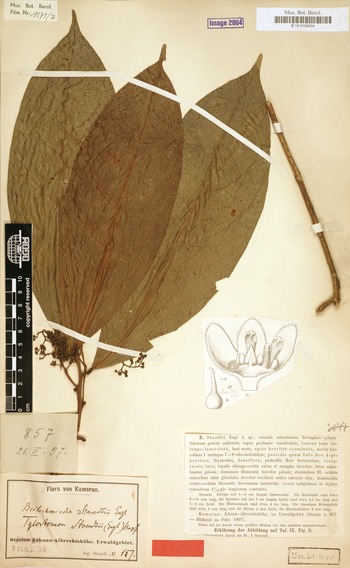
The documentation process for the herbarium sheet can be illustrated with the example of the laurel plant species Beilschmiedia staudtii and its duplicates (Figure 1). A label printed at the Botanical Museum, as well as the institutional stamp, both located at the bottom left of the sheet, identify the specimen as an object of the Berlin collection. The label includes the name of the plant, placing it within the classification system of the plant kingdom according to botanical epistemology. The first component of the binomial nomenclature, which dates back to Carl Linnaeus, designates the genus, the second the species.Footnote 17 In this case, the second component (or specific epithet) is staudtii. The name of the collector, Alois Staudt, whom the species is named after, is given on the label at the bottom right (leg. = has collected).Footnote 18 The author epithet Engl. that follows the botanical name is the abbreviation for Adolf Engler, director of the Botanical Garden and Museum and author of the first description of this species. The location, the government station Johann-Albrechtshöhe in the former German colony of Cameroon, is described in more detail as Urwaldgebiet (‘primeval forest area’).
Herbarium specimen Beilschmiedia staudtii, Herbarium B (Botanical Museum Berlin), with permission of Botanischer Garten & Botanisches Museum Berlin, Freie Universität Berlin.

A stamp in the left-hand corner of the label records that the herbarium specimen of Beilschmiedia staudtii entered the Berlin collection on 2 February 1898. A red sticker identifies the specimen as the type on which the initial description is based. In the extract from a publication attached to the herbarium sheet, the description of Beilschmiedia staudtii by Engler refers to the herbarium specimen with the number 857.Footnote 19 This number, noted on a small piece of paper attached to the herbarium sheet, had been allocated by Staudt himself, who numbered his objects consecutively – a common practice among collectors. Presumably, the note was taken from documents accompanying the collection, such as letters or field notes. However, this must remain conjecture, as most letters and catalogues archived in the Botanical Museum were destroyed during the Second World War. The label also indicates the exact date when the specimen was collected: 21 February 1897. Engler's description adds that the specimen was collected in full bloom. A special feature is the illustration of the flower of Beilschmiedia staudtii from the published description, which is glued to the herbarium sheet. The sheet thus comprises three forms of representation – herbarium plant, illustration and description – that together facilitate the analysis of the specimen.
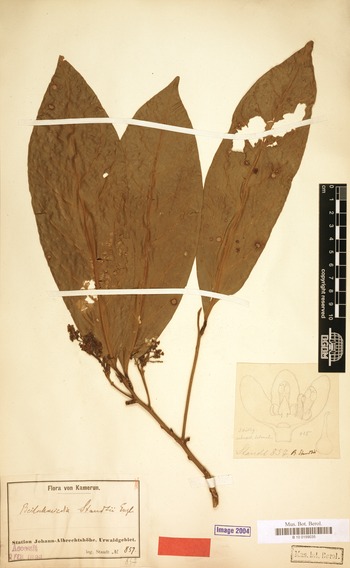
A second herbarium specimen kept in Berlin even includes a hand drawing of the blossom, in all likelihood carried out by Engler (Figure 2). Here, too, the label bears the number 857 and the same date of accession, as do the herbarium specimens of Beilschmiedia staudtii collected by Staudt and held in collections in Munich, Hamburg and Kew.Footnote 20 A total of five herbarium specimens of Beilschmiedia staudtii collected by Staudt bearing the same number exist, several of which were defined as duplicates. Today, in the natural sciences a duplicate is defined as an object that corresponds to at least one other object in some criteria, such as genus, species, sex and location.Footnote 21 In botany, the term ‘duplicate’ more specifically refers to part of a collection of a single species made by a collector at the same time.Footnote 22 In the case of woody plants, this can be parts of the same individual tree or shrub; in the case of herbaceous plants, several individual plants that grow close to one another. Duplicates can also be produced after collecting and mounting. Since Linnaeus, it is common practice to remove parts of an abundant herbarium specimen and to designate them duplicates.Footnote 23 The herbarium specimens in Hamburg and Munich are considered isotypes, i.e. duplicates of the types in Berlin on which the description was based. It is owing to this definition that the type and duplicate have a different value. The definition of the botanical duplicate seems not to have changed significantly since the eighteenth century. Whereas in other cases during the same period under examination here, for example at the Berlin Museum für Naturkunde, custodians did not adhere to the aforementioned natural-scientific definition of the duplicate, deciding rather to not consider any zoological object a duplicate, the identification of botanical duplicates was evidently uncontested.Footnote 24 Additionally, botanical duplicates always retain a subordinated status even after they are distributed to different institutions, where they represent the first or singular representation of a species possessed by that collection.
Herbarium specimen Beilschmiedia staudtii, Herbarium B (Botanical Museum Berlin), with permission of Botanischer Garten & Botanisches Museum Berlin, Freie Universität Berlin.

In general, it can be said for botany that duplicates were relatively easy to obtain and that herbarium plants could be traded with little effort. In the best-case scenario, duplicate material was collected for exchange or sale from the outset. While eighteenth-century exchange of duplicates often took place in correspondence networks between naturalists and plant enthusiasts, by the late nineteenth century it took on the form of institutional politics in national and international contexts that served to redistribute material and knowledge.Footnote 25 A completeness paradigm guided the accumulation of objects, and the goal of encyclopedic comprehensiveness pervaded the rhetoric of directors of all museum types at that time.Footnote 26 Completeness was desired not only in order to create favourable conditions for comparison-based research, but also because the sheer size of the collections, along with the published results of underlying scientific research, brought national and international renown. Engler, for example, compared his institution solely with the largest botanical gardens and museums of his time, particularly Kew and St Petersburg.Footnote 27 And indeed, during the period of the colonial expansion of the German Reich, the Berlin botanical institutions assumed a leading position alongside Kew by concentrating on the exploration of African flora and the enormous expansion of their collections, mainly with material from the colonies.
The distribution and circulation of plant material from the colonies
The mission and motivation of scientists working at botanical institutions in colonized territories and the metropolises of European colonial powers was to organize, control and exploit the plant world, especially in the colonies. While there was no German colonial empire to speak of until the end of the nineteenth century, the Berlin Botanic Garden nevertheless had tropical plants from its founding in 1679 at the gates of Berlin near the village of Schöneberg by Friedrich Wilhelm, grand elector of Brandenburg. Many of these plants entered the garden by way of Louise Henriette of Nassau, Friedrich Wilhelm's wife, who came from the Netherlands, the most important colonial power at the time. In the early nineteenth century, the garden grew into a botanical institution of greater scientific importance, having been incorporated into the newly founded University of Berlin.Footnote 28 Through connections to naturalists, explorers and botanical institutions worldwide, the institution acquired plant material from various parts of Europe, northern and southern Africa, east India, North America and other regions. The Botanic Garden and the Botanical Museum (the latter opened in 1880) thus received plant material from many parts of the world through their global networks long before Germany formally became a colonial power.Footnote 29
The unification of German territories and the founding of the German Reich in 1871 created the all-important prerequisites for the national and imperial politics that were dominated by Prussia, the leading economic and military power with the largest territory and population of the German states. Prussian science was also to have a defining effect in the German Reich. Despite the prevailing struggle for global leadership, especially with Britain and America, international scientific exchange was encouraged.Footnote 30 While Kew represented Berlin's ultimate role model to be emulated, director Engler nevertheless saw his institution's connection to the university as a unique advantage, which he believed allowed for better and more thorough research on plant material from the colonies: ‘It is indisputable that much more could have been done with the material available at Kew if Kew had been connected with a university.’Footnote 31 However, the Berlin Botanic Garden's status as part of a Prussian university simultaneously meant that it was not analogous to Kew as a national institution. It had comparatively less authority, especially vis-à-vis the heads of the botanical gardens and experimental stations in the German colonies, on whom Berlin depended for plant transfers. These colonial officials, hailing from all the German states, did not have to feel beholden to a Prussian academic institution. Moreover, Kew's budget was about three times higher than that of Berlin.Footnote 32
During the German Reich's colonial expansion between 1884 and 1918, the networks of the Berlin Botanic Garden and Botanical Museum expanded too, becoming noticeably diversified and consolidated. There was a significant shift towards more exchanges with the institutions of other colonial powers. The reasons for this must be seen in the new tasks assigned to the Berlin institution by the Foreign Ministry, as well as in new scientific and economic interests. Only a few years after the annexation of overseas territories in 1884, legal regulations ensured that the botanic garden and museum were firmly integrated into colonial politics and the focus of its work shifted to the German colonies.Footnote 33 In 1889, a resolution was passed by the Federal Council (Bundesrat) – the highest authority of the German Reich – which allocated all objects from expeditions financed by the German Reich to the three leading Prussian museums in Berlin: the Botanical Museum, the Museum of Natural History, and the Ethnological Museum. Shortly afterwards, following an amendment to the resolution in 1891, these museums were to receive all the collections of colonial officials active in Africa and the Pacific.Footnote 34 Furthermore, the Foreign Office advocated for the transfer of specimens to the Berlin museums to include objects that were not directly subject to the provisions of the resolution, for example because they came from expeditions involving private donors. In doing so, the Foreign Office sought to centralize the collections from the colonies as well as the research conducted with these collections in Berlin. Consolidating the study and dissemination of collections in one place was meant to ensure that the research results could be used for what was called ‘practical purposes’: the economic exploitation of the colonies’ flora and fauna and the control of the local population.Footnote 35 The directors of the three Berlin museums supported this project, as archived letters show, and used their prominent position to expand their collections.Footnote 36
In accordance with the provisions of the Federal Council's resolution, a Commission for Scientific Collections from the German Protected Areas (Kommission für die wissenschaftlichen Sendungen aus den deutschen Schutzgebieten – ‘protected areas’ was a euphemism for colonies) was formed by Adolf Engler, in his capacity as director of the Botanical Garden and Museum; Karl August Möbius, the director of the Museum of Natural History; and Adolf Bastian, director of the Museum of Ethnology.Footnote 37 Under the chairmanship of Möbius, the commission prepared and distributed printed lists of the collections arriving from the colonies, as well as of the duplicates that other German museums could request. Between 1889 and 1903, six lists were published. While the first three offered an overview of all objects from the colonies, the remaining recorded only the duplicates, which could be claimed by other German institutions according to a distribution key laid down in the resolution. The three museums thus held a privileged position that provided first access to all colonial material procured at the expense of the German Reich and hence the prerogative of deciding which objects were to be considered duplicates that could be given away.
Even if Engler repeatedly expressed dissatisfaction with what he considered insufficient quantities of colonial objects, the invoices for the related transport cast his frustrations in a different light. In fact, quite literally tonnes of botanical, zoological, and ethnological objects arrived in Berlin from the colonies each year.Footnote 38 The colonial powers used their ‘possessions’ for the accumulation of objects and knowledge in the imperial centres of calculation, such as Berlin, London and Paris.Footnote 39 With the knowledge generated from, and with, these objects predominantly serving the scientific, political and economic interests of the colonizing states, Eugene Cittadino is right to call this a form of exploitation.Footnote 40 In the case of the Berlin Botanical Museum, by the beginning of the twentieth century alone, between two thousand and three thousand herbarium plants (each often comprising several specimens) arrived every year, along with museum objects such as wood or rubber samples, fruits preserved in alcohol or products made from plant-based raw materials, as well as live plants and seeds.Footnote 41 The collections thus increased on an unprecedented scale. According to estimates at the time, the museum department grew fourfold between 1890 and 1910, with estimates putting the total size of the herbarium at around four million specimens for the period before the Second World War.Footnote 42 The number of live plants that arrived at the Berlin Botanical Garden also increased nearly fourfold between 1880 and 1894 alone.Footnote 43 After the defeat of the German Empire in the First World War, the Treaty of Versailles in 1919 had regulated the cession of the German colonies, but scientific, economic and political interests in the former colonial property remained on the German side. At the Botanical Garden and Museum, the material from the colonies received until 1914 (collection transport was subsequently interrupted by warfare) were further researched and integrated into the collection after the war.Footnote 44
The centralization ordered in the Federal Council resolution was in the interest of the Foreign Office, the Prussian Ministry of Culture and the museums, which took on a number of functions in this context. First, the museums had to accommodate the enormous quantities of objects arriving from the colonies. In addition to premises, the museums provided the academic staff and their collections with material for comparison, both prerequisites to order, determine and prepare new material, and to sort out duplicates. Through their more or less well-organized collections and displays, they trained naturalists and other collectors or offered experts opportunities for self-study. When they saw their privileged position in the acquisition of collections threatened, the museums were more than happy to refer to their respective contributions to the research community.Footnote 45 Of course, this was also a rhetorical strategy to justify and consolidate their privileges. The Botanic Garden and the Botanical Museum had sufficient space for the fast-growing collections as well as for research and exhibiting purposes, especially at the new location in Dahlem on the outskirts of Berlin.
The three Berlin museums established themselves as colonial archives and places of production and transfer of knowledge about the colonies. A ‘colonial archive’ is more than just an institution that collected and stored records about the colonies for the purpose of making them available to colonial administrators or scientists. In keeping with Michel Foucault's influential and comprehensive concept of the archive, libraries and museums, alongside archives, are also institutions embedded in and constitutive of colonial power structures.Footnote 46 Knut Eliassen emphasizes that, in terms of their basic function, the archives ‘were originally, and still are, primarily tools for governing’.Footnote 47 The accumulation of knowledge – or what was regarded as knowledge – in the metropolitan centres of European power has been an essential feature of archival institutions since early modernity.Footnote 48 Lynn Nyhart points out that natural-history collections, especially in the ‘central museums’, are comparable to other state archives.Footnote 49 Instead of files, natural-history objects form the basis of knowledge production.Footnote 50
The provisions of the Federal Council's decision that allowed the Berlin museums to become powerful colonial archives were sharply criticized, especially by non-Prussian institutions, which complained about Berlin receiving preferential treatment and suspected that they were being deprived of duplicates.Footnote 51 In 1904, after the Colonial Council had accepted a proposal to have a commission of museum directors from different German states decide on the distribution of the collections, the three Berlin museum directors protested, insisting on their prerogative to continue allocating all material from the colonies in order to identify duplicates. They feared losing access to type material, saying this would lead to a ‘dispersal of valuable unique specimens’.Footnote 52 Arguing that the ‘fragmentation’ of colonial collections had to be avoided at all costs, the Berlin directors used scientific and institutional justifications to maintain the status quo of evaluation and distribution.Footnote 53 They claimed that their institutions had the ‘richest comparative material’ for the correct identification of plants, as well as sufficient scientific personnel for the preparation and classification of the material.Footnote 54 If the incoming collections were to be distributed to different museums, they predicted that new species would receive different names.Footnote 55 The Berlin museums insisted that the removal of their status as colonial knowledge centres and as distributors of research material throughout Germany would threaten the accuracy of the scientific findings. The message was that both Germany's museums and the Foreign Office were at risk of facing disadvantages if the existing agreements and the alliance with Berlin's institutions were to be altered.Footnote 56
In any case, even before a modification of the resolution was discussed, Engler had claimed that the supposedly modest quantity of material that had reached the Botanical Museum following the Federal Council's resolution contained hardly any duplicates: ‘However, these new species are based only to a very small extent on material that was collected by officials of the German colonies and sent to the Botanical Research Centre [for the German colonies].’Footnote 57 Also, ‘Only a few station officials … collected individual plants in large numbers so that they could be distributed to other museums’.Footnote 58 Engler's statement is somewhat surprising, given the significant numbers recorded in the annual reports of the Botanical Research Centre for the German Colonies and the commission's lists of scientific collections from the colonies. It appears that he was trying to downplay the actual volume of collections as well as the number of duplicates the collections contained in order to ward off any efforts from institutions outside the capital to stake a claim on these objects.Footnote 59 The disparity between what Engler claimed to have arrived and what actually landed in Berlin from the colonies illustrates the highly competitive climate governing access to colonial material and the distribution of duplicates.
The privileged role assigned to Berlin museums in the Federal Council resolution gave the custodians in the capital a monopoly over the definition of the nature of the duplicate. They could decide how many specimens were considered indispensable for achieving the desired comprehensiveness of collections in Berlin. The Botanical Museum not only expanded its holdings but also increased its prestige on a national and international level. This renown elevated it to the position of equal partner to the botanical institutions of other colonial powers in the exchange of plant material and knowledge. It is therefore all too understandable that other German museums felt at a disadvantage. Even to this day, these accessions from the German colonies remain an important basis for the scientific research and exhibition activities of the Berlin museums. In the end, according to the distribution key in the Federal Council's resolution, the Berlin Botanic Garden and Botanical Museum gave duplicates of plants from the German colonies to the botanical institutions of the following German cities: Munich, Göttingen, Hamburg, Stuttgart, Bremen, Lübeck, Strasburg, Erlangen, Braunschweig, Jena, Dresden, Breslau, Görlitz, Aachen, Greifswald, Hildesheim and Marburg.Footnote 60 The modification of the mode of distribution, finalized in 1911, changed little for the Botanic Garden and the Botanical Museum, however, owing to one particular requirement the resolution contained, namely that ‘botanical collections from expeditions sent to the colonies at the expense of the Empire must be transferred to the Botanical Research Centre, an imperial institution affiliated with the Royal Prussian Botanical Museum in Dahlem near Berlin’.Footnote 61
The Botanical Research Centre for the German Colonies and the trans-imperial exchange of duplicates
The Botanical Research Centre for the German Colonies was tied to the Botanic Garden and the Botanical Museum on 1 April 1891 by a contract between the Foreign Office and the Prussian Ministry of Culture, a state organ that supervised the Berlin botanical institutions by virtue of their connection to the university.Footnote 62 The two ministries shared the costs of the Botanical Research Centre, whose main function was to ship useful plants to the colonies. In addition, the centre was responsible for determining the economic value of plants and fostering the development of the colonies.Footnote 63 More specifically, the Botanical Research Centre was charged with establishing botanical institutions in the colonies, training gardeners for colonial service, and distributing equipment and instructions for collecting.Footnote 64 The latter measures, in particular, were intended to ensure that the Botanical Research Centre received abundant and well-preserved plant material, as Engler had wished for, since the botanists and gardeners working at the botanical institutions could be assumed to send in high-quality herbarium specimens as well as duplicates. The contract also promised support from colonial authorities such as governors in obtaining plant material, meaning that the Botanical Research Centre was able to use colonial infrastructure, and in fact did so.Footnote 65 In addition, shipping companies offered reduced rates for transporting plant material between the German Reich and the colonies.Footnote 66
Duplicates of material originating from Germany's colonies were sent back from Berlin to the botanical research institutions in the colonies: the Botanic Garden (later the Versuchsanstalt für Landeskultur, or Agricultural Research Station) in Victoria in Cameroon, the Biological-Agricultural Institute Amani (Biologisch-Landwirtschaftliches Institut Amani) in the German East Africa colony, and the Government Garden (Gouvernementsgarten) in Dar es Salaam received herbaria consisting of duplicates compiled in Berlin with the help of extensive comparative material and specialist literature.Footnote 67 Victoria and Amani were particularly important exchange partners, having previously sent plants to the Botanical Research Centre for identification and received information from Berlin.Footnote 68 The aim of Berlin's policy of sending duplicates to the colonies enabled colonial institutions to use these herbaria to identify new species on site in the future. In this case, duplicates made it possible for the research institutions in the colonies to become independent of Berlin. This was supported by the Botanical Research Centre, not least with a view to reducing the workload of the Berlin institutions. Amani and Victoria were thereby able to establish themselves as independent centres of knowledge production outside Europe. Thus the exchange of knowledge between the colonies and the metropolis took place in both directions: The institutions in the colonies were more than mere data and material collection sites, but in fact influenced research in Europe through the knowledge generated there. For these institutions and the German scientists working there, ties with scientific networks and journals in Europe remained important, especially with regard to the dissemination and implementation of new knowledge.Footnote 69
On the other hand – and to a far greater extent – the plants collected in the German colonies by private collectors or missionaries who were beyond the reach of the Federal Council's resolution could be used as duplicates in exchanges with botanical institutions worldwide. If there were multiple herbarium specimens of a plant, some were given away in exchange for herbarium specimens from other regions that could be used as comparative material. In line with the institutions’ colonial research focus, the emphasis was on the expansion of the collections from the tropics.Footnote 70 The distribution of collecting equipment and instructions to travellers in the colonies helped to establish links with potential collectors, and contracts with successful collectors helped to secure the inflow of objects.Footnote 71 These contracts gave the Berlin museum the best-preserved specimen of a species in exchange for plant identification and the distribution of duplicates. Duplicates that the institution received through such contracts were sold to botanical institutions worldwide for the benefit of the collectors.Footnote 72 Others were sold to finance expeditions.Footnote 73
Kew was by far the most important exchange partner for the Berlin Botanical Museum, not only because it had plants from many regions of the British Empire. The sheer mass of material brought together in the tropics, which Kew received with the help of its extensive networks, made it possible to give 59,022 numbers to Berlin in the years between 1847 and 1913. The Bureau of Science in Manila (Philippines), which was part of the American colonial possessions, gave almost 15,500 numbers to Berlin, the Muséum d'histoire naturelle in Paris 10,329 numbers, the Botanic Garden New York 6,729 numbers, the US National Museum and the US Department of Agriculture in Washington 5,700 numbers, the Botanical Museum Melbourne 4,000 numbers, and the same from the Botanic Garden Buitenzorg (today Bogor). In the case of British India, 8,328 numbers came from the Botanic Garden Sidpur near Calcutta (today Kolkata) and 2,110 numbers from the Botanic Garden Singapore.Footnote 74 These are but a few of the main exchange partners for plants from the colonies of the Netherlands, France, the United Kingdom and the United States, as well as from North America itself, and serve to give an impression of the botanical networks and the hundreds of thousands of herbarium specimens in circulation. Berlin received collections originating in the German colonies from botanical museums in Hamburg, Zurich and Uppsala, facilitated to some extent through agreements that stated that the Berlin Museum was to be furnished with the duplicates from the collections sent in return for the identification of the plants. St Petersburg also was an important partner for duplicate exchange, handing over a total of 20,996 numbers to Berlin, in this case in exchange for plants from other regions.Footnote 75 An equally detailed list of the duplicates provided by Berlin has unfortunately not been published, nor does any such document seem to have survived in archives. Given that, as described above, the exchanges were based on the principle of reciprocity, however, it can be assumed that a similarly extensive transfer took place. Indeed, as mentioned in the beginning, Engler stated that the exchange partners assumed that they would receive appropriate compensation.Footnote 76
The collection of plants in the colonies was based on colonial infrastructure that was indispensable for amassing, storing and transporting collections. Colonial officials, military officers and missionaries were active as collectors; objects were prepared at botanical gardens and government gardens as well as at military, administrative, research and mission stations, where they were packed for transport. The majority of objects were sent to Berlin by military and colonial officials and also by participants in expeditions financed by the German Reich, which collected tens of thousands of botanical objects. The collections of missionaries and some private collectors were not subject to the Federal Council's resolution, but some were also sent to the Berlin museums.
Though seldom mentioned in the garden and station reports, members of the local population in the German colonies, young men in particular, were involved in shifting hundreds of plants for the purpose of drying; they took on hard physical labour, for instance carrying large boxes with plant material to the coast, where they were loaded onto ships. Furthermore, very few German scientists and gardeners were employed at the botanical research stations, meaning that the institutions relied heavily on local workers for physically strenuous horticultural work such as watering the plants.Footnote 77 More research is needed into the contribution local populations made towards both plant collection and preparation and knowledge production. These questions are important not only in regard to the research stations but also in connection with expeditions and private collectors employing local men or women as informants, preparators, porters or translators.Footnote 78
From the perspective of the Berlin botanical institutions, the ideal way to secure well-trained staff and collectors was to train gardeners for colonial service. They could then accompany Wardian cases with live plants to the colonies, observe and document the cultivation of plants in the botanical gardens in the colonies, and send well-prepared plant material, including all the important information, back to Berlin. In all, between 1891 and 1914 the Botanical Research Centre for the German Colonies trained more than fifty young German men in Berlin, many of whom actually went on to work in Victoria and Amani or on private plantations.Footnote 79 In addition to teaching practical knowledge about collecting and preserving plants, the training at Berlin's Botanic Garden and Botanical Museum included lectures on tropical crops. The apprentice gardeners were also responsible for labelling and preserving herbarium plants and especially for cataloguing the collections received from the colonies. In the colonies and in Berlin they were therefore key human resources trained specifically to work with plant material from the tropics.Footnote 80 Research on this material was prioritized and rigidly organized by Engler; the reports and retrospective accounts underline the well-planned, fast, uninterrupted work. Engler first had all the material arranged into plant families before handing it over to botanists who were experts in these families. These scientists’ zeal for work is best exemplified by the substantial annual list of publications resulting from the colonial material.Footnote 81
As early as 1904 Engler noted with satisfaction that the Berlin Botanical Museum had an unrivalled collection of comparative material in the German Reich. For this reason, Engler continued, the museums of Portugal and Italy had also sent plant specimens from their colonies to Berlin for identification, some of which went to the Botanical Museum.Footnote 82 The exchange and the option of selling duplicates or receiving herbarium specimens in return for the identification work thus contributed significantly to the growth of the Berlin collections. Particular interest in the materials from the German colonies was shown by Kew, the British Museum, Zurich, Buitenzorg (today Bogor), Paris, Calcutta/Kolkata, Manila and Singapore.Footnote 83
Colonial infrastructure and power relations, legal regulations such as the Federal Council's resolution on the distribution of colonial objects, the establishment of the Botanical Research Centre for the German Colonies, contracts with private collectors, and established networks of duplicate exchange between botanical institutions worldwide enabled and regulated the inflow of objects, which continued uninterrupted with the exception of a few years at the start of the First World War. In retrospect, the collections from the German colonies, being considered ‘rich material’, were attributed a special role in the exchange.Footnote 84 In all, the generosity in the transfer of plant material and knowledge between botanists from different colonial empires during a time of pronounced political and economic competition is striking, even though tension between imperial competition and cooperation can be observed in other cases.Footnote 85 The crucial factor for Berlin's institutions seems to be the fact that this exchange of plant material – according to contemporary views – took place not only for economic reasons but, more importantly, also under scientific premises, as well as among botanical institutions, and that everyone adhered to the principle of reciprocity among the colonial powers.
Loss and reconstruction of the collection
The activities at the Berlin Botanic Garden and the Botanical Museum in connection with the former colonies experienced a dramatic break with the destruction of buildings and collections during the Second World War. In a March 1943 air raid, bombs hit the museum; most of the herbarium and the library burned to the ground. The destruction of the herbarium, which before the war was considered the world's second-largest collection after Kew, went down in the history of botany as the ‘Dahlem Catastrophe’.Footnote 86 Since this traumatic loss, security has been a strong motivator in the transfer of duplicates to cushion the loss of valuable types and keep a record of plants collected. If the holotype is destroyed (the single specimen designated as the type of a species by the original author), duplicates can then change their status: a later researcher can choose a lectotype to serve as if it were the holotype. It is chosen from among the specimens available to the original publishing author, such as isotypes, which are duplicates of the holotype, as explained above using the example of Beilschmiedia staudtii.
The digitization of many botanical collections worldwide has made it possible to reconstruct the destroyed Berlin collections on the basis of duplicates in other institutions. For example, of the almost five thousand herbarium plant specimens sent to Berlin by Georg Zenker, who collected in the German colony of Cameroon, as few as five hundred objects can be found to date in the Berlin collection database due to wartime losses.Footnote 87 The Meise Botanical Garden in Belgium, however, has almost the entire collection of herbarium plants, with a total of 4,661 specimens.Footnote 88
This experience of digital reconstruction is also applied to efforts of retrospectively establishing archives of floras in the global South, accompanied by control mechanisms that direct type specimens to herbariums there. Since 1992, botanical collections have been subject to the Access and Benefit Sharing regime introduced by the Convention on Biological Diversity (CBD), which regulates access to genetic resources and the equitable sharing of benefits with countries of origin.Footnote 89 A legally binding framework was created under the 2010 Nagoya protocol and further documents on fair and transparent benefit sharing encourage the return of holotypes of newly identified species from recent collections to the countries of origin and their keeping in collections there.Footnote 90 This agreement in effect counteracts the imbalance in the distribution of type material that came about during the colonial expansion. In many cases it is now the institutions of the global North that receive duplicates. Nevertheless, they still possess the mass of type material that is indispensable for knowledge production and the identification of new species. Against this background, they have a responsibility to critically reflect on their entanglements with and continued possession of colonial heritage to provide transparency about the collections.
In the public and political debate on the repatriation of objects from the colonial context, the concept and practise of digital repatriation is discussed as a mode of returning at least, and as a first step, a digital image of an object.Footnote 91 Such digital surrogates can provide ‘an alternative form of – and dynamic life for – certain physical objects’.Footnote 92 But digital repatriation should not be seen as a replacement for the objects extracted from the global South and brought to institutions in the global North. Nevertheless, for botanical research high-resolution digital recordings can serve as duplicates. Whereas traditionally duplicates circulated worldwide for the required authentication of newly described species, today often digital images suffice. These digital duplicates might even have the potential to (re)negotiate power and status within the international institutional landscape and strengthen the position of institutions in the global South by providing access to information and objects.Footnote 93