There have been major advances in recent years in the development of health technology assessment (HTA) but challenges remain. One of the take-home messages of the European Union-funded INTEGRATE-HTA project is that the way healthcare interventions lead to health outcomes is frequently complex, and that this complexity should be taken sufficiently into account when conducting an HTA. Ignoring such complexity, for instance in the case of palliative care, runs the risk of producing outcomes that are of limited relevance to policy makers. The INTEGRATE-HTA project recommends five steps for a comprehensive integrated assessment of complex technologies and interventions (Reference Wahlster, Brereton and Burns1): (i) Conducting a scoping exercise, involving stakeholders right from the start of the project (engagement, ownership); (ii) Collaboratively building program theory, by making explicit assumptions as to how, through what mechanisms, interventions may produce health outcomes, and what contextual factors need to be addressed; (iii) Examining a wide range of possible outcomes (not just safety and clinical and cost-effectiveness) that guides the collection of evidence; (iv) Structuring and, where possible, visualizing the assessment results, and considering different scenarios for the intervention depending on context, potential for implementation, and characteristics of beneficiaries; (v) Being explicit about how the various outcomes of the assessment might be integrated into an overall conclusion regarding the merits and demerits of the healthcare technology or intervention under investigation.
The question that will be addressed in this study is whether such an approach could be useful, appropriate, and feasible in the context of low- and middle-income countries (LMICs). We will first briefly describe the key challenges faced by healthcare systems in those countries. We will then discuss whether issues of complexity are sufficiently being addressed, the availability and use of vital health and healthcare data, experience with stakeholder involvement, the feasibility of the INTEGRATE-HTA approach in LMICs, and the need for capacity building. A specific approach to assessment of healthcare strategies that has gained momentum (Joint Assessments of National Health Strategies, or JANS) will be presented.
METHODS
A nonexhaustive literature review was performed on the implementation in LMICs of the five aspects recommended by the INTEGRATE-HTA project, using the following search terms: national health planning, health sector strategy, health sector performance, assessment criteria, health (management) information, complexity, context, stakeholder consultation.
RESULTS
Key Challenges Faced by Healthcare Systems in LMICs
The allocation of scarce healthcare resources is a challenge worldwide, one with which decision makers are confronted globally. Particularly in LMICs, this is the case, as these countries face demographic and epidemiological transition, rising health expenditure and severe budget constraints. The epidemiological transition is characterized by a triple burden of disease, much of which is poverty-related, composed of infectious/communicable diseases, chronic/non-communicable diseases and injuries (Reference Lopez2). The Medical Research Council of South Africa coined the term quadruple burden of diseases, pointing to the rapidly growing morbidity and premature mortality due to HIV/AIDS and related conditions (Reference Bradshaw, Groenewald and Laubscher3).
Many LMICs are in the process of undertaking health sector reforms. In the 1980s and early 1990s, such reforms were mostly undertaken in the context of economic structural adjustment programs, promoted by World Bank and International Monetary Fund, and they typically involved government budget cuts in the social sectors (health, education), along with broader fiscal and economic measures (Reference Peabody4). These programs have drawn criticism because of their negative implications for health systems and the adverse effects on people's health and equity in general, for instance, in the case of Zimbabwe, which saw its reputable health system crumble during the 1990s, after adopting an economic structural adjustment program that provided Zimbabwean citizens barely any social protection (5).
The Millennium Summit in the year 2000, which culminated in a global commitment to address extreme poverty through the adoption of the United Nations (UN) Millennium Declaration, gave a new boost to health reforms as they became much more geared toward addressing inequity. Nowadays, health reforms are considered necessary in the pursuit of universal health coverage, which the World Health Organization has labeled “the best strategy to achieve the health-related Sustainable Development Goals,” the successor of the Millennium Development Goals (6). Universal health coverage embodies three related objectives: (a) equity in access to health services—those who need the services should get them, not only those who can pay for them; (b) ensuring that the quality of health services is good enough to improve the health of those receiving services; and (c) financial-risk protection, ensuring that the cost of using care does not put people at risk of financial hardship.
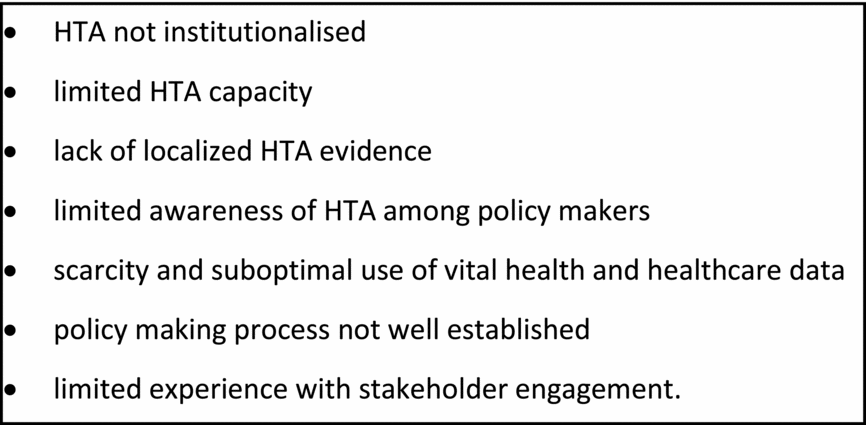
Most LMICs have not institutionalized health technology assessment, due to limited HTA capacity and limited awareness of the potential of HTA among policy makers. Figure 1 illustrates this.
Challenges for health technology assessment (HTA) development in low and middle income countries.

Acknowledging Complexity and the Importance of Context
After almost 2 decades of high expectations and large amounts of funding that were directed to global health initiatives and priority diseases (HIV, malaria, tuberculosis; triggered by the UN Millennium Declaration), complex interventions are increasingly being recognized in LMICs as a concept in public health practice, health systems strengthening, social policy, and innovation (Reference Atun7–Reference McMahon, Brenner and Lohman10). The concept of complexity and the importance of context has also been acknowledged in attempts to scale-up health services and interventions that are considered promising (Reference Subramanian, Naimoli, Matsubayashi and Peters11–Reference Noordam, George and Sharkey13), for example, in the field of emergency obstetric care, essential surgery, health insurance, and performance-based financing.
Availability and Use of Health(care) Data
Most countries have a national health management information system in place that serves to monitor trends, not only in the occurrence of diseases, service production, and population coverage, but also the functionality of health sector support systems, such as human resource development, human resource management, supply chain management (vaccines, drugs, medical supplies), infrastructure development, maintenance, etcetera (Reference Chaulagai, Moyo and Koot14). A recent systematic review that sought to understand the barriers and facilitators to the implementation and adoption of health information exchange reveals a lack of importance given to data in decision making, corruption and insecurity, lack of training, and poor infrastructure as barriers (Reference Akhlaq, McKinstry, Bin Muhammad and Sheikh15). Strong leadership and clear policy direction, coupled with financial support to acquire essential technology, improve the communication network and provide staff training all helped to promote implementation. Brazil, Kenya, and South Africa are cited as good examples where health information exchange has been implemented through leapfrog technologies such as telehealth/telemedicine and mHealth, despite limited resources and capability.
Assessment Criteria
The collection and “systematization” of evidence to periodically assess national health sector performance is being practiced in several countries, especially those that have a long history of external aid from multiple international donor agencies (e.g., Ghana, Ethiopia, Mali, Burkina Faso, Tanzania, Zambia). Initially, such health sector reviews, as they are often referred to, used the five Organisation for Econonomic Co-operation and Development / Developmental Assistance Committee criteria for the evaluation of development assistance: relevance, effectiveness, efficiency, impact, and sustainability (16). Other dimensions were added at some later point: for example, environmental effects, gender equality (Reference Kruk and Freeman17).
As both the Western world and recipients of donor assistance became increasingly concerned about international aid, health sector reviews received a further boost under the “Paris Declaration on aid effectiveness” from 2005. It emphasized the five principles of country Ownership, Harmonization of external aid, Alignment of that aid with national priorities and procedures, a focus on Results, and Mutual accountability. Initially, however, there was no agreed performance assessment framework on the basis of which health sector reviews were conducted. In most cases, they involved an assessment of the extent to which national priority programs, which were mostly disease-related (malaria, tuberculosis, HIV, noncommunicable disease control) or dealt with the health of specific vulnerable groups (child health program, maternal and neonatal health, adolescent health) had achieved their objectives and targets. Health sector reviews often also involved a more or less independent assessment of (some of) the six building blocks that constitute the widely recognized World Health Organisation (WHO) health systems framework (service delivery, human resources, infrastructure, medicines and vaccines, health information, governance) (18), but without any clear benchmarks.
Joint Assessments of National Health Strategies
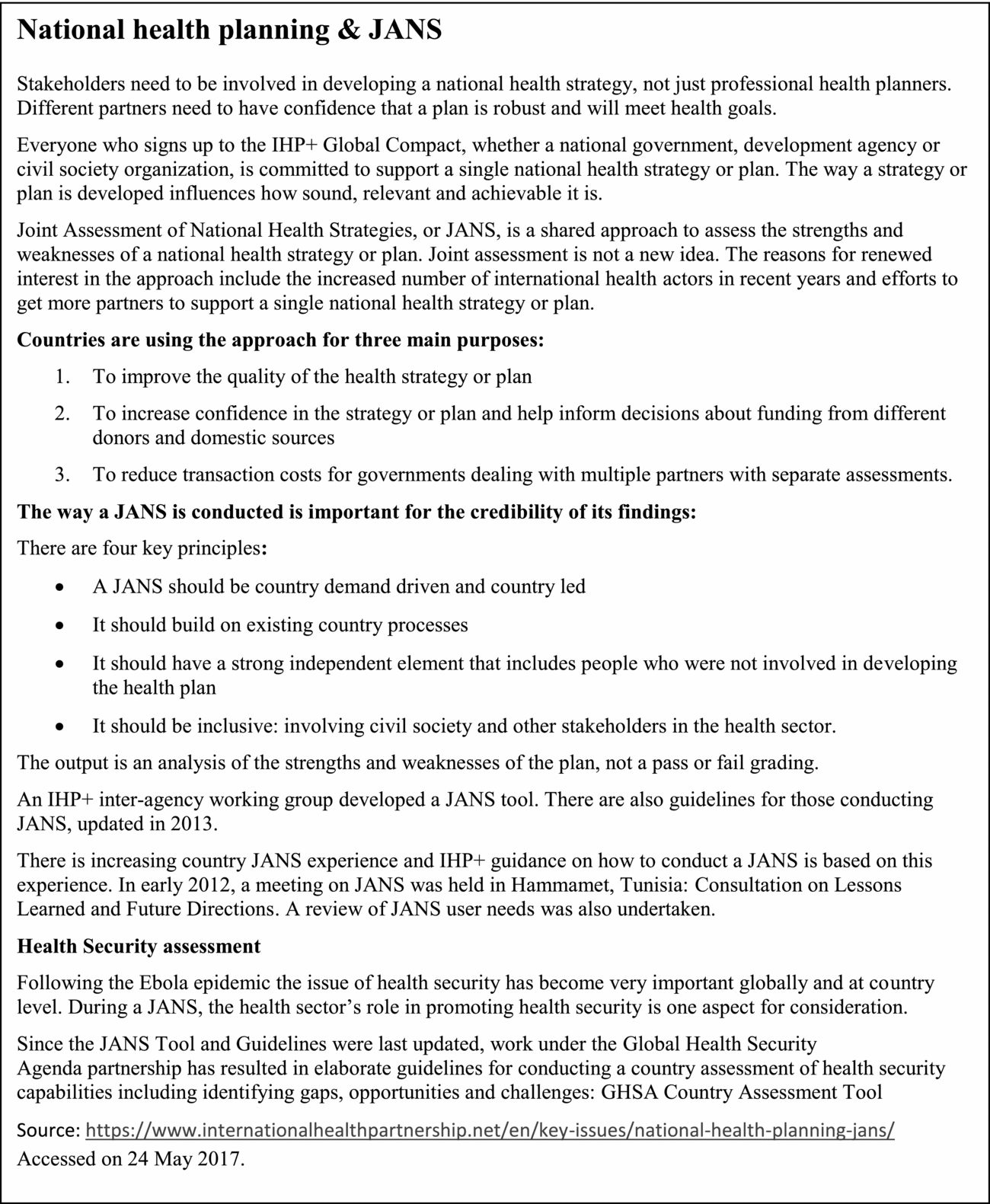
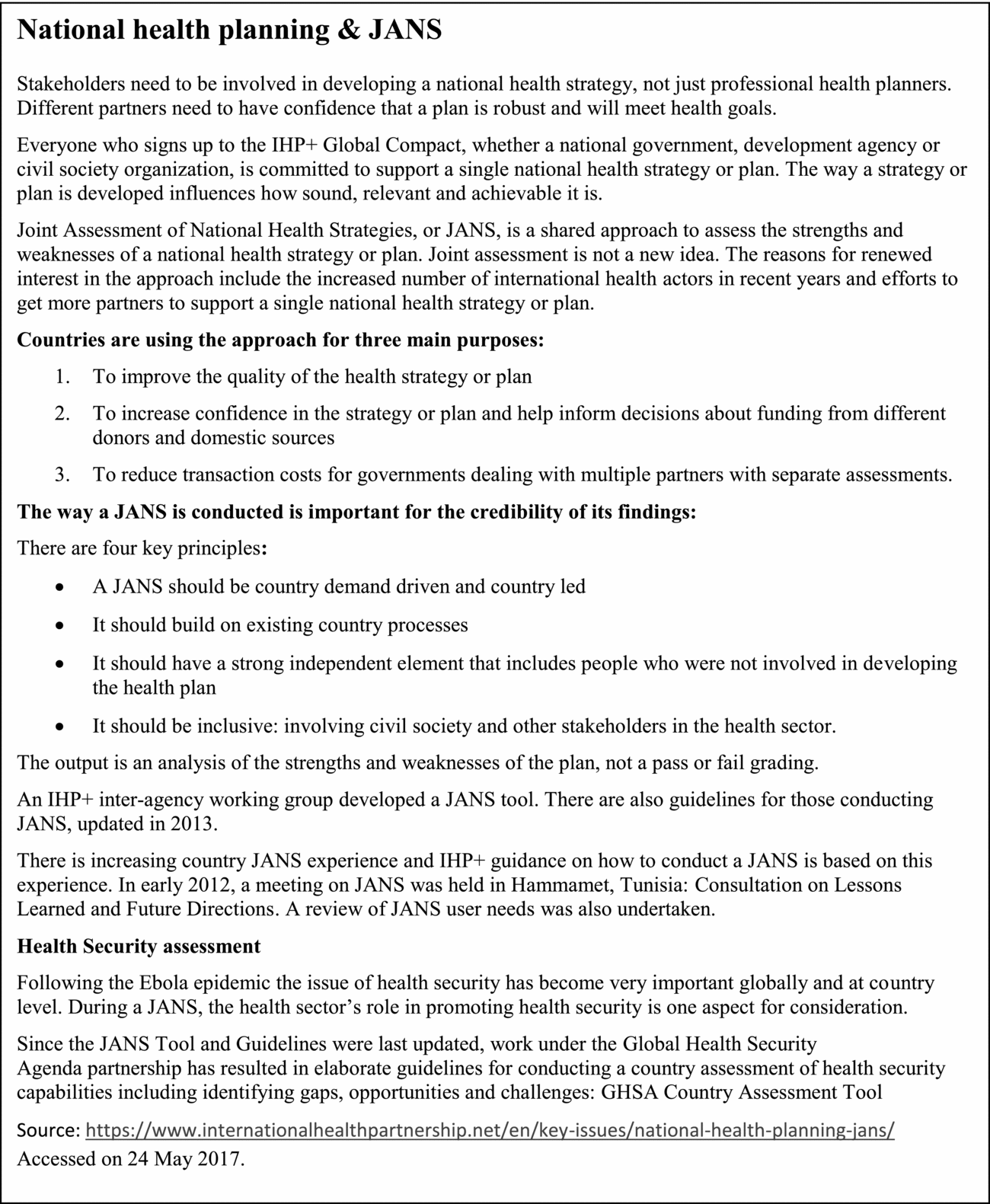
The approach became more systematic through the JANS. JANS was developed by the International Health Partnership (IHP), an initiative of WHO and World Bank. It led to the IHP+ Global Compact, which was signed by more than sixty parties, including countries, bilateral donor agencies, multilateral organizations, and civil society organizations (see Figure 2). The JANS approach is linked to national health planning, in particular the development of a country's national health strategy, which in Sub-Saharan Africa (SSA) typically has a 5-years duration, for which strategic choices need to be made. In principal, JANS include assessments of large-scale and far-reaching interventions, for instance road maps to maternal and neonatal health, which are high on the agenda all over the SSA continent; social/national health insurance schemes that are being run in Ghana and Kenya.
National health planning & Joint Assessments of National Health Strategies (JANS).
Many innovations involve technological interventions, such as for example rapid diagnostic tests that replace laboratory investigations, new forms of medical treatment, solar energy, Internet-based communication, or innovative ways of delivering blood plasma to remote hospitals that do not have their own blood bank. Such innovations are not always recognized as “complex”: while they often concentrate on the technological aspect of the innovation at hand, some of the required accompanying measures, such as staff training, maintenance, or funding to procure the necessary supplies, may be underestimated or overlooked.
There seems to be scope for less naivety and more consistency and methodological rigor in piloting innovation and complex interventions, especially in resource-limited environments that have their own typical socio-cultural values (e.g., delivery of blood plasma to remote hospitals in Rwanda by drones, to assist in blood transfusions after hemorrhage and combat maternal mortality). What is clear though, is that the health systems performance assessment frameworks that are being used in national health planning in SSA are not well linked to typical HTA assessment frameworks, even though some of the criteria are similar: for example, effectiveness, efficiency, appropriateness, feasibility, acceptability, meaningfulness.
Stakeholder Consultation
Stakeholder consultation is being practiced in several countries, more or less on a routine basis, as part of national health strategy development and/or health sector performance reviews (Reference Lauer, Rajan and Bertram19). Consultations are held in the form of consultative groups on specific topics and may involve annual health sector summit meetings which serve as a platform during which the evidence, collected by the team of experts that conducted the health sector review/JANS, is presented and discussed. This has been the case in Burkina Faso (Reference Zida, Lavis and Sewankambo20), Ghana, Ethiopia, Rwanda, Zambia, among others. Such consultations may serve as a precursor to broader stakeholder participation in priority setting and/or health policy making.
At the international level, Web-based communities of practice (CoP) are ongoing on a variety of topics in the domain of health, mostly on innovations that are considered promising. These CoPs provide a platform for health practitioners, program implementers, researchers, and policy makers from various countries to interact. They share evidence, successes/failures, lessons learned, models, papers, new initiatives, pilots and information on training courses, research calls, consultancy opportunities, conferences, vacancies, etcetera. Examples are: the performance-based financing Google Group, moderated by Prof Bruno Meessen from the Institute of Tropical Medicine in Antwerp, with very active participation by member subscribers, especially from both Anglophone and Francophone countries in Sub-Sahara Africa; the technical working group on Community health workers that operates under Health Systems Global; Global public health platforms, for example on Maternal & reproductive health and on Health finance & economics.
Arguably, universal health coverage requires strict priority setting. More specifically, it requires mechanisms and tools that can help policy makers in deciding which interventions need to be made available and how to allocate scarce resources in the most effective, efficient, and equitable way. Cost-effectiveness analyses are widely being used as a tool to inform health priority setting in LMICs, but cost-effectiveness can obviously not be the sole criterion. There is increasing recognition that a broader set of criteria is required to inform policy choices (Reference Baltussen, Mitton, Danis, Williams and Gold21); and that the process of priority setting is as important as the evidence on the selected set of criteria (Reference Baltussen, Jansen and Mikkelsen22).
The PRISMA project in West Java for instance, a joint undertaking of two faculties from Padjadjaran University in Bandung, Indonesia, and the medical faculty from Radboud University in Nijmegen, The Netherlands, is supporting district-level authorities in West Java in priority setting for HIV/AIDS control, based on an integrated multi-criteria decision analysis/accountability for reasonableness framework (Reference Tromp23). Not only has the project helped to define and reach a consensus on a set of indicators on which evidence is required before decisions are taken which HIV/AIDS control activities will be undertaken (and which ones will not be undertaken for the time being), the project has also developed a mechanism through which various district-level stakeholders get the opportunity to be part of the decision-making process.
It involves the collection and synthesis of available evidence about the performance of various candidate interventions, which is then subjected to deliberation and eventually scoring on the agreed criteria. This corresponds more or less with the five steps of the INTEGRATE-HTA model, described earlier. It should be noted though, that it is labor-intensive to engage policy makers and program managers in a priority setting process based on multiple criteria, whereby they themselves discuss and weigh the available evidence. Caution is also required not to turn such prioritization into bureaucratic exercises, outside the purview of parliamentary control in which the voice of citizens is no longer heard. Panteli et al. (Reference Panteli, Kreis and Busse24) have pointed out that even in high-income countries that have established mechanisms in place for priority setting, equity considerations are not always included in HTA evaluations as a matter of standard practice.
Feasibility
The human technical capacity to undertake economic studies and HTA varies greatly between countries. Most economic evaluations in LMICs pertain to interventions in the domain of communicable disease control (HIV/AIDS, malaria, tuberculosis, diarrheal diseases) and most of these analyze therapeutic interventions, chemoprevention, or diagnostic tools. Many health economics studies in SSA are led by researchers from the United States, United Kingdom, or other European countries, and there is weak south-south collaboration between health economics researchers (Reference Hernandez-Villafuerte, Li and Hofman25). This is problematic, because it may jeopardize the inclusion of criteria associated with local values and preferences.
Chalkidou et al. (Reference Chalkidou, Li and Culyer26) have suggested that capacity for priority setting in LMIC could be developed around a small technical unit in the health ministry or a health insurer. They also emphasized the role of networks, development partners, and global norm setting organizations in building such capacity. INAHTA (International Network of Agencies in Health Technology Assessment) and HTAi (Health Technology Assessment international) have stated the importance of collaboration and networking for sharing information resources, training, and opportunities for practical work and expertise (27).
CONCLUSION
The conditions for functional HTA are not always fulfilled in LMICs. At least four aspects would require special attention: (i) the scope and quality of routine health information that can support and be fed into health technology assessments and strategic planning; (ii) consensus on health system performance assessment frameworks and their main criteria, in particular the inclusion of social disparities/equity and sustainability; (iii) institutional capacity to set evidence-based priorities based on a variety of explicit criteria; (iv) political will to engage with stakeholders in a transparent and inclusive consultation process about health priorities.
HTA is being practiced in LMICs, including SSA, even though it is seldom or not referred to as HTA. It does not necessarily follow the five steps distinguished in the INTEGRATE-HTA model (scoping; defining the initial logic model; providing concepts and methods to identify, collect, and synthesize evidence in relation to various dimensions; extracting and presenting evidence in respect of agreed assessment criteria; providing guidance to draw conclusions and formulate recommendations). These steps are being taken in various contexts, for example, in health sector performance reviews or reviews of specific program strategies, mostly in a retrospective manner for accountability purposes; less so with the intention to inform future strategic choices. There is scope to harmonize and be more explicit about the criteria on the basis of which such assessments are being conducted; and for legitimacy purposes there is scope to engage stakeholders in a more inclusive process of priority setting and HTA in general.
CONFLICTS OF INTEREST
The authors have nothing to disclose.