Introduction
Dialectical behaviour therapy (DBT) is a multi-modal psychotherapy originally developed for the treatment of borderline personality disorder (BPD), which includes individual psychotherapy, group skills training, between-session skills coaching, environmental intervention, and therapist support (Linehan, Reference Linehan1993a, Reference Linehan1993b). DBT targets an agreed set of problem behaviours for change with skills training, exposure, cognitive modification, and contingency management within a validating therapeutic context (Swales & Heard, Reference Swales and Heard2009; Koerner, Reference Koerner2012). Regarded as the gold standard of care for the reduction of suicidal and self-injurious behaviours, DBT is classified as an evidence-based treatment with more than a dozen well-controlled trials and scores of uncontrolled studies (Stoffers et al. Reference Stoffers, Völlm, Rücker, Timmer, Huband and Lieb2012). DBT is effective in reducing frequency and severity of self-injury. DBT also reduces length of hospitalisation, anger, depression, suicidal ideation, and alcohol abuse (Linehan et al. Reference Linehan, Armstrong, Suarez, Allmon and Heard1991, Reference Linehan, Schmidt, Dimeff, Craft, Kanter and Comtois1999, Reference Linehan, Comtois, Murray, Brown, Gallop, Heard and Lindenboim2006; Koons et al. Reference Koons, Robins, Tweed, Lynch, Gonzalez, Morse, Bishop, Butterfield and Bastian2001; Verheul et al. Reference Verheul, van den Bosch, Koeter, de Ridder, Stijnen and van den Brink2003; van den Bosch et al. Reference van den Bosch, Koeter, Stijnen, Verheul and van den Brink2005; Stanley et al. Reference Stanley, Brodsky, Nelson and Dulit2007; Carter et al. Reference Carter, Willcox, Lewin, Conrad and Bendit2010). The mechanisms of action of DBT remain an empirical question (Koerner, Reference Koerner2013). However, Neacsiu et al. (Reference Neacsiu, Rizvi, Vitaliano, Lynch and Linehan2010) found DBT skills use by patients mediated changes in key clinical domains.
As with all evidence-based treatments, dissemination of DBT into routine community settings is a complex task, which involves far more than merely training clinicians (Carmel et al. Reference Carmel, Rose and Fruzzetti2014; Karlin & Cross, Reference Karlin and Cross2014). It cannot automatically be presumed that training will inevitably confer comparable outcomes in the community. Many other variables may contribute to outcomes, such as organisational and systemic factors, level of clinician supervision, patient preferences, and greater levels of co-morbidity (Swales, Reference Swales2010; Landes & Linehan, Reference Landes and Linehan2012). Despite the complexities and challenges in implementing evidence-based treatments into the community, a small number of studies indicate the viability of DBT in non-expert community settings. Pasieczny & Connor (Reference Pasieczny and Connor2011) found DBT led to reductions in self-injury and crisis service utilisation in routine practice when delivered by non-experts in the absence of expert supervision. There are also indications that DBT can be successfully implemented in the Irish health service (Blennerhassett et al. Reference Blennerhassett, Bamford, Whelan, Jamieson and Wilson O’Raghaillaigh2009). Further investigation of clinical outcomes associated with DBT in routine practice remains warranted, given the relative paucity of such community-based studies.
Of note, dropout was higher in two recent British community-based effectiveness studies of DBT than the efficacy literature might have predicted (Feigenbaum et al. Reference Feigenbaum, Fonagy, Pilling, Jones, Wildgoose and Bebblington2012; Priebe et al. Reference Priebe, Bhatti, Barnicot, Bremner, Gaglia, Katsakou, Molosankwe, McCrone and Zinkler2012). Dropout (or premature termination) from treatment has long been considered a significant problem in psychotherapy and remains high across different approaches, standing as a significant barrier to desirable clinical outcomes (Wierzbicki & Pekarik, Reference Wierzbicki and Pekarik1993; Garfield, Reference Garfield1994; Barrett et al. Reference Barrett, Chua, Crits-Christoph, Gibbons, Casiano and Thompson2008). Many factors have been attributed to dropout, among them age. A recent meta-analysis of 669 studies from across the field of psychotherapy found patients’ age to be a significant predictor of treatment dropout with younger adults more likely to terminate treatment prematurely (Swift & Greenberg, Reference Swift and Greenberg2012). To the best of our knowledge, data has not been published from the DBT adult clinical trials on dropout as a function of patients’ age, but anecdotal accounts suggest younger adults in DBT may show a tendency towards premature termination.
Age-related attrition was a particular clinical concern facing the first author (J.L.) before our study, where comparatively very high levels of dropout existed among younger adults (i.e. individuals between 18 and 25 years) accessing the DBT programme at his community mental health service. A total of five out of six clients accessing the local DBT programme within this age group had prematurely terminated from treatment during the 3 years before the commencement of this study. Although the British studies above suggest patient retention rates in DBT may be somewhat reduced in community settings, there is a precedent where the provision of DBT to a similar age cohort has reversed established trends on retention as a function of age, namely DBT for adolescents. DBT has been successfully adapted to treat adolescents with problems of suicidal and self-harm behaviours, with good levels of retention (Mehlum et al. 2014; Millar et al. 2007; Neece et al. 2013), despite the typically high levels of dropout frequently observed among adolescents in psychotherapy (Pekarik & Stephenson, Reference Pekarik and Stephenson1988). Although treatment characteristics appear to clearly contribute to good levels of retention of adolescents in DBT, there is also the possibility that some additional factors may be influencing lower dropout. As DBT is notable for the inclusion of a group skills training component, the effect of accessing a treatment alongside a similar age cohort could be contributing to the retention of adolescents in DBT. Being part of a homogeneous cohort can boost retention and render group-based psychotherapy programmes more attractive (Burlingame et al. Reference Burlingame, Fuhriman and Johnson2011). We subsequently wondered if a DBT programme offered exclusively to younger adults may influence retention rates. A new DBT programme was subsequently piloted at J.L.’s service exclusively for younger adults between 18 and 25 years.
The present study is primarily an evaluation of this programme for younger adults. Our aims were to explore any changes in borderline-typical symptoms or mental health symptoms for users of the DBT programme for younger adults. Alongside this aim, we tracked dropout rates from the programme. The present study also aimed to investigate any changes in the use of DBT skills for users of the programme for younger adults.
Methodology
Setting
The study was conducted in a state-funded multi-disciplinary general mental health service in the Dublin area with responsibility for the delivery of services for a range of acute and enduring mental health difficulties.
Participants
Inclusion criteria for the study had been to meet the referral criteria for the DBT programme for young adults, namely 18–25 year olds with an existing diagnosis of BPD (American Psychiatric Association, 2000) and more than one incident of suicidal behaviour and/or non-suicidal self-injury in the previous year in the absence of a primary drug or alcohol problem or an active psychotic illness. The decision to refer to the DBT programme for younger adults was made by the treating community clinical team on a voluntary basis, in consultation with the patient and other stakeholders as needed. All patients accepted onto the DBT programme for young adults over an 18-months period were invited to participate in this study. Although patients were expressly informed that the availability of DBT was independent of participation in the study, all 16 patients accepted onto the DBT programme for young adults over this period consented to participate in the study. Although the programme was open to both male and female patients, referrals to the programme over the duration of the study were exclusively female with the exception of a single male who dropped out early in treatment. This may reflect proportionately higher rates of BPD in females but also may indicate a diagnostic bias (Simmons, Reference Simmons1992). All but four of the participants were in full-time or part-time education at second or third level at the beginning of treatment and of the remainder only two were not gainfully employed outside of the home. More than two-thirds of participants still lived with at least one parent or guardian. A range of co-morbid problems were diagnosed among participants, with the majority presenting with at least a mood disorder and/or an anxiety disorder.
Treatment
The five ‘modes’ of the DBT were included in the programme for younger adults, that is, individual psychotherapy, skills training, telephone consultation, structuring the environment, and therapist consultation group (Linehan, Reference Linehan1993a). The programme matched standard DBT in all respects with the single exception that the DBT skills group consisted exclusively of young adults between 18 and 25 years. Linehan’s (Reference Linehan1993b) four module skills curriculum of mindfulness, emotion regulation, distress tolerance, and interpersonal effectiveness was scheduled to take 22 weeks to complete, with the option to repeat all modules if needed, consistent with standard comprehensive DBT for BPD (Koerner & Dimeff, Reference Koerner and Dimeff2007). The skills training group was designed to function as an ‘open group’, so that patients would be able to join the programme at the beginning of any skills module and as the group skills training component was planned to run on a continuous cycle, patients would be able to complete the desired number of modules regardless of his or her starting point.
Treatment was delivered by a team of 10 clinicians consisting of three clinical psychologists, one counselling psychologist, a mental health social worker, and five mental health nurses who fulfilled at least one of the roles of either individual therapist or groups skills trainers, and frequently both. This team of clinicians was drawn from across the service and had voluntarily opted to avail of DBT training and to work towards the delivery of DBT as a minor component of their weekly clinical duties. All clinicians had received at least the first part of intensive training in DBT (Landes & Linehan, Reference Landes and Linehan2012) at the onset of the study and by the conclusion of the study, all clinicians had completed the second part of this training. The majority of clinicians had no prior experience in delivering DBT and specialist supervision was not available at the time of the study.
Measures
Borderline Symptom List 23 (BSL23) (Bohus et al. Reference Bohus, Kleindienst, Limberger, Stieglitz, Domsalla, Chapman, Steil, Philipsen and Wolf2009)
The BSL23 is a self-rating instrument for the specific assessment of borderline-typical symptoms employing 23 questions answered on a five-point scale, from 0=‘not at all’ to 4=‘very strong’. Bohus et al. (Reference Bohus, Kleindienst, Limberger, Stieglitz, Domsalla, Chapman, Steil, Philipsen and Wolf2009) reported that the development of the scale was based on five different samples with borderline patients and the internal consistency of the BSL23 was found to be high (Cronbach’s α=0.94–0.97; n=694). In addition, test–retest reliability was found to be satisfactory alongside ability to discriminate between the patient group and sensitivity to change.
Symptom Checklist-90-Revised (SCL-90-R) (Derogatis Reference Derogatis1994)
The SCL-90-R was used to assess a broad range of mental health symptoms. The SCL-90-R comprises 90 questions about symptom or problem areas over the past 7 days answered on a five-point scale, from 0=‘not at all’ to 4=‘extremely’, which produce nine scales that reflect major symptom dimensions, namely somatisation, obsessive–compulsive behaviour, interpersonal sensitivity, hostility, depression, anxiety, phobic anxiety, paranoid ideation, and psychoticism. In addition, the SCL-90-R can be scored and interpreted on three global indices of distress including the Global Severity Index. Horowitz et al. (1988) reported test–retest reliability coefficients on the SCL-90-R individual scales ranging from 0.68 to 0.83 over the course of 10 weeks among a psychiatric outpatient sample.
DBT ways of coping checklist (DBT:WCCL) (Neacsiu et al. Reference Neacsiu, Rizvi, Vitaliano, Lynch and Linehan2010)
The DBT:WCCL is a self-report questionnaire with 38 items measuring frequency of DBT skills use over the previous month (e.g. ‘just took things one step at a time’) and 21 items measuring dysfunctional, non-DBT coping strategies (e.g. ‘blamed others’). All items are rated from 0=‘never use’ to 3=‘always use’, and neutral ‘non-DBT’ language is used to describe skills in order to avoid potential response bias alongside the removal of any reference to DBT on the questionnaire. In the current study, only the DBT Skills Usage Subscale was used. Neacsiu et al. (Reference Neacsiu, Rizvi, Vitaliano, Lynch and Linehan2010) reported favourable psychometric properties of the DBT:WCCL, where the DBT Skills Subscale of the DBT:WCCL was found to have excellent internal consistency (Cronbach α=0.92–0.96; n=316) and acceptable test–retest reliability at 4 months treated without access to skills training (ρI=0.71, p<0.001), whereas individuals who did receive skills training had significantly higher scores after 4 months.
Dropout
Dropout for the purpose of the study was defined as not attending both DBT skills group and individual therapy at least once each in the 4 weeks before week 22 of treatment, consistent with definitions of dropout in standard DBT practice (Linehan, Reference Linehan1993a, Reference Linehan1993b).
Procedures
Once a patient was referred to the DBT programme for younger adults, a member of the DBT team conducted ‘pre-treatment’, a clearly defined stage of DBT involving assessment and commitment building (Linehan, Reference Linehan1993a; Koerner, Reference Koerner2012), where a decision was subsequently made to offer DBT, the patient was then invited to participate in the study. Informed consent to participate in the study was achieved through a mixture of discussion and the provision of written materials. The independence of the study from clinical decision making and treatment provision was stressed, whereby the availability of DBT was not contingent on participation in the study. Participants were also made aware that no remuneration was available and they were welcome to withdraw from the study at any time. On agreeing to participate in the study, participants were asked to complete all self-report measures (BSL23, SCL-90-R, and DBT:WCCL) during the first week of the ‘treatment phase’ of DBT, usually coinciding with the onset of the participant’s first week of DBT group skills training (at which time participants had been working with their individual therapists for on average 1 month on ‘pre-treatment’). Participants were then asked to complete the same battery of measures again 22 weeks later coinciding with their completion of the full DBT skills curriculum for the first time alongside an equivalent number of weekly individual DBT sessions. The decision to measure at 22 weeks was not intended to capture final clinical outcomes since treatment was available for 1 year. However, since 22 weeks reflected the first full completion of the DBT skills curriculum, it was judged to represent a meaningful point to assess whether treatment was associated with clinical progress. Dropout rates were also recorded.
Results
A total of 11 out of 16 participants (69%) remained in DBT at 22 weeks. In all, 10 out of 11 went on to complete a full year of treatment in the DBT programme for younger adults. In total, five of the participants dropped out of treatment before week 22, three of these within the first 5 weeks (including the single male in the cohort), one of these at week 16, and one was referred to an alternative treatment at week 18 following a revision of diagnosis and clinical needs. Follow-up data could not be collected for participants who dropped out of the study as they were not accessible for evaluation purposes. Analyses of differences between scores at week 1 and week 22 were conducted on the remaining 11 completers using the Wilcoxon signed-rank method for non-parametric data (see Table 1 for a summary of the analyses). Effect sizes were calculated by dividing the z value by the square root of n, where n is the number of observations (Pallant, Reference Pallant2010). When describing this method, Cohen (Reference Cohen1988) classified r=0.1 as a small effect size, r=0.3 as a moderate effect size, and r=0.5 as a large effect size.
Wilcoxon signed-rank analyses of the BSL23, SCL-90-R, and DBT:WCCL median scores at week 1 and week 22 of DBT for younger adults
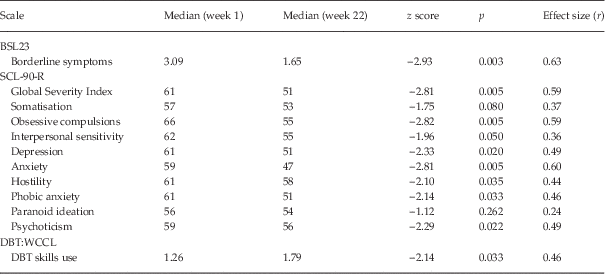
BSL23, Borderline Symptom List 23; SCL-90-R, Symptom Checklist-90-Revised; DBT:WCCL, Dialectical Behaviour Therapy ways of Coping Checklist; BPD, borderline personality disorder.
Statistical analyses conducted using the Wilcoxon signed-rank test showed significant improvements in BPD symptoms (as measured by the BSL23), general psychopathology (as measured by the Global Severity Index on the SCL-90-R), and domains of psychopathology (as measured by the obsessive compulsions, depression, anxiety, hostility, phobic anxiety, and psychoticism subscales on the SCL-90-R) over 22 weeks. There was also a significant increase in self-reported DBT skills over 22 weeks (as measured by the Skills Usage Subscale of the DBT:WCCL). These changes over time were associated with estimated effect sizes in the medium to large range.
Discussion
We found reductions in borderline-typical symptoms, global levels of distress, and several mental health symptoms among young adult females with BPD following the delivery of community-based DBT for younger adults (18–25 years) over 22 weeks. We also found an increase in DBT skills use among this sample following the delivery of 22 weeks of DBT. Dropout from the DBT programme at 22 weeks was 31%.
The modest rate of patient dropout during the 22 weeks of treatment is noteworthy. At a local level, this compares favourably with the high levels of dropout from DBT, which occurred among the 18–25 age groups when DBT was delivered in a single programme to adults of all ages. Improvements in psychopathology are also encouraging, especially considering that measurement took place at 22 weeks, whereas DBT treatment continued for a further half year for 10 out of 11 of the participants. Nonetheless, since participants showed symptom scores at 22 weeks, which indicate some ongoing difficulties despite gains, the study does not seem to support the provision of a shortened version of DBT for younger adults as is typical in the provision of DBT for adolescents (Neece et al. Reference Neece, Berk and Combs-Ronto2013). During subsequent treatment over the remainder of 1 year, there were anecdotal accounts of further clinical gains and one full year of DBT may be indicated for this age group, as has been indicated for adults generally (Stoffers et al. Reference Stoffers, Völlm, Rücker, Timmer, Huband and Lieb2012). Although further controlled investigation is necessary, the delivery of DBT to younger adults in an age-specific cohort could have specific benefits.
Substantial methodological limitations apply to the study. In addition to the problems of a small sample size, the study utilised a single group pre–post-test design. In particular, the statistical artefact of regression towards the mean may also have impacted on findings, whereby extreme scores have a general tendency to move in the direction of more moderate scores on retesting. The pretest scores were also collected at the beginning of the treatment phase of DBT rather than at the beginning of the pre-treatment stage, a distinct commitment and motivation centric stage of DBT that can take several weeks. It is entirely possible that clinical improvement already occurred during pre-treatment and the reported gains under-represent the true nature of clinical progress. A further limitation was the lack of a measure of DBT adherence among participating clinicians in the study, despite including all modes of DBT within the treatment.
Collecting data in routine settings is challenging, yet crucial in understanding the effects of evidence-based treatments in the community (Lambert & Ogles, Reference Lambert and Ogles2004). The trends identified in this study regarding symptom reduction are consistent with the pattern of symptom reduction established in controlled, larger trials where DBT for BPD has established efficacy. In addition, the increased use of DBT skills is also consistent with controlled research, which has indicated the mediation effects of DBT skills use on symptom reduction in BPD (Neacsui et al. Reference Neacsiu, Rizvi and Linehan2010). Broadly speaking, the study lends further support to the viability of DBT for BPD in community settings delivered by appropriately trained non-experts. It will be of particular interest to note whether similar trends are observed in the ongoing large multi-site study of DBT outcomes in Irish community mental health settings funded by the National Office of Suicide Prevention and coordinated by the Irish Health Service Executives’ National DBT Project Office based in Cork.
Acknowledgements
The authors thank to the DBT team (past and present) at Cluain Mhuire for their commitment and skill and for the support and guidance of my manager principal clinical psychologist Lucy Moore. Heartfelt appreciation also for the inspiring young adults on whose engagement and participation this project depended.