Pediatric antimicrobial stewardship programs (ASPs) have been shown to improve patient outcomes and reduce antibiotic overuse. Reference Gerber, Jackson, Tamma and Zaoutis1 Despite these efforts, inappropriate antibiotic prescribing continues to occur in children’s hospitals. A study of 32 children’s hospitals demonstrated that one-quarter of pediatric inpatients treated with antibiotics received suboptimal therapy, with half of suboptimal use not captured by ASP review. Reference Tribble, Lee and Flett2 In addition, there are concerns that antibiotic prescribing at hospital discharge is also often inappropriate. Reference Hersh, Newland and Gerber3 Approximately 30% of pediatric discharges include an antibiotic prescription, Reference Hersh, Newland and Gerber3 and in one single-center pediatric study, 27% of antibiotic prescriptions at discharge were suboptimal. Reference Olson, Thorell and Hersh4 Discharge stewardship interventions by adult ASPs have resulted in improved prescribing, Reference Su, Hidayat, Rahman and Venugopalan5,Reference Yogo, Shihadeh and Young6 however, pediatric ASP oversight for children prescribed antibiotics at discharge has not been widely described. The objective of this study was to describe the current state of antimicrobial stewardship activities at discharge among hospitals with a pediatric ASP.
Methods
We conducted a cross-sectional survey of institutions in the Sharing Antimicrobial Reports for Pediatric Stewardship (SHARPS) collaborative from April to July 2019. The SHARPS collaborative includes >70 children’s hospitals and general hospitals with pediatric beds and aims to establish best practices for antimicrobial use among hospitalized children. Reference McPherson, Lee and Terrill7
One SHARPS collaborative physician or pharmacist from each US-based hospital was e-mailed the survey invitation and up to 3 reminders, which was administered through a secure Research Electronic Data Capture (REDCap) tool hosted at Stanford University. Survey completion indicated consent to participate. The Institutional Review Board of Stanford University approved this study.
Survey items asked about hospital practice setting, locations of ASP oversight, ASP review of discharge prescriptions, and discharge stewardship strategies used. Respondents rated the perceived frequency of problems with discharge antibiotic prescriptions at their institution using a Likert scale: rarely (<10% of the time), sometimes (11%–49% of the time), or often (≥50% of the time). Respondents then ranked the 3 highest priorities that needed to be addressed regarding discharge antibiotic prescribing. The survey instrument is available in Supplementary File 1 (online).
Survey items were developed by the investigator group, which consisted of pediatric infectious diseases clinicians. Investigators reviewed each item for importance, applicability, and clarity to establish content validity, and items were revised accordingly. The survey was reviewed by noninvestigator experts in pediatric infectious diseases for readability, interpretation, and understanding, pilot tested to assess functionality, and then distributed through REDCap.
Responses were reported using descriptive summary statistics. Data were analyzed using Stata version 15 software (StataCorp, College Station, TX).
Results
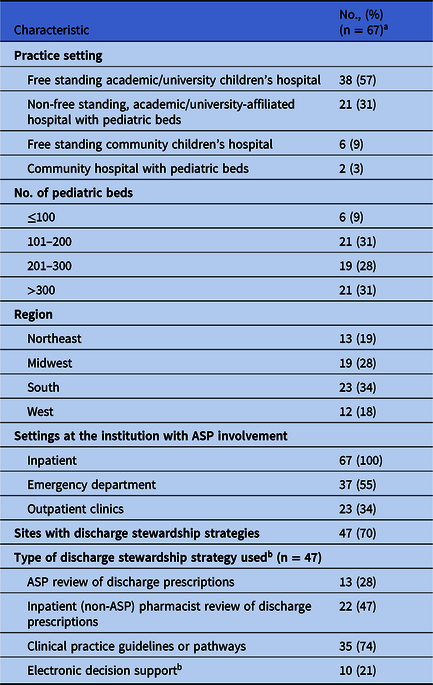
The survey was completed by 67 of 74 (91%) institutions in the SHARPS collaborative (Table 1); 42 (63%) were ASP medical directors, 22 (33%) were pharmacists, and 3 (4%) were other infectious diseases physicians.
Characteristics and Discharge Stewardship Activities of Participating SHARPS Hospitals

Note. SHARPS, Sharing Antimicrobial Reports for Pediatric Stewardship; ASP, antimicrobial stewardship program.
a Percentages may not add up to 100 due to rounding.
b Percentages add up to >100 because sites could report using >1 strategy.
c Examples of electronic decision support include discharge order sets and Smart tools.
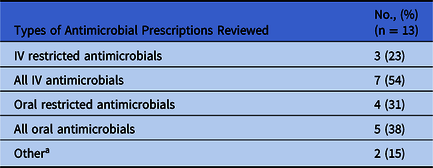
Overall, 47 (70%) sites reported using 1 or more of the following discharge stewardship strategies: ASP review of discharge prescriptions, non-ASP pharmacist review of discharge prescriptions, clinical pathways and guidelines, and/or electronic decision support (Table 1). Of the 47 sites with discharge stewardship strategies, 13 (28%) reported ASP review of discharge prescriptions. Specific strategies used for discharge prescription review included prospective audit with real-time feedback and approval or denial of restricted antimicrobials. At 3 sites, all discharge antimicrobials were reviewed, and at the remaining 10 sites, specific subgroups (eg, oral, IV, or restricted antimicrobials) were reviewed (Table 2). Of 47 sites with discharge stewardship strategies, 22 (47%) reported that non-ASP pharmacists reviewed discharge antimicrobials. Stewardship by non-ASP pharmacists comprised a wide spectrum, from review of all discharge antimicrobial prescriptions by an inpatient or transitions of care pharmacist to review at the discretion of the pharmacist following up on their own patients. Other strategies by non-ASP pharmacists included pharmacist review through discharge rounds conducted daily or twice weekly and inpatient pharmacist review through a bedside medication delivery program. The most common discharge stewardship strategy was clinical guidelines or pathways that recommended appropriate discharge antibiotics for specific infections, reported by 35 sites (74%). Ten sites (21%) reported having electronic decision support to promote stewardship, such as discharge antibiotic order sets, based on clinical guidelines.
Types of Prescriptions Reviewed by ASP at Discharge

Note. ASP, antimicrobial stewardship program; IV, intravenous.
a 1 site reviewed all discharge prescriptions for one service (hospital medicine), and 1 site reviewed durations for 6 common antibiotics.
The most commonly perceived problems with discharge antibiotic prescribing were incorrect duration of therapy, inappropriate drug selection, and incorrect dose, which corresponded directly with 3 highest priorities identified for discharge stewardship interventions (Supplementary Fig. 1 online).
Discussion
In this national survey of pediatric discharge antimicrobial stewardship practices, most pediatric ASPs reported that they do not perform review of antimicrobial prescriptions at the time of discharge. With an estimated 30% of hospitalized children discharged with an antibiotic prescription, Reference Hersh, Newland and Gerber3 these findings highlight discharge stewardship as an opportunity for improvement during the transition from hospital to home. Although ASP leaders perceived that discharge antimicrobial errors were common, multicenter pediatric data on appropriateness of discharge antibiotic prescriptions are needed to fully understand the scope of the problem.
The optimal approach to discharge antimicrobial stewardship remains unknown, including who should provide oversight, what strategies for pharmacist review should be utilized, and which patient populations and medications to target. ASP strategies for antimicrobial review, such as prospective audit with real-time feedback and approval/denials of restricted antimicrobials, have been successful in improving appropriate antimicrobial use for hospitalized children, Reference Newland, Stach and De Lurgio8 but these have not been studied for pediatric discharge prescriptions. One adult discharge stewardship intervention utilizing prospective audit with real-time feedback was associated with decreased use of antibiotics with broad gram-negative coverage and shorter treatment durations after discharge. Reference Yogo, Shihadeh and Young6 Although pharmacist-led medication reconciliation and review has been associated with decreases in medical errors, readmission, and ED visits, Reference Mekonnen, McLachlan and Brien9 programs may be limited in the resources they have to implement such efforts. In addition, guidelines, pathways, and decision support tools for optimal prescribing of antimicrobials continue to evolve. Efforts to standardize care through institutional guidelines have been shown to improve appropriate antibiotic prescribing for infections such as community-acquired pneumonia. Reference Newman, Hedican, Herigon, Williams, Williams and Newland10 Such guidelines are considered an important aspect of inpatient stewardship strategies because they provide evidence-based treatment recommendations based on local data, and they may require fewer resources than pharmacist review of discharge prescriptions. Reference Gerber, Jackson, Tamma and Zaoutis1
This study has several limitations. First, we only surveyed leaders from SHARPS collaborative institutions, which are mostly university-affiliated and already have ASPs. Second, we only surveyed one leader per site. Perceived problems and priorities may have differed by respondent, even within the same program. Third, as most institutions do not regularly collect data on the appropriateness of discharge antibiotics, we were unable to compare perceived problems with actual institutional data. Fourth, we did not collect detailed data on categories of antimicrobials reviewed by non-ASP pharmacists or whether they also performed medication reconciliation. Lastly, we were unable to evaluate the effectiveness of reported stewardship interventions.
In conclusion, despite the growing evidence for inappropriate antibiotic use as patients transition from hospital to home, most pediatric ASPs do not review discharge antimicrobial prescriptions. Opportunities may exist for improvements in prescribing at discharge, including drug selection, dose, and duration. Future research should characterize the extent of inappropriate discharge prescribing across multiple institutions to better inform the development of discharge stewardship interventions.
Financial support
No external funding was obtained for this study.
Conflicts of interest
The authors have no financial relationships relevant to this article to disclose. The authors have no conflicts of interest relevant to this article.
Supplementary material
To view supplementary material for this article, please visit https://doi.org/10.1017/ice.2021.283