This study examines to what extent the two young democracies in the Greater China region, Taiwan and Hong Kong, have fostered a robust level of “civic solidarity.” While the freedom to exchange different or even conflicting opinions with fellow citizens openly, without state interference, is one of the prized ideals of civil society, this ideal of respecting differences is premised upon the existence of certain levels of “civic solidarity,” which refers to a sense of “we-ness”Footnote 1 or a symbolic, collective community bonded together distinctly by civic ties rather than family, kinship, ethnicity or primordial identities.Footnote 2 As illustrated below, debates over the nature of civic solidarity commonly point to the importance of a shared cultural repertoire used by members of civil society to recognize their particularistic goals in terms of broader, more widely shared ideals or common purposes. Taking the civil society discourse approach, we conceptualize this shared cultural repertoire specifically in terms of a cultural vocabulary, along with its dramaturgical usage, that both enables the fostering of a sense of “we-ness” and allows for articulations of different values, opinions and collective identities. Is there such a cultural vocabulary and related dramaturgy in the young, fragile yet vibrant civil societies in Taiwan and Hong Kong? How and why is this important for the development of their political cultures?
The issue of civic solidarity is relevant in these cases. Both societies face serious (though very different) political and cultural cleavages, testing the promise of a civic community capable of encompassing diverse values and opinions. In Taiwan, the opposition movement in the 1970s and 1980s sought to challenge both the authoritarian rule of the KMT government and the particular “Chinese national identity” that was perceived to be an imposition of an alien regime. After the abolition of martial law in 1987, competing narratives of national identity quickly abounded on the island. The pro-unification/pro-independence divide (and variants of it) fractured the island's collective imagination of national identities, giving rise to worries that social fragmentation may become a serious threat to meaningful deliberations among citizens.Footnote 3 Conversely, some scholars observe that public debate may be strengthening a sense of civic community which may keep the national identity controversy at bay.Footnote 4
In contrast, in Hong Kong the years leading up to the 1997 reunification with China cultivated a largely uncontested national identity among local residents: “the newly acquired identity of Hong Kong people as Chinese nationals and soon-to-be PRC citizens endowed them with a powerful commitment to, and strong identification with, China.”Footnote 5 However, local deliberations over the “1997 issue” also nurtured a growing consciousness of a Hong Kong identity, articulated generally through a narrative of liberty, law, the free market and cosmopolitanism.Footnote 6 In the electoral arena, the clandestine Beijing–London negotiations over the pace and nature of reform polarized the political landscape into a pro-democracy/pro-Beijing dichotomy. Although the major political fault lines underwent significant transformations after 1997,Footnote 7 public discourse about the common good remains divided. While democrats emphasize the ideals of freedom, equality and autonomy, the pro-Beijing and conservative coalition (along with the HK-SAR government after 1997) champions the values of harmony, stability and prosperity.Footnote 8 Culturally, the narratives of localism continue to distinguish Hong Kong identity from the immigrants from mainland China.Footnote 9 One can argue that both Taiwan and Hong Kong face the challenge of how to develop and sustain a civic community that can, surpassing cultural and political divisions, serve as a basis for further democratic consolidation. Investigating the question of civic solidarity allows us to assess key aspects of the strength of the civic community. Before moving on to the analysis of our cases, the next section briefly explains the discourse of civil society approach.
Civic Solidarity: The Discourse of Civil Society Approach
The solidarity question, in one form or another, has been central to the philosophical discussion of civil society, inspiring diverse theoretical views. These different positions generally agree on the importance of common ideals, symbols and narratives in the civic community, which provide cultural coherence to a salubriously diverse society.Footnote 10 In recent years, discussions informed by feminist perspectives formed an important addition to this literature, challenging the very possibility of a common cultural repertoire. Feminist scholars observe that even when a civil society is formally open and inclusive to all, its cultural vocabulary often becomes an informal mechanism of exclusion, as it is composed of styles of speech and discursive codes that have been shaped by past legacies of discrimination. Thus, discursive interaction in civil society is “governed by protocols of style and decorum that were themselves correlates and markers of status inequality, [which] functioned informally to marginalize women and members of the plebeian classes.”Footnote 11 Scholars of civil society are therefore faced with a dilemma. If a shared sense of “we-ness” is necessary to facilitate debate without threat of social disintegration (as civil society scholars argue), and if cultural vocabularies articulating such symbolic solidarity inevitably favour certain cultural styles at the expense of others (as feminist scholars contend), then how should we conceptualize civic solidarity to capture both its function and its threats?
The discourse of civil society approach addresses this difficult question. Developed mostly by Jeffrey Alexander and his students, it argues that the binary cultural codes of the civil (sacred) and the uncivil (profane) provide the fundamental cultural language for discourses on democratic ideals. People resort to characteristics associated with the civil and the uncivil in their shared cultural repertoire to make sense of social events and construct narratives about them. It is true that groups differ in how they label events or persons; they press their own interpretation, but the shared binary code provides the common ground for mutual engagement. Rather than seeing marginal groups as enjoying a fair hearing in universal, critical-rational discourses or operating with completely different cultural systems, Alexander contends that they are coded with stigmatized categories within a shared system of meaning.Footnote 12 Thus, it is possible (though certainly challenging) for marginal groups to strive for the opportunity to argue in front of the general public that their stigmatized qualities are in fact a different manifestation of characteristics on the sacred side of the binary.
For Alexander, this system of binary codes provides the basic cultural vocabulary for the articulation of civic solidarity. Building upon this framework, we further specify the concept of civic solidarity as having three analytical dimensions: content of the cultural codes, level of code sharing, and narratives of “the public” or “the people.” We briefly elaborate these three dimensions below.
Content of binary codes
Alexander grounds his analysis in the case of the United States, describing most clearly the binary codes of liberty. Scholars who have extended this framework beyond the American contextFootnote 13 document cases of other cultural codes that share similar semiotic structure but differ in content. We argue that in transitional, young democracies, discourses of civil society often develop through social groups’ appropriation of the code of liberty, their elaboration of past cultural legacies or a creative mix of the two. While civic solidarity refers to civic rather than particularistic bonds, we acknowledge that there may be cultural variations in how civic relationships are defined (such as a civic community of rational, independent social actors, a civic community of caring, compassionate individuals or a civic community of orderly, rule-binding, authority-respecting citizens). Attending to the content of the codes also allows us to scrutinize whether they are truly civic. For example, the codes that cherish individual autonomy or compassion have greater civic and democratic implications than those that enshrine state power or religious authority.
Level of code sharing
Alexander's discussions pertain to established civil societies with a single, more or less enduring set of binary codes. Other scholars have shown that in transitional, young democracies, rival groups often resort to competing sets of binary codes.Footnote 14 In well-established civil societies, dominant cultural codes tend to be “sedimented in institutions and practices. [But] in a civil society that is less established there will be more flux and less certainty about the dominant code, and actors will more often contest the validity of the codes themselves.”Footnote 15 The extent to which competing groups share the same codes through which they articulate opposing opinions directly indicates the level of civic solidarity.
Cultural narratives or images of “the public”
Narratives and images of “the public” or “the people” provide a concrete picture of the “we-ness,” coalescing broader, more abstract ideals of civility into an actual description of the civic community. By referencing available narratives or images of the public, interest groups and civic associations connect their particularistic goals with the common good. However, concrete studies of civil society suggest a model of multiple public spheres nested in the larger structure of civil society.Footnote 16 So the discourses of “the public” that are grounded and circulated within each of these public spheres can be quite distinct from one another. This diversity can be a healthy sign of a vibrant civil society that engages rich and plural collective imaginations. But if the discursive difference is located along major political fault lines, it may indicate non-communication or mutual disengagement between these opposing groups; they are each appealing to a different “people” when addressing the common good and having little success at mutual engagement.
The first two analytical dimensions outlined above define the shared cultural vocabulary available for articulating civic “we-ness,” whereas the third dimension refers to the dramaturgical presentations of this collective identity. Jacobs’ study of how mainstream media and black newspapers in Los Angeles reported the 1992 Rodney King controversy in drastically different ways is a good example to illustrate the distinction.Footnote 17 While both sides share a set of democratic codes (such as rationality/irrationality, rule of law/arbitrary use of power and so on), they use this shared cultural language to describe two very different stories of “the people.” The democratic content of the codes and the high level of code sharing indicate a high degree of civic solidarity – both sides agree that civil society needs to purge those who violate individual autonomy and abuse power. But the two sides differ in the understanding of what really happened and who the code violators were. This reveals a potential worry about a lack of meaningful dialogue between the black and mainstream public spheres.Footnote 18 In some cases, the disparity may have resulted from “uncivil” narratives with racial biases or discriminations (such as the assumptions that whites can never truly treat blacks as equals or that blacks are prone to violence).Footnote 19 In this situation, the difficult task of civil repair is in demand. If equipped with shared democratic codes of civility, social groups are potentially capable of taking on this task; that is, eventually learning to recognize how their biases violate their own cultural codes of civility.Footnote 20
Data and Method
This study focuses on two important moments of democratization: the 1995 LegCo election campaign in Hong Kong and the 2000 presidential election campaign in Taiwan. Although they were different in content and form, both elections marked moments of significant (if limited) democratic progress amidst unresolved political and cultural divisions. The two LegCo elections before 1997 were limited in scope but served to build a popular support base for the pro-democracy camp; both times the democrats captured two-thirds of the popular vote. The 1995 election is sometimes described as a face-off between pro-Beijing and pro-democracy forces, getting “as close to a two-party competition as it ever was in Hong Kong.”Footnote 21 In Taiwan, the 2000 election followed the first direct presidential election and the missile crisis in the Taiwan Strait in 1996. This election marked a historical turning point: citizens elected the first non-KMT president in the post-Second World War history of the island. Meanwhile, as discussed earlier, the coherence of the symbolic civic community in both places faced many challenges (including a national identity crisis, a divided vision for the common good, and a strained relationship between local and national identities) despite the progress of democratization. While the two moments represent a mere snapshot of civic engagement, a systematic analysis of civic solidarity during these moments can be important, and can offer a base-line measure for observations of the development of these two civil societies in subsequent years.
This article uses political cartoons for its data. Both cases have important local memories of using cartoons as political commentary. In Hong Kong, the censure of newspapers printing controversial political cartoons in the 1960s was commonplace.Footnote 22 More recently, indirect government pressure and self-censorship of the newspaper resulted in the infamous removal of Larry Feign's “World of Lily Wong” from the South China Morning Post in the mid-1990s.Footnote 23 In Taiwan, local artists put up with similar efforts under martial law. Po Yang's 柏楊 translation of a Popeye cartoon was construed as an expression of his contemptuous attitude towards Chiang Kai-shek and eventually used as part of the evidence to justify his imprisonment. CoCo's biting political satire in the late 1970s forced him to sojourn in the United States for several years rather than face a displeased dictatorship. With democratization proceeding, this “weapon of the weak” has taken on new roles. In Taiwan, social groups are now learning to address their antagonisms civilly and openly, whereas this could only be done through underground channels in the past. Political cartoons are used as a means to communicate one social group's disliking of another in the public sphere.Footnote 24 In Hong Kong, political cartoons have been similarly transformed from a “weapon of the weak” to a particular genre of civil discourse. In addition to observing the local social norms of being civil in one's mockery of others, presses began to exercise some degree of self-censorship for fear of alienating Beijing as the 1997 transition approached.Footnote 25
The changing nature of discourses about social antagonism in both cases, along with the rise of self-censorship in Hong Kong, has affected the local cultural landscapes in general. Political cartoons are neither unique nor particularly representative. The most informative aspect of the study of political cartoons is the non-elite discourses that test the limits of “civil antagonism.” Like their Western counterparts, policy debates, opinion polls and newspaper editorials are typically organized with frameworks produced by cultural and political elites,Footnote 26 whereas political cartoons are more commonplace and thought to be nearer the sentiments of the public.Footnote 27 In order to communicate complex ideas and subtle jokes within a couple of frames of simple drawing, political cartoons must use familiar, easily accessible cultural metaphors and referents. The use of popular cultural references enables the “process by which abstract ideas and distance, unfamiliar persons or events are converted into something close, familiar, and concrete.”Footnote 28 This discursive presentation makes the genre of political cartoons especially telling about the locally embedded cultural repertoires that resonate with the general public. Furthermore, in serious political commentaries (such as editorials and policy debates) and institutionalized forms of expressions (such as opinion polls), great efforts are typically made to ensure that the framing of discussions of sensitive topics is not overly offensive or inflammatory. But as a genre, political cartoons are “licensed to heckle” and thus allowed greater room for bold expression.Footnote 29 This genre thus offers a fitting forum for observing how far one can go in mocking others without being perceived as “uncivil” in the local, commonplace speech.
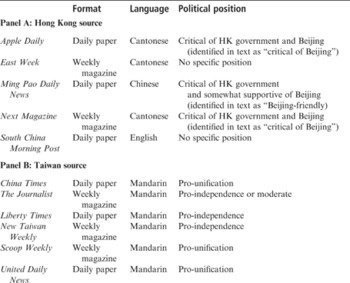
Our sample consists of 371 political cartoons from Hong Kong (140) and Taiwan (231), which were printed in the two months prior to the 1995 LegCo election and the 2000 presidential election. As is widely acknowledged (and directly relevant to our inquiry), the newspapers and weekly news magazines in both settings often represent sharply divided political standpoints. We included what were commonly recognized at the time as representative publications from each position (excluding the ones that did not publish political cartoons). For our research goal of understanding locally embedded popular political discourses, we limited our pool to market-based publications with large readerships, excluding the party-run, party-funded papers with limited circulations (see Table 1).
Sources of Political Cartoons in Hong Kong and Taiwan

In Hong Kong, we selected every cartoon available in these sources for which a legible copy could be found. In Taiwan, we retained all cartoons available from all newspapers and news weeklies with the exception of the Ziyou shibao (自由時報, Liberty Times). For the Liberty Times, which is rich in political cartoons, we selected at least one from each day and favoured cartoonists who were represented infrequently over cartoonists whose work was more commonly published.
Based on the political stand of the newspaper or magazine that they came from, the cartoons were coded for their political position. In Hong Kong, newspapers and news magazines could roughly be typed into pro-Taiwan and pro-Beijing camps prior to the 1990s,Footnote 30 but this dichotomy then broke down. By the time of this study there was still a set of newspapers and news magazines critical of Beijing (represented here by Pingguo ribao [蘋果日報, Apple Daily] and Yi zhoukan [壹週刊, Next Magazine]) a second set that was friendly towards Beijing and often critical of both Taiwan and the present Hong Kong government (represented here by Ming bao [明報, Ming Pao Daily]), and a third category that was more scattered politically and often described as apolitical (represented here by Dong zhoukan [東周刊, East Week] and the South China Morning Post).Footnote 31
In Taiwan, the issue of independence divided most papers and news magazines. Anti-independence papers (Zhongguo shibao [中國時報, China Times], Dujia baodao [獨家報導, Scoop Weekly] and Lianhe bao [聯合報, United Daily News]) were strident in their political stance. The pro-independence papers and magazines (Liberty Times and Xin Taiwan xinwen zhoukan [新台灣新聞週刊, New Taiwan Weekly] were combined with papers and magazines that took a more moderate stand (represented here by Xin xinwen [新新聞, The Journalist]). The categories we used for this coding schema obviously cannot address the nuances of competing identity narratives in these two settings. Rather, they are meant to capture major political positions along which serious social divisions formed.
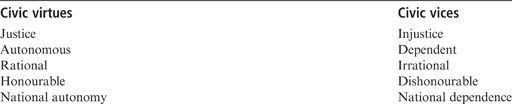
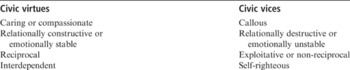
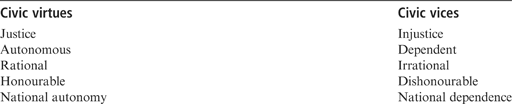
In addition to political position, we coded each cartoon for the main binary codes of civic ideals/vices, as guided by our discourse of civil society approach. We read each cartoon in order to identify its punch line, which, in turn, was interpreted as informed by a particular binary code. Typically, cartoons create political humour by presenting a situation where a cultural code is violated in an exaggerated or unexpected manner. For example, one cartoon features a politician visiting victims of a landslide and expressing sympathy. As soon as the reporters leave, the politician abruptly drops his smile, ends the visit and rushes to his next public appearance. In our interpretation, the joke is on the politician, who pretended to be compassionate but was found callous or self-seeking. The binary code informing this cartoon would be “compassionate versus callous or self-seeking.” In this manner, a list of codes emerged from our interpretative coding of the data. These codes appeared to cluster around three broad themes: liberty, caring and bureaucratic efficiency. The set of binary codes grouped under “liberty” closely resembles Alexander's description of the American civil society discourse (see Table 2). The codes grouped under “caring” focus on the values of compassion and interdependence (see Table 3). Finally, the set of codes whose overarching theme is “bureaucracy” focuses on the efficacy and competence of the state (see Table 4).
Binary Codes of Liberty
Binary Codes of Caring

Binary Codes of Bureaucracy

The liberty codes are dominant – though obviously imported – in both cases. Because over three-quarters of the cartoons draw on this set of codes, in the findings section below we report the percentage of cartoons informed by each individual code within this set. The codes of compassion and bureaucracy represent alternative, non-dominant civic values. While our data here do not address the origins of these codes, one can speculate that the codes of caring have roots in Confucian values. Elsewhere the first author also documented how this set of codes has been elaborated and transformed by contemporary feminist groups in both Hong Kong and Taiwan.Footnote 32 The codes of bureaucracy may also originate from the Confucian tradition of state paternalism and have been co-opted by and disseminated from contemporary government ideologies. For example, Ku explains how the British colonial government and conservative socio-economic elites in Hong Kong had cultivated a hegemonic discourse of administrative efficiency that elevated the value of government performance over democratic practices.Footnote 33
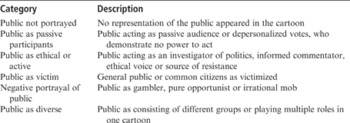
Finally, we coded cartoons for their portrayal of the public. In our interpretive coding, the public is recognized as the depiction of common citizens, an audience, voters or other everyday figures who are present in civil society. Six categories emerged from our data (see Table 5). As discussed previously, if different political camps consistently differ in their dramaturgical presentations of the public, it can be a sign of fractured civic solidarity: both sides invoke the moral anchor in democracy (the public) yet have little in common in their concrete descriptions of the stories of the public. To understand these images and narratives requires an in-depth interpretation of the process of meaning-construction, which, as part of our larger project, is addressed elsewhere through a qualitative inquiry.Footnote 34 As the current study focuses on quantitatively documenting the level of civic solidarity, our discussion is limited to whether cartoons from across the political spectrum share similar understandings of the roles of the public in various political dramas.
Portrayal of Public

Like all studies with interpretive coding, our data analysis is biased by our subjective reading of the materials and we acknowledge this as a limitation. But we made careful efforts to ensure that the coding process was consistent. The two authors jointly coded a subset of cartoons to develop a draft codebook, which continued to be revised during the coding process as new codes emerged from the data and infrequently used codes were merged. After we drafted the codebook, we coded each cartoon separately on these three variables. We then compared results and discussed any discrepancies, resolving them by checking on each other's application of our coding schema and correcting inconsistent usage. Thus all cartoons have been double coded.
Findings
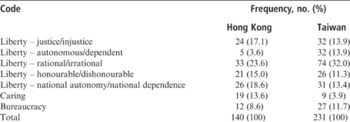
Table 6 reports the use of binary codes. As a set, the liberty codes are invoked in more than three-quarters of the cartoons in Hong Kong. The percentage is even higher in Taiwan (84.4). The codes of caring are quite often used in Hong Kong, and both cases have a significant number of cartoons informed by the codes of bureaucracy. Within the liberty codes, personal honour, national autonomy and justice are more salient in Hong Kong, while autonomy and rationality are more commonly used in Taiwan. This suggests that, local variations of the same theme notwithstanding, the codes of liberty have become the most dominant cultural sources of civic ideals in both cases. However, they do not constitute the only discourse of civil society; the discourse of bureaucracy in Taiwan and the discourses of bureaucracy and caring in Hong Kong are non-dominant but relevant cultural sources for civic ideals.
Frequency of Binary Code by Setting

Within the codes of liberty, the binary of national autonomy versus dependence deserves some comment. Cartoons coded as such extend the liberal ideal of autonomy to the international stage, focusing on how the supposed autonomy and self-sufficiency of the nation are undercut by the reality of international power relations. This extension of the discourse of liberty elaborates a normative expectation of a nation-state, rather than an individual citizen, as an autonomous (and rational) actor. In both settings, China loomed large as a threat to the sovereignty of the people or the will of self-governance. Beijing's interference in the LegCo election was almost as commented on as its more general manoeuvring with the Basic Law and the 1997 issue. In Taiwan, China's sabre-rattling took the alarming form of missile tests. Thus it is hardly surprising that national autonomy versus dependence was a common binary in both locations: 18.6 per cent in Hong Kong and 13.4 per cent in Taiwan. We speculate that this category of the liberty theme is something of a transitional category that also includes a discourse of nationalism.
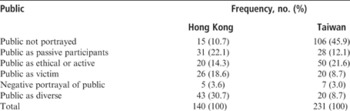
Table 7 illustrates how the public is figured. Portrayals of the public are much more common in Hong Kong cartoons (89.3 per cent) than those from Taiwan (54.1 per cent). While the public is invoked more frequently in Hong Kong, it is often portrayed as inactive or powerless: the combined categories of “public as passive participants” and “public as victim” account for 40.7 per cent of all the cartoons. The public in Taiwan is portrayed with greater agency: while 20.8 per cent of the cartoons fall in the combined categories of “public as passive participants” and “public as victim,” almost the same percentage depict the public as an ethical or active social force.
Frequency of Portrayal of Public by Setting

This brief overview offers a description of general patterns of non-elite discourses of civil society. But the key question is to what extent the language of civility is shared across political positions.
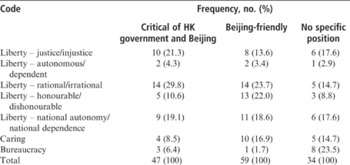
As Table 8, panel A reveals, there are significant differences in code use by political position in Hong Kong. In papers critical of Beijing, the liberty sub-codes of justice and rationality (with a combined percentage of 51.1) are most popular. Their overt political opponents, the Beijing-friendly papers, share in the frequent use of the liberty sub-code of rationality (23.7 per cent), but they are less likely to employ justice and more likely to centre their political humour on the theme of honour (22.0 per cent). The frequent invocation of honour echoes that same group's noticeable usage of the codes of caring (16.9 per cent). This suggests that the Beijing-critical papers commonly resort to liberal ideals. Importantly, even the pro-Beijing papers share the codes of liberty to some extent, but they are more likely to avoid the theme of justice, a major theme in the Hong Kong criticisms of the Chinese government in the aftermath of the Tiananmen incident. Instead, these papers anchor their political comments on an alternative set (or sets) of moral codes, namely honour and caring.
Newspaper Position by Binary Code in Hong Kong

The differences between these two political positions, however, are mild compared to the contrast between both groups and those papers with no specific position. The no-position group is much more inclined to draw on the code of bureaucracy in their cartoons (23.5 per cent). As Hong Kong moved towards 1997, those who eschewed the major political debates tended to employ “alternative” binary codes. Thus, cultural solidarity was fracturing to some degree.
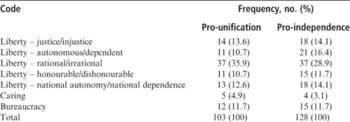
In comparison, the differences in Taiwan are muted. Table 8, panel B shows the pro-unification and pro-independence camps as employing largely the same codes. The only mild differences are within the sub-codes of liberty. The pro-unification camp is more likely to focus on rationality while the pro-independence side is slightly more likely to comment on the violation of autonomy. It makes sense that those who support a position of national independence are more sensitive to the general civic ideal of independence than their pro-unification counterparts, but the difference is surprisingly mild.
Newspaper Position by Binary Code in Taiwan

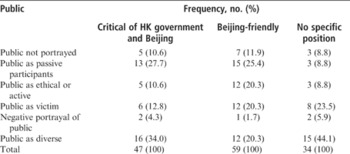
Differences in code use by political position in Hong Kong are paralleled by differences in how the public is portrayed. As Table 9, panel A reveals, those without a specific political position portray the public in ways starkly different from their more overtly politicized counterparts. Over two-thirds of cartoons produced by the no-position camp portray the public as diverse or as victims. The otherwise common portrayal of the public as passive participants is nearly completely absent in cartoons from this group. The Beijing-friendly papers are most likely to portray the public as ethical and least likely to emphasize the diversity of the public. Given their sentiments on the 1997 transition, it is not surprising that this political position mutes the diversity of the public. Their political opponents, the papers critical of Beijing, more commonly pointed out this diversity.
Newspaper Position by Portrayal of Public in Hong Kong

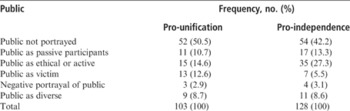
Table 9, panel B differs strongly from Table 8, panel B. Whereas there appears to be a high level of code-sharing across political positions in Taiwan, the portrayals of the public are less uniform. Cartoons in pro-independence papers are more prone to depict the public and when they do, to portray them as an ethical or active force, capable of establishing a new nation in the future. The pro-unification papers frequently portray the public as victimized and disempowered, possibly revealing a hint of residual state paternalism.
Newspaper Position by Portrayal of Public in Taiwan

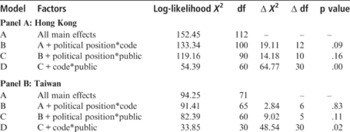
The strength of the differences illustrated in the preceding cross-tabulations can be assessed with a loglinear analysis involving binary code, political position of newspaper and portrayal of the public.Footnote 35Table 10 presents four nested models. Model A serves as the baseline helping us assess how much of the total interaction is accounted for by any given interaction or set of interactions. Subsequent models are nested, each building from the preceding model. The reductions in loglikelihood chi-square and degrees of freedom between any two models follow a Pearson's chi-square distribution.
Loglinear Models between Newspaper Position, Binary Code and Use of Public by Place*

Note:
* Models are fitted using a Poisson distribution.
Political position and binary code (Model B)
Model B adds to Model A the interaction between political position and binary code and thus corresponds to Table 8. It assesses to what degree cartoons from papers of contrasting political stances invoke different cultural codes. This interaction explains about 13 per cent of variation in Hong Kong but only 3 per cent in Taiwan. This implies that political opponents in Taiwan largely share the same codes. In Hong Kong, the cultural language of civility fragments to a greater degree. The cartoons from the papers with no specific political position in particular employ different codes.
Political position and portrayal of the public (Model C)
Model C adds to Model B the interaction between political position and portrayal of the public. Thus it corresponds to Table 9. The model assesses to what degree cartoons with different political stances portray the public differently. In Hong Kong, about 9 per cent of total variation is explained by this interaction. The differences in code use are paralleled by differences in portrayals of the public. In Taiwan, however, there is a contrast between models B and C. Whereas there is great unity in code use among cartoons with divergent political stands, when it comes to portrayals of the public, the interaction with political position explains nearly 10 per cent of total variation. This indicates that political opponents tend to imagine different stories about “the people” and possess different understandings of who “the people” are.
Binary code and portrayal of the public (Model D)
Model D adds to Model C the interaction between binary code and portrayal of the public. This interaction is outside the scope of this article; it is presented here to comment on the relative importance of political position in determining discourse. The interaction between binary code and portrayal of the public is strong in both cases, which reinforces our belief that they can be treated as two parallel ways of comparing political discourse.
Conclusion
How does our study of civic solidarity in the mundane, commonplace sectors of public spheres, with political cartoons as an example, contribute to broader understanding of political cultures in Taiwan and Hong Kong? By way of conclusion, we discuss how the study fills in an empirical gap. In addition, we join the “Chinese values versus democracy” discussion, speculating on the different possibilities in which traditional Chinese values might be transformed in the processes of democratization. More broadly, we elaborate on how, with our application of the notion of civic solidarity, we assess the inclusive potential of civic discourses in the two cases.
Recent scholarship has significantly advanced our understanding of the political cultures in Taiwan and Hong Kong. Some studies focus on individual values and opinions, often through analyses of survey data, to document subjective, individual-level orientations towards political values,Footnote 36 ethnic or national identities,Footnote 37 or political or social trust.Footnote 38 In general, these studies report significant clashes of collective identities in both settings, with more visible signs of identity hybridizations in Hong Kong. This research also documents a mixture of democratic and traditional values, with the former becoming stronger but still not prevalent in these two young democracies. Alternatively, other research approaches the issue of political cultures through analyses of hegemonic contestation over collective identities, social memories or the framing of significant events, by tracing (often qualitatively) the macro processes that shape the struggles between the state or economic elites and mobilized civic groups.Footnote 39 These studies tend to take a more process-oriented approach towards political culture, tracing the power relationships that shape dominant discursive constellations and exploring the complexity of cultural formation that escapes conventional descriptors of identity categories or political values.Footnote 40
Building on this rich scholarship, our study addresses a previously under-examined area, the mundane collective political culture. We contend that individuals’ self-reported values are not always the same as the values they actually employ in interpreting concrete social or political events. More importantly, every individual's values or frameworks are not equally represented in the formation of collective frameworks; socially salient frameworks, as the hegemony studies remind us, come into being through processes of discursive construction grounded in power relationships. At the same time, while the hegemonic contest between the power elites and civic groups or activists may trickle down to the more mundane, popular political discourses, the latter is not dictated by the former. Both hegemony and counter-hegemony are neither singular nor total. The political discourses in the everyday, non-activist sectors of public spheres, though currently under-studied, are an important piece of political culture that is not mutually reducible with either individual-level values or hegemonic contestation among mobilized political groups. Studying them fills in a gap in the tapestry of our current understanding of the political cultures in Taiwan and Hong Kong. Our analysis of political cartoons from two major elections provides a snapshot and lays some groundwork for this neglected issue.
In addition, our study joins the scholarship that challenges the argument of Chinese cultural values being incompatible with democracy.Footnote 41 Scholars have pointed out that the “Chinese values” argument essentializes culture, without considering how culture develops and transforms in changing social processes. To add to this scholarship, our finding about the salience of liberty codes in Hong Kong and Taiwan, historically imported but now quite indigenous, offers a case in point.
Our study further contributes to this discussion by exploring the possibilities of how Chinese values may be transformed. Though dominant, the discourse of liberty is not the only game in town. Our findings show that the codes of caring (such as interdependence or compassion) and the codes of bureaucracy (such as government competence or clear-sightedness) provide alternative cultural sources for conceptualizing civic virtues. These values resemble subsets of what scholars typically describe as Confucian values. Other scholars have elaborated on the relationships between these discourses and the discourse of liberty,Footnote 42 a full-fledged discussion of which is beyond the scope of this article. Suffice it to say that the codes of caring can be complementary to liberal values; the value of an interdependent community and the principle of independent citizens form a well-balanced set of cultural principles for civil society.Footnote 43 However, the discourse of bureaucracy, with its emphasis on government performance and economic growth over democratic procedures and individual autonomy, seems anti-democratic in nature. Its continued existence raises potential challenges to the legitimacy of democracy. This tells us that part of Confucian culture can potentially be transformed and integrated with democratic thinking, thus challenging a static dichotomy between the two.
Finally, one of the key questions taken up by the scholarship on political cultures in the two offshore Chinese democracies addresses how significant identity controversies may affect democratic consolidation. Many studies discuss how the identity question can threaten the fabric of democracy in TaiwanFootnote 44 or how the “othering” of mainland immigrants dampens the democratic spirit in Hong Kong.Footnote 45 Acknowledging these as important challenges to civil society, some research begins to explore how well these challenges might be contained by the deliberative potential of communicative spheres, such as through fostering common valuesFootnote 46 or developing hybridized identities.Footnote 47 These investigations identify concrete, if limited, instances of civil society successfully resolving internal tensions. Adding to this literature, the notion of civic solidarity offers a theoretical language to specify the cultural conditions conducive to the expansion of the inclusive potential of civil society amidst competing identity claims.
To recapitulate briefly, in this perspective, the dominance of liberal cultural codes would indicate a basic level of democratic consolidation. If opposing sides share the same cultural language, structured by these democratic codes, these identity contestations tend to reinforce opponents’ shared values further and, perhaps more importantly, foster a common basis for mutual engagement. Engagement of differences, not just shared values, is necessary for the inclusiveness of civic discourses. Finally, social groups commonly invoke “the public” to signal their orientation towards wider civic solidarity, but they can, in practice, produce disparate understandings about the public. Diverse dramaturgical presentations of the public are healthy signs of a pluralistic society. But when this difference is consistently located along major political fault lines, it becomes a warning signal for lack of meaningful dialogue. While divergent civic discourses co-exist, their interaction remains non-deliberative, which limits the expansion of their inclusiveness.
Turning to our empirical analysis, findings indicate that the codes of liberty have become the dominant cultural source for popular political discourses. This basic level of civic solidarity indicates initial democratic consolidation. Given their past histories of open criticisms of the pro-democracy camps, it is particularly significant that the KMT-sympathetic and the Beijing-friendly newspapers participate in the discourse of liberty. These social actors may occupy an ironic position in the process of democratization: they have to “play the game” of democracy in order to defend themselves against criticisms of being anti-democratic, but thereby further spread democratic values.Footnote 48
Taiwan's pro-independence/pro-unification divide is a strong demarcation. But advocates for both identities less frequently resort to the “sacred nation” rhetoric than liberal values (such as people's choices). Thus, the identity debates in Taiwan are reinforcing the core values of liberty, which are in turn gradually forming a basis for mutual engagement. In the face of Beijing's assertion of state sovereignty at the expense of people's sovereignty as a response to the two off-shore democracies,Footnote 49 this development is especially significant. That even the pro-unification discourse in Taiwan has shifted predominantly to anchoring itself in the codes of liberty rather than the ideology of the “sacred nation” challenges and de-naturalizes Beijing's claim.
The inclusiveness of civic discourses is challenged in this aspect in Hong Kong. Here, actors from across the political divide tend to invoke divergent codes. Perhaps surprisingly, the cleavages do not locate primarily along the pro-Beijing/anti-Beijing contention. Rather, groups with and without a clear political stand resort to different civic ideals. We speculate that contentious political debates that appear futile erode the legitimacy of the liberal ideals; social groups who withdraw from these debates seek alternative moral anchors, centring on efficiency, order, compassion or inter-dependence. If the cultural split becomes an enduring situation, engagement of difference is unlikely to ensue.
In both cases, dramaturgical presentations of the “public” fracture along major political fault lines, suggesting a lack of meaningful dialogues between opposing sides. In Hong Kong, given the lack of a shared cultural language among opponents, it is not surprising that engagement of differences appears scant or superficial. For Taiwan, their shared basis for mutual engagement notwithstanding, opposing sides are yet to engage fully and comprehend each other's discourses, such as addressing the discrepancies between the pro-independence camp's story of an active public fighting against domination and the pro-unification camp's view of a victimized people in need of state protection. Civil repairs – meaningful dialogues and quite possibly self-recognition of biases – are needed for civic discourses to curb their polluting claims about each other.
The prevalence of democratic values alone does not guard against hegemonic domination. Hegemonic contestation, in turn, does not inevitably arrest the expansion of civic inclusiveness. It matters with what cultural language, and with how much deliberative interaction, hegemonic contestation unfolds. In-depth understanding of political cultures in these two settings goes far beyond our quantitative analysis of political cartoons. This modest contribution, we hope, lies in articulating a theoretical language and reporting an empirical assessment that helps specify the cultural conditions for the expansion of civic inclusiveness in these two young democracies.