INTRODUCTION
Sociolegal scholars contend that the relationship between media representations of crime, crime policy, and criminal justice processes is circular. Mass media influence how people think about crime, while criminal laws on the books and their implementation in policing, courts, and prisons impact how crime is portrayed on TV, in newspapers, and in online news outlets (Erickson Reference Erickson1991; Kappeler and Potter Reference Kappeler and Potter2017). The well-documented racialization of street crime in the United States has been sustained and propelled by this iterative relationship (Carlson Reference Carlson2016; Glynn Reference Glynn and Glynn2021; O’Malley and Smith Reference O’Malley and Smith2022).
Nonwhite Americans suffer from systematic disadvantage at all stages of the criminal justice process—from racial profiling in policing (Welch Reference Welch2007) to explicit discrimination in courts (Van Cleve Reference Van Cleve2016) and disproportionate likelihood of incarceration (Alexander Reference Alexander2020). Compared to their Caucasian counterparts, nonwhite Americans are more likely to be targeted by law enforcement, to be convicted in court, and to serve heavier punishment for similar crimes (see Walker, Spohn, and DeLone Reference Walker, Spohn and DeLone2016 for overview). Mass media, however, tend to highlight these racial inequalities without addressing the historical legacy of discrimination and the ongoing structural racism at their root (Gonzáles and Torres Reference González and Torres2011; Dukes and Gaither Reference Dukes and Gaither2017). From disproportionally frequent mentions in the crime news to emphasis on their physical aggression, African and Latinx Americans suffer from a range of prejudiced representations (see Greer Reference Greer2019 for overview; Gilliam, Valentino, and Beckmann Reference Gilliam, Valentino and Beckmann2002; Lyon Reference Lyon2008). Such portrayals, then, trigger public alarm, mobilize popular support for punitive policies, and sustain discriminatory practices in the criminal justice system (Gerbner Reference Gerbner1995).
While much has already been written on the racialization of street crime, the goal of our article is to consider how media representations of white-collar criminals fit into this story. Crimes classified as white-collar typically require access to material and social resources from which racial and ethnic minorities have been systematically excluded. Is it possible, then, that these crimes are framed as “white by default”—simply through the omission of any racial signifiers? Or do the media “whitewash” racial minorities involved in white-collar crimes to highlight their difference from street criminals? Alternatively, could it be that nonwhite white- collar criminals are racialized in similar ways to their counterparts on the streets?
To address these possibilities, we analyze the framing accorded to white and nonwhite perpetrators of several white-collar crimes in select national newspapers over six decades. Theoretically, we draw on John Hagan’s brilliant 2012 book, Who Are the Criminals? The Politics of Crime Policy from the Age of Roosevelt to the Age of Reagan. Hagan describes the post–Civil Rights era political strategy that enabled a slew of conservative politicians to capture the vote of white Americans and convince them to support economic deregulation. One part of this strategy, he argues, was the collective framing of black and brown bodies as criminal, resulting in disproportional and racialized targeting of the perpetrators of petty, nonviolent, and drug-related street crimes. The other, equally important but rarely acknowledged, part of this strategy entailed underplaying the risks of economic deviance by the rich and powerful. According to Who Are the Criminals?, the simultaneous construction of street crime as black and dangerous and white-collar crime as white and acceptable has served to redirect criminal justice efforts away from the boardrooms.
Our analyses confirm that racialization of white-collar criminals in print media can be traced back to Nixon’s presidency, when the strategy of collective framing around the interconnected issues of race and risk first gained steam in the post–Civil Rights era America. We also find that white-collar criminals’ race is a robust predictor of their individualization—or of the amount of coverage dedicated to their description. In our sample, African American perpetrators are individualized significantly more extensively than their white counterparts, which, we argue, connotes the oddity of black offenders in the context of white-collar criminality. These findings support John Hagan’s argument that the racialization of street crime in the United States is mirrored by the collective framing of the elite economic crime as “white” and, by extension, a nonthreatening side effect of capitalism.
RACIALIZATION OF STREET CRIME IN THE US MEDIA
John Hagan (Reference Hagan2012) writes that, in the post–Civil Rights era, Richard Nixon’s and Ronald Reagan’s War on Drugs gave rise to the collective framing of black and brown bodies as criminal. Concerned with the proliferation of drugs, street protests, and increased demands for minority rights, white middle-class Americans readily embraced the framing that justified their continuous privilege (Barlow Reference Barlow1998). Over time, it became ingrained in the political rhetoric (Peffley, Hurwitz, and Sniderman Reference Peffley, Hurwitz and Sniderman1997), popular discourse, and dominant media representations (Reinarman and Levine Reference Reinarman and Levine1989; Hurwitz and Peffley Reference Hurwitz and Peffley1997; Chiricos, McEntire, and Gertz Reference Chiricos, McEntire and Gertz2001).
Much has been written about the racialized media portrayals of street crime and criminals. According to Entman (Reference Entman1992, Reference Entman1994), Pointdexter, Smith, and Heider (Reference Pointdexter, Smith and Heider2003), and Chiricos and Eschholz (Reference Chiricos and Eschholz2002), crime is the primary topic of coverage that features African Americans in local news. Relative to official crime statistics, in the media, nonwhite Americans tend to be overrepresented as perpetrators and underrepresented as victims of crime (Peffley, Shields, and Williams Reference Peffley, Shields and Williams1996; Chiricos and Eschholz Reference Chiricos and Eschholz2002; Dixon and Linz Reference Dixon and Linz2002; Dixon, Azocar, and Casas Reference Dixon, Azocar and Casas2003; Bjornstrom et al. Reference Bjornstrom, Kaufman, Peterson and Slater2010). Moreover, African American and Latinx perpetrators tend to be portrayed as more threatening, violent, and noncompliant than their white counterparts (Oliver Reference Oliver2003), while “pro-defense soundbites,” or discussions that are favorable to the perpetrator, are more common, and longer, for white offenders (Entman Reference Entman1992).
In this literature, racialization is often measured by the extent of individualization or the amount of personal detail about an offender that is included in the news report. These details typically consist of family history, educational and professional background, health-related information, and descriptions of appearance and property. Positive details, expectedly, humanize the perpetrator, while negative descriptions achieve the opposite. Whether positive or negative, however, individualization serves to differentiate the perpetrator from the rest of the people who share their sociodemographic characteristics, such as gender, race, and social class. In other words, the perpetrator description operates on two levels: while its content sends a specific message to the reader, so does its length. Thus, Entman (Reference Entman1992) argues that white offenders experience higher levels of individualization in crime news because they are framed as “bad” apples in an otherwise-good barrel. By contrast, low individualization of African American offenders serves to emphasize their belonging to a “criminal class” or a group of people who share a propensity for criminality, “thereby reinforcing negative stereotypes” of black Americans (1992, 347–48).
WHITE-COLLAR CRIME, RACE, AND MEDIA DEPICTIONS
In his analysis of the US crime policy, Hagan (Reference Hagan2012) argues that the semantic linking of racial minorities to street crime in the discourse of, first, Republican and, later, Democratic leaders has been a part of a two-pronged collective framing strategy favorable to America’s pro-business political elites. By exaggerating the threats of nonviolent drug crimes in inner-city neighborhoods populated by racial minorities, these politicians capitalized on white Americans’ deep-seated fear of the changing demographic profile of their country. The racialization of street crime, Hagan writes, inspired waves of popular mobilization behind conservative politicians.
While this story of white backlash is well known (see Beckett and Francis Reference Beckett and Ming Francis2020 for overview), Hagan (Reference Hagan2012) identifies another concurrent dynamic that remains underappreciated in most accounts of US crime policy. The second part of this political strategy, Hagan argues, consists in the neutralization of public angst regarding the economic crimes routinely happening in America’s boardrooms, Wall Street offices, and corporate suites. Collective framing of white-collar offenses as nonthreatening to the racial majority of Americans has allowed for the noncontested deregulation of financial markets and big businesses, within which the most consequential white-collar crimes tend to occur. This, according to Hagan, was an exercise in brilliant politics because, over time, unregulated elite deviance has led to a large-scale transfer of wealth into the pockets of a tiny sliver of the country’s population (see also Cohen Reference Cohen, Van Slyke, Benson and Cullen2016).
In this article, we present a partial empirical test of John Hagan’s argument about the racialized collective framing of white-collar crime as a nonthreatening consequence of American-style capitalism. If Hagan’s theory holds, we expect news portrayals of white-collar crimes (and their perpetrators) to minimize the social dangers of such deviance, thereby underplaying the need for control and regulation of the economic elites. By extension, we expect the nonwhite perpetrators of elite deviance to be “whitewashed”—or portrayed as nonthreatening and markedly different from “typical” African Americans. This, we expect, is achieved through individualization. In other words, if Hagan is correct, the more detailed description of nonwhite perpetrators of white-collar crime (individualization) will serve to mark them as distinct from other black and brown bodies stereotyped as threatening to the status quo.
H1: Black offenders are subject to more extensive individualization than white offenders in the articles on white-collar crime
Moreover, if our argument holds, nonwhite perpetrators are also likely to be described by reporters in terms that are typical for traditional white-collar criminals—which are, coincidentally, the opposite of the standard way in which African Americans are portrayed in the news. The two dimensions that are especially salient in these racialized descriptions are (a) the degree to which the person suspected or accused of crime is a respectable member of the community; and (b) the extent to which the alleged offender is compliant with authorities. Regarding the first dimension, white-collar criminals are usually described as successful, independent, and contributing members of society, while street offenders tend to be framed as downtrodden, marginal, and unproductive individuals, either unable or unwilling to succeed in mainstream society. The second salient dimension of variance has to do with offenders’ cooperation with authorities—often, media portrays street offenders as aggressive or threatening to police and prison guards, while white-collar criminals are rarely portrayed as noncompliant (see Barlow and Barlow Reference Barlow and Hickman Barlow2010 for overview of literature on both dimensions).
Together, we argue, these two dimensions point to another major divergence in the collective framing of the two types of crime and their perpetrators—the degree of belonging to the mainstream society. White-collar criminals, with their demonstrated ability to reap systematic rewards within the system, are depicted as its rightful members. By contrast, street criminals are the disrupters: they refuse to conform, use nonsanctioned violence, and, thereby, threaten the status quo.
The racialized undertones of this variance are as obvious as they are aligned with John Hagan’s theory. African Americans, overrepresented among street-level offenders, are portrayed by the media as dangerous to the system that had been built for white Americans, whose crimes, far from upending the dominant order, tend to reinforce the status quo in the same way that an occasional exception may uphold a rule. But what happens when a white-collar criminal is black? We expect the reporters to resolve the resulting dissonance by emphatically underscoring the perpetrator’s adherence to the dominant, white-defined values. While increased individualization allows reporters to frame white-collar offenders as different from the “typical” black criminals, an added emphasis on their symbolic belonging to the mainstream (white) society completes the process of racialized collective framing of white-collar crime.
H2: Descriptions of black offenders’ belonging are more extensive than descriptions of white offenders’ belonging in articles on white-collar crime
If Hagan’s theory holds, however, the divergence in the portrayal of white and nonwhite perpetrators in the media must stem specifically from the political project of the racialized framing of crime in the aftermath of the Civil Rights era. While a direct test of the origins of this divergence is not possible with the archival data on press coverage, such data do allow us to trace the emergence of race-related disparities in white-collar crime news back to a specific point in time. We, therefore, hypothesize that it was not until the late 1960s that portrayals of white-collar criminals in the media became racialized in the ways we describe above.
H3: Media portrayal of white and black white-collar criminals diverged in the late 1960s—early 1970s
DATA AND MEASURES
All data analyzed in this article were collected from the ProQuest Historical Newspapers database, accessed through the University of Iowa Library. Five newspapers were analyzed: the Atlanta Constitution, the Los Angeles Times, the New York Times, the St. Louis Post-Dispatch,Footnote 1 and the Chicago Defender. The first four newspapers were chosen as major national outlets representative of different regions of the United States (South, West, East, and Midwest, respectively). The New York Times and the Lost Angeles Times are the oldest, the most widely read, and the most impactful periodicals on the East and West Coasts of the United States. Both papers are over 150 years old and boast the readership of multiple millions in their respective states, nationally, and around the world. Both papers have won multiple Pulitzer Prizes for their reporting, and both regularly cover news on elite crimes that happen in New York and California—the two national hubs of business activity and concentration of significant wealth and power (Los Angeles Times 2022; New York Times Company 2022).
To represent the South, we chose the Atlanta Constitution, which grew out of a 1950 merger of two separate papers, the Atlanta Constitution and the Atlanta Journal; each paper had been in circulation for roughly seventy years prior, and the Atlanta Constitution has collected multiple accolades and is recognized as one of the most successful and influential newspapers in the region (Hammond Reference Hammond2018). Last, to represent the Midwest, we chose two different papers. The Chicago Defender was also included because for most of the century, it was the largest national newspaper oriented toward African American readership in the United States (PBS 2022). It was included to control for potential differences in how white-collar crime perpetrators are racialized in newspapers serving different racial communities. When choosing the second newspaper from the Midwest, to avoid overrepresenting news outlets based in Chicago, we included the St. Louis Post-Dispatch rather than the Chicago Tribune. Compared to other options—the Omaha World Herald and the Des Moines Register—our preliminary search of the St. Louis Post-Dispatch yielded more results for articles discussing white-collar crimes by minorities.
Our analyses focused on four types of white-collar crime: bribery, tax evasion, credit card fraud, and voter fraud. Because legal and analytical categories of white-collar crime are exceedingly broad and include a range of very different offenses (Simpson Reference Simpson2013), we sought to select crimes that are committed by individuals with a wide range of sociodemographic characteristics, that require different degrees of access and skill, and that differ in size and type of payoff. For instance, crimes of bribery and tax evasion span the boundaries of class as individuals of different education and income levels can participate. Our selection also includes crimes committed for political gain (voter/election fraud), economic gain (credit card fraud), and gain in access to bureaucratic decision making (bribery); crimes that require premeditation and planning (voter/election fraud) and crimes that can be committed through neglect (tax evasion); crimes that have always existed (bribery) and those that have emerged recently (credit card fraud); crimes that often require organizational access (election fraud) and crimes that do not (tax evasion, credit card fraud); and so on.Footnote 2
The first step in our data collection was to gather all articles published in five national newspapers between 1950Footnote 3 and 2010, featuring an African American perpetrator of the four crimes under consideration. The newspapers were digitally searched for combinations of several racial indicators and type of crime. The terms indicating the perpetrators race included “African American,” “black,” “negro,” and “colored.”
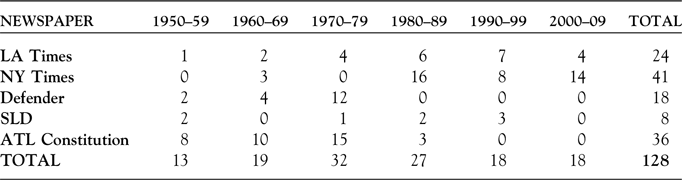
After scraping all the articles that included one of these epithets and a name of one of the four crimes (for instance, “black AND bribery,” “negro AND tax evasion,” and so on; please see the Appendix for a complete list of search terms), a team of trained research assistants read every article, identifying and excluding those that did not qualify for the analyses (such as articles in which the word “black” did not refer to the race of the perpetrator, or “African American” was used to describe the victim).Footnote 4 After this screening, the finalized sample consisted of 128 articles.Footnote 5 Most articles with African Americans as perpetrators of these four crimes (32) were published during the 1970s (see Table 1).
Distribution of Articles with Black Perpetrators by Newspaper and Decade

Our next step was to gather a control sample of articles in which the perpetrator is presumed to be white because his or her race is not mentioned explicitly. Our assumption that the absence of any mention of race suggests that, most likely, the perpetrator was white is consistent with the dominant consensus in the literature that whiteness is a default racial category in the American public discourse. Critical race scholars, especially those who study whiteness, argue that being white is “an invisible norm” (Andersen Reference Andersen, Ashley and Bonilla-Silva2003, 24). A hegemonic system of privilege that normalizes and legitimizes its own existence, in part, by assuming the default status (Dyer Reference Dyer2013), whiteness operates in the media “through euphemisms” rather than direct and honest acknowledgment (Bonilla-Silva Reference Bonilla-Silva, Ashley and Bonilla-Silva2003).Footnote 6
While race of the perpetrator was not explicitly mentioned anywhere in our control sample except for one article (published in the Chicago Defender in the 1970s, this article stated that the perpetrator was “white”), there were other indirect indicators (usually, of social status and profession) that alleged offenders were, indeed, white. For instance, in the articles from 1950s, perpetrator descriptions included “the personal friend of President Truman,” “former St. Louis Cardinals owner,” and the “reputed policy king of the South Side.” In the articles from 1960s, perpetrators were described as “Russian immigrant whose generosity rocked official Washington,” “retired aide of President Eisenhower,” and so on. Although possible, it is unlikely that these individuals were African American given the low rates of integration of African Americans into the political and business elite at the time.
Our control sample of articles was matched to the primary sample by decade, newspaper, and type of crime. For instance, for every article featuring an African American perpetrator of one of the four white-collar crimes, we collected an article that was published in the same paper and decade but omitted any mention of race. To that end, we first scraped all articles about each type of crime published during a certain decade in each newspaper. To match the size of the control sample to that of the African American perpetrator sample, we had to choose among the numerous results that our search yielded (as articles featuring white perpetrators far outnumber the articles about minority offenders). Our strategy was to employ a random number generator.
In each pool of eligible articles, we identified and retrieved an article corresponding to the random number. If it satisfied the criteria for the control sample, it was included in the analyses; the process was repeated until the desired sample size (matching the corresponding sample of African American offenders) was achieved.
After finalizing the two samples, a team of research assistants manually coded the articles.Footnote 7 For the first coding category, the description of the perpetrator, the coders noted the offender’s age, gender, social, and marital statuses, and any information about the perpetrator’s family, education, occupation, place of origin and residence, professional history, and criminal record. The second coding category focused on the crimes themselves. Besides noting the type of crime, we recorded the presence and race of collaborators, monetary and nonmonetary damage the crimes generated (i.e., public health or environmental costs), and whether victims were individuals, the community, or the government. In the last coding category, research assistants noted the justice system–related characteristics of the crime—for instance, where in the legal process the case was at the time of publication, whether the guilt of the perpetrator was legally established, whether there was any mention of the perpetrator’s resistance to the authorities or, by contrast, compliance, with police, court, or prison employees, as well as the length of any “pro-defense” soundbites (Entman Reference Entman1992). The variables were constructed from the resulting data set.
This method, formally called content analysis, is better suited for our purposes than discourse analysis because our goal was to consider the length and substance of media coverage of white-collar criminals rather than the actual language used in this coverage. Moreover, while discourse analysis is a qualitative method, our goal was to create a quantitative data set for statistical analyses. In creating numeric measures of individualization and belonging, we followed the argument developed by Entman (Reference Entman1992) that the sheer amount of detail in the description of a perpetrator (of any kind, in case of individualization, and of professional success and compliance with mainstream values, in case of belonging) impacts readers’ perception of how specific perpetrators fare relative to their sociodemographic reference groups. This argument suggests that the effect occurs regardless of the kind of language used in the descriptions.
Dependent Variables
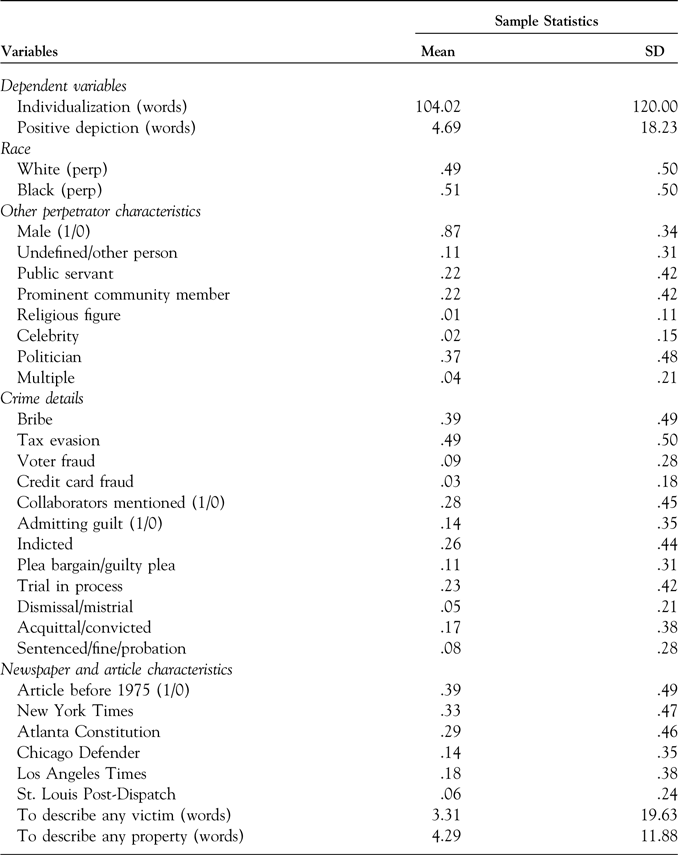
Our two outcome variables are the extent of perpetrator individualization (Individualization) and the description of perpetrators’ belonging to the dominant class/ mainstream community (Belonging) (please see Table 2 for the summary statistics).
Summary Statistics

Note: N = 249 articles.
Individualization was measured with a number of words that describe perpetrators, including any description of their social status, education, professional history, appearance, prior run-ins with the law, family, residence, and other personal information. We also included in this measure a count of words in the direct quotes attributed to the perpetrator. The mean number of words used to individualize the perpetrator is 104.
Consider, for instance, example of Tony Accardo, a white perpetrator of tax evasion described in the New York Times article from April 27, 1960. The value of Individualization for this article was estimated with a sum of words in the description of Accardo’s property (e.g., “his two-seat sports car, a red Mercedes-Benz,” “his stone mansion,” “the electronically controlled iron gate”), of his appearance (e.g., “he donned a natty blue suit, dark blue tie, a gray topcoat,” etc.), his pastime (e.g., “he took his wife to Europe last summer”), and his interactions with legal authorities (e.g., “he walked into his yard to let the Federal agents through,” “he was handcuffed and taken to the Federal Courthouse,” etc.).
Our second outcome, Belonging, reflected the extent to which perpetrators are portrayed as effective in complying with dominant social values (i.e., successful, self-sufficient, reliable, capable, etc.) and, thereby, legitimate members of society. It is based on (1) the number of words used to describe the perpetrator as successful professionally; added to (2) the number of words describing the perpetrator as cooperative with formal institutions; and added to (3) the number of words describing extenuating circumstances or positive perpetrator characteristics (which Entman (Reference Entman1992) called “pro-defense soundbites”). The mean number of words used to describe the offenders’ belonging in our sample is under five. One example of belonging-relevant description comes from an article that appeared in the Los Angeles Times on January 9, 1983. An African American perpetrator of bribery, judge Alcee Hastings, is described in this article as a someone “who seems far too bright to be a fool.” Other descriptions of Mr. Hastings counted to measure Belonging are: “The only child of a butler and a housemaid, he became a popular spokesman for civil rights in South Florida and the first black U.S. district judge in the state. He was widely thought incorruptible”; and “In his years as an attorney, Hastings, 46, has become well-known but never wealthy. Eight times, he ran what seemed quixotic – and unsuccessful – races for public office, posts from city commissioner to U.S. senator. He has a faithful, if small, following in Fort Lauderdale, where he urged activism among the black minority.”
Independent Variables
The main predictor variable for assessing the first two hypotheses is the race of the perpetrator, Black, coded as a dummy variable with “1” representing an African American perpetrator and “0” referring to a white offender. By design, half of our sample consists of articles with black perpetrators and half with white perpetrators. Another core predictor used to test Hypothesis 3 is Before 1975, which indicates whether the article is published before that date, coded as “1” if the article appeared in the press prior to the mid-seventies, and “0” if the publication date is after.
We also include in our models a range of control variables that may affect individualization and the description of perpetrators’ belonging. First, we controlled for the social status of the perpetrator with a series of dummy variables for different social positions, including Public servant, Prominent community member, Religious figure, Celebrity, Politician, and Multiple (for more than one category). If there was no mention of the social status corresponding to these categories, the perpetrator was coded as Undefined/other person. Next, we included a control for the perpetrators’ sex, Male, coded as “1” for men and “0” for women. Several other control variables relate to the crime itself, such as the type of offense—Bribe, Tax evasion, Credit card fraud, or Electoral fraud (coded as 1/0); presence of collaborators (Collaborators mentioned); and the admission of guilt by the offender (Admitting guilt).
Because the length of the case may determine the amount of information available to the press and, consequently, impact the extent of coverage, we also controlled for the criminal justice status of each offense using dummy variables for Indictment, Plea bargain, Trial in process, Dismissal/mistrial, Acquittal/conviction, and Sentence/fine/probation. Finally, we controlled for the length of the description of the crime victims and of the property damage inflicted by the crime, both of which could affect the amount of coverage of the perpetrator. These variables, Victim description and Property damage, were measured in the number of words. Last, we control for the newspaper in which the article appeared, as different publications may have distinct standards pertinent to article length and depth of coverage—the variables Atlanta Constitution, Chicago Defender, Los Angeles Times, and St. Louis Post-Dispatch were coded as 1/0. New York Times is omitted in the models as it is the reference category.
We hasten to note that our methods of data collection and analysis entailed a large degree of discretion on behalf of the research team. From selecting only four types of white-collar crime for our analyses to manually coding the articles in the samples that were assembled based on a number of assumptions—for instance, about perpetrators’ race—to relying on the coders’ judgment about what constitutes an indicator of belonging, we have, likely, made a series of choices in the research process that limit our conclusions. For one, some of the most socially consequential white-collar crimes (and, therefore, the crimes that are most important for the purposes of collective framing) involve organizational perpetrators, making the analysis of racial trends in coverage impossible. Besides, we have no way of knowing whether a different selection of newspaper outlets (for instance, more local newspapers) or a focus on TV and radio reporting would have yielded different results. We recognize these possibilities and invite other researchers to improve on our analyses in the future.
RESULTS AND DISCUSSION
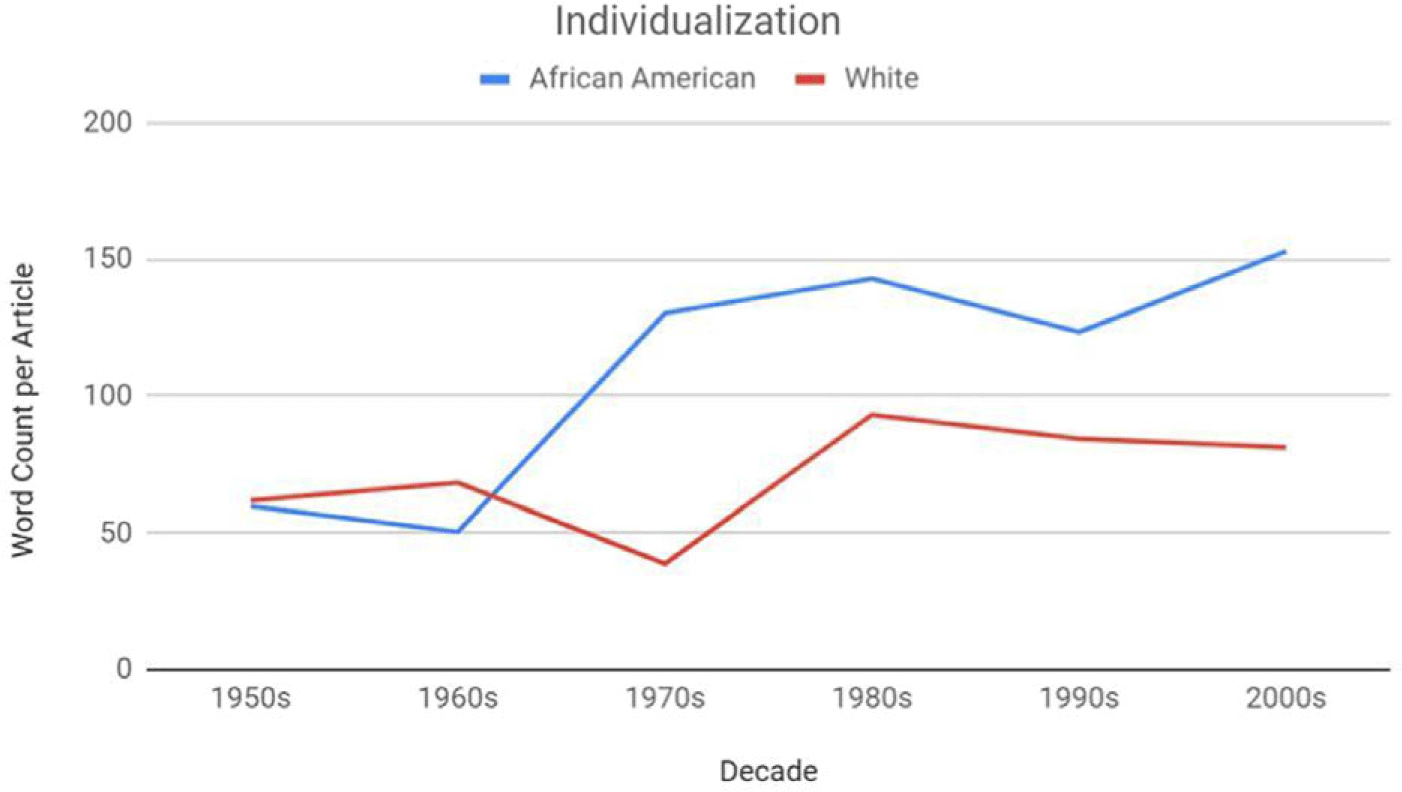
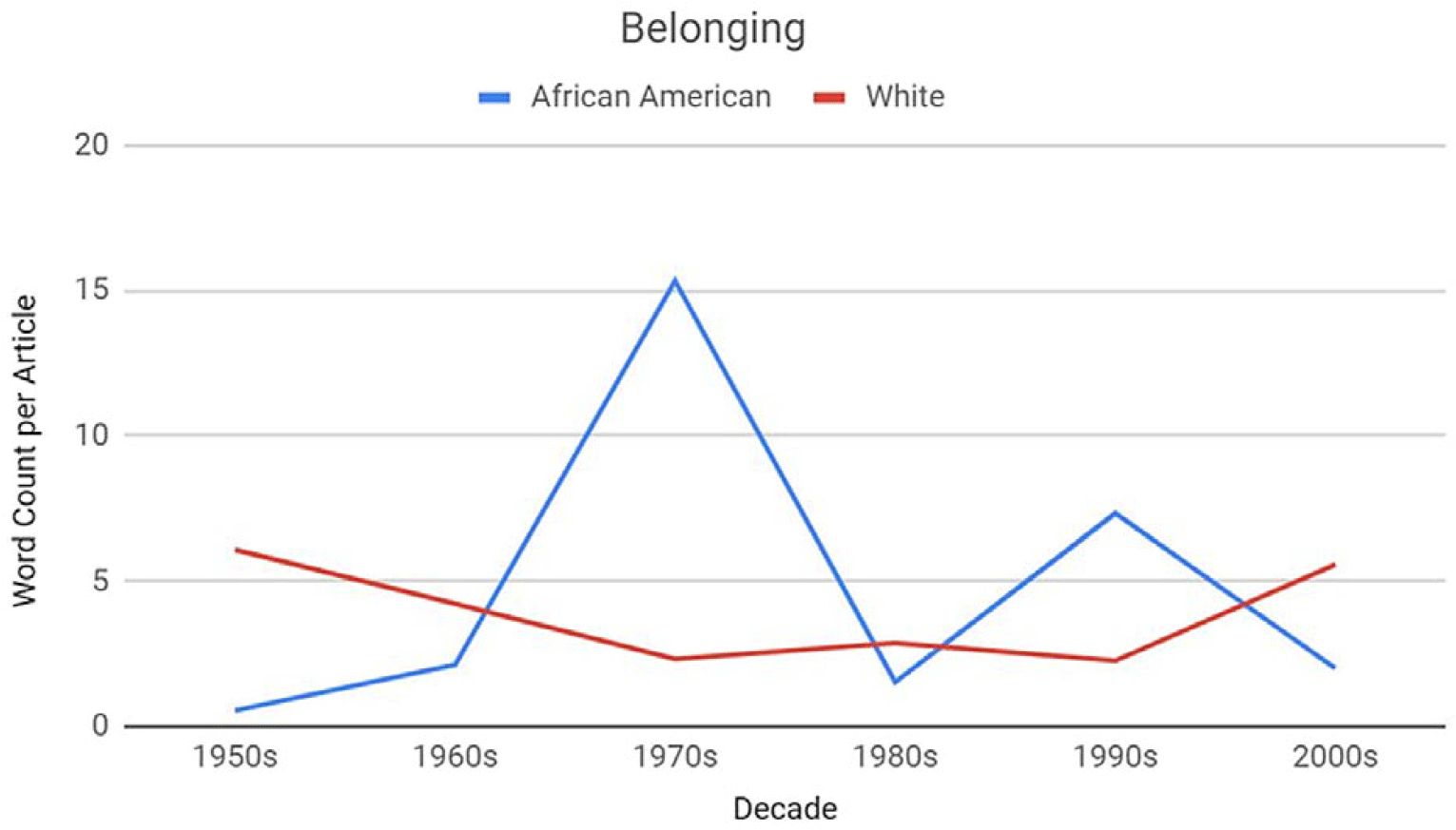
We begin assessing our hypotheses by charting the extent of individualization and depictions of belonging of black and white perpetrators of white-collar crime, measured as the number of words per article, over the period between 1950 and 2010 (see Figure 1 and Figure 2). Both graphs suggest that trends in the coverage of black and white perpetrators of white-collar crimes—specifically as they relate to the individualization and the description of perpetrators’ belonging—have followed distinct trajectories since the 1950s. What is important for our purposes is that, for most of this period, African American offenders have experienced higher levels of both individualization and described belonging than their white counterparts.Footnote 8
Average Individualization of Black and White Offenders (per article) by Decade.

Average Description of Belonging of Black and White Offenders (per article) by Decade.

This, we conclude, provides preliminary support for our first two hypotheses—that black perpetrators of white-collar crime tend to receive more extensive coverage with a stronger emphasis on their belonging to mainstream communities than their white counterparts.
Turning now to our third hypothesis about the political roots of white-collar crime racialization in the Civil Rights era, we note that for both outcomes, the trends in the coverage of white and nonwhite perpetrators converged in early-to-mid-1960s. Following this conversion, they reversed, reaching the highest levels of diversion around 1970. This observation is consistent with John Hagan’s theory about the political causes of the collective framing of different types of crimes as white or black and, respectively, as more or less dangerous. We, therefore, conclude that these analyses provide preliminary evidence in support of our third hypothesis. While, prior to the Civil Rights era, the trends in the coverage of white-collar crime by black and white offenders were either similar (in the case of individualization) or, in fact, reversed (with white perpetrators receiving more extended descriptions of belonging than their nonwhite counterparts), the onset of the political project of the collective framing of crime in racialized terms as a means of capitalizing on the popular backlash against the events of the 1960s crystallized their divergent trajectories. The graphs offer clear preliminary evidence that the onset of the racialization of white-collar criminals in national newspapers coincided with the much-better-documented patterns of the racialization of street criminals. In sum, while these analyses do not offer a complete or direct test of Hagan’s theory, they do reveal that the timing of the emergence of distinct racialized trends in the coverage of elite deviance is consistent with Hagan’s account in Who Are the Criminals?
It is possible, of course, that it is not the race of a perpetrator but other, unaccounted for, variables that explain this divergence in the racial coverage of white-collar crime in the US print media. To assess this possibility, we now turn to the more nuanced multivariate analyses, beginning with the discussion of our modeling strategy.
Because our dependent variables (Individualization and Belonging) are measured as word counts, and therefore violate the assumptions of ordinary least squares regression (OLS), we implemented Poisson regression in Stata 15 to predict both Individualization and BelongingFootnote 9 (Long and Freese Reference Scott and Freese2014). A general expression of the models that we estimate is as follows:
 $$y = {\rm{B}}1{\rm{AA}} + {\rm{B}}2{\rm{PD}} + {\rm{B}}3{\rm{CD}} + {\rm{B}}4{\rm{AD}} + \alpha ,$$
where y is the number of words for individualization or belonging, AA is a dichotomous measure that indicates whether the perpetrator is black (1 = black, 0 = white), PD is a matrix of the (remaining) perpetrator characteristic measures, CD is a matrix of the crime characteristic measures, AD is a matrix of the newspaper and article characteristic measures, and α is an intercept. The estimated models capture 249 articles: 128 articles featuring a black perpetrator and 121 articles featuring a white perpetrator.
We assessed and found no evidence of multicollinearity problems, as the mean variation inflation factor score (VIF) never exceeded 2.55 across all the models estimated, which is significantly less than the commonly used cutoff of 10 (Kennedy Reference Kennedy2003; O’Brien Reference O’Brien2007). Furthermore, the correlation between Individualization and Belonging is .40, providing evidence that the dependent variables are empirically distinct from each other.
Below, we discuss the results of two models: (1) a model predicting Individualization that emphasizes the potential effect of a perpetrator’s race, and (2) a model predicting Belonging that emphasizes the potential effect of perpetrator’s being black in relation to being white.
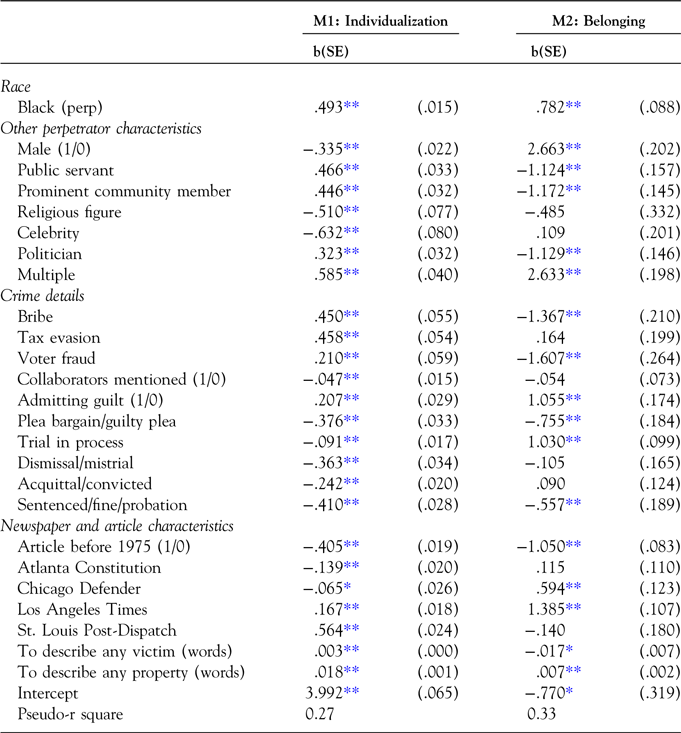
Model 1 in Table 3 reveals that the dummy variable Black is significantly and positively associated with the extent of individualization, even after controlling for a range of characteristics pertaining to the offender, the crime, the newspaper, and the article itself. Consistent with Hypothesis 1, this finding means that black offenders tend to be individualized more than white offenders in articles on white-collar crime. Based on the formula (exp(β) – 1)100, an article that depicts a black offender is expected to have 64 percent more Individualization in comparison to an article that depicts a white offender.
Poisson Regression: Predicting Individualization and Belonging

Notes: N = 249 articles.
b = unstandardized coefficient.
(SE) = standard error.
*p < 0.05, **p < 0.01.
In Model 2 (Table 3), we find that the dummy variable for Black also has a significant and positive association with Belonging. Thus, an article that features a black offender is expected to have 119 percent more words that indicate the perpetrator’s belonging in comparison to an article that features a white offender. Interestingly, while the articles discussing black offenders exhibit considerably more extensive individualization and description of the perpetrator’s belonging than the articles featuring white alleged offenders in our sample, there is a greater racial discrepancy in our measure of Belonging relative to Individualization (i.e., 119 percent more individualization versus 64 percent more described belonging for black perpetrators than for their white counterparts).
In Model 1, Individualization is negatively associated with a perpetrator being male. Similarly to a black offender, a female white-collar criminal is an oddity (Daly Reference Daly1989; Dodge Reference Dodge2008) and therefore is individualized extensively, highlighting her distinction from other women. The expected performance of the gender variable in regard to the concept of individualization increases our confidence in the validity of our results. Interestingly, the articles that contain mentions of the social status of the perpetrator (in comparison to articles in which the social status of the perpetrator is undefined) are generally characterized by higher levels of offender individualization when a perpetrator is described as a public servant, prominent community member, politician, or as falling in more than one of the specified status categories. In cases of perpetrators with a celebrity or religious social status, by contrast, there is a negative association with Individualization. Since we expect lower individualization to be accorded to more “typical” perpetrators, it is possible that these two status categories represent the most prominent offenders in our sample. However, the evidence of an inconsistent relationship between the social status of the perpetrator and her individualization by news media are, likely, a function of how the status categories are constructed. Specifically, it is difficult to rank our categories in terms of social prestige and influence relative to each other. In including these variables into our analysis, our goal was to control for potential biases in the identification of race effects on individualization rather than conduct a systematic analysis of the effects of social status on individualization of white-collar offenders in the press. We, do, however, hope that future analyses will shed light on this important topic (Table 4).
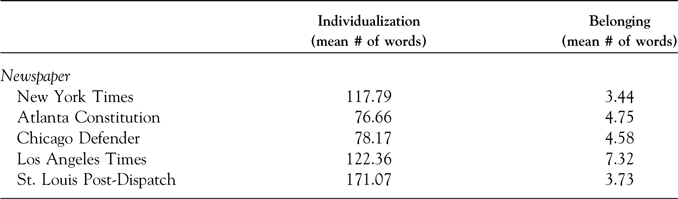
Mean Values of Individualization and Belonging by Newspaper

Next, we observe that articles documenting bribery, tax evasion, or voter fraud are associated with higher levels of Individualization than articles that deal with credit card fraud, which has no statistically significant relationship to our measure of individualization. This is, likely, because the sociodemographic profile of perpetrators who engage in credit card fraud is more varied than the profiles of those who partake in voter fraud, resulting in a clearer relationship with individualization. Mentions of collaborators are associated with less individualization, whereas an article indicating that a perpetrator has admitted guilt, which is relatively uncommon, is, expectedly, associated with more. Regarding how far the case has progressed in the criminal justice process, we observe that cases further along in the process (i.e., in the plea bargain/guilty plea, trial, dismissal/mistrial, acquittal/conviction, and sentenced/fined/probation categories), were associated with lower Individualization. One possible explanation of this relationship is that cases that had progressed further in the system were already familiar to the readership due to their previous coverage in the press. As a result, the description of the perpetrator may be shortened or omitted by the author to avoid repetition.
Model 1 also controls for different newspapers, with the New York Times omitted as the reference category. The Atlanta Constitution and the Chicago Defender exhibit negative association with individualization, whereas publication in the Los Angeles Times and the St. Louis Post-Dispatch is related to this outcome positively. The analyses also show that articles published before 1975 have lower levels of offender individualization than articles published after 1975, which provides statistical evidence in support of our third hypothesis: that the political climate following the Civil Rights era provided a favorable climate for the racialization of crime in the press (of which, we argue, individualization is a measure). Last, descriptions of property damage and crime victims, which tend to generate interest among readers, are both positively linked to individualization—perhaps because articles dedicated to more damaging and costly crimes tend to be longer on average.
Turning now to the effects of our predictors on Belonging, Model 2 demonstrates that, relative to female offenders, male perpetrators tend to receive more extensive descriptions of professional success, collaboration with authorities, and various extenuating circumstances, which we code as Belonging. However, we warn against overinterpreting this finding because the number of female perpetrators is very low in our analysis. In comparison to credit card fraud, bribery and electoral/voter fraud are significantly and negatively associated with Belonging. Moreover, as might be expected, perpetrators who had admitted guilt received more extensive descriptions of their belonging to the mainstream society relative to those who had only been indicted; the same effect holds for the offenders who were on trial at the time of publication—likely because the overall length of these articles was greater (due to the larger amount of material for reporting given the ongoing trial). As expected, those who had been found guilty and sentenced received shorter positive descriptions.Footnote 10 In line with our theoretical expectations, the number of words used by authors to describe any property in the possession of the alleged perpetrator was associated with more extensive descriptions of Belonging, while the number of words used to describe crime victims exhibited negative association with levels of Belonging. These findings, we note, suggest that our concept of Belonging has high validity.
Finally, we find that articles published before 1975 were characterized by overall lower rates of offender belonging description, compared to articles published after 1975. Again, because we theorize the post–Civil Rights era as the time when racialization of crime became an important dimension of its collective framing, the reversal in the trends of Belonging (which, we argue, is another measure of racialization) for different types of white-collar criminals around that time offers additional support for our theory. Last, regarding the effects of specific newspapers, the Chicago Defender and the Los Angeles Times showed positive effects on Belonging relative to the New York Times, which, likely, reflects the specificities in the format and writing conventions of different outlets.
In sum, our results yield robust evidence in support of our hypotheses derived from John Hagan’s theory of the collective framing of white-collar crime. Based on our analyses of crime coverage in the national newspapers since 1950s, we conclude that, consistent with Hagan’s expectations, African American perpetrators of white-collar crimes are individualized and described as belonging to the nonthreatening, “normal,” or mainstream society. Together, we argue, individualization and emphasized belonging function to symbolically lift black offenders out of the group into which they are placed by collective framing of petty street crime as black and dangerous (accomplished through individualization) and to reposition them as belonging among the “ordinary” (white) people. This reframing defines their crime as routine, not menacing, and, most importantly, different from the kind of deviance that needs to be systematically regulated and heavily punished by the government. To achieve this, we find, African American perpetrators of white-collar crime are portrayed not simply as white but as “whiter than white”—the technique that, we expect, allows reporters to overcome the disadvantage associated with the typical portrayal of black offenders in crime news.
CONCLUSION
Social scientists contend that, at least in the United States, political and business elites usually shape media portrayals of such deviance to their advantage (Michel, Cochran, and Heide Reference Michel, Cochran and Heide2016). Thus, such representations underplay the frequency of white-collar crime relative to street crime (Burns and Orrick Reference Burns and Orrick2002; Friedrichs Reference Friedrichs2002; Marsh and Melville Reference Marsh, Melville, Marsh and Melville2014), redirect the blame for white-collar deviance from individual or organizational perpetrators onto the regulatory or criminal justice institutions (Beckett and Sasson Reference Beckett, Sasson and Sally2000; McMullan and McClung Reference McMullan and McClung2006), and underplay its social, environmental, and financial costs (Friedrichs Reference Friedrichs2009; Kappeler and Potter Reference Kappeler and Potter2017). Yet, to date, hardly any research has been done on the racialized collective framing of white-collar crime as an unfortunate yet acceptable side effect of free-market capitalism. This is simultaneously very surprising and not surprising at all. In light of the media’s well-documented tendency to racialize street criminals, simultaneously overemphasizing the dangers of petty crime and criminalizing black and brown bodies (Barlow and Barlow Reference Barlow and Hickman Barlow2010), one might expect that researchers would interrogate the parallel processes in media portrayals of white-collar deviance. At the same time, the notable absence of such research suggests that the very project of the collective framing described by John Hagan in Who Are the Criminals? was a resounding success. White-collar crime is presumed white—by social scientists and other analysts alike.
Inspired by Hagan’s focus on white-collar crime as a window into the ways that race, class, and criminality interact in producing social inequality, we examined media portrayals of white-collar criminals across time and across space. This is uncommon in extant research, as most relevant studies focus on specific geographic areas and on short periods of time (e.g., Sheley and Ashkins Reference Sheley and Ashkins1981; Entman Reference Entman1992; Dixon and Linz Reference Dixon and Linz2000, Reference Dixon and Linz2002; Chiricos and Eschholz Reference Chiricos and Eschholz2002). Yet, as argued by Bjornstrom and colleagues (Reference Bjornstrom, Kaufman, Peterson and Slater2010), such narrow focus makes it harder for scholars to infer the impact of structural conditions on the collective faming of crime, and, in turn, to shed light on the effects of such framing on the patterns of race-based disadvantage in the United States. We, therefore, conclude with an invitation to other researchers interested in the sociopolitical implications of mass media—especially as they relate to crime and criminal justice policy—to follow our lead in embedding their analyses in the appropriate sociohistorical contexts. This, we believe, is an important lesson of John Hagan’s legacy.