How does gender influence the American judicial system? Scholars interested in this question have focused on several areas, including the substance of the law (Bender Reference Bender1993; Olsen Reference Olsen1995; Rifkin Reference Rifkin1981), the presence of women on a jury (Fowler Reference Fowler2005; Marder Reference Marder1987; Taylor-Thompson Reference Taylor-Thompson2000), and the sex of criminal defendants (Sarnikar, Sorenson, and Oaxaca Reference Sarnikar, Sorensen and Oaxaca2007; Starr Reference Starr2012). Among political scientists in particular, most work has examined judicial decision-making and whether the rulings of female judges differ from those of their male counterparts. Results of these studies have been mixed: some indicate that female judges vote differently, at least in certain types of cases (Boyd, Epstein, and Martin Reference Boyd, Epstein and Martin2010; Peresie Reference Peresie2005; Songer and Crews-Meyer Reference Songer and Crews-Meyer2000), but others have found no, or only a minimal, gender effect (Segal Reference Segal2002; Songer, Davis, and Haire Reference Songer, Davis and Haire1994; Walker and Barrow Reference Walker and Barrow1985).
Given the significance of gender in other political environments (Kahn Reference Kahn1994; Lawless and Fox Reference Lawless and Fox2010; Thomas Reference Thomas1994; Wolbrecht Reference Wolbrecht2000), the mixed findings with regard to gender and judging are somewhat surprising (but see Kritzer and Ulman Reference Kritzer and Uhlman1977; Sisk, Heise, and Morris Reference Sisk, Heise and Morris1998). These studies, however, have focused almost exclusively on judicial decision-making over case outcomes. They have not examined the cases themselves, the “raw material” that comes before those judges and forms the basis for judicial policy-making. In this article, I use an original web-based survey to address this shortcoming by investigating the ways gender can affect who is using the legal system and which cases appear before judges.
LITIGANT DECISION-MAKING
There has been relatively little research on litigant decision-making, particularly when it comes to “ordinary” citizens. Existing scholarship centers primarily on the legal tactics of interest groups (Baird Reference Baird2007; Caldeira and Wright Reference Caldeira and Wright1988; Collins Reference Collins2008; Epstein Reference Epstein, Johnson and Gates1991), the federal government (Bailey, Kamoie and Maltzman Reference Bailey, Kamoie and Maltzman2005; Black and Owens Reference Black and Owens2012; Zorn Reference Zorn2002), and “cause lawyers” who use the legal system to achieve larger social and political goals (Marshall and Hale Reference Marshall and Hale2014; McCammon and McGrath Reference McCammon and McGrath2015; Sarat and Scheingold Reference Sarat and Scheingold2006). Some scholars have now also begun to tend to a small cadre of “elite” attorneys who frequently appear before the Supreme Court (Biskupic Reference Biskupic2015; Lazarus Reference Lazarus2008; see also McGuire Reference McGuire1995).
There is much less scholarship investigating when and why private individuals pursue legal action. Most of the work that examines this topic is grounded in law and economics (see generally Sanchirico Reference Sanchirico2012). Fueled primarily by Priest and Klein's (Reference Priest and Klein1984) seminal “selection hypothesis,” which postulates that litigants assess the costs and benefits when determining whether to pursue or settle a case, scholars have developed sophisticated formal models of some aspects of litigant decision-making, including the filing of lawsuits and settlement behavior (Bebchuk Reference Bebchuk1984; Donahue Reference Donohue1988; Hylton Reference Hylton2002; Waldfogel Reference Waldfogel1998; Watts Reference Watts1994; Wittman Reference Wittman1988). A few have also empirically tested these models in certain substantive areas of the law, such as telecommunications contracts and employment discrimination (de Figueiredo Reference de Figueiredo2005; Drahozal and Hylton Reference Drahozal and Hylton2003; Siegelman and Donahue Reference Siegelman and Donohue1995).
Political scientists have devoted less study to “ordinary” litigant behavior (but see Yates, Cann, and Boyea Reference Yates, Cann and Boyea2013). The works that do exist usually focus on the behavior of prosecutors and criminal defendants (Landes Reference Landes1971; Reinganum Reference Reinganum1988), the decision to appeal cases to a higher court, and how litigant decisions might affect appellate court behavior (Baird Reference Baird2007; Cross Reference Cross2003; Songer, Cameron, and Segal Reference Songer, Cameron and Segal1995; Yates and Coggins Reference Yates and Coggins2009). The decision to initiate litigation, settle cases that have already been filed, or pursue alternative forms of dispute resolution, particularly in the civil litigation system, remain generally unexplored (see Boyd et al. Reference Boyd, Hoffman, Obradovic and Ristovski2013 and Boyd and Hoffman Reference Boyd and Hoffman2013 for important exceptions).
One reason for the lack of research in this area likely stems from data challenges. A thorough study of litigant decision-making needs to incorporate the initial decision about whether to commence legal action. That decision, however, cannot be evaluated without identifying cases that could have been filed in the legal system, but were not. Such information is clearly difficult to gather, particularly if one wishes to compile a large-N dataset.
Yet the general neglect of the choices of litigants remains troubling. Unlike the legislative or executive branches, the judiciary is a fundamentally passive institution: it must rely on others to bring cases to it. The issues about which judges make decisions do not “magically jump” into the legal arena, but are brought there by an “active initiator” (Baird Reference Baird2007, 2–3) who has decided to pursue a dispute.Footnote 1 Only when an individual begins legal action does the potential for judicial policy-making appear, but we know virtually nothing about why, when, and how individuals elect to use the legal system.
Aside from whether a court is able to issue a ruling, what that ruling is about is also largely determined by the litigant. Although jurists can theoretically step outside the dispute as filed, they almost always confine themselves to the legal issues presented by the parties (Epstein, Segal, and Johnson Reference Epstein, Segal and Johnson1996). It is only when an aggrieved person decides to initiate legal action over, for instance, health care, gay marriage, voting rights, or women's rights that the courts have the opportunity to determine policy in those areas. If no litigant raises the issue, there is no legal policy, regardless of how much a jurist wishes to formulate it. Given their fundamental role, a better understanding of why and how litigants make the choices they do is required.
GENDER AND LITIGANT DECISION-MAKING
This project focuses on a particular component of litigant decision-making: the ways gender can shape the inputs, and therefore the outputs, of the legal system. Cases that become the locus for judicial policymaking have gone through a complex and lengthy process in which parties make a series of choices about whether and how to continue with litigation. Injured persons must decide whether to start legal action, whether to settle the case, whether to pursue mediation or other forms of alternative dispute resolution (ADR),Footnote 2 and whether to appeal an unfavorable ruling. Since each of these decisions determines the universe of cases that become the “raw material” of legal policymaking, I formulate expectations for each of these stages.
Why would female litigants make any of these choices differently than males? First, women are more risk- and competition-averse than men. Studies in economics (Charness and Gneezy Reference Charness and Gneezy2012; Ertaca and Gurdalb Reference Ertaca and Gurdalb2012) and psychology (Byrnes, Miller, and Schafer Reference Byrnes, Miller and Schafer1999; Campbell Reference Campbell2002; Harris and Jenkins Reference Harris and Jenkins2006) have found that women are less likely to take risks than men. In politics, female candidates also appear to evaluate the risks of running for elected office differently than men, and their lower political ambition has been attributed in part to greater risk aversion (Lawless and Fox Reference Lawless and Fox2012; Maestas et al. Reference Maestas, Fulton, Maisel and Stone2006). Women also are more likely to avoid competitive situations (Booth and Nolan Reference Booth and Nolen2009; Gneezy, Leonard, and List Reference Gneezy, Leonard and List2009) and withdraw earlier than men from competitive environments (Hogarth, Karelaiab, and Trujillo Reference Hogarth, Karelaiab and Trujillo2012).
Women also are often viewed as more collaborative than men, preferring cooperation over coercion and control (Burke and Collins Reference Burke and Collins2001; Gilligan Reference Gilligan1982; Thomas Reference Thomas1994; but see Reingold Reference Reingold1996, Reference Reingold2000). When confronted with a conflict, women are thought to seek inclusive solutions that “make everybody happier” rather than framing the issue as “zero-sum game” with winners and losers (Gilligan Reference Gilligan1982, 33; see also Sherry Reference Sherry1986). Women see conflict resolution, moreover, as best attained through communication and compromise, in which the positions of both sides are deemed reasonable and worthy of accommodation (Bartlett Reference Bartlett1990; Menkel-Meadow Reference Menkel-Meadow1985). Such behavior has been suggested for female officeholders, for example, who are expected to “emphasize … compromise, consensus building, and cooperation” (Reingold Reference Reingold, Wolbrecht, Beckwith and Baldez2008, 132), as compared to men's skills in “personal assertiveness and competition” (Rosenthal Reference Rosenthal2000, 25).
Several scholars have built upon these concepts to posit how female judges might behave differently. They have postulated that female jurists will encourage more negotiation between the parties, write opinions that reflect more nuanced, contextual reasoning, and attend to facts or relationships between the parties that male judges might not consider legally relevant (Bartlett Reference Bartlett1990; Brown, Parmet, and O'Connel Reference Brown, Parmet and O'Connell1999). Recent evidence on judicial behavior has borne out such expectations: female district judges settle more cases and settle them more quickly than male judges (Boyd Reference Boyd2013).
Similarly, it has been suggested that female lawyers might make legal arguments whose content better reflects women's lives (MacKinnon Reference MacKinnon1990) and present those arguments differently to a court (Abrams Reference Abrams1991). They also may reject the traditionally combative style of courtroom litigation in favor of the more, dialogue-centered and consensus-focused methods of negotiation, mediation, and other forms of ADR (Colker Reference Colker1990; Menkel-Meadow Reference Menkel-Meadow1985; Rackley Reference Rackley2012). And, as in the gender dynamics identified in Congressional committees (Volden, Wiseman, and Wittmer Reference Volden, Wiseman and Wittmer2013b), female jurors might focus more on constructing agreements rather than provoking or prolonging conflict (see, e.g., Taylor-Thompson Reference Taylor-Thompson2000).
I build on these works to suggest that when it comes to decisions about litigation, females will behave differently from their male counterparts. Litigation is, by its very nature, adversarial, risky, and competitive. It involves two parties engaged at cross-purposes, clashing over whose legal claim will prevail. There are certain procedural rules that promote information sharing and may funnel the litigants toward agreement, but the process inherently involves argument, conflict, and confrontation. There also is no guarantee of success.
As a result, I theorize that female litigants will make different choices than their male counterparts and do so across all stages of the legal process. In particular, I suggest they will be less willing to employ the legal system at all, and, if they do, they will be more likely to favor approaches that involve negotiation, collaboration, and compromise. They will, in short, be “kinder and gentler” in their approach to resolving a conflict. Thus, I hypothesize the following:
H1a:
When confronted with a potential legal dispute, female litigants will be less likely than male litigants to institute legal action.
H1b:
When confronted with a potential legal dispute, female litigants will be more likely than male litigants to pursue alternative dispute resolution.
H1c:
Having begun litigation, female litigants will be more likely than male litigants to pursue alternative dispute resolution.
H1d:
Having begun litigation, female litigants will be more likely than male litigants to settle a case before it reaches trial.
H1e:
Female litigants will be less likely than male litigants to appeal an unfavorable court decision.
Women's underlying propensity to litigate may vary by the type of legal issue involved, however. Political scientists have found that female legislators behave more assertively if the policy involves a “women's issue” (Carey, Niemi, and Powel Reference Carey, Niemi, Powell, Thomas and Wilcox1998; Dodson and Carroll Reference Dodson and Carroll1991; Swers Reference Swers2002; Thomas Reference Thomas1994; Wolbrecht Reference Wolbrecht2000). Precisely what constitutes a “women's issue” has been the subject to extensive debate. Scholars have grappled with how to identify issues that may be particularly relevant to women as a group, while at the same time avoiding essentializing women and ignoring the intersecting influences of race, class, sexuality, and political ideology (see 2011 Politics & Gender symposium). Concerns have also been raised about the appropriateness of defining “women's issues” exogenously, rather than relying upon legislators themselves to identify certain policies (Reingold and Swers Reference Reingold and Swers2011; Volden, Wiseman, and Wittmer Reference Volden, Wiseman and Wittmer2013a).
In defining “women's issues,” some scholars have employed a relatively narrow framework to include only those issues that have a disproportionate effect on women, such as reproductive rights, or that directly relate to women's political or economic equality, such as discrimination in the workplace (Barnello and Bratton Reference Barnello and Bratton2007; Boyd et al. Reference Boyd, Hoffman, Obradovic and Ristovski2013; Carroll Reference Carroll1984; Reingold 2002). Others have favored a more inclusive approach to incorporate issues that touch on areas of “traditional” concern to women, such as families, education, health, and social welfare (Reingold Reference Reingold2000; Reingold and Haynie Reference Reingold, Haynie, Escobar-Lemmon and Taylor-Robinson2014; Reingold and Swers Reference Reingold and Swers2011; Swers Reference Swers2002).
Despite these conceptual challenges, there is strong evidence that, regardless of which issues are included, female legislators are more proactive in these areas, particularly at the agenda-setting stage (Cammisa and Reingold Reference Cammisa and Reingold2004; Carroll Reference Carroll2001; Swers Reference Swers2013; Thomas Reference Thomas1994). A general resistance among women to the adversarial process therefore may be conditional on the type of legal claim that is involved. More precisely, if a female litigant is confronting a conflict involving one of these “women's issues,” she should be more likely to pursue the case than a male and behave more aggressively throughout the entirety of the adjudicative process. I suggest several reasons for this.
First, since women are disproportionately affected by, for instance, sexual harassment and unequal pay, it is simply more likely that a woman will find herself facing these types of violations.Footnote 3 Given increasing public and political attention, a woman also may be more attuned than a man to when she is experiencing sex discrimination.Footnote 4 A woman probably is more likely than a man to know of, or be close to, other women who have litigated such issues. This may make her less reluctant to bring the claim into the court system or pursue the litigation to its fullest extent.
Strategic considerations about the likelihood of success also may be at play. Precisely because these issues are associated with women, a man may feel uncomfortable having the claim in the public arena or be concerned that judges and juries would be suspicious of his claim of gender inequality.Footnote 5 In contrast, a woman should be more likely to see pursuit of legal action as legitimate and feel more positively about her chances of winning in court.
Thus, I hypothesize the following:
H2a:
When confronted with a potential legal dispute involving a “women's issue,” female litigants will be more likely than male litigants to institute a legal claim.
H2b:
When confronted with a potential legal dispute involving a “women's issue,” female litigants will be less likely than male litigants to pursue alternative dispute resolution.
H2c:
Having begun litigation, female litigants will be less likely than male litigants to pursue alternative dispute resolution in a case involving a “women's issue.”
H2d:
Having begun litigation, female litigants will be less likely than male litigants to settle a case involving a “women's issue.”
H2e:
Female litigants will be more likely than male litigants to appeal an unfavorable court decision in a case involving a “women's issue.”
DATA AND METHODS
To evaluate the hypotheses, I conducted a survey of 529 individuals using an online, anonymous panel provided by Qualtrics.Footnote 6 The sample of respondents matched the general population in the United States on gender, race, and income as closely as possible. The final sample reflected the overall population on these measures reasonably well, with 51.23% female (compared to 50.9% in the U.S. population), 85.25% Caucasian (versus 77.77% in the U.S. population), and a median income of approximately $50,000 (versus $52,244 for the U.S. population).Footnote 7 Since minors cannot institute legal action on their own behalf, the panel excluded those who were under the age of 18. It also excluded individuals who indicated they were not fluent in English and those residing outside the United States.
After answering questions about their age, gender, education, income, political ideology, and employment, respondents were presented with two hypothetical scenarios in which they confronted a situation that could warrant legal action. In the first vignette, which was designed to contain a potentially common and “generic” legal dispute, the respondent is placed in a scenario where he or she is physically injured in a “big box” retail store; in the second, the respondent learns that he or she may be the victim of sex-based pay discrimination. I centered the second vignette on pay discrimination in particular because it is included in virtually all the definitions of “women's issues” found in the literature discussed above.
The precise wording of the vignettes are as follows:
Vignette #1: Imagine that you are shopping at a large “big box” retail store. As you walk down an aisle, you see several construction workers working on the large light fixtures that hang from the store's ceiling. You notice and follow signs that direct you around the repairs, but as you walk past, a piece of one of these lights suddenly drops, hitting you in the neck and back. After visiting your doctor, you learn that you have sustained damage to several disks in your spine and will need expensive surgery to correct the problem. Your health insurance company has refused to pay the claim, stating that it is the store's responsibility. The store claims that you did not follow their signs and should have avoided the area entirely. Assume that the cost of taking action is not a concern to you.Footnote 8 If this happened to you, what would you do?
Vignette #2: Imagine that you have worked happily at the local branch office of a very large company (more than 1,000 employees) for more than ten years. You recently learned, however, that a person of the opposite sex does basically the same job as you do, but is paid a lot more. You have spoken to supervisors at the company's headquarters but they have said they cannot discuss salary matters with you. Assume that the cost of taking action is not a concern to you. If this happened to you, what would you do?
After each vignette, I gave respondents four options designed to evaluate what initial decision they would make in this situation:
-
1. File a lawsuit
-
2. Use a third party mediator who would work with you and the store/company to try and find common ground and resolve the dispute
-
3. Try to resolve the dispute outside the legal system (for example, through an informal meeting)
-
4. Do nothingFootnote 9
I call this stage of the decision-making process Stage One.
For those respondents who said they would pursue litigation, I then described a situation in which they were presented with a settlement offer by the defendant. The text is as follows:
Vignette #1: Imagine now that you file the lawsuit. A few weeks later, the store's attorney contacts your attorney and offers you a substantial sum of money, which will cover the cost of surgery and compensate you somewhat (but not completely) for your pain and suffering, if you agree to end the lawsuit. Assume that the cost of taking further action is not a concern to you. Which of the following courses of action would you take?
Vignette #2: Imagine now that you file the lawsuit. A few weeks later, the attorney for the company contacts your attorney and offers to increase your salary to that of the other employee but not pay you any of the back pay you feel you are owed. Assume that the cost of taking further action is not a concern to you. Which of the following courses of action would you take?
I then instructed respondents to select one of the following four options:
-
1. Refuse the offer and continue with the lawsuit
-
2. Accept the store/company's offer and end the lawsuit
-
3. Continue with the lawsuit but use a third party mediator who would work with you and the store/company to try to find common ground and resolve the dispute
-
4. Stop the lawsuit and try to resolve the dispute outside the legal system (for example, through an informal meeting)
I call this stage of the decision-making process Stage Two.
For those respondents who opted to refuse the settlement offer and continue with litigation, I described a situation in which they lost their case at trial and asked them to indicate whether they would appeal the case or not. I used the following text:
Vignette #1: Imagine now that you did not agree to the store's offer and your case went to trial before a jury. Unfortunately, you lost the case and did not receive any compensation from the store. Your attorney is unable to predict the outcome if you pursue your case further. Again, assume that the cost of taking further action is not a concern to you. Which of the following courses of action would you take?
Vignette #2: Imagine now that you did not agree to the company's offer and your case went to trial before a jury. Unfortunately, you lost your case and did not receive any money from the company. Your attorney is unable to predict the outcome if you pursue your case. Again, assume that the cost of taking further action is not a concern to you. Which of the following courses of action would you take?
Respondents were then asked whether they would:
-
1. Ask a higher court to review the jury's decision
-
2. Accept the jury's decision and take no further action
I call this stage of the decision-making process Stage Three.
RESULTS: DESCRIPTIVE STATISTICS
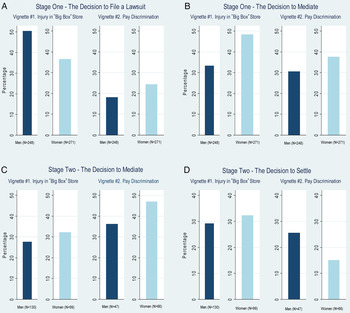
The descriptive statistics reveal several important differences between the litigation choices of men and women. The results are reported for each of the three stages of the decision-making process. Figure 1 displays the results.
Comparing litigation decisions of men and women.

Stage One: Filing a Lawsuit
Panel A of Figure 1 displays the rates at which male and female respondents indicated that they would file a lawsuit in each of the two vignettes. H 1a suggests that women would have an overall lower propensity to litigate than men, and the data on the left side of the figure show support for this hypothesis: 38% of female respondents said that they would file litigation if injured in a “big box” store versus 51% of male respondents. This difference of 13% is statistically significant at p < 0.01 (two-tailed).Footnote 10
H 2a posits that women's lower propensity to litigate would be conditional on the type of legal issue involved, with women more likely than men to litigate if the harm involved a “women's issue.” As seen on the right side of panel A of Figure 1, there is some support for this hypothesis. A greater percentage of female than male respondents indicated they would file a lawsuit over pay discrimination: 24% of women versus 18% of men would initiate litigation. The p-value on this 6% difference was marginally significant at the p < 0.1 level.
Stage One: Mediation
I hypothesized that women, given their tendency to favor cooperation and avoid confrontation, would be more likely than men to pursue mediation; if the case involved a “women's issue,” I expected them to favor mediation less than men. As seen in the left side of panel B of Figure 1, female respondents were more likely than male respondents to employ mediation in the “generic” dispute, with respective rates of 48% versus 32%. This statistically significant 16% difference (p < 0.01) supports H 1b .
The descriptive statistics provide some support for the notion ( H 2b ) that women would be less likely than men to favor ADR when the dispute involved a “women's issue.” As seen in the figure, women were more likely to favor ADR than men, even in cases of pay discrimination. In particular, 38% of women versus 31% of men would use mediation when suing their company over pay discrimination, a marginally significant difference (p < 0.09) of 7%.Footnote 11
Stage Two: Mediation
Respondents were also given the choice to favor mediation during Stage Two, once a settlement offer had been made. Again, the hypotheses predicted that women would be more likely than men to pursue mediation than men, unless a “women's issue” was involved. The data, displayed in panel C of Figure 1, do not support either of these hypotheses.
In the dispute involving the “big box” store, women were more likely than men to favor mediation (32% of women versus 27% of men), but the difference was not statistically significant. When the dispute involved pay discrimination, women again showed a greater preference for mediation (47% of women versus 36% of men), but the difference again was not statistically significant. When combined with the results for Stage One, it seems, therefore, that women generally prefer mediation, regardless of the type of issue involved, but only during the initial decision-making stage. Once litigation has begun, a gender-based preference for mediation appears to dissolve. This may be due, however, to the much smaller number of respondents who reached this question in the survey.Footnote 12
Stage Two: The Decision about Settlement
H 1d proposed that once litigation had begun, women would be more willing to settle than men. If the case involved a “women's issue,” H 2d suggested they would be less likely to settle than men. As seen in panel D of Figure 1, the data provide mixed support for these hypotheses.
In the “big box” case, the rates of agreeing to settlement were virtually identical, with 29% of men and 32% of female respondents selecting this option. The data provide tenuous support for H 2d , that women would be less likely to settle in the pay discrimination case: 15% of women and 26% of men said they would settle the case; the 11% difference reaches marginal significance at p < .15. Given the relatively small N (130 men and 190 women in Vignette #1 and 47 men and 66 women in Vignette #2), however, these results should be interpreted with caution.
Stage 3: The Decision to Appeal
Finally, I suggested in H 1e that women would be less likely to appeal cases they had lost. If the case involved a “women's issue,” H 2e predicted women would be more likely than men to appeal. The data (not displayed) do not show support for these hypotheses. In the dispute with the “big box” retailer, the appeal rates of men and women are virtually indistinguishable. When the case involves pay discrimination, the rates do differ somewhat, though in an unexpected direction: 100% of the men, but only 88% of women indicated they would appeal their case. This difference is not statistically significant, however.Footnote 13 The small number of respondents answering this question (25 men and 16 women) again may be a factor in this result.
RESULTS: MULTIVARIATE MODELS
To determine if these findings persisted when controlling for other variables, I also conducted a multivariate analysis.Footnote 14 Given the categorical nature of the dependent variables, I used multinomial logit.Footnote 15 The primary independent variable was the gender of the respondent, coded 1 for female, 0 for male.
Decisions about adjudication may also be affected by other individual-level traits, so I included several controls. First, those with higher socioeconomic status may make decisions about litigation differently than those of lower socioeconomic status. Individuals with higher incomes and education likely have more knowledge about the legal system or may have others in their social networks who can help them navigate the litigation process. Higher SES individuals also may have more internal efficacy, a belief that they have the requisite skills and know-how to deal with the complexities of filing a lawsuit. As a result, they may feel more comfortable using the legal system. I therefore account for the respondent's annual income and level of education.Footnote 16 Respondent's ideology may also play a role, with liberals more willing to use government institutions such as courts. The model thus includes a variable for political ideology.Footnote 17
Extant literature and recent polling data also suggest that racial minorities are more distrustful of the legal system than their white counterparts (Anderson 2014; Longazel, Parker, and Sun Reference Longazel, Parker and Su2011; Tyler and Huo Reference Tyler and Huo2002). Most of the data relates to minorities’ perceptions of the criminal justice system, but this mistrust could extend to the civil court system as well and make minorities less likely than whites to pursue litigation, more likely to pursue remedies outside the legal system, and less likely to pursue appeals. Accordingly, I include a dichotomous variable indicating whether respondents are minority (= 1) or nonminority (= 0).Footnote 18
Lastly, individuals who have been exposed to or are generally more familiar with the legal system may be more likely to pursue legal remedies. I attempted to capture this with several questions. I asked respondents whether they were an attorney or judge, whether a member of their immediate family (parent, partner/spouse, or children) was an attorney or judge, and whether they had ever been a plaintiff or a defendant in a lawsuit. I also asked respondents whether they “generally understood the legal system” and, if they “had a problem that warranted it,” whether they would “feel comfortable filing a lawsuit.”Footnote 19 I used factor analysis to generate two factor scores. The first, which I term “legal background,” included responses to the first set of questions. The second, which I term “familiarity,” captures responses to the last two questions. I then included both of these variables in the model.
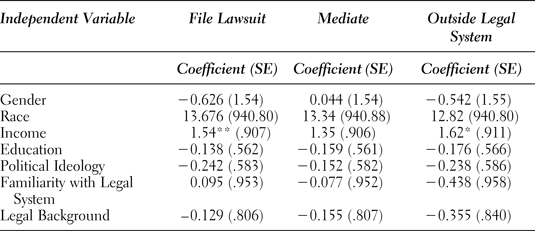
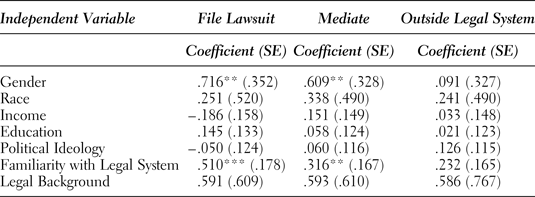
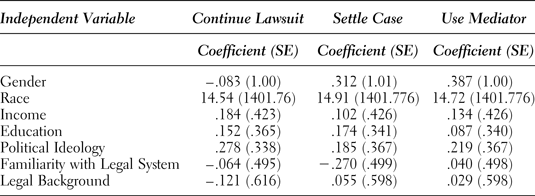
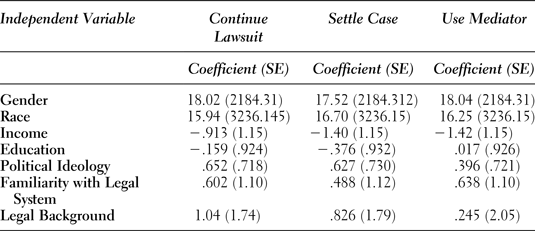
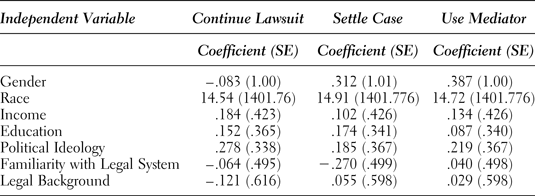
Coefficients in a multinomial logit are difficult to interpret directly, as they represent the log odds of a particular outcome when compared to the base category. The results presented in Table 2 indicate, however, that gender has a significant effect on the decision to file suit (p < .01) and mediate (p < .05) versus “do nothing” in the pay discrimination case. Familiarity with the legal system was also significant in that model, at p < .01 for filing suit and p < .05 for mediation. In the vignette involving the “big box” store (Table 1), income had a statistically significant effect on the decision to file a lawsuit and resolve outside the legal system (p < .05) when compared to doing nothing. As seen in Tables 3 and 4, no variables reached statistical significance in the models of settlement behavior.
Initial decision, injury in the “big box” store

Notes: Omitted reference category is “Do Nothing.”
***p < .01; **p < .05; *p < .10. (N = 529)
Initial decision, pay discrimination
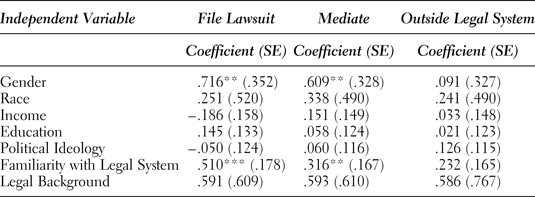
Notes: Omitted reference category is “Do Nothing.”
(N = 529)
***p < .01; **p < .05; *p < .10.
Settlement decision, injury in “big box” store
Omitted reference category is “Resolve Outside Legal System.”
(N = 229)
Settlement decision, pay discrimination
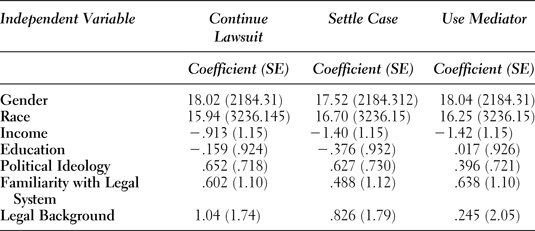
Notes: Omitted reference category is “Resolve Outside Legal System.”
(N = 113)
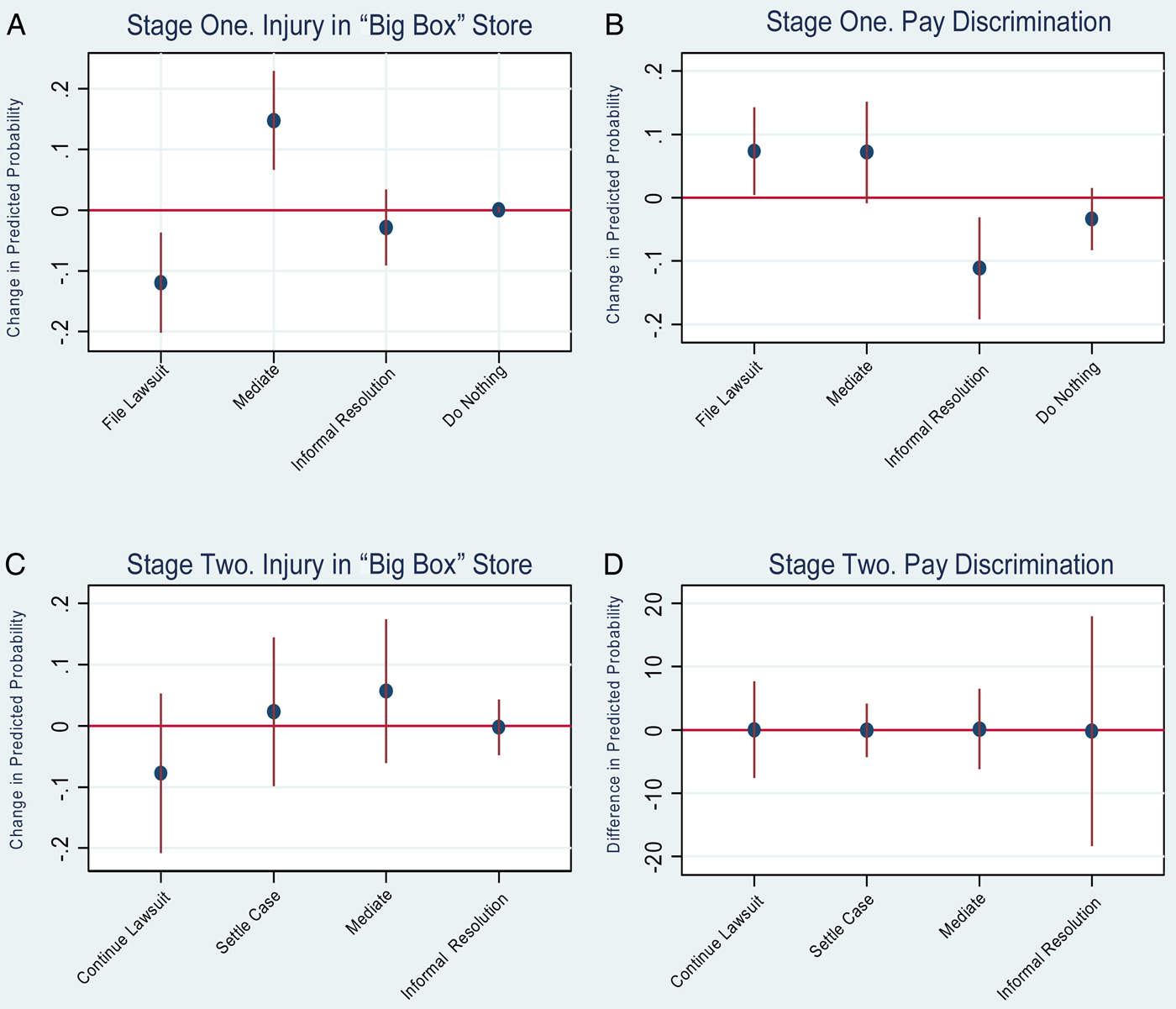
Calculation of the substantive effects of the effect of gender yields more useful information (Long Reference Long1987). To ease interpretation, I present the results graphically in the form of changes in predicted probabilities.Footnote 20
Stage One: Filing a Lawsuit
I first examine whether a litigant's gender influences the initial decision-making about filing a lawsuit.Footnote 21 As with the descriptive data, the results for the vignette involving the “big box” retailer support the prediction that women would be less likely than men to initiate formal litigation. Panel A in Figure 2 shows the difference between women's mean predicted probability of filing a lawsuit (.36) and men's (.48). That difference is statistically significant (p < 0.01), providing support for H 1a and indicating that women are approximately 12% less likely than men to embark on legal action.
Comparing litigation decision of men and women, change in predicted probabilities.
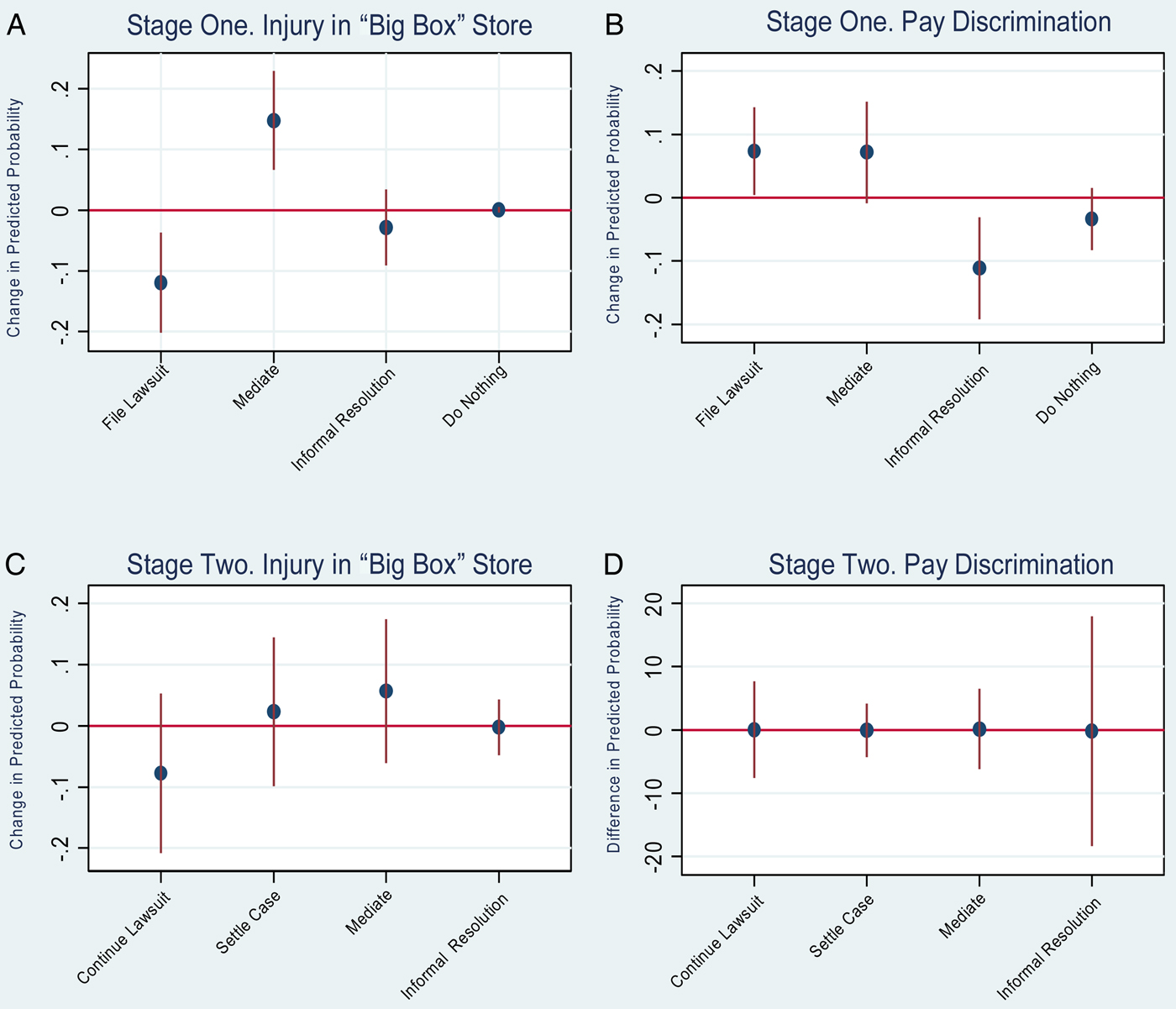
The results also support the hypothesis that women will be more likely than men to file a lawsuit when a “women's issue” is involved. As seen in panel B of Figure 2, the mean probabilities of doing so differ (0.17 for men and 0.24 for women), and this 7% difference is statistically significant (p < .05). In addition, though I did not hypothesize about the choice specifically, it is notable that women are also 11% (p < .00) less likely to seek resolution in these types of cases outside the legal system.
Stage One: Mediation
As hypothesized, women also appear to favor mediation more than men, at least during the initial stage of the legal process. The model produced mean probabilities of 0.50 and 0.35, respectively, in the dispute with the “big box” store. The difference is statistically significant (p < 0.01), indicating that women are approximately 15% more likely than men to opt for mediation. Panel A of Figure 2 shows this result.
In the case involving pay discrimination, the prediction that women would be less likely than men to prefer mediation was also supported. As seen in panel B of Figure 2, women's mean probability of favoring mediation was higher than men's (0.37 and 0.30, respectively), comporting with the descriptive results reported above. This 7% difference is (marginally) significant, with a p-value of .08.
Stage Two: Mediation
Once litigation has begun, women and men no longer differ in their propensity to favor mediation, regardless of the issue involved. The results in panels C and D of Figure 2 show that while women and men's mean predicted probabilities of opting for mediation differ somewhat (0.31 and 0.26, respectively, against the “big box” store and 0.47 and 0.39, respectively, in the pay discrimination case), these differences were not statistically significant.
Stage Two: The Decision about Settlement
There also appear to be no real differences in how men and women respond to a settlement offer.Footnote 22 As seen in panel C of Figure 2, men and women agreed to settle against the “big box” retailer at rates that were statistically indistinguishable. Similarly, the results displayed in panel D of Figure 2 suggest that gender is not a predictive factor for settlement, even if a “women's issue” is involved. Women and men's mean predicted probability of refusing settlement and continuing litigation were virtually identical, at approximately 0.37. Women were slightly less likely to agree to settle this type of case than men (0.14 versus 0.20, respectively), but the difference was not statically significant.
DISCUSSION
This study uncovers several differences in the litigation decision-making of men and women. These differences vary somewhat by the stage of the litigation process and the type of legal issue involved, but they demonstrate that gender affects the adjudicative process, at least in the earliest stages. The study shows that women are less likely to file lawsuits than men, at least if the case involves a “generic” legal issue. Though it is difficult to confirm that this reluctance is due to an aversion to the nature of litigation, women do seem less eager than men to employ the inherently competitive and risky legal system. This comports with the findings of other political science subfields that gender shapes who is willing to enter and participate in certain political institutions (such as Congress and state legislatures) and suggests that this list may need to include courts as well.
If the case involves pay discrimination, women's disinclination to litigate disappears and they become more likely than men to file a lawsuit. Again, as in other political arenas, it seems that women are willing to take a more active role when confronted with a conflict which disproportionally affects them or when they might feel more optimistic about their chance for success.
It is also worth noting that both sexes were less likely to litigate the pay discrimination case than the injury in the “big box” store. Men's mean probability of filing a lawsuit in that case declined from 0.48 to 0.17; women's declined as well, from 0.35 to 0.24. In other words, if a dispute involves sex discrimination, all litigants, regardless of sex, are more reluctant to bring the dispute into the adversarial system.Footnote 23
The findings also show that women favor mediation more than men, at least when first deciding if and how to pursue a potential legal dispute. As with their reluctance to file a lawsuit, women's preference for mediation further supports the notion that they are more collaborative and less combative than men. In fact, although one might expect that pay discrimination would provoke women to behave more aggressively, their preference for mediation persisted. This suggests that even when personally faced with sex discrimination, women still opt for more collaborative methods of dispute resolution.
In contrast, there seem to be no real gender differences in the subsequent stages of litigation: if litigation has begun, women and men generally do not have different rates of opting for mediation, refusing settlement, or appealing a case. This could mean that once a lawsuit has been filed, women's preference for compromise and collaboration disappear; alternatively, it could simply mean that if a woman is litigious enough to file a lawsuit, she is litigious enough to use the legal system to the fullest extent. Lastly, a smaller number of respondents reached the latter portions of the survey. Gender differences about settlement and appeals in particular might exist in the population but could not be uncovered here due to the small number of respondents answering these questions.
CONCLUSION
The existence of the gender differences uncovered here does not necessarily mean those differences are significant in any meaningful sense of the word. To rephrase the classic question, What difference do these gender differences make (Rhode Reference Rhode2002)? The variance between men and women's decision-making processes could have several potentially significant effects on the legal process and the law.
If women are filing fewer lawsuits than men, then they are not partaking in a powerful mechanism for dispute resolution. Of course, litigation can be costly, and plaintiffs do not always receive favorable results. Nonetheless, in many cases, adjudication can generate substantial benefits, both symbolic and substantive, that other processes, like alternative dispute resolution, cannot match. If women are less likely to file lawsuits, then they are less able to reap its potential rewards, including financial compensation for wrongdoings, favorable publicity, and the psychic benefits associated with winning in a court of law.
The nature of the adjudicative process itself may also be affected. The results indicate that men are more litigious, more competitive as plaintiffs, and more insistent on aggressive litigation tactics. As a result, the legal system may be required to handle more time-consuming and costly litigation than it might otherwise, posing challenges for courts struggling with limited resources.
When it comes to the type of case brought to court, gender also plays an important, though less obvious, role. The results show that women are more likely than men to litigate cases involving at least one “women's issue.” However, both men and women are less likely to litigate cases of pay discrimination than a “generic” conflict. If these types of disputes are less likely to end up in the legal system, then the nature of the “raw material” of judicial policy-making has been shaped by gender, albeit in a subtle way. Both male and female judges are more likely to favor the plaintiff in sex discrimination cases (Boyd, Epstein, and Martin Reference Boyd, Epstein and Martin2010). But if those cases are less likely to be brought to court in the first place, then judges never have the opportunity to remedy the inequality.
There remains fertile ground for additional study. The data here come from a single survey and should be replicated, perhaps with a different survey sample. Due to their inherently artificial nature, surveys also pose problems in terms of research design, and observational data, where available, would help ensure the robustness of the results.Footnote 24 The survey questions could also be improved, including, for example, extant measures of judicial efficacy.
Gender may also operate differently in conflicts over other “women's issues” and in other types of harms, such as toxic torts or contract disputes. Women may be more willing to litigate all types of discrimination cases (including those based on race or sexual orientation) but not necessarily those about reproductive rights. Moreover, as the severity of the “legal harm” involved escalates, so too may women's willingness to engage the legal system.
Decisions about litigation may also be affected by the relationship between a female plaintiff and the potential defendant. If, as some theorists suggest, women seek to maintain personal connections and “good feelings” between themselves and others (Gilligan Reference Gilligan1982; Noddings Reference Noddings2003), they may be especially disinclined to adjudicate against defendants with whom they have had prior interaction. Varying the nature of the potential legal disputes presented to respondents is a rich area for future research.
Still, the results of this study should be of interest to scholars of gender, judicial behavior, and political action, broadly conceived. The findings that women use the legal system less than men and that certain gender-based issues are brought before courts less often illustrate another way that gender shapes the judiciary. Legal policy may be affected by gender bias, even if the policymakers themselves are not. That this gendering occurs at the earliest stage of the adjudicative process underlies the need for scholarly attention to not only what is produced by our political structures and systems, but to what is introduced to them as well.