Antimicrobial time-outs (ATOs) are structured processes to facilitate review at a designated time point, typically 48–72 hours. The CDC Core Elements of Hospital Antibiotic Stewardship Programs suggest ATOs as a broad intervention to improve antimicrobial use.1 The Infectious Diseases Society of America and Society for Healthcare Epidemiology of America antimicrobial stewardship implementation guidelines also suggest ATOs as a strategy to encourage prescribers to perform routine review of antimicrobials.Reference Barlam, Cosgrove and Abbo2
Studies assessing the impact of ATOs on antimicrobial consumption, appropriateness, and clinical outcomes are limited.Reference Lee, Frenette, Jayaraman, Green and Pilote3–Reference Thom, Tamma and Harris8 Previously described ATOs are heterogeneous in implementation: electronic versus paper-based, embedded within an electronic health record (EHR) versus external, select antimicrobials versus all, and time of review. We assessed the impact of an EHR-embedded ATO at 72 hours for all empiric antimicrobials at a large health system.
Methods
This study was approved by our institutional review board. It was a retrospective quasi-experimental study including inpatients who received ≥1 systemic antimicrobials before (October–December 2016) and after (October–December 2017) electronic ATO implementation. Patients were admitted to an academic medical center or 1 of 8 health-system community hospitals. Antimicrobial stewardship activities throughout the health system remained consistent throughout the study and included formulary restrictions, prospective audit and feedback utilizing clinical decision support software, and blood culture rapid diagnostic review.
Antimicrobial time-out
An EHR (Epic, Verona, WI) alert (Supplementary Fig. 1) was implemented in August 2017, prompting prescribers at 72 hours to review antimicrobials with an empiric indication and no defined duration. Prescribers could acknowledge the alert or defer because of consultant status or an emergency situation. To complete the ATO, prescribers could (1) discontinue or de-escalate the antimicrobial, (2) enter a stop date, (3) modify the indication to pathogen directed, or (4) document the review as having been completed. If the alert was acknowledged but no action was taken, the alert reappeared daily.
Study outcomes
The primary objective was to compare antimicrobial days of therapy per 1,000 patient days (DOT per 1,000 PD) before and after ATO implementation. The DOT per 1,000 PD metric was calculated according to National Healthcare Safety Network Antimicrobial Use and Resistance Module guidance (January 2017 version).9 Antimicrobial groups were derived from the same guidance and included broad-spectrum agents predominately used for hospital-onset/multidrug-resistant infections, agents predominately used for community-acquired infections, and anti–methicillin-resistant Staphylococcus aureus (anti-MRSA) agents.9 Secondary objectives were to compare indications for use, to describe actions taken after the ATO, and to assess C. difficile rates by polymerase chain reaction (PCR, Xpert C.difficile Epi, Cepheid, Sunnyvale, CA). Prescribers documented indications for use at time of order entry, as previously reported.Reference Wang, Neuner and Pallotta10 Actions taken within 6 hours after the ATO alert acknowledgment were evaluated. De-escalation was defined using an antimicrobial spectrum index.Reference Gerber, Hersh, Kronman, Newland, Ross and Metjian11
Statistical analysis
The ATO process metrics were characterized using descriptive statistics. Continuous and categorical data were analyzed using the Mann-Whitney U test, the Fisher exact test, or the χ2 test, as appropriate.
Results
Of 31,945 patients with an antimicrobial in the preintervention group, 5,029 (16%) had an empiric antimicrobial active at 72 hours and would have been eligible for an ATO.
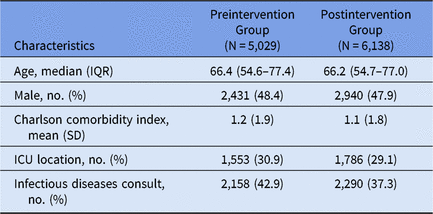
In the postintervention group, of 33,378 patients who received any antimicrobial, 6,138 (18%) had an ATO alert at 72 hours of empiric therapy. Baseline characteristics between ATO eligible patients were similar (Table 1). Most prescriber-selected antimicrobial indications were empiric (44.5% preintervention vs 47.8% postintervention) or prophylactic (41.4% preintervention vs 37.8% postintervention). The rate of pathogen-directed indications did not significantly change (14.1% preintervention vs 14.4% postintervention; P = .11).
Baseline Characteristics of Patients Eligible for an Antimicrobial Time-Out
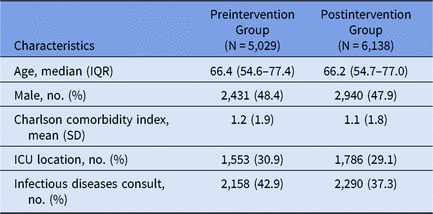
Note. IQR, interquartile range; SD, standard deviation; ICU, intensive care unit.
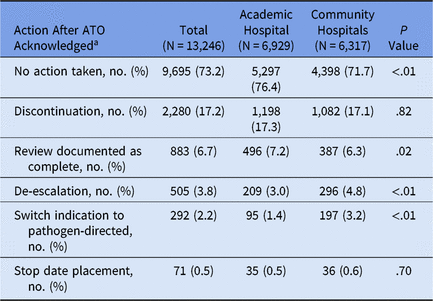
In the postintervention group, there were 32,956 ATOs among 6,138 patients, with a median number of ATO alerts per patient of 4 (interquartile range [IQR], 2–7). Alerts were acknowledged by residents and fellows (14,557, 44.2%), staff physicians (11,090, 33.7%), and advanced nursing practitioners (7,309, 22.1%). Providers acknowledged 13,246 (40.2%) of all alerts; acknowledgement was higher at the academic medical center 42.5% versus community hospitals 36.9% (P < .01). In the remainder, ATO review was deferred due to consultant status (48.0%), emergency situation (9.4%), or other (2.4%). The actions taken within 6 hours after ATO acknowledgement overall and by location are displayed in Table 2. Overall, 17.2% of antimicrobials were discontinued and 3.8% were de-escalated after ATO acknowledgement.
Antimicrobial Time-Out Responses
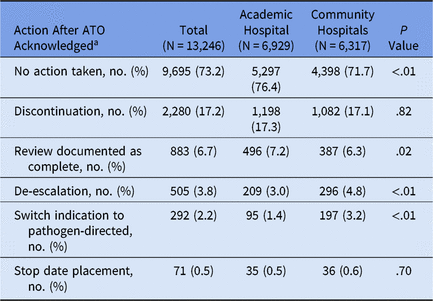
Note. ATO, antimicrobial time-out.
a Multiple actions may have occurred for the same alert.
The DOT per 1,000 PD for broad-spectrum agents for hospital-onset/multidrug-resistant infections did not significantly differ before and after ATO implementation (206 vs 216; P = .50). Similarly, no significant difference was observed between agents for community-acquired infections (154 vs 155 DOT per 1,000 PD) or anti-MRSA agents (128 vs 127 DOT per 1,000 PD). Individual hospital analysis also showed no difference (data not shown). However, median empiric antimicrobial duration in ATO eligible patients was reduced from 71 hours to 62 hours in the postintervention group (P < .05). No difference was observed in median length of stay (7.9 vs 8.1 days) or rate of C. difficile positivity (2.4% vs 2.5%).
Discussion
In this study, an EHR-embedded, prescriber-driven ATO for all empiric antimicrobials did not significantly impact DOT per 1,000 PD; however, after the ATO, 21% of patients had antibiotics discontinued/de-escalated resulting in a shorter duration of therapy. Previous studies have demonstrated that although 15%–67% of antimicrobial regimens change post ATO intervention, this does not translate into reduced overall antimicrobial utilization.Reference Lee, Frenette, Jayaraman, Green and Pilote3, Reference Graber, Jones and Glassman4, Reference Thom, Tamma and Harris8 In the current study, only 18% of postintervention group patients were eligible for an ATO alert. This small percentage of patients, compounded by a clinician acknowledgement rate of 40%, may explain why global DOT per 1,000 PD was not impacted. It is unclear whether targeting ATOs to select broad-spectrum agents or providers would have impacted alert acknowledgment or DOT. If the ATO had occurred earlier, more orders would have been eligible, but not all necessary clinical and microbiological data may have been available. Antimicrobial stewardship programs should carefully evaluate the optimal time(s) for an ATO balancing many factors, including average duration of antimicrobials, typical microbiologic result time, clinician alert fatigue, and hospital setting.
Despite not affecting overall utilization, ATOs may still have a role in reducing inappropriateness or duration of therapy.Reference Lesprit, Duong, Girou, Hemery and Brun-Buisson6, Reference Thom, Tamma and Harris8 Although appropriateness was not assessed in this study, median duration of therapy was reduced. Another potential advantage of electronic-based ATOs is the facilitation of antimicrobial reassessment while preserving prescriber autonomy.Reference Jones, Butler and Graber5 A disadvantage is that without mandating ATO completion, acknowledgment may be deferred, as was seen in this study. A study evaluating electronic checklists for empiric antibiotics found face-to-face prompting for completion resulted in lower antibiotic utilization.Reference Weiss, Dibardino, Rho, Sung, Collander and Wunderink7
This study had several limitations, including a design centered on aggregate antimicrobial utilization without consideration of clinical appropriateness. Additionally, the 6-hour period to assess actions taken post ATO intervention was chosen to consider rounding and order entry practices throughout the health system. Different time periods may have varied results, however, the inability to directly attribute changes in drug therapy to the alert is a limitation. Seasonal influenza resulted in an increased number of hospital admissions (63 influenza admissions in the health system in October–December 2016 versus 495 in October–December 2017), which may have influenced antimicrobial use. Lastly, there is no standard definition for de-escalation within antimicrobial stewardship literature. Our definition was based upon the antimicrobial spectrum index score; alternative definitions may have yielded different results.Reference Gerber, Hersh, Kronman, Newland, Ross and Metjian11
Given the increasing regulatory emphasis on ATOs as a stewardship intervention combined with a paucity of data, it is notable that in our study, a prescriber-facing, electronic ATO did not demonstrate a significant effect on overall antimicrobial DOT per 1,000 PD. We did observe that, post ATO intervention, 21% of patients had empiric antimicrobials discontinued or de-escalated, resulting in a shorter duration of therapy. Further studies are needed to identify ideal ATO characteristics and outcome metrics reflecting the impact of ATOs as a stewardship tool.
Supplementary Material
To view supplementary material for this article, please visit https://doi.org/10.1017/ice.2019.105
Author ORCIDs
Elizabeth A. Neuner, 0000-0002-5534-1748
Financial support
No financial support was provided relevant to this article.
Conflicts of interest
All authors report no conflicts of interest relevant to this article