The World Health Organization declared the Coronavirus 2019 (COVID-19) outbreak to be a global pandemic, 1 which has affected all facets of life in all parts of the world. Many countries introduced recommendations to reduce the spread of COVID-19, with many educational institutions providing education through online meeting applications.Reference Ahmed, Allaf and Elghazaly 2 Also, human resource development related to nuclear emergency preparedness, as well as other education, was affected in 2020 with training sessions being cancelled, postponed, or changed to being held online.
Since 2010 (before the GEJE), Hirosaki University (HU) has been active in research and engaged in the development of education courses related to REM. In particular, HU has continued holding training programs for medical personnel at medical institutions in Nuclear Emergency Core Hospitals and Nuclear Disaster Medical Cooperation Agency where nuclear power plants are located. As the training program included exercises that could only be done face-to-face, such as the GM survey meter handling and decontamination of victims, it was decided that such training could not be done completely online. Therefore, in 2021, HU conducted the training in a hybrid manner with a mix of face-to-face and online components.
In this study, we will examine the effects and challenges of using a hybrid approach that combines online and face-to-face components, including considerations such as preparation, setting, and teaching methods.
Methods
Participants
The participants were selected from all over Japan and included 24 online participants (9 nurses and 13 radiological technologists) and 5 face-to-face participants (2 nurses and 3 radiological technologists).
Training program
The HU Radiation Emergency Medicine Training course (HUREMT) is a human resource development training program for nurses and radiological technologists who will deal with victims of radioactive contamination. It was held on the 28th and 29th of August 2021.
Prior to HUREMT, all participants had taken an e-learning course comprising of 3 hours of lectures that included the basics of radiation, biological effects of radiation, human effects of radiation, radiation protection, and emergency medical care.
The instructors who took part in this training included 1 doctor, 1 dentist, 8 nurses, 6 radiological technologists, and 3 administrative staff. These professionals taught the lectures and provided feedback, as well as coaching, for each student during the exercises in order to promote understanding.
For each exercise during the training process, 1 person was assigned to each of camera and audio to handle audio switching, feedback, focus, and image switching. The online video was delivered using Zoom, with the video selected by a spotlight.
The HUREMT program contained 3 lectures and 6 exercises. On the first day, Lecture 1 covers psychological care in a nuclear disaster while Lecture 2 is about past nuclear disasters and current nuclear disaster prevention. In Exercise 1, participants learn how to handle a detector, and Exercise 2 is about decontamination of healthy skin and wounds. Exercise 3 is learning how to put on or off protective gears for all participants. The second day was dedicated to the topic of the current situation regarding GEJE and the path to recovery from the radiation disaster, with an introduction to the activities of researchers who are still working on dosimetry in Namie Town, Fukushima Prefecture. Exercise 4 was a team-building exercise and Exercise 5 was a simulation of the entire process from receiving a patient contaminated by or exposed to radiation, to treatment, all while wearing protective gear. Exercise 6 was a review of the simulation in Exercise 5.
Questionnaire
After the training, all participants were requested to complete a questionnaire created on Microsoft Forms. It consisted of understanding, satisfaction, achievement, and fatigue determinants of each lecture and exercise.
Ethical considerations
The post-training survey is an online questionnaire that does not identify individuals and is used to improve the training program. We also included a section about reporting at conferences, etc., and obtained permission from all respondents for publication of their data.
Results
Lectures were delivered online by sharing the lecturer’s images and slides. Participants learned decontamination of healthy skin and wounds in Exercise 2. Wet wipes, fluorescent paint, and a black light for checking decontamination of healthy skin were sent to the participants in advance. During the session, they were asked to apply fluorescent paint to their own arm, ‘decontaminate’ it using wet wipes, and check for the spread of contamination using the black light. In Exercise 3, participants were sent protective gear, caps, and gloves in advance and practiced putting on, and removing, the protective gear in an appropriate manner. Exercise 4 was a team building activity which took place before the training for receiving contaminated wounded victims. The discussion was delivered mainly by the face-to-face participants, and the online participants joined in by chatting. In Exercise 5, participants wore protective gear and simulated the entire process of receiving, treating, and discharging a contaminated/radiation exposed patient. Total camers set up were 4, 2 of which were webcams installed on stabilizers to capture the images that we wanted the online participants to focus on and zoom in on. 2 microphones were placed in the hot area, plus 1 for the live broadcast, and the audio was mixed and adjusted for delivery. For the simulations, the instructor added the live action and used a switcher to select the images they wanted the participants to see. The online participants asked questions via chat as needed, and staff responded to the questions as they were delivered. Exercise 6 was a debriefing session. The face-to-face participants discussed what they did while the online participants posted various opinions and questions in the chat room depending on their interests.
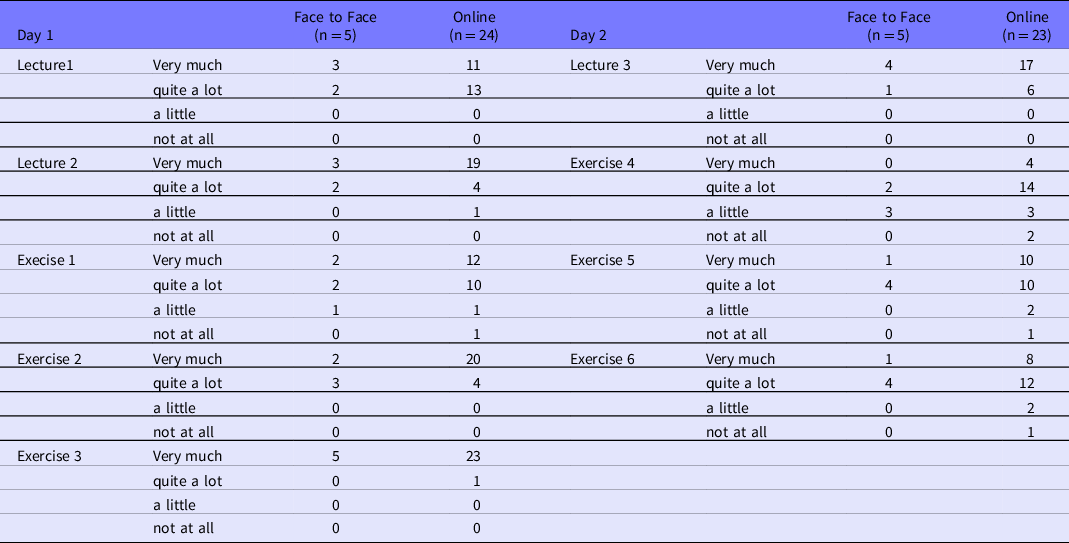
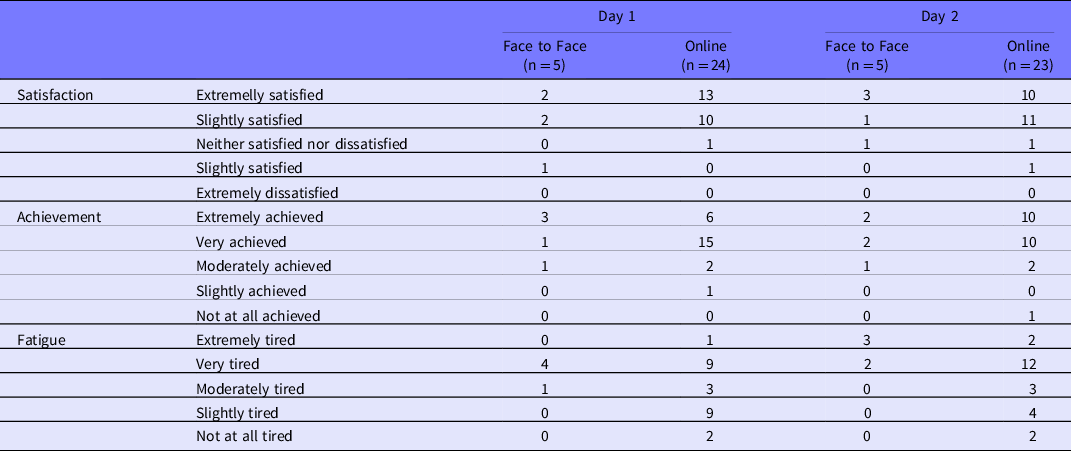
Table 1 shows participants’ level of understanding for exercises 1 through 6. For Exercises 2 and 3, online students also showed a high level of understanding, similar to that of the face-to-face students. Table 2 shows the questionnaire results for satisfaction, sense of accomplishment, and sense of fatigue. The level of satisfaction was generally high and as for the sense of accomplishment, most of the participants were able to achieve goals with the course on both days. More than 50% of the online participants answered that they felt quite fatigued on both days.
Level of understanding of the lectures and exercises

Satisfaction, achievement and fatigue on each lecture for 2 days

Limitations
We acknowledge that there are several limitations to this study. First, the seminar delivery method prioritized cost of staff, time, and convenience for users ahead of maximizing the educational effectiveness. Second, facilitators in the simulations were not necessarily well trained.
Discussion
The results of the questionnaire indicated a high level of satisfaction and sense of accomplishment with the hybrid REM training. For sessions in which the participants had been sent materials beforehand so that they could take part at the same time as the face-to-face participants, the level of understanding was the same for online and face-to-face sessions. Also. In the case of exercises that required individual work, the amount of information passed to participants were the same for both online and face-to-face sessions, and there were no major obstacles other than the communication situation. As long as the facilitation is done carefully and slowly, there is little difference between face-to-face and web-based sessions.
However, our training was modified from seminars based on face-to-face training, which might be why the group work sessions in the hybrid type were less successful. Many participants showed a tendency to be passive learners in online seminars. Self-training exercises, both face-to-face and online, can proceed simultaneously without information gaps. The use of multiple cameras to provide varied camera angles from the perspective of the participants, as well as the selection and provision of images to be shown to the participants and provision of play-by-play comments, connected the images and information, and encouraged a sense of presence and realism for the participants. However, online group work sessions were marred by the difficulty of natural conversation, possible resistance to discussion at first meeting, the difference in atmosphere between online and face-to-face sessions, and the difficulty of achieving a sense of unity among the participants. Even if the filming method can provide a realistic experience that simulates being there in person, the subsequent debriefing process changes the degree of learning for the participants. The online participants could view the content and listen to play-by-play comments so they could understand the whole process, but their understanding and interest were not necessarily the same as those of the face-to-face participants. If breakout rooms are used in the debriefing, grouping sessions by experience and job category might encourage participants to talk more freely.
Although the high level of satisfaction and sense of accomplishment was showed by both groups of participants, however, online participants raised complaints of eye strain and fatigue due to having to stay prolonged times in the same posture. Lengthy exposure to computer screens is associated with increased stress, sleep disturbance, fatigue, anxiety, and depression.Reference Kummer, Recker and Bick 3 Thus, the length of a webinar is recommended not to exceed up to 1.5 hours.Reference Reyna, Todd and Hanham 4 As a result of this, long hybrid trainings should be avoided, as putting face-to-face training directly online would increase this burden on the participants. It is important to identify what can be achieved only in face-to-face sessions, to mix online learning and face-to-face learning, and to encourage participants to learn autonomously while adopting the advantages of online learning.Reference Radović-Marković 5
Conclusion
We conducted a hybrid-type training program for learning REM that incorporated face-to-face learning and remote trainingwhile analyzing the educational effects and validity of this method of implementation. Some of the exercises provided online participants with the same experience as in the face-to-face situation, and the simulations were designed to be easy to understand, with the addition of live coverage. Accordingly, there was a high level of satisfaction and sense of accomplishment for both the face-to-face and online participants. While individual practice was successful in the hybrid model, group work and simulation were less successful in promoting in-depth discussions. The fatigue of the online participants indicated that hybrid delivery was burdensome; therefore, the relative merits of conducting separate work and conducting face-to-face or online training must be considered in order to maximize effectiveness in future training sessions.
Acknowledgement
The authors would like to thank the participants in the REM training program.
Authors’ contributions
Tomisawa T, In N, Ota K, Osanai M, Mikami K, Hosokawa S, Terashima S, Kitajima M, Tsujiguch T, Kudo H, Hanada H, and Urushizaka M were involved in study design and data interpretation. Saga R, Yamaguchi M, Hosokawa Y, and Tsuchiya R were involved in the data collection and making methods. All authors critically revised the report, commented on drafts of the manuscript, and approved the final report.
Funding statement
This research was supported by Functional Enhancement Project (Strategy 3) funding to HU from the Government of Japan.
Conflict of interest
The authors have no conflicts of interest to declare.