A heritage speaker is a bilingual who grew up hearing and possibly speaking an immigrant or minority language in the family or home and who has been dominant in the majority language of the wider community since early childhood (see Kondo-Brown, Reference Kondo-Brown2006; Silva-Corvalán, Reference Silva-Corvalán1994; and the introduction to this issue). Research on heritage languages has consistently shown that both the production and comprehension of heritage speakers is different from that of native speaker controls, whose language constitutes the baseline of comparison (e.g., Montrul, Reference Montrul2004, Reference Montrul2006; Polinsky, Reference Polinsky2006, Reference Polinsky2008a, Reference Polinsky, Brinton, Kagan and Bauckus2008b).
One of the major questions concerning the linguistic knowledge in heritage speakers is whether these speakers manifest incomplete acquisition or attrition of grammar. In other words, do heritage speakers fail to learn certain structures or do these structures get acquired and then undergo subsequent degradation due to lack of use or transfer from the dominant language?Footnote 1 Although the field is still in the early stages of exploring this question, some patterns have emerged. The short answer is that both attrition and incomplete acquisition are implicated in the final shape of adult heritage grammars. The longer answer to this question will probably take many years to develop because answering it amounts to mapping out the entirety of natural language: which aspects are robust and which are more fragile, which can be learned with greater or lesser difficulty, and so on. The unfortunate revelation that comes from addressing this question is that current theories are not yet in a position to predict all areas of greater vulnerability or strength, although some patterns have emerged and have been captured in a number of hypotheses. Given that the theoretical basis of acquisition models is still under construction, empirical mapping of the differences between complete and incomplete grammars is particularly relevant.
The comparison of child and adult heritage language speakers is a plausible way of separating incomplete acquisition and attrition—of course, this assumes that those children and adults have a comparable language learning background and that they arrived in the host country at roughly the same age or were born there. The incomplete acquisition and attrition scenarios make different predictions, as given in (1):
(1) a. Incomplete acquisition: If a child and an adult deviate from the baseline in the same way, it can be assumed that the feature has not been acquired.
b. Attrition: If a child performs as his or her age-matched baseline control but the adult does not, the feature can be assumed to have been acquired but may have subsequently been lost or reanalyzed.
The need to distinguish between these two scenarios limits the phenomena for which acquisition data in the child control population are available—after all, it is only possible to claim attrition or incomplete acquisition if there is independent evidence for the acquisition of a phenomenon.
This study compared these two scenarios by analyzing the grammatical knowledge of relativization in heritage speakers of Russian living in the United States (so-called American Russians; see Polinsky, Reference Polinsky, Kagan and Rifkin2000, Reference Polinsky2006, Reference Polinsky2008a, Reference Polinsky, Brinton, Kagan and Bauckus2008b). To compare the two possibilities, the comprehension of relative clauses was examined in four groups of speakers: monolingual children and adult controls and heritage speakers, also both children and adults.
The value of this study lies in its ability to tease apart the effects of incomplete acquisition and attrition in adult heritage speakers. The results show that, at least for relative clauses, incomplete acquisition is not a viable explanation of the degraded performance of adult heritage speakers. Instead, it appears that attrition is at work in the domain of relativization. The relevance of this finding is in establishing that not all domains of grammar are necessarily subject to incomplete acquisition and in identifying a particular domain that may be vulnerable to attrition. Additionally, these results show that, at least in some domains of language structure, it is possible to tease apart the effects of transfer and the effects of attrition proper.
RELATIVE CLAUSES
Relative Clauses in Acquisition and Processing
Relative clauses have long been the focus of research in acquisition and processing as well as in theoretical explorations of syntax. Their investigation in a heritage population can both build upon and add to the existing body of knowledge of syntactic phenomena.Footnote 2
The acquisition of relative clauses occurs fairly early, typically in the beginning of the third year of life.Footnote 3 The reasonably early and unencumbered acquisition of relative clauses in monolingual populations suggests that, overall, they do not pose insurmountable challenges to acquisition. Experimental data on early acquisition show that subject relative clauses (e.g., the dog that chased the cat) generally appear earlier, are produced more frequently, and cause fewer comprehension errors than other types of relative clauses.Footnote 4 However, by age 4, children learn all other types of relative clauses as well, and when confronted with reversible stimuli in an experimental setting, they make very few errors in the choice of the head of a relative clause: under 8% in English according to a variety of studies (see Kwon, Lee, Gordon, Kluender, & Polinsky, Reference Kwon, Lee, Gordon, Kluender and Polinsky2010, for discussion and references), under 3% in Mandarin Chinese (e.g., Hsu, Reference Hsu2006; Hsu, Hermon, & Zukowski, Reference Hsu, Hermon and Zukowski2009), and under 3% in Russian, as this study will show.
In terms of processing, relative clauses have long enjoyed a particularly prominent role in experimental work on syntax because they represent a robust example of a long-distance dependency. Such dependencies have two crucial characteristics. First, the expressions that fill the head and tail points of the dependency differ in their articulation. Second, the positions are separated by a number of unrelated segments. The examples in (2) demonstrate these properties (where i represents condexation).
(2) a. A reporter asked the senatori what hei was trying to accomplish in the new bill.
b. A reporter asked the senatori about the new bill but the diplomati avoided the answer.
c. A reporter asked the senatori at the press conference ___i to elaborate on the new bill.
The identity of a more articulated expression occupying one of the positions (the senator) determines the referential identity of the linguistic expression in the other position; this expression may have less descriptive content and can be silent (null). For instance, a lexically specified noun phrase can serve as the antecedent of a pronoun (including a null pronoun) as in (2a), an epithet (2b), or a hypothetical null element (2c). The relationship between the lexically specified antecedent (filler) and the less elaborated expression or gap is established at a distance across other linguistic expressions. This distance imposes a memory task: The two linguistic positions have to be held in working memory until they are associated with the same referent.
Numerous experimental studies show that in English, subject relative clauses as in (3a) are easier to process than object relative clauses (3b); this result has been replicated across various methodologies (for reading time: King & Just, Reference King and Just1991; for event-related brain potentials [ERPs]: King & Kutas, Reference King and Kutas1995; for functional magnetic resonance imaging [fMRI]: Caplan, Alpert, & Waters, Reference Caplan, Alpert and Waters1999; Caplan, Alpert, Waters, & Olivieri, Reference Caplan, Alpert, Waters and Olivieri2000; Caplan et al., Reference Caplan, Vijayan, Kuperberg, West, Waters and Greve2001; Cooke et al., Reference Cooke, Zurif, DeVita, Alsop, Koenig and Detre2002; Just, Carpenter, & Keller, Reference Just, Carpenter and Keller1996; for positron emission tomography scans [PET]: Caplan, Alpert, & Waters, Reference Caplan, Alpert and Waters1998, Reference Caplan, Alpert and Waters1999; Caplan et al., Reference Caplan, Alpert, Waters and Olivieri2000; Stromswold, Caplan, Alpert, & Rauch, Reference Stromswold, Caplan, Alpert and Rauch1996; for eye-tracking: Traxler, Morris, & Seely, Reference Traxler, Morris and Seely2002). Furthermore, that subject relative clauses are easier to process has been confirmed for other languages (see, e.g., Frazier, Reference Frazier1987, for Dutch; Mecklinger, Schriefers, Steinhauer, & Friederici, Reference Mecklinger, Schriefers, Steinhauer and Friederici1995; Schriefers, Friederici, & Kühn, Reference Schriefers, Friederici and Kühn1995; Schwartz, Reference Schwartz2007, for German; MacWhinney & Pleh, Reference MacWhinney and Pleh1988, for Hungarian; Arnon, Reference Arnon, Brugos, Clark-Cotton and Ha2005, for Hebrew; Miyamoto & Nakamura, Reference Miyamoto, Nakamura, Garding and Tsujimura2003, for Japanese; Kwon, Reference Kwon2008; Kwon, Polinsky, & Kluender, Reference Kwon, Polinsky, Kluender, Baumer, Montero and Scanlon2006; Kwon et al., Reference Kwon, Lee, Gordon, Kluender and Polinsky2010, for Korean, to name just a few). These studies suggest that the processing of an object relative clause, as in (3b), imposes a heavier load on working memory than its subject relative counterpart (King & Just).Footnote 5
(3) a. The reporteri whoi ___i harshly attacked the senator admitted the error.
b. The reporteri whoi the senator harshly attacked ___i admitted the error.
Relative Clauses in Russian
Crosslinguistic generalizations on the formation of relative clauses can be captured in the accessibility hierarchy (Keenan & Comrie, Reference Keenan and Comrie1977). This hierarchy encodes the basic empirical generalization that if a language is able to relativize at a given position, then it will be able to relativize at every higher position in the hierarchy. No language is expected to disallow relative clause formation; however, it is predicted that there should be some languages that only allow relativization of one position, which has to be the subject (many Austronesian languages show such restricted relativization). A common motivation for this hierarchy is that it represents the processing ease associated with relativizations of syntactic positions: The more salient a particular expression, the easier it is to associate it with a modifying relative clause. The hierarchy is given in (4), where the symbol > indicates that the following position is lower.
(4) Accessibility Hierarchy
subject > direct object > indirect object > oblique object > possessor > standard of comparison
Russian allows relativization of any position on the accessibility hierarchy. Relative clauses are formed using the gap strategy (the extracted constituent is replaced by silence) and involve a relative pronoun kotor–, which agrees with the extracted constituent in gender and number and also shows case concord with the gap site.Footnote 6 Examples (6a)–(6d) show the relativization of different constituents from the baseline sentence in (5).Footnote 7
(5) deti polučili na roždestvo podarki ot babuški
children.nom.pl received on Christmas gifts.acc.pl from grandma.gen
“(The) Children received gifts from their grandmother on Christmas”
(6) a. detii [kotor-ye ___i polučili na roždestvo podarki ot babuški]
children rel-nom.pl received on Christmas gifts from grandma
“The children who received gifts from their grandmother on Christmas”
b. podarkii [kotor-ye deti polučili ___i na roždestvo ot babuški]
gifts rel-acc.pl children received on Christmas from grandma
“The gifts that (the) children received from their grandmother on Christmas”
c. prazdniki [na kotor-yj deti polučili podarki ___i ot babuški]
holiday on rel-acc.sg children received gifts from grandma
“The holiday on which (the) children received gifts from their grandmother”
d. babuška [ot kotor-oj deti polučili na roždestvo podarki ___i ]
grandma from rel-gen.sg children received on Christmas gifts
“The grandmother from whom the children received gifts on Christmas”
Russian is known to have extensive scrambling (e.g., Bailyn, Reference Bailyn2004; King, Reference King1995), and a short note on the order of constituents in relative clauses is needed. In both subject and object relative clauses formed with transitive verbs, the order of constituents in the relative clause can vary; the nonextracted determiner phrase (DP) can either precede or follow the verb, as demonstrated by (7) and (8).
(7) Subject relative
a. deti [kotor-ye ___ polučili podarki]
children rel-nom.pl received gifts
b. deti [kotor-ye ___ podarki polučili]
children rel-nom.pl gifts received
“The children that received gifts.”
(8) Object relative
a. podarki [kotor-ye deti polučili ___]
gifts rel-acc.pl children received
b. podarki [kotor-ye polučili ___ deti]
gifts rel-acc.pl received children
“The gifts that the children received.”
The discussion of the different word orders in subject and object relative clauses is limited to relative clauses with nominal—and not pronominal—constituents, such as those illustrated in (7) and (8). There are two reasons for excluding pronominal constituents: First, the surface order of nouns and pronouns in Russian is different, and it is necessary to formulate the generalizations on each subtype separately. Second, the experimental work on Russian relatives (and for other languages as well) uses relative clauses with nominal constituents, and it is the distribution of such relatives that is relevant here.
The right edge of a Russian clause is strongly associated with focus (Adamec, Reference Adamec1966; Kovtunova, Reference Kovtunova1976; Padučeva, Reference Paducˇeva1985), both at the root-clause level and in embeddings. Therefore, the object-verb and verb-object word orders are not equal. In subject relatives, verb-object is the communicatively neutral order as in (7a). In this order, the verb and the following object receive a wide focus reading, whereas the head of the relative clause receives the appropriate topic reading (see Kuno, Reference Kuno1973, for the connection between topicalization and relativization). In the object-verb order in (7b), the verb receives a contrastive reading, which limits the interpretation of the DP to something like “the children that received (rather than, e.g., gave) gifts.”
In the object relative, the choice of a communicatively neutral order is more difficult. In corpora, most object relatives actually have a pronominal subject, as in (9):
(9) podarki [kotor-ye oni polučili ___]
gifts rel-acc.pl they received
“The gifts that they received.”
In relative clauses with nominal constituents, the subject-verb order as in (8a) entails a contrastive reading of the verb, as in “the gifts that the children received,” which can be remedied if the preverbal subject is stressed and the verb is deaccented. In (8b), because the subject is inverted after the verb, yielding verb-subject order, it is possible to have a contrastive reading on the subject (i.e., “the gifts that the children received”) or to interpret the entire verb-subject sequence as one receiving wide focus.
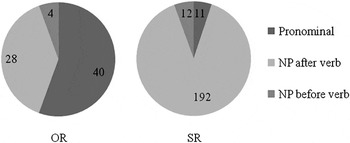
The information-structural properties of these relative clauses find an interesting reflection in the frequencies of the relevant clauses. In the corpus count of 400 subject relatives (SRs) and object relatives (ORs) (with both nominal and pronominal constituents), 228 relative clauses (57%) were SRs and the remaining 172 (43%) were ORs. However, when relative clauses with pronominal constituents were excluded, the distribution changed dramatically: Of the 252 relative clauses with nominal constituents (already a significantly reduced subset of the initial 400 tokens), 217 (86%) were SRs and only 35 (about 14%) were ORs. Because the experimental stimuli will involve out-of-the-blue isolated relative clauses without any pronominal constituents, this study will be concerned with this particular distribution (86% SR to 14% OR).
Within this subset, SRs with the order verb object (VO) are much more frequent than SRs with OV order (see Levy, Fedorenko, & Gibson, Reference Levy, Fedorenko and Gibson2007; Say, Reference Say2005). In ORs with nominal constituents, the verb-subject (VS) order is more frequent than SV. This pattern is illustrated in Figure 1.Footnote 8
Distribution of pronominal, nominal postverbal, and nominal preverbal constituents in subject and object relatives (400 relative clauses, random selection from the Russian National Corpus).

The discussion of relative clauses presented here is theory neutral; there is no discussion of the actual derivation of preverbal and postverbal orders in the relevant relative clauses. For syntactic observations on the difference between preverbal and postverbal subject orders, see Bailyn (Reference Bailyn2004).Footnote 9
The next section will formulate the predictions for the comparison of SRs and ORs in different groups of Russian speakers.
THE STUDY
Predictions Regarding Incomplete Acquisition Versus Attrition
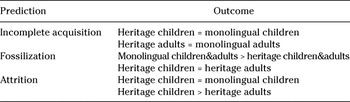
If adult heritage speakers show some deficit in their control of relative clauses, this may be due to the fossilization of their childhood language. One way to determine this is to examine four populations: heritage speaker adults and children and adult and child controls. Several predictions can be made: First, if heritage-speaker children (children of immigrants) differ from their monolingual peers in their knowledge of relative clauses, that would suggest that they may have never fully learned them. This lack of acquisition would then continue into the adult language (see Montrul, Reference Montrul2002, Reference Montrul2008, for an insightful discussion). The concomitant prediction is that the adult heritage speakers would match the knowledge of relative clauses demonstrated by the heritage-speaker children.
It is also possible that heritage speakers (both children and adults) will match their monolingual peers in their knowledge of relative clauses. Such an outcome would indicate that relative clauses are not affected by whatever processes of degradation that take place in heritage language acquisition and might provide further support for the idea that relativization has a basis in Universal Grammar and is relatively independent of exposure. This result would strongly suggest that the children do acquire a knowledge of relative clauses and that this knowledge is a robust area of language competence; once acquired, it stays with the speaker throughout life and remains unchanged, even if that speaker no longer uses the language.
Finally, if child heritage speakers do not show deficits in relative clauses but the adult speakers do, that should be an indication of true loss (i.e., attrition) of the grammar learned in childhood. The summary of these possible outcomes is presented in Table 1. Of course, given all of the groups, there are more possibilities than those listed here, but these seem to be the most realistic ones.Footnote 10
Control of relative clauses by heritage and monolingual speakers

Note
X = Y indicates similar performance between X and Y; X > Y indicates that X outperforms Y.
Predictions Regarding Subject Versus Object Relative Clauses
Several predictions can be formulated here. First, based on the consistent preference for SRs, it is possible to predict that SR clauses should be easier to process than ORs in Russian. Next, it is expected that the more frequent and communicatively more neutral relative clauses should be easier than the ones that are less frequent or more restricted from the standpoint of information structure. In the case of Russian relative clauses, frequency and communicative markedness are correlated, and so it is hard to determine what the deciding factor is. Nevertheless, the prediction is given in (10) (the symbol > means “easier to process”).
(10) a. SR > OR
b. SRs: VO > OV
c. ORs: VS > SV
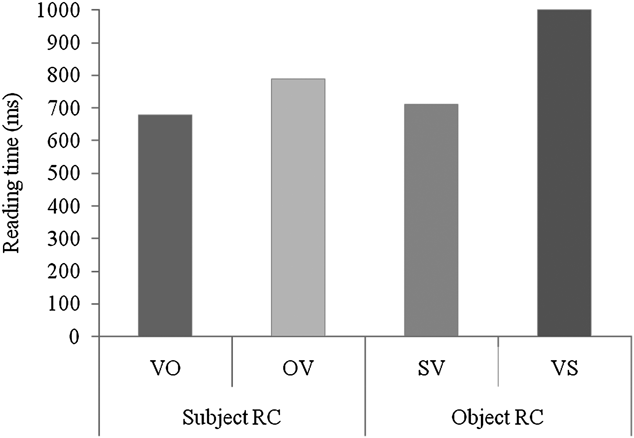
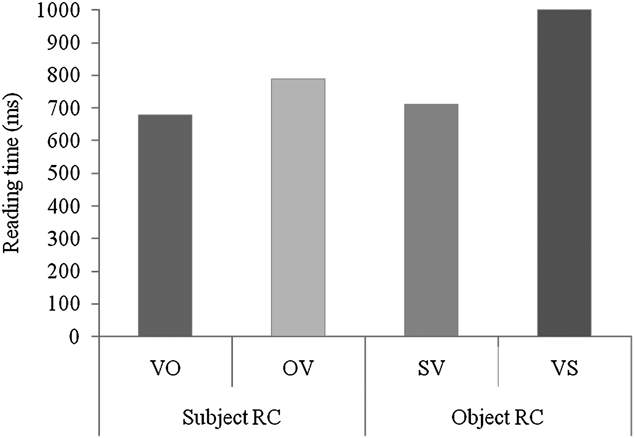
These predictions have been confirmed by a self-paced reading experiment testing monolingual Russian speakers (N = 40) conducted by Levy et al. (Reference Levy, Fedorenko and Gibson2007). Figure 2 shows the reading times for the different word orders of SRs and ORs obtained in this study.
Reading times (in ms) at the embedded verb in Russian relative clauses (RCs) for 40 adult monolingual participants (Levy et al., Reference Levy, Fedorenko and Gibson2007).
For heritage speakers, several other predictions can be offered. First, the expectation that heritage speakers should find SRs easier to process still holds. In terms of the more fine-grained distinctions, three sets of factors could play a role: First, the influence of frequency might be expected, such that more frequent constructions are easier to process. Second, heritage speakers may also be expected to share certain processing preferences with monolingual speakers. Finally, the dominant language of the heritage speakers—in this case, English—might also be expected to impose its own biases.
Frequency and monolingual processing data are more or less consistent with each other and predict that VO subject relatives should be easier than OV subject relatives as well as that VS object relatives should be easier to process than SV object relatives. Assuming that heritage speakers may show the same patterns as monolingual speakers, it could also be predicted that heritage speakers will show the same hierarchy of processing ease as was found by Levy et al. (Reference Levy, Fedorenko and Gibson2007) for monolingual speakers (the symbol > means “easier to process”). This is given in (11).
(11) SR, VO order > OR, VS order > SR, OV order > OR, SV order
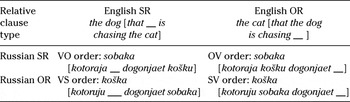
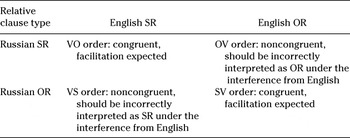
Finally, if the surface order of Russian and English relative clauses are matched, certain correspondences emerge: English and Russian subject relatives have the same word order when the Russian relative clause is VO. English and Russian ORs have the same word order when the Russian relative clause is SV. In the other two cases, the relative clauses do not match. A summary is given in Table 2. For heritage speakers who are dominant in English and may ignore morphological cues based on case, it may be predicted that the congruent word orders in relative clauses would facilitate processing and that the mismatched (noncongruent) structures would be subject to strong transfer from English and, as a result, would be interpreted in the wrong way. These transfer predictions are summarized in Table 3, which presents a general summary of the expectations based on surface similarities between English and Russian relative clauses—the main factor expected to play a role in the transfer from English is similarity in word order. If the expectations presented in Table 3 are on the right track, transfer from English should result in the following strategies for heritage speakers’ interpretation of relative clauses. Combining possible transfer and frequency effects, the interpretation of subject relatives with VO order can be expected to be the easiest and most accurate: They have a corresponding structure in English and are very frequent. Subject relative clauses with OV order should show transfer effects because they are infrequent and incongruent with the English construction.
Surface order correspondences between SRs and ORs in Russian and English

Directions of possible transfer from English in heritage speakers’ knowledge of Russian relative clauses

For the OR clauses, the possible effects of frequency and transfer may cancel out each other. More data from corpus studies and acquisition in monolinguals would be needed to rank these two factors; in the absence of such empirical data, it is hard to make specific predictions.
The current study has also laid out a set of predictions spelling out possible differences between heritage child and adult speakers. These predictions, together with the predictions based on transfer and frequency, inform the experiment of this study.
Experiment
The goal of this experiment was to determine possible differences in the comprehension of SR and OR clauses in monolingual baseline speakers and heritage speakers of Russian, both children and adults. The experiment also tested possible effects of frequency in all speakers and effects of transfer from English in heritage speakers.
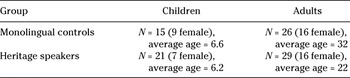
Participants.Four groups of speakers took part in the experiment: monolingual speakers and heritage speakers, with children and adults in each subgroup. The breakdown of participants is given in Table 4. The monolingual controls were all tested in Moscow; the children were tested in an after-school program at a local private school. The children were all from professional families, who represent the emerging middle and upper middle class in Russia; hence, their socioeconomic status was directly comparable to that of the heritage group. The heritage speakers were tested in Los Angeles, Boston, and San Diego. Adult speakers were all undergraduates at American universities; the child heritage speakers were selected from kindergarten and first grade based on advertisements in the local newspaper and at Jewish community centers (many Russian immigrants in the United States are Jewish). All of the heritage speakers, both children and adults, were children of first-generation immigrants, so the groups were homogenous in this regard. All of the heritage speakers were given a pretest questionnaire and were asked to produce a story based on a set of pictures (frog story elicitation, as described in Berman & Slobin, Reference Berman and Slobin1994). Of the child heritage speakers surveyed, 16 were born in the United States and the rest arrived in the country before age 3.5. The selection of these speakers out of a larger group was based on two main criteria. First, the participant pool was limited to those children who reported that they spoke more English than Russian with their parents. Second, the pool was also limited to speakers whose rate of speech, as measured using their frog story narrative, was under 100 words per minute (see Polinsky, Reference Polinsky2008a; Polinsky & Kagan, Reference Polinsky and Kagan2007, for evidence that rate of speech is a reliable predictor of proficiency in heritage speakers).
Participants in the picture-matching experiment

The composition of the adult heritage group was similar to that of the child group; 17 were born in the United States and the rest arrived as young children (the average age at immigration was 4.3). All participants were prescreened and, again, speakers whose rate of speech was under 100 words per minute were selected. Thus, the adult and the child heritage groups are comparable with respect to immigration background and language proficiency.
All of the monolingual children tested in Russia had some basic reading ability in Cyrillic. Of those children in the heritage group, only 8 participants had some reading knowledge of Cyrillic. The adult monolinguals were all highly literate in Russian; all had high school diplomas and 18 had college degrees. Of the adult heritage speakers, all of whom were students in an American community college or university, only 11 reported basic knowledge of Cyrillic. Reading ability was evaluated only based on the initial questionnaire and, given the discrepancies in the reading abilities, no reading pretest was administered. All adult participants were compensated for their participation in the study.
Materials. Thirty-six pairs of pictures that described reversible actions (i.e., actions that could be performed by either of the two main participants) were included as materials. Of the 36 pairs, 4 depicted reversible actions with inanimate participants: a bicycle making a circle around a car, a book covering a newspaper, a kettle holding a pot, and a wagon pulling a cart. In principle, it would be desirable to have a more balanced ratio of animate and inanimate participants. However, considerations of plausibility, verb frequency, and the ability to present an event in a picture all conspire against inanimates. Both pictures within a pair were put on the desk or table in front of the subject. An example pair is given in Figure 3. All of the verbs used for the stimuli were selected from the high- and mid-frequency range, based on data from the Russian National Corpus and Brown (Reference Brown1996). For each pair, participants heard a relative clause within a question and had to choose the picture that matched the description. The questions in (12) and (13) provide examples of SRs with both word orders.
Reversible action pictures with animate referents used in picture-matching experiment.

(12) Gde koška [kotor-aja sobak-u dogonjaet]?
where cat rel-nom dog-acc is_catching up
“Where is the cat that is chasing the dog?”
(13) Gde koška [kotor-aja dogonjaet sobak-u]?
where cat rel-nom is_catching_up dog-acc
“Where is the cat that is chasing the dog?”
Object relatives with both word orders are illustrated in (14) and (15).
(14) Gde sobaka [kotoruju dogonjaet koška]?
where dog rel-acc is_catching up cat.nom
“Where is the dog that the cat is chasing?”
(15) Gde sobaka [kotoruju koška dogonjaet]?
where dog rel-acc cat.nom is_catching up
“Where is the dog that the cat is chasing?”
The pairs were presented in random order, and each set of pictures appeared four times (twice for the SR condition and twice for the OR condition).
The experimental sentences were presented auditorily.Footnote 11 The auditory presentation, administered in person by the author or her research assistant, was necessary, given that some participants in the monolingual child group and most participants in the heritage groups did not know how to read Cyrillic. The auditory presentation therefore allowed the most inclusive coverage. Participants’ choices had to be done offline, and the only measure was the accuracy of response. In some cases, particularly with both groups of children, participants did not give any response; these instances were excluded from the results. The responses were recorded on a worksheet by the experimenter and were later subjected to a standard statistical analysis.
In the adult group, all of the participants completed the experiment, and the number of occasions when adults failed to respond was so small that it did not affect the results. In the monolingual child group, two of the children gave virtually no response and were excluded from the analysis. In the heritage child group, one child consistently chose the picture that was on his right and his data were excluded from the results.
RESULTS
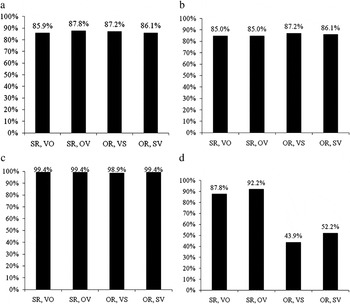
The data were quantified using a standard one-way ANOVA for raw responses by participant. The accuracy of responses by group, in percentages, is shown in Figure 4. As Figures 4a and 4b show, the choice of the correct picture was a very simple task for the monolingual speakers, both children and adults—both groups gave highly accurate responses. In fact, several monolingual adults and one monolingual child noted that the task they were given was extremely simple, and some characterized it as boring. The effect of the slight processing disadvantage associated with OR clauses was not statistically significant, and the results do not show any difference between the two word orders in each of the relative clause types. There was no effect based on gender, and in the monolingual child group, there was no effect of incipient literacy.
Accuracy in percentages of comprehension of subject and object relatives, picture-matching task in (a) child monolingual speakers (N = 15); (b) adult monolingual speakers (N = 26); (c) child heritage speakers (N = 21); and (d) adult heritage speakers (N = 29).

With respect to the child heritage speakers, their responses were also quite accurate and did not differ significantly from the responses in the control child group, as can be seen by comparing Figures 4a and 4c. There was no effect of literacy in Cyrillic, and the overall results were comparable to the controls. There was no difference between children who were born in the United States to Russian-speaking families and children who arrived in the United States at an early age, and these groups are not separated in the graphs, for ease of presentation. In both groups of children, there was a consistent subset of pictures that proved challenging: These were the four pairs of stimuli with inanimate objects. If those stimuli were excluded, the performance in both child groups became indistinguishable from that of the adult monolinguals.
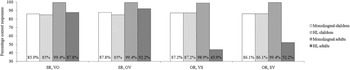
The most surprising results are in the adult heritage group, which differs significantly from all the other groups as shown in Figure 4d. Adult heritage speakers were still quite accurate with SR clauses (the difference between this group and the other three groups is not significant) but more or less at chance with ORs, F(3, 91) = 240.81, p < .0001. The asymmetry between SRs and ORs persisted regardless of the word order within the relative clauses. The accuracy of response did not correlate with the knowledge of Cyrillic (r = .03). As with the child heritage group, there was no difference between subjects who were born in the United States and those who arrived as young children. Finally, unlike the children, the adult heritage speakers did not show differential treatment of inanimate stimuli. Figure 5 presents the accuracy rates of each group in each condition.
Accuracy of comprehension of SRs and ORs for monolingual controls (adults and children) and heritage speakers (adults and children).

DISCUSSION
This study was designed to test the linguistic competence of heritage speakers of Russian with respect to relativization and had the goal of quantifying the effects of transfer from English, fossilization of incomplete acquisition, and attrition. The different routes to heritage language competence make different predictions, as reiterated in (16).
(16) Incomplete acquisition: If a child and an adult deviate from the baseline in the same way, the feature can be assumed to have not been acquired.
Attrition: If a child performs as his or her age-matched baseline control but the adult does not, the feature can be assumed to have been acquired but may have subsequently been lost or reanalyzed.
There were three main possible predictions concerning the status of heritage speakers in comparison to the monolingual baseline, including no effect of incomplete acquisition, fossilization of childhood knowledge, or attrition.
In comparing the monolingual and heritage speakers, both monolingual groups and the heritage child group performed with comparable accuracy, essentially at ceiling. With respect to child speakers, this indicates that 6- and 7-year-olds have adultlike control of relative clauses, with equal mastery of SRs and ORs. This also indicates that child heritage speakers (whose experience with Russian is more limited and who are ostensibly subject to interference from English) do not show any discernible effects of attrition or transfer. In fact, the stimuli that cause problems for both groups of child speakers are similar, with inanimate reversible states being particularly difficult (e.g., the book that covers the newspaper, the kettle that the pot supports, the bicycle that the car is circling). The discrimination of animate and inanimate actors is a well-established property of early child language (e.g., Bowerman, Reference Bowerman1973), but it is intriguing that some effects of this discrimination persist even into later years.
The similar performance of monolingual and heritage children indicates that the mastery of relative clauses is achieved at comparable levels across the two groups. However, adult heritage speakers are qualitatively different from the three other groups in that they perform at chance in ORs. Thus, they stand out as a group different from the three others. This result indicates that, at least in this particular domain, the linguistic knowledge of adult heritage speakers is not due to the fossilization of incompletely acquired childhood grammar. Instead, it must be a true case of attrition over the life span of the speaker: At least in adult heritage Russian, speakers maintain their competence of SRs but show significant degradation of OR clauses.
If the alternatives concerning the comprehension of relative clauses by heritage speakers, both children and adults, as compared to the baseline (monolingual) speakers are revisited, the results presented here do not support maintenance or fossilization of what could possibly be an incompletely acquired feature but argue instead in favor of attrition. Heritage children perform on a par with monolingual children and adults but outperform heritage adults.
If the performance of adult heritage speakers is due to attrition, the next question that needs to be addressed has to do with the causes of that attrition. Specifically, is it caused by transfer from English?
If transfer is implicated, heritage adult speakers should correctly interpret SRs with the postverbal object (SR-VO) and ORs with the preverbal subject (OR-SV). They should misinterpret SRs with the preverbal object (SR-OV) as OR clauses, and they are also expected to treat ORs with a postverbal subject (OR-VS) as SRs. In sum, they should show differential comprehension of different word orders regardless of the gap type. In other words, both a subset of SR clauses and a subset of OR clauses should cause problems for these speakers.
As the results of the current study show, these transfer-based predictions are not borne out. Heritage adults perform uniformly well on SRs, regardless of their word order. With regard to ORs, adult heritage speakers perform poorly, again regardless of word order. This pattern points to a significant subject bias in relativization. Such a subject bias has been observed in other populations—for example, under Broca’s aphasia (Caplan, Reference Caplan, Grodzinsky, Shapiro and Swinney2000; Friedmann, Reznick, Dolinski-Nuger, & Soboleva, Reference Friedmann, Reznick, Dolinski-Nuger and Soboleva2010; Gadler, Reference Gadler1995). In their interpretation of SR and OR clauses with reversible actions, aphasic patients showed a significant subject advantage.
Unlike aphasics, adult heritage speakers clearly do not have any disturbance in their syntactic competence. They have no problem with cognitive tasks in English, and the change in the system is observed only when it comes to the heritage language. The metaphor that invites itself here is that the gate between the two languages—the dominant and the heritage language—has been locked, so no direct effect from the dominant language is observed. In the absence of sustained input and without the influence of the dominant language, the heritage language system undergoes restructuring. The resulting divergent grammar is such that only subject arguments seem to be accessible for relativization. It is important to note that this grammar, although divergent from the grammar of the baseline language, is consistent with the universal constraint on relative clause formation noted by Keenan and Comrie (Reference Keenan and Comrie1977): If a language limits its relativization to a subset of argument positions, it has to relativize subjects. Heritage Russian thus resembles an Austronesian language, for which only one argument—the highest—can be relativized (Keenan, Reference Keenan and Li1976; Keenan & Comrie).
The experimental results presented here attest to the generalized subject advantage independently observed in environments beyond relative clauses (Keenan & Comrie, Reference Keenan and Comrie1977; Kwon et al., Reference Kwon, Polinsky, Kluender, Baumer, Montero and Scanlon2006). Although this finding is empirically pleasing, it is still far from explaining why the generalized subject advantage exists and recurs under different circumstances. What the divergent grammar of heritage language shows, however, is that the ubiquitous subject preference develops in yet another population of speakers, heretofore unnoticed by linguists.
CONCLUSION
This study presented a behavioral experiment on the comprehension of SR and OR clauses in child and adult speakers of Russian, comparing monolingual controls with heritage speakers whose dominant language is English. The results showed that child speakers at age 6 have full adultlike mastery of relative clauses. Heritage child speakers did not show interference from English in any type of relative clause and performed at the same level as their monolingual counterparts.
Adult heritage speakers, however, were significantly different from the monolingual adult controls and from the heritage child group. This divergent performance indicates that, at least for the domain investigated here, the adult heritage grammar is not a product of the fossilization of child language—no effects of incomplete acquisition in the domain of relativization were found. Instead, the divergent performance of adult heritage speakers suggests the attrition, over the life span, of forms that exist in the baseline. This result is consistent with observations on narrative structure in child and adult heritage speakers (Polinsky, Reference Polinsky, Brinton, Kagan and Bauckus2008b). In the frog story narrative, children also performed very close to the monolingual baseline, whereas adults showed divergent patterns.Footnote 12
Taken more generally, these results suggest that the reanalysis of language over the life span, in the absence of consistent input, leads to a significant disregard for inflectional morphology such as the case forms that distinguish between SRs and ORs. Such morphological deficit is compatible with the fundamentals of the bottleneck hypothesis (Slabakova, Reference Slabakova2008), albeit applied to a different population and in more depth than originally intended for Slabakova’s analysis. The main principles on which the bottleneck hypothesis is based are given in (i), (ii), and (iii).
i. Functional morphology is more difficult for a learner than syntax or semantics.
ii. The syntactic representations used by learners may be accurate, but the associated overt morphology may be lacking.
iii. The semantic representations employed by learners are accurate.
The original conception proposed by Slabakova (Reference Slabakova2008) emphasized performance errors in morphology and created a strong dissociation between morphological performance, which is prone to error, and correct mental representations of syntax and semantics. Although this may initially be the case for young heritage speakers, their developmental trajectory instantiates the situation in which the language starts to wear a constraining mask and gradually grows to fit this mask. What starts out as performance error eventually becomes the essence of the mental representation of a language—a divergent, restructured grammar that grows out of a morphological bottleneck.
If this conception of restructured grammar in heritage speakers is on the right track, it indicates that several types of follow-up studies on heritage language are needed: an investigation of the same phenomena in older heritage speakers (the adult participants in this study were all in their 20s) and of other grammatical phenomena that may be present in child language and undergo attrition later in life. More sophisticated experimental work on child and adult heritage speakers is needed to understand the immense variance found among these speakers. Because relative clauses are such a widespread linguistic phenomenon, it is possible that this preliminary study will inspire similar investigations of other heritage languages.
Although the results of this study support the phenomenon of attrition over the life span—what starts out as an intact grammar in childhood undergoes significant reanalysis later in life—they should not be taken as an across-the-board argument against incomplete acquisition. To reiterate the starting point of the current study, the complex phenomenon of heritage language competence is shaped by several phenomena: incomplete acquisition, reanalysis due to attrition, language transfer, and possibly other factors (see Rothman, Reference Rothman2007). Recognizing the role of these factors is important, but, more importantly, it is necessary to understand which phenomena are more likely to fall within the domain of incomplete learning and which are prone to attrition. With the assumption that it is possible to identify particularly fragile linguistic areas, the next challenge is to understand what affects the direction of attrition. In the study presented here, adult heritage speakers were quite consistent in reanalyzing the baseline grammar: They reformatted the syntactic design of Russian in such a way that the only robust relativization position is that of the syntactic subject. This is consistent with the accessibility hierarchy (Keenan & Comrie, Reference Keenan and Comrie1977), but the consistency is not an explanation; it simply upholds a well-established empirical generalization. These results further reflect the special status of subjects, which surfaces in other grammatical phenomena such as the interpretation of anaphors: As in relativization, anaphors are also more likely to select a subject antecedent than a grammatical function lower on the scale (see Polinsky & Kluender, Reference Polinsky and Kluender2007, for further discussion). The general principle seems clear: Subjects have a special status across languages. Yet the question remains as to why the preference for subjects exists and what makes them special.