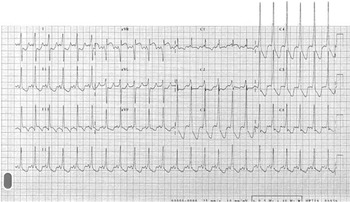
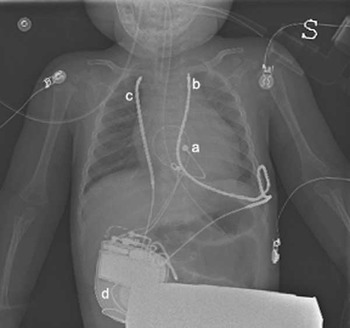
A female baby, born at term (birth weight 2920 g), was found to have ventricular pre-excitation at screening electrocardiogram (Fig 1). A 24-hour Holter recording performed at the age of 1 month showed stable pre-excitation and an episode of torsade de pointes. Physical examination and baseline blood tests were normal. Echocardiography revealed deep trabeculations in the apical, septal, and lateral left ventricular walls compatible with left ventricular non-compaction, reduced thickening of postero-inferior and basal septum, and a mild reduction of the ejection fraction (43%). No associated heart abnormalities were found. The baby was initially treated with propranolol and captopril and genetic testing was started. A month later, an episode of self-terminating torsade de pointes lasting 33″ occurred. The baby was readmitted to the hospital, and propranolol was replaced by flecainide and finally by amiodarone because of frequent short episodes of torsade de pointes. Looking for causative mutations, genetic testing on KCNQ1, KCNH2, SCN5A, KCNE1, and KCNE2 genes, the most frequently mutated genes in suspected channelopathies, was performed after relatives’ informed consent and no mutations were found. Amiodarone was apparently effective in controlling arrhythmias, but a few weeks later the baby had syncope, and thus we decided to implant an implantable cardioverter defibrillator. The patient’s weight was 7 kg. The procedure was performed under general anaesthesia, via a partial median inferior sternotomy and pericardiotomy, thus allowing the placement of an epicardial bipolar sensing and pacing lead, two subcutaneous coils, and an active can (Fig 2). The device was programmed with an anteroposterior configuration (can excluded) for the 1st and the 2nd 35 J shocks and with an alternate anteroposterior/posteroanterior configuration for further 35 J shocks. In the following months, despite the use of almost all combinations of antiarrhythmic drugs, including propafenone, quinidine, procainamide, and mexiletine, a dramatic recurrence of ventricular fibrillation episodes occurred. Electrophysiological study showed low-risk accessory pathway and, on the basis of ventricular arrhythmias’ features, an attempt of radiofrequency ablation of Purkinje tissue was made, resulting in 12 hours’ freedom from arrhythmias followed by arrhythmic storm recurrence. Ineffective sympathetic denervation by removal of T2–T3 sympathetic ganglia – stellate ganglion and other ganglia were spared in order to minimise surgical impact on such a fragile patient – was also performed. The patient remained in the intensive care unit for 5 months, requiring prolonged intubation and vital support. She suffered from a very high arrhythmic storm recurrence causing the exhaustion of the device’s battery, which had to be replaced four times. In an attempt to minimise shock frequency, we increased the device detection to 30 of 40 beats with a CI of 260 ms. Redetection was placed at 12 of 16. A transplant evaluation was initiated and the baby underwent heart transplant at the age of 16 months. The surgery was uneventful and the patient could finally be discharged home. Histological examination of the explanted heart was consistent with histiocytoid cardiomyopathy. Further genetic testing by Next Generation Sequences found a frame-shift mutation in the CACNA2D1 gene (Exon 24; g.81603880_g.81603881delAA; stop codon after three amino acids, thus predicting the p.Arg652Argfs*3) and a missense mutation in the RANGRF gene (alias MOG1; Exon 5; p.Pro155Ser). Both mutations were de novo (by microsatellite analysis) and we determined that the mutated allele for the CACNA2D1 gene was of paternal origin while the mutated allele for the RANGRF gene had a maternal origin. The role of the CACNA2D1 gene mutation relies in its nature (frame-shift mutation), while results of in silico analysis (PolyPhen 2 and Sift) for the RANGFR mutation were conflicting. We thus performed transient gene expression assessed by quantitative PCR showing an mRNA decay of the mutated allele (pP155S). At 6 months’ follow-up, she is well, showing normal physical and cognitive development.
12-leads ECG showing ventricular pre-excitation.

Chest x-ray performed after ICD implant: epicardial bipolar sensing and pacing lead ( a ), two subcutaneous coils ( b and c ) and active can ( d ).

Discussion
Histiocytoid cardiomyopathy is a rare, genetic disorder causing sudden death in infants.Reference Finsterer 1 Concurrency with ventricular non-compaction is known, mainly as a post-mortem finding.Reference Edston and Perskvist 2 CACNA2D1 (MIM*114204) encodes for a calcium-channel subunit and the few pathogenetic variations so far described are associated with “J wave syndromes”,Reference Antzelevitch 3 short QT syndrome,Reference Templin, Ghadri and Rougier 4 and Brugada Syndrome,Reference Burashnikov, Pfeiffer and Barajas-Martinez 5 whereas RANGFR (MIM*607954) specifies for a sodium-channel regulatory peptide and its mutations give rise to abnormal repolarisation and arrhythmias, although recent findings suggest its association with Brugada Syndrome as well.Reference Campuzano, Berne and Selga 6 To the best of our knowledge, this is the first description of the unique concurrence of these two gene mutations and histologic pattern of hystiocytoid cardiomyopathy, suggesting that such a coexistence could create the ground for the “perfect” arrhythmic storm. Arrhythmias became more frequent and malignant with the baby’s growth, suggesting an association with heart enlargement and conduction system development. Despite the lack of large prospective studies, there is general agreement that children with documented ventricular fibrillation without evidence of reversible causes require cardioverter defibrillator implantation.Reference Epstein, Di Marco and Elenborgen 7 In small children, this could be technically challenging; in our case, the insertion of two subcutaneous coils allowed a more effective shock distribution. Despite the device efficiency, the baby’s quality of life and prognosis were heavily conditioned by the disease. The use of almost all possible pharmacological and interventional therapeutic options, requiring a multidisciplinary approach and prolonged invasive support, showed to be ineffective. We believe that in the presence of recurrent refractory ventricular arrhythmias in a baby, genetic testing should be performed and should include rare mutations, and in patients with histiocytoid cardiomyopathy heart transplant should be considered as the first-line therapeutic option. In addition, a deeper understanding of such cardiomyopathy is needed.
Acknowledgements
None.
Financial Support
NM was funded by the Italian Ministry of Health research program RF2010-2313451.
Conflicts of Interest
None.