
Introduction
In 2015, Rost et al. demonstrated that configurational entropy can be exploited to stabilize many-component oxide solid solutions.[Reference Rost, Sachet, Borman, Moballegh, Dickey, Hou, Jones, Curtarolo and Maria1] They performed a thermodynamic study of the entropy-stabilized oxide (ESO) composition: MgxNixCoxCuxZnxO (x = 0.2), henceforth denoted J14; which undergoes an entropy-driven phase transformation at ~875 °C to a randomly distributed rocksalt (RS) solid solution that is metastable at 25 °C.[Reference Rost, Sachet, Borman, Moballegh, Dickey, Hou, Jones, Curtarolo and Maria1] This J14 composition represents a model ESO system, because it has an easily accessible transition temperature, at which the configurational entropy gained by solid solution formation overcomes the enthalpy penalty for incorporating Cu and Zn into a RS structure.[Reference Rost, Sachet, Borman, Moballegh, Dickey, Hou, Jones, Curtarolo and Maria1]
The most common synthesis method for RS ESOs remains solid-state sintering,[Reference Rost, Sachet, Borman, Moballegh, Dickey, Hou, Jones, Curtarolo and Maria1–Reference Rak, Rost, Lim, Sarker, Toher, Curtarolo, Maria and Brenner6] but J14 has also been synthesized via nebulized spray pyrolysis, flame spray pyrolysis, reverse co-precipitation,[Reference Sarkar, Djenadic, Usharani, Sanghvi, Chakravadhanula, Gandhi, Hahn and Bhattacharya7] and pulsed-laser deposition (PLD).[Reference Rost, Sachet, Borman, Moballegh, Dickey, Hou, Jones, Curtarolo and Maria1, Reference Meisenheimer, Kratofil and Heron8] Researchers reported the successful equimolar incorporation of Li+ into J14;[Reference Bérardan, Franger, Dragoe, Meena and Dragoe2] as well as the co-incorporation of Ga3+ with Li+,[Reference Bérardan, Franger, Dragoe, Meena and Dragoe2, Reference Berardan, Meena, Franger, Herrero and Dragoe4] Na+, or K+[Reference Berardan, Franger, Meena and Dragoe3] via solid-state reactions of binary oxide powders. However, it remains difficult to incorporate aliovalent 3+ or 4+ cations without charge compensation from co-additions such as Li+.[Reference Bérardan, Franger, Dragoe, Meena and Dragoe2, Reference Rost5, Reference Rak, Rost, Lim, Sarker, Toher, Curtarolo, Maria and Brenner6] Increasing interest in ESO discovery and characterization motivates an evaluation of synthesis methods that may expand the palette of known formulations and produce high-quality specimens.
It is interesting to consider non-equilibrium pathways to stabilize more chemically diverse ESO phases. For example, the high-entropy alloy community can access an expanded set of metastable solid solutions by employing rapid non-equilibrium solidification during casting.[Reference Miracle and Senkov9] For oxide systems with relatively high melting points, it may be prudent to follow this experimental course with physical vapor deposition. Rost showed that PLD can be used to incorporate an equimolar addition of Ca, Sc, Cr, Ge, Sn, and Sb into J14 grown on MgO, while the same formulations could not be stabilized as single-phase solutions using solid-state reactions.[Reference Rost5] It is conceivable that the extreme rapid quenching during film condensation and the kinetic energy associated with energetic plasma species contribute to observations of enhanced cation solubility in diverse ESO formulations.
Laser–solid interactions commonly produce species with kinetic energies on the order of 10s of eV and under the correct deposition conditions, much can be retained by adatoms during condensation.[Reference Zheng, Huang, Shaw and Kwok10] On a per-atom basis, this is much more energy than is available to systems processed via bulk synthesis. By controlling deposition pressure, working distance, and laser energy density, one may control the initial energy distribution and the amount of gas-phase scattering, thereby tuning the kinetic energy of incident particles. PLD plume diagnostic experiments show that increasing pressure progressively slows plume propagation and attenuates the kinetic energy distribution at typical PLD working distances.[Reference Geohegan11–Reference Ojeda-G-P, Schneider, Lippert and Wokaun16] Additionally, by controlling the gas composition (i.e., inert/O2 ratio), one may tune the gas-phase reactivity, and ultimately regulate film stoichiometry.[Reference Orsel, Groenen, Bastiaens, Koster, Rijnders and Boller17, Reference Groenen, Smit, Orsel, Vailionis, Bastiaens, Huijben, Boller, Rijnders and Koster18] This ability to modulate laser–solid interactions and ablation plume kinetics makes PLD a useful technique for studying how bombardment impacts complex oxide film growth.[Reference Amoruso, Aruta, Bruzzese, Maccariello, Maritato, Miletto Granozio, Orgiani, Scotti di Uccio and Wang13, Reference Aruta, Amoruso, Bruzzese, Wang, Maccariello, Miletto Granozio and Scotti Di Uccio14, Reference Tseng, Yeh, Liu and Lin19–Reference Saremi, Xu, Dedon, Mundy, Hsu, Chen, Damodaran, Chapman, Evans and Martin22]
In this report, we explore the extent to which kinetic energy can expand solubility in chemically diverse ESOs. As a prototype formulation, we focus on the daughter ESO composition J14 with an equimolar Sc addition. We name the composition J30 and the chemical formula is MgxNixCoxCuxZnxScxO (x ~ 0.167). This composition was chosen for several reasons: (1) the predominant valence state for Sc ions is 3+, but the ionic radius (0.745 Å) is similar to the average J14 cation radius;[Reference Rak, Rost, Lim, Sarker, Toher, Curtarolo, Maria and Brenner6] (2) RS ScO is thermodynamically unstable up to 1500 °C, even in the presence of a reducing agent;[Reference Work and Eick23] (3) thus far, single-phase J30 has eluded bulk synthesis up to sintering temperatures of 1650 °C,[Reference Rost5] but J30 RS thin films were demonstrated by PLD;[Reference Rost5, Reference Rak, Rost, Lim, Sarker, Toher, Curtarolo, Maria and Brenner6] (4) density functional theory (DFT) calculations were carried out for J30[Reference Rak, Rost, Lim, Sarker, Toher, Curtarolo, Maria and Brenner6] and provide a context for comparison; (5) single-phase J30 exemplifies a defining characteristic of high-entropy phases: cation stabilization in uncommon bonding coordinations (e.g., Sc, Cu, and Zn at the center of edge-shared oxygen octahedra); and (6) Sc is an aliovalent addition, thus a compensating defect equilibrium must be present, and is likely sensitive to plasma oxygen activity.
We hypothesize that kinetic energy contributes an “effective temperature” facilitating the condensation of a metastable and high-entropy phase, analogous to thermal energy stabilizing single-phase J14.[Reference Rost, Sachet, Borman, Moballegh, Dickey, Hou, Jones, Curtarolo and Maria1] In the context of Gibb's free energy: G = H–TS, where H is enthalpy, T is temperature, and S is entropy; kinetic energy may contribute to the TS product and promote the assembly of a high-configurational entropy phase.[Reference Rost5] If true, this requires at least four conditions: (1) adatoms have enough energy to assemble in a crystalline, solid solution microstate at the growth front; (2) adatom energy is dissipated sufficiently fast such that phase separation is avoided within experimental timescales; (3) the substrate temperature is low enough to inhibit phase separation due to enthalpic driving forces within the film interior; and (4) the partial O2 pressure during deposition promotes cation oxidation states consistent with a RS solid solution. In principle, one may test this hypothesis experimentally using PLD, since gas pressure and composition can modulate plume dynamics and adatom kinetic energy with only modest effect on other growth conditions (e.g., growth front temperature and time-averaged particle flux). This paper is built upon a corresponding set of experiments designed to evaluate the described hypothesis.
Experimental methods
Target preparation
A J30 PLD target was mixed stoichiometrically from binary oxide powders: MgO (Sigma-Aldrich, 342793), CoO (Sigma-Aldrich, 343153), NiO (Sigma-Aldrich, 203882), CuO (Alfa Aesar, 44663), ZnO (BeanTown Chemical, 211845), and Sc2O3 (Sigma-Aldrich, 307874). The mix was shaker-milled with 5 mm diameter yttrium-stabilized zirconia milling media for 2 h. Milling produced a wide particle distribution with diameters ranging from ~100 nm to several μm. The powder mix was pressed uniaxially into a 2.5 cm diameter pellet at 140 MPa (Carver Laboratory Press), then pressed isostatically at 350 MPa in a cold isostatic press (Autoclave Engineers, Inc.). The pellet was sintered in air at 1000 °C for 12 h (Lindberg tube furnace) and air-quenched, resulting in a geometric density of 3.5 g/cm3.
Thin film preparation
PLD employed a Coherent KrF 248 nm excimer laser, with a pulse rate of 6 Hz and target–substrate distance of 4 cm. A laser fluence of 1.3 J/cm2 was achieved by focusing 0.17 J to an area of 0.13 cm2. The beam was shaped using vertical slits and laser fluence was calculated for every deposition by measuring laser energy with a Coherent LabMax-Top energy meter and laser spot size with ZAP-IT® thermal paper. Deposition rate was calibrated using x-ray reflectometry. The substrate heater was held at 400 °C for all experiments. O2 and Ar gas purities were 99.6% and 99.999%, respectively. Substrate materials included (100)-MgO, polycrystalline Al2O3 (alumina), and amorphous SiO2, which were cleaned using a solvent rinse sequence of acetone, isopropanol, and methanol followed by a 10-min ultraviolet/ozone treatment (Jetlight, Model 42A).
We prepared several sets of J30 thin films to probe the effects of kinetic bombardment, partial O2 pressure, and epitaxy on the resulting phase and structure. Three sets of J30 films were grown on (100)-MgO substrates to a target thickness of 100 nm to provide enough sample volume for phase identification while avoiding potential structural relaxation as a function of thicknesses. The first set was grown in pure O2 ranging in total pressure from 50 to 300 mTorr. The other two film sets on MgO employed a mixed atmosphere of O2 and Ar. For the second set, partial O2 pressure was constant at 50 mTorr and Ar pressure was added sequentially in 50 mTorr increments. For the third set, the O2 partial pressure was held at 100 mTorr and Ar was again added in 50 mTorr increments. The second and third film sets are designed, to the best of our capability, to separate the potentially competing effects of particle mean free path and oxygen activity levels.
Additional films were grown on alumina and SiO2 substrates to eliminate the possibility of epitaxial stabilization.[Reference Gorbenko, Samoilenkov, Graboy and Kaul24] A target thickness of 400 nm was chosen to increase diffracted signal intensity from x-ray diffraction (XRD). Thicker films were also annealed at 1000 °C for 1 h to investigate the thermal stability of as-deposited J30 films.
Sample characterization
XRD was performed to determine phase structure using a Panalytical Empyrean diffractometer with a Cu x-ray source, Bragg–Brentano HD incident optics, 1/8° divergence slits, and a PIXcel3D area detector. Bragg–Brentano (symmetric, divergent beam θ–2θ) geometry maximizes the observed intensity of Bragg reflections from second phases. Rocking curves (ω scans at constant 2θ) and skew-symmetric diffraction (surface normal tilted out of the diffraction plane) employed parallel beam optics with a 2-bounce Ge monochromator incident optic and 0.18° parallel plate collimator with Xe detector. Asymmetric diffraction (surface normal tilted within the diffraction plane) for reciprocal space mapping employed the Ge monochromator and PIXcel3D detector. Atomic force microscopy (AFM) was performed using an Asylum MFP3D instrument in tapping mode to view the surface morphology and determine root-mean-squared (RMS) roughness values. No compositional analysis was carried out.
Results and discussion
PLD target phase structure
The diffraction pattern of the sintered target (Fig. S1) indicates two phases: RS solid solution (space group Fm-3 m) and bixbyite Sc2O3 (space group Ia-3). We estimate a lattice parameter of 4.25 Å for the cubic RS phase, based on pseudo-Voigt peak fitting. This closely matches Sc-free J14 lattice parameters reported previously.[Reference Rost, Sachet, Borman, Moballegh, Dickey, Hou, Jones, Curtarolo and Maria1, Reference Bérardan, Franger, Dragoe, Meena and Dragoe2, Reference Rost, Rak and Maria25] The substantial presence of Sc2O3 in the XRD pattern indicates limited Sc incorporation into the RS phase for the thermal budgets applied and that the J30 transition to a single RS phase either takes place above 1000 °C, or requires chemical boundary conditions that facilitate the reduction and subsequent dissolution of Sc2O3.
Phase structure of films on MgO
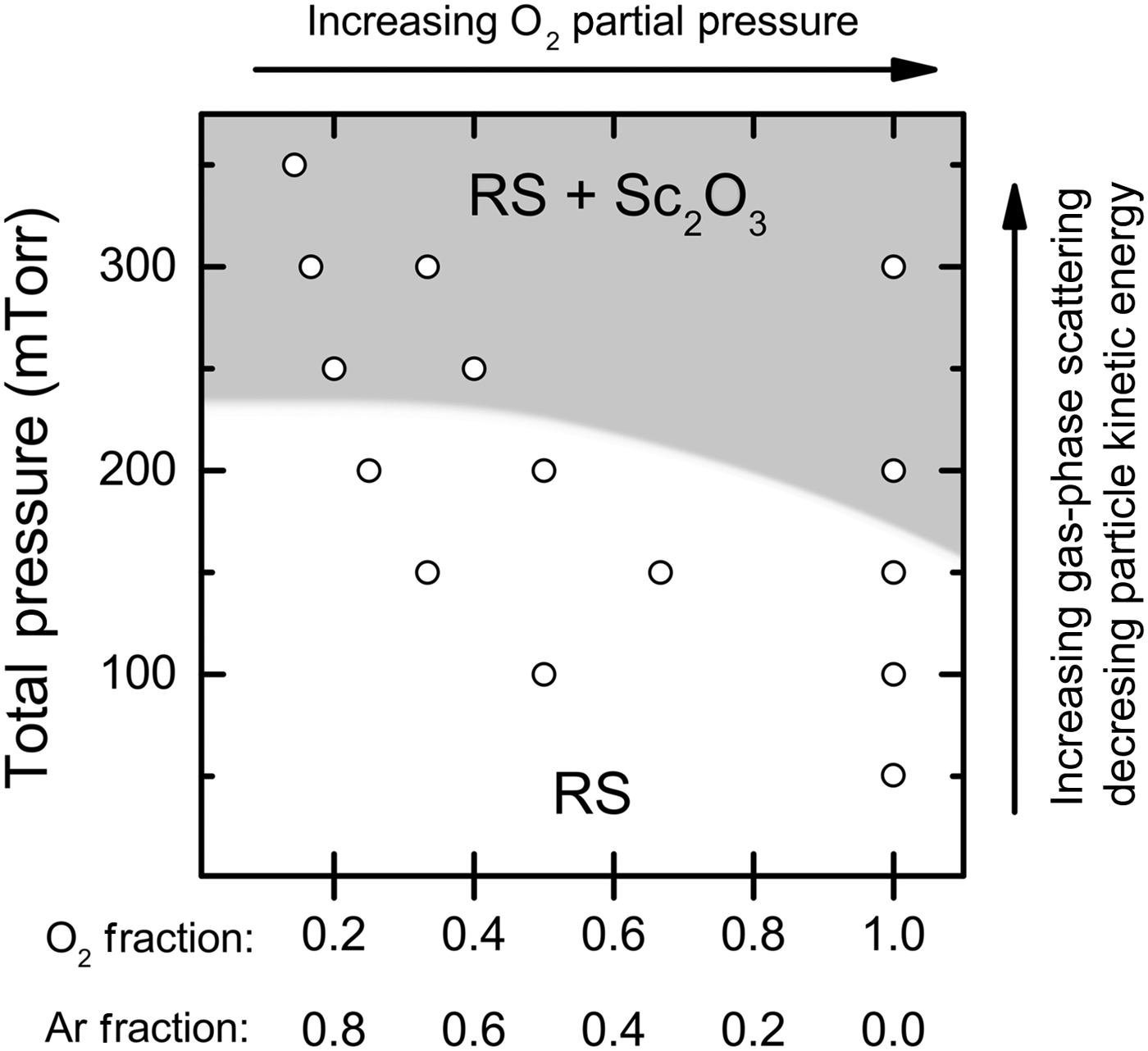
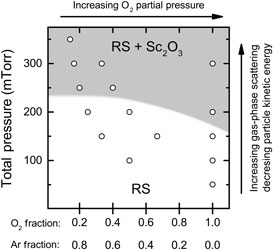
The gas pressure and gas composition dependence of J30 thin film phase evolution on MgO substrates is presented graphically in Fig. 1: a phase map with O2 fraction on the horizontal axis and total pressure (O2 + Ar) on the vertical axis. Data points in the white phase field indicate films that are [001]-oriented, single-phase RS while data points in the gray phase field indicate samples containing both RS and Sc2O3 phases.
Phase structure of J30 films as a function of total deposition pressure and O2 gas fraction. Data points in the white phase field correspond to films exhibiting a single-phase rocksalt (RS) structure and points in the gray phase field correspond to films with both RS and Sc2O3 phases.

It was important to consider the formation of a spinel-type structure, rather than a RS structure, since Mg, Ni, Co, Cu, and Zn are all known to exist in  $\hbox{A}^{2 +} \hbox{B}_2^{3 +} \hbox{O}_4^{2 -} $ spinels.[Reference Bérardan, Franger, Dragoe, Meena and Dragoe2Reference Rak, Rost, Lim, Sarker, Toher, Curtarolo, Maria and Brenner6] RS and spinel structures cannot be differentiated conclusively by <100> XRD scans alone, but the relatively large spinel unit cell produces a reflection from {111} planes at 2θ~18°, with reflections from spinel {222} planes appearing near reflections from RS {111} planes. For all films identified as RS, skew-symmetric θ–2θ scans, aligned to capture these reflections, show no features in the vicinity of 18°, providing evidence that no other structures or phases are present.
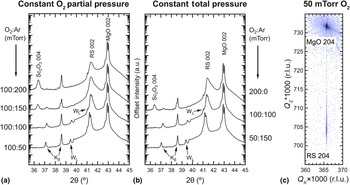
The transition from single-phase RS to RS + Sc2O3 is identified by the appearance of the bixbyite Sc2O3 004 reflection in the diffraction pattern and a broadening of the RS peaks, resulting in an inability to resolve the Cukα doublet for film reflections. In general, at relatively low total pressure conditions, the film structure is (001)-oriented, single-phase RS, while at high pressures the films show reflections from both RS and Sc2O3 phases. In phase-separated films, both the RS and Sc2O3 phases are [001]-oriented, suggesting a RS[100]//Sc2O3[100] epitaxial relationship between the Sc2O3 grains and the RS grains. The cation–cation separation in Sc2O3 along <100> differs from J14 and MgO by >10%[Reference Rak, Rost, Lim, Sarker, Toher, Curtarolo, Maria and Brenner6, Reference Wyckoff27] so structurally relaxed interfaces are expected. Changes in the RS phase out-of-plane lattice parameter were recorded (Fig. S2) but show no clear universal trend as a function of total pressure.
The relative Sc2O3 004 peak intensity and RS 002 peak broadening tend to be greater at higher total pressures, regardless of gas composition. Higher O2 percentages at a constant total pressure also appear to promote phase separation. A subset of the XRD patterns for films on MgO is presented in Fig. 2 to illustrate these two trends. Figure 2(a) shows the appearance of Sc2O3 as the Ar partial pressure is increased while maintaining a constant O2 partial pressure of 100 mTorr. Figure 2(b) shows the second trend where increasing the oxygen fraction at constant total pressure (200 mTorr) results in phase separation. Long-range θ−2θ scans for all films on MgO can be found in supplemental Fig. S3. These data collectively illustrate relative roles of total pressure (thus particle kinetic energy[Reference Amoruso, Aruta, Bruzzese, Maccariello, Maritato, Miletto Granozio, Orgiani, Scotti di Uccio and Wang13–Reference Sambri, Cristensen, Trier, Chen, Amoruso, Pryds, Bruzzese and Wang15]) and oxygen partial pressure (thus gas reactivity[Reference Orsel, Groenen, Bastiaens, Koster, Rijnders and Boller17]). Ultimately, both are instrumental in phase stabilization. Increasing kinetic energy by minimizing gas-phase scattering promotes solid solution, however, more kinetic energy is needed when oxygen activity is higher. We can understand this trend given the net-lower oxidation state of the cations, particularly Sc, when stabilized in the RS structure. This lower oxidation state is also predicted by DFT calculations.[Reference Rak, Rost, Lim, Sarker, Toher, Curtarolo, Maria and Brenner6]
X-ray diffraction data for a subset of films on MgO: Bragg–Brentano scans of (a) films grown at constant O2 partial pressure and varying total pressure; (b) films grown at a constant total pressure of 200 mTorr and varying partial O2 pressure; and (c) reciprocal space map of J30 grown at 50 mTorr O2. In (a) and (b), the Cukα doublet can be resolved in single-phase films and reflections from stray CuKβ and WL radiation are indicated with arrows. A CuKα1 monochromator was used for (c).

Structural characterization of epitaxial J30
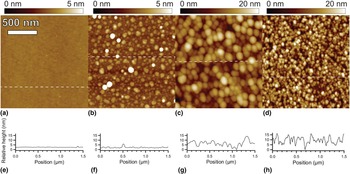
High-resolution XRD was carried out on J30 grown at optimized conditions (50 mTorr O2) to assess crystal quality and epitaxial strain. Measurements of the J30 002, 022 and 111 reflections indicate heteroepitaxy and a tetragonally distorted unit cell with a = b = 4.20 Å and c = 4.38 Å. The alignment of the J30 and MgO 111 reflections in φ (Fig. S4) indicate an in-plane crystallographic relationship J30[100]//MgO[100]. The full-width-half-maximum (FWHM) of the rocking curves for the J30 and MgO 002 reflections are 0.015° and 0.0058°, respectively (Fig. S5). The narrow FWHM of single-phase J30 indicates a high degree of crystallinity and low mosaic spread. A reciprocal space map of the MgO and J30 204 reflections [Fig. 2(c)] illustrates the commensurate nature of the film. The peak location of the J30 204 is consistent with the lattice constants stated above. Two x-ray artifacts indicative of a high-quality film are observed in the out-of-plane diffraction pattern (Fig. S6): Pendellosung fringes[Reference Kato and Lang28] and a pronounced “hybrid” x-ray reflection.[Reference Smith, King, Soukiassian, Ast and Schlom29] Additionally, single-phase J30 is smooth with an RMS roughness <0.5 nm, while increasing O2 pressure to 300 mTorr progressively increases the RMS roughness to 3 nm and produces a fine-grained microstructure upon phase separation (Fig. 3). The same roughness trend is observed in films grown in mixed O2/Ar.
AFM images of J30 grown on MgO in: (a) 50 mTorr O2; (b) 150 mTorr O2; (c) 200 mTorr O2; (d) 300 mTorr O2; and (e)–(h) respective line traces. Note the variable color scales in (a)–(d) and constant height scale for (e)–(h). Coordinates of line traces are denoted by dashed white lines in (a)–(d). The scale bar in (a) applies to (b)–(d).

To understand the origin of the observed tetragonal distortion, we first consider the predicted bulk lattice constant of cubic J30: 4.34 Å.[Reference Rak, Rost, Lim, Sarker, Toher, Curtarolo, Maria and Brenner6] If such a RS phase were forced commensurate to MgO, an out-of-plane elongation is expected. Assuming a Poisson's ratio for J30 of 0.18 (the literature value for MgO[Reference Zha, Mao and Hemley30]) and biaxial in-plane compression, one predicts an out-of-plane value of 4.4 Å, which is similar to the measured quantity of 4.38 Å. As such, it is reasonable to attribute J30 tetragonality to epitaxial strain. It is interesting to note that these films can withstand a tremendous amount of in-plane strain without relaxation, in this case, nearly 3% biaxial compression. Current studies are underway to identify if this capacity for strain is related to the high-entropy condition.
Thin films on alumina and SiO2
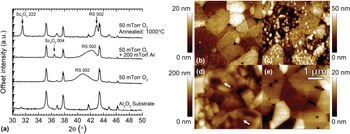
J30 films were prepared on polycrystalline alumina and amorphous SiO2 substrates to test for the possibility of epitaxial stabilization, as opposed to kinetic stabilization. Epitaxial stabilization refers to the growth of relatively unstable phases only when epitaxy is induced.[Reference Gorbenko, Samoilenkov, Graboy and Kaul24] XRD of films prepared at 50 mTorr O2 on alumina and SiO2 reveal a single, broad film reflection consistent with a RS 002 (Fig. S7). The peak position corresponds to ~4.4 Å and no intensity from the 004 or any off-axis reflections could be observed. We suspect the 004 reflection may be too broad to measure clearly due to a combination of small grains [Fig. 4(b)] and local lattice distortion from the Jahn–Teller effect,[Reference Rak, Rost, Lim, Sarker, Toher, Curtarolo, Maria and Brenner6, Reference Rost, Rak and Maria25] which can broaden the 200 reflection from bulk ESOs.[Reference Berardan, Meena, Franger, Herrero and Dragoe4] There is no discernible peak splitting or reflections attributable to Sc2O3, suggesting the films are single phase.
Collective data set for J30 films grown on alumina: (a) offset XRD plots and corresponding AFM images for (b) 50 mTorr O2; (c) 50 mTorr O2 + 200 mTorr Ar; (d) 50 mTorr O2 post-annealing; and (e) bare Al2O3 substrate. Deposition atmospheres are labeled in (a). Data for a bare substrate is included in (a) and (e) for reference. Arrows in (d) denote scandium-rich grains. The scale bar in (e) applies to (b)–(d).

Figure 4(a) shows XRD data for films grown on alumina in 50 mTorr O2 and 50 mTorr O2 + 200 mTorr Ar—a condition that produced phase separation in the epitaxial case. The results on ceramic alumina are similar; additional gas-phase scattering results in the evolution of Sc2O3 and a RS component that shifts to a smaller interplanar spacing of 4.3 Å. A similar trend of increasing surface roughness at higher pressures also occurs on alumina substrates [Figs. 4(b) and 4(c)]. Similar trends in the case of epitaxial and textured growth indicate that PLD energetics are the more influential drivers for single-phase growth as compared to epitaxy.
Thermal stability of thin films
To test J30 metastability, 50 mTorr J30 films on ceramic alumina, (100)-MgO, and SiO2 were annealed at 1000 °C for 1 h to equilibrate the structure in the same temperature and atmosphere the target was sintered. On alumina, after annealing the RS reflection sharpened substantially and shifted to a higher 2θ value corresponding to a lattice parameter of 4.2 Å and a strong reflection attributed to the Sc2O3 222 emerged [Fig. 4(a)]. A bare substrate scan is included in Fig. 4(a) for reference, because extra reflections (attributed to impurity phases in the Al2O3 substrate) appear in the XRD pattern. After annealing, the polycrystalline J30 film developed grains with sharp, cubic facets and some dispersed nebulous grains [Fig. 4(b)]. SEM with EDS indicates the poorly defined grains are Sc-rich and likely Sc2O3 grains detected by XRD.
Annealing J30 on MgO also produced phase separation to RS and Sc2O3 [Fig. S8], but the results of annealing J30 on SiO2 were inconclusive. Silica and olivine silicate reflections dominated the XRD pattern, indicating significant substrate crystallization and reaction with the film at the annealing temperature. In the absence of substrate reaction, the annealed phase structure of J30 appears the same as the phase structure of the sintered PLD target, implying metastable as-deposited films which phase separate to the equilibrium assembly given 1000 °C of thermal energy.
Conclusion
Employing established experimental methods and analyzing the results in the context of PLD plume diagnostic studies[Reference Geohegan11–Reference Ojeda-G-P, Schneider, Lippert and Wokaun16] reveals a correlation between incident particle kinetic energy and the as-deposited J30 phase structure. These observations are consistent with the model where adatom kinetic energy enables a crystalline, solid solution microstate associated with a high effective temperature (thus large TS product) that is subsequently quenched. Growth at high kinetic energy (low-pressure) conditions produces single-phase films while growth at low kinetic energy (high-pressure) conditions produces phase separation. Additionally, the pressure threshold for second-phase formation depends on the O2 fraction; increasing the O2/Ar ratio appears to promote phase separation at lower total pressures. Pressure-dependent trends are observed in the case of epitaxial and textured growth, but epitaxy significantly improves film crystal quality. The collective data set strongly suggests that kinetic energy contributes significantly to the growth of single-phase J30.
It is extremely difficult, perhaps impossible, to completely isolate the effects of kinetic energy, so it is important to acknowledge that all boundary conditions during deposition must contribute to film structure: activity of the gas phase, substrate temperature, strain, plasma ionization fraction, laser fluence, working distance, net deposition rate, effective Fermi energy, etc. Important considerations for future ESO thin film characterization also include point defect concentrations and cation valence states. The scope of the present report provides a preliminary observation of pressure and temperature space, so a complete understanding of these dependencies is needed to identify the full opportunity space for stabilizing many-cation solid solutions.
While this report tested just one composition, we believe that our conclusions may be generally applicable to the non-equilibrium synthesis of other ESO compositions. The present work provides the oxide community with a reliable methodology for the kinetic stabilization of ESO phase structures whose bulk synthesis may require extreme physical or chemical conditions.
Supplementary material
The supplementary material for this article can be found at https://doi.org/10.1557/mrc.2018.184.
Acknowledgments
The authors acknowledge support from NSF Ceramics, award 1610844.