Introduction
Noonan syndrome (NS) is an autosomal dominant congenital disorder, first described in the 1960s (Noonan & Ehmke, Reference Noonan and Ehmke1963). Although relatively unknown, NS is fairly common, with an estimated incidence between one in 1000 and one in 2500, and a presumably higher prevalence of milder expression (Allanson, Reference Allanson2007). Different activating germline mutations in genes encoding participants of the Ras-mitogen-activated protein kinase (MAPK) pathway have been found to cause NS. At present, genetic testing reveals a mutation in approximately 70% of Noonan cases. Research aimed at the identification of other NS-causing genes is ongoing and the diagnosis is still established primarily on clinical grounds, by observation of key features such as short stature, heart defects and facial dysmorphology. Typical facial appearance involves ptosis, wide-spaced eyes, low-set and posteriorly rotated ears with a thickened helix, and a broad or webbed neck.
Although cardinal characteristics are well described, there is a large variability in expression and, with increasing age, the phenotype often becomes less pronounced. Diagnosis is generally made in early childhood because of congenital heart disease, feeding problems or other somatic complications. In otherwise healthy adults, the diagnosis may only be ascertained after the birth of a more significantly affected child. Life expectancy is mildly reduced, predominantly by serious cardiac defects (Allanson, Reference Allanson2007; van der Burgt, Reference van der Burgt2007). The pathogenesis of NS has been associated with tissue disruption or displacement by lymphoedema during (congenital) development (Witt et al. Reference Witt, Hoyme, Zonana, Manchester, Fryns, Stevenson, Curry and Hall1987). Furthermore, vascular changes and malformations may occur slightly more frequently in NS, but there is limited evidence for structural abnormalities of the central nervous system.
At a cognitive level, a low average IQ and learning difficulties are considered to be typical for NS and deviations in social adaptation have been suggested repeatedly (Verhoeven et al. Reference Verhoeven, Wingbermühle, Egger, van der Burgt and Tuinier2008; Wingbermühle et al. Reference Wingbermühle, Egger, van der Burgt and Verhoeven2009). In the majority of publications on clinical features of NS, the authors refer to anecdotal evidence from clinical observations regarding the social competence of their patients. For example, children with NS are often said to mature more slowly, have a diminished insight into social situations and have problems in verbalizing and explaining emotions (Wood et al. Reference Wood, Massarano, Super and Harrington1995; Sarimski, Reference Sarimski2000; Lee et al. Reference Lee, Portnoy, Hill, Gillberg and Patton2005). In adults, a tendency towards a socially desirable attitude has been reported (Verhoeven et al. Reference Verhoeven, Wingbermühle, Egger, van der Burgt and Tuinier2008). In a case study of an adolescent with NS, a specific problem in the expression of emotions was demonstrated, in combination with an anxiety disorder (Verhoeven et al. Reference Verhoeven, Hendrikx, Doorakkers, Egger, van der Burgt and Tuinier2004). Moreover, in a pilot study (n=10), an increased incidence of alexithymia and higher levels of mood and anxiety problems were found in adult NS patients compared to clinical cut-off scores (Verhoeven et al. Reference Verhoeven, Wingbermühle, Egger, van der Burgt and Tuinier2008). However, a case–control study in a larger sample to substantiate these findings has not yet been performed. Hence, the aim of the current study was to examine different aspects of affective information processing and social cognition in adults with NS. Social cognition reflects a neuropsychological approach and definition of social–emotional processes. The perception, experience and expression of emotions was evaluated, in addition to social interaction and psychological well-being.
Method
Participants
Eighty participants were enrolled in this study; 40 of these were Dutch adults (17 males) with NS who volunteered after being invited either by the human genetics department of a university medical centre or by the Dutch Noonan Syndrome Foundation. All were referred to the out-patient neuropsychiatry clinic of the Vincent van Gogh Institute for Psychiatry, Venray, The Netherlands. The other 40 participants were matched healthy Dutch adults (16 males) recruited for control purposes. The study was approved by the local Institutional Review Board in accordance with the Declaration of Helsinki. After full explanation of the procedure, written informed consent was obtained from all participants and their caregivers, where appropriate.
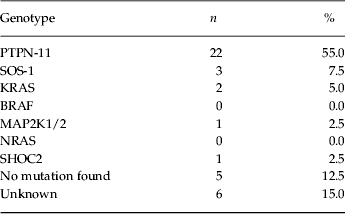
In all patients, a clinical diagnosis of NS was confirmed by a clinical geneticist with a special expertise in NS (I.vdB.). Genotyping resulted in ascertainment of a mutation in 29 patients. In five patients no known mutation was found, and in another six the mutation was unknown (one patient did not want to undergo DNA testing and the DNA of five patients was still under examination to test for the most recent mutations). Five of the NS patients used psychotropics [selective serotonin reuptake inhibitors (SSRIs)/mood stabilizers in all cases, additional methylphenidate in one case], mainly because of current anxiety and mood symptoms. The control participants neither had a history of neurological or psychiatric disorder, nor were they diagnosed with a genetic disorder, according to self-reports. Two of them used psychotropic drugs (SSRIs) because of mood complaints in an earlier period in their lives. All patients had normal or corrected-to-normal vision.
The control group was carefully matched. The two groups did not differ with respect to age (NS: mean=29.1 years, s.d.=13.4, range=16–61; controls: mean=33.8 years, s.d.=14.0, range=18–54; F 1,78=2.34, p=0.13) and sex distribution (U=780.0, Z=0.23, p=0.82). No differences were found between NS patients and controls with respect to overall intelligence [Wechsler Adult Intelligence Scale III (WAIS-III; Wechsler, Reference Wechsler1997) Full-Scale IQ NS: mean=91.2, s.d.=14.5, range=67–124; controls: mean=91.4, s.d.=8.3, range=73–109; F 1,78=0.007, p=0.93; National Adult Reading Test (NART; Nelson, Reference Nelson1982) IQ NS: mean=87.65, s.d.=13.62, range=55–123; controls: mean=87.90, s.d.=8.79, range=68–111; F 1,77=0.009, p=0.93], verbal intelligence (WAIS-III VIQ NS: mean=90.3, s.d.=15.9, range=64–127; controls: mean=91.7, s.d.=9.3, range=72–110; F 1,78=0.248, p=0.62) or performance intelligence (WAIS-III PIQ NS: mean=93.8, s.d.=14.4, range=61–120; controls: mean=93.4, s.d.=9.4, range=73–114; F 1,78=0.017, p=0.90). Finally, there were no differences in education level (mode NS=5, mode controls=5, U=694.5, Z=1.12, p=0.26), which was scored using seven categories, category 1 being the lowest and 7 the highest (Duits & Kessels, Reference Duits, Kessels, Hendriks, Kessels, Gorissen and Schmand2006). Table 1 shows the genetic subtypes of the NS patients.
Genetic subtypes of the patients with Noonan syndrome (NS)

Materials and procedure
The Emotion Recognition Task (ERT) was administered to examine emotion perception. This is a computer-generated paradigm for the recognition of six basic facial emotional expressions: anger, disgust, fear, happiness, sadness and surprise. The emotions are mimicked by actors (two males, two females) and they are presented at different intensities. The degree of expression is increased incrementally from 20% to 100% (Montagne et al. Reference Montagne, Kessels, de Haan and Perret2007). After each video clip, the participant is asked to make a forced choice between the six emotional expressions, displayed in labels on the test computer. Each emotion in each intensity is presented four times. This task provides a static measure of accuracy with respect to emotion recognition and also is a sensitive measure for the assessment of emotional expressions of lower intensities. The ERT has been validated in several clinical groups (Montagne et al. Reference Montagne, Schutters, Westenberg, van Honk, Kessels and de Haan2006).
To assess emotion experience and individual habits in emotion expression, two alexithymia questionnaires were completed by the participants. The Toronto Alexithymia Scale (TAS-20) is the standard instrument for evaluating alexithymia, with 20 items and three factor-based subscales, measuring difficulties in identifying feelings (DIF), difficulties in describing feelings (DDF) and a tendency to externally oriented thinking (EOT) (Bagby et al. Reference Bagby, Parker and Taylor1994a). The Bermond–Vorst Alexithymia Questionnaire (BVAQ) consists of 40 items and differentiates between affective and cognitive dimensions of alexithymia (Vorst & Bermond, Reference Vorst and Bermond2001). Increased scores on the affective dimension would reflect problems in the conscious experience of arousal that accompanies emotions (factor-derived scales Fantasizing and Emotionalizing), whereas a heightened score on the cognitive dimension is presumed to refer to difficulties in Identifying, Verbalizing and Analysing emotions (analogous to factor and subscale names). In both the TAS-20 and the BVAQ, respondents are asked to rate the applicability of statements about alexithymic features to themselves on a five-point scale. The factor structure of both instruments has been confirmed in clinical and non-clinical samples (Bagby et al. Reference Bagby, Taylor and Parker1994b; Vorst & Bermond, Reference Vorst and Bermond2001; Müller et al. Reference Müller, Bühner and Ellgring2004).
To evaluate mentalizing capacities, a basic Theory of Mind (ToM) test was included. This test comprises tasks to assess precursors of ToM, in addition to general ToM abilities such as first-order belief, false-belief and second-order belief, using stories and images based on the ToM paradigm (Steerneman et al. Reference Steerneman, Meesters and Muris2003; Baron-Cohen et al. Reference Baron-Cohen, Leslie and Frith2007).
The Dutch version of the Symptom Checklist-90 Revised (SCL-90-R), a multidimensional questionnaire based on self-assessment of recent complaints, was used to estimate general psychological, somatic and cognitive well-being (Arrindell & Ettema, Reference Arrindell and Ettema2003). The 90 items of the SCL-90-R are rated on a five-point scale. The Dutch translation includes eight subscales: Agoraphobia, Somatization, Anger-Hostility, Depression, Interpersonal Sensitivity and Paranoid Ideation, Anxiety, Cognitive-Performance Difficulty, and Sleep Disturbance. The total scale Psychoneuroticism indicates the general level of distress. Additionally, the subscale Somatization can be used as an indicator of the level of the physical symptoms and the subscale Cognitive-Performance Difficulty can be considered an indicator of cognitive complaints.
As an index for engagement in social behaviour and the associated experience of stress, the Scale for Interpersonal Behaviour (SIB) was administered (Arrindell et al. Reference Arrindell, Bridges, van der Ende, St Lawrence, Gray-Shellberg, Harnish, Rogers and Sanderman2001). This questionnaire was validated for the likelihood of getting involved in a variety of interpersonal behaviours and for the level of distress accompanying assertive responses. The SIB consists of 50 items, to be evaluated on two separate five-point scales by the participant; one for the frequency of engagement in a specific social situation (Performance) and one for the degree of discomfort experienced (Distress). The index provides four subscales, based on factor analyses: Negative Assertion (disclosure of negative feelings), Insecurity (expression of and dealing with personal limitations), Initiating Assertiveness (social assertiveness and expressing one's own opinion) and Positive Assertion (praising others and the ability to deal with compliments).
Data analysis
ERT data for both groups were compared using a general linear model (GLM) repeated-measures analysis, with Emotion type (six levels: anger, disgust, fear, happiness, sadness and surprise) and Intensity (nine levels: 20–100%) as within-subject factors, and Group (NS patients versus healthy controls) as the between-subject factor. A one-way ANOVA was used to reveal significant differences between NS patients and controls in their performances on the ToM test and on all questionnaires (TAS-20, BVAQ, SCL-90-R, SIB). For all analyses, α was set at 0.05.
Results
Affective information processing
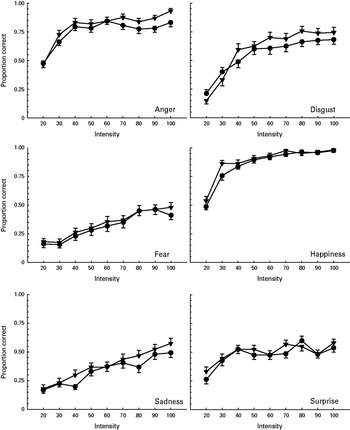
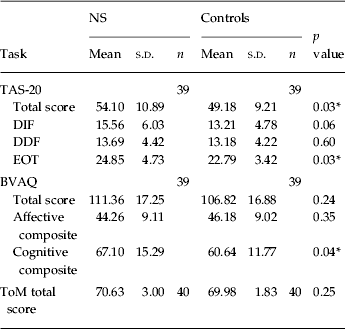
Table 2 shows the results for both groups on measures of affective information processing. Figure 1 depicts the mean ERT performance for the NS patients and the control group for all emotion types, and for the different intensity levels.
Mean performance (proportion correct and standard error of the mean) for the different levels of intensities (20–100%) of the six basic emotions in the Noonan patient group (–•–) and healthy controls (–▾–).

Results for the patients with Noonan syndrome (NS) and controls on measures of emotion experiencing, emotion expression and mentalizing

TAS-20, 20-item Toronto Alexithymia Scale; DIF, difficulties in identifying feelings; DDF, difficulties in describing feelings; EOT, externally oriented thinking; BVAQ, Bermond–Vorst Alexithymia Questionnaire; ToM, Theory of Mind test; s.d., standard deviation.
* Statistical significance at p<0.05 (NS versus controls).
A small, yet significant, overall group effect was found on the ERT, indicating that the NS patients performed slightly worse than the controls (F 1,78=4.52, p<0.05). Overall main effects were found for Emotion (F 5,74=227.26, p<0.0005) and Intensity (F 8,71=114.94, p<0.0005). This indicates that, as usual, some emotions were more difficult to recognize than others and performance improved when faces with a higher level of emotion intensity were presented. A significant interaction between Emotion and Intensity was found (F 40,39=5.99, p<0.0005), indicating that the intensity did not affect each emotion in the same way, in line with previous findings (Montagne et al. Reference Montagne, Kessels, de Haan and Perret2007). None of the other interactions were significant (all F values <0.91).
According to the TAS-20, NS patients scored significantly higher on alexithymia than the healthy controls (F 1,76=4.65, p<0.05). A stronger externally oriented mode of thinking in the participants with NS contributed most to this difference. The BVAQ revealed no statistical differences with respect to the total score (F 1,76=1.38, p=0.24), but the cognitive composite core was significantly higher in the NS patients (F 1,76=4.37, p<0.05), again referring to more alexithymic features. Subsequent analysis showed that problems in Verbalizing emotions had a large part in this (F 1,76=4.80, p<0.05). These results suggest problems in the cognitive processing of emotions in NS, in the presence of an intact affective experience. Mentalizing abilities (ToM total score) did not differ significantly between the groups (F 1,78=1.37, p=0.25).
Psychological well-being and social interaction
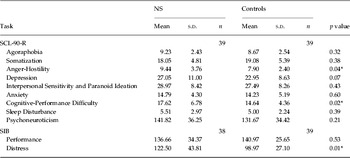
Table 3 presents the results of the questionnaires addressing aspects of psychological well-being and social interaction. There was no group difference in the general level of personal complaints on the Psychoneuroticism scale of the SCL-90-R (F 1,76=1.61, p=0.21). However, the NS patients manifested significantly more complaints on Anger-Hostility (F 1,76=4.63, p<0.05), and they reported significantly higher levels of Cognitive-Performance Difficulty (F 1,76=5.32, p<0.05). There was no group difference on the Anxiety subscale (F 1,76=0.27, p=0.60), nor did the patients show different avoidance tendencies, given the results on Agoraphobia (F 1,76=1.00, p=0.32).
Results for the patients with Noonan syndrome (NS) and controls on measures of psychological well-being and social interaction

SCL-90-R, Symptom Checklist-90 Revised; SIB, Scale for Interpersonal Behaviour; s.d., standard deviation.
* Statistical significance at p<0.05 (NS versus controls).
The SIB results indicate a significant difference between the groups with respect to Distress experienced during the execution of social behaviour; NS patients reported substantially higher levels of distress (F 1,75=8.08, p<0.01). The results on the Performance scale show that frequencies of actual engagement in social situations did not differ (F 1,75=0.39, p=0.53).
Discussion
This is the first case–control study to examine affective processing, social cognition and interpersonal behaviour, in addition to psychological well-being, in NS. To objectify previously reported anecdotal problems in these domains, relevant measures were chosen and findings of adult NS patients were compared with those of matched controls.
First, our findings demonstrate that the perception and labelling of emotional facial expressions was lowered in patients. However, the effect size was small and no selective deficits were found in the perception of any specific emotions. These findings suggest that NS patients do not fundamentally lack the ability to correctly perceive and label emotions. Second, difficulties in the subjective experience and expression of emotions were more prevalent in the patient group, in agreement with the concept of alexithymia. In particular, cognitive aspects of alexithymia, that is problems in verbalizing emotions, were problematic for individuals with NS. Although several studies report that alexithymia often underlies concurrent objective deficits in facial emotion recognition (Parker et al. Reference Parker, Taylor and Bagby1993; Jessimer & Markham, Reference Jessimer and Markham1997; Karlsson et al. Reference Karlsson, Näätänen and Stenman2008), such an association was not apparent in our study as only a small difference between NS and controls was found with respect to emotional perception. Third, basic ToM or mentalizing abilities were found to be satisfactory in all participants.
At the level of social participation and psychological well-being, NS patients reported experiencing significantly higher levels of distress during interpersonal behaviour. Levels of general anxiety were, however, comparable to controls and social interaction was not avoided. Furthermore, most patients had a significant medical history related to somatic conditions as part of NS. Consequently, higher scores were expected on the somatic subscale of the symptom checklist, as it also contains items that could refer to somatic aspects of NS. However, on this subscale, NS patients reported a similar extent of somatic complaints as the controls.
The origins of alexithymia may be found on three interacting levels: the genetic, the neurocognitive, and the psychosocial level. A first explanation for the occurrence of alexithymia in NS could be found in the direct influence of syndrome-specific genetic mutations on the development of the brain, and, as a result, on cognitive development. From the 1970s onwards, heightened levels of alexithymia, more in particular on the externally oriented mode of thinking (as represented in the TAS-20 EOT subscale), have been associated with genetic influences (Heiberg & Heiberg, Reference Heiberg and Heiberg1978; Valera & Berenbaum, Reference Valera and Berenbaum2001). In our study, NS patients showed marked problems specifically in this aspect of alexithymia. In recent years, research has shifted from a classical behavioural–genetics approach to a more specific focus on molecular genetics. Recent studies focus upon the cognitive and behavioural consequences of dysfunctions in the Ras-MAPK pathway, which is affected in NS and in phenotypically associated syndromes, such as the cardiofaciocutaneous (CFC) syndrome. Here, for example, correlations have been found between mutations in Ras/MAPK and adaptive functioning in NS and CFC syndrome (Pierpont et al. Reference Pierpont, Pierpont, Mendelsohn, Roberts, Tworog-Dube, Rauen and Seidenberg2010). Likewise, dysfunctions in this pathway may be related to the occurrence of alexithymia.
An alternative explanation at the neurocognitive level may be that lowered verbal intellectual abilities could have been the cause of problems in the expression of emotions. However, the NS patients in this study did not have specific deficits in verbal intelligence. NS patients reported more cognitive complaints compared to controls. As emotion regulation and social adaptation rely heavily on executive control processes, such as integration, control and guidance, impairments in executive functioning could be the core deficit in NS, resulting in secondary problems in social cognition. Although dysexecutive symptoms have been suggested in NS, this domain has not yet been studied empirically (Wingbermühle et al. Reference Wingbermühle, Egger, van der Burgt and Verhoeven2009).
Considering psychosocial aspects contributing to alexithymia in NS, heightened levels of social distress may underlie deficits in emotional expression. Experiencing social discomfort may result in social withdrawal or in a lack of confidence to express oneself. Individuals scoring high on cognitive aspects of alexithymia have been shown to be more prone to suppressive emotion regulation strategies, rather than to apply reappraisal strategies (Swart et al. Reference Swart, Kortekaas and Aleman2009). Consequently, alexithymia may be considered as the reflection of an inadequate coping strategy. However, the reverse may be the case as well; the inability to express emotions may lead to feelings of frustration and discomfort. It is plausible that emotion regulation is altered by deviating interpersonal experiences, for example in relation to the frequent medical interventions in early childhood, or because of experiences with being bullied.
As mentioned earlier, these explanations are likely to interact and thus may not be mutually exclusive. Alexithymia in NS is probably the manifestation of a complex interaction between genetic, neurocognitive and psychosocial influences. Deficits in affective information processing or social cognition, notably alexithymia, may result in unrecognized discomfort and a lower quality of life in many patients (Mattila et al. Reference Mattila, Poutanen, Koivisto, Salokangas and Joukamaa2007).
The strengths of this study lie in the novelty of the findings and the inclusion of a high-quality, matched control group. A limitation is in the relatively small sample size, although it is the largest behavioural study yet. Previous studies were either single cases or small groups or lacked a control group. Nevertheless, studies in larger samples are required to replicate our findings and to compare NS subgroups, for example based on mutation type, sex, age group, or age of diagnosis. Moreover, future studies may be able to clarify whether neurocognitive impairments in other domains, in particular in the executive functions, are related to alexithymia in NS. Research should also address the question of specificity of the social cognitive problems found in NS by comparing the performances of NS patients with those of Noonan-like phenotypes, such as Turner syndrome.
In conclusion, this study demonstrates that cognitive alexithymia and elevated levels of psychological and social distress are part of the behavioural phenotype in adults with NS. Adopting a longitudinal, developmental perspective may elucidate the variability of the behavioural phenotype during the process of ageing.
Acknowledgements
This study is part of a collaborative project of the research group ‘Psychopathology and Genetics’ of Radboud University Nijmegen and the Vincent van Gogh Institute for Psychiatry, Venray, The Netherlands. We thank M. Wiltink and M. Schrijvers for their assistance in recruiting participants and collecting data, and also the Dutch Noonan Syndrome Foundation for their support in recruiting participants.
Declaration of Interest
None.