INTRODUCTION
Factors that determine the composition and structure of natural communities is one of the central themes of ecology (see Ricklefs and Schluter, Reference Ricklefs and Schluter1993). In general, the species compositions in communities are arrangements of species grouped considering their morphological, ecological and evolutionary characteristics according to the environmental characteristics and interrelationships between species and the regional species pool (Cornwell and Ackerly, Reference Cornwell and Ackerly2009). For parasite communities the same assumptions are valid; however, community assembly rules are more complex, since in addition to the parasites and environmental characteristics, host morphological, ecological and evolutionary traits also have an important role on the organization of communities (May and Anderson, Reference May and Anderson1990; Krasnov et al. Reference Krasnov, Shenbrot, Khokhlova, Medvedev and Vatschenok1998).
In this sense, several factors have been identified as responsible for the structural organization of parasite communities (Morand and Poulin, Reference Morand and Poulin1998; Combes, Reference Combes2001). Among them, host identity is considered a major factor (Bell and Burt, Reference Bell and Burt1991; Guégan and Hugueny, Reference Guégan and Hugueny1994; Poulin and Valtonen, Reference Poulin and Valtonen2002; Krasnov et al. Reference Krasnov, Shenbrot, Mouillot, Khokhlova and Poulin2005, Reference Krasnov, Korallo-Vinarskaya, Vinarski, Shenbrot, Mouillot and Poulin2008, Reference Krasnov, Shenbrot, Khokhlova, Stanko, Morand and Mouillot2014; Lareschi and Krasnov, Reference Lareschi and Krasnov2010) since hosts are an ultimate habitat for parasites, providing a termo-stable site to live, forage and reproduce. To a lesser extent, other factors have been observed, for example, the effect of space (Krasnov et al. Reference Krasnov, Shenbrot, Mouillot, Khokhlova and Poulin2005, Reference Krasnov, Shenbrot, Khokhlova, Stanko, Morand and Mouillot2014; Lareschi and Krasnov, Reference Lareschi and Krasnov2010), climate (Krasnov et al. Reference Krasnov, Shenbrot, Mouillot, Khokhlova and Poulin2005, Reference Krasnov, Korallo-Vinarskaya, Vinarski, Shenbrot, Mouillot and Poulin2008; Lareschi and Krasnov, Reference Lareschi and Krasnov2010), host size (Guégan and Hugueny, Reference Guégan and Hugueny1994; Muñoz and Cribb, Reference Muñoz and Cribb2005; Harrison et al. Reference Harrison, Scantlebury and Montgomery2010) and host sex (Klein, Reference Klein2004; Krasnov et al. Reference Krasnov, Stanko, Matthee, Laudisoit, Leirs, Khokhlova, Korallo-Vinarskaya, Vinarski and Morand2011).
Most studies seeking to understand these relationships prioritize endoparasite communities, while those considering ectoparasite communities focus primarily on a single group (Krasnov et al. Reference Krasnov, Stanko, Miklisova and Morand2006, Reference Krasnov, Korallo-Vinarskaya, Vinarski, Shenbrot, Mouillot and Poulin2008, Reference Krasnov, Shenbrot, Khokhlova, Stanko, Morand and Mouillot2014) and/or cover a large geographical scale (Krasnov et al. Reference Krasnov, Stanko, Miklisova and Morand2006, Reference Krasnov, Korallo-Vinarskaya, Vinarski, Shenbrot, Mouillot and Poulin2008, Reference Krasnov, Mouillot, Khokhlova, Shenbrot and Poulin2012, Reference Krasnov, Shenbrot, Khokhlova, Stanko, Morand and Mouillot2014; Cruz et al. Reference Cruz, Fernandes and Linhares2012; Linardi and Krasnov, Reference Linardi and Krasnov2013). Thus, regional studies evaluating the entire community of ectoparasites associated with hosts are rare (but see Lareschi and Krasnov, Reference Lareschi and Krasnov2010). Another important factor to consider is the degree of importance of each factor, which may vary among different biogeographical regions, since each region has a unique set of species and environmental characteristics. In addition, each region can also have distinct levels of host–parasite specialization and evolutionary history (Marshall, Reference Marshall1981; Korallo et al. Reference Korallo, Vinarski, Krasnov, Shenbrot, Mouillot and Poulin2007; Krasnov et al. Reference Krasnov, Mouillot, Khokhlova, Shenbrot and Poulin2012).
Based on the above assumptions, there are some gaps to be filled, including: (i) What factors can influence ectoparasite community in a regional scale with no major environmental variation (e.g. vegetation, climate, etc.)? (ii) Are the processes that generate the assembly patterns in a wide spatial scale also translated into the community assembly structure on a smaller spatial scale? In this sense, the present study aims to assess the contribution of host traits (rodents and marsupials) in the organization of ectoparasite communities present in woodland patches in a savannah region of Brazil. Specifically we ask: what is the relative effect of host species, sex and body mass, as well as the host environment (portion of the vertical strata – on the ground or in the understory – and the season – dry or wet – in which each host was captured), on the composition, richness and abundance of ectoparasite communities? We predict that the host traits (species, sex and body mass) would have a preponderant role in the organization of ectoparasite communities, since the study was conducted on a small spatial scale and geographical/environmental variation should be barely noticeable. However, ectoparasites belonging to different taxa differ in their evolutionary history and the degree of host association. Therefore, ectoparasites that are closely associated with their hosts (e.g. mites and lice) would tend to be more influenced by host characteristics, while ectoparasites that spend most of their life cycle outside the host (e.g. ticks) would be more influenced by environmental characteristics (vertical strata and seasonality).
MATERIALS AND METHODS
Study area and data collection
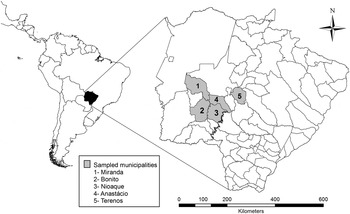
This study was carried out in 54 woodland patches in a savannah region, located in the Paraguay River basin in the border of Pantanal, central–western Brazil (Fig. 1). Data collection was carried out during the rainy seasons of February/March 2012 and November/December 2012, and the dry seasons of July/August 2012 and June/July 2013. Details on the study region and procedures to capture and identification of small mammals and their ectoparasites have been described elsewhere (Sponchiado et al. Reference Sponchiado, Melo, Martins, Krawczak, Labruna and Cáceres2015a , Reference Sponchiado, Melo, Landulfo, Jacinavicius, Barros-Battesti and Cáceres b ).
Municipalities where small-mammal ectoparasites were sampled in a savannah region in Brazil.

Data analyses
In all analyses, we consider only the first capture of each host. In addition, we analysed the host species that had at least one parasite species recorded.
The variance partitioning analysis (Borcard et al. Reference Borcard, Legendre and Drapeau1992; Peres-Neto et al. Reference Peres-Neto, Legendre, Dray and Borcard2006) was used to quantify how much each predictor explains the response variable when all predictors are analysed simultaneously. This analysis allows us to extract the portion of the variance explained by each predictor separately and in conjunction with other variables. We used as dependent variable the ectoparasite community composition considering each host captured as sample unit; the independent variables were: identity (categorical variable: host species), use of vertical stratum (categorical variable: host captured on the ground or in the understory), host body mass (quantitative variable measured in grams), host sex (categorical variable: male or female) and seasonality (categorical variable: host captured in dry or rainy season). These analyses were conducted separately for each ectoparasite order, i.e. mites, ticks or lice.
We limited variance partitioning analysis to four predictors to avoid many interaction terms arising from more than four predictors, which would generate difficulty in results interpretation. In addition, the varpart function we applied [Vegan package (Oksanen et al. Reference Oksanen, Blanchet, Kindt, Legendre, O'hara, Simpson, Solymos, Stevens and Wagner2011)] is also limited to a maximal of four predictors. Thus, we used only the four independent variables with the strongest relationship with the dependent variable in the variance partition, considering the value of R 2. For the parasite species composition data, in this previous selection, first, we performed a principal component analysis (PCoA – dissimilarity Bray–Curtis) to summarize the community structure into orthogonal axes; we then used the first and second axes in the regressions.
We repeated the same analyses considering the total richness and abundance of the main ectoparasite orders separately as dependent variables. For composition and richness analyses, we excluded ectoparasites that were not identified to species level because they could represent more than one species (e.g. larvae of Amblyomma sp. and protonymphs of Ornithonyssus sp.). However, all ectoparasites were considered for the analysis of total abundance. For ectoparasite composition matrix, we used the Hellinger transformation to correct the asymmetry between species abundance (Legendre and Gallagher, Reference Legendre and Gallagher2001). We also logarithmized (log x + 1) the total abundance data in order to reduce its dispersion.
Subsequently, we apply a PCoA to observe the general patterns of relationship between ectoparasites and the variables that had greater explanatory power in the variance partition analysis. In these analyses, we grouped the abundance of ectoparasite species by family (Ixodidae, Argasidae, Laelapidae, Macronyssidae, Rhopanopsyllidae) or order (Phthiraptera). The later was grouped by order because of the low number of captured lice representing different families. In these analyses, we consider only the parasitized hosts. The abundance data for families/order were logarithmized (log x + 1) to reduce dispersion.
All analyses were performed using the Vegan package (Oksanen et al. Reference Oksanen, Blanchet, Kindt, Legendre, O'hara, Simpson, Solymos, Stevens and Wagner2011) in the R environment (Development Core Team, 2012).
RESULTS
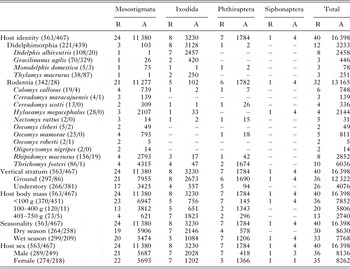
We captured 1040 small mammals belonging to 20 species, eight marsupials and 12 rodents. Among these, 563 specimens (of four marsupial and 11 rodent species) were parasitized. Calomys tener (Winge, 1887), Cryptonanus cf. agricolai (Moojen, 1943), Marmosa constantiae (Thomas, 1904), Marmosa murina (Linnaeus, 1758) and Philander opossum (Linnaeus, 1758) were captured in small numbers and did not have ectoparasites. We identified 40 ectoparasite species of four orders (Mesostigmata, Ixodida, Phthiraptera and Siphonaptera) and ten families (Laelapidae, Macronyssidae, Ixodidae, Argasidae, Hoplopleuridae, Polyplacidae, Trimenoponidae, Gyropidae, Haematopinidae and Rhopanopsyllidae), totalling 16 398 ectoparasites (Table 1, online Supplementary S1).
Richness (R) and abundance (A) of small-mammal ectoparasite collected on woodland patches in a savanna region of Brazil. Number of host parasitized/non-parasitized in parentheses

The host sex predictor showed the weakest relationship with composition, richness and abundance for mites and ticks (online Supplementary S2). Thus, this variable was excluded from the variance partitioning analysis for these groups. Seasonality showed the weakest relationship with composition, richness and abundance of lice; therefore, it was excluded from further analysis for this dependent variable (online Supplementary S2).
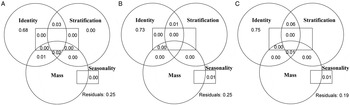
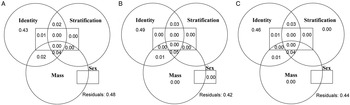
For mites (Mesostigmata), host species was determinant as a pure factor (composition – Adj. R 2 = 0·68; richness – Adj. R 2 = 0·73 and abundance – Adj. R 2 = 0·75) with a small influence of seasonality (online Supplementary S3). The vertical stratification and host mass, when considered as single factors, were not significant (online Supplementary S3). When we analysed the factors together, the relationship between host species and vertical stratification showed a secondary contribution to community assembly (Fig. 2, online Supplementary S3).
Venn diagram representing the percentage of variation partition of mites (Mesostigmata) associated with small mammals in woodland patches of a savannah region in Brazil. Each circle or rectangle represents the percentage of variance explained by each predictor as a pure factor and as shared effects between factors. (A) Composition; (B) richness and (C) abundance. Values <0 were not showed.

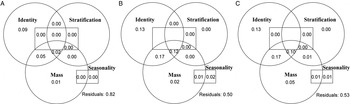
The factors analysed did not have great influence on the composition of ticks (Ixodida); only host species (Adj. R 2 = 0·09) and host body mass (Adj. R 2 = 0·01) were significant, but explained little of the variation in the data. On the other hand, host species factor alone (Adj. R 2 = 0·13), host species plus host body mass (Adj. R 2 = 0·44) and these two factors together with vertical stratification (Adj. R 2 = 0·44) were important to determine tick richness. Considering the species abundance, the factors that had more influence alone were host species (Adj. R 2 = 0·13) and host body mass (Adj. R 2 = 0·10). Together, these two factors explained 17% of variation in the data, and 10% when considered together with vertical stratification (Fig. 3, online Supplementary S4).
Venn diagram representing the percentage of variation partition of ticks (Ixodida) associated with small mammals in woodland patches of a savannah region in Brazil. Each circle or rectangle represents the percentage of variance explained by each predictor as a pure factor and as shared effects between factors. (A) Composition; (B) richness and (C) abundance. Values <0 were not showed.

Similarly to mites, lice (Pthiraptera) also had host species a key factor in the group organization (composition – Adj. R 2 = 0·43; richness – Adj. R 2 = 0·49 and abundance – Adj. R 2 = 0·46, pure factor); however, this effect was not as high as it was for mites. The other factors were not significant when analysed separately. All together, the most important factors for community assemblage were: host species, host body mass, and vertical stratification, although this relationship was weak (Fig. 4, online Supplementary S5).
Venn diagram representing the percentage of variation partition of lice (Phthiraptera) associated with small mammals in woodland patches of a savannah region in Brazil. Each circle or rectangle represents the percentage of variance explained by each predictor as a pure factor and as shared effects between factors. (A) Composition; (B) Richness and (C) abundance. Values <0 were not showed.

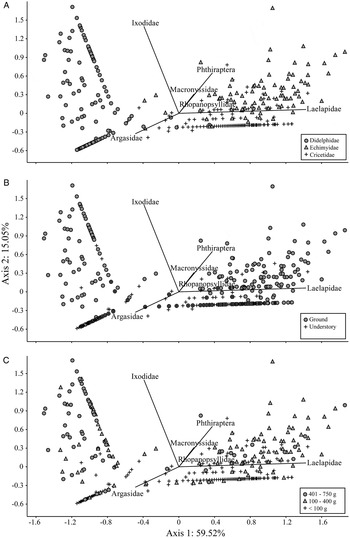
When the abundance of ectoparasite species of each host were grouped by family (except lice, which were grouped in order) and ordered through a principal coordinate analysis, the first axis explained 59·52%, while the second axis explained 15·05% of data variation. The first axis showed a separation between hosts parasitized mainly by ticks (Ixodidae and Argasidae) and those infested by mites (Laelapidae, Macronyssidae), lice (Phthiraptera) and fleas (Rhopanopsyllidae). In the second axis, there was a separation of hosts parasitized by Ixodidae, Macronyssidae and Phthiraptera from those parasitized by Argasidae. When we considered host family (Didelphidae, Cricetidae and Echimyidae), Didelphidae were shown to be parasitized mainly by ticks, while rodents (Cricetidae and Echimyidae) were parasitized mainly by mites, lice and fleas (Fig. 5A). On the other hand, when we categorized hosts based on their vertical stratification (ground or understory), the ordination showed a separation mainly in axis 2, with hosts captured on the ground parasitized by Ixodidae, Macronyssidae and Phthiraptera, while hosts captured in the understory were parasitized by Argasidae (Fig. 5B). Likewise, when we considered the host body mass, the separation was also given by the second axis, with host of larger mass more related with Ixodidae, Macronyssidae and Phthiraptera (Fig. 5C). We also categorized the data based on seasonality (captures in the dry or rainy season) and sex of host, but the ordination did not show any clear pattern, as also found in the partition analysis.
Relationship between ectoparasites and the variables that had greater explanatory power in variance partition analysis. (A) host species; (B) vertical stratification and (C) host mass. The biplots comprise an ordination diagram (PCoA) of the ectoparasites community composition grouped by families/order present in each host.

DISCUSSION
Our data showed that the organization of ectoparasite communities related to small mammals is determined mainly by host species, being this factor important (mainly for mites and lice rather than ticks) to explain the ectoparasite composition, richness and abundance. The community structure, in general, remained constant between individuals of a particular host species, but differed between host species. This pattern was consistent even without the influence of other analysed factors. This result was expected because numerous studies have found a similar pattern for different groups of ectoparasites (Krasnov et al. Reference Krasnov, Shenbrot, Mouillot, Khokhlova and Poulin2005, Reference Krasnov, Korallo-Vinarskaya, Vinarski, Shenbrot, Mouillot and Poulin2008, Reference Krasnov, Shenbrot, Khokhlova, Stanko, Morand and Mouillot2014; Lareschi and Krasnov, Reference Lareschi and Krasnov2010). In the study area, we found a strong specificity among ectoparasite/host relationship. Almost every ectoparasite species had its specific host and therefore, each host had a particular parasitic fauna (Sponchiado et al. Reference Sponchiado, Melo, Landulfo, Jacinavicius, Barros-Battesti and Cáceres2015b ). This is mainly attributed to the coevolution process or co-adaptation of parasites and hosts, which contributes to a given ectoparasite species to become adapted to one or more characteristics of a particular host species (Ward, Reference Ward1992; Poulin, Reference Poulin1998; Combes, Reference Combes2001).
However, an ectoparasite community of a particular host is not only composed by specialist species, but also by generalist ones, such as ticks (Sponchiado et al. Reference Sponchiado, Melo, Martins, Krawczak, Labruna and Cáceres2015a , Reference Sponchiado, Melo, Landulfo, Jacinavicius, Barros-Battesti and Cáceres b ). For this reason, when we considered ticks, the strengthness of the host–parasite specificity became weak, or virtually null. Furthermore, ticks parasitized mainly marsupials, while lice and mites (Laelapidae and Macronyssidae) parasitized mainly rodents. These results emphasize the evolutionary character of the ectoparasite community assembly.
Another hypothesis is that the larger the hosts, the greater is the richness and abundance of ectoparasites (e.g. Guégan and Hugueny, Reference Guégan and Hugueny1994; Muñoz and Cribb, Reference Muñoz and Cribb2005; Harrison et al. Reference Harrison, Scantlebury and Montgomery2010). In part, this pattern is attributed to the fact that the larger the host, the greater the body surface, and therefore, the dimension and amount of available niches (Korallo et al. Reference Korallo, Vinarski, Krasnov, Shenbrot, Mouillot and Poulin2007). Moreover, larger hosts generally have higher-energy requirements. In this sense, they need to travel longer distances searching for food resources (McNab, Reference McNab1963; Mace and Harvey, Reference Mace and Harvey1983). Since many ectoparasite species show life stages outside the host (Bush et al. Reference Bush, Fernández, Esch and Seed2001), higher host mobility increases the chance of infestation by different ectoparasites, either by the availability in the environment or the exchange with other hosts (Nunn et al. Reference Nunn, Altizer, Jones and Sechrest2003). Despite of this, we did not observe any pattern related to host body mass, except when combined with other variables. In fact, to have such a strong effect of host body mass, it is necessary to have a marked intra- and interspecific variation in body size of the host community and/or a low specificity in host–parasite relationship. In our data, the interspecific body mass variation was not high and the analysed ectoparasite communities had generally high specificity, thus justifying the low effect of host body mass on the ectoparasite composition, richness and abundance.
In turn, as ticks have low host/parasite specificity, this feature increases the importance of the body mass factor in the community organization. During the early stages of development, larvae and nymphs of ticks [stages that often parasitize small mammals (Szabó et al. Reference Szabó, Nieri-Bastos, Spolidorio, Martins, Barbieri and Labruna2013)] spend much of their time in the environment. These arthropods mainly use an ambush strategy (Needham and Teel, Reference Needham and Teel1991), remaining on vegetation waiting for a potential host. The height the ticks are positioned on vegetation is directly correlated with the height of their preferred host (Szabó et al. Reference Szabó, Labruna, Garcia, Pinter, Castagnolli, Pacheco, Castro, Veronez, Magalhães, Vogliotti and Duarte2009). Thus, the larger the host and/or the longer the distance travelled by it, the greater the chances of receiving new ticks. Corroborating these results, the PCoA plot shows that ticks (Ixodidae), as well as lice and mites (Macronyssidae), are more related with larger hosts.
On the other hand, we observed that seasonality significantly influenced the richness and abundance of mites and ticks; however, these relationships were weak. The reproductive cycle of small mammals is generally determined by the availability of food resources, which is mainly governed by variations in temperature and precipitation throughout the year (Bergallo and Magnusson, Reference Bergallo and Magnusson1999; Mendel et al. Reference Mendel, Vieira and Cerqueira2008). Thus, the birth of pups occurs mostly during periods of greater availability of food resources during the rainy season (Pinheiro et al. Reference Pinheiro, Diniz, Coelho and Bandeira2002). Some ectoparasites synchronize their reproduction with their hosts (Marshall, Reference Marshall1981; Blanco and Frías, Reference Blanco and Frías2001) increasing their reproduction rates. As a result, there may be an increase in parasites dispersion rates during breeding periods, in which hosts show higher population density and are more gregarious, either during copulation (horizontal transmission) or during birth and parental care of offspring (vertical transmission) (Clayton and Tompkins, Reference Clayton and Tompkins1994). Conversely, certain climatic conditions may promote the breeding and development of some ectoparasite groups. For example, some species of ticks synchronize the incubation period of eggs during the rainy season (in this case, during the spring and summer). Higher humidity and higher temperatures shorten the incubation period and increase the egg hatchability (Labruna et al. Reference Labruna, Terassini and Camargo2009). Thus, seasonal changes can cause an increase or decrease in reproductive rates of ectoparasites. Even if it is not valid for all species or taxonomic groups, these changes can have a significant effect that interferes at some extent with the general pattern of community structure.
Many studies showed the importance of environment and space in the ectoparasite community assembly (e.g. Krasnov et al. Reference Krasnov, Shenbrot, Mouillot, Khokhlova and Poulin2005, Reference Krasnov, Stanko, Miklisova and Morand2006; Lareschi and Krasnov, Reference Lareschi and Krasnov2010). However, most of them evaluated the species distribution along a horizontal gradient covering a large geographical range. Since the sampled patches are relatively homogeneous in vegetation structure, geographically close among each other, and biogeographically have a similar small-mammal fauna, we chose to check how the vertical stratification of host species influenced ectoparasite assembly. Regardless of where each host species was sampled (on the ground or in the understory) the parasitic fauna remained constant. Although the PCoA analysis indicated that Argasidae ticks were sampled mainly on hosts captured in the understory, and Ixodidae ticks, lice and mites were sampled mainly on hosts captured on the ground, the former was more specific to marsupials and the later more specific to rodents, emphasizing the greater interaction between taxonomy and vertical stratification in such analyses. For example, the marsupials Gracilinanus agilis, Didelphis albiventris and Thylamys macrurus and the rodent Rhipidomys macrurus have similar spatial niches, i.e. they use the understory in similar frequencies and hollow trees as shelters (Vieira and Camargo, Reference Vieira, Camargo and Cáceres2012). However, while Argasidae often parasitized the three species of marsupials, only three rodent individuals were found parasitized by Argasidae. Although these species coexist in the same microhabitat, another factor besides vertical stratification (the host species as an example) is contributing to marsupials having largely different ectoparasites assemblies, even occupying similar niche of rodents.
Like the vertical stratification, the sex of host showed little or no influence on ectoparasite community assembly. We included this variable in our analysis because other studies have shown that male small mammals have higher infestation rate than females (e.g. Khokhlova et al. Reference Khokhlova, Serobyan, Degen and Krasnov2011; Krasnov et al. Reference Krasnov, Stanko, Matthee, Laudisoit, Leirs, Khokhlova, Korallo-Vinarskaya, Vinarski and Morand2011; Kiffner et al. Reference Kiffner, Stanko, Morand, Khokhlova, Shenbrot, Laudisoit, Leirs, Hawlena and Krasnov2014; Kowalski et al. Reference Kowalski, Bogdziewicz, Eichert and Rychlik2015). Males generally have larger home ranges and move more than females, resulting in more frequent contact with other individuals (Moore and Wilson, Reference Moore and Wilson2002) and increasing the chances of getting parasites. Moreover, androgen hormones, such as testosterone, increase their susceptibility to parasitism by causing immunosuppression (e.g. Roberts et al. Reference Roberts, Buchanan and Evans2004). Our results indicate that this is not a general pattern applied to all species, as also found elsewhere (e.g. Kiffner et al. Reference Kiffner, Stanko, Morand, Khokhlova, Shenbrot, Laudisoit, Leirs, Hawlena and Krasnov2013; Sponchiado et al. Reference Sponchiado, Melo, Martins, Krawczak, Labruna and Cáceres2015a , Reference Sponchiado, Melo, Landulfo, Jacinavicius, Barros-Battesti and Cáceres b ).
In summary, our results showed that each ectoparasite order responded differently to the analysed predictors. Host species play an important role in ectoparasite community assembly of small mammals in the Cerrado. Then the composition, richness and abundance of mites and lice are highly influenced by the host identity, although the former in a higher extent than the later. Host body mass had an important role in the richness and abundance of tick species. The vertical stratification and seasonality had little influence, while the sex of host had no influence on the community organization. However, it is necessary to take into account that these results are closely related to the evolutionary history of the species involved and the local environmental characteristics. Thus, it is possible that the degree of importance of each predictor could change depending on the geographic region and/or the taxonomic group.
SUPPLEMENTARY MATERIAL
The supplementary material for this article can be found at https://doi.org/10.1017/S0031182016001906.
ACKNOWLEDGEMENT
Our thanks to staff of the Laboratory of Ecology and Biogeography of the Universidade Federal de Santa Maria for help in the fieldwork and the owners of areas sampled for allowing the realization of the research.
FINANCIAL SUPPORT
We are grateful for scholarships granted by Coordenação de Aperfeiçoamento de Pessoal de Nível Superior (CAPES) to J. S. and G. L. M., Conselho Nacional de Desenvolvimento Científico e Tecnológico (CNPq) to T. F. M. and Fundação de Amparo à Pesquisa do Estado de São Paulo (FAPESP) to F. S. K. We are also grateful to Conselho Nacional de Desenvolvimento Científico e Tecnológico (CNPq) for the financial support (Edital Universal 2011, Processo 470324/2011-2). N. C. C is a CNPq research fellow (Ecology) in Brazil.