Introduction
Features of the male tiger beetle (Cicindela Linnaeus; Coleoptera: Carabidae: Cicindelinae) genitalia have long been useful adjuncts for the systematic placement of various taxa. This method was pioneered by Rivalier (Reference Rivalier1950, Reference Rivalier1954). In an imposing series of publications he portrayed the entire genitalic assembly including the external structure of the median lobe and several sclerites associated with the internal sac. With this impressive technique, Rivalier was able to use genitalic features for taxa identification and for the establishment of major natural species groups that he labelled genera, which soon became customary practice among tiger beetle researchers. Also, many articles in the journal Cicindela are evidence of Rivalier’s contributions to the large body of tiger beetle genitalia structure literature developed since the 1950s. Among other studies, Rivalier’s systematics work has led to a growing understanding of complex cicindeline mating behaviours, and functions of male sclerites of the internal sac, that connect with female sexual structures in copulation.
As part of a scanning electron microscope (SEM) survey for male genitalia characters, Schincariol and Freitag (Reference Schincariol and Freitag1986) found that in Cicindela tranquebarica Herbst the flagellum, an elongate sclerite of the internal sac, had a deep groove throughout its full length. Dissected genitalia of mating pairs of C. tranquebarica frozen in liquid nitrogen revealed that the flagellum enters the spermatheca duct. In addition, series of tiny appressed teeth-like structures occupied different surface areas of the flagellum. It was confirmed that these were useful diagnostic features as well as gripping devices when the flagellum is inserted into the female spermatheca duct in copula. To further determine the diversity of these structures in the context of systematics and functional morphology, Freitag et al. (Reference Freitag, Hartwick and Singh2001) examined the male genitalia of 11 tiger beetle species. Specifically, the flagellum and microscopic appressed teeth-like structures (which were coined tempers) were studied.
The purpose of this paper is to examine the flagellum and tempers of 32 tiger beetle species (21 for the first time), representing five subgenera of Cicindela Linnaeus, to look for diagnostic characters at lower and higher taxonomic levels. Eight species reviewed by Freitag et al. (Reference Freitag, Hartwick and Singh2001) are compared with the same species in the present study as a means of gauging the extent of variation or structural patterns of the flagellum and temper characteristics. Also, it is proposed that the dynamics of the flagellum and tempers are principally designed for gripping the inner walls of the spermatheca duct, and a phylogenetic concept is suggested for these two complex mating structures.
Materials and methods
A total of 32 tiger beetle species were represented in this study each by at least one selected male, and in several species by up to five males. Most of the selected males were collected by the author and colleagues and were preserved in glycerine following male genitalia dissections as described in Freitag et al. (Reference Freitag, Hartwick and Singh2001). For SEM observations, the male median lobe was removed from the glycerine, placed in a petri dish with clean water, and the internal sac was everted with a hooked micro-pin tip. Number 5 jeweller forceps were used to tease out the flagellum which was placed in a petri dish with 10% KOH for 10 minutes, again washed in clean water, dried on tissue paper and transferred to a metallic stub onto a double sticky tab, and gold coated in a Fullum Sputter Coater.
Characters used for analysis were: flagellum size and shape, flagellum groove (open or closed), presence and location of tempers on flagellum, length and shape of tempers, patterns of temper distribution, and any character correlations. It was noted that the tempers, in all species examined, pointed toward the basal end of the flagellum, and mainly aligned in rows transverse to the long axis of the flagellum.
Micrograph measurements of the flagellum and temper lengths were made along their long central axes. The relatively straight parts of the characteristics were considered to be reasonably straight against the micrograph scale. A flagellum loop was measured for length by the use of formula πd to define circumference of the loop, the diameter (d) was measured across the edge of the loop.
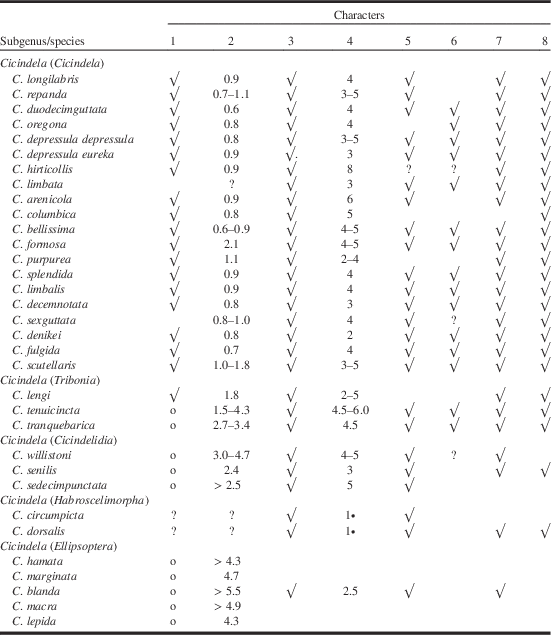
The classification in Table 1 is recognised by most tiger beetle systematists.
Male flagellum and temper characters of selected species of Cicindela.

Notes: Characters: 1. Flagellum sinuate (√) or looped (ο); 2. Length of flagellum (mm); 3. Flagellum with tempers (√), with a few tempers (√), tempers absent (blank), or tempers undetermined (?); 4. Maximum length of tempers (μm), very short tempers (<1 μm) mainly recessed in impressions of the flagellum of C. circumpicta and C. dorsalis (1∙); 5. Tempers on/near basal portion of flagellum (√); 6. Tempers on/near mid portion of flagellum (√); 7. Tempers on/near apical portion of flagellum (√); 8. Tempers on/near main longitudinal groove of flagellum (√).
Results and discussion
All the selected species from the five Cicindela subgenera were found to have a number of flagellum characteristics that are either inconstant or shared as listed in Table 1. For these subgenera, a reasonable taxonomic diagnosis might be expressed by the combined length and shape of the flagellum. Species of subgenus Cicindela Linnaeus tend to have an unlooped, slightly curved or sinuate, and relatively short flagellum, ranging from 0.6 to 2.1 mm long. The remaining four subgenera have a longer flagellum with at least one loop. The flagellum of subgenus Tribonia Rivalier species is 1.5–4.3 mm long and looped once or twice. Subgenus Cicindelidia Rivalier species similarly have a flagellum 2.4–4.7 mm in length and looped at least twice. While parts of the flagellum of the subgenus Habroscelimorpha Dokhtouroff species were examined in detail, the entire structure is as yet undetermined for length and shape. Overall, subgenus Ellipsoptera Dokhtouroff species have an elongate flagellum, 4.3–5.5 mm, and looped two or more times.
Species recognition and placement on the basis of temper features complement patterns of structural variation of the flagellum itself (Table 1). Unlike that of subgenus Cicindela, tempers cover fewer areas of the flagellum surface of Tribonia, Cicindelidia, and Habroscelimorpha, and with the exception of C. blanda Dejean, Ellipsoptera species have no tempers on the flagellum.
Sixteen and one questionable species of the 19 listed for subgenus Cicindela and all species of subgenera Tribonia, Cicindelidia, and Habroscelimorpha have tempers at the base of the flagellum (Table 1). Only one of five Ellipsoptera species has tempers at the base of the flagellum. Concerning species with tempers at middle parts of the flagellum, subgenus Cicindela has 13 and two questionable, three of the three Tribonia, and one questionable Cicindelidia. Species with tempers at the flagellum apex include 19 in Cicindela, three in Tribonia, two in Cicindelidia, and one in each of Habroscelimorpha and Ellipsoptera. Most species show at least a few tempers situated in the main flagellum groove, namely all Cicindela and Tribonia, one of the three Cicindelidia, one of the two Habroscelimorpha, and no Ellipsoptera.
As a character taken alone, the temper length is not a promising systematic tool, mainly because of its uniformity among disparate taxa (Table 1). The observed range of temper length is 2.0–8.0 μm in species in the subgenus Cicindela, 2.5–6.0 μm in Tribonia, 3.0–5.0 μm in Cicindelidia, and 2.5 μm for C. blanda (the only Ellipsoptera with tempers). Habroscelimorpha species have extremely truncate tempers.
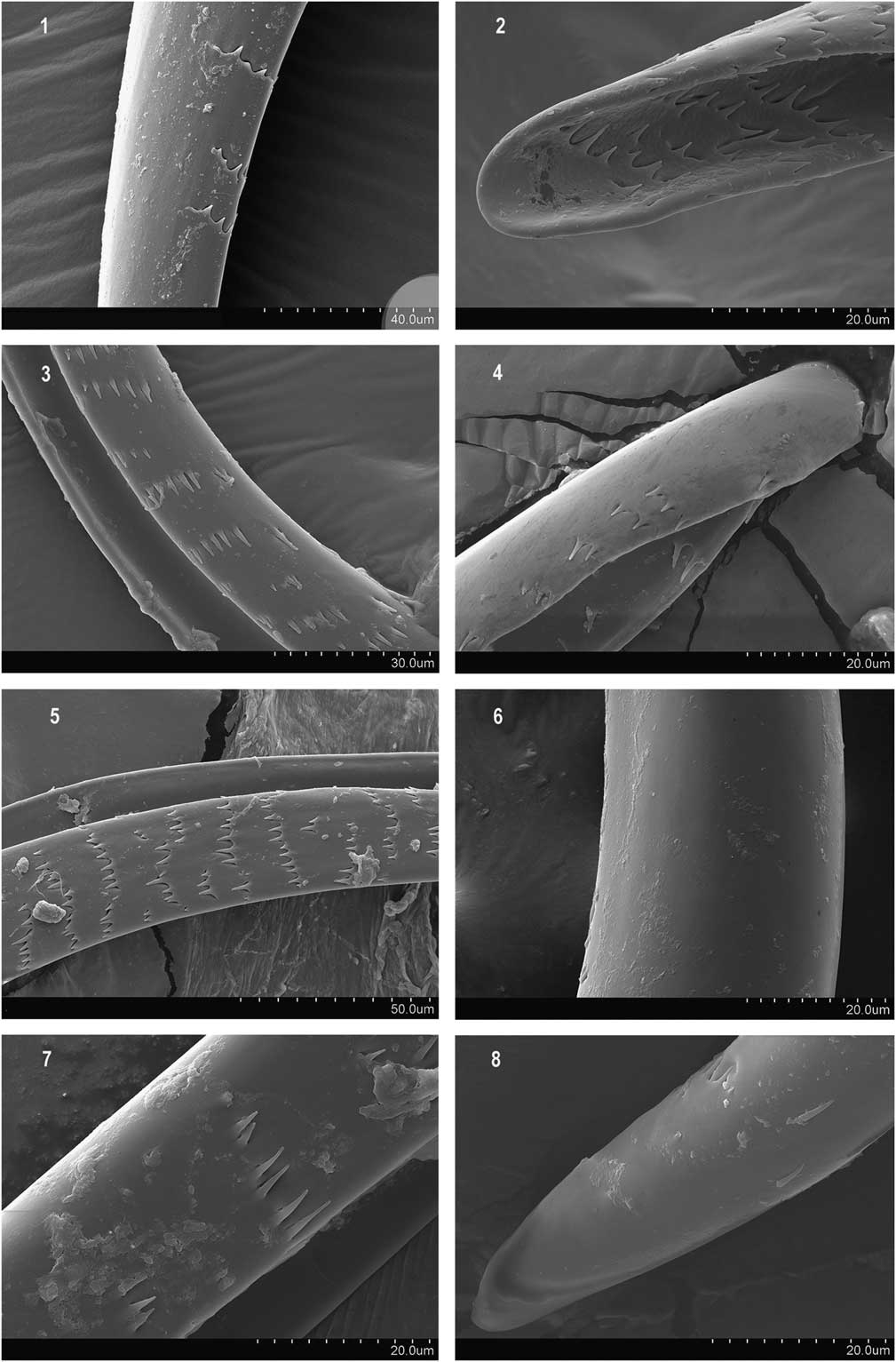
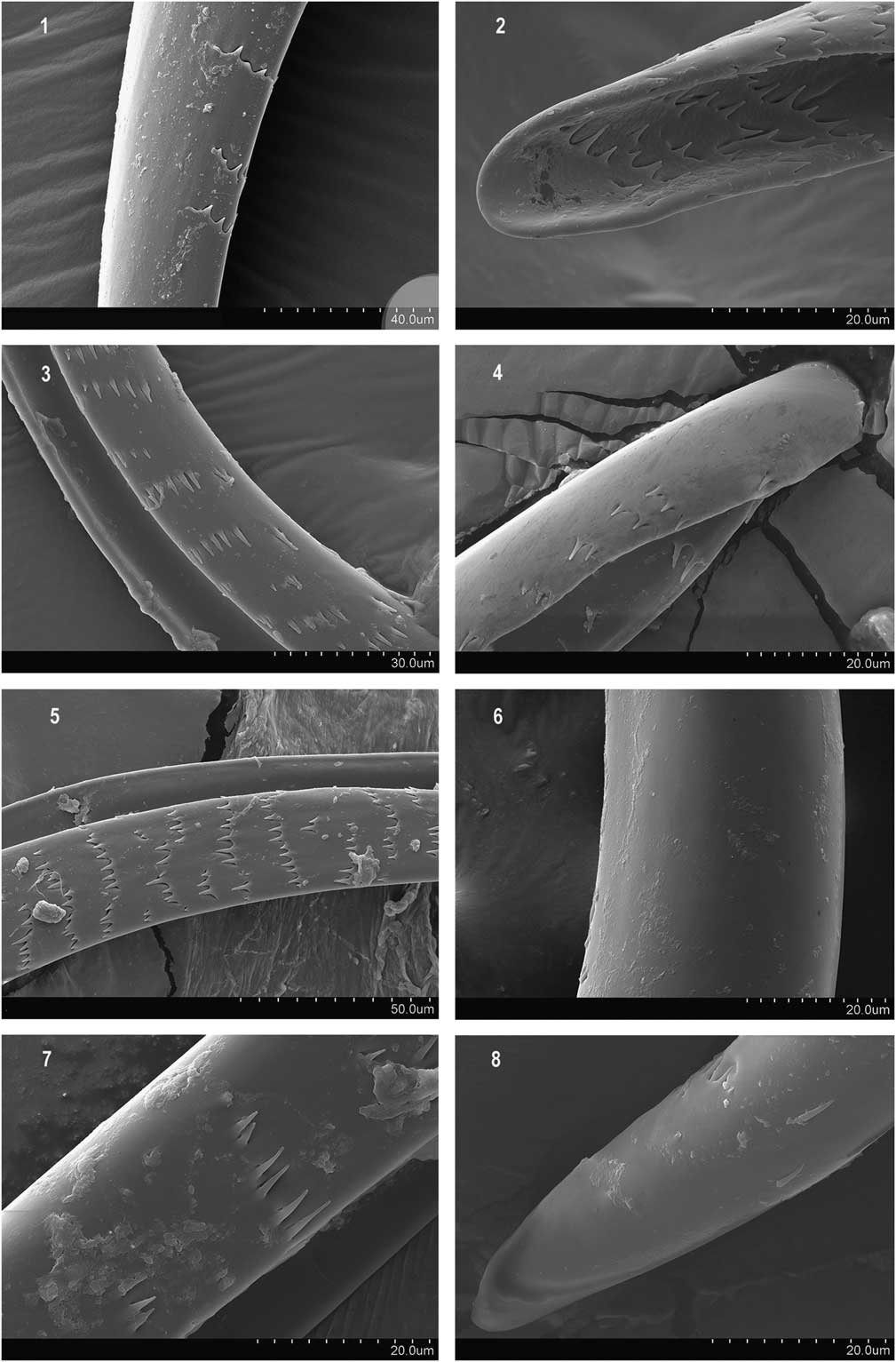
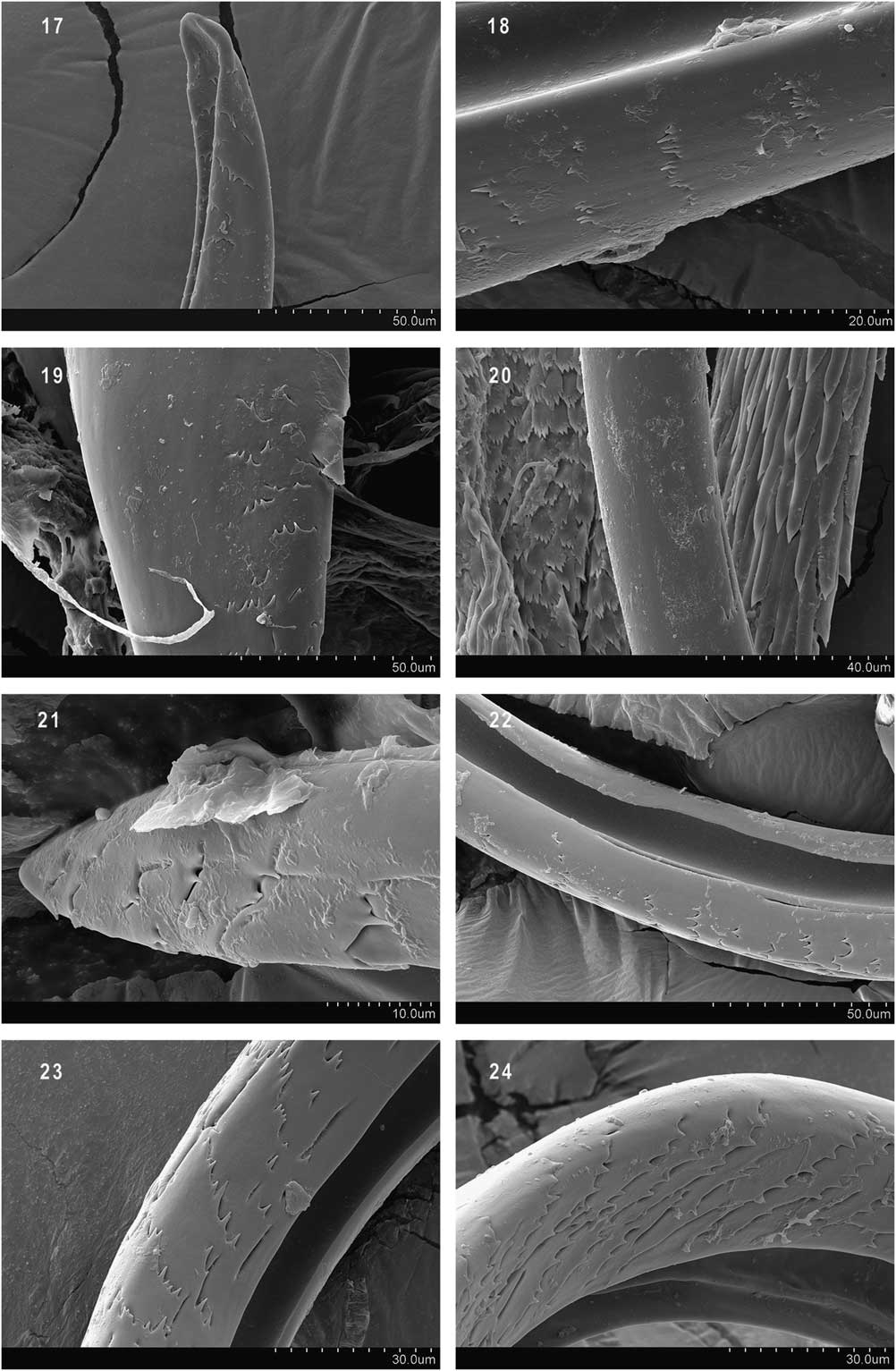
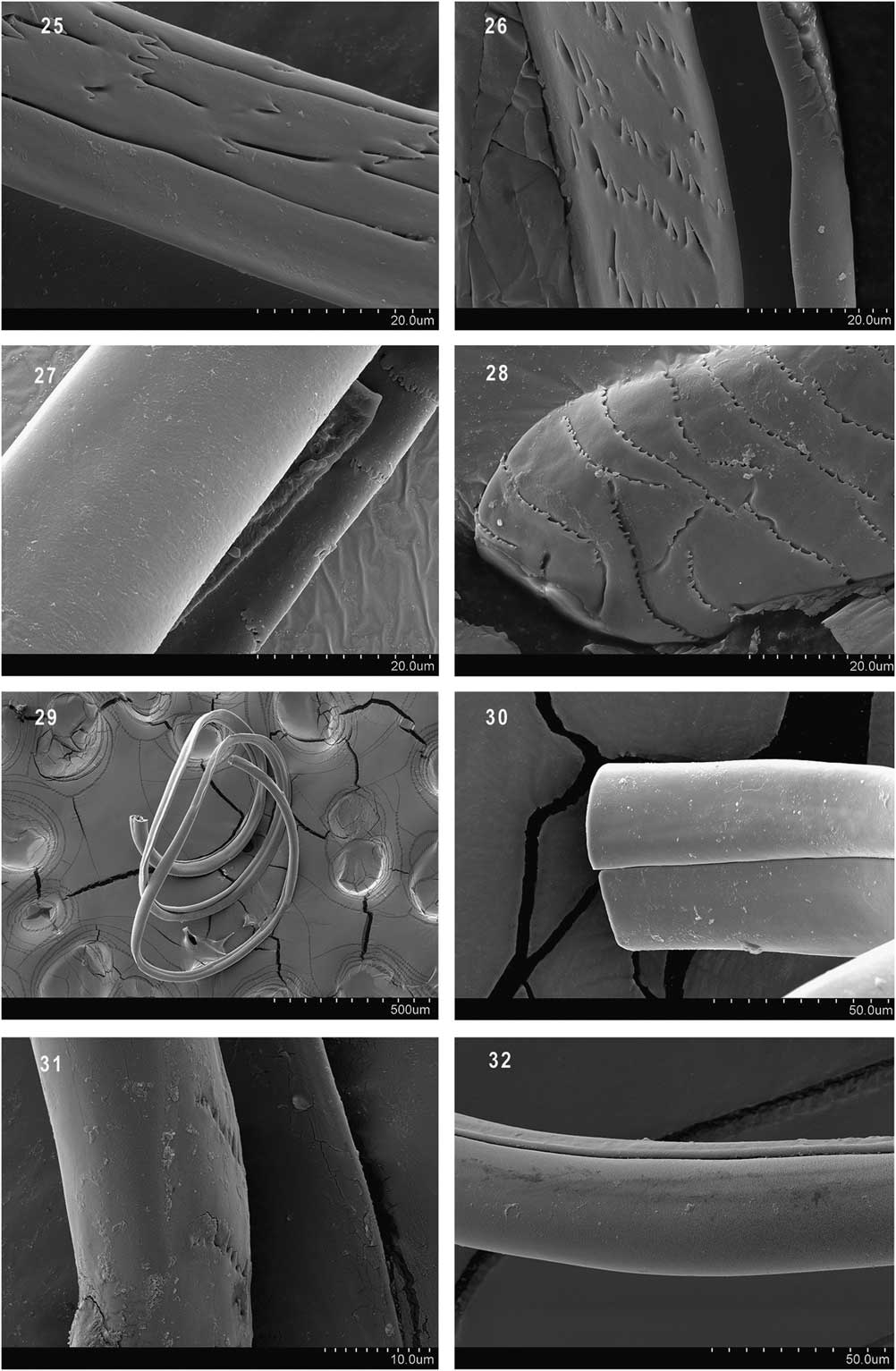
Conversely the shape of a temper might be specific or subspecific in nature, as illustrated by Figures 1–33, and could contribute to a sound diagnosis if linked with other flagellum attributes, such as the temper spatial distributions on the flagellum. Among the 20 taxa of subgenus Cicindela, the temper shapes vary considerably. Cicindela longilabris Say has most tempers wide at their base, which connect with adjacent tempers and appear as a series of continuing waves. Many tempers have a low profile, and some have double apices (Fig. 1).
Micrographs of Cicindela flagella tempers. 1. Cicindela longilabris. 2. Cicindela repanda. 3. Cicindela duodecimguttata. 4. Cicindela oregona. 5. Cicindela depressula depressula. 6. Cicindela depressula eureka. 7. Cicindela hirticollis. 8. Cicindela limbata.
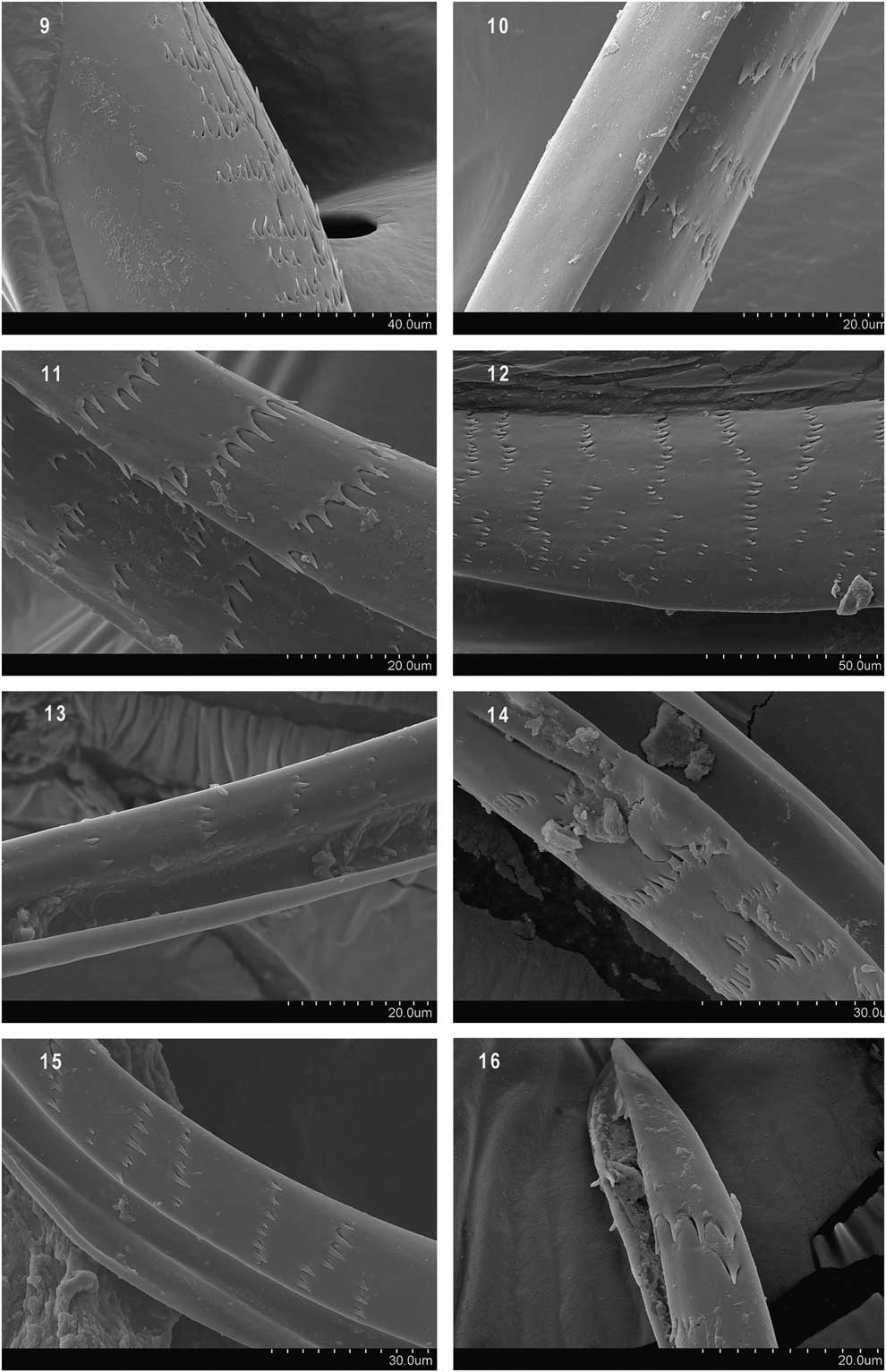
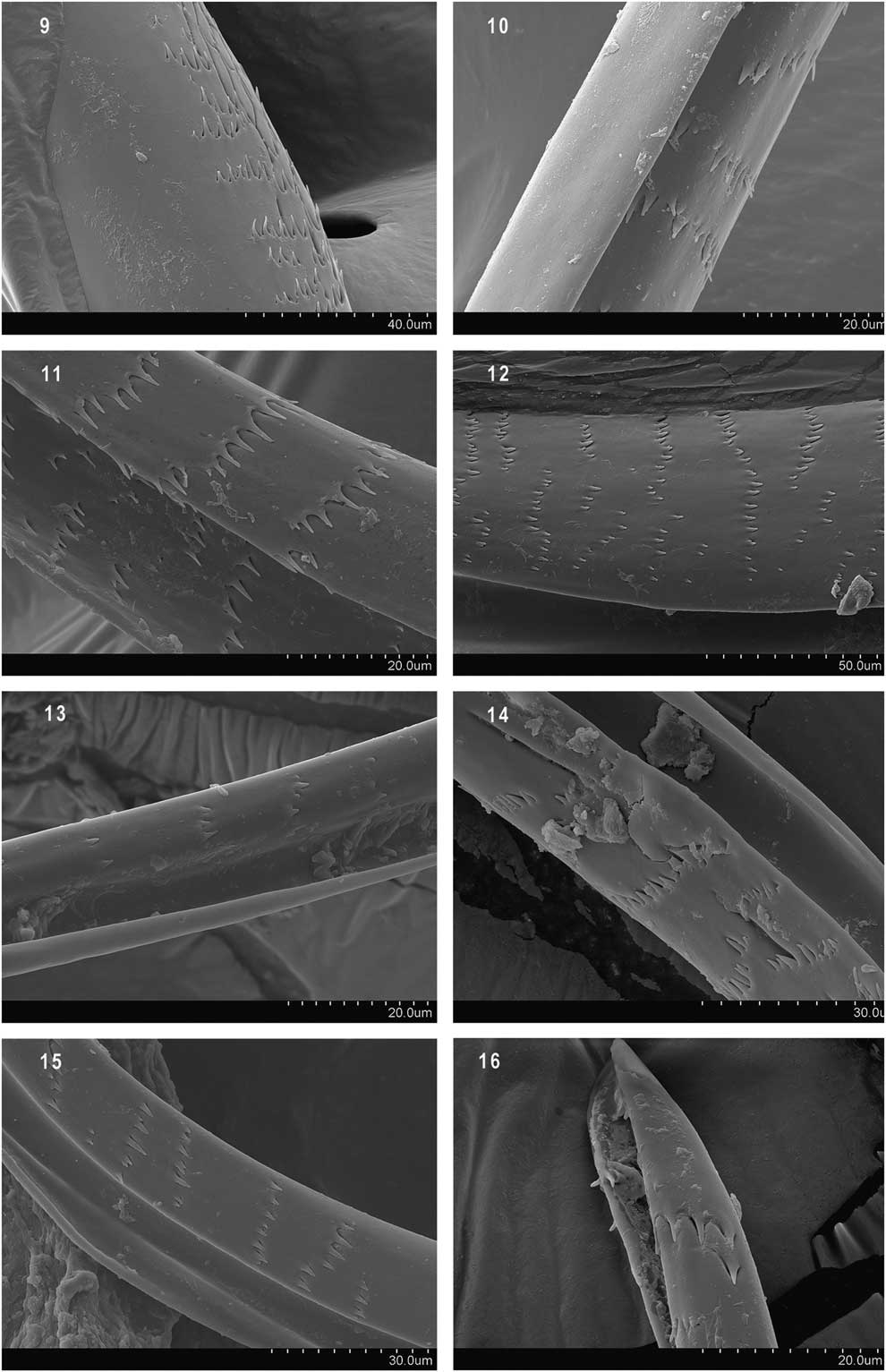
Micrographs of Cicindela flagella tempers. 9. Cicindela arenicola. 10. Cicindela columbica. 11. Cicindela bellissima. 12. Cicindela formosa. 13. Cicindela purpurea. 14. Cicindela splendida. 15. Cicindela limbalis. 16. Cicindela decemnotata.
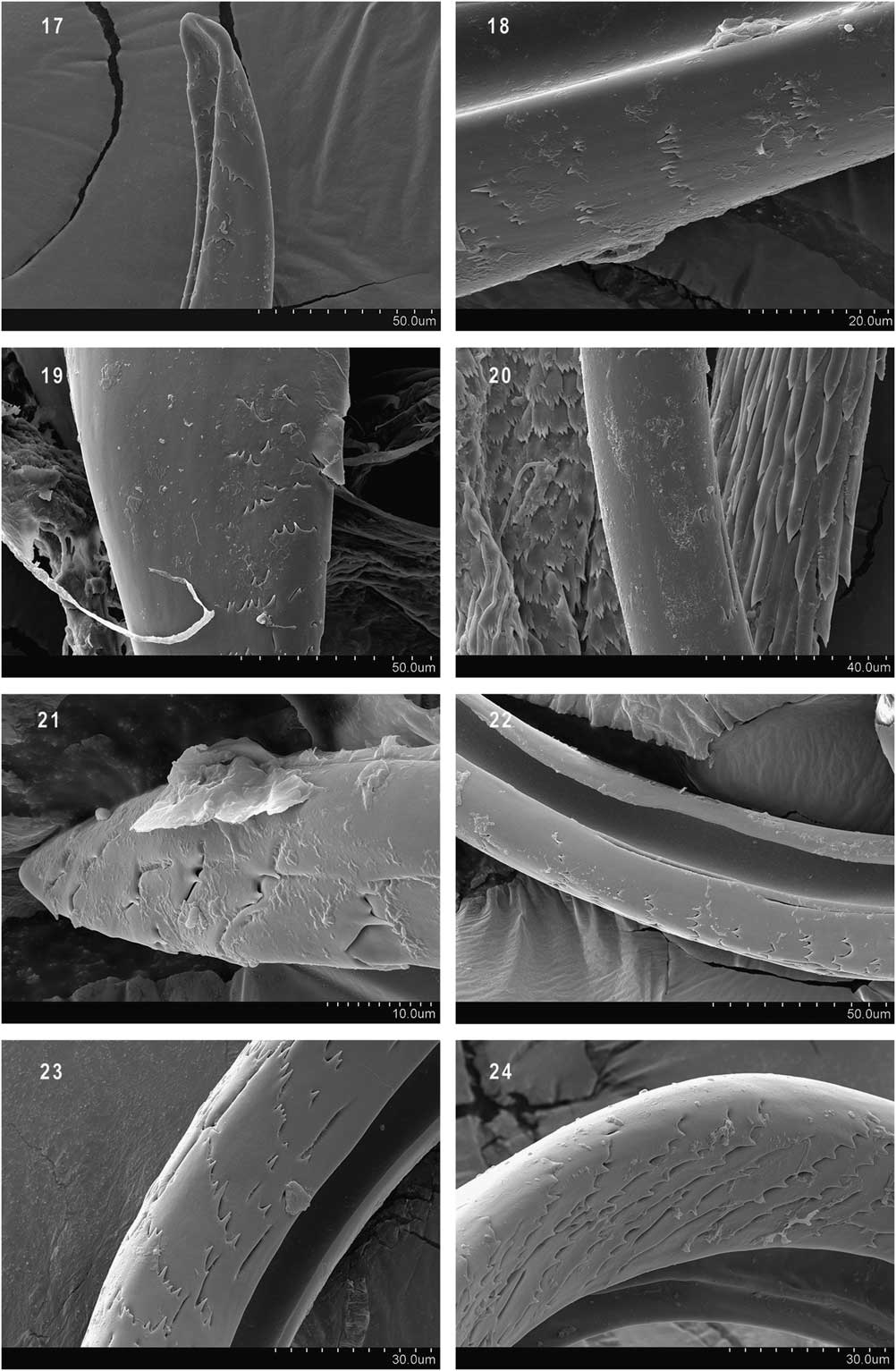
Micrographs of Cicindela flagella tempers. 17. Cicindela sexguttata. 18. Cicindela denikei. 19. Cicindela fulgida. 20. Cicindela scutellaris. 21. Cicindela lengi. 22. Cicindela tenuicincta. 23. Cicindela tranquebarica. 24. Cicindela willistoni.
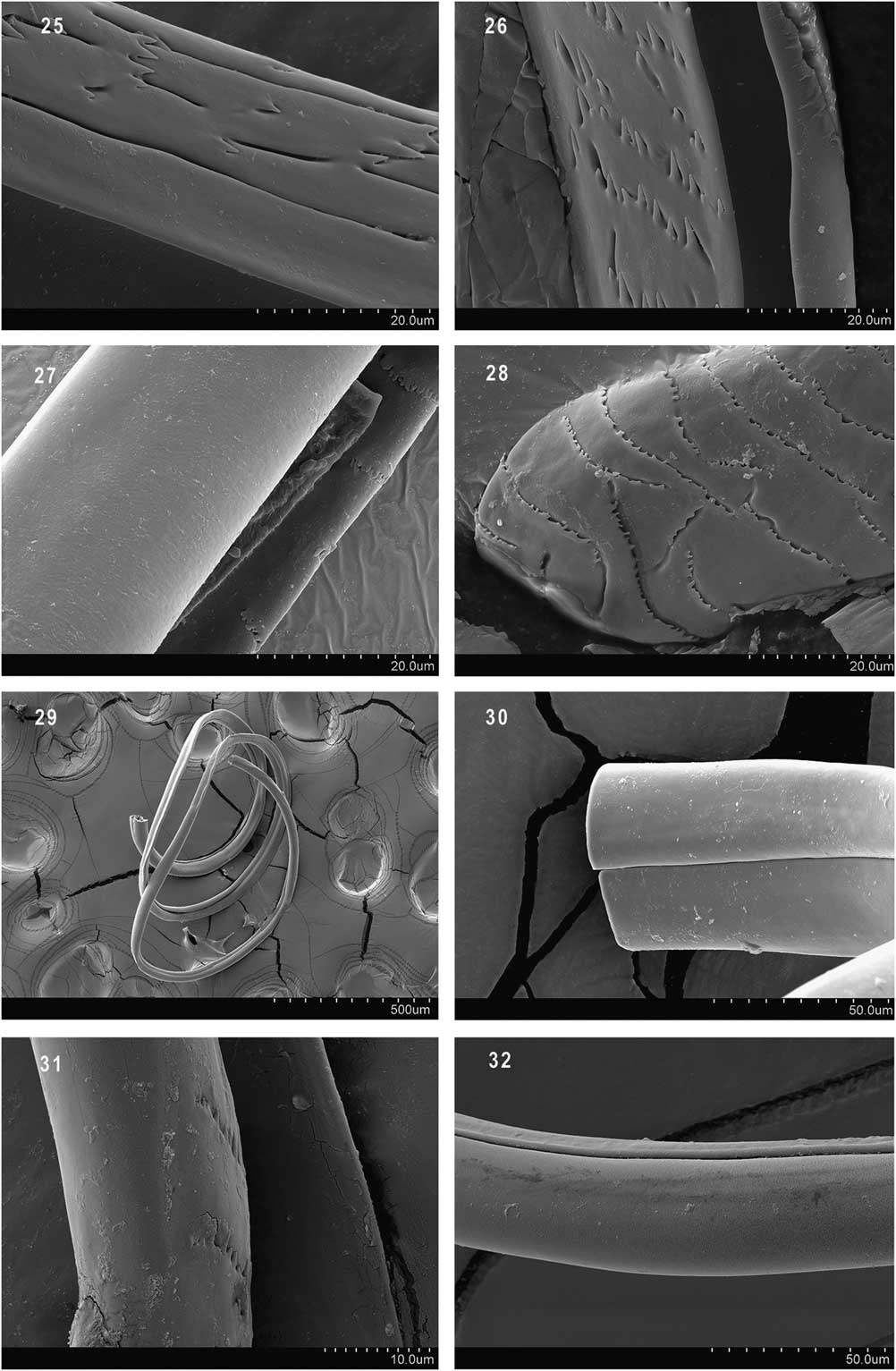
Micrographs of Cicindela flagella tempers. 25. Cicindela senilis. 26. Cicindela sedecimpunctata. 27. Cicindela circumpicta. 28. Cicindela dorsalis. 29. Cicindela hamata. 30. Cicindela marginata. 31. Cicindela blanda. 32. Cicindela macra.
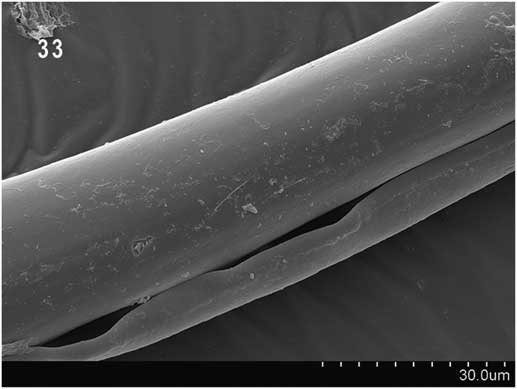
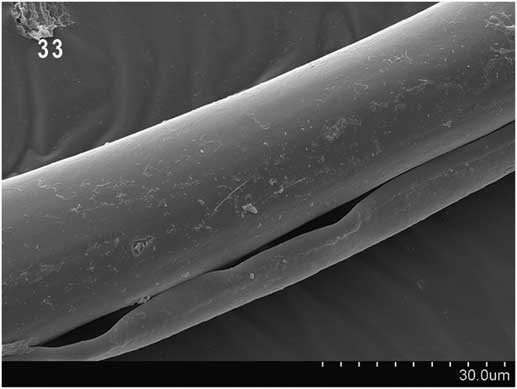
Micrograph of Cicindela lepida flagellum tempers.
Among the 10 species of the C. maritima Dejean species group, a wide spectrum of temper shapes exists (Figs. 2–11). Cicincela repanda Dejean features transverse rows of tempers of varying length, and notably most tempers form a patch at the flagellum base and are absent from the flagellum middle while the apical flagellum groove is furnished with well-developed tempers (Fig. 2). In C. duodecimguttata Dejean, tempers are mainly uniform in length, separate at the base and tend to be sparsely aligned (Fig. 3). Tempers of C. oregona LeConte are similar to those of C. duodecimguttata, but less densely distributed within the transverse temper rows (Fig. 4). The subspecies C. depressula depressula Casey has tempers that tend to be more regularly tapered apically and more densely aligned than those of other tiger beetles (Fig. 5). Overall C. depressula eureka Fall (Fig. 6) has considerably fewer, almost devoid of, tempers in transverse rows than that of C. depressula depressula.
Tempers of C. hirticollis Say are long and narrow throughout, and marked by a wide basal gap from each other within the transverse temper rows (Fig. 7). In general, thin and sparsely distributed tempers for all areas of the flagellum feature the species C. limbata Say (Fig. 8). In C. arenicola Rumpp elongate tempers are separated from each other at the base, and temper rows shape a temper patch that covers the flagellum from the base to the middle on its ungrooved side. The flagellum groove is partly covered by its sides that fold onto the groove (Fig. 9). In contrast with that of C. arenicola, tempers of varying lengths form an asymmetrical temper patch located on one side of the flagellum of C. columbica Hatch (Fig. 10).
Most of the tempers of C. bellissima Leng are connected with each other at their bases but stand widely apart at their apices (Fig. 11). This species has a unique temper pattern with abundant, well-developed rows on the apical half of the flagellum groove and on the apical three quarters of the ungrooved flagellum surface. Among most species with a good supply of tempers, C. bellissima has one of the densest coverings on the flagellum.
An abundance of detached, stout tempers are densely aligned near the flagellum basal portion of C. formosa Say (Fig. 12). A few tempers are located at the apex and middle portions of the flagellum, and much of the main flagellum groove is covered over by its sides. The flagellum of C. purpurea Olivier is mainly devoid of tempers, except for a few near the flagellum apex, and diffuse rows of stout tempers to one side of the flagellum groove (Fig. 13). Cicindela splendida Hentz has a sparse distribution of tempers of varying shapes and lengths, mainly outside the flagellum groove, some with double apices, and many with sharply tapered apices (Fig. 14). Cicindela limbalis Klug flagellum characteristics are remarkably similar to those of C. splendida as to their distribution format, and the sharply pointed tempers (Fig. 15). Both species have temper rows that occupy one side of the flagellum. Cicindela decemnotata Say has tempers, of varying shapes and sizes, located mainly in and around the apex of the flagellum (Fig. 16). The longest of these tempers are widely spaced at the apex but connected at the base. An occasional temper appears near the flagellum middle portion, or base. Similarly C. sexguttata Fabricius tempers of different profiles are aligned at the flagellum apex and base but absent from the middle portion (Fig. 17). Varied in shape, small, short tempers, some with double apices, are scattered diffusely on the flagellum of C. denikei Brown (Fig. 18). In the species C. fulgida Say, small groups of short tempers are scattered near the base of the flagellum, rows of longer tempers are located in and around the flagellum apical groove, and in the middle portion of the flagellum rows of tempers occupy one side of the flagellum near the groove (Fig. 19). A sparse distribution of mostly small tempers with one or two apical tips, and only on one side of the flagellum groove, are characteristic of C. scutellaris Say. Adjacent to the flagellum base two types of large, temper-like structures are established as separate groups, one with members equipped with marginal palmations and another that has sharp wedge-shaped units (Fig. 20).
A single or double flagellum loop, and a membranous sheath that envelops the flagellum together distinguish the species of Tribonia. In the species Cicindela lengi Horn, almost the entire flagellum is without tempers, but there are a few erratic rows of tempers of various shapes on the apical parts of the flagellum (Fig. 21). Cicindela tenuicincta Schaupp has only a few varied tempers, widely scattered, near and to one side of the flagellum base, around the apex, and to a smaller extent along the sides of the flagellum middle groove. The main temper profile of this species is located at the flagellum base where tempers that have merging, wide bases appear in small clusters (Fig. 22). The flagellum of C. tranquebarica Herbst has some long and short tempers situated in ragged rows at the flagellum base, others are scattered near and to one side of the flagellum middle groove, and a few more in and out the flagellum apical groove (Fig. 23).
As in Tribonia, the Cicindelidia species have a membrane that envelops a single or double looped flagellum. Most of the flagellum in C. willistoni LeConte is devoid of tempers except near the flagellum base where the tempers are both short and long and aligned in rows oblique to the long axis of the flagellum (Fig. 24). The species C. senilis Horn has a flagellum with probably two loops, and is chiefly without tempers. A few are sparsely distributed on both sides and in the flagellum groove near the flagellum base and apex (Fig. 25). The species C. sedecimpunctata Klug had its flagellum apex broken off in dissection. The remaining parts are devoid of tempers except for the basal area that has some temper rows (Fig. 26).
The two Habroscelimorpha species, C. circumpicta LaFerté-Sénectére and C. dorsalis Say, are clearly distinguished from other Cicindela species by their numerous truncate tempers. The flagellum of the former is mainly devoid of tempers except for a few very short tempers at the flagellum basal third (Fig. 27). The basal and apical portions of the C. dorsalis flagellum have many erratic, deep grooves with marginal rows of densely arrayed, extremely short tempers; a flagellum groove is lacking. Here the temper apices are varied, truncate, pointed, flat, single, and doubled (Fig. 28).
Ellipsoptera species, except for C. blanda, lack tempers, and have a longer flagellum than other Cicindela of this study. In preparation for observation the apex and base of the C. hamata Audouin and Brullé flagellum were inadvertently broken off. Nonetheless it was observed that this species has a three-looped flagellum and a flagellum groove repeatedly covered by its sides (Fig. 29). Similarly the flagellum groove of C. marginata Fabricius is covered over by its sides. The number of flagellum loops was not determined as the only C. marginata specimen studied was damaged in preparation for viewing (Fig. 30). A membranous sheath covers the flagellum of C. blanda much like that of C. tranquebarica, and a few tempers are scattered near the base and apex of the flagellum. Because the flagellum was broken in preparation for viewing the number of flagellum loops was undetermined, at least part of the flagellum groove was covered here and there by its sides (Fig. 31). Comparably parts of the flagellum of C. macra LeConte were broken and the full number of loops was obscured as a result, the flagellum groove is partially covered by its sides, tempers are absent (Fig. 32). In C. lepida Dejean the flagellum was damaged and its complete number of loops were undetermined, the flagellum groove was closed at various places by its folded sides (Fig. 33).
The character comparison of a few species between Freitag et al. (Reference Freitag, Hartwick and Singh2001) and this paper indicates a low level of variation: C. longilabris has tempers with two or three apical prongs that are more-or-less of the same forms in both studies; C. repanda has large, elongate tempers in and near the apical groove; C. denikei has short tempers; C. punctulata Olivier has a membranous sheath around the flagellum as in other Cicindelidia; and C. dorsalis that appears to lack a flagellum groove, has tiny tempers lined along deep erratic grooves. Hence there is a clear correlation with the flagellum and tempers of species examined here and those of their counterparts examined by Freitag et al. (Reference Freitag, Hartwick and Singh2001), which indicates a good degree of stability among these characters. In some species of the subgenus Cicindela, the tempers are difficult to define, and require a complementary review of the flagellum as well, particularly those of the C. maritima species group, and C. hamata among Ellipsoptera species.
The complicated process for SEM examinations of male genitalic microstructures as tiger beetle identifiers suits the objectives set out for this study. While other large character sets often provide efficient taxa identification, the new features revealed here are now known for about one third of cicindelines in North America and together imply flagellum and temper uniqueness at micro levels of tissue organisation.
These basic findings suggest that configurations of the flagellum and tempers are specific aspects of gripping modes of the spermatheca duct. It has been argued by Schincariol and Freitag (Reference Schincariol and Freitag1986), and Rodriguez (Reference Rodriguez1998, Reference Rodriguez1999) that the male flagellum is highly active in the sperm transfer process both by precopulatory clearing of the spermatheca duct and emplacement of the male spermatophore into the proximal end of the female genitalic apparatus. Such actions would likely require periodic gripping of the inside walls of the spermatheca duct for which the tempers appear to be formed. As Freitag et al. (Reference Freitag, Hartwick and Singh2001) inferred, by rapidly shaking the flagellum it can be more easily pulled out particularly on temper-free areas of its surface. What then can be said for the gripping mode and overall habitual activity of the flagellum that is devoid of tempers? It is concluded that by flexing a long flagellum produces a gripping effect for species with a temper-free flagellum. That is by flexing against the inner wall of the spermatheca duct, a tighter fit without the assistance of tempers is accomplished and the flagellum is more strongly held in place until it is straightened when pulled out of the duct.
It also might be considered that the longest flagella (Ellipsoptera species) do not require many tempers for the above reasons and that the shortest flagella (Cicindela species) require them for a firmer grip. This seems to be consistent with the data in Table 1. Note that among the shortest flagella is that of C. bellissima (0.6 mm) and is covered with relatively more tempers than are other species examined. Hence it is proposed that an inverse relationship exists between flagellum length and extent of temper coverage of the flagellum.
Acknowledgements
The author is thankful for the special assistance from the following individuals: Barbara Barnes conducted laboratory preparations of the dissected specimens, an occupation that spanned a period of many years; Gayla Freitag formatted and reviewed the initial manuscript versions; Alan MacKenzie arranged for access to the scanning electron microscope at the Lakehead University Instrumentation Laboratory; Gousheng Wu provided SEM instruction and assistance; Gail Zanette of the Graphics Department at Lakehead University produced the final manuscript micrographs; and Dr. Susanne Walford of the Biology Department at Lakehead University provided technical advice and assistance.