




No CrossRef data available.
Article contents
- Abstract
- Background
- FR Parental behaviors
- Differentiating the Qualitative Aspects of FR Behavior
- FR and AMBIANCE/FR+: Links to Parental U and Infant D Attachment
- A Consideration of Propensities to Develop Dissociation in Terms of U/CC Parental Status, Parental FR, and Infant D: May Some “Dissociative” Forms of AAI Lapses and Infant D Create a Particularly Strong Diathesis?
- Conclusions
- References
Frightened, threatening, and dissociative parental behavior in low-risk samples: Description, discussion, and interpretations
Published online by Cambridge University Press: 28 March 2006
Article contents
- Abstract
- Background
- FR Parental behaviors
- Differentiating the Qualitative Aspects of FR Behavior
- FR and AMBIANCE/FR+: Links to Parental U and Infant D Attachment
- A Consideration of Propensities to Develop Dissociation in Terms of U/CC Parental Status, Parental FR, and Infant D: May Some “Dissociative” Forms of AAI Lapses and Infant D Create a Particularly Strong Diathesis?
- Conclusions
- References
Abstract
In 1990 we advanced the hypothesis that frightened and frightening (FR) parental behavior would prove to be linked to both unresolved (U) adult attachment status as identified in the Adult Attachment Interview and to infant disorganized/disoriented (D) attachment as assessed in the Ainsworth Strange Situation. Here, we present a coding system for identifying and scoring the intensity of the three primary forms of FR behavior (frightened, threatening, and dissociative) as well as three subsidiary forms. We review why each primary form may induce fear of the parent (the infant's primary “haven of safety”), placing the infant in a disorganizing approach-flight paradox. We suggest that, being linked to the parent's own unintegrated traumatic experiences (often loss or maltreatment), FR behaviors themselves are often guided by parental fright, and parallel the three “classic” mammalian responses to fright: flight, attack, and freezing behavior. Recent studies of U to FR, as well as FR to D relations are presented, including findings regarding AMBIANCE/FR+. Links between dissociation, FR, U, and D are explored. Parallel processing and working memory are discussed as they relate to these phenomena.
The work described in this paper was supported by a Guggenheim fellowship to the second author and by grants from the William B. Harris Foundation and the Amini Foundation for the Study of Affects. We are grateful to Alberto Amengual, Giovanni Liotti, and John Watson for directing us to varying portions of the literature discussed. Alvin Nye Main first pointed to the relevance of the quotation from Darwin.
Information
- Type
- SPECIAL SECTION ARTICLE
- Information
- Copyright
- 2006 Cambridge University Press
This paper focuses upon frightened, threatening, and dissociative parental behavior (frightening [FR]; Main & Hesse, 1992–2006), together with (a) its origins in parental unresolved trauma and (b) its frequent outcome: infant disorganized attachment (Main & Solomon, 1986, 1990). Here, we review the mechanisms by which these three forms of FR parental behavior may be frightening to infants and suggest that parental FR behaviors themselves are often guided by fright. This latter proposal is partly based upon the three “classic” outcomes of mammalian fright, namely, attack (comparable to threat), flight (comparable to frightened withdrawal from the infant), and freezing (comparable to dissociative behavior; Vanderlinden, Van Dyck, Vandereycken, & Vertommen, 1991).
It has long been recognized that infant disorganized (D) attachment as identified in Ainsworth's Strange Situation procedure (Ainsworth, Blehar, Waters, & Wall, 1978) often takes its origins in fear of the parent (Main & Hesse, 1990). We examine how FR (frightened/frightening) parental behavior inevitably places the infant in a behaviorally irresolvable situation in which the attachment figure simultaneously becomes both the haven of safety and the source of the alarm. We have termed this a situation of “fright without solution,” because unlike other frightening situations also involving the parent (such as extended separations, which are solvable by parental return), it should create an irresolvable approach–flight paradox for the infant. This paradox may also lead to a feedforward “looping” of attention, which we can express as a self-perpetuating series of if–then propositions, namely, “IF toward, then away, IF away, then toward, IF toward, then away, and so forth.”1
Behavior not only starts but also stops, and it is evident that this series could continue ad infinitum. At this point, we do not know what normally brings such looping to an end, but changes in the immediate environment and self-guided attentional shifts of a kind not yet understood could certainly be factors.
Although fear-related experiences and behaviors no doubt occur in some maltreating parents of D infants, in maltreatment samples many parents may abuse offspring because of, for example, problems involving lack of impulse control, lack of empathy, and excessive negative affect. However, this paper focuses upon low-risk samples and therefore presumably largely (but by no means exclusively) nonabusive parents. In samples of this kind, infant D has been connected to indications of unresolved trauma identified by lapses in speech or reasoning within the Adult Attachment Interview (AAI; George, Kaplan, & Main, 1984, 1985, 1996; Main & Goldwyn, 1984–1998; Main, Goldwyn, & Hesse, 2002; see van IJzendoorn, 1995, for review). We have proposed that these AAI lapses fit well to a dissociative model. In addition, they may result from the effects of fear upon working memory and, in the home situation and elsewhere, intrude upon interactions with the infant in the form of FR behaviors.
It is important to stress again that these subtle, nonabusive yet untoward (FR) outcomes of parental fright may occur in the absence of direct maltreatment. Indeed, infant disorganization has only a minimal relation to parental sensitivity in general (van IJzendoorn, Schuengel, & Bakermans-Kranenburg, 1999). The clear inference is, then, that many parents exhibiting bouts of FR behavior, having themselves endured major loss or maltreatment (sometimes termed a “first-generation” effect), are otherwise sensitive and responsive. Because in the low-risk samples with which we are concerned the infant has obviously not “lost” the parent, nor ordinarily experienced abuse, its disorganization can be viewed as a second-generation effect of the parent's earlier trauma.
The background section to this paper opens with a review of Bowlby's theory regarding the origins of attachment behavior as the primate infant's “solution” to fear, and shows why an infant frightened by its attachment figure is likely to experience “fright without solution” and become disorganized/disoriented (D) under stress. Next, we turn to a brief discussion of the characteristics of infants placed in the “D” Strange Situation category, and reference studies regarding its unfavorable sequelae. Because D also serves as the earliest behavioral predictor of vulnerability to psychopathology in later life (Carlson, 1998), identifying its origins has clear relevance for developmental psychopathology. Unresolved/disorganized (U/d) attachment status in adults as identified within the AAI (Main, Goldwyn, & Hesse, 2002) is also briefly described. Among adults (as first demonstrated by Allen, Hauser, & Borman-Spurrell, 1996) this category, parallel to and predictive of the infant D attachment category, is also markedly associated with psychopathology (van IJzendoorn & Bakermans-Kranenburg, 1996). The background concludes with an overview of studies attempting to predict infant D attachment status from parental U/d status in the AAI.
The remainder of the paper is organized as follows. First, we describe the varying subcategories of “FR” parental behavior (Main & Hesse, 1992–2006), and the sometimes surprising mechanisms through which, we propose, they may produce infant fright. Here, two new findings relevant to parental FR behavior via its link to “U” attachment status on the AAI are also presented (Gribneau, 2005; Rifkin, 2005). Second, the outcomes of published studies using both the FR system, and a closely related system (AMBIANCE/FR+) are reviewed. In the third, relations between U, FR, D, and dissociation are explored. Virtually all U/d lapses during the AAI appear to fit to a dissociative model, but some are less suggestive of “segregated systems” (a stronger form of disassociation) than absorption (a more normative form). The dissociative subcategory of FR appears to be the strongest predictor of infant D, but aspects of the threatening and FR subcategories seem to have dissociative elements as well. Although some D behavior appear to be the outcome of a readily comprehensible conflict, or of simple confusion, many (as first suggested by Liotti, 1992, 1999) appear dissociative, albeit to varying degrees.
The above suggests that by searching for the exact form taken by lapses placing a parent in the U/d category, examining the exact forms of FR behavior displayed by that parent, and looking specifically for dissociative subcategories of infant D behavior, researchers engaged in short-term longitudinal studies may be able to identify infants vulnerable to developing dissociative disorders more precisely than is possible at present. In the concluding section, we discuss parallel processing and working memory, especially as they permit an increasingly “structural” understanding of the effects of “fright without solution” of the type discussed above.
Background
Bowlby's theory
Most ground-living primates seek an “attachment figure” when frightened, rather than simply fleeing, attacking, or freezing as do the majority of mammals. This given, Bowlby emphasized the likely existence of a universal biologically based behavioral program that would lead human infants raised in all but extremely anomalous circumstances to form an attachment to a parental figure during the first 3 years and usually by the end of the first year of life (Bowlby, 1969/1982). Given the strong relation between maintenance of proximity to an older conspecific and survival for infant primates, including humans, infants and young children were expected not only to maintain reasonable proximity to the “attachment figure” (usually but not always the biological parent) in unthreatening circumstances, but also greatly increase efforts to gain proximity or contact to that figure in times of alarm. Thus, the normal functioning of the attachment system should include its marked activation when cues to threat or danger are present. A corollary of Bowlby's proposal is that frightening behavior on the part of the parenting figure should therefore lead to disruptions in the functioning of this system under stress (Main & Hesse, 1990).
To clarify this line of reasoning, it is necessary to consider our phylogenetic heritage. Bowlby pointed out that most primates differ from other animals (including most mammals) in that gaining proximity to a protective conspecific, as opposed to a place (e.g., a den or burrow) provides our primary solution to situations of fear (Bowlby, 1958, 1969/1982). Thus, for the human infant and many other ground-living nomadic primates it is not a place, but rather a selected individual who provides the primary “solution” to conditions that elicit fright. Because this propensity is biologically based, when frightened, the attached young human will seek proximity to the attachment figure even if, paradoxically, that figure is the source of its fear.
At first glance an inherent propensity to approach the location of alarm of course appears irrational. However, the powerful influence of phylogeny and the sometimes unusual outcomes it can produce is well illustrated by Darwin's observations regarding the Galapagos sea lizard. Darwin noted that this animal, able to move about with ease on both land and sea, exhibited the peculiar behavioral feature that, when frightened, it would not enter the water. To further his understanding of this phenomenon, Darwin repeatedly threw a sea lizard into the ocean. Strikingly, although possessed “of perfect powers of diving and swimming,” the sea lizard invariably returned in a direct line to the promontory of land on which its “attacker” (Darwin) stood. Darwin (1839/1972, pp. 334–335) speculatively solved this conundrum by consideration of the animal's evolutionary history or “phylogeny”:
Perhaps this singular piece of apparent stupidity may be accounted for by the circumstance, that this reptile has no [natural] enemy whatever on shore, whereas at sea it must often fall a prey to the numerous sharks. Hence, probably, urged by a fixed and hereditary instinct that the shore is its place of safety, whatever the emergency may be, it there takes refuge.
Returning to human evolution, parallel to Darwin's sea lizard, the human infant alarmed by its attachment figure, and constrained by its phylogeny, has no inherent (i.e., instinctively organized) means for separating the location of its attacker from the location of its haven of safety. Confronted with circumstances unanticipated within its evolutionary history, then, it should experience strongly contradictory propensities regarding solutions to threat. A natural correlate of this condition is, then, that anomalous forms of alarming parental behavior, including as the example par excellence direct maltreatment in the form of physical abuse, should lead to a malfunctioning of the attachment system, created by simultaneous and contradictory infant propensities to approach, and to flee from, the (same) attachment figure. This should create a “looping” of behavior and attention, because the source of alarm and haven of safety are one and the same. As noted, this appears to be a situation involving “fright without solution” (Main & Hesse, 1990, 1992) or more specifically, fright taking the alarming behavior of the phylogentically established “haven of safety” as its source. Repeated experiences of fright without solution should be inherently disorganizing, and, effecting emotion and attention as well, cannot be “resolved” at the behavioral level. As such, it is not surprising if experiences of this kind, when repeated, increase the individual's vulnerability to psychopathology (Main & Hesse, 1990, 1992; see also Liotti, 1992, and Sroufe, Egeland, Carlson, & Collins, 2005).
Thus, we proposed some years ago that, observed with the parent in stressful settings such as the Ainsworth Strange Situation procedure, maltreated infants would become disorganized and disoriented (see Main, 1981; Main & Weston, 1982). A first test of our hypothesis regarding the probable role of fear of the parent in creating D infant behavior under stress was conducted by Cicchetti and his colleagues, and independently by Lyons-Ruth and her colleagues. Here, as predicted, a very strong majority of maltreated infants were indeed found disorganized with the parent in the Strange Situation (Carlson, Cicchetti, Barnett, & Braunwald, 1989; Lyons-Ruth, Connell, Zoll, & Stahl, 1987). D behavior in low-risk samples where the majority of disorganized infants have presumably not ordinarily been maltreated had, however, yet to be explained.
D infant attachment: A collapse of attentional and behavioral strategies under stress
By 1990, infant response to the Ainsworth Strange Situation had been videotaped in many laboratories investigating low-risk and well as high-risk dyads. This well-known procedure introduces infants to several of Bowlby's “natural clues to danger,” namely an unfamiliar environment, a stranger, and two separations from the parent (Ainsworth et al., 1978). One secure and two insecure (insecure–avoidant and insecure–ambivalent) “organized” responses to the parent during the Strange Situation had been identified by the late 1960s and related to maternal behavior toward the infant in the home (e.g., Ainsworth, Bell, & Stayton, 1971). Later, Main (1990) emphasized the role of organized (flexible/secure vs. inflexible/avoidant or inflexible/ambivalent) behavioral and attentional strategies within these patternings. In conjunction with her 1973 doctoral thesis, Main had already noted the occurrence of “conflict” behaviors in some insecure infants, a finding twice replicated by 1981 (Main & Stadtman, 1981; these behaviors had been termed “disorganized/disordered” by 1979). Main and Solomon later undertook an exacting description of these behaviors, creating a fourth, “disorganized/disoriented” (D) infant Strange Situation category based upon what often appeared to be a collapse in behavioral and attentional strategy (Main & Solomon, 1986, 1990).
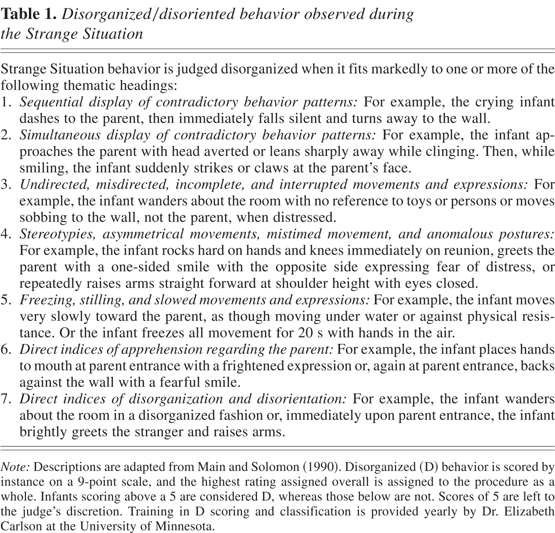
Infants are placed in Main and Solomon's (1986, 1990) D category if, in the parent's presence during the Strange Situation, they display any of an array of D behaviors, including substantially misdirected movements, contradictory movements, stilling or even freezing of all movement for 20 s or longer, stereotypies and anomalous gestures and postures, and direct indices of confusion or apprehension (for a summary of exemplar behaviors, see Table 1; for a more complete overview of the D category and its correlates see Hesse & Main, 2000). The D classification is always assigned together with a secondary, best-fitting “organized” classification, for example, D/secure, or D/insecure–avoidant.
Disorganized/disoriented behavior observed during the Strange Situation
Some of the sequelae to early D attachment status with the mother include unfavorable outcomes that do not reach the clinical level, for example, parent–child role inversion, “catastrophic” stories told in response to pictured parent–child separations, and bizarre/frightening elements seen in family drawings by age 6 (Main, Kaplan, & Cassidy, 1985; each of these findings have been replicated in other laboratories). Infant D also predicts later affect dysregulation (see Bakermans-Kranenburg, van IJzendoorn, & Juffer, 2005, for review), and in an interesting series of case studies, difficulties in peer relations (Jacobvitz & Hazen, 1999). Finally, young adults D with mother in infancy are found to be having the most difficulties overall in couple relationships, and to be the most hostile to their partners (Sroufe et al., 2005).
However, infant D also predicts varying forms of psychopathology (van IJzendoorn et al., 1999; see also Bakermans-Kranenburg et al., 2005 for references to more recent “clinical” sequelae). For example, following a suggestion made by Liotti (1992), Carlson (1998) found infant D attachment status with mother predictive of dissociative behavior in elementary through high school settings, and in the DSM-like K-SADS interview at age 19, a finding that the author termed “unpredecented.” Infant D also predicts externalizing and internalizing disorders in both high-risk and low-risk samples. (Interestingly, however, and at least in preschoolers, these disorders may include a substantial dissociative component, as recent studies by Macfie, Cicchetti, & Toth [2001a, 2001b] have demonstrated.) Most recently, infant D attachment has also been found predictive of self-mutilating (self-injurious) behaviors in young adulthood (Sroufe et al., 2005). Strikingly, despite several rigorous investigations (e.g., Lakatos et al., 2000), genetic contributors to D have yet to be successfully established (see Bakermans-Kranenburg & van IJzendoorn, 2003; Bokhorst, Bakermans-Kranenburg, van IJzendoorn, Fonagy, & Schuengel, 2003).
Earlier it was noted that, given their repeated experiences of “fright without solution,” a high percentage of maltreated infants had been found disorganized within the Strange Situation. However, a strikingly substantial minority of infants in low-risk samples (averaging 15%, but ranging to 33%; van IJzendoorn et al., 1999) are also judged disorganized. Although some infants in low-risk samples are undoubtedly maltreated, proportions ranging to 33% are unlikely, and an explanation for the appearance of D Strange Situation behavior in such samples initially seemed problematic. Surprisingly, the first clues to identifying forms of FR parental behaviors other than physical abuse emerged in the finding that disorganized Strange Situation behavior in low-risk samples was linked to unusual linguistic responses made by parents of D infants to queries regarding loss (or abuse) experiences during a semistructured interview, the AAI (see George et al., 1984, 1985, 1996; Hesse, 1999).
U/d attachment status as identified on the AAI: Lapses in reasoning or discourse during the discussion of loss or abuse experiences
The AAI focuses upon a participant's description and evaluation of early childhood experiences (particularly, relationships with each parent or primary caregiver) and their effects upon current personality and functioning. Like the Strange Situation, most AAI transcripts differ systematically in ways which permit classification into one of three “organized” categories. As is the case with the Strange Situation, AAI transcripts can be viewed as reflecting differences in the flexibility (secure–autonomous) or inflexibility (insecure–dismissing or insecure–preoccupied) of the speaker's attention (Hesse, 1996; Main, 1993, 2000). Each adult attachment category is considered equivalent to, and, in parents, has repeatedly been found predictive of, the corresponding “organized” category of infant Strange Situation response (see van IJzendoorn, 1995, for a meta-analysis regarding the “organized” adult to infant links). However, as is the case for infant Strange Situation behavior, disorganizations in language usage during this interview also sometimes appear.
Global disorganization of interview texts does occur, especially within high-risk samples, in which case the texts are termed “cannot classify” (CC; see Hesse, 1996). In low-risk samples disorganization most frequently takes a more restricted form termed a “lapse in the monitoring of reasoning or discourse” appearing during the discussion of loss (including miscarriage; see Bakermans-Kranenburg, Schuengel, & van IJzendoorn, 1999; as well as stillbirth; see Hughes, Turton, Hopper, McGauley, & Fonagy, in press) or abuse. These lapses can and usually do occur in otherwise well-organized texts, and, frequently appearing in only a few sentences, are used to identify “U” states of mind (see Table 2). Such transcripts are termed unresolved/disorganized or “U/d.” As with the infant D system, a second best-fitting alternate “organized” category is always assigned, for example, U/secure or U/preoccupied. For many years, we have attributed these brief failures in reasoning or distortions in discourse to brief collapses or failures in working memory, which can, importantly, be negatively effected by fright (Arnsten, 1998).
Identifying unresolved/disorganized attachment status in the Adult Attachment Interview

Examples of lapses in the monitoring of reasoning include statements implying that the lost person is simultaneously dead and alive in the physical sense. This in turn suggests an intrusion from a “segregated system” wherein a dead person is also held to have remained alive. The concept of “segregated systems” was utilized by Bowlby (1980), following upon Hilgard's (1977/1986) work concerning the existence of “multiple controls on action” found in some hypnotized subjects. A real-life exemplar was described in the case of “Geraldine,” a young woman who occasionally entered wandering “fugue” states that Bowlby attributed to the reemergence of a “segregated system” that believed her deceased mother was still alive, and, searching for her, had taken executive control. The subtle reasoning slips occasionally found within the AAI indicating that a dead person is believed alive are usually brief, are often discovered in individuals who are high functioning, and normally appear to go unnoticed by the speaker. The momentary intrusion of this secondary “system” of belief is most likely elicited by the persistent questioning regarding loss found within the AAI and is currently believed unlikely to result in actions approaching extremes such as that described in the case study above.
Examples of lapses in the monitoring of discourse often consist in indices of high-level absorption that appear to have drawn the speaker out of a speech register appropriate to the interview context, including extreme and inappropriate attention to detail, sometimes accompanied by funereal speech (for a summary of exemplar statements, see Table 2). Absorption is considered to be a relatively normative aspect of dissociation, indicative of diminished awareness of the surround. A direct link between this index of an “U/d” state as assessed in the AAI and Tellegen's Absorption Inventory (Tellegen & Atkinson, 1974; Tellegen, 1992) was first uncovered in two independent samples by Hesse and van IJzendoorn (1999; see Gribneau, 2005, for replication).
Linking parental U to infant D attachment status: Cross-generational (parental U/d to infant D) links are continuing to be identified, and infant D is beginning to predict U/CC status on the AAI
By the late 1980s AAI texts classified as U/d for loss and/or abuse were found predictive of infant D attachment to the speaker in two independent samples of mother–infant dyads living in poverty (van IJzendoorn et al., 1999; see also Carlson, 1990). At the same time, U/d attachment status in parents was also found associated with infant D attachment within a low-risk sample (Main & Hesse, 1990). These findings were replicated in a second low-risk sample 1 year later (Ainsworth & Eichberg, 1991). By 1995, nine studies of the U to D link were included in a meta-analysis, yielding an overall moderate effect size (d = .64, r = .31; van IJzendoorn, 1995), while an extremely strong relation was found between the effect size and the amount of training the coders had had in identifying infant D attachment status (as well as its mid-childhood “D-controlling” equivalent; see Main & Cassidy, 1988). At least 10 further studies of the relations between parental U attachment status and infant D attachment status have been conducted, and in several of the most recent studies the effect size has been remarkably higher (e.g., Abrams, Rifkin, & Hesse, 2006; Behrens, 2005; φ = .56 and .59, respectively). Among the recent studies with which we are familiar, an association has failed to appear in only one, when the infants were 18 months of age (Lyons-Ruth, Yellin, Melnick, & Atwood, 2005). The expected U to D link was however significant for this same sample at 12 months of age (Lyons-Ruth, Yellin, Melnick, & Atwood, 2003).
It should be noted that, whereas this presentation focuses upon the prediction of D attachment status with a given parent from circumscribed U lapses observed in the same parent's AAI, a second path from the AAI to infant D (and/or infant CC, a fifth infant Strange Situation category being developed in our laboratory) is also viable, and is currently being explored. Hesse's (1996) identification of a fifth, CC adult attachment category is based upon “global disorganization” found throughout the interview, usually, but not always, readily identified via evidence for conflicting (e.g., both dismissing and preoccupied) discourse strategies found throughout the text as a whole. Like U/d adult attachment status, albeit in only a few cases and studies, CC to date appears to predict infant D/CC behavior toward the CC speaker within the Strange Situation (Ammaniti & Speranza, 1994; Hughes & McGauley, 1997; Jacobvitz, personal communication, 2005). Interestingly, in two case studies (Hughes & McGauley, 1997; Minde & Hesse, 1996) CC status on the AAI has predicted sharply contradictory, hence most likely unpredictable and FR, behaviors toward the infant in the home.
The above set of findings refer to the relation between the parent's U attachment status and D attachment status in their offspring. However, two laboratories are now able to examine the association in a different way entirely, considering the follow-up AAI status of subjects who had been seen in the Strange Situation with the mother 18 to 25 years previously. The two samples are different in important ways, one consisting of 40 dyads observed in our own low-risk Bay Area study (e.g., Main et al., 1985; Main, Hesse, & Kaplan, 2005), and the other consisting of well over 100 dyads observed in the Minnesota poverty sample (e.g., Sroufe et al., 2005; Weinfield, Whaley, & Egeland, 2004). In both samples, infant D attachment status with the mother was recently found significantly predictive of U and/or CC AAI status (the latter, again, signals a more global disorganization within the transcript; see Hesse, 1996).
FR Parental behaviors
We now describe our system for identifying parental FR behavior and its varying subcategories (Main & Hesse, 1992–2006). Like infant D behavior, and indeed the linguistic “lapses in the monitoring of reasoning or discourse,” which constitute indices of U/d responses to trauma within the AAI, FR behavior most often appears very briefly and, being both subtle and novel, is initially difficult to observe. Nonetheless, it appears to us to be similar in import to both infant disorganized and adult U attachment status.
The FR system originated in our 1990 work (Main & Hesse, 1990), entitled “Parents' unresolved traumatic experiences are related to infant disorganized attachment status: Is frightened and/or FR parental behavior the linking mechanism?” in which we hypothesized that parents judged U/d on the AAI would show FR behavior in interaction with their infants in other situations. Here, we provide further support for this hypothesis. First, for some time, we have seen the “lapses in the monitoring of reasoning and discourse,” which identify U status on the AAI as attributable to lapses in working memory (Main & Hesse, 1992), an intermediary between short-term and long-term memory closely related to reasoning and language (e.g., Baddeley & Hitch, 1994). Lapses in working memory are suggestive of a lowering of conscious attention, as implied by the normal connectedness between working memory and consciousness assumed by some (Kihlstrom, 1987; LeDoux, 1996). However, recent studies have shown that working memory is negatively affected by fear (Baddeley & Hitch, 1994; Beilock & Carr, 2001; Elzinga & Roelofs, 2005; see Arnsten, 1998, for review of the neurotransmitters implicated). Moreover, a recent dissertation study conducted in our laboratory showed that U/d speakers performed significantly less well on several tests of working memory conducted under semistressful conditions than did non-U/d speakers, while long-term memory and procedural memory appeared unaffected (Rifkin, 2005; see also Main, 1999). Thus, individuals experiencing lapses in working memory when queried regarding FR experiences during the AAI may reasonably be expected to exhibit more frightened (FR) behavior during stress-associated interactions with the infant as well.2
A highly tentative but related explanation could be derived from our observations of the unexpected primitive hissing, growling, and canine exposure, which we have placed under the heading of “FR-threatening” behavior (see below): this is because working memory is located largely in the prefrontal cortex and lapses in working memory not only may be indicative of experiences of fright but also may permit intrusions from more primitive brain structures. Note also that mammalian responses to “predatory” behavior likely involve fear modules developed across the course of evolution (Ohman & Mineka, 2001) and (especially, we suppose, in young infants) may utilize subcortical pathways to the amygdala.
Our second early hypothesis had been that, for U compared to not-U individuals, a broader range of stimuli reminiscent of earlier traumatic (e.g., loss) experiences might draw their attention, and be found frightening as well. Recently, a dissertation study supporting the first half of this proposal has been conducted (Gribneau, 2005). Here, using visual stimuli presented in an evoked response potential paradigm, individuals U (U/d) with respect to loss were compared to individuals who had also had important loss experiences, but were not U, in their early ERP responses to symbolic reminders of death (peaceful cemetary scenes) versus blatant reminders (highly disturbing pictures of dead and dying persons). As expected, both groups showed an early heightened EEG response (N2, usually considered to be indicative of early involuntary attention) to the blatant reminders of death, whereas neither group showed heightened EEG response to pleasant nature scenes. However, again as expected, unlike the non-U women, the U women showed the same heightened early EEG response to peaceful cemetary scenes as they did to blatant images of death and dying. These findings are consistent with our earlier reasoning that in the home and other places in which U persons interact with the infant, an unusually broad range of stimuli may be found reminiscent of trauma-associated experiences, and lead to FR behavior.
Systems for identifying FR parental behavior
Following our 1990 study (Main & Hesse, 1990), we began to develop our system for identifying FR parental behavior. It presently consists of six subcategories, including dissociative behavior as well as frightened and threatening behavior as the three subcategories expected to lead directly to infant disorganization. Independently and simultaneously, two friends and colleagues began drafting similar systems. All three systems successfully predict infant D behavior.
One, developed by Jacobvitz, based directly upon the anecdotes and theory provided within our 1990 chapter, was applied to a large sample of infant–mother dyads (p < .001, two-tailed test; Hesse & Jacobvitz, 2003) differing from the sample included in this special section. The second (described initially by Lyons-Ruth, Bronfman, & Atwood, 1999) was intended to capture a wider group of “atypical” parental behaviors, and included the entire early set of items within our system (Main & Hesse, 1992), which Lyons-Ruth, Bronfman, and Atwood (1999, p. 52) termed FR+. This system included five subcategories, one exclusive to Lyons-Ruth et al.'s thinking (“affective errors”), two initially composed entirely of FR items (“disorientation” and “negative-intrusive behavior”), and the final two including a mix of FR items and other forms of atypical maternal behavior (“role confusion” and “withdrawal”).
Although Jacobvitz left her early data unpublished, moving to the use of the 1995 version of the FR system within a second sample (Jacobvitz, Leon, & Hazen, 2006), Lyons-Ruth (1999) have continued to develop their system of “atypical/disruptive” maternal behaviors into a system termed AMBIANCE, inclusive of (but still separately crediting) items from the FR system. Despite the obvious overlap, the three systems are by no means identical, and their independent success in predicting infant disorganization underscores the absence of any “method bias” interfering with tests of the essential hypothesis.
Differentiating the Qualitative Aspects of FR Behavior
This section of the paper focuses upon differentiating the qualitative aspects of FR behavior. More specifically, we discuss parental expressions of fear, threat, and dissociative-like states that should lead to infant disorganization versus those that should not. We begin with a brief consideration of the latter.
FR-like behaviors not expected to produce alarm in the infant: Normative expressions of fear, anger, and mild absorption
There are several common frightened (fearful), threatening (angry or disciplinary) and pseudodissociative (mildly absorbed) parental behaviors that would not be expected to produce disorganization. For example, fearful parental expressions can indicate impending danger (e.g., the appearance of a large aggressive looking dog; the toddler beginning to move toward oncoming traffic). In the former case, it is the mother's perceptions of potential “outside” threat that lead to expressions of fear, while in the latter it is the infant's actions themselves that she understands to have immediately dangerous consequences. In both of these examples, however, what is alarming, that is, the source of the alarm, is external to the parent. The alarming stimulus will therefore ordinarily be both discernible and comprehensible. This will be made obvious in the parent's orientation and action and, in addition, the infant will usually be free to approach the parent. Further, when most parents accidentally do something that frightens the infant, they are likely to take immediate actions that provide comfort and contact, or (in clinical terms) “repair” (see especially Lyons-Ruth & Jacobvitz, 1999; Lyons-Ruth, Bronfman, & Parsons 1999). Another well-known example of parental expressions of “fright” that alter infant behavior without leading to disorganization are found in Campos' studies of infant “visual cliff” performance, where infants are observed to monitor and respond to parental expressions of apprehension or alarm as the infant approaches what appears to be a dangerous “edge” by inhibiting further movement (see Kermoian & Campos, 1988; Klinnert, Campos, Sorce, Emde, & Svedja, 1983).
Threatening parental behavior often arises in ordinary contexts. Thus, it is not unusual for a parent to become angry and/or threatening in disciplinary interactions, for example, when the child does something impulsive and dangerous (as above), or fails to respond to parental requests for compliance. At such times, the parent may harshly raise their voice, or even spank the child. Here again, however, the origin or stimulus for the parent's behavior is both external to the parent and is comprehensible. In addition, via compliance the infant or child should to able to terminate the “frightening” parental behavior. Moreover, as just noted, the child will ordinarily be able to (or even encouraged to) approach the parent. This, too, provides an opportunity for “repair.”
Finally, all people engage in expressions of behavior that could, but do not, in fact, represent dissociation, or anomalous forms of absorption. The completely unmoving and “glazed” eyes of someone in a trance has an entirely different quality than the slight “blankness” (accompanied by slight eye movements) that may appear on a parent's face as they enter a brief daydream or try to remember everything they need to write down on a shopping list. Given that the former suggests an abnormal alteration in consciousness, it is likely to be alarming, whereas the latter are simply everyday examples of “drifting” or mildly absorbed minds. Thus, in the situations just described, conditions leading to parental expressions of fright, threat, or pseudodissociation are discernible and comprehensible, and the expressions themselves are not anomalous.
The six subcategories of parental FR behavior: Primary (threatening, frightening, and dissociative) and secondary (timid/deferential, sexualized, and disorganized)
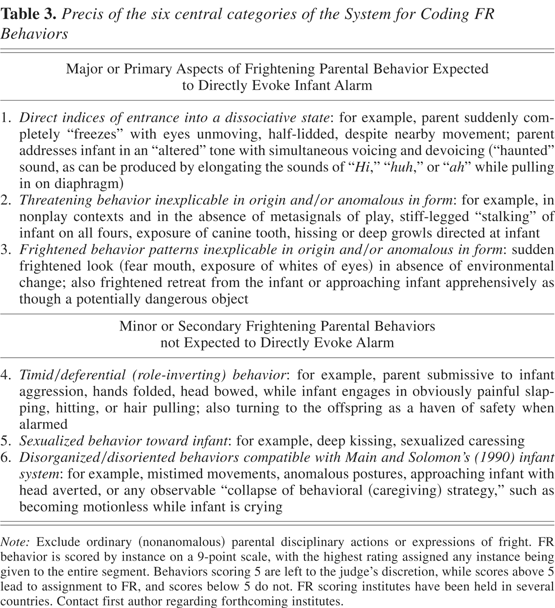
Our system for identifying parental FR behaviors is divided into six subcategories, which appear in two sets. The first constitutes three “primary” behavior subcategories that are expected to be alarming in themselves. As noted at the outset of this presentation, we believe that the parent exhibiting FR behavior in the infant's presence is often likely to be experiencing fear themselves. This given, it is unlikely to be coincidental that this primary set of behaviors parallel the three “classic” mammalian forms of response to fright which are (e.g., Nijenhuis, Vanderlinden, & Spinhoven, 1998), respectively, attack (parental threatening behavior), flight (parental frightened behavior), and freezing (dissociative behavior, which often takes the form of trancelike stilling).
The remaining three (“secondary”) FR behavior subcategories are not necessarily alarming in themselves, but have been observed in a substantial proportion of the parents of D infants. They have clear connections to the primary forms of FR behavior named above in that, for example, “timid/deferential” behavior may appear most frequently in parents who are overtly frightened (particularly, of the infant) at other times, whereas both “sexualized” and “disorganized/disoriented” adult behavior would seem most likely to appear in parents prone to entering dissociative states. The full set of FR behaviors are provided with examples in Table 3.
Precis of the six central categories of the System for Coding FR Behaviors
Parental behavior likely to be directly frightening and/or disorganizing: Dissociative behavior, anomalous threat, and anomalous expressions of fright
Unlike the “normal” frightened, threatening, and pseudodissociative parental behaviors noted briefly above, parental behaviors that originate in internal factors related to unresolved experiences of trauma and fear should normally disrupt the regulated functioning of the offspring's attachment behavioral system. The central reason for this outcome is that the parent's psychological state will most likely be “altered” when the behaviors occur. As will be discussed below, this in itself is cause for infant alarm.
Dissociative parental behavior
Some parameters of dissociative experiences are subjective and thus difficult to identify. These include depersonalization, some forms of amnesia, and the subjective sense of the existence of alternative identity states. Other manifestations of dissociation are, in contrast, overtly observable, for example, trance states, and altered, anomalous facial and vocal expressions. The clinical extremes of dissociative phenomena, such as dissociative identity disorder and fugue states, have frequently been associated with a history of trauma, and hence with high levels fear (Putnam, 1985, 1997).
Dissociative parental behaviors were first informally recognized as a possible correlate to D infant attachment status by Main and Hesse (1990). For example, we noticed what linguists refer to as a “simultaneous voicing and devoicing” intonation being used by some parents when greeting their (D) infants. This intonation most often has a haunted quality, not unlike that common to characters observed in classic “horror” films (as when “Hi … iiiii” is spoken while pulling in on the diaphragm). In a more recent study, one mother of a D infant used a devoiced “haunted” whisper (“aaaaaa … ahhh, get the blocks”) in addressing her infant. Strikingly, as if coaching herself, this mother was also sometimes observed whispering instructions to herself just prior to speaking the same words in a normal conversational tone (Abrams et al., 2006), and this apparent “self-coaching” speech occurring prior to her normal speech also had a devoiced or “haunted” quality. Another mother of a D infant grunted briefly and growled in a deep, aggressive, and almost “inhuman” male voice while smiling and apparently attempting to pleasantly engage her infant in play. These sounds were so anomalous that earlier observers of the same videotape had assumed that they were mechanical, originating from outside of the room. Once it was determined that the “sounds” were, in fact, the vocalizations of this U/d mother they were described by the observers as “chilling and frightening.”
Another type of behavior that we consider indicative of dissociation consists in lengthy “freezing” of all movement including half-closed, and often unblinking, eyes. Here the parent appears to have become completely unresponsive to, or even unaware of, the external surround, including the physical and verbal behavior of their infant. For example, we observed one mother who remained seated in an immobilized and uncomfortable position with her hand in the air, blankly staring into space for 50 s. In total, for 5 out of the 20 min of infant feeding she entered similar trancelike states. This particular behavior example received the highest possible score (9) on the 1- to 9-point FR scale and is presently expected to be rare in low-risk samples.
As will be noted later, in a recent study of 75 parent–infant middle-class dyads, a marked relation between FR scores assigned specifically for dissociative behavior, and the degree to which the infant had shown disorganization with the same parent in the Strange Situation was found for both mother–infant and father–infant dyads (Abrams et al., 2006; see also Schuengel, 1997, for a similar finding in a sample utilizing mothers only).
Both the Abrams et al. (2006) and the Schuengel (1997) studies point to the possibility that at high levels of intensity and/or in stressful situations, dissociative parental behavior can in itself be sufficiently alarming to leave the infant without a strategy for maintaining behavioral, emotional, and attentional organization. Relatedly, in three separate instances in which we observed a parent using devoicing (haunted) tones in addressing the infant, the infant's behavior immediately became disorganized. Similarly, two infants seen in the Strange Situation immediately “froze” (Main & Solomon's [1990] guidelines identify freezing and stilling as forms of D behavior) as soon as the parent entered a trancelike state. When marked, then, many dissociative behaviors are likely to be intrinsically alarming, creating a paradoxical stimulus. At the same time, because the parent is visibly “not there,” the infant is left with “nowhere to go.” Thus, a state of “fright without solution” will be created.
Anomalous forms of threatening parental behavior
Main and Hesse (1990) noted the presence of unusual movement patterns during the Strange Situation in some parents of D infants. These included abrupt and unpredictable invasions of “personal space”; for example, while behind the infant, several parents silently and without warning slid their hands over the infant's face or throat. In addition, we informally described nongamelike movements or postures that resembled a hunt or chase–pursuit sequence in the parents of some D infants, leading to the impression that the infant was being stalked.
In more recent formal investigations utilizing home or laboratory free play observations, other researchers have now also described the abrupt appearance of predatory and/or animallike forms of threatening behavior in some parents of D infants. For example, these parents have suddenly begun stalking the infant on all fours, silent and stiff-legged, without providing “meta-signals” of play. In one study, for example, an U mother of a D infant, assuming an “eerie” expression (Schuengel, 1997, p. 19; see also Schuengel, Bakermans-Kranenburg, van IJzendoorn, & Blom, 1999) crawled silent and catlike abruptly toward her infant and then, simulating “mauling” behavior, turned the infant over with fingers extended like claws. Later, while tickling her infant, she loomed close to her face and bared her teeth. Another mother clawed repeatedly toward her infant's face; still another tossed the infant in the air while growling and baring her teeth.
Recent free-play laboratory observations by Abrams and colleagues (2006) and home observations by Jacobvitz and colleagues (2006) have continued to confirm the existence of “predatory” forms of threat behavior in parents whose infants were independently judged disorganized. The behaviors observed have included not only teeth baring but also catlike hissing, deep threatening growls, and even one-sided lip raising (in essence, vestigial canine exposure, a threat gesture noted by Darwin, in 1872). None of these behaviors and expressions appeared playful, and most seemed to arise “out of nowhere” and then to disappear.
The approach–flight conflict leading to disorganization within the context of (anomalous) threatening parental behavior should, of course, be similar to cases involving of overt battering. Because most of the anomalous forms of parental threat just described appeared suddenly, briefly, and without apparent context, we infer that transient or fleeting affects, which are partially dissociated and are connected to the parent's own trauma or fearful ideation, may drive the abrupt appearance and disappearance of these behaviors. It should be noted that in the Abrams et al. (2006) study of 75 infant–parent dyads, scores for these anomalous (predatory) forms of parental behavior were in themselves moderately associated with infant disorganization. To our surprise, in our own study and in Schuengel's (1997) study, “sharp” disciplinary actions such as robust shaking were not found associated with D behavior.
Anomalous frightened parental behavior
Why particular anomalous manifestations of parental fright are also likely to lead to disorganization in the offspring is a subtle and initially confusing problem. Ultimately, we believe that, as with dissociation and anomalous threat, the operative or key mechanism also involves alterations in normal consciousness stemming from the parent's fearful state of mind.
Most anomalous forms of frightened parental behavior are presumed, then, to result from events associated with the parent's unresolved state. The stimuli leading to expressions of fright stemming from the parent's traumatic experiences should therefore most often be internal or idiosyncratically associated with the environment such that they are unlocatable and incomprehensible to the infant. Thus, the infant should “sense” impending danger, the source of which cannot be identified and/or understood.
Main and Hesse (1990) described one example of behavior of this type in the parent of a D toddler who responded with an immediate, frightened intake of breath as the toddler began moving a toy car across the room. The parent then cried out “Uh-oh! Gonna have an accident! Everybody's gonna get killed!!” Although no access to this parent's history was available, the panic implied by the frightened intake of breath combined with the particular statement made could well suggest some connection to earlier personal or familial experiences of loss through automobile or other accidents. This is, of course, a single and idiosyncratic example. A parent who suddenly looks about or reacts to an unchanged benign environment with fear provides a more general illustration.
Although a parent engaged in an anomalous display of fright (as above) may or may not also be in a dissociative state, it would seem that the arousal of this kind of unintegrated fear would normally be the product of a somewhat altered and anomalous state of consciousness. The fearful parent is therefore likely to be simultaneously alarming and unavailable, placing the infant in a disorganizing situation involving “fright without solution” (Kaplan, 1987; Main & Hesse, 1992). Finally, we should mention a study (Manassis, Bradley, Goldberg, Hood, & Swinson, 1994) that reported that in a sample of children of mothers with anxiety disorders 65% were disorganized. This approaches the proportion of D infants found in maltreatment samples, but of course, there is no reason to presume an association between anxiety disorder and abuse. The relation between parental anxiety disorder and infant disorganization has surprisingly not yet been further explored. Importantly, some clinicians believe that, due to “disconnectedness,” clinical levels of anxiety involve dissociation (L. Martin, personal communication, 2004).
Another form of frightened behavior is where the infant becomes the source of the parent's alarm. It is almost self-evident that in some cases a parent who remains frightened by partially dissociated experiences may come to confuse or identify their infant with their own original traumatic experience(s) or earlier frightening ideation. One U/d parent was observed backing away from their infant during the separation episode of the Strange Situation, while stammering in a frightened voice: “D-don't follow me, d-don't” (Main & Hesse, 1990). During the succeeding reunion, the infant stilled against the parent with eyes dazed for over 1 full min, and was, of course, judged disorganized. Parents have also been seen stepping cautiously about as though attempting to keep the offspring at the greatest possible distance, or even trying to “escape” from the infant by moving out of reach as if the infant was, for example, a potentially dangerous animal.
How can we account for such anomalous responses to an infant? Consider the following U mother of a D infant discussed by Ainsworth and Eichberg (1991, p. 175). While being asked about loss during the AAI this mother stated “… there was a little man …” as she broke out in tears. The “little man” was an elderly caretaker who had worked briefly for the participants parents when she was age 8. At one point the man jokingly asked the interviewee if she would marry him when she grew up, and she responded “No, you'd be dead.” Not long after this exchange the man died of a brain hemorrhage. This very high-functioning mother then went on to say that she had killed him “with one sentence.” This lapse in reasoning was left unmonitored, and the AAI text was categorized as a U/d. Her infant's Strange Situation behavior was also highly disorganized.
What should be noted here is that this mother appears to have retained the childhood belief that people can be killed with words. This idea is, no doubt, largely unconscious and in some way segregated from normal consciousness. However, if at times this speaker believes that children have the power to kill through thoughts or words, the frightening idea that it is possible to be killed by one's own offspring could well be present. “Anniversary” reactions occurring when an offspring reaches the age at which the parent lost an important person may therefore be mediated not only by, for example, the renewed onset of depression, but also in some situations by the rearousal of anxiety and fright. Fear of the offspring in traumatized parents is therefore perhaps not as unlikely an outcome as might be imagined (see Hesse & Main, 1999), especially if the parent harbors a (usually inaccessible) belief that they themselves had killed an important primary or subsidiary attachment figure.
Finally, if a parent “believes” that their infant is a source of danger, the infant's position becomes especially perplexing and disorganizing and could lead to the following experiences, observations, or suppositions, however preattentive, inaccessible to consciousness, or infantile in form:
- Attempts to increase proximity to the attachment figure are, paradoxically, likely to trigger parental propensities (however subtle) to increase parent–offspring distance. Moreover, rather than appearing simply indifferent (neglecting), the potentially retreating parent appears alarmed.
- Danger that originates from within the self is intrinsically inescapable. Thus, the disorganizing need to take flight from or to “get out of” the self should arise. The ultimate “solution” to this perplexing situation could necessitate, in extreme cases, the creation of segregated systems or multiple executors (selves; see Bowlby, 1980; Hilgard, 1977/1986; Main & Hesse, 1992). Here, however, rather than simply requiring two “selves” to perform contradictory actions (as in the case of severe abuse), two selves are required in order for one to retreat from the second. Although perhaps a rare outcome, these circumstances provide a particularly compelling backdrop for “splitting” or dissociative sequelae in the event of future trauma.
- Finally, as is known from observations of animals, flight behavior on the part of one individual can be a stimulus provoking attack or hunt–chase behavior on the part of a second (T. Johnson, personal communication, 1994). A parent who exhibits fear or inclinations to take flight in response to infant approach could therefore also provoke aggressive propensities, as are noted as an aspect of infant D behavior when the infant attacks or strikes the parent out of context (Main & Solomon, 1990). Parental fear of the infant could then eventually lead to still more frequent inclinations to “attack” the parent and contribute to the intensification of frightening and aggressive ideation. Because infant disorganization has been found predictive of aggressive, “externalizing” behaviors (e.g., see van IJzendoorn et al., 1999, for a meta-analysis), this suggestion is reasonable. Among clinicians, note that later attempts to identify the origin of intrusive, aggressive ideation resultant from interactions with a subtly frightened parent could be difficult for patient and clinician alike, unless both were alerted to the possibility of disorganization in infancy.
“Secondary” behaviors likely to be associated with U parental states: Timid/deferential, sexualized, and D behavior
The final three subcategories within in the FR coding system most likely would not in themselves lead directly to an approach–flight paradox for the infant. Nonetheless, they each imply alterations in normal consciousness. This should, in principle, increase the likelihood that the anomalous behaviors capable of directly producing disorganization will appear at other times.
Timid/deferential behavior and (role inverting) tendencies to utilize the offspring as an attachment figure
In our early observations (Main & Hesse, 1990) of Strange Situation behavior in the parents of D infants, “extreme timidity” in one mother's handling of her infant was noted. During a reunion episode, another U/d mother welcomed her daughter with extended hands, but when the child made an impatient gesture, the mother responded by slumping her shoulders, folding her hands, and assumed an “humbled” posture, accompanied by a pleading expression. Similar timid/deferential behavior was observed by Schuengel (1997), in a mother classified U on the AAI regarding a parental suicide. More extreme examples have also been noted, such as deferential submission to obviously painful slapping, hitting, or hair-pulling on the part of the infant. In these more extreme cases, the infant was either disorganized or unclassifiable.
We infer from the above behaviors that, at times, some parents may conceive of the infant as superior and/as having relatively greater power. This is consistent with George and Solomon's (1996) interview-based finding, that the parents of D children sometimes report that the child has supernatural capabilities, and that (as identified from a caregiving interview) these parents feel helpless with respect to their offspring who are, correspondingly, perceived as powerful (see DeOliveira, Moran, & Pederson, 2005, for similar results).
Because an infant, in fact, has no actual capacity to control, harm, or protect the parent, we may ask why, from an evolutionary vantage point, behavior of this type would occur. Recall, then, that ground-living nomadic primates have at least two relatively universal tendencies that are aroused during heightened states of alarm.3
In older individuals, both the protective and agonistic systems may also become activated.
Sexualized behavior
We have rarely encountered overtly sexualized parental behavior in parent/child dyads in the low-risk Western Strange Situation samples we have most often studied. Nevertheless, mild forms of these behaviors have been observed. For example, Abrams (2000) noted one parent of a D infant who suddenly, but very briefly, grunted and twisted her body suggestively with a “come hither” expression. In a few samples, intimate kissing of the infant has been noted.
It is hard to imagine that parents in the westernized nations where these studies were undertaken could (a) lack the capacity to monitor their actions sufficiently to permit observation of sexualized behavior toward their infants without (b) having had experiences rendering them vulnerable to exhibiting overtly dissociated and/or FR behavior in other contexts.
D parental behaviors compatible with the infant system
From the outset, the FR system has included all parental behaviors fitting to the system for classifying D infant behavior (Main & Solomon, 1986, 1990). Some such behaviors, even during infancy, have been regarded as dissociated (Liotti, 1992; Main & Morgan, 1996). Abrams et al. (2006) found that two mothers of D infants momentarily appeared “blind” (both facially and by changes in movement pattern) during the play session, whereas to that point the functioning of their eyes had appeared normal. A “sudden blind look to eyes” had until that time only been observed in infants. Another parent of a D infant suddenly moved in a stiff, asymmetrical, robotlike manner, suggestive of neurological impairment. Assuming no momentary neurological interference (the mother moved normally at other times) this behavior was inexplicable, pointing to a brief “collapse of attentional and behavioral strategy” (Main & Hesse, 1992). Rifkin (see Abrams et al., 2006) has speculated that this “dissociation of movement” could have been produced by a lapse in procedural memory (e.g., memory for muscle movement), perhaps comparable to the concept of a lapse in explicit (verbal) memory.
FR and AMBIANCE/FR+: Links to Parental U and Infant D Attachment
Above, the FR system and the mechanisms through which the varying forms of FR parental behavior should affect the infant have been discussed. We now review the main results known to us respecting studies involving FR, as well as a closely related system mentioned earlier and termed AMBIANCE or the Atypical Maternal Behavior Instrument for Assessment and Classification. We refer to the latter as AMBIANCE/FR+ because of the close relation of several subscales to the FR system, and Lyons-Ruth et al.'s (1999) use of the title FR+ prior to finalization of the system.
Studies utilizing the FR system
To date, four published studies have utilized Main and Hesse's (1992–2006) FR coding system. Three were conducted in home settings, with the fourth consisting in a laboratory observation of videotaped free play separated by 1 week from the Strange Situation procedure. All home observations were conducted from 1 week (generally, several weeks) to over 1 year prior to the Strange Situation.
The pioneering study investigating our hypothesis regarding probable relations between U, D, and FR parental behavior was undertaken by Schuengel and colleagues (Schuengel, 1997; Schuengel, van IJzendoorn, & Bakermans-Kranenburg, 1999). Schuengel made two visits to the homes of 85 low-risk mothers who were known to have experienced the death of someone important to them, videotaping behavior with their 10- to 11-month-old infant for 2 hr per visit. The mothers were asked to go about their day as usual., and the videotapes of the resulting 4 hr of maternal and infant behavior were studied for FR behavior. The AAI was conducted at 12 months of infant age, and the Strange Situation at 14–15 months.
In this study, intercoder reliability was established over 16 cases for the FR scale as a whole (r = .83). Reliability for dissociative behavior was r = .73, as was reliability for threatening behavior (r = .73). Frightened behavior had to be combined with a similar scale presently termed timid/deferential behavior to obtain satisfactory reliability (r = .68). One-tailed t-tests showed that while overall FR behavior in the home did predict infant disorganization (p < .05), the subscale for dissociative behavior predicted infant D the most strongly (p < .01). Frightened maternal behavior predicted infant disorganization at a trend level when combined with the “minor” but conceptually similar subscale for timid–deferential behavior.
Maternal U attachment status predicted FR behavior only when the mother's alternative best-fitting attachment category was insecure (dismissing or preoccupied), and for these dyads, maternal FR behavior, as expected, mediated the relation between maternal U and infant D. However, U mothers whose alternative attachment category was secure did not show substantial FR behavior, and FR did not mediate the relation to infant D. In Jacobvitz et al.'s (2006) study, U/F mothers also showed significantly less FR behavior than U/non-F mothers. However, in contrast to Schuengel, van IJzendoorn, and Bakermans-Kranenburg's (1999) study, both U/F and U/non-F mothers in Jacobvitz et al.'s study showed significantly more FR behavior than parents falling in the “organized” AAI categories.4
This was the first study to point to differences in the behavior of U/F and U/non-F parents, a difference that now appears critical. In studies of videotaped couple interactions (Busch, Cowan, & Cowan, 2005; Creasey, 2002), U/F partners have been found barely distinguishable in couple interactions from F partners, while U/non-F partners have been observed to behave in distressing ways in interactions with both their partners and (Busch et al., 2005) their 6-year-old children. Furthermore, Heinicke and colleagues found that U/F mothers “worked” harder than mothers whose transcripts were placed in any other AAI classification at making therapeutic use of the home visits (Heinicke et al., in press). Each of these findings are useful to stressing that “U” lapses, no matter how “unrealistic” in the sense of, for example, dead/not dead, are not simply signs of overall mental disturbance, because where the speaker's underlying state is secure, behavior in many situations appears normative. We should bear in mind, however (as did Schuengel, 1997), that U/secure individuals may be more capable of self-monitoring in public settings than U/insecure individuals and that the majority of situations in which their behavior appears normative have involved videotaping.
A second study using the FR system was conducted with 44 dyads in the Dogan ethnic group in Mali, West Africa (True, Pisani, & Oumar, 2001), with the sample consisting of 27 dyads from a rural town setting and 15 from two different agrarian villages; infants ranged from 10 to 12.5 months at the first of the five assessments. Mother–infant interactions were videotaped during two brief well-baby exams, and for two more “natural” periods in which the infant, always in near proximity to the mother, or else carried, was bathed, or nearby as the mother cooked. Subscales were not utilized, and interrater reliabilities for the home and field observations for FR behavior across 10 observations was r = .79, whereas for the very brief well-baby exams FR reliabilities for 13–24 observations ranged from .71 to .84. Strange Situations were conducted at an average of 12.5 months in semiopen westernized buildings, separated from the previous assessment by 1 to 4 weeks. A majority of the infants were secure, but one quarter were disorganized. Although the level of maternal FR behavior observed was low, disorganization was nonetheless predicted by maternal FR behavior (p < .01). No babies were classified as insecure–avoidant. Mean FR scores for the three C (insecure–resistant/ambivalent) babies were calculated separately, and did not differ from those for B (secure) babies.
In a third study, Jacobvitz et al. (2006) administered the AAI to 116 mothers in a low-risk sample during the mother's third trimester of pregnancy. Infants were videotaped interacting with their mothers at 8 months, and mothers were “directed” to complete a set of normal interactive tasks with their infants, including a diaper change, feeding, and play for about 45 min in total. Half the videotapes were co-coded by two raters, who conferenced with a third coder in the case of substantial disagreement. The intraclass correlation between the two first raters was .68, and subscales of FR were not utilized. Mothers' U AAI status strongly predicted FR behavior during interactions with the infant (p < .000). Using one-tailed tests, U/insecure mothers were observed to be more frightening than U/secure mothers, but both were significantly more frightening than non-U mothers. For loss of alternative attachment figures, U mediated the relation between loss and FR behavior, but for loss of parents it did not.
In the fourth study, Abrams et al. (2006) conducted Strange Situations for infants at 12 or 18 months of age. Parent–infant interaction was observed during a 30-min free play session for 75 dyads (50 mother–infant dyads, 25 unrelated father–infant dyads, i.e., not married to the mothers) 1 week later. These research participants were part of the Bay Area Social Development Project, and observations were made in a 30-min laboratory play session separated from the Strange Situation by 1 week. Two coders established agreement across 30 of the 75 videotapes. Intraclass reliability for the FR scale overall was .80. Reliability for the threatening subcategory was .70, for the dissociative subcategory it was .75, and for the frightened subscale it was .70. Among the “secondary” FR subcategories, frequencies were too low for computation, with the exception of the disorganized subscale, which was r = .85 (for all four subscales, p < .001). Thirty-two of the parents in this study had participated in the AAI when their offspring had reached 6 years of age, and had experienced loss or other trauma prior to the play session.
Both paternal and maternal FR status was found strongly related to infant D attachment status (p < .001, d = 1.26). As in the case of Schuengel's (1997) study, the dissociative subscale was the best predictor of infant D (p < .001, d = 1.12), whereas the threatening subscale was also significantly predictive (p < .01, d = 0.80). In contrast to Schuengel, van IJzendoorn, and Bakermans-Kranenburg's (1999) study, the frightened subscale did not predict infant disorganization. For the subsample of 32 parents where AAIs were available (n = 32), FR behavior was found significantly associated with U attachment (φ = .59, p < .001). This was the first study to use FR classifications (ratings of 5.5 or above, with ratings of 5 left to the discretion of the coder) as well as scores. None of the parents of the 28 B babies were classified as FR. Only 1 parent of the 28 A babies and no parents of the 3 C babies were classified as FR. Thirteen of the 23 parents of D infants were classified as FR.
Studies utilizing AMBIANCE/FR+
Main and Hesse (1990) founded their speculations entirely upon anecdotal parental behaviors observed inside the Strange Situation itself. Perhaps for this reason, Lyons-Ruth's first test of AMBIANCE/FR+ was conducted within the Strange Situation, and to our knowledge, studies published to date utilizing this system have analyzed maternal behavior either within the Strange Situation, or in the first few minutes following.
AMBIANCE presently includes five subcategories of “atypical/disrupted” maternal behavior: affective communication errors, role-boundary confusion, withdrawal, intrusiveness/negativity, and fearful/disoriented/disorganized/dissociative behavior. The AMBIANCE system carefully marks items taken from the FR system, and all subcategories excepting “affective communication errors” contain elements of the early (1992) FR system (Lyons-Ruth, Bronfman, & Parsons, 1999). Among its five subscales, the third, titled fearful/disoriented (or more fully, “fearful, disoriented, disorganized, and dissociative parental behavior” is derived exclusively from the FR system, containing not only FR-fearful (frightened) items but also FR-dissociative and FR-disorganized items. Intrusiveness/negativity is based largely on early FR descriptions of threatening behavior, while withdrawal includes timid/differential behavior as well as some elements of dissociated behavior (e.g., Goldberg, Benoit, Blokland, & Madigan, 2003).
In constructing AMBIANCE/FR+, Lyons-Ruth, Bronfman, and Atwood (1999) and Lyons-Ruth, Bronfman, and Parsons (1999) reasoned that in addition to direct FR behaviors, simple extreme insensitivity, as, for example, seen in complete lack of responsiveness to the infant, could be frightening as well. In addition, they suggested that when extreme insensitivity is not followed by “repair,” the insecure infant will be left without access to an “organized” strategy for influencing the attachment figure in times of stress or alarm. Further, Grienberger, Kelley, and Slade (2005) describe AMBIANCE as stressing the “competing strategies,” which may arise when caregivers feel simultaneously compelled to heighten, and reject, infant attachment. Notably, however, competing strategies have been observed as well in case studies of CC parents and their infants in the home, and the infants of CC parents are to date being found either D or CC within the Strange Situation, see below).
Goldberg et al. (2003) offer a particularly useful comparison of the FR and AMBIANCE/FR+ systems, comparing Lyons-Ruth's thinking to Solomon and George's (1999) suggestion that the “key element in D attachment is the caregiver's failure to terminate attachment needs when they have been aroused.” Thus, they conclude that an important theme in both Lyons-Ruth's and Solomon and George's model is that “lack of response (withdrawal) can be as fear-provoking for the child as behavior that is frightening in and of itself” (pp. 242–243). Except for cases in which extreme “lack of response” actually stems from a parental dissociative state, this conceptualization is very different from the bouts of FR behavior and the resultant paradox with which the FR system is concerned. However, when a parent is extremely unresponsive without accompanying indices of a dissociative state, the authors would more likely expect unorganized than disorganized infant Strange Situation behavior. Exploring this hypothesis may necessitate use of a fifth, CC category of infant Strange Situation behavior presently being developed in our laboratory.
In their first test of AMBIANCE, Lyons-Ruth, Bronfman, and Parsons (1999) observed 65 high-risk infant–mother dyads in the Strange Situation, finding that AMBIANCE as a whole predicted D/insecure but not D/secure Strange Situation behavior, with the subscales for affective communication errors, fearful/D behavior, and withdrawal behavior serving as the strongest predictors. Results for two substudies of the AMBIANCE items including (a) only those separate from FR, and (b) those marked as exclusively FR, were essentially the same, with both identifying D/insecure, but not D/secure infants. However, in a subject-level analysis, the mothers of D/secure infants were found to be less hostile, negative, or intrusive than the mothers of D/insecure infants, and more likely to exhibit withdrawal.
Goldberg et al. (2003) attempted to replicate Lyons-Ruth's “high-risk” Strange Situation findings by analyzing 197 Strange Situation procedures within two low-risk samples. Strange Situations were conducted at 12 months, and AAIs had been administered prenatally to all subjects. Prenatal AAIs predicted AMBIANCE in the Strange Situation, and U/d mothers were higher on AMBIANCE (p < .05). In contrast to Schuengel, van IJzendoorn, and Bakermans-Kranenburg's (1999) findings and Jacobvitz et al.'s (2006) partial replication, no significant differences were found between the U/autonomous and the U/nonautonomous groups in relation to AMBIANCE/FR+. Within the Strange Situation itself, the scale constructed for overall AMBIANCE/FR+ was strongly related to infant disorganization (p < .0001); however, although the authors did not consider their interjudge agreement strong enough for reliable assessment of subcategories, two scales closely related to FR (fearful/disoriented/disorganized/dissociated; p < .01, and withdrawal; p < .02) made the strongest showing in discriminating not-U from U mothers.
However, in a later analysis of the same sample, Benoit, Madigan, and Goldberg (2003) reported that AMBIANCE/FR+ in fact had not discriminated D from C resistant/ambivalent infants. They concluded that AMBIANCE/FR+ might be “more sensitive than specific,” pointing to insecure rather than U infants.
Grienberger et al. (2005) examined relations between AMBIANCE/FR+ and infant Strange Situation classifications for 45 infant–mother dyads. Perhaps following upon Benoit et al.'s (2003) reanalysis of the Goldberg et al. (2003) report, Grienberger and colleagues predicted that insecure infants generally, rather than D infants specifically, would have higher scores. Interrater reliability was calculated only for the scale as a whole, and reliabilities for subscales were not tested. The intraclass correlation was .85 for the AMBIANCE total score. Here, as in the Benoit reanalysis, D infants could not be discriminated from resistant (C) infants, and had identical mean scores on AMBIANCE/FR+. However, avoidant infants had scores virtually identical to secure infants.
The latest study of AMBIANCE/FR+ (82 adolescent mothers and their infants) was conducted by Madigan, Moran, and Pederson (2006). Many of the mothers had been sexually abused, and 59% of the sample was D, 9% avoidant (A), and 33% secure (B). As in Lyons-Ruth, Bronfman, and Parsons's (1999) study, all infants classified as C were also classified as disorganized (D/C), composing 31% of the group of D infants.
Although AMBIANCE/FR+ checklists the occurrence of each set of behaviors, Madigan et al. (2006) reworked the five checklists, emerging with five 7-point Likert scales. Interrater reliabilities were established across 18 cases and were high both for the “general” scales for AMBIANCE/FR+ and for all five subscales. In contrast to previous studies, this AMBIANCE/FR+ assessment was conducted in a 6-min play session designed by Pederson, which followed upon, rather than occurring within, the Strange Situation procedure. In the first 3 min, mothers were asked to play with their infants in the absence of all toys: in the second 3 min, toys were brought in. In the subsession of the play procedure without toys, which can readily be regarded as the more stressful, all findings were stronger, and form the basis for the findings reported here. The overall AMBIANCE/FR+ scale was related to U maternal AAI status (p < .05), while the subscales were not. AMBIANCE/FR+ was strongly related overall to infant D attachment status (p < .0001). This may have been accounted for in part by the third subcategory of AMBIANCE/FR+, fearful/D/dissociative, which was found very strongly related to infant D attachment (p < .0001 in the session without toys) with intrusive negativity appearing as the second strongest contributor (p < .001). Other relations to subscales were modest, and withdrawal was not significant.
Because two previous studies found that AMBIANCE/FR+ predicted resistant (C) equally as well as D infant attachment status, (underlying) resistant attachment was tested against the overall scale (“disrupted communications”), and was again found significantly related to AMBIANCE/FR+ scale. The mean level of disrupted communications was, in fact, significantly higher for underlying or alternate C infants than for non-C infants (p < .001). Importantly, planned t tests also revealed significant differences between C and non-C infants specifically on affective communication errors (p < .01), the only subscale not inclusive of FR items, but the other AMBIANCE/FR+ subscales failed to point to group C infants. Fearful/D/dissociated behavior, intrusive negativity, and role-boundary confusion were, in contrast, unique to identifying D attachment.
Other sources of D behavior
From the above review, it is apparent that our hypothesis regarding the ability of repeated experiences of FR parental behavior to specifically yield D infant Strange Situation behavior (Main & Hesse, 1990) has obtained considerable support, both from studies using the FR system alone and from studies utilizing FR+. At this point, however, it is important to note that some D behaviors occur in response to neurological difficulties (see Barnett et al., 1999; Main & Solomon, 1990), although others can originate in pharmacological intervention (see Hesse, 1999, for an overview) and thus may not involve concommitant experiences of fear.
In addition, if sufficiently frightened by the situation in which they are placed, infants who are normally “organized” in their attachment to the primary caregiver(s) can become disorganized. For example, when Ainsworth (attempting an early stability study) subjected infants who were insecure–avoidant in the Strange Situation at 50 weeks to a repeat of the procedure at 52 weeks, almost all these formerly avoident infants were considered “unclassifiable” by her student coders (the “D” classification, of course, did not yet exist). At the outset of the second Strange Situation fright was highly apparent in these now overly stressed infants. This was no doubt due to the very short interval between administrations of the proceedure. Some of the infants began crying simply on seeing the door to the Strange Situation room while still in the hallway. This distress led to distorted proximity-seeking making the best-fitting “forced” classification “secure” in all seven cases (Ainsworth et al., 1978).
As we have already pointed out (Main & Solomon, 1990), it seems highly unlikely that the mothers of these avoidant Baltimore infants, already observed to be consistently aversive to tactual contact with their infants in the home (Main & Stadtman, 1981), had suddenly become frightening over the 2-week period. Rather, the “disorganization” seen in the infant's approach was probably more the result of meeting with a “problem without solution” (True, 2003): how to approach a mother who is not frightening but has stably shown a dislike of physical contact, when you are frightened. This is quite a different “tangle” than the experience of fright without solution. Similarly, True et al. (2001) found FR behavior predicted infant D in the Strange Situation among the Dogon ethnic group of Mali. Dogon infants, however, are continually carried by their mothers, and the Strange Situation conducted in a semiwesternized building was no doubt especially frightening. True later discovered that scores for mother's observed aversion to physical contact in the home substantially increased her power to predict D behavior within the Strange Situation (True, 2003).
The same increased likelihood of the appearance of D behavior holds, of course, for infants observed in stressful long-term separation settings (as see case histories presented by Heinicke & Westheimer, 1966; note, however, that although disorganization appeared in the separation setting, organized avoidance of the parent appeared upon reunion). However, disorganization in Strange Situation behavior itself does appear following repeated or long separations (Main & Solomon, 1990; see also Solomon & George, 1999). In addition, the majority of toddlers raised in orphanages absent the assignment of special caregivers are coded as disorganized within the Strange Situation (Vorra et al., 2003). Thus, despite the appearance of D behavior in the Strange Situation, none of these conditions, that is, excessively long separations from the mother, placement in a context sufficiently frightening to necessitate approaching a usually unapproachable mother, or orphanage rearing, involve fear of the parent, or are self-perpetuating “feedforward” experiences.
In that the above findings underscore a large set of conditions associated with D infant behaviors beyond the repeated experiences of “fright without solution” associated with FR parenting emphasized in this presentation, they exemplify the principle of “equifinality” (as see Cicchetti & Rogosch, 1996). At the same time, and at our present state of knowledge, only parental FR behavior appears to involve the infant in a looping of attention. If so, as opposed to other situations associated with disorganized Strange Situation behavior, repeated interactions involving FR parenting may be more likely to result in increased dissociative propensities. Thus, we propose that persons who had repeated FR interactions with the primary caregiver during infancy may be more vulnerable than others to dissociation. This is suggested by the longitudinal associations between infant D with mother and U/CC adult attachment status in the same individual found in two independent samples (Main et al., 2005; Sroufe et al., 2005).5
These findings offer us a new interpretation of a puzzle that is sometimes presented to researchers utilizing the AAI. Although most often a lost person is convincingly important, at other times the relation to the person to the speaker seems slight, indeed, and, at an extreme, one mother of a D baby was coded U for a loss of a closely related toddler she had not met (around the time of her own infant's birth), and another mother of a D baby for a much discussed suicide of a close family member who had died before she met her. In these rare instances, we may do best to look to for our source of U lapses to repeated frightening and frightened family discussions, and perhaps as well an inherently fearful D background for the person to whom the AAI was administered.
A Consideration of Propensities to Develop Dissociation in Terms of U/CC Parental Status, Parental FR, and Infant D: May Some “Dissociative” Forms of AAI Lapses and Infant D Create a Particularly Strong Diathesis?
The phenomena of dissociation have intrigued psychologists since the turn of the last century (e.g., Breuer & Freud, 1895/1986; James, 1890/1983; Janet, 1907/1965; Prince, 1905/1978). Only recently, however, through the work of Hilgard (1977), Kihlstrom (1997), Liotti (1992), Putnam (1985, 1997), and Spiegel (1990), among others, has undertaken a careful consideration of dissociative processes. The essential feature of the dissociative disorders has been identified as a disturbance or alteration in the normally integrative functions of identity, memory, or consciousness. Although minor dissociations are normative, the phenomena of dissociation include trance states and ideas of possession, experiences of depersonalization and derealization, fugues, and dissociative identity disorder. Of special relevance to this aspect of our presentation is Liotti's (1992) hypothesis that D children would be more vulnerable than others to dissociation in the face of later trauma, via early FR experiences of paradoxical (approach–flight) injunctions resulting in trancelike states parallel to self-hypnosis.6
Liotti's (1992) hypothesis was based upon the phenotypic link between dissociative behaviors and hypnotic (trancelike) states, and upon the fact that paradoxical behavioral injunctions constitute one technique for inducing hypnotic states. These are seen in “confusion techniques” of hypnotic induction, in which the hypnotist may, for example, very rapidly urge the subject to engage in contradictory movements that cannot be carried out at the same time. Liotti (1992, 1999) linked these paradoxical confusion techniques to the experience of the infant exposed to the paradox of interacting with an FR attachment figure. If trancelike states are sometimes induced in D infants exposed to these interactional patterns, and if early self-hypnotic experiences are in fact linked to later dissociation, then, Liotti argued, an ability to dissociate may indeed develop.
A strong link has been established between the development of dissociative symptoms and trauma (Putnam, 1985, 1989, 1997; Spiegel, 1990). As a recent example, Macfie et al. (2001a, 2001b) used Putnam's dissociative child checklist (Putnam, Helmers, & Trickett, 1993) with a sample of 198 preschoolers (in all likelihood the youngest age studied formally to date) who had experienced sexual abuse, direct physical abuse, child battering, or abusive levels of neglect. Observed dissociative behavior was substantially related to all forms of abuse; children experiencing more forms of abuse were more dissociative; and children experiencing direct physical abuse were especially likely to have reached “clinical” levels of dissociation. Because it had already been established earlier in Cicchetti's laboratory among others that most maltreated children are found disorganized in the Strange Situation (van IJzendoorn et al., 1999), these findings, in keeping with Carlson's report of links between infant D and dissociative behavior extended from elementary school to young adulthood in the Minnesota poverty sample, provide new support for an association between early D attachment and the development of dissociative tendencies.
Maltreatment constitutes an experience of trauma, and at its extremes has been found predictive of dissociation (Putnam, 1985). Carlson (1998), however, has established the infant D attachment to the mother predicts later dissociative tendencies even controlling for experiences of maltreatment. Given the above findings, we should ask, then, if it is possible to determine which individuals experiencing maltreatment during childhood will be especially vulnerable to developing dissociative disorders. A first step toward this determination is provided by Sroufe et al. (2005), who reported that infants disorganized with mother during infancy were more likely to develop dissociation in the face of later maltreatment than those who had been secure. Sroufe's findings suggest that the early experiences of “fright without solution” experienced by D, but not by B, infants may affect the developing brain so as to lead to increased vulnerabilities to dissociation in the face of maltreatment.
The remainder of this section is devoted to a discussion pertinent to the ways in which we may still more incisively predict dissociative versus nondissociative outcomes as they relate to trauma. Thus, we review the directions for identifying U status in the AAI, which are in keeping with normative to high-level indices of dissociation, and then undertake a closer examination of those subcategories of infant D and parental FR, which we consider particularly dissociative. Our prediction would be that (a) the offspring of U/d parents identified via especially dissociative discourse lapses during the AAI who (b) are subjected to notably frightening forms of parental FR behavior and (c) exhibit D behavior taking a dissociative form will be the most vulnerable to developing dissociative tendencies.
Dissociative aspects of U/d attachment during the AAI
As noted earlier, self-reported tendencies to enter states of absorption (Tellegen, 1992; Tellegen & Atkinson, 1974), a normative index of dissociation, have been linked to U status on the AAI in three independent, low-risk samples (Gribneau, 2005, unpublished data; Hesse & van IJzendoorn, 1999), while scores on Carlson and Putnam's (1993) Dissociative Experiences Scale scale have functioned similarly in a low-risk sample (Schuengel, van IJzendoorn, & Bakermans-Kranenburg, 1999). This suggests a direct link between dissociative or dissociative-like experiences and lapses in the monitoring of reasoning or discourse during the discussion of potentially traumatic events, which are the two chief indices used to identify U/d (U) status in the AAI.7
A third index, rare in low-risk samples, consists in reference to extreme behavioral reactions to such events, reactions that seem to have contained a substantially dissociative element and have not convincingly been placed solely in the past. Finally, CC texts are often filled with references to trauma, with lapses in reasoning and discourse, and with references to extreme behavioral reactions. Nonetheless, CC texts are rare in low-risk samples, and, like extreme behavioral reactions, will not be discussed further here.
Lapses in the monitoring of reasoning or discourse during discussions of potentially traumatic experiences: Indications of lapses into mildly to more fully dissociative states
In our view, all indices identifying AAI transcripts as U/d fit to a dissociative model, as indicated directly below. However, there is much variability in the intensity and extremity of these lapses, and some approach the normative. This point is critical to our aim of creating a more incisive means of identifying early vulnerabilities to dissociation.
1. Dissociation is associated with traumatic/frightening experiences. Similarly, the anomalous patterns of speaking and reasoning discovered in interviews conducted with the parents of D infants in low-risk samples normally appear specifically during their discussions of potentially traumatic/frightening events.
2. Dissociation is identified through “alterations” in consciousness and behavior: correspondingly, our directions for identifying U/d responses to trauma refer to “alterations”/lapses in the monitoring of reasoning or discourse (Main et al., 2002).
3. Our directions for identifying “lapses in monitoring of reasoning or discourse” appear compatible with those which might also be used to identify (a) efforts to dissociate memories from awareness, as when as speaker remarks that memories of a dead person have been put away in a special place in their mind, or that when confronted with traumatic experience, their mind has just “gone off somewhere”; (b) current interference from partially dissociated memories; and (c) evidence of coexisting but incompatible and dissociated “memories” for past events (Main et al., 2002). We consider each of these in turn.
a. Lapses suggestive of efforts to dissociate memories from awareness. One type of lapse in the monitoring of reasoning consists in “psychologically confused statements” in which the subject describes manipulations of his or her mind in the service of “forgetting” bad experiences or bad aspects of attachment figures. Thus, one subject, describing an abusive attachment figure, said that it was “almost better when he died, because then at last I could forget the bad parts of him, and remember just the good.” Others described efforts to put bad memories in special places in their minds, or making their minds “just go away.”
b. Lapses suggestive of current interference from partially dissociated memories. Lapses in the monitoring of discourse are described in the AAI manual as indicating that the speaker “seems to have lost awareness of the discourse context . . This lack of immediacy suggests an encapsulation or segregation of the event from normal consciousness” (Main et al., 2002). Examples include lapses into a eulogistic style of speech during discussions of a loss (“She was young, she was lovely, she was dearly beloved by all who knew her and who witnessed her as she was torn from us by that most dreaded of diseases, cancer”); sudden, elaborate, and lengthy attention to details surrounding the event; and changes into speech forms appropriate to much younger speakers during discussions of early traumatic experiences (“If I didn't tell my mom about how I did on my piano lesson, then she'd be really mad, 'cause I'd hided it from, you know, I hid it from her, and um … that's when the punishment came, you know …”). Lapses in the monitoring of discourse are also identified when visual/sensory images/memories intrude into the speaker's sentence, distorting or destroying its logical meaning or grammatical form. Visual/sensory intrusions are characteristic in hypnotic states, and also occur in association with the “flashbacks” long linked with posttraumatic and other dissociative disorders (Hilgard, 1977/1986; Horowitz, 1976).
c. Lapses suggesting the simultaneous existence of incompatible systems of memory and consciousness. Lapses in the monitoring of reasoning during the discussion of a loss experience include indications of belief that the lost person is simultaneously dead and alive (in the physical., rather than the religious/metaphysical sense). For example, one speaker said of a father who died some years previously, “now he can get on with being dead and I can get back to my business.” Aspects of this sentence indicating the existence of ideas regarding the father's status as simultaneously dead and not-dead include (i) use of the present tense; (ii) the implication that being dead is something that a dead person can actively “get on” with or “do,” that is, that being dead is an activity; and (iii) the implication that the deceased and the speaker are leading parallel lives in the present, each “getting on” with something. As noted earlier, Bowlby (1980) discussed one such case (“Geraldine”) extensively, pointing out that a bereaved person is faced with two worlds of plans and memories: the current one, in which the attachment figure is absent, and a second one in which feeling and behavior was organized with respect to the lost person for whom search processes may still be taking place.
As is clear from the above, not all U/d lapses are indicative of extreme dissociation. For example, the use of funereal speech, or unusual attention to detail, merely suggest elevated levels of the most “normative” component of dissociation (Spiegel, 1990), absorption. In contrast, most of those cited under section (c), above, suggest the presence of real dissociative phenomena such as “segregated systems,” although in most cases we assume these are unlikely to involve multiple executors capable of guiding action. Future investigations should attempt to discriminate whether individuals exhibiting more extreme dissociative components in their discourse lapses are more frightening during interactions with their offspring, and have offspring who are more prone to dissociation.
FR behavior: Will differences in its expression be found to be associated with differences in vulnerabilities to dissociation?
The theme surrounding the primary subcategories of parental “FR” behavior is that they are directly frightening to the infant, thereby invoking the approach–flight paradox which, if experienced frequently enough at sufficient intensities, is expected not only to produce infant disorganization, but also to leave the infant vulnerable to developing dissociative tendencies if faced with intervening trauma at later ages (Liotti, 1992; Ogawa, Sroufe, Weinfield, Carlson, & Egeland, 1997). Above we reported that the dissociative subcategory of FR parental behavior was the strongest predictor of infant D for both Schuengel (1997) and Abrams et al. (2006), whereas for AMBIANCE/FR+, the “D” subcategory (fearful/disoriented/D/dissociative) was also the strongest predictor of infant D (Madigan et al., 2006).
However, aspects of the two other primary subcategories of FR also may fit to a dissociative model, and should not be overlooked in this regard. For example, a dissociative element may be present when the parent treats the infant as prey (seen in some “threatening” behaviors) or as a powerful and potentially harmful stimulus (some “frightened” behaviors). Because dissociative FR behavior appears to be the strongest predictor of infant D, and infant D is presumed to result from a disorganizing fear of the parent, it may be that dissociative behavior is particularly frightening and constitutes a theme connecting the subcategories of FR. Because, however, fear may not be readily observed in videotapes of young infants, physiological indices (see Montoya, Campos, & Schandry, 2005) might be utilized. Thereafter, following the model provided by Macfie et al. (2001a, 2001b), short-term longitudinal studies may assist in determining whether the dissociative component of FR behavior is, in fact, the most frightening to infants, and if so, the most likely to lead to vulnerabilities to dissociative disorders. At present, however, we need to leave open the possibility that it is simply the frequency and intensity of varied types of FR behavior that lead to increased likelihoods of D attachment, and hence to dissociative tendencies.
D infant Strange Situation behaviors particularly fitting to a dissociative model
Although, as noted earlier, many D behaviors identified as disorganized are unlikely dissociative, as hiding under the chair at the entrance of a clearly frightening mother), some D behaviors (chiefly, trancelike behaviors and seemingly “dissociated” actions) do seem to fit to a dissociative model. Indeed, at the phenotypic/descriptive level, a review of a subset of Main and Solomon's (1990) directions for identifying D behaviors reveals some remarkable resemblances to behavior indicative of dissociative states:
Trancelike behaviors
According to Putnam et al. (1993), “the single best predictor of a dissociative disorder [in children] is frequent trance-like behavior … The child is usually amnesic for these episodes and upon termination of the trance state may resume an interrupted task as if nothing had happened” (p. 42). The Strange Situation behavior of several D children we have observed in low-risk samples does fit to this description. For example, one child (Main & Morgan, 1996) was observed sitting on the floor playing happily beside the mother during their second reunion. Suddenly, she slumped forward, collapsed her upper body between her legs, and pressed her torso to the floor. Three seconds later, she rose to a sitting position and resumed her play. Another child had been playing actively until his mother picked him up and sat him on her lap. He then stilled and closed his eyes, and remained stilled with closed eyes despite his mother first calling his name, and then jiggling his body. After several seconds, however, he opened his eyes, slid off her lap and, crossing the room, renewed his play. Both cases exemplify as well our directions for identifying a type of “disorientation” termed: “freezing, stilling, and slowed movements and expression,”which makes primary reference to immobilized postures accompanied by dazed or trancelike expressions, both of which are classic expressions of dissociative states.
Dissociated actions
In ethological terms, some D behaviors are simply indicative of high levels of conflict. Dissociative status need not be implied when, for example, the infant shows signs of fear in smiling at an abusive parent, or makes awkward, repeated stop–start approach movements toward her.
The phenomena of hypnosis (and dissociation) include, however, complex and purposeful “conflicting” actions undertaken outside of the awareness of the actor. In Hilgard's “neodissociation” theory (1977/1986), it is not considered unreasonable to attribute these actions to the operation of dissociated “systems,” occurring either alongside or outside of the principal system usually associated with consciousness, each producing relatively coherent patterns of behavior with sufficient complexity to represent some degree of internal organization (Hilgard, 1977/1986; see also Bowlby, 1980; Main & Hesse, 1992). We may term these dissociated actions, and some D behavior does appear in this form.
In the low-risk samples with which we are familiar, two instances of apparently “dissociated actions” were particularly striking. For example, directly upon reunion, one infant, creeping rapidly toward her father with a happy and normal expression, suddenly stopped, turned her head to the side in a strangely slow movement, and gazing blankly at the wall with half-closed eyes, slapped a toy and then her empty hand on the floor in a highly aggressive manner. Again, in a strangely slowed movement, she then turned her head back to face the door, opening her eyes. This interruption lasted only 3 or 4 s, and the infant then continued her strong, happy approach and reached for pickup. Her alternative attachment classification was secure. Another toddler approached her mother, slapped her full in the face with her left hand, and then, with a dazed expression, and still standing in place, used her right hand to pull the left hand and arm down.
The behaviors described above may be regarded as candidates for description as dissociated to greater and lesser degrees, depending in part upon complexity, duration, and the infant's apparent awareness of the immediate context. In addition, like Putnam et al. (1993, above) we have been impressed by some infant's sudden change back to completely “normal” behavior, as though the “dissociative” episode had not occurred, or at the least had lost all influence.
Summary
In sum, our directions for identifying U adult attachment status are, insofar as we are aware, well fitting to a dissociative model, albeit at varying intensities. FR behavior shown by U parents (e.g., Jacobvitz et al., 2006) is probably frequently dissociative, but may effect the infant only sufficiently to produce conflict behavior, or, as in the cases just cited, become associated with trancelike states and/or dissociated actions. A worthwhile endeavor for developmental psychopathology will be to examine the exact form taken by U/d lapses shown in parents during the AAI and the intensity and type of FR behaviors displayed and to compare these to the forms of D behavior exhibited by their infants. If possible, this should be undertaken utilizing several home observations, and more than one Strange Situation. Such studies must be followed up by “outcome” data assessing childhood dissociation but, as recently demonstrated, this can be assessed as early as preschool (Macfie et al., 2001a, 2001b).
Conclusions
Lyons-Ruth and colleagues (e.g., Lyons-Ruth, Bronfman, & Parsons, 1999; Lyons-Ruth et al., 2005) have speculated that, even in the absence of intervening trauma, the D infant will be highly likely to develop contradictory (hostile–helpless, compare CC) mental states by adulthood. Lyons-Ruth's speculation receives partial support in that, as mentioned earlier, recent data from our own low-risk sample as well as the Minnesota high-risk sample (Main et al., 2005; Sroufe et al., 2005) shows significant prediction of U/CC from early D attachment status. However, it should be noted as well that in both samples almost half the D infants had become dismissing on the AAI by young adulthood, while a rare few had become secure–autonomous. Our review of a subset of these latter dismissing and secure-autonomous transcripts has shown normal, nonanomalous patterning for the great majority: that is, CC status was not indicated, even in the form of alternate category placement. This suggests a “self-organizing” capacity (Cicchetti & Rogosch, 1997) in the majority of previously D infants, who had come to employ a clearly singular strategy with respect to the AAI discourse task by young adulthood. Developmental psychopathology, which considers the normal simultaneously with the abnormal (Sroufe & Rutter, 1984), will find rich ground for exploration here.
In this concluding section, however, we focus upon FR parental behavior, D infant attachment, and possible sources for their more unfavorable outcomes. The section begins with an overview of some conceptualizations of mental processing that we find especially relevant to FR behavior and its correlates. It has been suggested for almost 20 years now that complex mental activities can take place outside of consciousness, in the form of parallel, distributed, and relatively unlimited processing “nets,” which are (a) locally guided and (b) capable of influencing not only “mind” but also actions. The goals/assessments of some nets may readily contradict others. Although for some time the attention of neuroscientists vacillated between “modularized” and “neural net” models of the brain, at present it seems largely agreed that brains can and do work in both ways.
We return now to the concept of working memory, described roughly earlier as an intermediary between short- and long-term memory which, functioning serially, is held responsible for reasoning and language processing, among a number of other tasks (the concept is complex: see D'Esposito & Postle, 2002). Jacobvitz et al. (2006) have shown that lapses in working memory associated with reasoning and language processes during the discussion of potentially traumatic events are strongly associated with FR behavior toward the infant of that same individual. However, it is possible that aspects of FR behavior in itself may also be seen as indicative of lapses in working memory directive of actions. In direct opposition to parallel distributed processes, the operations of working memory are presumed to be undertaken in coordination with a single overriding “processing goal,” and overseen by control processes termed executive and monitoring functions. In that working memory is presumed to be limited by its singular and exclusively serial nature, it seems possible that some lapses in “action” seen in FR behavior may, in direct parallel to infant D behavior, provide evidence for contradictory impulses.
We apply these conceptualizations of mental processes first to the “lapses” in the behavior of D infants themselves. We suggest that paradoxical situations involving fright originating in anomalous FR interactions with attachment figures are unsolvable at the serial level; cannot be avoided through a shift in attention; and will almost inevitably overwhelm the infant's already limited attentional capacities. Trancelike and dazed behaviors may then indicate lapses in serial processing. At the extreme, repeated exposures to traumatic/abusive paradoxical situations may facilitate the development of independent, dissociated nets of mental activity. This was seen at a comparatively minor level in one of the examples provided earlier of a D infant who interrupted a joyful approach to angrily strike the floor, before continuing forward toward her parent with a happy expression. The “daze,” which preceded and followed her interruptive aggressive gestures, may have assisted her in switching between competing and incompatible goals that may not have been “allowed” simultaneous access to awareness. In other words, this behavioral secquence includes phenomena suggestive of what we had termed a (trancelike) “lapse out of serial processing” precedent to and following upon a “dissociated action.”
Parallel processing and working memory
Connectionism constitutes a reconceptualization of information processing theory based on the concept of parallel subprocessing of subsymbols rather than the serial processing of symbols. Connectionism became popular in the 1980s with the development of the “parallel distributed processing (PDP)” model offered by Rumelhart and McClelland (1986).8
We are grateful to Alberto Amengual, a dissertation student and Assistant Professor in computer science, for the revised wording of these latter two sentences.
The computer metaphor of mind has therefore since been supplemented with a “brain” metaphor of mind, in which each “node” or net may be in principle connected to all others. Memories are generally not presumed to be located in any particular node, but rather in the patterning of relations between nodes and the strength of these connections. Presented with a problem (e.g., the identification of a sound), these nets are presumed (a) to reach a solution through local changes in excitation and inhibition (“computations”) and (b) to be capable of generalization.
In contrast to parallel processors, which can handle virtually unlimited data, working memory is understood to be a limited, serial processor, whose central task is that of activating information in long-term memory to operate upon it in short-term memory in coordination with a current “processing goal.” Thus, in keeping with its limited and serial nature, working memory is believed able to contain only one currently active goal at a time.9
With respect to the response of working memory to conflict situations, Dennett (1991) also reviews a model (SOAR) in which conflict situations provide the basis of new mental activities at higher levels.
In this one-page overview, we have given the impression of greater unity regarding the entity under consideration than is warranted. There may be several (Squire, 1987) rather than one working memory, and working memory may (Baddeley & Hitch, 1994) or may not (Dennett, 1991) be controlled by a central executive. Moreover, current definitions of consciousness, as well as working memory and the relations between them differ as seen in conflicting conceptualizations offered by, for example, Baars (2003), Crick and Koch (1998), and Prinz (in press).
Working memory, parallel processing, and lapses in narrative surrounding trauma
One characteristic of individuals suffering from dissociative disorders, and particularly, of course, posttraumatic stress disorder, is a failure to mark trauma-related memories exclusively as memories rather than immediate perceptions. In an intriguing early analysis of this problem, Siegel (1992) proposed that the unique nature of trauma-specific memories may prevent the reflective, rehearsal modifications that permit their inclusion in an individual's life narrative. Drawing upon a model of memory that simultaneously stored both perceptual and reflective components (Johnson, 1991) he suggested that if a traumatic event is too overwhelming for reflective processing to occur, its encoding may have a predominance of perceptual processing only. In this case, when reactivated, the “high-perception, low-retrieval” memory configuration is likely to be difficult to identify as originating solely from internal sources.
In light of Siegel's proposal, some “lapses in the monitoring of discourse” observed in narratives surrounding traumatic events could be understood as (a) lapses in working memory stemming from (b) intrusions from long-term memories which are partially processed as perceptions. In other words, lapses in the monitoring of discourse occurring in the parents of D infants may be attributable to loss of the maintenance of context, a central task of working memory that is especially critical to language production. In some cases, this loss of context may occur because the speaker's limited working memory capacity is overwhelmed by the fact that attentional processes are being forced toward frightening memories, some (but by no means all) of which are still partially processed perceptually. This is almost certainly the case when visual/sensory memories distort sentence formation. In other instances, the speaker may lose the immediate context through a shift to a mental state not presently appropriate, but appropriate to the time of the episode being described (e.g., eulogistic speech).
Lapses in the monitoring of reasoning in the parents of D infants often reveal ideas that cannot be true in the same episode of space and time (e.g., dead/not dead) and violate the XOR requirement in that sense. At the least, such statements suggest intrusions from segregated processes whose products are not appropriately monitored for compatibility by the “reasoning” function in working memory, perhaps again because its limited capabilities are momentarily overwhelmed by frightening material (Arnsten, 1998; Main & Hesse, 1992). However, lapses in reasoning such as dead/not dead also suggest that two parallel, segregated nets of associations may surround these incompatible premises, and that both are momentarily accessed. This would imply the development of dissociated structures, over and above lapses in serial processing.
Working memory, parallel processing, and infant response to frightening, paradoxical situations involving attachment figures
More than 15 years ago, David Spiegel (1990) pointed out that the “parallel processing” model of mind is inherently “contentious,” and that its emphasis upon local computations operating outside of an overseeing awareness makes special sense in application to the dissociative disorders. At the present time, neural nets are still believed to compete for access to motor circuits (e.g., Mink, 1996), and (although “locations” are liable to change over neuroscientific time) there has even been preliminary identification of, for example, the basal ganglia as an action selection device (Gurney, Prescott, & Redgrave, 1998). Here, we further utilize this model to assist us in taking a developmental approach to the dissociative disorders, exploring the consequences of exposing an infant to the “paradox” presented by the FR-threatening attachment figure discussed earlier.
The paradox presented to a young infant severely frightened by an attachment figure, and with no alternative attachment figures available is, again, inherently unsolvable. As noted earlier, it does not permit an escape through a shift of attention (one classic solution to animal conflict situations), nor is a behavioral solution available. Unlike the classic “double bind” situation, which involves externally originating conflicting signals, the attached infant is biologically rather than externally driven to perceive/respond to this single element of the environment in completely opposing ways. Moreover, its flight and approach tendencies, both vital to survival, are mutually exacerbating. A situation of this kind should lead not only to a collapse of behavioral strategies, but also, as we have long proposed (Main & Hesse, 1992), to confusions of attention, because it is simultaneously too frightening to permit an attentional escape, and simultaneously too frightening to permit an attentional focus. Involving fear which, at least partially modularized, may under some conditions escape cortical pathways (Ohman & Mineka, 2001), this may lead to a loss of awareness of the surround, and inevitably a lapse in serial processing.
How does the above apply to the two central kinds of phenotypically dissociative behaviors that we have observed in 12-month-olds? It is possible that the trancelike states observed in some infants may represent no more than a lapse in working memory or serial processing. In contrast, the dissociated actions observed in other infants may represent advanced byproducts of incompatible perceptions, experiences and impulses in which the “(IF toward, then away, IF away, then toward, IF toward, then away, etc.)” confusions of attention have finally resulted in the development of independent, segregated “nets,” each having the power to momentarily control behavior.
Whereas to date consideration of the effects of trauma may have essentially involved degrees of severity (i.e., have been quantitative), the attachment paradox described above adds a structural or qualitative dimension to our understanding of traumatic experiences, at least, insofar as the trauma involves FR behavior (or, of course, direct abuse) involving an attachment figure. The theory presented here may then permit an increased understanding of qualitative or structural results of repeated frightening experiences, insofar as they involve inherently paradoxical interactions with an FR attachment figure. To reiterate, FR interactions with a parenting figure may lead to (a) high levels of trancelike looping of attention and, relatedly, (b) eventually to diminished guidance by a “singular” executive. In addition, (c) such interactions may be beyond the infant's capacity for serial processing, and thus encourage propensities toward developing divided and relatively independent/dissociated mental processes which, becoming structural, are poorly remembered.
Insofar as these structures eventually begin to appear in alternation (rather than in the disorganized-simultaneous forms observed in infancy) they may be seen as providing a “solution” to the attachment paradox. However, as Sroufe et al.'s (2005) findings suggest, vulnerability to dissociation in response to maltreatment may be considerably greater if the infant has already (i.e., previously) repeatedly experienced “fright without solution” involving an attachment figure. Indeed, especially perhaps for individuals who have experienced FR interactions with more than one primary attachment figure, we may summarize an increased vulnerability to dissociation as follows: one consciousness cannot solve this paradox, but a divided consciousness can.11
As noted earlier, the XOR problem is presented to infants exposed to the attachment paradox in an insoluble form. Of course, this problem may be more readily solved by adults, who no longer look to their early primary attachment figures for safety, and can hold more items of information in working memory. During extremely traumatic events involving attachment figures, however, even adults may be unable to move beyond the simultaneous toward/away paradox. In other words, processing demands may be so immediate in this situation that awareness is not possible.
References
REFERENCES
Abrams, K. Y.
(2000).
Pathways to disorganization: a study concerning varying categories
of parental frightened and frightening behaviors as related to infant
disorganized attachment.
Doctoral dissertation,
University of California, Berkeley.
Abrams, K. Y.,
Rifkin, A., &
Hesse, E.
(2006).
Examining the role of parental frightened/frightening
subcategories in predicting disorganized attachment within a brief
observational procedure.
Development and Psychopathology,
18,
345–361.Google Scholar
Ainsworth, M. D. S.,
Bell, S. M., &
Stayton, D. J.
(1971).
Individual differences in Strange Situation behavior of
one-year-olds. In
H. R. Schaffer (Ed.),
The origins of human social relations (pp.
17–57).
London:
Academic Press.
Ainsworth, M. D. S.,
Blehar, M. C.,
Waters, E., &
Wall, S.
(1978).
Patterns of attachment: A psychological study of the strange
situation.
Hillsdale, NJ:
Erlbaum.
Ainsworth, M. D. S., &
Eichberg, C. G.
(1991).
Effects on infant–mother attachment of mother's
unresolved loss of an attachment figure, or other traumatic
experience. In
C. M. Parkes,
J. Stevenson-Hinde, &
P. Marris (Eds.),
Attachment across the life cycle (pp.
160–183).
London:
Routledge.
Allen, J. P.,
Hauser, S. T., &
Borman-Spurrell, E.
(1996).
Attachment theory as a framework for understanding sequelae of
severe adolescent psychopathology: An 11-year follow-up study.
Journal of Consulting and Clinical Psychology,
64,
254–263.Google Scholar
Ammaniti, M., &
Speranza, A. M.
(1994).
Maternal representations and disorganized patterns of attachment in
children.
Poster presented at the International Conference on Infant
Studies, Paris.
Arnsten, A. F. T.
(1998).
Catecholamine modulation of prefrontal cortical cognitive
function.
Trends in Cognitive Sciences,
2,
436–447.Google Scholar
Baars, B. J.
(2003, October).
The global brainweb: An update on global workspace theory.
Science and Consciousness Review,
1–10.Google Scholar
Baddeley, A. D., &
Hitch, G. J.
(1994).
Developments in the concept of working memory.
Neuropsychology,
8,
485–493.Google Scholar
Bakermans-Kranenburg, M. J.,
Schuengel, C., &
van IJzendoorn, M. H.
(1999).
Unresolved loss due to miscarriage: An addition to the Adult
Attachment Interview.
Attachment and Human Development,
1,
157–170.Google Scholar
Bakermans-Kranenburg, M. J., &
van IJzendoorn, M. H.
(2003).
No association of the dopamine (DRD4) and -521C/T polymorphisms
with infant attachment disorganization.
Attachment and Human Development,
6,
211–218.Google Scholar
Bakermans-Kranenburg, M. J.,
van IJzendoorn, M. H., &
Juffer, F.
(2005).
Disorganized infant attachment and preventive interventions: A
review and meta-analysis.
Infant Mental Health Journal,
26,
191–216.Google Scholar
Barnett, D.,
Hunt, K. H.,
Butler, C. M.,
McCaskill, J. W., IV,
Kaplan-Estrin, M., &
Pipp-Siegel, S.
(1999).
Indices of attachment disorganization among toddlers with
neurological and non-neurological problems. In
J. Solomon &
C. George (Eds.),
Attachment disorganization (pp.
189–212).
New York:
Guilford Press.
Behrens, K.
(2005).
Mothers' attachment status as determined by the Adult
Attachment Interview predicts their 6-year-olds' responses to
separation and reunion.
Unpublished doctoral dissertation,
University of California, Berkeley.
Beilock, S. L., &
Carr, T. H.
(2001).
On the fragility of skilled performance: What governs choking under
pressure?
Journal of Experimental Psychology: General,
130,
701–725.Google Scholar
Benoit, D.,
Madigan, S., &
Goldberg, S.
(2003).
Presentation in symposium on frightened/frightening parental
behavior.
Presented at the Biennial Meeting of the Society for Research in
Child Development, Tampa, FL.
Bokhorst, C. L.,
Bakermans-Kranenburg, M. J.,
van IJzendoorn, M. H.,
Fonagy, P., &
Schuengel, C.
(2003).
The importance of shared environment in mother–infant
attachment security: A behavioral genetic study.
Child Development,
74,
1769–1782.Google Scholar
Bowlby, J.
(1958).
The nature of the child's tie to his mother.
International Journal of Psychoanalysis,
39,
350–373.Google Scholar
Bowlby, J.
(1969/1982).
Attachment and Loss: Vol. 1. Attachment.
New York:
Basic Books.
Bowlby, J.
(1980).
Attachment and loss: Vol. 3. Loss, sadness and depression.
New York:
Basic Books.
Breuer, J., &
Freud, S.
(1895/1986).
Studies on hysteria.
New York:
Pelican Books.
(Original work published 1895)
Busch, A.,
Cowan, P., &
Cowan, C.
(2005).
Unresolved/disorganized responses to loss during the AAA are
related to observed difficulties in women's marital and parental
relationships.
Manuscript submitted for publication.
Carlson, E. A.
(1990).
Individual differences in quality of attachment organization of
high-risk adolescent mothers.
Unpublished doctoral dissertation,
Columbia University.
Carlson, E. A.
(1998).
A prospective longitudinal study of disorganized/disoriented
attachment.
Child Development,
69,
1107–1128.Google Scholar
Carlson, E. B., &
Putnam, F. W.
(1993).
An update on the Dissociative Experiences Scale.
Dissociation,
7,
16–27.Google Scholar
Carlson, V.,
Cicchetti, D.,
Barnett, D., &
Braunwald, K.
(1989).
Disorganized/disoriented attachment relationships in maltreated
infants.
Developmental Psychology,
25,
525–531.Google Scholar
Cassidy, J.
(1999).
The nature of the child's ties. In
J. Cassidy &
P. R. Shaver (Eds.),
Handbook of attachment: Theory, research, and clinical
applications (pp.
3–20).
New York:
Guilford Press.
Cicchetti, D., &
Rogosch, F. A.
(1996).
Equifinality and multifinality in developmental
psychopathology.
Development and Psychopathology,
8,
597–600.Google Scholar
Cicchetti, D., &
Rogosch, F. A.
(1997).
The role of self-organization in the promotion of resilience in
maltreated children.
Development and Psychopathology,
9,
799–817.Google Scholar
Creasey, G.
(2002).
Associations between working models of attachment and conflict
management behavior in romantic couples.
Journal of Consulting and Clinical Psychology,
49,
365–375.Google Scholar
Crick, F., &
Koch, C.
(1998).
Consciousness and neuroscience.
Cerebral Cortex,
8,
97–107.Google Scholar
Darwin, C.
(1839/1972).
The voyage of the Beagle.
New York:
Bantum.
Darwin, C.
(1872).
The expression of emotions in man and animals.
London:
John Murray.
Dennett, D. C.
(1991).
Consciousness explained.
Boston:
Little, Brown.
DeOliveira, C. A.,
Moran, G., &
Pederson, D. R.
(2005).
Understanding the link between maternal adult attachment
classifications and feelings about emotions.
Attachment and Human Development,
7,
153–170.Google Scholar
D'Esposito, M., &
Postle, B. R.
(2002).
The neural basis of working memory storage, rehearsal, and control
processes: Evidence from patient and functional magnetic resonance imaging
studies. In
L. Squire &
D. Schacter (Eds.),
Neuropsychology of memory
(3rd ed., pp.
215–224).
New York:
Guilford Press.
Elzinga, B. M., &
Roelofs, K.
(2005).
Cortisol-induced impairments of working memory require acute
sympathetic activation.
Behavioral Neuroscience,
119,
98–103.Google Scholar
George, C.,
Kaplan, N., &
Main, M.
(1984, 1985, 1996).
Adult Attachment Interview Protocol.
Unpublished manuscript
(1st–3rd eds.).
University of California, Berkeley, Department of Psychology.
George, C., &
Solomon, J.
(1996).
Representational models of relationships: Links between caregiving
and attachment.
Infant Mental Health Journal,
1,
198–216.Google Scholar
Goldberg, S.,
Benoit, D.,
Blokland, K., &
Madigan, S.
(2003).
Atypical maternal behavior, maternal representations, and infant
disorganized attachment.
Development and Psychopathology,
15,
239–257.Google Scholar
Gribneau, N. I.
(2005).
Is adult attachment status reflected in brain responses to
emotional stimuli? In student poster symposium,
Attachment and responses to emotional challenges: Cultural,
psychological, and biological perspectives.
Paper presented at the Biennial Meeting of the Society for
Research in Child Development, Atlanta, GA.
Grienberger, J.,
Kelley, K., &
Slade, A.
(2005).
Maternal reflective functioning, mother–infant affective
communication, and infant attachment: Exploring the link between mental
states and observed caregiving behavior in the transmission of
attachment.
Attachment and Human Development,
7,
299–311.Google Scholar
Gurney, K. N.,
Prescott, T. J., &
Redgrave, P.
(1998).
The basal ganglia viewed as an action selection device.
Paper presented at the Eighth International Conference on
Artificial Neural Networks, September 2–4.
Heinicke, C.,
Goorsky, M.,
Levine, M.,
Ponce, V.,
Ruth, G.,
Silverman, M.,
et al.
(in press).
Pre- and post-natal antecedents of a home visiting intervention and
family development outcome.
Infant Mental Health Journal.
Heinicke, C., &
Westheimer, I.
(1966).
Brief separations.
New York:
International Universities Press.
Hesse, E.
(1996).
Discourse, memory, and the Adult Attachment Interview: A note with
emphasis on the emerging “Cannot Classify” category.
Infant Mental Health Journal,
17,
4–11.Google Scholar
Hesse, E.
(1999).
The Adult Attachment Interview: Historical and current
perspectives. In
J. Cassidy &
P. R. Shaver (Eds.),
Handbook of attachment (pp.
395–433).
New York:
Guilford Press.
Hesse, E., &
Jacobvitz, D.
(2003).
Discussion for symposium on frightened/frightening parental
behavior.
Presented at the Biennial Meeting of the Society for Research in
Child Development, Tampa, FL.
Hesse, E., &
Main, M.
(2000).
Disorganization in infant and adult attachment: Description,
correlates, and implications for developmental psychopathology.
Journal of the American Psychoanalytic Association,
48,
1097–1127.Google Scholar
Hesse, E., &
van IJzendoorn, M. H.
(1999).
Propensities towards absorption are related to lapses in the
monitoring of reasoning or discourse during the Adult Attachment
Interview: A preliminary investigation.
Attachment and Human Development,
1,
67–91.Google Scholar
Hilgard, E. R.
(1977/1986).
Divided consciousness: Multiple controls in human thought and
action.
New York:
Wiley.
Horowitz, M. J.
(1976).
Stress response syndromes.
New York:
Jason Aronson.
Hughes, P., &
McGauley, G.
(1997).
Mother–infant interaction during the first year with a child
who shows disorganization of attachment.
British Journal of Psychotherapy,
14,
147–158.Google Scholar
Hughes, P.,
Turton, P.,
Hopper, E.,
McGauley, G. A., &
Fonagy, P.
(in press).
Disorganized attachment behavior among infants born subsequent to
stillbirth.
Journal of Child Psychology and Psychiatry.
Jacobvitz, D., &
Hazen, N.
(1999).
Developmental pathways from infant disorganization to childhood
peer relationships. In
J. Solomon &
C. George (Eds.),
Attachment disorganization (pp.
127–159).
New York:
Guilford Press.
Jacobvitz, D.,
Leon, K., &
Hazen, N.
(2006).
Does expectant mothers' unresolved trauma predict
frightened/frightening maternal behavior? Risk and protective
factors.
Development and Psychopathology,
18,
363–380.Google Scholar
James, W.
(1890/1983).
The principles of psychology.
Cambridge, MA:
Harvard University Press.
(Original work published 1890)
Janet, P.
(1907/1965).
The major symptoms of hysteria.
New York:
Hafner.
(Original work published 1907)
Johnson, M. K.
(1991).
Reflection, reality monitoring and the self. In
Mental Imagery: Proceedings of the Twelfth Annual Conference of the
American Association for the Study of Imagery.
New York:
Plenum Press.
Kaplan, N.
(1987).
Individual differences in 6-year-old's thoughts about
separation: Predicted from attachment to mother at age 1.
Unpublished doctoral dissertation,
University of California, Berkeley, Department of Psychology.
Kermoian, R., &
Campos, J. J.
(1988).
Locomotor experience: A facilitator of spatial cognitive
development.
Child Development,
59,
595–624.Google Scholar
Kihlstrom, J. F.
(1997).
Consciousness and me-ness. In
J. D. Cohen &
J. W. Schooler (Eds.),
Scientific approaches to consciousness. Carnegie Mellon Symposium on
Cognition (pp.
451–468).
Mahwah, NJ:
Erlbaum.
Klinnert, M. D.,
Campos, J. J.,
Sorce, J. F.,
Emde, R., &
Svedja, M.
(1983).
Emotions as behavior regulators: Social referencing in
infancy. In
R. Plutchik &
H. Kellerman (Eds.),
The emotions
(Vol. 2).
San Diego, CA:
Academic Press.
Lakatos, K.,
Toth, I.,
Nemoda, Z.,
Ney, K.,
Sasvari-Szekely, M., &
Gervai, J.
(2000).
Dopamine D4 receptor (DRD4) polymorphism is associated with
attachment disorganization in infants.
Molecular Psychiatry,
5,
633–637.Google Scholar
LeDoux, J.
(1996).
The emotional brain: The mysterious underpinnings of emotional
life.
New York:
Simon & Schuster.
Liotti, G.
(1992).
Disorganized/disoriented attachment in the etiology of the
dissociative disorders.
Dissociation,
5,
196–204.Google Scholar
Liotti, G.
(1999).
Disorganization of attachment as a model for understanding
dissociative psychopathology. In
J. Solomon &
C. George (Eds.),
Attachment disorganization (pp.
291–317).
New York:
Guilford Press.
Lyons-Ruth, K.,
Bronfman, E., &
Atwood, G.
(1999).
A relational diathesis model of hostile–helpless states of
mind: Expressions in mother–infant interaction. In
J. Solomon &
C. George (Eds.),
Attachment disorganization (pp.
33–70).
New York:
Guilford Press.
Lyons-Ruth, K.,
Bronfman, E., &
Parsons, E.
(1999).
Maternal frightened, frightening, or atypical behavior and
disorganized infant attachment patterns.
Monographs of the Society for Research in Child Development,
64(3),
67–96.Google Scholar
Lyons-Ruth, K.,
Connell, D. B.,
Zoll, D., &
Stahl, J.
(1987).
Infants at social risk: Relations among infant maltreatment,
maternal behavior, and infant behavior.
Developmental Psychology,
23,
223–232.Google Scholar
Lyons-Ruth, K., &
Jacobvitz, D.
(1999).
Attachment disorganization: Unresolved loss, relational violence,
and lapses in behavioral and attentional strategies. In
J. Cassidy &
P. R. Shaver (Eds.),
Handbook of attachment (pp.
520–554).
New York:
Guilford Press.
Lyons-Ruth, K.,
Yellin, C.,
Melnick, S., &
Atwood, G.
(2003).
Childhood experiences of trauma and loss have different relations to
maternal unresolved and Hostile–Helpless states of mind on the
AAI.
Attachment and Human Development,
5,
330–352.Google Scholar
Lyons-Ruth, K.,
Yellin, C.,
Melnick, S., &
Atwood, G.
(2005).
Expanding the concept of unresolved mental states:
Hostile–helpless states of mind on the Adult Attachment Interview
are associated with disorganized mother–infant communication and
infant disorganizaton.
Development and Psychopathology,
17,
1–23.Google Scholar
Macfie, J.,
Cicchetti, D., &
Toth, S. L.
(2001a).
The development of dissociation in maltreated preschool-aged
children.
Development and Psychopathology,
13,
253–234.Google Scholar
Macfie, J.,
Cicchetti, D., &
Toth, S. L.
(2001b).
Dissociation in maltreated versus nonmaltreated preschool-aged
children.
Child Abuse and Neglect,
25,
1253–1267.Google Scholar
Madigan, S.,
Moran, G., &
Pederson, R.
(2006).
Unresolved states of mind, disorganized attachment relationships,
and disrupted mother–infant interactions of adolescent mothers and
their infants.
Developmental Psychology.Google Scholar
Main, M.
(1981).
Avoidance in the service of attachment: A working paper. In
K. Immelmann,
G. Barlow,
L. Petrinovitch, &
M. Main (Eds.),
Behavioral development: The Bielefeld interdisciplinary
project (pp.
651–693).
New York:
Cambridge University Press.
Main, M.
(1990).
Cross-cultural studies of attachment organization: Recent studies,
changing methodologies and the concept of conditional strategies.
Human Development,
33,
48–61.Google Scholar
Main, M.
(1993).
Discourse, prediction, and recent studies in attachment:
Implications for psychoanalysis.
Journal of the American Psychoanaltic Association,
41,
209–244.Google Scholar
Main, M.
(1999).
Epilogue. Attachment theory: Eighteen points with suggestions for
future studies. In
J. Cassidy &
P. R. Shaver (Eds.),
Handbook of attachment: Theory, research & clinical
applications (pp.
845–888).
New York:
Guilford Press.
Main, M.
(2000).
The Adult Attachment Interview: Fear, attention, safety and
discourse processes.
Journal of the American Psychoanalytic Association,
48,
1055–1096.Google Scholar
Main, M., &
Cassidy, J.
(1988).
Categories of response to reunion with the parent at age 6:
Predicted from infant attachment classifications and stable over a 1-month
period.
Developmental Psychology,
24,
415–426.Google Scholar
Main, M., &
Goldwyn, R.
(1984–1998).
Adult attachment scoring and classification system.
Unpublished manuscript,
University of California at Berkeley, Department of
Psychology.
Main, M.,
Goldwyn, R., &
Hesse, E.
(2002).
Adult attachment scoring and classification system.
Unpublished manuscript,
University of California at Berkeley, Department of
Psychology.
Main, M., &
Hesse, E.
(1990).
Parent's unresolved traumatic experiences are related to
infant disorganized/disoriented attachment status: Is frightened
and/or frightening parental behavior the linking mechanism? In
M. Greenberg,
D. Cicchetti, &
E. M. Cummings (Eds.),
Attachment in the preschool years: Theory, research, and
intervention (pp.
161–182).
Chicago:
University of Chicago Press.
Main, M., &
Hesse, E.
(1992). In
M. Ammaniti &
D. Stern (Eds.),
Attachment and psychoanalysis (pp.
86–140).
Rome:
Gius, Laterza & Figli.
Main, M., &
Hesse, E.
(1992–2006).
Frightened, threatening, dissociative, timid-deferential,
sexualized, and disorganized parental behavior: A coding system for
frightened/frightening (FR) parent–infant interactions.
Unpublished manuscript,
University of California at Berkeley.
Main, M.,
Hesse, E., &
Kaplan, N.
(2005).
Predictability of attachment behavior and representational
processes at 1, 6, and 19 years of age: The Berkeley longitudinal
study. In
K. E. Grossmann,
K. Grossmann, &
E. Waters (Eds.),
Attachment from infancy to adulthood: The major longitudinal
studies (pp.
245–304).
New York:
Guilford Press.
Main, M.,
Kaplan, N., &
Cassidy, J.
(1985).
Security in infancy, childhood and adulthood: A move to the level of
representation. In I. Bretherton & E. Waters (Eds.),
Growing points of attachment theory and research. Monographs of the
Society for Research in Child Development,
50,
66–104.Google Scholar
Main, M., &
Morgan, H.
(1996).
Disorganization and disorientation in infant Strange Situation
behavior: Phenotypic resemblance to dissociative states? In
L. Michelson &
W. Ray (Eds.),
Handbook of dissociation: Theoretical, empirical, and clinical
perspectives (pp.
107–138).
New York:
Plenum Press.
Main, M., &
Solomon, J.
(1986).
Discovery of a new, insecure-disorganized/disoriented
attachment pattern. In
T. B. Brazelton &
M. Yogman (Eds.),
Affective development in infancy (pp.
95–124).
Norwood:
Ablex.
Main, M., &
Solomon, J.
(1990).
Procedures for identifying infants as disorganized/disoriented
during the Ainsworth Strange Situation. In
M. T. Greenberg,
D. Cicchetti, &
E. M. Cummings (Eds.),
Attachment in the preschool years: Theory, research and
intervention (pp.
121–160).
Chicago:
University of Chicago Press.
Main, M., &
Stadtman, J.
(1981).
Infant response to rejection of physical contact by the mother:
Aggression, avoidance and conflict.
Journal of the American Academy of Child Psychiatry,
20,
292–307.Google Scholar
Main, M., &
Weston, D. R.
(1982).
Avoidance of the attachment figure in infancy: Descriptions and
interpretations. In
C. M. Parkes &
J. Stevenson-Hinde (Eds.),
The place of attachment in human behavior (pp.
31–59, 932–940).
New York:
Basic Books.
Manassis, K.,
Bradley, S.,
Goldberg, S.,
Hood, J., &
Swinson, R. P.
(1994).
Attachment in mothers with anxiety disorders and their
children.
Journal of the American Academy of Child and Adolescent
Psychiatry,
33,
1106–1113.Google Scholar
Minde, K., &
Hesse, E.
(1996).
The role of the Adult Attachment Interview in parent–infant
psychotherapy: A case presentation.
Infant Mental Health Journal,
17,
115–126.Google Scholar
Mink, J. W.
(1996).
The basic ganglia: Focused selection and inhibition of competing
motor programs.
Progress in Neurobiology,
50,
381–425.Google Scholar
Minsky, M. L., &
Papert, S. A.
(1988).
Perceptrons: Expanded edition.
Cambridge, MA:
MIT Press.
Montoya, P.,
Campos, J. J., &
Schandry, R.
(2005).
See red? Turn pale? Unveiling emotions through cardiovascular and
hemodynamic changes.
Spanish Journal of Psychology,
8,
79–85.Google Scholar
Nijenhuis, E. R. S.,
Vanderlinden, J., &
Spinhoven, P.
(1998).
Animal defensive reactions as a model from trauma-induced
dissociative reactions.
Journal of Traumatic Stress,
11,
243–260.Google Scholar
Ogawa, J. R.,
Sroufe, A. L.,
Weinfield, N. S.,
Carlson, E. A., &
Egeland, B.
(1997).
Development and the fragmented self: Longitudinal study of
dissociative symptomatology in a nonclinical sample.
Development and Psychopathology,
9,
855–879.Google Scholar
Ohman, A.
(2005).
The role of the amygdala in human fear: Automatic detection of
threat.
Psychoneuroendocrinology,
10,
953–958.Google Scholar
Ohman, A.,
Flykt, A., &
Lundqvist, D.
(2000).
Unconscious emotion: Evolutionary perspectives, psychophysiological
data, and neuropsychological mechanisms. In
R. D. Lane &
L. Nadel (Eds.),
The cognitive neuroscience of emotion (pp.
296–327).
New York:
Oxford University Press.
Ohman, A., &
Mineka, S.
(2001).
Fears, phobias, and preparedness: Toward an evolved module of fear
and fear learning.
Psychological Review,
108,
483–522.Google Scholar
Prince, M.
(1905/1978).
The dissociation of a personality.
New York:
Oxford University Press.
(Original work published 1905)
Prinz, J. J.
(in press).
A neurofunctional theory of consciousness. In
A. Brook &
K. Atkins (Eds.),
Philosophy and neuroscience.
Cambridge:
Cambridge University Press.
Putnam, F. W.
(1985).
Dissociation as a response to extreme trauma. In
R. P. Kluft (Ed.),
The childhood antecedents of multiple personality.
Washington, DC:
American Psychiatric Press.
Putnam, F. W.
(1989).
Diagnosis and treatment of multiple personality disorder.
New York:
Guilford Press.
Putnam, F. W.
(1997).
Dissociation in children and adolescents: A developmental
perspective.
New York:
Guilford Press.
Putnam, F. W.,
Helmers, K., &
Trickett, P. K.
(1993).
Development, reliability and validity of a child dissociation
scale.
Child Abuse and Neglect,
17,
731–741.Google Scholar
Rifkin, A.
(2005).
Individual differences in response to the Adult Attachment Interview
predict responses to neuropsychological testing, as well as both basal and
laboratory cortisol.
Unpublished doctoral dissertation,
University of California at Berkeley.
Rumelhart, D. E., &
McClelland, J. L.
(1986).
Parallel distributed processing: Explorations in the microstructure
of cognition: Vol. 1. Foundations.
Cambridge, MA:
MIT Press.
Schuengel, C.
(1997).
Attachment, loss, and maternal behavior: A study on
intergenerational transmission.
Unpublished doctoral dissertation,
Leiden University.
Schuengel, C.,
Bakermans-Kranenburg, M. J.,
van IJzendoorn, M. H., &
Blom, M.
(1999).
Unresolved loss and infant disorganization: Links to frightening
maternal behavior. In
J. Solomon &
C. George (Eds.),
Attachment disorganization (pp.
71–94).
New York:
Guilford Press.
Schuengel, C.,
van IJzendoorn, M.,
Bakermans-Kranenburg, M. J.
(1999).
Frightening, maternal behavior linking unresolved loss and
disorganized infant attachment.
Journal of Consulting and Clinical Psychology,
67,
54–63.Google Scholar
Siegel, D. J.
(1992, February).
Using the memories of childhood trauma in the treatment of
adults. Paper presented at the American College of
Psychiatrists Annual Conference, San Francisco, CA.
Solomon, J., &
George, C.
(1999).
The place of disorganization in attachment theory: Linking classic
observations with contemporary findings. In
J. Solomon &
C. George (Eds.),
Attachment disorganization (pp.
3–32).
New York:
Guilford Press.
Spiegel, D.
(1990).
Hypnosis, dissociation and trauma: Hidden and overt
observers. In
J. L. Singer (Ed.),
Repression and dissociation: Implications for personality theory,
psychopathology and health (pp.
121–142).
Chicago:
University of Chicago Press.
Squire, L. R.
(1987).
Memory and brain.
Oxford:
Oxford University Press.
Sroufe, L. A.,
Egeland, B.,
Carlson, E. A., &
Collins, W. A.
(2005).
The development of the person: The Minnesota study of risk and
adaptation from birth to adulthood.
New York:
Guilford Press.
Sroufe, L. A., &
Rutter, M.
(1984).
The domain of developmental psychopathology.
Child Development,
55,
17–29.Google Scholar
Tellegen, A.
(1992).
Note of structure and naming of the MPQ Absorption Scale.
Unpublished manuscript,
University of Minnesota.
Tellegen, A., &
Atkinson, G.
(1974).
Openness to absorbing and self-altering experiences
(“absorption”), a trait related to hypnotic
susceptibility.
Journal of Abnormal Psychology,
83,
268–277.Google Scholar
True, M.
(2003).
Presentation in symposium on frightened/frightening parental
behavior.
Biennial meeting of the Society for Research in Child
Development, Tampa, FL.
True, M.,
Pisani, L., &
Oumar, F.
(2001).
Infant–mother attachment among the Dogon in Mali.
Child Development,
75,
1451–1466.Google Scholar
Vanderlinden, J.,
Van Dyck, R.,
Vandereycken, W., &
Vertommen, H.
(1991).
Dissociative experiences in the general population in The
Netherlands and Belgium: A study with Dissociative Questionnaire
(DIS-Q).
Dissociation,
4,
180–184.Google Scholar
van IJzendoorn, M. H.
(1995).
Adult attachment representations, parental responsiveness, and
infant attachment: A meta-analysis on the predictive validity of the adult
attachment interview.
Psychological Bulletin,
117,
387–403.Google Scholar
van IJzendoorn, M. H., &
Bakermans-Kranenburg, M. J.
(1996).
Attachment representations in mothers, fathers, adolescents, and
clinical groups: A meta-analytic search for normative data.
Journal of Consulting and Clinical Psychology,
64,
8–21.Google Scholar
van IJzendoorn, M. H.,
Schuengel, C., &
Bakermans-Kranenburg, M. J.
(1999).
Disorganized attachment in early childhood: Meta-analysis of
precursors, concomitants, and sequelae.
Development and Psychopathology,
11,
225–249.Google Scholar
Vorra, P.,
Papaligoura, Z.,
Dunn, J.,
van IJzendoorn, M. H.,
Steele, H., &
Kontopoulou, A.
(2003).
Early experiences and attachment relationships of Greek infants
raised in residential group care.
Journal of Child Psychology and Psychiatry,
44,
1208–1220.Google Scholar
Weinfield, N.,
Whaley, G., &
Egeland, B.
(2004).
Continuity, discontinuity and coherence in attachment from infancy
to late adolescence: Sequelae of organization and disorganization.
Attachment and Human Development,
6,
73–97.Google Scholar

Disorganized/disoriented behavior observed during the Strange Situation

Identifying unresolved/disorganized attachment status in the Adult Attachment Interview

Precis of the six central categories of the System for Coding FR Behaviors
 You have
Access
- 319
- Cited by