Effective October 2008, the Centers for Medicare & Medicaid Services (CMS) enacted a policy that limited additional payment for selected hospital-acquired conditions (HAC) considered “reasonably preventable.” 1 , 2 CMS used a combination of The International Statistical Classification of Disease, Ninth Revision (ICD-9) billing codes and a present-on-admission indicator to identify and target high-volume and/or high-cost HACs, including 2 healthcare-associated infections: vascular catheter–associated infections (VCAI) and catheter-associated urinary tract infections (CAUTI). 1 Although the intent of the HAC policy may have been to improve delivery of care by incentivizing hospitals to prevent these conditions, the use of billing data as the metric for motivating behavior change has been fraught with controversy owing to the potential for changes in coding and documentation practices without concurrent improvements in patient outcomes.Reference McNair, Luft and Bindman 3 – Reference Hartmann, Hoff, Palmer, Wroe, Dutta-Linn and Lee 7
Billing data is necessary for reimbursement purposes, yet experience using administrative and claims data to measure quality of care has been mixed. Some billing metrics have provided an efficient means of assessing and comparing quality across large populations, particularly for surgical site infections,Reference Huang, Placzek and Livingston 8 – Reference Bozic, Grosso and Lin 10 whereas other metrics using claims data have been found to be imprecise and lacking validity when compared with clinical data.Reference Shahian, Silverstein, Lovett, Wolf and Normand 11 – Reference Meddings, Reichert, Hofer and McMahon 18 Although claims and administrative data have been used in the past for quality metric assessment, the 2008 CMS HAC payment policy was one of the first large-scale efforts by a national payer in the United States to link payment and quality.
Prior work in a large nationwide sample of US hospitals demonstrated no impact of the CMS HAC policy on rates of central line–associated bloodstream infection (CLABSI) and CAUTI reported to the National Healthcare Safety Network (NHSN) using standardized surveillance definitions.Reference Lee, Kleinman and Soumerai 19 However, the policy specifically targeted HACs identified in billing data for reimbursement purposes. In the context of the prior findings based on NHSN data, an assessment of the policy’s impact on billing rates for VCAI and CAUTI could provide insights into whether there might have been changes in coding and documentation practices. Although previous studies have examined the impact of the CMS HAC policy on coding for VCAI and CAUTI, they had limited postpolicy data (through 2009), included only single states, did not take into account whether infections were hospital-acquired, or did not account for secular trends.Reference Meddings, Reichert, Rogers, Saint, Stephansky and McMahon 17 , Reference Schuller, Probst, Hardin, Bennett and Martin 20 , Reference Peasah, McKay, Harman, Al-Amin and Cook 21 Thus, we sought to examine whether the CMS HAC policy was associated with changes in billing rates for VCAI and CAUTI through September 2011, while accounting for present-on-admission status. We focused our analysis on 3 states—California, Massachusetts, and New York—because these states required hospital reporting of present-on-admission codes prior to implementation of the CMS HAC policy in October 2008.
METHODS
Study Population and Data Sources
Our study population included adult Medicare patients admitted to acute care hospitals in California, Massachusetts, or New York. Eligible hospitals were those subject to the Inpatient Prospective Payment System. We excluded federal, critical access, long-term care, cancer, psychiatric, children’s, and rehabilitation hospitals, since they were not subject to the Inpatient Prospective Payment System or HAC payment policies. 22
To examine billing rates for VCAI and CAUTI in California, Massachusetts, and New York, we obtained data from the State Inpatient Databases, Healthcare Cost and Utilization Project, Agency for Healthcare Research and Quality. 23 These databases include all inpatient discharge abstracts in participating states, representing more than 97% of community hospital discharges. Although these data sets include hospital discharge information on all payers, we restricted our analysis to Medicare hospitalizations because the HAC policy specifically targeted this population. Of note, we were unable to use the CMS Medicare Provider Analysis and Review File because the present-on-admission field was not consistently populated prior to the implementation of the HAC policy. Hospital characteristics, including urban vs rural designation (metropolitan, micropolitan, rural), hospital size (≤99, 100 to 399, ≥400 beds), type of ownership (public, for-profit, not-for-profit), teaching status (major, graduate, limited, nonteaching), and percent Medicare admissions, were obtained by linking the State Inpatient Databases to the 2009 American Hospital Association Annual Survey Database using hospital identifiers. 24
Study Design
We used an interrupted time series design to evaluate whether the CMS HAC policy was associated with declines in billing rates for VCAI and CAUTI. Quarterly rates of billing for infection (per 10,000 discharges) were calculated. Billing for VCAI and CAUTI was ascertained in claims data using CMS HAC definitions, 1 , 25 which incorporate ICD-9 codes and present-on-admission indicators. First, we used ICD-9 diagnosis code 999.31 [other and unspecified infection due to central venous catheter] to identify coding for VCAI, and ICD-9 diagnosis code 996.64 [infection and inflammatory reaction due to indwelling urinary catheter] to identify coding for CAUTI. 1 Infections were then considered coded as hospital-acquired, and therefore included in our analysis, if the present-on-admission indicator was designated as not present-on-admission, unknown, exempt from reporting, or missing.
Corresponding to when respective ICD-9 diagnosis codes became available, we included hospitalizations with discharge dates in January 1, 2008, and beyond for VCAI analyses, and in January 1, 2007, and beyond for CAUTI analyses. Though data were available through December 31, 2011, we included hospitalizations with discharge dates only through September 30, 2011, to ensure complete accrual of data.
Statistical Analysis
Descriptive statistics were examined among hospitals included in the study. To examine whether the CMS HAC policy was associated with changes in billing rates for VCAI or CAUTI, we used 2 separate logistic regression mixed-effects models clustered by hospital, with the outcome as the odds of a discharge with coding for hospital-acquired VCAI or CAUTI. The primary analytic model included terms for time (calendar quarter), policy period (before October 2008 vs October 2008 and beyond), and a 2-way interaction between time and policy period. Adjusted for secular trend, the model thus assessed whether there was an immediate level change at policy implementation and/or a difference in the trend (or slope) per quarter before vs after the policy. The primary analytic model also adjusted for state, hospital size (≤99, 100–399, or ≥400 beds), ownership type (public, for-profit, or not-for profit), teaching status (major, graduate, limited, or nonteaching) and percent Medicare admissions (in quartiles).
We also conducted a series of secondary analyses. First, we hypothesized that the impact of the CMS HAC policy might differ by the following hospital characteristics: size, ownership type, or percent Medicare admissions. We individually assessed for any interaction between these characteristics with time, with policy period, and with the interaction between time and policy period. Second, to assess whether the CMS HAC policy may have had a “spillover” effect beyond Medicare hospitalizations, we examined whether the HAC policy had similar effects in non-Medicare (including Medicaid, private insurance, and self-pay) patients hospitalized in these 3 states. Third, among Medicare patients, we examined billing rates for surgical site infection (SSI, identified using ICD-9 diagnosis codes and present-on-admission indicators) following cardiac implantable electronic device (CIED, identified using ICD-9 procedure codes at the same hospitalization as SSI) as a negative control condition. SSI after CIED was not explicitly targeted by the CMS HAC policy during the study period (ie, January 2007 through September 2011).
RESULTS
Study Population
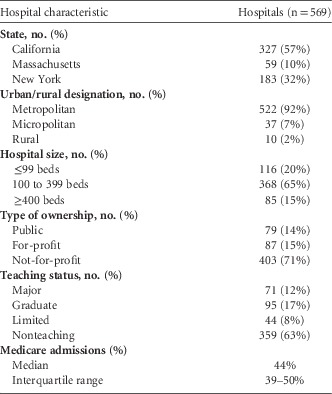
A total of 569 eligible hospitals located in California, Massachusetts, or New York were included in this analysis, with approximately 90% located in New York or California (Table 1). The majority were located in metropolitan areas (92%) and were mid-sized (100 to 399 beds, 65%), not-for-profit (71%), and nonteaching (63%).
Characteristics of Hospitals in the California, Massachusetts, and New York State Inpatient Databases Subject to the Centers for Medicare and Medicaid Services Inpatient Prospective Payment System Rule

Coding for VCAI and CAUTI
From January 2008 through September 2011, a total of 24,298 out of 9.0 million (26.9 per 10,000) Medicare discharges had the ICD-9 code indicative of VCAI. Of these, only 8,470 (35%) were designated as not-present-on-admission, for a VCAI rate of 9.4 per 10,000 discharges. Over the same period, the proportion of hospitalizations with the ICD-9 code indicative of VCAI increased from 20.2 to 32.9 per 10,000 discharges, with most of the increases attributable to present-on-admission infections (Online Supplementary Appendix 1).
From January 2007 through September 2011, a total of 38,326 out of 11.4 million (33.8 per 10,000) Medicare discharges had the ICD-9 code indicative of CAUTI. Only 5,502 (14%) were designated as not present-on-admission, for a CAUTI rate of 4.85 per 10,000 discharges. Over the same period, the proportion of hospitalizations with ICD-9 codes indicative of CAUTI increased from 23.0 to 44.9 per 10,000 discharges, with most of the increases attributable to present-on-admission infections (Online Supplementary Appendix 2).
Impact of Policy on Billing Rates for VCAI and CAUTI
In the period prior to the CMS HAC policy, the billing rate for VCAI was increasing by 17% (95% CI, 11%–23%) per quarter (Figure 1 and Table 2). After the CMS HAC policy went into effect in October 2008, there was an immediate reduction of 25% (95% CI, 19%–31%) in the odds of billing for VCAI, followed by a slight downward trend of 2% (1%–3%) per quarter in the postpolicy period.
Rates of billing for A, vascular catheter–associated infections (VCAI), and B, catheter-associated urinary tract infections (CAUTI), before and after implementation of the Center for Medicare and Medicaid Services hospital-acquired conditions policy in October 2008, among adult Medicare patients admitted to acute care hospitals in California, Massachusetts, or New York State.

Odds Ratios (ORs) for Changes in Billing for Vascular Catheter–Associated Infections (VCAI) and Catheter-Associated Urinary Tract Infections (CAUTI) Among Medicare Patients

NOTE. Independent variables include terms for time (calendar quarter), policy period (before October 2008 vs October 2008 and beyond), and the interaction between time and policy period. Models are also adjusted for state and a hospital’s size, ownership type, teaching status, and percent Medicare admissions (in quartiles).
a VCAI models include January 1, 2008, through September 30, 2011.
b CAUTI models include January 1, 2007, through September 30, 2011.
c Odds ratios comparing the fourth quarter to the third quarter in 2008.
The billing rate for CAUTI was increasing by 19% per quarter (95% CI, 16%–23%) in the period prior to the CMS HAC policy (Figure 1 and Table 2). There was a 13% (95% CI, 4%–21%) decrease in the odds of billing for CAUTI at the time of policy implementation, followed by a leveling-off in the postpolicy period (odds ratio, 0.99 [95% CI, 0.97–1.00]).
Secondary Analyses
We had hypothesized that the CMS HAC policy might have a differential impact by a hospital’s size, for-profit status, or proportion of Medicare admissions. We found no evidence to suggest that the effect of the policy on billing rates for VCAI or CAUTI differed by any of these characteristics (P>.05 for all interaction terms).
In secondary analyses, we also examined whether the CMS HAC policy had a “spillover” effect on billing rates for VCAI and CAUTI in non-Medicare patients. Unlike among the Medicare population, the CMS HAC policy was not associated with any change in billing rates for VCAI or CAUTI among non-Medicare patients at the time of policy implementation (Table 3). The policy was, however, associated with a downward trend in the billing rate for VCAI and a leveling-off in the billing rate for CAUTI among non-Medicare patients in the postpolicy period, similar to the Medicare population.
Secondary Analysis among Non-Medicare Patients: Odds Ratios (ORs) for Changes in Billing for Vascular Catheter–Associated Infections (VCAI) and Catheter-Associated Urinary Tract Infections (CAUTI)

NOTE. Independent variables include terms for time (calendar quarter), policy period (before October 2008 vs October 2008 and beyond), and the interaction between time and policy period. Models are also adjusted for state and a hospital’s size, ownership type, teaching status, and percent Medicare admissions (in quartiles).
a VCAI models include January 1, 2008, through September 30, 2011.
b CAUTI models include January 1, 2007, through September 30, 2011.
c ORs comparing the fourth quarter to the third quarter in 2008.
Finally, for comparative purposes, we examined SSI after CIED as a negative control condition because it was not targeted by the policy during the study period. We found no change in billing rates for SSI after CIED following implementation of the CMS HAC policy in October 2008 (odds ratio per quarter in prepolicy period, 1.01 [95% CI, 0.94–1.08]; odds ratio comparing Q4 2008 vs Q3 2008, 1.10 [0.81–1.50]; odds ratio per quarter in postpolicy period, 0.98 [0.95–1.02]).
DISCUSSION
The CMS HAC policy appears to have resulted in reductions in billing rates for 2 targeted conditions, VCAI and CAUTI, in the adult Medicare population. Among adult Medicare patients, the CMS HAC policy appears to have been associated with a sudden drop in the billing rate for VCAI followed by a slight downward trend in the postpolicy period. The policy was also associated with a sudden drop in the billing rate for CAUTI followed by a leveling-off in the postpolicy period, among adult Medicare patients.
Our findings of decreases in billing rates for VCAI and CAUTI following the CMS HAC policy are similar to prior work examining the impact of the policy on the billing rate for mediastinitis after coronary artery bypass grafting. Using Medicare claims data, Calderwood et alReference Calderwood, Kleinman and Bratzler 9 found that the policy was associated with a sudden, sizeable drop, followed by a downward trend in the billing rate for mediastinitis after coronary artery bypass grafting. These consistent findings for coding of 3 of the healthcare-associated infections targeted by the CMS HAC policy might suggest that financial disincentives lead to improvements in patient outcomes. In fact, among hospitals reporting data to the National Database of Nursing Quality Indicators, Waters et alReference Waters, Daniels and Bazzoli 26 recently found that the CMS HAC policy was associated with declines in CLABSI and CAUTI as measured using standardized definitions that incorporate clinical and laboratory data; however, the study was limited by a short observation period prior to the policy’s implementation of only 9 months. In contrast, using a longer prepolicy observation period of nearly 4 years, Lee et alReference Lee, Kleinman and Soumerai 19 previously demonstrated that the CMS HAC policy had no impact on CLABSI or CAUTI rates, using standardized definitions that incorporate clinical and laboratory data. This was evidenced by their finding that the rate of decline for CLABSI and CAUTI did not change following the CMS HAC policy. Similarly, Calderwood et alReference Calderwood, Kleinman and Bratzler 9 observed no impact of the CMS HAC policy on rates of mediastinitis after coronary artery bypass grafting, as measured by NHSN data. If true improvements in patient outcomes were to result from the CMS HAC policy, we postulate that they would be observed in both hospital surveillance and billing data, not billing data alone.
Discordant findings between NHSN and billing data with respect to the impact of the CMS HAC policy on healthcare-associated infection rates may be compatible with 2 explanations, including overall lack of validity of billing codes and changes in hospitals’ coding and billing practices. First, billing data likely does not reflect true clinical outcomes. Prior studies have demonstrated that billing data for VCAI and CAUTI have poor sensitivity and moderate predictive value.Reference Zhan, Elixhauser and Richards 15 , Reference Meddings, Saint and McMahon 16 , Reference Tehrani, Russell and Brown 27 – Reference Stevenson, Khan and Dickman 30 Lack of complete capture in billing data may be, in part, because medical coders must base their coding on healthcare providers’ documentation, which may be incomplete. Two observations in the present study support the notion that billing data does not reflect true clinical outcomes. In this study, the billing rate for CAUTI was lower than for VCAI, a pattern that contrasts with that seen in NHSN data, where reported rates of CAUTI have been higher than for CLABSI. Furthermore, we found that only a small minority (14%) of ICD-9 codes for CAUTI were designated as hospital-acquired. Although this is consistent with another study that suggested that few CAUTIs meet HAC criteria,Reference Meddings, Saint and McMahon 16 they contrast with the same study that, on the basis of retrospective medical record review by a physician, found that CAUTIs were far more likely to be hospital-acquired than present-on-admission.Reference Meddings, Saint and McMahon 16
A second possible explanation for the discordant findings between NHSN and billing data, with respect to the impact of the CMS HAC policy on healthcare-associated infection rates, is that hospitals responded to the policy by changing coding practices. The lack of any observed impact of the policy on the billing rate for SSI following CIED, a control condition not targeted by the policy during the study period, suggests that if present, any such changes in coding practices may have been specific to conditions targeted by the policy. Such changes in coding for VCAI and CAUTI could potentially explain our observation of improvements in infection rates in billing data without concurrent improvements in NHSN data.
This study was subject to some limitations. First, we were unable to directly assess whether declines in billing rates for VCAI or CAUTI following the CMS HAC policy reflect changes in coding practices. We also could not examine whether any such changes might actually represent more accurate information than was previously recorded prior to the policy. Second, the upward trends in rates of coding for hospital-acquired VCAI and CAUTI prior to the CMS HAC policy implementation may have been due to increased adoption of ICD-9 codes for these conditions, because they were not available prior to 2007 and 2008, respectively. A similar rapid rise in the use of ICD-9 codes specific for methicillin-resistant Staphylococcus aureus was also reported after these codes were introduced in October 2008.Reference Tehrani, Cao, Kwark and Huang 31 Nevertheless, we noted sudden drops in billing rates for VCAI and CAUTI coinciding with the implementation of the CMS HAC policy, followed by a downward trend in VCAI and a leveling-off in CAUTI. Third, because the ICD-9 code for VCAI was not introduced until 2008, the prepolicy period (ie, January through September 2008) for assessing the baseline trend of the billing rate for this HAC was short. Finally, we could not assess the financial impact of billing for VCAI or CAUTI on hospital reimbursement, which could provide more direct insights into whether the policy had a sufficient financial impact to motivate hospitals to reduce infection rates.
Among Medicare patients, the CMS HAC policy appeared to be associated with decreases in billing rates for VCAI and CAUTI. In actuality, the policy may not have had its intended impact of reductions in these targeted healthcare-associated infections, because prior work demonstrated that rates based on hospital surveillance did not change following implementation of the CMS HAC policy. This discordance demonstrates the importance of choosing appropriate metrics for implementing payment-based incentives and measuring the impact of programs addressing quality of care. In line with this notion, CMS has recently incorporated hospital surveillance data for CLABSI, CAUTI, and other healthcare-associated infections into its Value Based Purchasing Program, which adjusts hospitals’ payments based on several measures reflecting hospital quality. 32 Nonetheless, the HAC policy based on billing data has now been expanded to the Medicaid population. 33 Additionally, Partnership for Patients, a large national quality improvement learning collaboration, utilizes billing metrics, as well as NHSN, National Database of Nursing Quality Indicators, and other data sources, to evaluate its impact on a number of HACs, including CLABSI and CAUTI.Reference Felt-Lisk 34 Continued evaluation of the impact of these policies and programs with standardized outcome metrics is necessary to ensure they achieve their intended impacts.
Acknowledgments
We sincerely thank Melisa Rett, Kenneth Kleinman, ScD, and William Kassler, MD, MPH, for reviewing the manuscript. We also thank Dr. Kleinman for assistance with the statistical analysis.
Financial support. Agency for Healthcare Research and Quality (grant R01HS018414). The content is solely the responsibility of the authors and does not necessarily represent the official views of the Agency for Healthcare Research and Quality.
Potential conflicts of interest. All authors report no conflicts of interest relevant to this article.
Supplementary material
To view supplementary material for this article, please visit http://dx.doi.org/10.1017/ice.2015.86