A recent estimate suggests that more than 5,000,000 children, or 7% of all US children, have experienced a coresident parent leaving to spend time in jail or prison, and this is likely an underestimate (Murphey & Cooper, Reference Murphey and Cooper2015). The vast majority of affected children have incarcerated fathers; although the number of incarcerated mothers has increased dramatically in the past 20 years, it is still relatively small (Glaze & Maruschak, Reference Glaze and Maruschak2008). In the past decade, numerous population-based studies have documented elevated risk for deleterious outcomes in children whose parents are incarcerated, even when accounting for preincarceration risk factors (Geller, Garfinkel, Cooper, & Mincy, Reference Geller, Garfinkel, Cooper and Mincy2009; Wakefield & Wildeman, Reference Wakefield and Wildeman2011; Wildeman Reference Wildeman2010), with the most consistent results found for children of incarcerated fathers (Turney & Wildeman, Reference Turney and Wildeman2015). However, few studies have examined dyadic or family relationships when their fathers are incarcerated, and fewer still have examined resilience processes in these children. The current study, which draws on attachment theory (Bowlby, Reference Bowlby1982) and developmental ecological theory (Bronfenbrenner, Reference Bronfenbrenner1979, Reference Bronfenbrenner2005), addresses two aims. First, we examine whether caregiving quality in the home buffers risks associated with paternal incarceration on young children's attachment security. Second, we report findings from a new observational measure that attempts to capture children's attachment-based emotions and behaviors while visiting their incarcerated parents in a corrections setting.
Caregiving Risk and Protective Factors During Parental Incarceration
Ecological models emphasize the importance of multiple contexts, or interrelated settings in which development occurs (Bronfenbrenner, Reference Bronfenbrenner2005), whereas attachment theory focuses on the quality of the parent–child interactions that contribute to children's close relationships and well-being across the life span (Bowlby, Reference Bowlby1982). Attachment theory also emphasizes the significance of disruptions in relationships that occur when a child is separated from a parent (Bowlby, Reference Bowlby1973). Dyadic interactions such as those that contribute to a child's attachment relationships are examples of proximal processes, and often function as key contextual mediators, or the primary drivers of development (Bronfenbrenner & Ceci, Reference Bronfenbrenner, Ceci, Plomin and McClearn1993, Reference Bronfenbrenner and Ceci1994).
Parental incarceration may cause disruption in children's attachment relationships because of the enforced separation that occurs, especially if the parent and child were living together or had a meaningful relationship prior to incarceration (Poehlmann, Dallaire, Loper, & Shear, Reference Poehlmann, Dallaire, Loper and Shear2010). Following paternal incarceration, 80%–90% of children are cared for by their mothers, although grandparents and other relatives also often tend to play important caregiving roles (Glaze & Maruschak, Reference Glaze and Maruschak2008). Previous research with young children of incarcerated mothers has found that children's caregiving environments during parental incarceration are important for children's development, for better or for worse (Poehlmann, Reference Poehlmann2005a, Reference Poehlmann2005b). However, there is a dearth of research investigating such processes following paternal incarceration.
The current literature suggests that children of incarcerated parents (COIP) are, on average, exposed to multiple risk factors. In addition to separation from the parent, children may have witnessed the parent's criminal activity or arrest (Dallaire & Wilson, Reference Dallaire and Wilson2010), which can be anxiety provoking or even traumatizing, especially if the parent's crime is violent. Additional general risk factors have been empirically implicated in the formation of insecure attachments (De Falco et al., Reference De Falco, Emer, Martini, Rigo, Pruner and Venuti2014; Diener, Nievar, & Wright, Reference Diener, Nievar and Wright2003; Eiden, Edwards, & Leonard, Reference Eiden, Edwards and Leonard2002), and these risks often co-occur alongside incarceration-specific risks. For example, incarcerated parents report a high incidence of substance and alcohol abuse and mental health problems. Data from 2004 indicate that 67% of parents in state prison reported substance dependence or abuse, while 57% experienced mental health issues within the 12 months prior to arrest (Glaze & Maruschak, Reference Glaze and Maruschak2008). Findings from the Fragile Families and Well-being Study suggest that, compared to children not affected by paternal incarceration, COIP are more likely to live in families marked by low maternal education, and prior to parental incarceration, have fathers that earn less and are unemployed (Geller, Cooper, Garfinkel, Schwartz-Soicher, & Mincy, Reference Geller, Cooper, Garfinkel, Schwartz-Soicher and Mincy2012). In addition to economic challenges, young COIP on average experience 1.2 more adverse childhood experiences (not including parental incarceration) compared to the national average, even after accounting for sociodemographic indicators (Murphey & Cooper, Reference Murphey and Cooper2015). Despite limited data, research suggests that many caregivers of COIP experience parenting strain, as well as domestic violence and drug use (Aaron & Dallaire, Reference Aaron and Dallaire2010; Arditti, Reference Arditti2012; Arditti, Lambert-Shute, & Joest, Reference Arditti, Lambert-Shute and Joest2003; Geller et al., Reference Geller, Cooper, Garfinkel, Schwartz-Soicher and Mincy2012; Nesmith & Ruhland, Reference Nesmith and Ruhland2008; Wildeman, Schnittker, & Turney, Reference Wildeman, Schnittker and Turney2012).
Although there is a high probability of risk within the caregiving environments of COIP, research with this population suggests heterogeneity in outcomes, including children's attachments. In particular, Poehlmann (Reference Poehlmann2005a) found that 63% of young children with imprisoned mothers had representations of insecure attachments. Some children develop positive relationships despite having an incarcerated parent; thus, it is important to investigate under what conditions risks are associated with children's attachment security in COIP. Given the theoretically and empirically supported etiology of secure attachment in early childhood, especially the importance of sensitive and responsive parenting (Bowlby, Reference Bowlby1982/1969; De Wolff & van IJzendoorn, Reference De Wolff and van IJzendoorn1997), caregiving quality is likely a key variable that may act to buffer or potentiate the effect of contextual risk on children's development. Therefore, the first aim of the current study was to examine the moderating role of caregiving quality in the relation between incarceration-related risks and children's attachment security during paternal incarceration. This study does not examine parental incarceration versus no parental incarceration, like a recent analysis examining resilience in COIP using the Fragile Families Child Wellbeing Study data set (Markson, Lamb, & Losel, Reference Markson, Lamb and Losel2016), but variability within a COIP sample that experienced different “dosages” of risk due to the incarceration (e.g., the incarceration caused a separation from the child, the child witnessed the parent's crime or arrest, and the parent is incarcerated for a violent crime). In other words, we examine heterogeneity in an at-risk sample, rather than exploring whether caregiving fully offset risk vis-à-vis a normative standard.
Children of Jailed Parents: Important Distinctions
Compared to children of parents in prison, we know less about children when their parents are in jail (as jails and prisons differ in several ways, as delineated below), in part because of methodological challenges, including recruitment difficulties and high mobility of participants (Poehlmann-Tynan & Eddy, Reference Poehlmann-Tynan and Eddy2013). The term COIP typically refers to children with jailed or imprisoned parents, experienced currently or in the past, and most studies make no distinction in their samples of children, despite differences in these correctional contexts (e.g., Murray, Farrington, & Sekol, Reference Murray, Farrington and Sekol2012). Jails are locally operated and typically house individuals before conviction and sentencing as well as those individuals sentenced for misdemeanor crimes, typically for 1 year or less. Both state and federal prisons incarcerate individuals sentenced for felonies, typically for more than 1 year. The vast majority of US incarceration occurs at the jail level; there were approximately 11,400,000 admissions to US jails in 2014, with 744,600 people housed in jails at midyear 2014, compared to 1,500,000 individuals housed in state or federal prisons at year end 2014 (Carson, Reference Carson2014; Minton & Zeng, Reference Minton and Zeng2015). Many jail incarcerations appear cyclic in nature (i.e., multiple short stays), potentially causing increased family instability and uncertainty compared to imprisonment.
In addition to the time component, the specific correctional context (i.e., prison vs. jail) may confer unique risks that have the potential to influence proximal processes for children (Bronfenbrenner & Morris, Reference Bronfenbrenner and Morris2006; Poehlmann et al., Reference Poehlmann, Dallaire, Loper and Shear2010), especially because children are common visitors in corrections facilities. For example, in the 12-month period between July 2011 and June 2012, the Wisconsin Department of Corrections recorded visits at half of its corrections facilities for adult men and found that 48,000 visits from children occurred, with more than 131 children walking into Wisconsin state prison visiting rooms per day (Poehlmann-Tynan, Reference Poehlmann-Tynan and Poehlmann-Tynan2015). Although similar data are not available for jails, previous research suggests that families may be more likely to visit jails than prisons, in part because jails are typically located in closer proximity to inmates’ families (Arditti et al., Reference Arditti, Lambert-Shute and Joest2003). Compared to prisons, jails across the United States are much more likely to offer barrier visitation (Shlafer, Loper, & Schillmoeller, Reference Shlafer, Loper, Schillmoeller and Poehlmann-Tynan2015), where all visitors, including children, sit behind Plexiglas and speak to the incarcerated individual through handheld devices that look like older telephones. Although often located far from the families of offenders, prisons are more likely to offer face-to-face visits, where children may touch their parents, usually at the beginning and end of visits (Shlafer et al., Reference Shlafer, Loper, Schillmoeller and Poehlmann-Tynan2015). Although parenting programs in corrections contexts have offered child-friendly visitation and examined parent and child outcomes (Eddy, Martinez, & Burraston, Reference Eddy, Martinez and Burraston2013), this is the first quantitative study to examine young children's behaviors during different types of visits at corrections facilities.
Children's Attachment Behaviors in the Context of Jail Visitation
Although the caregiving environment is implicated in attachment-related processes in high-risk children, for many COIP a second incarceration-specific context may activate attachment behaviors (Poehlmann et al., Reference Poehlmann, Dallaire, Loper and Shear2010). During visits with a parent in jail, children experience many conflicting feelings such as confusion, happiness, and anxiety (Poehlmann-Tynan et al., Reference Poehlmann-Tynan, Runion, Burnson, Maleck, Weymouth, Pettit, Huser and Poehlmann-Tynan2015) and the quality of the caregiver–child relationship may serve as a key determinant of children's affect and behaviors during this emotionally intense experience. Visitation practices and policies vary by institution, with some correctional facilities providing caregivers with little control over conditions. For example, because of the layout of many visitation areas, children are often exposed to other visitors (Poehlmann-Tynan et al., Reference Poehlmann-Tynan, Runion, Burnson, Maleck, Weymouth, Pettit, Huser and Poehlmann-Tynan2015). Because of the potential stressors present in a corrections environment, it is likely that children's attachment systems become activated. Numerous publications have noted the key role that caregivers play in regulating the frequency of contact between children and their incarcerated parents (e.g., Poehlmann et al., Reference Poehlmann, Dallaire, Loper and Shear2010; Shlafer & Poehlmann, Reference Shlafer and Poehlmann2010); nevertheless, studies have not examined children's reliance on caregivers and general adjustment within the context of jail visitation, especially regarding their attachment-related behaviors.
Our lab recently reported preliminary findings regarding children's affect and attachment behaviors while visiting their parents in jail (Poehlmann-Tynan et al., Reference Poehlmann-Tynan, Runion, Burnson, Maleck, Weymouth, Pettit, Huser and Poehlmann-Tynan2015). Using a measure that we developed, 20 children and their families were observed from the time that they arrived at the corrections facility until they completed the visit with the incarcerated parent. We found that the majority of children sought proximity to their caregivers and exhibited high levels of contact maintenance manifested as clinging and hand holding during entry into the corrections facility, while waiting to visit with the incarcerated parent, and during visitation. During the visit, 45% of children engaged in avoidant behaviors with their caregivers, and most (82%) also displayed avoidance at least once toward their incarcerated parents. However, despite their seemingly high levels of anxiety, nearly all children (95%) talked with their incarcerated parent, and the vast majority (80%) conveyed loving feelings toward their parents through either verbal or nonverbal behaviors. To our knowledge, this is the only prior study reporting observations of children's attachment-related behaviors during their visits with incarcerated parents.
The paucity of research detailing children's attachment-related behaviors in the context of corrections may be attributed to the difficulty of executing traditional attachment measures in situations where there are strict guidelines for children's behavior in relation to their parents and caregivers. Although conditions outside the visitation room may be undercontrolled, once children enter the visitation room, there are often rules for children that include extended periods of being stationary and very limited (if any) physical contact with the incarcerated parent. Moreover, video recording is generally not allowed in corrections facilities for security reasons, making it difficult to capture children's behaviors in such settings.
Measurement of Attachment for Children With Incarcerated Parents
Several approaches have been used to assess children's representations of the quality of their attachments to their parents and other caregivers during a parent's incarceration, including the Attachment Story Completion Task (Poehlmann, Reference Poehlmann2005a), family drawings (Dallaire, Ciccone, & Wilson, Reference Dallaire, Ciccone and Wilson2012), and the Inventory of Parent and Peer Attachment (Shlafer & Poehlmann, Reference Shlafer and Poehlmann2010). These approaches can be useful, as they indirectly assess children's cognitions and feelings about family relationships; however, such approaches do not directly assess children's attachment behaviors. The Strange Situation, a frequently used measure of children's attachment relationships, is difficult to implement with children of incarcerated parents because videotaping in corrections facilities is (usually) not allowed and incarcerated parents are not accessible in the community. Moreover, the limited age range of the Strange Situation can present a problem for studies focusing on children with incarcerated parents. Only two studies to date have used the Strange Situation with incarcerated parents and their children (Byrne, Goshin, & Joestl, Reference Byrne, Goshin and Joestl2010; Cassidy et al., Reference Cassidy, Ziv, Stupica, Sherman, Butler, Karfgin and Powell2010); the studies focused on infants in prison nursery and jail diversion programs for women, representing an extremely small percentage of children with a parent in prison or jail.
Another commonly utilized measure of attachment, the Attachment Q-Sort (Waters & Dean, Reference Waters and Deane1985) can be used to characterize the child's attachment to his caregiver during the parent's incarceration, although it cannot be used to characterize the child's attachment to the incarcerated parent because of the limited opportunities for interacting that occur during a parent's prison or jail stay. Alternative assessment methods that take advantage of naturally occurring times when incarcerated parents and children interact together are needed. One of the only examples of such times occurs when children visit their incarcerated parents in jails or prisons. Such visits usually occur face to face, through a Plexiglas barrier, or through video visitation. Although scholars and professionals have paid an increasing amount of attention to children's visits with incarcerated parents (Poehlmann et al., Reference Poehlmann, Dallaire, Loper and Shear2010; Poehlmann & Eddy, Reference Poehlmann-Tynan and Eddy2013), assessments have focused on frequency of visits and other forms of contact rather than on quality (Dallaire, Zeman, & Thrash, Reference Dallaire, Zeman, Thrash and Poehlmann-Tynan2015; Poehlmann, Reference Poehlmann2005c). For the current study, we present data from the new measure that we developed for characterizing children's attachments to incarcerated parents and their caregivers during a jail or prison visit. The assessment that we created takes the field beyond the prevailing measurement approaches that have characterized attachment research for decades by observing children's behaviors in a unique, high-risk setting while the child is interacting with two adults simultaneously (rather than with one caregiver). Although scholars have previously developed observational methods for characterizing children and coparents in triadic interactions (e.g., McHale, Salman, Strozier, & Cecil, Reference McHale, Salman, Strozier and Cecil2013), security and control considerations in corrections settings make it difficult to implement such assessments. Our new observational assessment is designed for use in corrections settings. It can be used to observe young children during video, barrier, and face-to-face visits with parents in jail or prison settings, and it has been adapted for older children as well (Shlafer, Hindt, & Davis, Reference Shlafer, Hindt and Davis2015).
Children's Age and Parental Race
Many children affected by parental incarceration are young. For children with a parent in state prison, 22% were 4 years or younger, 30% were 5–9 years, 32% were 10–14 years, and 16% were 15–17 years (Glaze & Maruschak, Reference Glaze and Maruschak2008). Although many scholars and professionals suggest that children's age may affect their ability to cope with a parent's incarceration, a recent meta-analysis found that child age at the time of the parent's incarceration did not moderate the effect of the incarceration on children's outcomes (Murray et al., Reference Murray, Farrington and Sekol2012). However, only two age groups (0–10 and 11–17 years) were contrasted, and attachment security was not among the outcomes examined. Previous studies using the Attachment Q-Sort have found that security scores increase with age (e.g., Carlson, Hostinar, Miner, & Gunnar, Reference Carlson, Hostinar, Mliner and Gunnar2014; Clark & Symons, Reference Clark and Symons2000), in part because some items focus on social behaviors that tend to improve as children grow older. Based on these findings, we expected children's age to relate to their Q-Sort security scores and to their behaviors during visits in the corrections setting.
Children of color are disproportionately affected by parental incarceration, reflecting large racial disparities in mass incarceration (Wakefield & Wildeman, Reference Wakefield and Wildeman2013). Black children are 7.5 times more likely than their White counterparts to experience parental imprisonment (Wildeman, Reference Wildeman2009). Black children of fathers without high school diplomas have a 50% likelihood of experiencing the incarceration of their fathers during childhood, compared to 7% of White children (Wildeman, Reference Wildeman2009). In some marginalized communities of color, the experience of caregiving for COIP is normative rather than atypical. In 2014, White inmates accounted for 47% of the total jail population, whereas Black inmates comprised 35% and Hispanics comprised 15% (Minton & Zeng, Reference Minton and Zeng2015), numbers that represent significant disproportionality in relation to the US population. Given these disparities, we entered parental race as a control variable in our analyses.
Hypotheses
Our investigation had two hypotheses. We hypothesized that sensitive, responsive, and developmentally supportive caregiving in the home would moderate risks associated with current paternal incarceration in jail (i.e., the incarceration caused a separation from the child, the child witnessed the parent's crime or arrest, and the parent is incarcerated for a violent crime) on young children's attachment to their caregivers, controlling for general risks (i.e., poverty, parental substance abuse, length of the current separation, and frequency of visits with the jailed parent), children's age, and the parent's race. Regarding validation of our new attachment measure, we also expected children's attachment-based emotions and behaviors with caregivers and parents while visiting in jail to be correlated with children's attachment security assessed at home. We anticipated that younger children would have more difficulty coping with the corrections setting than older children, and that children would experience heightened negative affect and behaviors during visits that occurred behind Plexiglas compared to other visit modalities.
Method
Participants
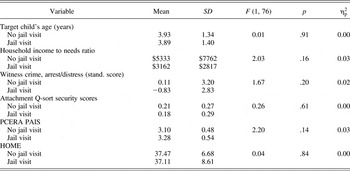
Seventy-seven children and their caregivers and jailed parents participated in the current study. Of the 77 children who participated, 28 were observed during a visit with their jailed parent. There were no significant differences between the children who had an observed jail visit and those who did not in regard to the child's age, family income to needs ratio, and assessments of attachment, parent–child interaction, and the home environment (see Table 1). There were also no differences regarding the child's gender, χ2 (2, N = 77) = 0.07, p = .80, the incarcerated parent's race, χ2 (2, N = 77) = 0.19, p = .67, whether the child's current caregiver was a mom or another relative, χ2 (2, N = 77) = 0.01, p = .94, whether or not the child had experienced a previous separation from the caregiver, χ2 (2, N = 77) = 0.47, p = .49, whether the father had lived with the child prior to incarceration, χ2 (2, N = 77) = 1.07, p = .30, whether or not the incarcerated father had committed a violent offense, χ2 (2, N = 77) = 0.47, p = .49, and whether or not the incarcerated father had a history of drug or alcohol abuse χ2 (2, N = 77) = 1.22, p = .27. However, children with an observed visit were more likely to have visited with the incarcerated father at the corrections facility in the past, χ2 (2, N = 77) = 20.45, p < .001.
Comparison of children with incarcerated fathers who did (n = 28) and did not (n = 49) participate in observed jail visits

Note: PCERA, Parent-Child Early Relational Assessment; PAIS, affective involvement, sensitivity, and scaffolding subscale; HOME, Home Observation for Measurement of the Environment.
Characteristics of children and families
The 77 children who participated in the study consisted of 40 boys (52%) and 37 girls (48%). The children ranged in age from 2 to 6 years, with an average of 3.9 years (SD = 1.4). Jailed parents were incarcerated for drug-related charges (15%), probation violations (21%), battery/violence (13%), nonpayment of child support (15%), domestic dispute/domestic violence (17%), DUI or DWI (11%), and other crimes (e.g., theft and property damage; 8%). Fifty-nine percent of jailed parents identified themselves as African American, 22% were Caucasian, 7% were Latino, and 12% were multiracial. Incarcerated parents indicated ways in which they communicated with their children during the jail stay. Sixty-two percent of incarcerated parents indicated they had telephone contact with their child. Twenty-seven percent of parents indicated that they wrote to their child, and 26% of parents indicated that their children wrote to them. Visit data are reported in the Results section.
Of the 28 children observed visiting their jailed fathers, children ranged in age from 2 to 6 years, with an average of 3.9 years (SD = 1.4). Fourteen children were girls, and fourteen were boys. Jailed fathers were incarcerated for drug-related crimes (21%), probation violations (25%), battery/violence (14%), nonpayment of child support (11%), DUI or DWI (11%), and other (e.g., theft and disorderly conduct; 18%). Fifty-four percent of jailed parents identified as African American, 25% were Caucasian, 7% were Latino, and 14% were multiracial. Incarcerated parents indicated ways in which they communicated with their children during the jail stay. Seventy-five percent of incarcerated parents indicated they had telephone contact with their child. Twenty-seven percent of parents indicated that they wrote to their child, and 29% of parents indicated that their children wrote to them. Additional data are reported in the Results section.
Inclusion and exclusion criteria
Recruitment efforts began with the jailed parent. Weekly, administrative staff at jails in three Wisconsin counties that represented diverse urban and rural populations provided either the names of newly sentenced parents who had children between 2 and 6 years of age or access to a database with this information. Identified inmates then participated in a brief initial screening with a trained researcher to determine if they met research criteria indicating that they (a) were at least 18 years old, (b) had a child who lived with kin within the county in which the inmate was serving time (or an adjacent county), (c) had retained legal rights to the child and had not committed a crime against the child, (d) had cared for the child at least part of the time prior to incarceration, (e) could understand and read English, and (f) had already been sentenced to serve jail time or were accused of committing a misdemeanor crime that would result in jail (rather than prison) time. If the inmate had more than one child in the age range, one child was randomly selected for participation in the study. Inmates who met criteria were invited to participate in the study, and those who agreed signed informed consent forms and participated in an interview, a vocabulary assessment, and self-administered questionnaires. The study was approved by the Institutional Review Board of the University of Wisconsin, and an NIH Certificate of Confidentiality was used.
Three jail systems participated in this research, all of which were run by county sheriff's departments. The sheriff's departments were in charge of both law enforcement and the jails in their counties. The first jail is located in a large urban community that experiences significant racial disparities in arrest and incarceration rates. Although 86% of people in the county are White, approximately half of the jail inmates are African American; for example, of the total 9,276 inmates who spent time in the county jail in 2012, 47% were Black. The facility has an 823-bed capacity, with an average daily population of 788 inmates (21% women, 79% men). In this jail, visits occur through a Plexiglas barrier in a secure section of the jail or through video visitation in a nonsecure section of the jail. The second jail site is located in a rural county. The jail has a 458-bed capacity, and in 2009, the jail had a daily count of 277 inmates (90% men, 10% women), although the daily count decreased during the study period. At this jail, visits occur through closed-circuit TV in a nonsecure part of the jail. The third jail is located in an urban community and holds a mix of individuals from urban and rural locations. In 2010, the average daily population of the county's three corrections facilities was 704, although our study focused on only two of the facilities. Visits in these two facilities occur through a Plexiglas barrier in a secure section of the jail or face-to-face in a secure section of the jail for incarcerated individuals with daytime work release privileges.
Procedure
Recruitment of families began with the jailed parents. Each jail added questions to its intake forms inquiring if the individual had children and the children's ages. Incarcerated individuals who had children in the specified age range were approached. If they met inclusion criteria, the jailed parent was presented with a consent form, which was read aloud. Consented inmates were interviewed by a researcher in a private area within the cell block, with security staff nearby. We asked jailed parents about demographics, children's living arrangements prior to and following incarceration, children's experience of incarcerated-related events, and previous and current contact with children and children's caregivers. During interviews with jailed parents, researchers also asked the inmate for the contact information of the child's caregiver; to sign a consent form for the child's participation and for the observed jail visit; and to sign release forms to contact the child's caregiver. We were unable to compensate jailed parents for their study participation. Researchers contacted children's caregivers by phone, letter, in person, by e-mail, or by text messages. Children and caregivers were assessed at home and, if scheduling permitted, during a jail visit. During the initial visit, caregivers were asked to sign an informed consent form for their own and the child's participation (read aloud because of potential literacy issues), and children were asked for their verbal assent.
Home visit
Two trained researchers conducted a home visit with the child and caregiver that lasted 2 to 3 hr and included interviews, standardized assessments, observations of the home environment, videotaped caregiver–child play with a standard set of toys, self-administered questionnaires, and observation of naturally occurring caregiver–child interactions. One researcher interviewed the caregiver, and the other assessed the child. Caregivers were paid $50 following the home visit, and children were given an age-appropriate book.
Observed jail visit
During the jail data collection, which lasted between 20 and 90 min (depending on the wait time and length of visit), the child's visit with the jailed parent was observed and rated. Children were accompanied to the jail visit by their caregivers. A researcher met the family at the entrance to the jail and observed the child during security procedures, wait time, and during the visit with the jailed parent. Visits occurred either through closed-circuit television (i.e., video visit), through Plexiglas (i.e., barrier visit), or face-to-face. In all types of visits, the caregiver and child (and observer) could see the jailed parent. However, during barrier and video visits, only one family member at a time could speak with and hear the jailed parent through a headset similar to a telephone receiver. The observer was not able to hear or interact with the jailed parent, although the jailed parent knew that the observer was present (and previously had provided written consent for the observation). Observers were able to see and hear the child, and thus they focused on rating the child's emotional and behavioral reactions to the visit rather than adult behaviors. Caregivers were paid $50 following the observed jail visit, and children were given stickers.
Measures
Incarceration-related risk factors
Interviews were conducted with incarcerated parents in the jail setting and with children's caregivers in the home setting. Incarcerated parents were asked if they lived with the target child prior to this incarceration, and caregivers were asked to corroborate this information. For children who lived with the incarcerated parent before the jail stay, we coded that this incarceration was responsible for a disruption in the child's attachment relationship with the jailed parent.
Caregivers were asked questions about the child's experience with incarceration-related experiences based on Dallaire and Wilson (Reference Dallaire and Wilson2010). We asked whether or not the child witnessed the parent's crime and how much distress the child experienced because of this, rated on a scale ranging from 1 (no distress) to 5 (extreme distress). Caregivers were also asked whether or not the child witnessed the parent's arrest and how much distress the child experienced because of this, again rated on a scale ranging from 1 (no distress) to 5 (extreme distress). These four items were standardized and summed to create a single witness-distress variable (Cronbach α = 0.80).
During their interviews, jailed parents were asked to describe the type of crime that led to their current incarceration. We categorized the offenses as violent (1) or nonviolent (0) and then used a public records database (Wisconsin Circuit Court Access; https://wcca.wicourts.gov/index.xsl) to corroborate this information, with only one disagreement that we coded as missing data.
Proximal processes in the home
Home Observation for Measurement of the Environment (HOME) summary score
Quality of the home and family environment was assessed through observations in caregivers’ homes and structured interviews with caregivers using Caldwell and Bradley's (Reference Caldwell and Bradley2001) HOME, early childhood version. The HOME is a standardized procedure designed to measure the family environment systematically through a combination of interview and observational data obtained in the child's home while the child is awake and interacting with adults. Although subscales for the HOME exist, we utilized total HOME scores for the current analysis (Cronbach α = 0.85). Two trained researchers independently coded the home environments of 10 families, resulting in an average κ = 0.87 for the HOME items, which are scored in a binary manner.
Parent-Child Early Relational Assessment (PCERA)
Caregiver–child interactions were assessed via 15 min of videorecorded free play. The caregiver and child were given a standardized set of toys and instructed to play as they normally would. The first 5 min were coded for caregiving quality due to technical issues in the field as well as some caregivers’ inability to participate in the entire 15-min play period.
Videos were coded using the PCERA (Clark, Reference Clark2014/1985), a coding scheme designed to assess the frequency, duration, and intensity of caregivers’ behavior and affect. Twenty-nine parent items reflect the caregiver's tone of voice, affect, mood, attitude toward child, and parenting style. Items are rated on a scale ranging from 1 (least desirable) to 5 (most desirable). While there are three empirically established parent subscales (Durik, Hyde, & Clark, Reference Durik, Hyde and Clark2000), only the parental positive affective involvement, sensitivity, and scaffolding (PAIS) subscale was utilized in the current study. Fourteen items in that subscale reflect caregivers’ sensitive and responsive caregiving, with higher scores indicating higher quality caregiving. Examples of items included in the PAIS subscale include warm tone of voice, ranging from 1 (cold or distant tone of voice is characteristic) to 5 (very warm; kind and loving tone of voice is characteristic); enjoyment and pleasure ranging from 1 (no enjoyment or pleasure in one's child expressed) to 5 (expresses a great deal of enjoyment and pleasure; characteristic); and parent reads child's cues and responds sensitively and appropriately, ranging from 1 (insensitive to child; oblivious, indifferent, or unresponsive to child's cues; consistently misreads or misinterprets child's cues) to 5 (very empathic, characteristically reads child's cues and responds sensitively and appropriately). Ten percent of the sample was independently coded by six trained researchers, and interrater reliability was calculated using intraclass correlations (ICCs). ICCs ranged from 0.70 to 0.93 (M = 0.82). PAIS scores ranged from 30 to 69 (M = 50.6, SD = 8.14), and the Cronbach α for the PAIS was 0.89.
Children's attachment to their caregivers
The Attachment Q-Sort (Vaughn & Waters, Reference Vaughn and Waters1990; Waters & Deane, Reference Waters and Deane1985) is an attachment measure that is based on observations of children, typically aged 1 to 5 years, naturally interacting with their caregivers in the home. It focuses on a range of attachment-related behaviors including secure base behaviors, exploration, emotional responses, and social cognitions. Meta-analyses have indicated that the Q-Sort, when used by trained observers, is reliably associated with children's Strange Situation security classifications and with parental sensitivity (van IJzendoorn, Vereijken, Bakersmans-Kranenburg, & Riksen-Walraven, Reference van IJzendoorn, Vereijken, Bakermans-Kranenburg and Marianne Riksen-Walraven2004). To minimize response bias, the 90 items are sorted into a fixed distribution (10 piles of 9 items each) based on the salience of children's attachment behaviors, relative to other behaviors (Waters & Deane, Reference Waters and Deane1985). Each child's security score is calculated as the correlation between the child's Q-profile and the Criterion Security Q-Sort (a composite of attachment expert ratings). The score for each child ranges from +1.0 (very secure) to –1.0 (very insecure) regarding his or her relationship with the attachment figure assessed. Because no natural cutoff score exists for the Q-Sort, we used the continuous security scores. Ten cases were independently completed by two trained researchers resulting in an ICC, reflecting interrater reliability, of 0.72.
Children's attachment behaviors and emotions during jail visits
The Jail-Prison Observation Checklist (JPOC; Poehlmann, Reference Poehlmann2012) was used to rate children's reactions to visits with their parents in jail. The JPOC is an observational rating scale designed to be rated in vivo by trained researchers in jail or prison settings starting from when a child enters the corrections facility for a visit until the time the child leaves. Because researchers are generally not able to videotape in corrections setting, ratings are made live, as the behaviors occur, and interrater reliability is established in the corrections setting.
Observers rate the presence or absence of security procedures (metal detector, frisking of adults or children, shoe removal, bag search, and checking identification), and the presence or absence of children's behaviors and affect during entry, wait, and visit. Additional items refer to cleanliness and noise in the jail or prison environment, families’ interactions with staff members, length of wait time, type of visit, length of visit, and presence of child-friendly materials (e.g., stickers and coloring materials). Following the visit, researchers also complete global ratings of children's activity level, behavioral dysregulation (i.e., how well the child is able to modify his or her own behaviors in response to demands of the context), and emotional lability as displayed throughout their time at the corrections facility. These ratings are made on a 1 to 5 scale, with higher ratings indicating more activity, dysregulation, and lability.
For the present study, we focused on children's behaviors and emotions toward caregivers and incarcerated parents during the actual visit (rather than the entry and waiting period). Codes for children's affect and behavior toward the incarcerated parent during the visit included visual attention, listening, verbal and nonverbal responding, avoiding, paying attention to other visits, happy, excited, loving, sad, angry, whining, fearful, confused, and somber. In addition, codes for children's affect and behavior toward the caregiver during the visit included proximity seeking, sitting on lap, holding hands, clinging, avoiding, hitting or pushing, happy, excited, sad, angry, whining, fearful, confused, and somber. Interrater reliability for items on the JPOC was established between two independent observers across 15 observed jail visits. Kappas (calculated for binary-coded items) fell within an acceptable to high range. Child's affect and behavior toward incarcerated parent during the visit ranged from κ = 0.65 to 1.0 (M = 0.87), and child's affect and attachment behavior toward caregiver during visit ranged from κ = 0.65 to 1.0 (M = 0.82). ICCs for global ratings of children's dysregulation, activity, and lability in the jail were 0.50 for individual scales but significantly higher when ratings were combined (ICC = –0.95, Cronbach α = 0.66); thus, the combined item (child's overall dysregulation in jail setting) was used in analyses.
Control variables and general risk factors
During interviews with caregivers, we asked for the child's birthdate and calculated the child's age based on the date of the interview. We also inquired about the family's income and how many individuals lived in the home; using this information, we calculated a family income to needs ratio. We asked if the child had ever visited the incarcerated parent during the current jail stay and how frequently this occurred. During interviews with jailed parents, we asked them to identify their race. For the purpose of our analyses, we coded race as White (1) and non-White (0). Jailed parents also reported on how much of their current sentence they had served, which also represents the amount of time that the parent had been separated from the child if they had lived together prior to the incarceration.
The Michigan Alcoholism Screening Test (MAST) was used to assess incarcerated parents’ self-reported alcohol abuse in the previous 12 months (Selzer, Reference Selzer1971). Twenty-five items comprise the measure. Scores range from 0 to 53, with higher scores indicating higher risk of alcohol abuse. In the current study, the MAST Cronbach α = 0.89. Jailed fathers received a 0 for low scores and a 1 for scores in the borderline or alcohol abuse categories. The Drug Abuse Screening Test (DAST) was used to assess incarcerated parents’ self-reported drug abuse in the previous 12 months (Skinner, Reference Skinner1982). Twenty items comprise the DAST. Scores range from 0 to 20, with higher scores indicating more drug abuse. In the current study, the DAST Cronbach α = 0.93. The DAST has shown adequate internal consistency and test–retest reliability (Villalobos-Gallegos, Pérez-López, Mendoza-Hassey, Graue-Moreno, & Marín-Navarrete, Reference Villalobos-Gallegos, Pérez-López, Mendoza-Hassey, Graue-Moreno and Marín-Navarrete2015). Jailed fathers received a 0 for low scores and a 1 for scores in the drug abuse category.
Results
Some variables had missing values (1.5% overall). Seventy-one families had complete data and six participants had missing data, although none had more than 10% missing data. To address this issue, a multiple imputation procedure (Raghunathan, Lepkowski, van Hoewyk, & Solenberger, Reference Raghunathan, Lepkowski, van Hoewyk and Solenberger2001; Van Buuren, Reference Van Buuren2007) was implemented, involving generating five data sets in which missing values were randomly produced conditional upon other variables in the analysis. Subsequent analyses were applied to all five data sets, with aggregated results reported (findings were similar in the original and pooled results). Outcome variables were not imputed.
Descriptive findings
Children's Attachment Q-Sort security scores in this sample of young children with incarcerated fathers ranged from –0.43 to 0.69, with a mean of 0.20 (SD = 0.28), similar to studies with clinical samples (the mean security score in clinical samples is 0.21, with a significantly higher mean of 0.32 for normative samples; van IJzendoorn et al., Reference van IJzendoorn, Vereijken, Bakermans-Kranenburg and Marianne Riksen-Walraven2004).
Caregivers reported that 27% of children witnessed the father's crime, and 22% of children witnessed the father's arrest. Whereas 59% of children who witnessed the father's arrest exhibited “extreme distress,” only 18% exhibited little or no distress. Of the children who witnessed the father's crime, 52% exhibited “extreme distress” and 24% exhibited little to no distress. Some arrests occurred at the child's home at predawn; some children were sleeping, but other children woke. For example, in one family law enforcement officers threw a stun grenade into the home and then used a ram to open the front door; the officers lined the children up on the couch and the parent was marched, in handcuffs, past the children. In another home, the law enforcement officer shot the family dog in front of the children and it died on the coffee table during the arrest. Other arrests occurred when families were out of the home. One father was stopped for a traffic violation and arrested while his child was in the car. The child was “crying, screaming, wanting his dad, asking why they have to take his dad.” Many children were described as crying or screaming and acting confused. As one caregiver stated about the child, “She started crying. She said to me, ‘What's going on? What's going on? Is Daddy getting arrested? Why are they not letting him go? Why can't he come with us?’ And the child said to the law enforcement officer, ‘Why are you taking him? Where is he going? Why isn't he coming with us?’”
Twenty-six percent of fathers were incarcerated for a violent crime. Sixty-nine percent of fathers reported that they lived with the target child prior to this incarceration, and 61% of caregivers reported that the child had visited the father in jail, with an average of one visit every other week.
Of the 28 children who were observed visiting their fathers in jail, 3 were accompanied by their grandmothers and the remainder were accompanied by their mothers, and other children in the family were present for 10 of the visits. Length of wait time prior to the visit ranged from 0 to 65 min, with an average of 14 min (SD = 17.8), and visits lasted from 12 to 55 min, with an average of 31 min (SD = 13.5). Thirteen of the observed visits were barrier visits (Plexiglas), 11 of the visits occurred through video monitors, and 4 of the visits were face to face.
Caregiving quality as a moderator
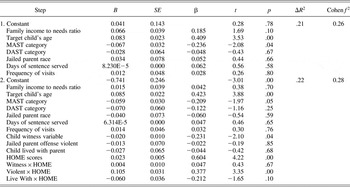
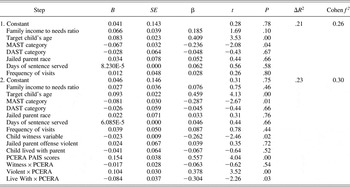
The first set of multivariate analyses examined caregiving quality as a moderator of the relation between incarceration-related risks and children's attachment security when parents were incarcerated in jail. Two multiple linear ordinary least squares regressions were conducted with Attachment Q-Sort security scores as the dependent variable. In both analyses, children's age, the family's income to needs ratio, the jailed parent's race, the length of time the parent served in jail, frequency of children's visits with the jailed father, and whether the jailed parent had alcohol (MAST category) or drug (DAST category) abuse were entered as control variables in the first step. In the second step, incarceration-related risks (the witness-distress variable, whether the child lived with the parent prior to incarceration, and whether the parent's offense was violent or nonviolent), the proximal caregiving moderator (HOME or PCERA), and interactions between the incarceration-related risks and caregiving moderator were entered. The first analysis included the HOME total score as the caregiving moderator (Table 2), whereas the second analysis included the PAIS subscale from the PCERA as the caregiving moderator (Table 3).
Results from regression analyses with the HOME as the moderator (N = 77)

Note: Home Observation of the Measurement of the Environment; MAST, Michigan Alcoholism Screening Test; DAST, Drug Abuse Screening Test.
Results from regression analyses with the PCERA as the moderator (N = 77)

Note: PCERA, Parent-Child Early Relational Assessment; MAST, Michigan Alcoholism Screening Test; DAST, Drug Abuse Screening Test; PAIS, affective involvement, sensitivity, and scaffolding subscale.
In Step 1 of both analyses, children's age and MAST scores were significantly associated with children's attachment security. Older children had higher security scores than younger children, and jailed parents who reported significant alcohol problems (borderline or abuse) had children with lower security scores. Other variables in Step 1 (family income to needs ratio, length of sentence served, frequency of visits, etc.) were not associated with children's security scores.
In Step 2 of both analyses, the witness-distress variable related to children's attachment security; children who witnessed the parent's crime and arrest and who expressed more distress about it were less likely to have a secure attachment to their caregivers. The other incarceration-related risks (the child lived with the parent prior to incarceration and the parent's crime was violent or nonviolent) were unrelated to children's attachment security with caregivers.
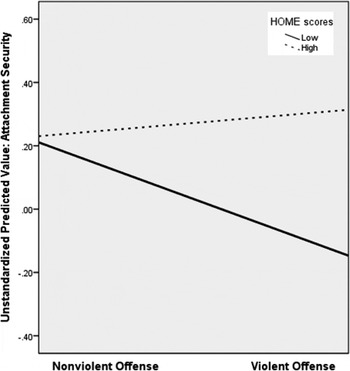
In Step 2 of the analysis with HOME scores entered as the caregiving variable, we found that overall, children who experienced more stimulating, learning-focused, and structured home environments were more likely to have secure attachments to their caregivers. The HOME × Violent Offense interaction variable was also statistically significant. Simple slopes analyses indicated that for children with low structure, stimulation, and responsivity in the home, there was a strong association between paternal violent crime and low attachment security for children (β = –0.44, p = .01; R 2 = .19, Cohen f2 = 0.23), whereas this association was not present for children in high-quality home environments (β = 0.16, p = .31; R 2 = .03, Cohen f2 = 0.03; Figure 1).
Positive Home Observation for Measurement of the Environment (HOME) scores as a moderator of the relation between violent offenses and children's attachment to caregivers when fathers are in jail.

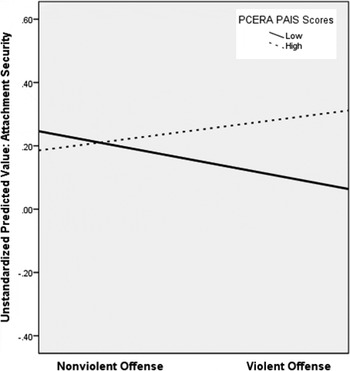
In Step 2 of the analysis with the PCERA scores entered as the caregiving variable, we found similar results. Overall, children who experienced sensitive, responsive, positive interactions with their caregivers during play at home were more likely to have secure attachments to the caregiver. The PCERA × Violent Offense variable and the PCERA × Child Lived with Parent variable were also statistically significant. Simple slopes analyses indicated that for children who experienced less sensitive and responsive interactions with their caregivers, there was a significant association between paternal violent crime and children's attachment security (β = –0.36, p = .03; R 2 = .13, Cohen f2 = 0.15), whereas this association was nonsignificant and positive for children whose caregivers interacted with them in a sensitive, responsive, and affectively positive manner (β = 0.27, p = .07; R 2 = .12, Cohen f2 = 0.13; Figure 2). An additional simple slopes analysis revealed associations in opposite directions, but neither were statistically significant (i.e., for children with more positive caregiver–child interactions, there was a nonsignificant negative association between living with the jailed parent prior to incarceration and attachment security (β = –0.16, p = .34; R 2 = .03, Cohen f2 = 0.03), whereas there was a nonsignificant positive association for children who experienced less positive interactions with caregivers (β = 0.13, p = .44; R 2 = .02, Cohen f2 = 0.02).
Positive parent–child interaction quality as a moderator of the relation between violent offenses and children's attachment to caregivers when fathers are in jail. PCERA, Parent-Child Early Relational Assessment; PAIS, affective involvement, sensitivity, and scaffolding subscale.

Children's emotions and behaviors during visits at the jail
The second set of analyses focused on our observations of children's visits with their jailed parents using the JPOC. For the purposes of data reduction only, principal components analysis with Varimax rotation was conducted on the 12 codes for children's affect and behavior toward the incarcerated parent during the visit that showed variability across children (listening, responding, avoiding, paying attention to other visits, happy, excited, loving, sad, angry, whining, fearful, and confused). Components with eigenvalues greater than 1.0 were included. A second principal components analysis was conducted on the 9 codes for children's affect and behavior toward the caregiver during the visit that showed variability across children (proximity seeking, sitting on lap, avoiding, hitting or pushing, sad, angry, whining, fearful, and confused). For each analysis, a three-component structure appeared to fit the data. Using this approach, component scores were estimated for each child using the Bartlett method. For children's behavior and affect with the incarcerated parent during the visit, items that loaded the highest on each component (0.60 and above) were (a) listening, responding, happy, excited, loving, which we labeled responsive-loving to incarcerated parent; (b) avoiding, paying attention to other visits, angry, whining, which we labeled avoidant–angry to incarcerated parent; and (c) fearful, sad, and confused, which we labeled fear–sad to incarcerated parents. For children's behavior and affect with the caregiver during the visit, items that loaded the highest on each component (0.57 and above) were (a) avoiding, whining, angry, sad, which we labeled as avoidant–angry to caregiver; (b) proximity seeking, sitting on lap, not confused, which we labeled proximity–contact to caregiver; and (c) hitting or pushing and fearful, which we labeled as aggression–fear to caregiver.
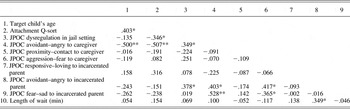
Subsequently, two sets of exploratory analyses were conducted to examine children's component scores in relation to characteristics of the jail setting and the child's attachment security measured in the home. Bivariate correlations were calculated among children's component scores, the global rating of children's dysregulation in the jail, length of children's wait before the jail visit, Attachment Q-Sort security scores, and children's age (see Table 4). Because younger children had more difficulty in the areas of avoidant–angry to caregiver (r = –.50, p < .01), global dysregulation (r = –.35, p < .05), and attachment security (r = .40, p < .05), partial correlations with age as the covariate were computed for these variables. Partial correlations were statistically significant for attachment security and the avoidant–angry to caregiver component (r = –.39, p < .05), indicating that, even controlling for age, children rated as more secure in the home environment were less likely to engage in avoidance, anger, whining, and sadness toward the caregiver during the jail visit, consistent with our hypothesis. Children's fear–sad to incarcerated parents component score positively correlated with the aggression–fear to caregiver factor (r = .48, p < .01) and the avoidant–anger to caregiver factor (r = –.41, p < .05), controlling for age, highlighting links between children's behaviors and emotions to caregivers and incarcerated parents. Although attachment security was correlated with children's overall dysregulation in the jail setting (r = –.35, p < .05), this was reduced somewhat when age was partialed (r = –.32, p = .06). Longer wait time prior to the visit was correlated with the avoidant–anger to incarcerated parents score (r = .35, p < .05).
Correlations with JPOC component scores (n = 28)

Note: JPOC, Jail-Prison Observation Checklist.
*p < .05. **p < .01.
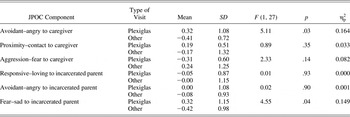
In the second set of exploratory analyses, six analyses of covariance were used to compare children's component scores during Plexiglas with other types of visits (video and face to face), with children's age as a covariate. The results indicated that, controlling for age, children's mean scores were higher for avoidant–anger to caregiver and fear–sad to incarcerated parents during Plexiglas visits compared to other types of visits, with medium effect sizes (see Table 5). The means of the other four component scores did not differ based on the type of visit. However, because of the large number of analyses relative to the small sample size, these findings should be viewed as tentative.
Analyses of covariance comparing children's JPOC component scores for plexiglas versus other visits (n = 28)

Note: JPOC, Jail-Prison Observation Checklist.
Discussion
As the number of US children affected by parental incarceration grows, it is imperative to increase our knowledge base about what experiences confer additional risk and what can support children during this potentially stressful time. In this study, we documented processes in children's proximal contexts that are related to young children's attachment relationships with their caregivers when their fathers are incarcerated. This is also the first study to present findings documenting children's attachment-related emotions and behaviors observed during visits with an incarcerated parent in a corrections setting.
In the present study, 27% of children witnessed the father's crime, and 22% of children witnessed the father's arrest, with most children who witnessed these events exhibiting extreme distress, and few children exhibiting mild or no distress. In their study of 32 children aged 7 to 17 years, Dallaire and Wilson (Reference Dallaire and Wilson2010) found that 60% of children had witnessed the parent's crime and 41% had witnessed the parent's arrest. Differences between the studies may have contributed to the varying estimates; in the Dallaire and Wilson study, more children with incarcerated mothers had witnessed incarceration-related events than those with incarcerated fathers, and the children were older. Dallaire and Wilson (Reference Dallaire and Wilson2010) also found that children who experienced incarceration-related events also exhibited more behavior problems. Similarly, we found that children's experience of incarceration-related events was associated with their attachment security. In the present study, young children who witnessed the parent's crime or arrest and exhibited more distress about it were more likely to have insecure attachments to their caregivers, controlling for a host of general risk factors. However, because our study is neither longitudinal nor experimental, we cannot attribute causality to this finding, and bidirectional influences are possible. Caregivers who are not sensitive and responsive to their children, and thus more likely to foster insecure attachments, may expose their children to more inappropriate parental behaviors, such as a parent's crime. It is also possible that children's exposure to potentially traumatic events, such as witnessing a parent's arrest, may engender anxiety that is difficult for caregivers to assuage. In any case, it would be helpful for our society to refrain from unnecessarily exposing children to the arrest of a parent, and if necessary, taking precautions to protect children from trauma associated with parental arrest. In line with this idea, the International Association of Chiefs of Police offers training regarding safeguarding children during the arrest of parents based on its 2014 model policy recommendations. These model policies are available for adoption by law enforcement professionals throughout the United States.
Consistent with attachment theory and research, we also found that caregivers who exhibited more sensitivity and responsivity during interactions with children in the home and those who provided more stimulating, responsive, learning-oriented home environments had children who were more likely to have secure attachments. This is the first study to report such findings in children with incarcerated fathers. In addition to these main effects, we also found interaction effects for measures of proximal processes in the home, two of which were consistent with our moderation hypothesis.
High-quality proximal processes with caregivers in the home attenuated the relation between paternal violent crime and children's attachment insecurity. Previous research focusing on children with incarcerated parents has either not examined or not found effects for type of parental crime in relation to children's outcomes. Moreover, few, if any, studies of children with incarcerated parents have examined type of parental crime as it interacts with proximal processes in the home on children's outcomes. Many studies of children with incarcerated parents have relied on secondary analysis of data sets that were not originally designed to focus on the sequelae of parental incarceration, and thus, many key incarceration-related risk factors or family-based protective factors are not assessed. Typically large data sets that have been analyzed in this literature fall into two categories: (a) rich in data focusing on the incarcerated individual, including the crime, sentence, mental health, type of corrections facility, recidivism, and so on; or (b) rich in data focusing on the child and/or family, including caregiver behaviors and attitudes, child behavior and emotions, and parent–child interactions. It is critical that future population-based studies focusing on children with incarcerated parents include depth of measurement in both areas.
When we examined the relation between general risk factors and children's attachment security, we found that children whose jailed fathers reported borderline or significant alcohol abuse had children with less secure attachments to their caregivers. In contrast, paternal drug abuse was not associated with children's attachment security in this sample. These findings are partially consistent with previous literature focusing on risk factors for insecure attachment in young children. For example, in a study of 12-month-old infants with alcoholic and nonalcoholic parents, Eiden et al. (Reference Eiden, Edwards and Leonard2002) found that fathers’ alcohol problems were associated with lower paternal sensitivity during play interactions, which related to elevated risk for infant–father attachment insecurity. Moreover, previous studies have found that children's attachments to their mothers can have a protective effect. For example, Edwards, Eiden, and Leonard (Reference Edwards, Eiden and Leonard2006) found that for preschoolers with alcoholic fathers, children with early secure attachments to their mothers exhibited fewer behavior problems than children of alcoholic fathers with insecure attachments to mothers.
New method of assessing children's attachment in corrections settings
Because traditional attachment measures are unsuited to corrections settings, we developed a new measure focusing on observations of children's attachment-related behaviors and emotions during visits with their incarcerated parents. Corrections facilities require that children be accompanied by an adult, usually the child's parent or guardian, and thus our measure included children's behaviors and emotions toward their caregivers as well as their incarcerated parents. We found preliminary evidence for validity of the measure, in that children's behaviors during the visit correlated with their attachment security as assessed by observers in the home using the well-established Attachment Q-Sort.
Our observations of children during Plexiglas visits corroborated Dallaire et al. (Reference Dallaire, Zeman, Thrash and Poehlmann-Tynan2015) results indicating that, in certain contexts, noncontact visits can be stressful for children. Because young children are able to see their parents through the Plexiglas but are unable to touch them, these visits in particular may activate a child's attachment system and trigger anxiety that cannot be easily assuaged since the parent–child separation continues following the visit. In contrast, video visitation may be more akin to Skype or Facetime or other types of video visitation that have become normative in the United States and allow families and children, even young children, to connect with relatives and friends who live at a distance. It should be noted that we found differences in children's negative behaviors toward caregivers and incarcerated fathers during barrier visitation, but not in children's positive behaviors or emotions toward caregivers or jailed fathers.
We also found that caregivers play a notable role during children's visits with incarcerated parents. Previous studies have documented how caregivers regulate frequency of visits between young children and their incarcerated parents (e.g., Poehlmann, Reference Poehlmann2005c). The present study also found that children's behaviors and emotions toward incarcerated fathers during visits correlated with their emotions and behaviors with the caregivers who accompanied them. Many of the interactions we observed were triadic rather than dyadic, with caregivers coaching children about what to say to incarcerated parents. Caregivers may benefit from education about their critical role during visits, and more can be done to emphasize the important role that the caregiver–child relationship can serve when families are visiting in the corrections setting. Policies and procedures that help reduce children's negative emotions (e.g., fear, confusion), such as preparing them for visits and providing support from caregivers and other loved ones before, during, and after visits are also important for fostering children's well-being. Our findings should not be used to limit children's visits, however, but rather to buoy supports. Parenting interventions in corrections and community settings could be more effective for this population by preparing caregivers, children, and incarcerated parents for visits, which can be emotionally charged, and suggesting multiple ways for families to connect with an incarcerated parent. For example, Sesame Street recently developed materials for young children and their families including an animated depiction of a child's visit to a corrections facility, a story book, videos, and a caregiver guide (Little Children, Big Challenges: Incarceration, 2013; http://www.sesamestreet.org/parents/topicsandactivities/toolkits/incarceration). Sesame Workshop developed a new Muppet character for the project, Alex, who has an incarcerated father and discusses his feelings and experiences about his father's incarceration, which can be helpful to children because they generally view Muppets as children. In the videos, a caring adult and other Muppets support Alex, and they discuss letter writing as a way to stay in touch with Alex's incarcerated father. The caregiver guide suggests ways for families to stay in touch with children's incarcerated parents, such as sending cards or making phone calls between visits, in addition to covering topics such as how to talk to very young children about parental incarceration and how to handle common emotional reactions that children have when their parents are incarcerated. Because these materials are free (available in hard copy, on Sesame Street's website, and as a free app) corrections facilities can use them widely. Corrections facilities could also post suggestions for supporting children during visits along with the rules and regulations for visits. Wait time for children should be limited as well, because longer waits were correlated with more problematic behaviors in children.
We also found that younger children struggled with several aspects of their behavior during their visits with incarcerated fathers, and they may need additional supports from caregivers during visits. In general, prior studies focusing on children with incarcerated parents have not consistently identified children's age as a risk factor (e.g., Murray et al., Reference Murray, Farrington and Sekol2012). However, prior analyses have focused on measures that can be used with older children or that can be used across childhood (e.g., behavior checklists); yet such measures often tap into only a very small sample of children's meaningful developmental competencies or challenges. In the future, scholars should use measures that are more developmentally appropriate and include fine-tuned analyses of age. Longitudinal studies of children with incarcerated parents and studies that pay more attention to family processes, especially those that are observed, are important in furthering our knowledge base about children with incarcerated parents and their families.
The present study has numerous limitations that should be kept in mind when interpreting the findings. The sample size of 77 children, their caregivers, and parents is modest, and the sample of 28 children who visited their fathers in jail is small and likely resulted in limited power to identify significant effects. The study did not include a matched comparison group that would have allowed for addressing questions about whether incarceration is a unique risk factor for children; however, many variables that we examined would not have been relevant for a comparison group (e.g., witnessing the parent's crime or arrest; visiting the incarcerated parent). A comparison group would provide a normative standard and allow more precise analyses of resilience processes. Jailed parents and caregivers who chose not to participate in the current study may have differed in significant ways from those that consented and whose children were ultimately enrolled. We cannot generalize our findings to children with incarcerated mothers, and our findings are based on correlations, limiting causal interpretations. One strength of our study is that we used several observational and developmentally appropriate measures, which is uncommon in the literature focusing on children of incarcerated parents.
Although previous research has shown that children with incarcerated parents, on average, are likely to experience multiple risk factors, there is heterogeneity within this group regarding risk exposure, potential assets, and developmental outcomes. Delving into such “dosage” effects, as we studied here regarding children's exposure to incarceration-related risk factors, may inform our understanding of children's development when parents are incarcerated, including security of attachment and attachment-related behaviors and emotions.