Introduction
Advances in paediatric cardiology and cardiac surgery have greatly improved survival, resulting in an increasing number of adults with CHD. In Japan, the estimated adults with CHD population was approximately 530,000 in 2020. Reference Kuraoka, Ishizu and Nakai1 Ventricular septal defect is the most common type of CHD, accounting for 20 to 40 % of cases. Reference van der Linde, Konings and Slager2,Reference Hoffman and Kaplan3 Pulmonary hypertension occurs in about 5% of CHD patients, and ventricular septal defect is associated with a relatively high incidence of pulmonary hypertension. Reference Hoffman and Kaplan3,Reference Jone, Ivy and Hauck4
Intracardiac repair for ventricular septal defect has been performed since the 1950s. Reference Lillehei, Cohen and Warden5 Although patients with ventricular septal defect and pulmonary hypertension (ventricular septal defect-pulmonary hypertension) typically undergo intracardiac repair during infancy or early childhood and are generally considered to have favourable long-term outcomes, Reference Wang and Chesler6 pulmonary hypertension can persist after intracardiac repair. Reference Myers, Tissot and Christmann7,Reference Luciani, Pessotto and Mazzucco8 Recently, the “treat-and-repair” strategy has been introduced to improve outcomes in CHD patients complicated by pulmonary hypertension. Reference Akagi, Yamada and Miyaji9
We examined the long-term outcomes and features of residual pulmonary hypertension after intracardiac repair in patients with ventricular septal defect-pulmonary hypertension.
Methods
We retrospectively reviewed medical records of patients with ventricular septal defect-pulmonary hypertension who underwent intracardiac repair and were followed at our institute between January 1970 and December 2024. Inclusion criteria were Reference Kuraoka, Ishizu and Nakai1 current age ≥13 years, Reference van der Linde, Konings and Slager2 history of intracardiac repair for ventricular septal defect-pulmonary hypertension, and Reference Hoffman and Kaplan3 follow-up visit within the past 5 years.
We assessed pulmonary hypertension in the long-term postoperative period and analysed related clinical factors. Data extracted including age, sex, Kirklin classification, genetic abnormalities, NYHA functional class, age at surgery, and type of surgical procedure. Ventricular septal defect location was categorised according to the Kirklin classification Reference Soto, Ceballos and Kirklin10 as Type I (outlet/subarterial), Type II (perimembranous), Type III (inlet/atrioventricular canal), or Type IV (muscular/trabecular).
Definition of pulmonary hypertension
Pulmonary hypertension was defined as a mean pulmonary arterial pressure >20 mmHg, measured by right heart catheterisation, according to the 2022 European Society of Cardiology/European Respiratory Society (ESC/ERS) guidelines and the 6th World Symposium on Pulmonary Hypertension. Reference Humbert, Kovacs and Hoeper11,Reference Simonneau, Montani and Celermajer12
For patients without right heart catheterisation, pulmonary hypertension was defined as estimated right ventricular systolic pressure ≥40 mmHg on echocardiography, based on tricuspid regurgitant jet velocity. Reference Rudski, Lai and Afilalo13
Comparison of hemodynamic parameters
We evaluated preoperative hemodynamic parameters, including estimated right ventricular systolic pressure and left ventricular ejection fraction by echocardiography, and right ventricular pressure, mean pulmonary artery pressure, pulmonary vascular resistance, and pulmonary-to-systemic flow ratio by cardiac catheterisation. In the long-term postoperative period, pulmonary hypertension was assessed by estimated right ventricular systolic pressure on echocardiography. For patients with persistent pulmonary hypertension, we reviewed current treatment and clinical course in detail.
Comparison of clinical variables according to preoperative pulmonary vascular resistance
Preoperative pulmonary vascular resistance is a predictor of irreversible pulmonary vascular remodelling and postoperative outcomes in CHD patients with pulmonary hypertension. A pulmonary vascular resistance of ≥3 Wood units is widely accepted as the threshold for pulmonary vascular disease.
Patients were grouped by preoperative pulmonary vascular resistance (≥3 or <3 Wood units), and we compared age at intracardiac repair; preoperative estimated right ventricular systolic pressure, PAP, mean pulmonary artery pressure, and pulmonary-to-systemic flow ratio; and postoperative estimated right ventricular systolic pressure between groups.
Exclusion criteria
We excluded patients without available estimated right ventricular systolic pressure or mean pulmonary artery pressure data during follow-up, and those with right ventricular outflow tract obstruction, pulmonary artery stenosis, or aortic disease, as these conditions can independently affect pulmonary hemodynamics and confound interpretation of postoperative pulmonary hypertension.
This study was conducted in accordance with the Declaration of Helsinki and approved by the Ethics Committee of Tokyo Women’s Medical University (approval number: 2024–0025). The opt-out method of obtaining consent was used in this study. Due to the retrospective design and anonymization of data, individual informed consent was waived.
Statistical analysis
Comparisons between the two groups were conducted using t-test and Fisher’s exact test. Continuous variables were presented as mean ± standard deviation if normally distributed. Non-normally distributed continuous variables were expressed as median and interquartile range. Categorical variables were compared using the chi-square test. All statistical analyses were performed using JMP software version 7.0.1 (SAS Institute, Inc., Tokyo, Japan). A probability value <0.05 was considered statistically significant.
Results
Patient characteristics
From January 1970 to December 2024, approximately 800 postoperative patients with ventricular septal defect-pulmonary hypertension aged ≥13 years were followed at our institution. However, many had discontinued follow-up voluntarily or had been advised by their physicians to end regular visits. As a result, a total of 115 patients (43 male and 72 female patients) were included in the final analysis. The age range at the time of the current follow-up was 13 to 56 years (median, 21 years). According to Kirklin’s classification, the distribution of ventricular septal defect types was as follows: Type I, 7 cases; Type I + II, 3 cases; Type II, 95 cases; Type II + III, 3 cases; Type II + IV, 2 cases; Type III, 4 cases; and Type IV, 1 case. The age at intracardiac repair ranged from 1 month to 589 months (median, 5.0 months). The postoperative follow-up duration ranged from 62 months to 573 months (median, 221 months). Genetic abnormalities were identified in 19 patients: trisomy 21 in 16, 22q11.2 deletion in 1, trisomy 18 in 1, and conotruncal anomaly face syndrome in 1. The remaining 96 patients had no identifiable genetic abnormality.
Comparison of pre- and post-operative hemodynamics
Among the 52 patients who underwent only preoperative echocardiography, the median estimated right ventricular systolic pressure was 80 mmHg (range: 44–92 mmHg). In 63 patients who underwent preoperative right heart catheterisation, the median right ventricular pressure was 68 mmHg (range: 40–110 mmHg), the median mean pulmonary artery pressure was 42 mmHg (range: 20–77 mmHg), pulmonary vascular resistance was 3.2 Wood units (range: 0.8–10.3 Wood units), and the pulmonary-to-systemic flow ratio was 2.6 (range: 1.0–8.8). In the long-term postoperative period, all patients were assessed using echocardiography. The median estimated right ventricular systolic pressure was 31 mmHg (range: 20–140 mmHg). Residual shunts were observed in 9 patients. In all cases, echocardiography revealed an effective defect diameter of less than 3 mm (tiny shunt), estimated right ventricular systolic pressure of less than 30 mmHg, and no evidence of left ventricular volume overload. Therefore, these residual ventricular septal defects were determined to be hemodynamically insignificant.
Comparison between patients with and without residual pulmonary hypertension
Residual pulmonary hypertension was identified in 3 of 115 patients (2.6%) during long-term postoperative follow-up. All three patients were female. There were no significant differences in age at intracardiac repair, preoperative estimated right ventricular systolic pressure, mPAP, pulmonary vascular resistance, or postoperative left ventricular ejection fraction between the two groups. Among the 3 patients with residual pulmonary hypertension, 2 underwent intracardiac repair after the age of 1 year.
Comparison of clinical variables according to preoperative pulmonary vascular resistance (<3 vs. ≥3 Wood units)
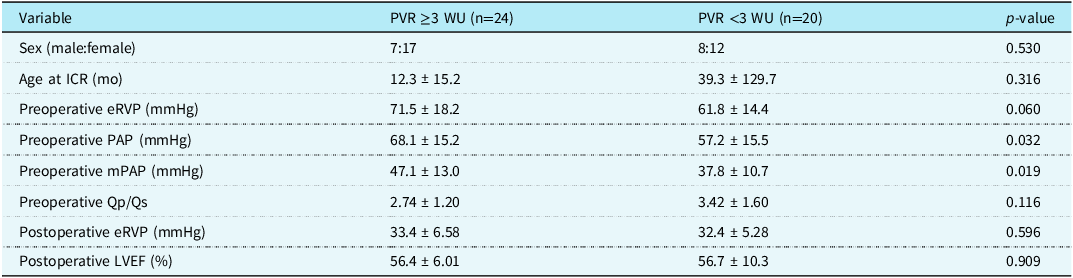
Table 1 presents a comparison of hemodynamic indices between the groups with pulmonary vascular resistance ≥ 3 Wood units and pulmonary vascular resistance < 3 Wood units. Preoperative PAP and mean pulmonary artery pressure were significantly higher in the pulmonary vascular resistance ≥ 3 Wood units group compared with the pulmonary vascular resistance < 3 Wood units group (68.1 ± 15.2 vs. 57.2 ± 15.5 mmHg, p = 0.032; 47.1 ± 13.0 vs. 37.8 ± 10.7 mmHg, p = 0.019, respectively). In contrast, there were no significant differences between the two groups in preoperative estimated right ventricular systolic pressure, pulmonary-to-systemic flow ratio, age at intracardiac repair, or postoperative estimated right ventricular systolic pressure (all p > 0.05). It should be noted, however, that Case 1 was not included in this comparison because preoperative right heart catheterisation had not been performed in this patient.
Comparison of Clinical Variables According to Preoperative Pulmonary Vascular Resistance

Abbreviations: eRVP, estimated right ventricular pressure; ICR, intracardiac repair; LVEF, left ventricular ejection fraction; mPAP, mean pulmonary artery pressure; PAP, pulmonary artery pressure; Qp/Qs, pulmonary-to-systemic flow ratio; PVR, pulmonary vascular resistance; RVP, right ventricular pressure; SD, standard deviation; WU, Wood units.
Note: Values are presented as mean ± SD.
Details of patients with residual pulmonary hypertension
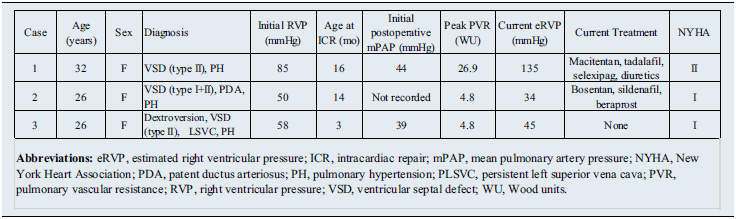
Table 2 summarises the clinical characteristics, hemodynamic data, and current therapies of the 3 patients who had persistent pulmonary hypertension during the long-term postoperative period. None of the three patients with persistent pulmonary hypertension had a residual ventricular septal defect. These cases highlight the heterogeneity in postoperative pulmonary hypertension progression and the importance of long-term surveillance even after anatomical correction.
Summary of Residual PH Cases

Case 1 presented with severe postoperative pulmonary hypertension despite repair at 16 months of age, and showed progressive elevation in PAP and pulmonary vascular resistance from childhood to adulthood. The patient currently requires combination therapy with macitentan, tadalafil, selexipag, and diuretics.
Case 2 showed persistent mild to moderate elevation in right ventricular systolic pressure from early childhood. Although vasoreactivity to oxygen was observed in adolescence, multiple pulmonary vasodilators have been required to maintain hemodynamic stability.
Case 3 showed a stable clinical course with mildly elevated right ventricular systolic pressure over time. The patient remains asymptomatic (NYHA class I) and has not required pulmonary vasodilator therapy.
Discussion
This study presents the long-term follow-up of 115 patients with ventricular septal defect-pulmonary hypertension who underwent primary intracardiac repair during infancy or childhood, with a maximum follow-up duration of 47 years. Few studies have evaluated the natural history of pulmonary hypertension in the late postoperative phase of ventricular septal defect. Although prior studies by Myers et al. Reference Myers, Tissot and Christmann7 and Luciani et al. Reference Luciani, Pessotto and Mazzucco8 have addressed postoperative pulmonary hypertension, their follow-up periods were short, typically 1 to 2 years after surgery. Despite historical variability in preoperative assessments and surgical indications, we identified residual pulmonary hypertension in 3 patients (2.6%) during long-term follow-up. Although postoperative pulmonary hypertension in patients with ventricular septal defect is generally considered reversible, it may persist, requiring long-term follow-up.
Among the 3 patients with residual pulmonary hypertension, we found no significant differences in preoperative hemodynamic parameters—such as estimated right ventricular systolic pressure, mean pulmonary artery pressure, or pulmonary vascular resistance—compared with those without residual pulmonary hypertension. Furthermore, when comparing patients with pulmonary vascular resistance ≥ 3 Wood units vs. those with pulmonary vascular resistance < 3 Wood units (Table 1), although preoperative PAP and mean pulmonary artery pressure were higher in the elevated-pulmonary vascular resistance group, there were no differences in pre- or post-operative estimated right ventricular systolic pressure. Thus, residual pulmonary hypertension cannot be reliably predicted by static preoperative hemodynamic indices alone. Instead, assessment of pulmonary vascular reactivity may be more important in predicting postoperative persistence of pulmonary hypertension.
According to reports by Yamaki Reference Yamaki, Mohri and Haneda14 and Monma, Reference Momma, Takao and Ando15 the optimal timing for surgical repair in patients with ventricular septal defect-pulmonary hypertension is during infancy or early childhood, as of the 1980s. However, all 3 patients with residual pulmonary hypertension in the present study underwent intracardiac repair by 18 months of age, suggesting that even earlier intervention than the timing recommended by Yamaki et al. may be necessary to prevent the persistence of pulmonary hypertension. Currently, in patients with ventricular septal defect-pulmonary hypertension, intracardiac repair is generally recommended around the age of 6 months.
Mechanisms of pulmonary hypertension development in ventricular septal defect
In ventricular septal defect, two pathophysiological patterns of pulmonary hypertension development have been proposed. The first is a “flow-dominant” pattern, in which pulmonary vascular resistance decreases after birth, but progressive pulmonary vascular remodelling occurs due to chronic high pulmonary blood flow. The second is a “resistance-dominant” pattern, in which pulmonary vascular resistance remains elevated from the neonatal period and progresses to irreversible pulmonary vascular disease. The latter is often associated with genetic abnormalities such as trisomy 21 and 22q11.2 deletion syndrome, and is characterised by poor vasoreactivity and a higher likelihood of persistent pulmonary hypertension requiring long-term pulmonary vasodilator therapy after surgery.
These findings indicate that postoperative pulmonary hypertension outcomes depend not only on preoperative hemodynamics but also on the underlying disease pattern and the reversibility of pulmonary vascular remodelling. Although detailed data were not shown, we found no significant differences in age at intracardiac repair, preoperative right ventricular systolic pressure, preoperative pulmonary vascular resistance, or postoperative right ventricular systolic pressure between patients with and without genetic abnormalities (n = 19 and n = 96, respectively).
Importance of preoperative acute vasoreactivity testing
Current surgical strategy for ventricular septal defect-pulmonary hypertension depends in part on patient weight during infancy. In low-weight infants, pulmonary artery banding is often performed initially to restrict pulmonary blood flow, followed by definitive intracardiac repair. Historically, intracardiac repair was considered feasible only if the preoperative pulmonary vascular resistance was below 6–8 Wood units. However, with the emergence of the “treat-and-repair” strategy, surgery is now considered even for patients with elevated preoperative pulmonary vascular resistance if pulmonary vascular reversibility can be demonstrated. Acute vasoreactivity testing has become an increasingly important tool for assessing this reversibility, and may serve as a critical predictor of residual postoperative pulmonary hypertension. Reference Pulido, Ghofrani and Chemla16,Reference Wang and Chesler17
Before the 1990s, acute vasoreactivity testing using oxygen challenge or inhaled nitric oxide was often not performed preoperatively, possibly leading to intracardiac repair without adequate assessment of reversibility. In contrast, since the 2000s, the treat-and-repair strategy and routine use of acute vasoreactivity testing with pulmonary vasodilator therapy have become standard, helping suppress residual pulmonary hypertension postoperatively. In this study, our cases span from the 1970s to recent years, reflecting temporal diversity in management and preoperative evaluation.
Several reports have shown the value of acute vasoreactivity testing in predicting outcomes in both adults and children. For example, acute vasoreactivity testing using nitric oxide and oxygen has demonstrated that changes in pulmonary vascular resistance and mean pulmonary artery pressure strongly correlate with long-term survival and reduced mortality. Reference Rich, Dantzker and Ayres18
As the risk of irreversible pulmonary vascular lesions increases after 1 year of age, preoperative assessment of pulmonary vasodilator responsiveness using acute vasoreactivity testing is crucial for preventing residual pulmonary hypertension. Recent reviews have also shown that acute vasoreactivity testing responsiveness is strongly associated with prognosis. Reference Beghetti, Berger and Schulze-Neick19 Standardising preoperative evaluation, including acute vasoreactivity testing, may improve the safety and efficacy of surgical interventions. Multi-centre studies are needed to identify risk factors and optimise management.
Long-term follow-up after ventricular septal defect surgery
Although ventricular septal defect may appear to be a simple CHD, it carries a significant risk of chronic complications into adulthood. In a large cohort study by Eckerström et al. Reference Eckerström, Nyboe and Maagaard20 long-term survival after ventricular septal defect repair was favourable; however, compared with the general population, the hazard ratio was 2.8, indicating that these patients remain at significantly elevated risk. Even late after surgery, patients remain at risk for infective endocarditis, valvular disease (such as aortic regurgitation), ventricular arrhythmias, and heart failure. As seen in our cases, some patients experience persistent pulmonary hypertension. Regardless of residual pulmonary hypertension, long-term regular follow-up is essential for all patients after ventricular septal defect repair.
Study limitations
At the outset, we note that the study period (1970–2024) is very long, during which diagnostic modalities, surgical techniques, postoperative management, and pharmacotherapy evolved substantially. This temporal heterogeneity may introduce bias into the interpretation of the results. With this context, the following limitations are outlined. First, it was a single-centre retrospective study, with variability in assessment methods (echocardiography or right heart catheterisation). Second, the number of residual pulmonary hypertension cases was small (n = 3), limiting statistical power; larger studies are needed to clarify risk factors. Third, many patients were not evaluated in long-term follow-up, raising possible sampling bias. Fourth, defining long-term pulmonary hypertension based only on echocardiographic right ventricular systolic pressure does not allow definitive diagnosis. Future studies should include comprehensive long-term prognostic analyses with cardiac MRI and right heart catheterisation.
Conclusion
This study documents the long-term natural history of ventricular septal defect-associated pulmonary hypertension over nearly 50 years. Residual pulmonary hypertension was observed in 2.6% of patients after surgical repair. Preoperative hemodynamic parameters did not predict pulmonary hypertension persistence, highlighting the importance of continued long-term follow-up after successful intracardiac repair.
Acknowledgements
We are grateful to all the patients and medical staff who were involved in our clinical practice.
Financial support
This research received no specific grant from any funding agency, commercial, or not-for-profit sectors.
Competing interests
The authors declare no conflicts of interest.