Introduction—The polyolefin success story
With a global production volume of nearly 150 million tons per year, polyolefins are undoubtedly a success story that was essentially enabled by the original discoveries of Karl Ziegler and Giulio Natta in the 1950s (see the Introductory article in this issue of MRS Bulletin). For polyethylene (PE), the gradual expansion of the density range toward very low crystallinities and the controlled variation of the molecular weight distribution (MWD) required constant modifications of polymerization technologies and catalyst performance. For isotactic polypropylene (iPP), the discovery that electron donors in the catalyst system can control the stereoselectivity and increase productivity, combined with carrier technology developments that enabled controlling the polymer particle morphology as well, led to the amazing growth of iPP from the first kilogram-scale production in 1957, to the close to 60 million tons today. Together with multistage polymerization technologies, modern iPP catalysts allow the production of “reactor-based thermoplastic elastomers” with high impact toughness in a temperature range from +80 to –30°C. While the market penetration of metallocene (MC) and other “single-site” catalysts has been significantly slower than anticipated, due in part to the continuous improvement of the traditional—and cheaper—Ziegler-Natta (ZN) systems, the former have enabled an unprecedented fine-tuning of chain microstructure by ligand design.
Polymers have been going through a hard time recently: for the first time since the oil crisis of the early 1970s, global production of polymers in general decreased in 2008 as a result of the unexpected economic crisis overlapping with the expected downturn of the cyclic polyolefin market. At the same time, public perception of “plastics” deteriorated, with critical views on issues such as endocrine disruption, littering, and waste.
Despite all the “green” concerns, polyolefins still excel in performance and energy efficiency over other materials. Large-scale food distribution and preservation would be unthinkable without polyolefins. Bimodal high and medium density PE grades have revolutionized water and gas distribution systems, being light, corrosion-resistant, and the safest choice in case of earthquakes. Efficient individual mobility requires cars combining low weight and high passenger safety with high-impact polypropylene (PP) copolymers at the frontline of this development.
In addition to reviewing the development of catalysts and resulting products, this article also presents some future perspectives for polyolefins.
A brief history of polymerization catalysts
The history of polyolefins starts with the synthesis of “polymethylene” in Germany in 1897 by the decomposition of diazomethane.Reference Mühlhaupt 1 In 1920, the polymeric nature of the substance was uncovered when Staudinger formulated his macromolecule hypothesis, and the practicality of PE was recognized in 1933 at ICI in England where high-pressure polymerization of low-density PE (LDPE) was developed. The limitations of the highly branched polymer in stiffness and melting point, however, became obvious, and an alternative route to a linear polymer was sought.
PE catalyst development
Karl Ziegler’s patent from 1953Reference Ziegler, Breil, Holzkamp and Martin 2 has just four pages and two claims, but it started the development of high-density PE (HDPE) and all of its “children” up to the modern MC elastomers. In his research at the German Institute for Coal Research in Mühlheim an der Ruhr, the combination of transition metal halides (such as TiCl3) with aluminum alkyls (such as Al(C2H5)3) was found to allow catalytic low-pressure polymerization of olefins. Despite its value, the patent lacked one thing: It did not include copolymers with higher α-olefins, which became a decisive factor for modifying the material’s properties. While linear polymer chains yielded high crystallinity and high melting points, this caused problems in the early years of HDPE application; in pure homopolymers, even small cracks could evolve into catastrophic failure.Reference Böhm 3
In comparison to the development for PP, the catalysts for ethylene polymerization did not evolve in so many steps, as the initial productivity was already relatively good. The substitution of TiCl3 by TiCl4 supported on MgCl2 resulted in the biggest increase in productivity, but morphology development in the direction of bigger and more regular particles did not yield a key advantage. Far more important for expanding the density range was the development of suitable polymerization technologies.
The recent development of linear low density polyethylene (LLDPE), the third type of PE in importance (after LDPE and HDPE), has been made possible by Exxon’s discovery of the effect of the catalyst’s organic ligands in MC-catalyzed ethylene polymerization,Reference Welborn and Ewen 4 followed by the development of the “Insite” technology by Dow using a constrained geometry catalyst, also enabling the introduction of long chain branching in PE for enhanced processability,Reference Stevens 5 and the phosphinimido titanium catalysts of Nova.Reference Stephan 6 Both of these catalyst types have outstanding temperature stability, a feature that allows the use of solution processes at temperatures up to 200°C.
PP catalyst development
Ziegler’s ideas also formed the basis for Giulio Natta’s discovery of the stereospecific polymerization of propylene to produce isotactic (i.e., crystalline) polypropyleneReference Natta, Mazzanti and Boschi 7 at the Politecnico di Milano, Italy, in 1954. Isotacticity was initially only around 40% but was increased to 80% within one year through catalyst modification. Also, the stereospecific polymerization of other monomers such as 1-butene and 4-methyl-pentene-1 became practically relevant; common to most of these polymers is the helical chain structure in the crystal lattice (a 3:1-helix for iPP).
More than those for PE, iPP catalysts evolved strongly over time (a detailed table of catalyst generations and their performance can be found in Reference 8). The ZN catalysts were initially heterogeneous but not supported, as TiCl3 was its own carrier. The two most important evolutionary steps were the use of MgCl2 as a reactive catalyst carrier, which improved the catalyst “mileage” (i.e., the yield over the full polymerization time) considerably, and the discovery that select Lewis bases (properly combined “internal” and “external” electron donors) could dramatically increase the stereoselectivity of the catalyst.Reference Soga and Shiono 9
One alternative approach gave up the use of initially solid particles altogether, replacing it with a particle formation process from an emulsion.Reference Bartke, Oksman, Mustonen and Denifl 10 This process delivers perfectly spherical catalyst particles with the desired narrow size distribution and high productivity despite their nonporous structure.
The discovery of MgCl2 as an “ideal” carrier was only challenged by SiO2, an alternative that remained limited to the PE areaReference Böhm 3 and to the immobilization of “single-site” catalysts.
Here, the need for heterogeneous catalysts for controlling the polymer particle morphology in the most important olefin polymerization processes (either in liquid propylene or in gas phase) is a disadvantage for MC catalysts, as these organometallic complexes, homogeneous and soluble by nature,Reference Resconi, Cavallo, Chadwick, Crabtree and Mingos 11 are not easily “forced” onto a solid, inert carrier. The use of SiO2 as a carrier dominated the initial development,Reference Severn, Chadwick, Duchateau and Friederichs 12 even if the results in terms of productivity and process stability were far from satisfactory when compared to their ZN counterparts. This limitation, paired with an intrinsically higher cost of MC versus ZN catalysts, is one reason for the limited market penetration of MC-iPP.
Catalysts for specialties
An exception to the limitations just described, and so far the main success of MC and other “single-site” catalysts, is their use in solution processes for the production of ethylene-propylene and ethylene-propylene-diene elastomers (replacing the old vanadium catalysts and enabling far better process economics) and plastomers (both ethylene- and propylene-based). The latter can be seen as a new family of polyolefins having properties bridging the gap between plastics and elastomers. Brand names such as Engage 13 and Exxact 14 (very low density PE with butene, hexene, or octene as a comonomer), Vistamaxx, 15 and VersifyReference Stephens, Poon, Ansems, Chum, Hiltner and Baer 16 , Reference Boussie, Diamond, Goh, Hall, LaPointe, Leclerc, Vince, Shoemaker, Turner, Rosen, Stevens, Alfano, Busico, Cipullo and Talarico 17 (propylene-ethylene copolymers) are well known to compounders and material designers alike. These copolymers, plus some grades of the “Tafmer” family from Mitsui, are all produced in solution with MC or post-MC catalysts, broadening the property envelope of polyolefins beyond what is achievable with gas phase or liquid propylene processes.
They have been followed in more recent times by Infuse, the first true ethylene—alpha-olefin block-copolymer. This development by Dow is based on a very elegant catalyst design: the combination of two post-MC catalysts having different comonomer reactivity ratios and low chain termination rates, coupled with a “chain shuttling” agent able to transfer the growing polymer chain from one type of catalyst active site to the second one and back. These polyolefins have finally broken the strict correlation between density and crystallinity in ethylene copolymers.Reference Chum and Swogger 18
Catalyst-defined polymer design
Designing the molecular weight distribution
The MWD and its weight average M w are the main defining factors for processability and mechanical performance of every polymer. Their effect on the mechanical performance is less pronounced for crystalline than for amorphous polymer types. For both iPP and HDPE, the M w effect on toughness or fracture is much stronger than on stiffness. In order to combine good processability (i.e., high flowability) with good mechanical properties, it is important to specifically design the MWD, for which the catalysts’ hydrogen response (i.e., the relation between hydrogen concentration in the polymerization and the resulting M w) is essential. For iPP, this can be modified by varying the type and amount of external donor,Reference Seppälä, Härkonen and Luciani 19 but this also affects stereoregularity and MWD.
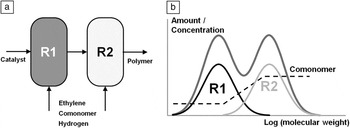
Unless a combination of two or more catalystsReference Galli and Veccellio 8 is used, multimodal MWDs requiring more than one log-normal distribution for description can only be produced in a multistage (multi-reactor) process. For PE, the production can be carried out both in parallel reactors and sequentially, the latter being preferred for reasons of residence time and productivity.Reference Böhm 3 As in every sequential polymerization, the production of bimodal HD/LLDPE with differentiated comonomer incorporation (see Figure 1 ) requires the catalyst to remain active over a longer period and to form stable polymer particles.
Two-reactor (R1 and R2) synthesis of a bimodal high density/low density polyethylene with (a) differentiated comonomer distribution and the (b) resulting molecular weight distribution with comonomer content; the homopolymer with lower molecular weight is typically produced in the first reactor.

For iPP, MWD broadness effects on stiffness are highly relevant due to the pronounced effects of flow-induced crystallization through the presence of very long molecules.Reference Jerschow and Janeschitz-Kriegl 20 This has been applied for designing high modulus PP grades, but just recently the massive effect of changing polydispersity on the thickness of the skin layer consisting of oriented crystals was documented.Reference Pantani, Balzano and Peters 21
Chain regularity, comonomer incorporation, and distribution
Polymer design starts at the molecular level, with the chain structure defining the basic characteristics and application properties of a material. For a comparable chain structure, stereochemistry separates crystallizable subspecies from amorphous subspecies, such as the members of the polypropylene family—atactic (aPP), syndiotactic (sPP), and isotactic (iPP).Reference Busico and Cipullo 22 Similarly, copolymerization can first reduce and finally disrupt the ability of the material to crystallize. The variation of PE with higher α-olefins such as 1-butene or 1-hexene is a classic example of this, with a direct correlation cascade from comonomer content via lamellar thickness and crystallinity to density, mechanical, and optical performance.Reference Böhm 3
For iPP, the effect of stereoregularity on crystallization speed is significant, with highly isotactic species crystallizing significantly faster.Reference Gahleitner, Bachner, Ratajski, Rohaczek and Neißl 23 With ZN catalysts, the type of internal and external donors are decisive in controlling the chain structure but can also have a side effect on hydrogen response and MWD; their effect is largely determined by the binding energy and mobility on the MgCl2 surface, resulting in changes in stereoregularity.Reference Andoni, Chadwick, Niemantsverdriet and Thüne 24 For a given system, varying the internal donor/Ti ratio yields strong variation of the polymer structure.Reference Garoff, Virkkunen, Jääskeläinen and Vestberg 25
Newer internal donors, especially diethers, allow polymerization without an external donor. When comparing a ZN/diether system without an external donor with a ZN/phthalate system with an external silane donor in terms of stereostructure and MWD,Reference Chadwick, van der Burgt, Rastogi, Busico, Cipullo, Talarico and Heere 26 the nature of catalytic centers can be related to the crystallization behavior.
The introduction of MC catalysts required the additional consideration of regio-defects in the chain structure resulting from head-to-head/tail-to-tail monomer insertions.Reference Busico and Cipullo 22 While MC-iPP can reach very high isotacticities (<99%), the regio-defects, by reducing the isotactic block length similar to a stereo defect or a comonomer unit, generally limit the melting point to <160°C. Ligand design can improve the selectivity of a MC catalyst greatly,Reference Schöbel, Herdtweck, Parkinson and Rieger 27 but a MC catalyst showing all properties in one molecule (high productivity and selectivity, high molecular weight capability also in copolymerization, good hydrogen response, and affordable cost) has not yet been reported.
For single-phase random copolymers (RACOs), the consequences of moving from traditional ZN to MC catalysts are even more drastic. In the case of PP with ethylene as a comonomer, the tendency to a blocky insertion normally sets the limit at ∼5 wt% ethylene for ZN-RACOs,Reference Gahleitner, Jääskeläinen, Ratajski, Paulik, Reussner, Wolfschwenger and Neißl 28 while MC-based types can go much higher, making softer and more transparent products accessible. Moreover, these catalysts allow the efficient incorporation of higher α-olefins such as butene or hexene, contributing to the complex polymorphism of iPP.Reference De Rosa, Auriemma, Vollaro, Resconi, Guidotti and Camurati 29
Multistage and multiphase products
For expanding the application range of PP, the glass transition (T g) of PP at around 0°C had to be compensated by impact modification with components having a much lower T g, initially by compounding with ethylene-propylene (EPR) or ethylene-propylene-diene elastomers.Reference Galli and Veccellio 8
The next step in efficiency and performance were products commonly referred to as “block copolymers” from multi-reactor plants, such as the Novolen gas phase process,Reference Schwager 30 or from bulk/gas phase combinations such as the SpheripolReference Cecchin, Morini and Pelliconi 31 or the Borstar PP process. These combine a crystalline PP matrix (produced in the first 1–2 reactors) with embedded particles of EPR and PE (produced in one or more reactors connected in sequence) defining impact and low-temperature resistanceReference Ramsteiner, Kanig, Heckmann and Gruber 32 and should correctly be called “heterophasic copolymers (HECOs)” or “PP impact copolymers.” Important for their development were both the flexible processes and the improved catalysts: With second-generation ZN catalysts,Reference Galli and Veccellio 8 it became possible to produce the first HECOs for technical applications with moderate EPR content of <20 wt%. The introduction of the third generation of ZN catalysts at the end of the 1970s together with solvent-free bulk processes enabled the synthesis of HECOs with high impact strength.Reference Galli and Veccellio 8
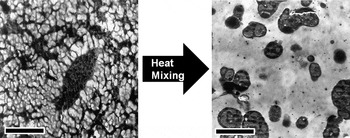
This opens many possibilities for designing multiphase PP copolymers combining different requirements. Applications are no longer limited to technical or automotive areas, but include advanced packaging solutions. Varying ethylene content and molecular weight of the dispersed EPR phase is step one of this design process,Reference Grein, Bernreitner, Hauer, Gahleitner and Neißl 33 , Reference Doshev, Lach, Lohse, Heuvelsland, Grellmann and Radusch 34 but more is possible with bimodal elastomer design. Operability limitations can appear when raising the “elastomer” content beyond 50 wt%, where powder stickiness, sheeting, and plugging in production has to be avoided by special production or design tricks.Reference Bouzid and McKenna 35 Decisive for understanding these limitations is the distribution of the EPR phase in the original reactor “powder” (see Figure 2 ).
Relation between powder morphology (left) and granule morphology (right), RuO4-contrasted transmission electron microscopy; high-impact ethylene-propylene copolymer type with 26 wt% ethylene and 22 wt% elastomer (EPR; xylene soluble fraction). EPR is dark because of lower crystallinity; polypropylene matrix and polyethylene inclusions in particles are light (scale bars 2 μm).

Future challenges
The speed of future developments is commonly overestimated, and many predicted developments never materialize. Future challenges for polyolefins can be summed up in three phrases: Improving sustainability and limiting environmental impact, keeping a tight cost regime, and expanding the existing product range in terms of processability and application performance.
Environmental and economical issues
The present public discussion about plastics focuses mostly on the supposed problems generated by conventional polymers, seeming to assume that these can be substituted rapidly by biodegradable polymers or other “traditional” materials. Biopolymers (i.e., bio-based and biodegradable types) are seen as a big development opportunity with their market growth rate of 20–30% p.a. Globally, however, only a market share of ∼0.4% has been achieved so far, and market penetration is increasingly restricted by technical performance problems. These do not apply to bio-based conventional thermoplastics such as ethanol-based PE. Like other biopolymers, however, also for “bio-PE” based on sugar cane or corn, volume expansion is jeopardized by the question of global food supply.
But even for conventional raw materials, the question of long-term monomer supply needs to be addressed, even if presently just ∼6% of the total crude oil consumption is employed for polymer production. Natural gas-based production, including olefin conversion steps such as olefin metathesis, therefore will become more important.
Product range issues
The main lines of polyolefin development have already been outlined. In all cases, the balance among price, performance, and processability must be kept—any additional cost from special monomers, catalysts, or processes must be compensated by increased performance or processability to make new development sustainable. Next to technology problems and intellectual property issues, this explains the so far limited volume of MC-iPP, while the post-MC catalysts have revolutionized the area of polyolefin elastomers from solution processes.Reference Stephens, Poon, Ansems, Chum, Hiltner and Baer 16 , Reference Boussie, Diamond, Goh, Hall, LaPointe, Leclerc, Vince, Shoemaker, Turner, Rosen, Stevens, Alfano, Busico, Cipullo and Talarico 17
High polydispersity (especially for PE) and high elastomer content (>40 wt%) for PP are not just a question of selecting the right catalyst, but depend as well on the applied polymerization technology. In the former case, the problem of homogenization in the extruder after polymerization is at least as important as the quality of comonomer incorporation, creating a challenge for future mixing as well as catalyst design.
Finally, the in situ synthesis of nanocomposites by supporting catalyst components on reinforcing nanoparticles such as carbon nanotubesReference Kaminsky, Funck and Wiemann 36 remains so far without practical application. While giving far better particle dispersion than melt compounding, the high productivity of modern catalysts is counter-productive here. For reasonable amounts of nanofillers in the final polymer (0.5–2.0 wt%), alternative concepts for catalyst and particle feeding to the reactor would need to be developed, as present residual catalyst amounts in the polymer are <0.1 wt%.