Introduction
Kapsulotaenia tidswelli (formerly Proteocephalus tidswelli Johnston, Reference Johnston1909) is a proteocephalidean cestode whose principal definitive host is the sand or Gould's goanna, Varanus gouldii gouldii. Previous studies on the adult parasite by transmission and scanning electron microscopy revealed a high level of microtrichial polymorphism on the tegument of the adult worm with structural and dimensional differences of the microtriches in different regions of the scolex and strobila (Thompson et al., Reference Thompson, Hayton and Jue Sue1980). At the time of this investigation it was also observed that some specimens had endogenous red pigmentation in the neck region that disappeared rapidly in specimens that were not preserved in glutaraldehyde (Thompson et al. Reference Thompson, Hayton and Jue Sue1979).
As far as we are aware, such pigmentation has not previously been described in proteocephalid cestodes or indeed any other adult cestode. Since this initial observation more specimens of V. g. gouldii and V. giganteus have been opportunistically examined and the endogenous red pigment occasionally observed in specimens of K. tidswelli. We here describe the ultrastructural characteristics of the red pigment and discuss its nature and possible functional significance. The availability of specimens also provided the opportunity to sequence specimens of K. tidswelli to confirm or otherwise compare its affinity to other proteocephalids presumed to be closely related.
Materials and methods
Sample preparation
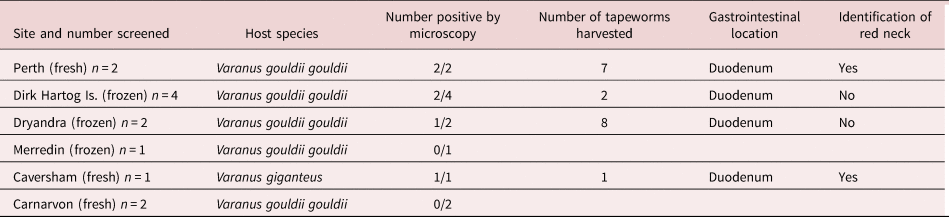
Twelve monitor lizard (11 Varanus g. gouldii and 1 Varanus giganteus) carcasses (road kill or sick euthanized animals) were obtained opportunistically from five locations in Western Australia (table 1). All frozen carcasses were defrosted overnight and dissected within 24 h of thawing. The entire gastrointestinal tract was removed from all carcasses and screened using a stereomicroscope for endoparasites. All samples were obtained under Department of Biodiversity, Conservation and Attractions Regulation 52.
Carcass identification.

A total of six monitor lizards were confirmed positive microscopically for tapeworm infections (table 1). All tapeworm specimens were harvested from the duodenum and further examined microscopically. The specimens were washed with saline and sectioned for preservation. The scolex and neck region of each tapeworm was removed and preserved in 5% glutaldehyde for imaging by transmission electron microscopy (TEM), and the remaining sample was stored in 70% ethanol for DNA isolation.
Polymerase chain reaction and sequencing
DNA extractions were carried out on the tapeworm specimens stored in 70% ethanol, using the blood and tissue extraction kit (Qiagen, Hilden, Germany) as per the manufacturer's instructions. DNA was eluted in 60 μl and stored at 20°C until further processing.
Partial cestode DNA was amplified targeting the 28S rRNA gene, using the following primers CEST28SF (5′-GGATTGCCATCTCACTCGAA-3′) and CEST28SR (5′-GACCCAACACCAAGCAGACA-3′) (designed during this study). The expected amplified product was 800 bp. The total reaction volume was 25 μl consisting of 12.5 μl of GoTaq mastermix (Promega), 2 μl of each primer, 7 μl water and 1.5 μl of DNA template. Reactions were performed on a PT100 thermocycler (MJ research) using the following thermal profile: pre-polymerase chain reaction step of 94°C for 3 min, followed by 40 cycles of 94°C for 30 s, annealing temperature of 58°C for 30 s, an extension step of 72°C for 2 min and a final extension step of 72°C for 10 min. Amplified product was run on a 2% agarose gel stained with SYBR safe and visualized using LED light. Bands were excised and purified using the in-house purification technique described by Yang et al. (Reference Thompson, Hayton and Jue Sue2013).
The purified amplicons were sequenced in both directions using an ABI Prism Dye Terminator Cycle Sequencing Kit (Applied Biosystems, Foster City, CA, USA) according to the manufacturer's instructions. Sequences were analysed and edited using Geneious v.8.1 and were compared with existing cestode 28S rRNA sequences published in Genbank. Selected published sequences were downloaded into Geneious and direct alignments were made using MUSCLE (Edgar, Reference Edgar2004). Novel sequences were deposited in Genbank.
A phylogenetic tree was constructed at the 28S rRNA gene region to determine the evolutionary relationship for putative tapeworm species (Accession number 1, Caversham MW092173; Accession number 2, Dirk Hartog Is., MW092174; table 1). JmodelTest (Posada, Reference Posada2008) was run to determine the nucleotide substitution method (general time reversible gamma proportion of invariant sites) for Bayesian analyses. MrBayes v.3.1.2 (Ronquist & Huelsenbeck, Reference Ronquist and Huelsenbeck2003) was run to generate Bayesian probabilities using the following parameters: 10,000,000 generations, sampling frequency of 1000 and burn in 3000). Acanthobothrium popi was used as the outgroup.
Transmission electron microscopy
Fixed specimens were post-fixed in 1% OsO4, dehydrated in a graded series of ethanols, infiltrated through a graded acetone-resin series, and embedded in epoxy resin. Sections (80–100 nm thick) were mounted on copper grids and examined using transmission electron microscopy. Unfortunately, as collections of individuals is opportunistic, they were routinely recovered from host tissues that had been frozen, leading to some compromise in ultrastructural preservation at the electron microscope level.
Results and discussion
Of the 16 tapeworm specimens recovered, all were morphologically and genetically identified as K. tidswelli. In addition, phylogenetic analysis confirmed the genetic identity of specimens from both V. g. gouldii and V. giganteus thus representing a new host record for K. tidswelli. It should be noted that a recent paper proposes a revised nomenclature for these cestodes from V. g. gouldii (see de Chambrier et al., Reference de Chambrier, Brabec and Scholzin press).
An alignment was generated from the 28S rRNA gene locus (730 bp) containing the novel Kapsulotaenia genotypes. The alignment contained published reference sequences including genotypes from the subfamily acanothotaeniinae. A single outgroup isolated from a species of Himantura from Northern Australian, Acanthobothrium popi, was included in the alignment.
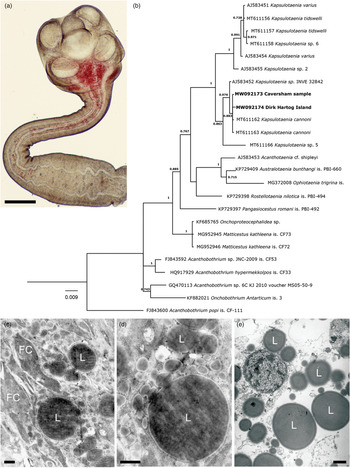
The alignment for the two K. tidswelli genotypes isolated in this study (Accession number 1, Caversham MW092173; Accession number 2, Dirk Hartog Is., MW092174; table 1) showed 99.86% genetic similarity and grouped in one distinct clade with isolates described as K. cannoni (fig. 1b). Within the Kapsulotaenia clade, Kapsulotaenia varius (AJ583451 and AJ583454; Chambrier et al, Reference de Chambrier, Zehnder, Vaucher and Mariaux2004), Kapsulotaenia tidswelli (MT611156; Chambrier et al, Reference de Chambrier, Brabec and Scholzin press) and Kapsulotaenia sp. (MT611158; Chambrier et al, Reference de Chambrier, Brabec and Scholzin press) were most distantly related to the K. tidswelli genotypes isolated in this study, sharing 96.68% genetic similarity with the Dirk Hartog Island genotype and 96.81% genetic similarity with the Caversham genotype (fig. 1b).
(a) Unstained whole mount of Kapsulotaenia tidswelli showing red pigmentation in neck region. (b) Phylogenetic relationships of proteocephalid spp. and Kapsulataenia tidswelli using Bayesian analysis of a 730 bp fragment of the 28S rDNA. The K. tidswelli genotypes isolated in this study are highlighted bold under accession numbers ((Accession number 1, Caversham MW092173; Accession number 2, Dirk Hartog Is., MW092174; table 1)). (c–e) transmission electron micrographs showing cellular ultrastructure of the neck region of K. tidswellii (L = lipid bodies; FC = flame cells).

Seven (Perth) and one (Caversham) tapeworms displayed red pigment that was principally located in the neck region (fig. 1a). It was observed that if not fixed in glutaraldehyde within 30 min of exposure to tap water, the red pigment disappeared.
Ultrastructural observations revealed abundant, somewhat-spherical, osmiophilic inclusions, which appear structurally similar to lipids, within the neck region of tapeworms that expressed the red pigment (fig. 1c–e). These spherical lipid bodies are present throughout both the outer (distal) and inner (perinuclear/proximal) cytoplasmic layers of the tegument. However, beneath the tegument, large amounts of the lipid-like material are present within cytoplasmic processes, usually associated with dense zones of glycogen. The lipid bodies appear to be membrane bound in well-preserved specimens. Some large lipid bodies are continuous with much smaller ones giving the appearance of either budding or fusion (fig. 1c–e). The only recognizable cell type in this parenchymal zone (central to the excretory ducts) is the flame cell, which has an electron-dense cytoplasm, nucleus (fig. 1c), and a regular arrangement of cilia. While the lipid bodies appear to be associated with processes of flame cell cytoplasm, none were convincingly found intracellularly within these cells and no lipid bodies were seen within the excretory ducts. Most lipid bodies appear to be situated in glycogen-rich cytoplasm that belongs to a cell type other than the adjacent flame cells. Similar lipid-like structures were not seen in the neck region of tapeworms that did not have red pigment (not shown).
The red pigmentation is presumably ‘dissolved’ within the lipid bodies and is indicative of a carotenoid, which are lipid soluble. Similar red pigmented inclusions have been observed in larval trematodes from snails and larval cestodes from fish (Kunnenkeri & Martin, Reference Kunnenkeri and Martin1962; Hamilton & Byram, Reference Hamilton and Byram1974; Fried et al., Reference Fried, Beers and Sherma1993). The only other adult cestode that has been reported with endogenous red pigmentation is Echinobothrium chisholmae (Cestoda, Diphyllidea) from the spiral valve of the elasmobranch Rhinobatos typus (Jones & Beveridge, Reference Jones and Beveridge2001). Interestingly, these authors were not able to describe the red pigmented inclusions and reported that they disappeared during processing and no images were obtained. We also observed that the red pigmentation disappeared within a few minutes if cestodes were not fixed in glutaraldehyde, as did Kunnenkeri & Martin (Reference Kunnenkeri and Martin1962) in cestode plerocercoids.
Phylogenetic analysis confirmed a close relationship between K. tidswelli and other species of Kapsulotaenia for which sequence information is available. There is thus no reason to consider that the red pigmentation is because K. tidswelli is atypical and as discussed below, pigmentation may more likely be associated with the diet of its varanid host.
The location of the carotenoid pigment is significant as the neck region of adult cestodes is a site of differentiation and contains dividing stem cells that exhibit continuous replicative activity and have considerable proliferative potential (Gustafsson, Reference Gustafsson1976; Eckert et al., Reference Eckert, Thompson and Mehlhorn1983; Mehlhorn et al., Reference Mehlhorn, Eckert and Thompson1983; Galindo et al., Reference Galindo, Paredes, Marchant, Miño and Galanti2003; Martínez et al., Reference Martínez, Paredes, Stock, Saralegui, Andreu, Cabezón, Ehrlich and Galanti2005; Thompson, Reference Thompson2017). Carotenoids are antioxidants and several studies have shown that in mammalian systems antioxidants can not only mitigate oxidative stress and improve stem cell survival but also affect the potency and differentiation of these cells (Shaban et al., Reference Shaban, El-Husseny, Abushouk, Salem, Mamdouh and Abdel-Daim2017). It is possible that they play a similar role in cestodes.
Carotenoids in animals are obtained from plants as they are not capable of synthesising them. Their presence in K. tidswelli therefore reflects acquisition from the hosts’ diet, which may include small mammals, reptiles, invertebrates and some plant material (King & Green, Reference King and Green1979). Since it is unlikely that the varanid host of K. tidswelli will always ingest reptile, invertebrate or plant material from which the adult cestode can obtain carotenoids, their presence maybe opportunistic rather than selective. Carotenoids therefore may not be essential nutrients for the parasite but functionally may provide an advantage. This is supported by the fact that not all the worms we examined contained the red pigmented material. Since the carotenoid material is confined to the neck region, it will be retained by the parasite during times when its host diet is restricted during periods of inactivity in winter when metabolic processes of the varanid hosts are reduced (King, Reference King1980; Christian et al., Reference Christian, Corbett, Green and Weavers1995).
Uptake maybe by endocytosis and restricted to the neck region, which has been proposed for other cestodes (Smyth & McManus, Reference Smyth and McManus1989), a region in K. tidswelli that exhibits the greatest polymorphism of microtriches which may be involved in the process (Thompson et al., Reference Thompson, Hayton and Jue Sue1980).
Although it would be very interesting to undertake more studies in order to determine the functional significance of the red pigmented material in K. tidswelli, this cannot be justified given the conservation status of the hosts, which are a protected species. However, as the report of red pigmented material in a fish cestode by Jones & Beveridge (Reference Jones and Beveridge2001) demonstrates, red pigmented carotenoids are unlikely to be restricted to a cestode of lizards and appropriate preservation of specimens at the time of necropsy may prove valuable in continued research on the host-parasite relationships of adult cestodes.