On 1 July 1969 at Caernarfon Castle, Charles Windsor was invested as the Prince of Wales, to varying reactions across his nation. The Daily Mirror thought Charles had “triumphantly and spectacularly draped his ermine-trimmed mantle around the shoulders of a nation and received more than an affectionate hug in return.”Footnote 1 Some opinion polls suggested that three-quarters of the Welsh population supported the event, but others claimed that half the Welsh thought it a waste of time.Footnote 2 Those proud to be both Welsh and British waved flags and rejoiced, but those who saw the event as an English colonial imposition reacted with apathy or protested, throwing eggs or even bombs. The day before the investiture, two members of Mudiad Amddiffyn Cymru (Movement for the defense of Wales) had been killed when gelignite, which they planned to plant on the Royal train's route, exploded prematurely.Footnote 3 What was meant to be a day of celebration for Wales had revealed how divided the nation was in understanding what it meant to be Welsh.Footnote 4
As The Times pointed out, the investiture was supposed to be “the greatest television spectacular in history, a carnival to entice tourists to Wales for years and thus fortify the Exchequer, a public relations and political sop to pacify the nationalist stirrings of Wales.”Footnote 5 The Labour Party, who had dominated post-1945 Welsh politics, thought a political sop was needed after the victory of Plaid Cymru's Gwynfor Evans in a 1966 by-election in Carmarthen, a largely Welsh-speaking constituency in west Wales. Evans was Wales's first nationalist Member of Parliament, and his election was a profound watershed in Welsh history; it marked the beginning of separatist nationalism as a serious political force in Wales. Before 1966 the nationalist party Plaid Cymru had been a marginal force in Welsh politics, but concern at the decreasing number of Welsh speakers—who were concentrated in the rural north and west and declined from 36.8 percent of the population in 1931 to 26.0 percent in 1961—was creating new demands for Welsh separatism, especially among the politicized student generation of the 1960s. There were rumblings of dissatisfaction with the Labour hegemony in English-speaking industrial Wales too. The south Wales coalfield had long been at the heart of the British Labour movement but in by-elections in the mining seats of Rhondda West (1967) and Caerphilly (1968) mammoth Labour majorities crumbled into marginals as people voiced their concern at the loss of mining jobs and their government's inability to rectify a local economic base that was too dependent on a fragile coal industry.
Four months before his investiture, Charles had attended the Wales versus Ireland rugby union international at Cardiff Arms Park. This was probably a deliberate attempt to ingratiate Charles with the Welsh public since rugby was widely considered to be something of a popular Welsh obsession.Footnote 6 In its report of the match The Times noted, “When the Prince of Wales came striding across the field in the sunshine, to his own tune, the crowd took him massively to their hearts and the singing of the national anthems was emotionally unrestrained.”Footnote 7 Here was the reconciliation of Wales's dual (British and Welsh) nationalities that the investiture was to seek. Wales won a bad-tempered game thanks to some artistry from their backs. The fly-half was one of Gwynfor Evans's constituents—Barry John, a player so talented and revered that he was to become known as “The King.” His skills were sublime yet they seemed casually executed; they won him such adoration that women even curtsied to him.Footnote 8 Wales won the triple crown in 1969, marking the beginning of the golden age of Welsh rugby, a decade when, according to The Times, “Welshmen express[ed] their tribal loyalty and some of their identity and surface nationalism” through the game.Footnote 9 As player Mervyn Davies noted, these teams have become part of how 1970s culture is remembered in Wales: “Long-haired men in red, with big sideburns, cutting up the turf with glee.”Footnote 10 But it was also a decade when, against a backdrop of economic decline, Wales and Scotland's political status within the United Kingdom were put to public votes. The devolution referendums of 1979 were held as a rather half-hearted response to the rise in popular support for Plaid Cymru and the Scottish National Party and as an attempt by the Labour government to retain control of Parliament through gaining the support of those parties.Footnote 11 But despite the government's lack of conviction in devolution, the referendum gave the Welsh electorate the opportunity to have its say on whether the fervor of the rugby field and the emotions of the investiture should be translated into political change.
This article explores the apparent tensions between the patriotism expressed in rugby and the rejection of Welsh devolution. That “No” vote has been seen as “one of the most painful events in Welsh history.” people were “now nothing but a naked people under an acid rain.”Footnote 13 Yet such pessimism at the state of Welsh identity ignored the popular pride in Welshness that was evident in rugby.
Other historians have interpreted sport as a key agent in the construction and reproduction of national identity in the British Isles.Footnote 14 Indeed, few other cultural forms have been as well equipped to express national identity. Sport's emotions, national colors, emblems, songs, and contests all make it a perfect vehicle through which collective but often otherwise abstract ideas of nationhood can be expressed. As Eric Hobsbawm put it, “The imagined community of millions seems more real as a team of eleven named people.”Footnote 15 Even for those with no interest in sport, the prominent media coverage of international competitions flags up the existence of the nation. Sport thus reinforces national consciousness, although sociologists have argued that the idea of nation that sport does articulate is often inherently conservative, reinforcing existing hegemonic identities. Sport, however, can contribute to nationalist struggles for independence, but it can also act as a safety valve for the expression of nationalist sentiments that might otherwise find a political voice.Footnote 16 Such ideas might suggest that the ardent patriotism expressed in rugby either helped minimize political nationalism in Wales or that it reflected, or even contributed to, how Welshness was superseding Britishness as the dominant Welsh identity. Either perspective raises questions about why the Welsh electorate rejected a degree of self-governance in 1979. Nonetheless, the political impact and salience of such sporting expressions of nationhood must not be overstated, and the historiography of sport and national identity sometimes fails to emphasize how situational and conditional the national unity expressed in sport can be. Thus this article aims to show the danger of interpreting displays of national pride in sport literally or unproblematically; the national narratives of sport can only be decoded by placing them in wider social and political contexts. This article begins with an overview of the golden age of Welsh rugby, which examines the culture of international rugby in the 1970s, and considers the importance of the game's amateur status to its popularity.
Rugby became an integral part of popular culture in south Wales in the late Victorian and Edwardian eras, a period when heavy industry was bringing prosperity to Wales and, on the back of this economic buoyancy, the middle classes were redefining Welsh national identity.Footnote 17 The leaders of the new industrial Wales saw the popularity of rugby as a symbol of the unity of a society and its people. To them, the successes the Welsh national team enjoyed in the Edwardian era were further evidence of the achievements and virtues of the nation, a metaphor for the wealth and confidence that industrialization had brought. The fact that rugby was an amateur sport, and its players were thus local men playing more for prestige than money, added to the appeal of the sport as a symbol of national pride. Rugby was more embracing and further reaching than other symbols of Welsh nationhood with more limited appeal, such as Nonconformity, the Welsh language, the Liberal Party, or any of the new national institutions. South Wales was becoming increasingly diverse through the effects of industrialization and migration, but rugby gave it an accessible and successful banner under which to unite. The new Welsh nationalism of this era was cultural rather than political; it celebrated Welsh traditions and achieved recognition for Welsh identity within the British context from which Wales drew pride, prosperity, and prestige. Sport offered a perfect vehicle for this recognition; it was an opportunity to get one over the English neighbor without any of the uncertainties or extremities of a political movement.Footnote 18 The allure of beating the English was enhanced by the fact that rugby in Wales had a strong working-class following, whereas in England it was a middle-class sport.
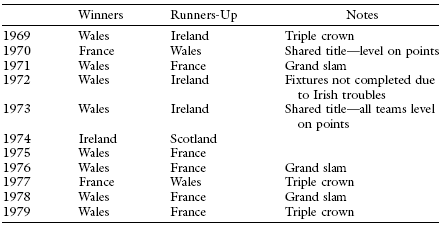
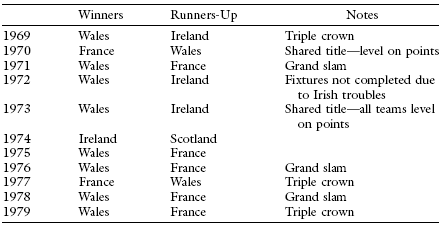
It was from this base that the 1970s golden age of Welsh rugby emerged, an era in which Wales excited and dominated. Thanks to coaching schemes, the work of teachers, the sport's dominance in school physical education, a lot of luck, and according to a contemporary humorous song, a factory beneath a mountain that manufactured players, there was a generation of players who were both world-class and Welsh.Footnote 19 Furthermore, the fact that rugby was amateur at every level meant that, unlike the best Welsh soccer players, the best Welsh rugby players stayed in Wales. The backs in particular—players like Gareth Edwards, J. P. R. Williams, Barry John, Gerald Davies, and Phil Bennett—excited fans and journalists alike and drew parallels with the “total football” played by the famous Dutch soccer sides of that decade. Thanks to their breathtaking play, and bolstered by some powerful forwards, Wales won the Five Nations championship six times between 1969 and 1979, collecting three grand slams and six triple crowns in the process (see 1).Footnote 20 A stability of selection had given the national side a strong core and allowed evolution around the stars as they gradually aged. The team was also a tightknit group of players, united by personal friendships and a squad system, which meant regular training sessions more characteristic of a club side. Gareth Edwards remembered, “We were young kids who just adored what we were doing and revelled in the thrill of it. The players in those Welsh teams had the confidence, the attitude, the belief but more than that, we loved being out there playing the game.”Footnote 21 By the end of the decade even the Welsh press could be found remarking that Wales's domination of the Five Nations was “so complete as to be almost embarrassing” and conceding that it was not good for rugby as a whole.Footnote 22
Five Nations Tournament, 1969–79
The players were a mixture of English and Welsh speakers and a combination of manual workers and the products of grammar schools, reflecting the nation they represented. With industrial Wales in terminal decline, the number of teachers, students, doctors, and other public-sector workers who played international rugby was increasing significantly. Those who did start in heavy industry, like Phil Bennett, who began his working life in a steelworks, took advantage of their stardom and often moved on to more comfortable occupations, notably in sales. As Bennett remembered, “A job as a rep was the fashionable choice for a Welsh international rugby player in the seventies. There were loads of us. The money was generally good, the work was not too strenuous, and your employers were usually fairly flexible in accommodating your rugby demands, because your profile as a player was important. Oh, and you had a nice new car. It certainly beat working down a mine, but being a sales rep was never really me.”Footnote 23 The developing importance of professional men for Welsh rugby, as well as the pull that the British capital continued to exert on the young and ambitious of Wales, was symbolized by the emergence of London Welsh Rugby Football Club (RFC) as a regular source of players for the national side in the late 1960s and early 1970s.Footnote 24 The club allowed ambitious young Welshmen to head for the better career prospects of England without losing their connections with home.
Grandeur on the pitch was matched by the surroundings of Cardiff Arms Park, described by Trevor Fishlock, one of Wales's most popular writers in the 1970s, as “a Coliseum dedicated to Rugby Football, where Englishmen are sacrificed on Saturday afternoons.”Footnote 25 The ground was developed into a concrete edifice and renamed the Welsh National Stadium, although nearly everyone still called it the Arms Park. The rebuilding left the Welsh Rugby Union (WRU) with a heavy debt, which it helped pay for by selling debentures that guaranteed the purchasers increasingly scarce match tickets. Fishlock thought that Welshmen in search of tickets became “as commercial as an opium dealer, as heartless as a highwayman, as determined and wheedling and cunning as a cat who has spied cream.”Footnote 26 Literary license aside, the black market was certainly a constant problem, and in 1979 Neil Kinnock MP even promised to introduce a private member's bill outlawing ticket touting, perhaps in an effort to show he still cared about Welsh issues after being one of the most vocal opponents of devolution.Footnote 27
For those lucky enough to get in, the national stadium became a Welsh Mecca, adorned on match days with red rosettes, giant leeks, and daffodils, and ringing to the sound of the hymn “Cwm Rhondda” and a new invented tradition of Max Boyce's “Oggy-Oggy-Oggy, Oy-Oy-Oy.” Such new traditions upset some of the conservative older generation, as did the decline in the quality and range of hymn singing at internationals, not to mention the sacrilegious intrusion of football songs like “You’ll Never Walk Alone,” but both players and spectators held the new stadium and its acoustics in special affection, and to many it was “the rugby shrine of the world.”Footnote 28 On match days, central Cardiff throbbed with fans, and the queues outside pubs took over the streets from the middle of the morning. Winger Gerald Davies noted of the crowds outside the team hotel: “North and South Wales accents co-mingle, as do the Welsh and English languages. The nation is one today.”Footnote 29 As people descended from across Wales to the Arms Park for rugby, Cardiff's role as the capital city (belatedly declared in 1955) was increasingly accepted.Footnote 30 Sport was the only sphere in which Cardiff, lacking the apparatus of a nation-state, actually provided the rest of Wales with something tangible to match its capital status.Footnote 31
With high levels of drinking, match days were not trouble free. In 1972, Cardiff was said to be “increasingly a rough place on international day: bands of hards, tarts and skinheads roam through St. Mary's Street like panzer divisions, making curious stiff-arm gestures that derive from either Harvey Smith or Il Duce, and chanting ‘We are the Champions.’”Footnote 32 In 1979, a Cardiff councillor complained to the press about the vandalism caused by “hordes of rampaging youths” that followed rugby internationals. He argued, “With rugby increasing in popularity, a soccer-type element is being attracted to the game because it is just an excuse for a big booze up. Half of them don’t even have tickets and just come into Cardiff for the fun and games.”Footnote 33 In 1977, the Welsh correspondent at The Times wrote that the “once-renowned humour and fairness of Welsh crowds has been infiltrated by strands of viciousness.” He noted that some were wondering how long it would be before bottle chucking à la football hooligans entered rugby.Footnote 34 Nonetheless, there was no crowd segregation and none of the premeditated violence of contemporary soccer hooliganism. In 1983, New Society called the Welsh crowds supporters rather than fans, to capture what it saw as an appreciation of the game rather than simple tribal affiliation. It noted that trouble could be policed by the crowd itself: “We don’t want that here boys. Now watch the bloody game,” their reporter heard shouted at two brawlers at an international. After the match the magazine noted, “The streets are awash with beer, broken bottles, stale piss and litter. They smell of the same, plus burgers and chips. … Men stagger off to bed, board, or clubland. Pissed and happy; boozy and belligerent.”Footnote 35
Welsh fans also traveled to away matches en masse, often saving for the trip with weekly contributions as they had begun to do before the Second World War. Such trips offered opportunities to enjoy oneself in the anonymity of London, Dublin, Paris, or Edinburgh, whether this meant mammoth drinking sessions or maybe even visiting a prostitute. The flavor of such excursions was captured in the BBC Wales television play Grand Slam (1978), which portrayed a group of friends attending a Wales game in Paris. Mog Jones, played by Windsor Davies, gives his friends a pre-match team talk in the hotel before they head off in search of a strip club:
Now all I want you to remember is that we are ambassadors of Wales. We’ve got a certain prestige to live up to, decorum at all times. Now I’ve got no objection if you want to show a French woman what a Welsh man is really like. Now, of course, if we get waylaid by any of the banditry, well it's one in the hole. But generally speaking boys, keep it cool, right. … Now some of us are going to fall by the wayside. Indeed, some of us might not even get to the match. It has been known for one or two of us not even to get back to Wales.
Such bravado is shown up when a beautiful French woman comes on to one boastful fan, who suddenly becomes rather bashful. Yet, he still ends up having sex with her three times that night and forgoes attending the match to watch it on television from her bed instead. The fans mix up French words with Welsh (“un, deux, tri”) and Mog ends up having to watch the first half from a cell after a fight.Footnote 36 How often the reality lived up to such parochial and beer-fueled stories is another matter, but one Glasgow hotel capitalized on the tradition by offering a weekend package to Welsh supporters that allowed fans to watch the game on an eight-foot screen and be entertained by a blue comedian and dancer-cum-stripper called Lulu. There were postcards on sale of Murrayfield, the Edinburgh rugby ground where the actual match took place, to send to wives back home.Footnote 37
The impact of the national team's victories went far beyond those watching in the stadium—“All Wales walked tall as victories in the new stadium came thick and thin.”Footnote 38 With interest bolstered by patriotic media, television now enabled internationals to become a regular national event that embraced areas outside the game's historic hinterlands, notably in north Wales, traditionally a soccer area. The move to color broadcasting made the matches all the more vivid. The BBC in Wales actually saw the broadcasting of rugby as an “instrument of nation building.”Footnote 39 For four Saturday afternoons a year, rugby seemed to bring much of Wales to a standstill, as it won the interest of even those for whom sport was a marginal aside at all other times.Footnote 40 With the rise of more independently minded single and married women with their own jobs, more females followed and watched rugby as well. (However, others, like my mother, took advantage of the fact that the shops were quiet on international days.) Although rugby had been an important part of popular culture in south Wales since the nineteenth century, a much broader section of the social and geographic spectrum of Wales was now embracing the sport. It was becoming a national game.
The developing popularity of the game had a significant impact on the game's stars. J. P. R. Williams felt that they were treated but also expected to behave like royalty. The attention was most intense on Barry John, the King, who lived up his star status. Phil Bennett said of him, “One minute he would be trying on clothes in Carnaby Street, the next he would be on the panel judging a beauty contest. Barry was showbiz.” But, like George Best, with whom he became friends and found he had much in common, John felt deified and like he was living in a “goldfish bowl.” The constant attention became too much, and he retired at age twenty-seven to regain his freedom and privacy.Footnote 41 The other leading lights of the team did not have quite the appeal of John, but fashionable clothes, long haircuts, and pretty wives were all part of the course, and they were sporting superstars in the modern sense. All felt the pressures of a nation that was coming to expect success. Bennett noted:
The success was intoxicating and made you feel during matches that some kind of force was sweeping you off your feet and allowing you to perform to the most incredible standards. But in between the games the expectations of the whole country were sometimes hard to bear. They were there when you played or trained with your club, when you went shopping or down the pub. It felt like a heavy burden, sometimes too heavy. After each victory we would celebrate like any other rugby team, but as soon as some supporter mentioned the next match, and how important it was that we beat the English/French/Scots/Irish, I would feel a tightening in my stomach.Footnote 42
Clem Thomas, a Welsh international in the 1950s and a pressman in the 1970s, summed up the period: “No rugby player in Wales needs to be a Freemason when he belongs to the far greater rugby fraternity, which is a brotherhood of friendship so embracing that at times it threatens to smother you and kill you with kindness.”Footnote 43
Current soccer stars are able to escape such attention by the physical and emotional distance that their wealth puts between them and their fans, but the Welsh rugby stars of the seventies were amateurs, working and living in the same communities as their supporters. This not only opened them up to pressures but also created a sense of responsibility to those fans, as J. P. R. Williams noted:
It's a sobering thought to see all those Welshmen in their thousands in Edinburgh or Paris and to remember that many of them had been saving for the trip for the two years leading up to it. The thought terrified me when I was up in Scotland for my first senior cap. I felt a sudden pang of responsibility and thought for a moment that the prospect of playing and letting them all down was too great. Luckily that particular moment soon passed, but not without leaving a definite impression in my mind of the true meaning of the words “to represent Wales.”Footnote 44
Edwards, John, Gerald Davies, and many of the other stars were the sons of manual workers but who themselves had, through education, gone into white-collar careers. This in itself reflected a broader social change that Wales was undergoing with industrial decline. Mines had been closing regularly since the 1950s, as the Welsh coal industry struggled to modernize and cope with falling demand; a whole way of life seemed in danger of dying. Like so many others, players were acutely aware of the industrial traditions of their communities and what rugby, a hard and masculine sport, had meant to the hard men who had worked underground. In his autobiography, Gerald Davies remembered that while his father, a miner, had known “suffering and hardship” rugby was the time “to get some of the floating coal-dust out of his lungs, to stretch those limbs which had been cramped and closeted for hours on end in a tiny, dirty black hole.” He wished his father had been alive to “savour all our recent magnificent success. … The whole nation basks in the reflected glory and relishes it with pride, which is not a bad thing, not a bad thing at all. But I just wish, oh, I do wish that he could put his feet comfortably up and do the same.” When people wished you luck, Davies noted, they meant it.Footnote 45 International Welsh rugby was thus of and for the nation, and at the heart of its culture was a Wales in flux, a Wales whose heavy industrial base was in decline and with it was going, but not yet gone, the traditional working-class culture that it had spawned. In its place a more modern, diverse, and commercialized popular culture was growing. Those shifts reverberated in rugby and could be seen in the mix of traditional and modern songs (hymns versus pop), behaviors (amiable drunks versus rowdy hooligans), and players (hard steelworkers versus long-haired sales reps).Footnote 46 Rugby bridged a world that was changing.
The sport itself was in transition too. It was an amateur game in a commercial world, and this tension meant that the material rewards were on the increase, despite the fact that any payment, financial or in kind, was strictly prohibited by the sport's authorities. Early in his career, when Barry John played for a police team, supporters would have a collection to raise pocket money for him.Footnote 47 Many smaller clubs made covert direct cash payments to their players to prevent them being lured away. When players did switch clubs, financial inducements were not uncommon. Similarly, expenses (for money lost or spent while playing) could be very generous. Graham Price, one of the Pontypool front row, spoke of a culture of “‘presents’ from clubs, the topping up of expenses, transfer fees and the like. … The great unmentionables.” Yet rumors exaggerated the extent to which expenses were fiddled. Price wrote in 1984, “If all the stories concerning expenses were true, I daresay many of Britain's top players would be driving around in Rolls Royces. When I look at my battered 1977 Ford Capri, I reckon I must have missed out somewhere.”Footnote 48 Unknown or overlooked by the game's authorities, some of the star players of the 1970s did receive cash payments for wearing the boots of various manufacturers. Bennett got around £200 a year from Adidas, “handed across in a brown envelope at the back of a car park on a selected day near the end of the season.”Footnote 49 Some of the bigger teams refused to make financial transactions but, with the help of local firms, offered rewards in kind such as easy jobs, free cars, and clothing. Rugby certainly opened doors for players in business and consultancy, where the fame of rugby was attractive to both employer and customer. People wanted to be associated with the best players, which also meant that there were free meals, drinks, and holidays to be enjoyed. John Taylor said of his fellow internationals, “He will undoubtedly have better job prospects than his peers and will also enjoy the benefits of being a celebrity. Anything from suits to motor cars will be offered at trade prices and if he can stand the non-stop questions on the game, he will never have to buy a drink.”Footnote 50 Such unofficial material benefits helped the stars resist the financial lure of switching to rugby league, a similar but completely separate sport, which was based almost entirely in the north of England and allowed its players to be paid.Footnote 51 But it was difficult to resist; sums such as the £35,000 offered to Phil Bennett by the St. Helens rugby league club were very tempting to young men with jobs beyond sport. But the stars were also kept at home and in the amateur game by the promise of playing success, by strong personal attachments to Wales and their local communities, and by pressure from within those communities.Footnote 52 There was also the knowledge that once a player had committed the crime of switching rugby “codes” by joining a professional rugby league team in the north of England, he would never be allowed to play for Wales or a Welsh club again.
Yet the professional sport of rugby league remained a threat, and memories of earlier generations of Welsh rugby stars who had switched “codes” and “gone north” were strong.Footnote 53 Even in the confident 1970s, past heroes could be asked to leave their local clubhouses in Wales because they had subsequently played the professional game in northern England. As the proverb went, there were three things best not discussed in polite Welsh society: politics, religion, and rugby league. The fear of and taboo surrounding rugby league reinforced a “paranoia and pompous hypocrisy” that ran through rugby administration concerning the material rewards that were on offer.Footnote 54 Players feared their payments being exposed by a WRU that enquired about fees whenever a player was spotted on television and even denied Graham Price the right to accept a few free pints of milk after an injury left him unable to eat solids.Footnote 55 The compromises could be ridiculous. J. P. R. Williams, for example, was allowed to publish his autobiography, but on condition that he did not receive any income from it while he was still playing. The BBC was sympathetic, and when Welsh stars appeared on the popular quiz show, A Question of Sport, they were paid a £150 cheque, to be handed straight to the Welsh Rugby Union, and a further secret £100 in cash. The players had mixed feelings about the system. Some felt rugby benefited from being an amateur game but resented being left out of pocket after having to take time off work to play an international or having to pay for their wife's hotel room in Cardiff.Footnote 56 Price resented seeing officials and their wives “enjoying tremendous hospitality on special occasions” and sometimes receiving gifts. He summarized, “After all my years in the game, it seems to me that the only people who actually believe in a totally amateur concept are those that can afford to and they are most definitely not the players. … The honour of playing for one's country is one thing. But unfortunately honour doesn’t pay the mortgage, nor does it feed and clothe the family.”Footnote 57
The “shamateurism” of rugby union may not have paid the mortgage but it had become a question of how you were paid, not if you were paid. And yet the game still remained amateur in a very real sense. Some players were still going to work the day before an international, and all were reliant on goodwilled employers to secure time to play, train, and tour. Some players took the steak they were given in pre-match meals home with them, knowing that it would not be digested properly before they took to the field but unwilling to simply leave such an expensive piece of food.Footnote 58 Rugby may not have been strictly amateur, but professionalism remained a long way off, and it was this that underpinned the intimate connections between the sport and the Welsh public.
Clive Rowlands, the Welsh coach from 1968 until 1974, held team meetings in the captain's hotel room where he employed patriotic rhetoric to try to inspire the players. Phil Bennett remembered:
There would be players sitting on the bed, on the dressing table, on the floor, even perched on the wardrobe—anywhere they could find a seat in a small hotel room. It would be stuffy and overwhelming. Wearing his Wales tie and pullover, Clive would pace the room, fag in hand, ranting and raving. He would demand you performed not just for yourself, but for your father, your mother, your long-lost aunt, the miners, the steelworkers, the teachers, the schoolchildren—in effect the whole Welsh nation. You were their representatives and you owed it to them to deliver. By the end of this sermon, some boys would be head-butting the walls and others would be crying their eyes out.
Such speeches could produce emotional displays on the pitch but they could only work so many times. Gareth Edwards and Barry John became “a little bored by all the nationalistic stuff and I’d notice they would be yawning or looking at their watch.”Footnote 59 Graham Price recalled that having to shout answers to Rowlands's rousing questions was “like being back at primary school or at the pantomime.”Footnote 60 Yet all players spoke of their pride in donning the sacred Welsh shirt. Gerald Davies said, “It is what children dream of. It is the glory of which a nation will passionately sing: the scarlet jersey of Wales.”Footnote 61 Whatever his reservations about Rowlands's patriotic rabble-rousing team talks, Price said, “Playing for Wales was unquestionably the greatest thing in my life, an honour and pride which I shall take to my grave.”Footnote 62 In 1977, captain Phil Bennett rallied his teammates before a match by declaring: “These English you’re just going out to meet have taken our coal, our water, our steel: they buy our houses and live in them a fortnight a year. … Down the centuries these English have exploited and pillaged us—and we’re playing them this afternoon boys.”Footnote 63 This may have helped raise the tempo of psyched-up sportsmen about to enter the field of play, but it was not necessarily a political sentiment shared by the whole team. There were some players, like Ray Gravell, who idolized Owain Glyndŵr, the leader of a medieval Welsh rebellion, and for whom playing for Wales was a near-spiritual event. In contrast, J. P. R. Williams was the son of a doctor and had been driven to primary school in his father's Rolls Royce and then educated at an English public school. He must have had rather a different understanding of what being Welsh meant.Footnote 64
Yet such niceties did not matter in rugby, where, for fans and players alike, divided understandings of Wales were subsumed beneath the heady patriotism of the occasion, particularly when England was the opposition. The internationals were, in the words of one historian writing in 1972, “stimulants, providing a fix of ‘Welshness’ to many thousands of people, in Glamorgan and Monmouthshire in particular, for whom Welshness is a sort of underground movement minus the revolution.”Footnote 65 That same year, Trevor Fishlock wrote that Welsh crowds at the Arms Park “swaying sparkle-eyed to the roared out anthem, are involved in a great communal experience, in the electric unity of tribalism. … Many of them do not know the meaning of the Welsh words of the anthem that they learned parrot-fashion at school or chapel or grandfather's knee. Yet there is an element in their singing of affirming their identity.”Footnote 66 Rugby was part of the everyday “banal nationalism” that helped sustain a sense of national identity among a disparate people.Footnote 67 It flagged up and reminded people of the existence of their nation and in doing so reaffirmed that nation, a nation that was often otherwise, for English speakers at least, an abstract concept with little relevance in daily life. Furthermore, rugby glossed over the different meanings that the people of Wales attached to their nationality, enabling them to assert, maybe even understand, their Welshness in the face of internal division and the political, social, and cultural shadow of England. This may not have created or reproduced a sense of national identity that pervaded all walks of life, but it did contribute, in some intangible way, to Welshness being one of the identities that people saw in themselves.
Rugby thus gave some form to the “imagined community” that was Wales but so did other cultural spheres and concerns.Footnote 68 In the early 1960s, Cymdeithas yr Iaith Gymraeg (the Welsh Language Society) began a direct-action campaign to demand the administrative recognition of Wales and the Welsh language.Footnote 69 They generated a passionate response among both English and Welsh speakers. Even where people disagreed with the defacing of English-only road signs or the refusals to pay television licenses for a service without a Welsh-language channel, it was impossible to ignore the fury surrounding the language issue. For some English speakers there was a resentment that history had denied them the ability to speak the tongue of their nation; for others there was a fierce resentment that their inability to speak Welsh somehow implied that they were not properly Welsh in nationality. The government responded by setting up a Welsh Office and passing a Welsh Language Act, but it was not enough for those who demanded independence, either through the ballot box or the bomb. But what the language issue did do was create a greater consciousness of being Welsh across Wales in the 1960s and 1970s. By 1979, an election survey suggested that 57 percent of the electorate saw themselves as Welsh but only 34 percent as British.Footnote 70
Fed by such issues, rugby internationals too were becoming “more overtly nationalistic” in this period.Footnote 71 From the late 1960s, T-shirts celebrating a mock-terrorist group, the Free Wales Army, were visible in the crowd, but it was the loud and routine booing of “God Save the Queen,” the national anthem of both the English and the British, that was most the obvious sign of a concerted nationalism. Its playing could at least be justified at matches in Cardiff against England and even Scotland, since it was the visitors’ requested anthem, but its inclusion at clashes against France was less explicable. At such games, the spectacle of three anthems (Welsh, British, and French) being played made no sense to many when there were only two teams playing. The booing of the British anthem quickly became an embarrassment and, from 1974, the WRU dropped it altogether for the visits of the French. The WRU's more confident assertion of Welshness was also evident in 1977 when it made the covers of its Five Nations match programs bilingual, although, like putting Dynion on the doors of the male toilets, this was really little more than tokenism toward the Welsh language.
There were problems at away games too. Everyone in Wales might have thought “Hen Wlad fy Nhadau” was the Welsh national anthem, but it had no official status, and the other rugby nations were only slowly coming to recognize the new cultural nationalism that Wales was developing. The “polite” inclusion of “Hen Wlad fy Nhadau” for Wales's visit to Twickenham in 1968, was unusual enough for the press to remark on, but it appears to have set a precedent.Footnote 72 The French first played “Hen Wlad fy Nhadau” for a Welsh match in Paris in 1971 but, at the end of the decade, and to much booing, they were still also playing “God Save the Queen” when the Welsh visited. Perhaps in response to the booing of the English anthem at Cardiff, the (English) Rugby Football Union (RFU) refused to allow “Hen Wlad fy Nhadau” to played at Twickenham in 1974. A letter to The Times called for a quick correction in case the anthem's absence led to the breakup of the United Kingdom.Footnote 73 The WRU made an official complaint and threatened to refuse to allow “God Save the Queen” for future English visits to Wales. The RFU backed down; Welsh nationality was recognized.
Rugby may have been uniting the Welsh, but the rowdy patriotism, confidence, and even arrogance of fans meant that Welsh rugby was not always universally admired in the otherwise middle-class and respectable world of rugby union. The reporter and former international Clem Thomas wrote of an “astonishing antipathy towards Welsh rugby by other nations.”Footnote 74 Richard Sharp, an England international in the early 1960s and then a reporter with the Sunday Telegraph, wrote that the supporters disturbed him, “for when you win they make you feel that you are lucky, and if you lose they are patronizing. … I respect the Welsh attitude to winning, but I have been sickened by the hangers-on and the rowdyism after the international matches.”Footnote 75 Similarly, Peter Robbins, another English international of the early 1960s who wrote for the Financial Times, claimed “The Welsh en masse can be horrid; … [they] have become arrogant because of their success.”Footnote 76 Yet countering such arrogance was the Welsh fans’ ability to laugh at themselves, evident in the popularity of Max Boyce's parodies and the South Wales Echo cartoonist Gren. If rugby changed the stereotype of the Welshman from, in the words of historian John Davies, “puritan chapel-goers” to “muscular boozers who were doubtful whether there was life beyond the dead-ball line,” then it was a humorous stereotype that the Welsh were complicit in.Footnote 77
In 1978, Trevor Fishlock, an Englishman living and working in Wales, wrote, “I do not think that it is mere fancy to say that in some ways Welsh rugby reflects the mood of modern Wales, the new confidence and pride in Welshness. It seems reasonable to relate the so-called golden age in rugby to the new awareness and the shaking off of old shackles.”Footnote 78 Similarly, Gareth Williams argued in 1972 that the “forces and currents which have been coursing through the arteries of Welsh rugby recently, are also those that have reddened the corpuscles of Welsh life in other directions: they have been part and parcel of a revitalising of Welsh society on a broad front.”Footnote 79 Some nationalist Welsh-language poets saw the rugby glories as not just reflecting, but even inspiring, a national revival. In 1975, one wrote proudly of Barry John: “The warrior from Cefneithin will eradicate the scar of a shrivelled people. … An impotent people is rousing itself, inspired by the unassuming B. J. Anyone who has known his genius can never grovel to foreign crowns.”Footnote 80
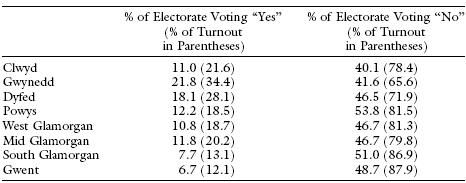
Yet when in 1979 a referendum on devolution gave Wales the opportunity to shake off the English “shackles” in a meaningful and political way, the Welsh voters gave the idea a resounding “No.” At the end of a decade where Welsh rugby had suggested a confident, even aggressive national identity, only 11.8 percent of the electorate voted in favor of the creation of a Welsh assembly (see 2). It was an emphatic result. John Morris, the Secretary of State for Wales who led the “Yes” campaign, said, “When you see an elephant on your doorstep, you know it is there.”Footnote 81
Result of the 1979 Referendum on Welsh Devolution
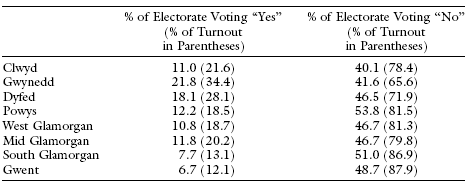
Note. “Yes” votes: 243,048 (11.8% of electorate). “No” votes: 956,330 (46.5% of electorate). Turnout: 58.3%. 40% of electorate required to vote “Yes” for devolution to be implemented.
There had been little enthusiasm for the issue, as the South Wales Echo noted on the day before the vote: “There are many people in Wales who are thoroughly sick of being bombarded with the views and counter-views. After all, it was an issue that the Welsh did not want in the first place.”Footnote 82 The referendum had been held, not because of widespread demand, but because the flailing Labour government hoped to keep control of the Commons through winning the support of Plaid Cymru and Scottish National Party MPs. Similarly, the Welsh rejected devolution because of the political issues of the day. It seemed to offer another tier of expensive and bureaucratic government, just five years after a complicated reorganization of local councils. It was proposed by a Labour government that was unpopular even in the south Wales valleys where voting Conservative was something of a heresy. The referendum came at the end of the “winter of discontent” when strikes had crippled the nation, and the government seemed to have lost control of the unions and the country. Ironically, the “Yes” campaign pushed the idea of making government more accountable and democratic. A newspaper cartoon joked that their arguments were as credible as the idea that devolution would mean a free international match ticket for everyone.Footnote 83 The “No” vote was thus as much a comment on the government of the day as it was on the issue of devolution.Footnote 84 In the 1979 Welsh Election Survey, 58.6 percent of respondents said they were Welsh rather than British or English, but only 21.7 percent of this group voted “Yes.”Footnote 85
But the referendum was also unavoidably about nationality. The “No” campaign consistently played upon fears that devolution would mean the southern-English-speaking majority being ruled by a Welsh-speaking clique from the north and that it would ultimately lead to the breakup of the United Kingdom. “Keep Wales united with Britain,” declared a full-page advertisement from the “No” campaign in most of the Welsh papers on the day of the vote. After the result, a cartoon on the front page of the South Wales Echo showed a lady sitting down with a map of Britain on her wall, saying, “There's lovely—still in one piece.”Footnote 86 Cymdeithas yr Iaith's magazine concluded that the referendum had “shown clearly that this last decade has not resulted in any loosening of the British knot in Wales.”Footnote 87 Determining precisely why people vote in a certain way is impossible, but it is unlikely that issues of nationality had no impact. When the 1979 Welsh Election Survey is compared with surveys from 1968 and 1970, there is even a tentative suggestion of a fall in people classifying themselves as Welsh rather than British over the course of the decade.Footnote 88 The “Yes” vote was largest in rural Welsh-speaking Wales, where rugby had less purchase, Welsh self-identification was significantly higher, and support for the separatist Plaid Cymru was stronger.Footnote 89 Despite the specific political issues of the day, it is difficult to avoid the conclusion that the 1979 referendum indicated that the majority of Welsh people were content to remain within the United Kingdom.
Is there a contradiction between the confident patriotism asserted in rugby and the essential Britishness of Welsh voting? Some commentators did suggest that rugby was a safety valve for nationalistic sentiments. The poet Nigel Jenkins wrote an angry piece entitled “Land of Song,” about what he saw as the shallow patriotism of Welsh rugby culture. It was subheaded “in memoriam 1/3/79,” the day of the devolution referendum:
Sing with the blindingly hwyl
of it all: you are programmed to sing …
Ar hyd y nos ar hyd
y dydd—the songs, the songs,
the hymns and bloody ariahs
that churn from its mouth
like puked up S. A. [beer]—
and not a word meant
not a word understood
By the Welsh machine.
Oggy! Oggy! Oggy!
shame dressed as pride.Footnote 90
Less emotionally, K. O. Morgan, Wales's most prominent living historian, wrote, “Rugby and investitures, the bread and circuses of the populace, became a peaceful therapy to suppress embarrassing political aspirations. … Most of the Welsh were content to have it that way. They rejoiced in their rugby skills, made no protest, and asked few questions.”Footnote 91 Sport may have been patriotism enough for some, but there is little to suggest that it actually minimized political nationalism in Wales. Identities are contextual and situational: taking pride in one's nation on the rugby field is one thing, taking a leap into the dark of devolution is quite another, particularly at a time of industrial decline and dislocation. This is not a contradiction or a sign of some limitation in Welshness but simply economic pragmatism and evidence of the plurality of Welsh identity. There was a place for pride but a need for jobs.
The national confidence seen in the Arms Park was highly misleading. In 1972, Gareth Williams called the Welshness of a match day atmosphere “phony, a fabrication, a shadow without the substance; it is a showpiece of maudlin sentimentality.”Footnote 92 It was certainly festive and carnivalesque, specific to its context rather than indicative of a wider, more everyday, outlook on Wales and Welshness. The Wales of the 1970s was a nation in economic decline. Between 1970 and 1979 the number of miners in Wales fell from 60,000 to little more than 30,000 and an “entire way of life in south Wales seemed to be coming to an end.”Footnote 93 The steel industry also contracted at an alarming rate, losing 19,000 jobs in 1978–80 alone. There were occasions of optimism—such as the miners’ successful pay strike of 1972 and the boost for coal demand caused by the tripling of oil prices in 1974—but these were fleeting moments of hope against a backdrop of terminal industrial decline. Rugby may have helped compensate for such economic miseries, but it did not disguise the fact that the large-scale public investment that had built up those industries in the first place, and might save them in the future, was not going to come from a devolved Welsh assembly.
The investiture of Prince Charles was supposed to be a celebration and reconciliation of British and Welsh patriotisms in Wales, designed to fight off the growing Plaid Cymru vote. As the 1970s progressed, it became clear that Plaid Cymru was not going to win widespread support in the contemporary economic and political conditions. During that decade, it failed to come even close in general elections to capturing a parliamentary seat outside Y Fro Gymraeg, the Welsh-speaking heartland. Even when Carwyn James, the highly popular coach of Llanelli RFC, stood for Plaid in that town in the 1970 general election, he only received 8,387 votes in contrast to Labour's 31,398. Most of the Welsh people did not need their Welshness and Britishness to be reconciled. The two were perfectly compatible. As many historians and sociologists note, identity may depend on “othering” but the binary of Wales was England, not Britain.Footnote 94 The 1979 Welsh Election Survey, which suggested that nearly 60 percent of the Welsh electorate saw themselves as Welsh rather than British, created the impression of a dichotomy that was not there by forcing people to choose between the two nationalities. Wars, political struggle, industry, and even mass leisure had given the Welsh a common experience with the rest of Britain but without destroying their pride in Wales.Footnote 95 A mass Welsh nationalist movement only emerged among Welsh speakers in the 1960s because it was deemed the only way to save a language that seemed in terminal decline. Rugby may have suggested a very overt and public Welshness in English-speaking Wales, but that did not undermine its parallel Britishness.
Plaid Cymru has never been able to reconcile the fact that most of its supporters are driven by concerns for and pride in the Welsh language, with the reality that to achieve Welsh separatism they need to win the support of English-speaking Wales. The conflicts over what being Welsh means may have helped undermine the 1979 referendum, but in rugby Wales found a respite, a place where all could celebrate their nation without worrying what that meant. At the 1979 Election Survey “rugby, music and singing” were second only to the environment in what made people most proud of Wales.Footnote 96 The stars of Welsh rugby were absent from the campaigns of both sides in the referendum. This was not surprising after the furor that followed Welsh rugby's decision to ignore political concerns and play South Africa at the start of the decade. Whatever the wrongs and rights of that particular situation, the WRU's determination to keep rugby apolitical ensured that its patriotisms had personal rather than collective meanings.Footnote 97 Nationalist poets wrote eulogies to Welsh rugby, and language campaigners used a trip to London to watch Wales play to also stage a demonstration for a Welsh-language television channel.Footnote 98 Neil Kinnock MP, in contrast, was a lynchpin of the antidevolution campaign, in the belief that it would harm the cause of the Welsh working class, but this never compromised his support for the rugby team.
Nineteen seventy-nine was a watershed for Wales in so many ways. There was not only the “No” vote but also the election of Margaret Thatcher's Conservative administration, a government that would oversee the dismantling of Welsh heavy industry but compensate for it by creating a quango-led Welsh civil society of sorts, passing legislation that buttressed the Welsh language and devolving much power to the Welsh Office. And then there were the celebrations accorded to J. P. R. Williams, who had graced Welsh rugby for its whole decade of success. As people were aware, a golden era was coming to an end. With the development of large comprehensive schools, where rugby did not dominate the physical education curriculum in the way it had at grammar schools, there was already a realization that another golden generation was going to be very hard to find.Footnote 99 It was 2005 before Wales would win a grand slam again. By then rugby had turned professional, Barry John was long retired, and Charles was still Prince of Wales but royalty had lost its shine.
Wales, however, had its own assembly after a referendum in 1997 had delivered a narrow “Yes” vote. This time the proposal was put forward by a Labour government with a landslide majority and honeymoon popularity. The political conditions were right, but surveys by political scientists suggested that a decisive factor may have been that Welshness in the south was becoming politicized.Footnote 100 The social, political, and economic dynamics of Welshness had changed, and the overt patriotism evident in Welsh rugby in the 1970s was beginning to penetrate other parts of English-speaking Welsh life.Footnote 101 But, as Wales moved toward something resembling a nation-state for the first time, it did not forget its golden age of rugby. The glories entered the mythical haze of Welsh public history, alongside the heroics of Owain Glyndŵr and Aneurin Bevan, and a time when all the Cymry spoke Welsh.Footnote 102 As Mervyn Davies, captain of the 1976 grand-slam team, put it, “We spend so much of our time in Wales staring into the past. I sometimes long to escape what was and welcome what is. But I cannot; I am locked in a time when rugby was fast, romantic and delicious, when it was the people's game, when it pulled us through the depths of winter and into eternal spring.”Footnote 103 But one man's eternal spring is another's shame, and rugby delivered a proud nation but not a political one. The unity Wales found in the Arms Park had few echoes elsewhere, but therein lies rugby's importance. It helped sustain a popular Welshness at a time when political and economic change threatened to undermine that same nation. Yet those changes were ultimately more far-reaching in their impact than rugby, and they did more to shape people's outlook on the world than a sport or a pride in Wales.