Introduction
The Sahara of Africa represents the largest desert of our planet and is between 7,000,000 and 9,000,000 km2 in area (Tucker et al., Reference Tucker, Dregne and Newcomb1991). According to Chehma (Reference Chehma2011), the Sahara is not only the largest of the deserts but also the most expressive and typical by its extreme aridity. In Algeria, the Sahara occupies more than 80% of the total area of the country, and the northern Sahara of this country has an area of 1 million km2 subjected to an extreme Mediterranean climate (Chehma, Reference Chehma2011). The desert shares a number of features (climate, weather and a low density of vegetation) (Tucker et al., Reference Tucker, Dregne and Newcomb1991). The number of species that a desert can harbour per unit area is relatively small. In the desert, a surprising variety of invertebrate animals, fish, reptiles, amphibians, birds and mammals exists (Sid Amar, Reference Sid Amar2011). Among these groups are arthropods, which include a diverse group of taxa, such as arachnids, crustaceans, hexapods and centipedes (Haupt, Reference Haupt1993; Mosharrof, Reference Mosharrof2010). The arthropods are essential for our existence, directly or indirectly, as they provide us with food, clothing, medicines and protection from harmful organisms (Mosharrof, Reference Mosharrof2010). Also, they constitute a good biological indicator and they form an essential element of the food availability for many animal species (Souttou et al., Reference Souttou, Sekour, Ababsa, Guezoul, Bakouka and Doumandji2011). Arthropods have been recognized as effective indicators of ecosystem function and recommended for use in conservation planning (Rosenberg et al., Reference Rosenberg, Danks and Lehmkuhl1986; Finnamore, Reference Finnamore1996) and many researchers have assessed habitat quality and measured habitat differences using arthropods (Kitching et al., Reference Kitching, Orr, Thalib, Mitchell, Hopkins and Graham2000; Gibb and Hochuli, Reference Gibb and Hochuli2002). Arthropods can be used to show the developed changes in an ecosystem, because they are sensitive to ecosystem change (Ali-Shtayeh et al., Reference Ali-Shtayeh, Ali and Jamous2010).
Many studies have been carried on arthropods, for example, Haupt (Reference Haupt1993) described the centipedes, arachnids and insects of the Mediterranean region. Norfolk et al. (Reference Norfolk, Abdel-Dayem and Gilbert2012) studied the effects of runoff agroforestry in Egypt, by comparing the biodiversity of ground arthropods within the gardens to that of the surrounding natural habitat. They found that the harvested rainwater has created agricultural home gardens that ameliorate the abundance of ground arthropods. Chapelin-Viscardi and Maillet-Mezeray (Reference Chapelin-Viscardi and Maillet-Mezeray2013) published a research paper on entomological diversity in the agricultural plain of Santerre (France) using another technique (Malaise trap). Their work provides new information on the biogeography of some species. Evans et al. (Reference Evans, Mahoney, Cashatt, Noordijk, De Snoo and Musters2016) in Central Illinois (USA) determined the relation between invertebrate richness and diversity in agricultural field interiors and edges, and the complexity of the surrounding landscape. Their paper shows that the taxonomic richness and diversity in field edges is positively related to large-scale landscape complexity, but the relationship is negative for field interiors. Arthropods have also been studied in Algeria. Brague-Bouragba et al. (Reference Brague-Bouragba, Habita and Lieutier2006) carried out a faunistic and ecological study of some families of Coleoptera in various sub-desert plant formations (Djelfa), and note the major plant damage in monoculture farming caused by pests, for which treatments are expensive. Brague-Bouragba (Reference Brague-Bouragba, Brague, Dellouli and Lieutier2007) studied the systematics and ecology of some groups of arthropods associated with various plant formations in semi-arid zones. They concluded that if reforestation did not change the biological diversity, it would induce dramatic modifications in the organization and functioning of the arthropod communities. In the Saharan zone, Kourim et al. (Reference Kourim, Doumandji-Mitiche, Doumandji and Reggani2010) compared the entomological diversity in different agricultural stations in the Ahaggar National Park (Tamanrasset, Sahara). Kherbouche et al. (Reference Kherbouche, Bousbia, Beddiaf, Souttou, Chakali and Sekour2016) reported on the evaluation and characterization of the arthropod diversity of a Ghout palm grove in Oued Souf. These authors note that insects, especially the Formicidae, collect in this type of oasis, while the Aphididae, Scoliidae and Muscidae assemble in the herbaceous stratum.
The current study aims to describe the composition and structure of the arthropod community in two contrasting environments (a palm grove and dunes) in the Touggourt region, northern Sahara, Algeria, and to create an inventory of arthropods, to enrich the knowledge on these environments.
Materials and methods
Study area
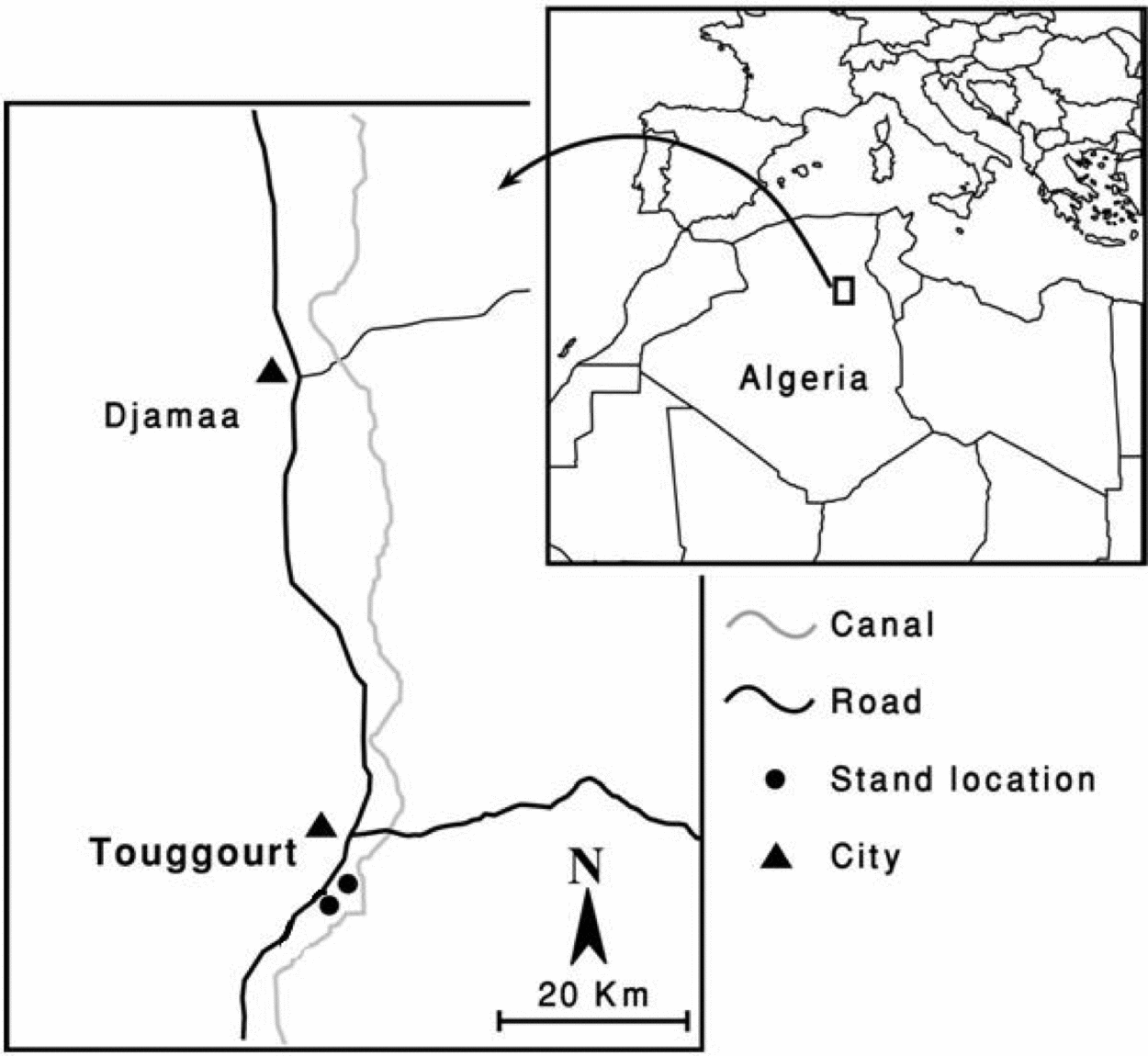
This study was conducted in the Touggourt region, southeast Algeria. This region resembles the high part of Oued Righ area. The region is bordered in the south and the east by the large Eastern Erg (a field of sand dunes), in the north by the palm plantations of Megarine and in the west by dunes (33° 02′ to 33° 12′ N, 5° 59′ to 6° 14′ E) (Fig. 1). The area is located at an altitude of 75 m (Dubost, Reference Dubost2002).
Map of the Touggourt area (southeast Algeria) and the location of sampling sites.

The daily temperature varies from a mean minimum of 11.7 °C in January to a mean maximum of 35.1 °C in July. The average annual rainfall is 155.7 mm. The climate is characterized by a long dry season from February to December. The rainy season is in January. The highest wind speed varies one month to another, and ranges between 10.3 m/s (37 km/h) in June and 19.5 m/s (70.2 km/h) in March.
Sampling sites
Two stations were selected for this study, the first was an agricultural site (palm grove) and the second represents a natural environment (dunes) (Fig. 1). The palm grove station (33 05′ N, 6 04′ E) is a semi-open area of 103 ha with 12,000 palm trees. In this location, two strata were recorded. First, the ‘nakhla’ Phoenix dactylifera L. trees form the arborescent stratum. Second, several species of wild plants, e.g. ‘gasba’ Phragmites communis Trin., ‘lebena’ Convolvulus arvensis L., ‘djerir’ Conium maculatum L. and ‘rezam’ Chrysanthemum myconis L. form the herbaceous stratum. These plants produce an appropriate microclimate for various species of animals.
The dunes site (33 05'N, 6 04' E) corresponded to an open area with herbaceous vegetation of low density. The species present were ‘el aggaia’ Zygophyllum album L., ‘zita’ Limoniastrum guyonianum Durieu ex Boiss. and ‘damran’ Traganum nudatum Delile. The scarcity of plants made an arid climate in this area.
Sampling techniques
Arthopods were sampled over a 12-month period (February 2009–January 2010). The capture of arthropods species was performed with Barber pitfall traps (Benkhelil, Reference Benkhelil1992; Kherbouche et al., Reference Kherbouche, Sekour, Gasmi, Chaabna, Chakali, Lasserre-Joulin and Doumandji2015; Selmane et al., Reference Selmane, Ben Atouss, Tliba, Farej and Marnich2016). The pitfall traps were cylindrical containers, buried vertically with an opening flush with the ground. The size of each trap was 1 L. Each of the Barber pitfall traps was filled to 1/3 of its height with water containing 2 g powdered soap detergent, to prevent trapped invertebrates from escaping. Eight Barber pitfall traps were installed in a line and separated 5 m apart. A flat stone raised above the opening by two small pebbles protected each trap. This flat stone slowed down the evaporation of the water in the trap. After 24 hr, the content of each trap was collected. Captured arthropods were identified using dichotomous keys (Perrier, Reference Perrier1923; Reference Perrier1926; Reference Perrier1927; Reference Perrier1932, Reference Perrier1937; Chopard, Reference Chopard1943; Balachowsky, Reference Balachowsky1962). The collections of the Agricultural Department and the Forest Zoology Department (ENSA, Algiers) were also used as a reference.
Data analysis
Results were expressed as the total richness (S), representing the number of families or species captured on each station over the course of a sampling session (Blondel, Reference Blondel1975; Caro, Reference Caro2001; Horn et al., Reference Horn, McMillan and St Clair2012), and average richness (Sm), the average number of species present in N surveys (Ramade, Reference Ramade1984). Additionally, results were expressed as a relative abundance (RA %), which is the percent proportion of the individual number of each species (ni) to the total number of captured individuals of all species from a station (N) (Hamdine et al., Reference Hamdine, Khammar and Gernigon2006; Hadjoudj et al., Reference Hadjoudj, Souttou and Doumandji2015).
To explain the diversity in the arthropods community, we also used the Shannon–Wiener Index (H′ = −∑ Pi * log (Pi), where Pi = ni/N). (H′) increases with (S), but in practice do not exceed 5.0 in biological communities (Reference KrebsKrebs, 1998). The evenness index (E) indicated how the species were distributed in the community, and was derived from H′ (E=H′/lnS) (Weesie and Belemsobgo, Reference Weesie and Belemsobgo1997; Faurie et al. Reference Faurie, Ferra, Médori, Dévaux and Hemptinne2006; Hadjoudj et al., Reference Hadjoudj, Souttou and Doumandji2015). The values varied from 0 (one dominant species) to 1 (all species equally represented in the community).
Results
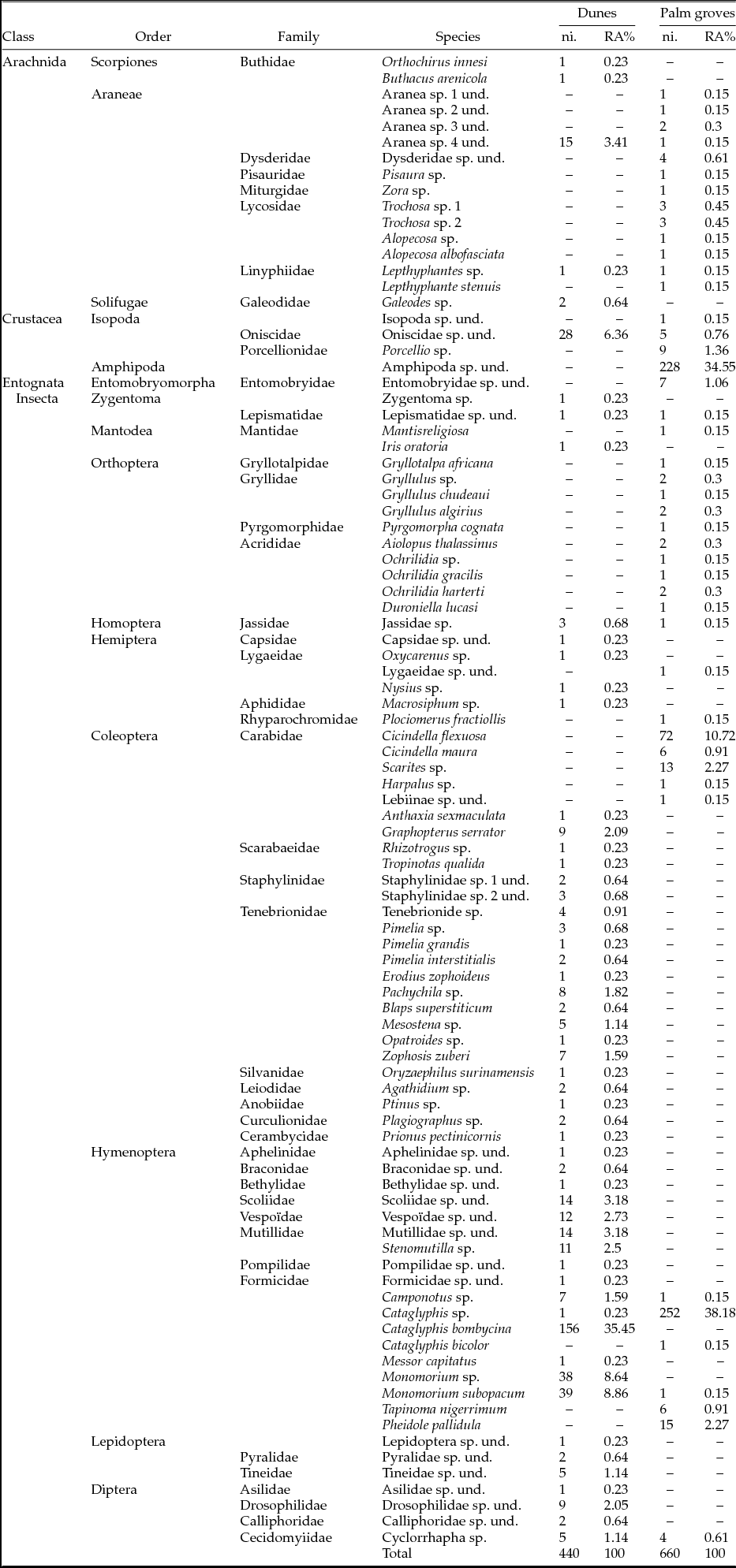
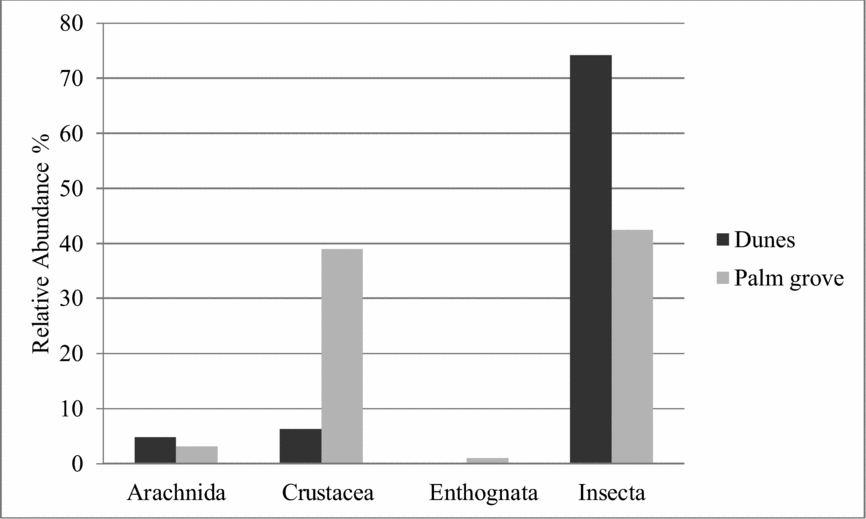
We collected 440 specimens from three classes of arthropods (Arachnida, Crustacea and Insecta) in the dune environment (Table 1). The Insecta class represented the largest part of the collected specimens with a highest relative abundance (392 specimens, RA% = 90.69%) followed by Crustacea (RA% = 6.36%) and Arachnida (RA% = 4.74%) (Table 1, Fig. 2). The capture of arthropods (660 specimens) in the palm grove was richer than the dunes of which four classes were inventoried (Arachnida, Crustacea, Entognata and Insecta) (Table 1, Fig. 2). Most species captured in this study were in the class Insecta with 392 specimens (RA% = 59.49%), followed by Crustacea (RA% = 36.82%), Arachnida (RA% = 3.16%) and Entognata.
Number and relative abundance of arthropods sampled in sand dunes and palm groves in the Touggourt, southeast Algeria

ni: Individual number; RA%: Relative abundance.
Relative abundance (RA%) of arthropod classes for two different environments (dunes and palm grove) in Touggourt, southeast Algeria.

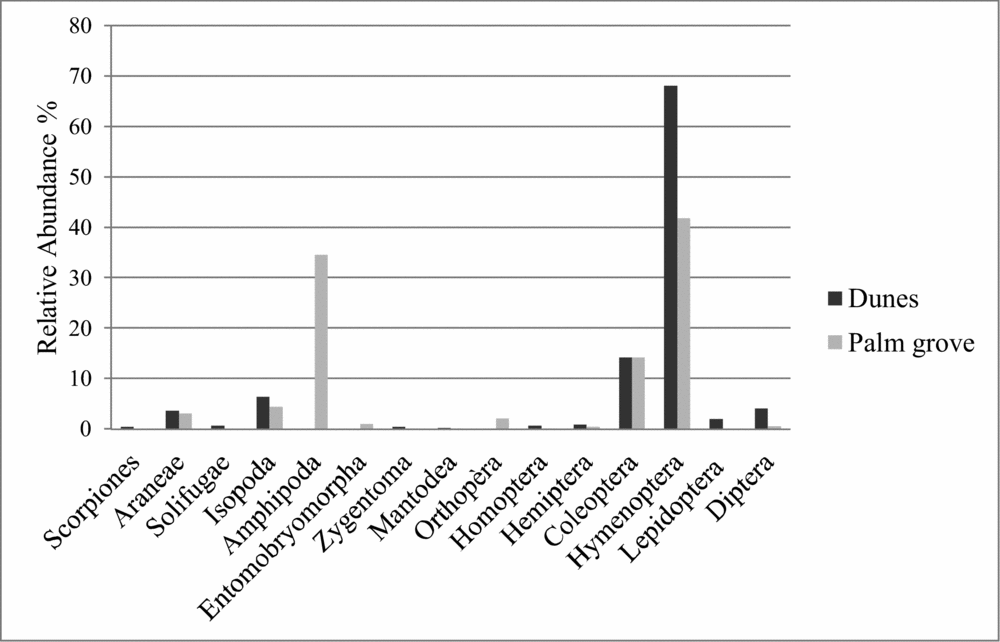
A total of 15 orders were inventoried. In the dunes, 12 orders were found where Hymenoptera dominated with 68.15% followed by Coleoptera (14.18%), Isopoda (6.36%) and Diptera (4.06%) (Table 1, Fig. 3). The relative abundances of the other orders varied between 0.46% and 3.64%. Three orders were not found in the dunes (Amphipoda, Entomobryomorpha and Orthoptera). In the palm groves, 12 orders were identified (Table 1, Fig. 3), with Hymenoptera the most abundant with a value of relative abundance of 41.81% followed by Amphipoda (34.55%), Coleoptera (14.2%) and Araneae (3.16%). The other orders had a relative abundance ranging between 0.15% and 2.27%. Three orders were absent from the palm grove (Scorpiones, Solifugae and Lepidoptera).
Relative abundance (RA%) of arthropod orders for two different environments (palm grove and dunes) in Touggourt, southeast Algeria.

In total, 44 families were recorded for the dunes and palm grove sites. First, in the dunes landscape, 33 families were captured in which the Formicidae was the most abundant with 243 specimens (55.23%) followed by Tenebrionidae (34 specimens; RA% = 8.11%) and Onicidae (28 specimens; RA% = 6.36%) (Table 1). However, 20 families were sampled in the palm grove environment, of which the Formicidae represented the most substantial part of the sampling with 276 specimens (41.81%), followed by an undetermined family of Amphipoda with 228 specimens (34.55%), and Carabidae (93 specimens; 14.2%).
Regarding species, the value of total richness noted in the dunes was 57 species and an average richness of 9.67 species. In this natural landscape, the high relative abundance value was recorded for Cataglyphis bombycina (35.45%) followed by Monomorium subopacum (8.86%), Monomorium sp. (8.64%) and undetermined Oniscidae sp. The other species were weakly represented (0.23% ≤ RA ≤ 3.41%).
In the agricultural landscape (palm grove), the total richness recorded was 42 species with an average richness equal to 3.5 species. Cataglyphis sp. was the most abundant species recorded in the palm grove with 38.18%, followed by an undetermined Amphipoda sp. (34.55%), and Cicindella flexuosa (10.72%). Pheidole pallidula (2.27%) and Scarites sp. (2.27%). The other values of abundance ranged between 0.15% and 1.36%.
The diversity values H′ and H′max varied between the two sample sites in this study. The Shannon–Weaver index H′ was 3.97 and H′max was 5.83 for the dunes site. For the palm grove site, H′ was 2.59 and H′max was 5.39. For the Evenness index, the values were dissimilar. For the dunes, the evenness was 0.68, meaning a tendency towards a balance between the arthropod species captured by our technique. In contrast, in the palm grove, the noted Evenness was 0.48, implying an imbalance between the arthropod species of this landscape.
Discussion
In this work, four classes of Arthropoda (Arachnida, Crustacea, Entognata and Insecta) were collected using Barber pitfall traps in the Touggourt region. The Insecta was the most abundant class in dunes (90.69%) and the palm grove (59.49%), followed by Crustacea and Arachnida. The Entognata class was found only in the palm grove landscape. The pitfall trap is considered an efficient technique to capture arthropods that are active at the ground surface. Using the same method at Ifri agricultural site in the Djanet region (Great South of Algeria), Beddiaf et al. (Reference Beddiaf, Kherbouche, Sekour, Souttou, Ababsa, Djillali, Doumandji, Ebouz, Guerguer, Hamid Oudjana and Hadj Seyd2014) found three classes (Arachnida, Crustacea and Insecta). These workers mention the high abundance of Insecta class with 98.5%. Another work carried by Kherbouche et al. (Reference Kherbouche, Sekour, Gasmi, Chaabna, Chakali, Lasserre-Joulin and Doumandji2015) at Ouargla (Northern Sahara of Algeria) records the existence of four classes (Arachnida, Crustacea, Entognata and Insecta) at three lucerne (Medicago sativa L.) fields where insects were the most sampled at three sites (64.4% ≤ RA ≤ 71.1%). These workers found Entognata in the three fields of lucerne. According to Bachelier (Reference Bachelier1978), the presence of Collembola in the Saharan environments is due to water runoff, which contributes to the spread of many species that float on the water surface. Near Touggourt in the Oued Souf area, Bousbia (Reference Bousbia2010) reported the sampling of Arachnida and Insecta classes, as well as the dominance of Insecta with the highest value of relative abundance (95.9%). The current study confirms the results of Bousbia (Reference Bousbia2010), Beddiaf et al. (Reference Beddiaf, Kherbouche, Sekour, Souttou, Ababsa, Djillali, Doumandji, Ebouz, Guerguer, Hamid Oudjana and Hadj Seyd2014) and Kherbouche et al. (Reference Kherbouche, Sekour, Gasmi, Chaabna, Chakali, Lasserre-Joulin and Doumandji2015). In another study on the abundance and diversity of arthropods in the Arabian Desert, Tigar and Osborne (Reference Tigar and Osborne1997) sampled four Arthropoda classes of which Insecta was dominant (97.34%) followed by Arachnida (2.63%). In the olive grove ecosystem (Portugal), Santos et al. (Reference Santos, Cabanas and Pereira2007) examined the abundance and diversity of soil Arthropoda. These workers found 12,937 arthropod specimens belonging to five classes (Arachnida, Entognata, Insecta, Chilopoda and Diplopoda) of which Insecta was the most abundant (70%). The results of our research concur with those of Tigar and Osborne (Reference Tigar and Osborne1997) and with those of Santos et al. (Reference Santos, Cabanas and Pereira2007). Mosharrof (Reference Mosharrof2010) conducted arthropod sampling of three habitats at Rajshahi University Campus in Bangladesh using the pitfall traps and mentions that the maximum number of the entire collected specimens was insects (85%) and the rest were arachnids (5%).
In the current study, the use of the pitfall trapping method allowed the sampling of 15 orders of Insecta at the two stations of Touggourt. In the dune landscape, Hymenoptera was the most dominant order with 68.15% followed by Coleoptera (14.18%), Isopoda (6.36%) and Diptera (4.06%). Also, in the palm grove site, the Hymenoptera was the most abundant (41.81%) followed by Amphipoda (34.55%), Coleoptera (14.2 %) and Araneae (3.41%). The current study is consistent with the results of Souttou et al. (Reference Souttou, Choukri, Sekour, Guezoul, Ababsa and Doumandji2015) on the ecology of arthropods in the reforested zone containing the evergreen Aleppo pine in a sub-Saharan area at Djelfa (Algeria), which identified 15 orders, with Hymenoptera being the most abundant (92.13%) followed by Coleoptera (2.93%) and Diptera (2.51%). Our results are also consistent with a study at a palm grove in a ‘ghout’, a traditional hydro agricultural system at Oued Souf, using the Barber pitfall traps in which Hymenoptera was dominant with 52.4% (Kherbouche et al., Reference Kherbouche, Bousbia, Beddiaf, Souttou, Chakali and Sekour2016). Also, these workers note that Coleoptera was second (19.4%) and Diptera third in abundance. The dominance of Hymenoptera in our study corresponds with the result of Ali-Shtayeh et al. (Reference Ali-Shtayeh, Ali and Jamous2010) in a natural grassland environment in Palestine. These workers showed that Hymenoptera was the most sampled order with 89.2%. Indeed, Pizarro-Araya et al. (Reference Pizarro-Araya, Alfaro, Agusto, Castillo, Ojanguren-Affilastro and Cepeda-Pizarro2012) studied the arthropods assemblages in the Quebrada del Morel private protected area (Atacama, Chile), sampling eight orders of which Coleoptera (33.8%) was the most frequent followed by Solifugae (22.8%), Orthoptera (21.9%) and Hymenoptera (12.6%). However, the other orders were inadequately represented. Nevertheless, the results of the present observation do not concur with those of Pizarro-Araya et al. (Reference Pizarro-Araya, Alfaro, Agusto, Castillo, Ojanguren-Affilastro and Cepeda-Pizarro2012). In the semi-dry grassland (Vienna, Austria), Zaller et al. (Reference Zaller, Kerschbaumer, Rizzoli, Tiefenbacher, Gruber and Schedl2015) established a comparison between three techniques (pitfall trapping, quadrat sampling and video monitoring). The pitfall traps allowed the capture of six orders of which Hymenoptera (54.54%) was dominant followed by Araneae (20%) and Coleoptera (18.18%). Indeed, it is known that Hymenoptera and Isoptera are distributed around the world, especially in the tropics, subtropics and particularly in semi-arid regions (Dushimirimana, Reference Dushimirimana2017). Aranea was captured to a much lower extent in our study but was more abundant in the palm grove than in the dune. This result is consistent with that of Philpott et al. (Reference Philpott, Cotton, Bichier, Friedrich, Moorhead, Uno and Valdez2014) who showed that spiders are more abundant in disturbed habitats, such as the palm grove examined here that experience more mowing and soil manipulation during the summer season. Orthoptera was also inadequately present in the palm grove but absent in the dune. The presence of Orthoptera in the palm grove was associated with plant communities. Pizzaro-Araya et al. (Reference Pizarro-Araya, Alfaro, Agusto, Castillo, Ojanguren-Affilastro and Cepeda-Pizarro2012) showed that the Gryllidae family (Orthoptera) existed under the different types of vegetation in sampling points.
Regarding families, our study recorded 44 families in total in the Touggourt region, with 33 families captured in the dunes. The most substantial abundance was noted for the Formicidae (55.23%) followed by Tenebrionidae (8.11%) and Onicidae (6.36%). However, 20 families were sampled in the palm grove environment in which the Formicidae represent the most significant part of the sampling with 41.81%. The undetermined family of Amphipoda occupies the second position (34.55 %), and the Carabidae occupies the third place (4.2%). Abensperg-Traun and Steven (Reference Abensperg-Traun and Steven1995) associated the rapid locomotory behaviour of many diurnal species (such as some Formicidae) to the proneness to capture by pitfall traps. Using five methods of sampling insect populations (Barber pitfall traps, Yallow plates, beating sheet, sweep net and sampling of branches and sheets) in two palm grove landscapes (El Kantara, Biskra), Achoura and Belhamra (Reference Achoura and Belhamra2010) found 31 families of Arthropoda of which the Acrididae (15.93%) was the most frequently found followed by the Pieridae (13.88%) and then by the Carabidae (7.45%). The results of our investigation are comparable with those of Achoura and Belhamra (Reference Achoura and Belhamra2010). In the sub-Saharan environment at Djelfa (Algeria), Souttou et al. (Reference Souttou, Choukri, Sekour, Guezoul, Ababsa and Doumandji2015) using pitfall trap sampling inventoried 45 families of Arthropoda, of which Formicidae dominated with 86.10% followed by an undetermined dipteran family. In Arizona, USA, Wynne and Voyles (Reference Wynne and Voyles2014) sampled approximately 29 Arthropoda families. Moreover, these workers mentioned the existence of seven families of Araneae and six families of Coleoptera. Our observations are similar to the results of Souttou et al. (Reference Souttou, Choukri, Sekour, Guezoul, Ababsa and Doumandji2015) and those of Wynne and Voyles (Reference Wynne and Voyles2014). According to Pizarro-Araya et al. (Reference Pizarro-Araya, Alfaro, Agusto, Castillo, Ojanguren-Affilastro and Cepeda-Pizarro2012), in the Atacama desert (Chile), a richness of 30 families was found of which the Mummuciidae was the most sampled with 22.5% followed by the Tenebrionidae (19.4%) and the Gryllidae (18.8%). A comparison between our results and those of Pizarro-Araya et al. (Reference Pizarro-Araya, Alfaro, Agusto, Castillo, Ojanguren-Affilastro and Cepeda-Pizarro2012) shows a similarity in the quantitative aspect but a difference in the qualitative aspect, because of the nature of the soil and vegetation, which are dissimilar.
An analysis of the total richness and the average richness shows that for dunes the total richness recorded was 57 species and the average richness was 9.67 species. Furthermore, at the palm grove station, the total richness equals 42 species, and the average richness accounts for 3.5 species. The results of our study are fewer when compared to those of Chouihet and Doumandji-Metiche (Reference Chouihet and Doumandji-Metiche2015) who conducted a study in three palm groves of Ghardaïa, where they found 85 species in Beni Izguen, 74 species in El Atteuf and 51 species in Dayah palm. Compared to Touggourt, in the two agricultural landscapes at Djanet (Tassili N'ajjer), Beddiaf et al. (Reference Beddiaf, Kherbouche, Sekour, Souttou, Ababsa, Djillali, Doumandji, Ebouz, Guerguer, Hamid Oudjana and Hadj Seyd2014) mention high values of total richness. These workers show that in Ifri site the total richness is 70 species and at In Abarbar it is 59 species. Tigar and Osborne (Reference Tigar and Osborne1997) carried out an investigation on the arthropods in Abu Dhabi for 2 years and found a total richness of 33 species, which is fewer than in our study because they set the traps 2 hr before dusk to 2 hr after dawn.
In the natural landscape (dunes), the high relative abundance value is unregistered for Cataglyphis bombycina (35.45%) followed by Monomorium subopacum (8.86%), Monomorium sp. (8.64%) and an undetermined Onicidae sp. Our results agree with those of Rubinstein et al. (Reference Rubinstein, Groner, Yirhaq, Svoray and Bar (Kutiel)2012) in the Nizzanim Nature Reserve (southwestern, Israel), as they mentioned that Cataglyphis nigra (15.17%) was the most frequent followed by Messor arenarius (11.11%) and Pimelia angulata (8.29%). The presence of sandy soil in this region could explain this similarity. Our results are similar also to those of Bousbia (Reference Bousbia2010) at the fixed dunes of Sidi Mestour (Oued Souf), at which Cataglyphis bombycina (17.4%) dominates followed by Messor sp. (7.4%). In the present study, we rarely captured the scorpions Orthochirus innesi (0.2%) and Buthacus arenicola (0.2%). According to Sadine and Idder (Reference Sadine and Idder2009), Orthochirus innesi is found exclusively in palm groves and Buthacus arenicola in sandy soil.
Moreover, in the agricultural landscape (palm grove), Cataglyphis sp. is the most frequent species with 38.18% followed by an undetermined Amphipoda sp. (34.55%), and then by Cicindella flexuosa (10.72%). This observation is consistent with that of Sekour-Kherbouche et al. (Reference Sekour-Kherbouche, Boucharia, Sekour, Souttou, Doumandji and Chakali2010) in a palm grove of Hassi Khalifa near El Oued (Oued Souf). These workers cite Messor arenarius (14.1%) as the dominant species followed by Cataglyphis bombycina (10.9%). Similar information is noted in the palm grove of the Technical Institute of Saharan Agronomy in Ouargla where Chennouf et al. (Reference Chennouf, Doumandji-Mitiche, Guezoul and Sekour2010) showed that Pheidole sp. is the most abundant species (17.4%) followed by Monomorium sp. (17%).
The diversity values H′ and H′max varied between the two sample sites in this study. The Shannon–Weaver index H′ was 3.97 and H′max was 5.83 for the dunes site. These results are close to those cited by Bousbia (Reference Bousbia2010) at Sidi Mestour near Oued Souf (H′ = 4.6). The present value of H′ is also similar to the result found by Souttou et al. (Reference Souttou, Choukri, Sekour, Guezoul, Ababsa and Doumandji2015) in the reforested zone in a sub-Saharan area at Djelfa with H′ equal to 3.38. In the palm grove, the value of H′ is 2.59 and H′max value is 5.39. This H′ result is close to 2.9 obtained by Souttou et al. (Reference Souttou, Farhi, Baziz, Sekour, Guezoul and Doumandji2006) on the border of Oued Sidi Zarzour near a palm grove near Biskra. The diversity richness in our study, however, appears less than that reported by Yasri et al. (Reference Yasri, Bouisri, Kherbouche and Arab2009) and by Sekour-Kherbouche et al. (Reference Sekour-Kherbouche, Boucharia, Sekour, Souttou, Doumandji and Chakali2010). Indeed, Yasri et al. (Reference Yasri, Bouisri, Kherbouche and Arab2009) report the value of H′ equal to 5.3 in Ghoufi palm grove. Similarly, in a palm grove environment (Oued Souf), Sekour-Kherbouche et al. (Reference Sekour-Kherbouche, Boucharia, Sekour, Souttou, Doumandji and Chakali2010) report an H′ value of 4.7.
Conclusion
The similarities and differences of arthropod communities were determined using Barber pot traps for two diverse habitats: dunes (a natural environment) and palm grove (an agricultural environment), in the Touggourt region, southeast Algeria. The results of the present study are essential to determine the arthropods biodiversity in the two different environments. The dune habitat has a much higher total richness than the palm grove habitat. In both habitats, the Insecta class was dominant. The Entognata class was present only in the palm site, most likely due to the availability of irrigated water. Among the Insecta, Hymenoptera was the most abundant in the palm grove and dunes. In addition, in the dunes habitat, Cataglyphis bombycina was the dominant species followed by the undetermined Amphipoda sp. and Cicindella flexuosa.
In contrast, Cataglyphis sp. was the predominant species in the palm grove agricultural landscape followed by Pheidole pallidula and Tapinoma nigerrimum. The Orthoptera, Amphipoda and Entomobryomorpha species were specific to the palm grove site. We also noted that Scorpiones, Solifugae and Lepidoptera were present only in the dunes. The palm grove, which is anthropized and disturbed by cultural practices, has less diversity than dunes, which are undisturbed by humans. The evenness in the palm grove shows an imbalance between the arthropod species of this landscape but shows a tendency towards a balance between the arthropod species at the dune site.
Acknowledgements
We thank Hadjoudj Mohammed Mahmoud for his help during the sampling process.