Introduction
More than half of the world's population is estimated to be bilingual (Grosjean, Reference Grosjean2012). This phenomenon is especially prevalent in multicultural countries like Canada, where, in 2016, the growth rate was estimated at 19.4%, mostly due to Québec's growing bilingual status. Bilingualism is inflated even further within bigger cities, like Toronto and Montréal, where over 20% of children are estimated to be bilingual (Schott, Kremin & Byers-Heinlein, Reference Schott, Kremin and Byers-Heinlein2019). This growing rate of bilingualism has intrigued researchers studying language due to its highly accessible nature and its potential link to cognitive capability. More specifically, interests lie in the potential link between this distinct linguistic ability and human cognitive capabilities across the lifespan. In this stream of psychological research, there has been a distinct focus on an important set of cognitive capabilities called executive functions. These are a set of mental processes that are crucial to everyday activities, such as planning, focusing attention, remembering commands and successfully performing multiple tasks simultaneously (Arizmendi, Alt, Gray, Hogan, Green & Cowan, Reference Arizmendi, Alt, Gray, Hogan, Green and Cowan2018). Three of the main executive functions are: cognitive flexibility (i.e., shifting), working memory (i.e., maintaining), and inhibitory control (IC; Arizmendi et al., Reference Arizmendi, Alt, Gray, Hogan, Green and Cowan2018). These three executive functions are of particular interest because they underlie several key abilities, including our ability to adapt behaviour in response to changes in the environment (cognitive flexibility), the immediate conscious and perceptual capability of linguistic processing (working memory), as well as the ability to inhibit natural or dominant behavioural responses to external stimuli (inhibitory control; Arizmendi et al., Reference Arizmendi, Alt, Gray, Hogan, Green and Cowan2018; Hendry, Jones & Charman, Reference Hendry, Jones and Charman2016). Executive functions have been extensively investigated in relation to bilingualism across the lifespan (Bialystok, Reference Bialystok2017).
A bilingual advantage in performing these executive functions has been found across the lifespan. The advantage may be due to the better grasp and control of attentional switching – or the ability that we have to unconsciously shift between tasks – a basic human cognitive ability (Bialystok, Reference Bialystok2017). Bilinguals are thought to have better developed this skill due to their constant switching between the two languages they have acquired, which is used to explain their increased performance on tests of executive functions that rely on attentional mechanisms, such as inhibitory control and cognitive flexibility. Many studies conducted with adult bilinguals support the conclusion that the practice of two languages leads to increased control of related executive functions (Bialystok, Reference Bialystok2017). It is important to note that research on this topic in adulthood has often been difficult to replicate and is the subject of an ongoing debate among researchers (Bright & Filippi, Reference Bright and Filippi2019; Goldsmith & Morton, Reference Goldsmith and Morton2018). While a meta-analysis by Adesope and colleagues (Adesope, Lavin, Thompson & Ungerleider, Reference Adesope, Lavin, Thompson and Ungerleider2010) suggests a reliable association between bilingualism and increased performance on several different cognitive outcomes across the lifespan, others disagree. A more recent meta-analysis published by Lehtonen and colleagues (Lehtonen, Soveri, Laine, Järvenpää, De Bruin & Antfolk, Reference Lehtonen, Soveri, Laine, Järvenpää, De Bruin and Antfolk2018) suggests that the available evidence is not sufficient to provide systematic support for the notion that bilingualism is linked to benefits in cognitive abilities in adults. Furthermore, Nichols and colleagues (Nichols, Wild, Stojanoski, Battista & Owen, Reference Nichols, Wild, Stojanoski, Battista and Owen2020) have also found evidence that suggests that, when confounding factors such as gender, age, education and socioeconomic status are considered, the bilingual advantage is no longer viable. This non-conformity was further elucidated in a systematic review by van den Noort and colleagues (van den Noort, Struys, Bosch, Jaswetz, Perriard, Yeo, Barisch, Vermeire, Lee & Lim, Reference van den Noort, Struys, Bosch, Jaswetz, Perriard, Yeo, Barisch, Vermeire, Lee and Lim2019), which suggests that the varying inclusion criteria for the selection of bilinguals, the use of unstandardized tests and the overlooking of individual differences, may very well explain these differing results. It is important to note, however, that more than half of the literature that was reviewed supported the “Bilingual Advantage Hypothesis,” although van den Noort and colleagues (Reference van den Noort, Struys, Bosch, Jaswetz, Perriard, Yeo, Barisch, Vermeire, Lee and Lim2019) emphasize the need for more longitudinal studies and better study designs to further clarify these results.
Similar to the mixed findings of a bilingual cognitive advantage in adults, recent research with children has also not been consistent in reporting advantages of bilingualism on cognitive abilities. For example, when children aged three to ten years old performed the Flanker task, bilingual children consistently outperformed monolingual children (Bialystok, Reference Bialystok2017). That is, bilingual children demonstrated enhanced inhibitory control. Furthermore, the link between bilingualism and cognitive flexibility has also been examined in childhood (Adesope et al., Reference Adesope, Lavin, Thompson and Ungerleider2010). When 4–5-year-old children are asked to draw an object that does not exist in the real world, bilingual children exhibited more flexibility than their monolingual counterparts (Adi-Japha, Berberich-Artzi & Libnawi, Reference Adi-Japha, Berberich-Artzi and Libnawi2010). Bilingual children showed more inter-representational flexibility in their drawings, meaning that they were able to include more unlinked aspects together in their drawings than monolingual children (e.g., a giraffe-flower – a flower that had the traits of a giraffe). In contrast, a number of studies conducted with very large samples of monolingual and bilingual school-aged children revealed no bilingual cognitive advantage (Antón, Duñabeitia, Estévez, Hernández, Castillo, Fuentes, Davidson & Carreiras, Reference Antón, Duñabeitia, Estévez, Hernández, Castillo, Fuentes, Davidson and Carreiras2014; Duñabeitia, Hernández, Antón, Macizo, Estévez, Fuentez & Carreiras, Reference Duñabeitia, Hernández, Antón, Macizo, Estévez, Fuentez and Carreiras2014; Gathercole, Thomas, Kennedy, Prys, Young, Guasch, Roberts, Hughes & Jones, Reference Gathercole, Thomas, Kennedy, Prys, Young, Guasch, Roberts, Hughes and Jones2014). Importantly, a wide range of tasks measuring executive skills were used (e.g., card sorting, Simon task, Stroop, ANT), and the groups were carefully matched on variables such SES and IQ. A recent meta-analysis conducted on 10,937 bilingual and 12,477 monolingual participants between the ages of 3 and 17 years concluded that the available evidence suggests that the bilingual advantage in children's executive functioning is small, variable, and potentially not attributable to the effect of language status (Lowe, Cho, Goldsmith & Morton, Reference Lowe, Cho, Goldsmith and Morton2021).
The bilingual advantage has also been examined in toddlers and preverbal infants. Poulin-Dubois and colleagues (Poulin-Dubois, Blaye, Coutya & Bialystok, Reference Poulin-Dubois, Blaye, Coutya and Bialystok2011) tested 24-month-old infants’ inhibitory control abilities using an adaptation of the Stroop task. Here, infants had to identify small pictures of fruit that were embedded in bigger pictures of fruit. Once again, bilingual infants outperformed monolingual infants on this task. Moreover, in a recent longitudinal study, toddlers were tested on a battery of executive functioning tasks in which the number of translational equivalents that the infants learned in each language was assessed at 24 months and again at 31 months (Poulin-Dubois et al., Reference Poulin-Dubois, Blaye, Coutya and Bialystok2011). Translational equivalents are concepts for which bilingual infants have acquired the words in each of their respective languages. For example, the English word “dog” would have the French translational equivalent “chien.” They observed that bilingual infants who had acquired more translational equivalents during the 7-month period showed better performance in inhibitory control tasks using the same adaptation of the Stroop task described above (Crivello, Kuzyk, Rodrigues, Friend, Zesiger & Poulin-Dubois, Reference Crivello, Kuzyk, Rodrigues, Friend, Zesiger and Poulin-Dubois2016). Also, past studies have reported memory differences between monolingual and bilingual infants (Brito & Barr, Reference Brito and Barr2012; Singh, Fu, Rahman, Hameed, Sanmugam, Agarwal, Jiang, Chong, Meaney, Rifkin-Graboi & GUSTO Research Team Reference Singh, Fu, Rahman, Hameed, Sanmugam, Agarwal, Jiang, Chong, Meaney and Rifkin-Graboi2015). More specifically, robust bilingual differences have been observed in memory generalization from 6- to 24-months of age, regardless of socioeconomic status (Brito, Greaves, Leon-Santos, Fifer & Noble, Reference Brito, Greaves, Leon-Santos, Fifer and Noble2020).
Research with preverbal infants has yielded mixed results. Seven-month-old bilingual babies have been shown to outperform monolinguals on an implicit anticipatory looking task (Comishen, Bialystok & Adler, Reference Comishen, Bialystok and Adler2019; Kovács & Mehler, Reference Kovács and Mehler2009). In this experiment, infants learnt to redirect their gaze towards a learnt cue while ignoring other distracting stimuli, suggesting that even bilingual infants without any expressive language skills have an increased ability to inhibit reflexive responding in an implicit measure of inhibitory control. In turn, the bilingual advantage develops long before infants have developed more complex linguistic capabilities. Additionally, Comishen and colleagues (Reference Comishen, Bialystok and Adler2019) replicated the anticipatory looking task findings, suggesting that increased mastery of attentional control in bilingual 6-month-old infants paves the way for better control of attention-based executive functions later in development. These results corroborate earlier findings that bilingualism enhances executive functioning prior to the ability to produce language (Bialystok, Barac, Blaye & Poulin-Dubois, Reference Bialystok, Barac, Blaye and Poulin-Dubois2010). However, several recent attempts to replicate this initial finding have failed. Infants between 7 and 10 months of age were administered a task similar to the original study and did not observe differences between monolinguals and bilinguals (D'Souza, Bradt, Haensel & D'Souza, Reference D'Souza, Bradt, Haensel and D'Souza2020; Ibanez-Lillo, Pons, Costa & Sebastian-Galles, Reference Ibanez-Lillo, Pons, Costa and Sebastian-Galles2010; Kalashnikova, Pejovic & Carreiras, Reference Kalashnikova, Pejovic and Carreiras2020; Molnar, Pejovic, Yee & Carreiras, Reference Molnar, Pejovic, Yee and Carreiras2014; Tsui & Fennell, Reference Tsui and Fennell2019).
Although there is a substantial amount of research examining the bilingual advantage hypothesis in very young children, there remain many gaps in the literature. Some studies have reported better attentional control by the age of 6 months and better conflict resolution at 24 months in bilinguals; however, research on the bilingual advantage over the second year of life is scarce. Second, whereas several studies have examined the effects of bilingualism on performance on memory generalization imitation paradigms in this age range (Brito & Barr, Reference Brito and Barr2012; Brito & Barr, Reference Brito and Barr2014; Brito, Grenell & Barr, Reference Brito, Grenell and Barr2014), to our knowledge, infants of this age have never been directly compared on a battery of executive function tasks. This group is of notable interest because it delimits a developmental period during which children are progressing from receptive to productive language and rapidly acquire translation equivalents in their vocabulary (Bosch & Ramon-Casas, Reference Bosch and Ramon-Casas2014; David & Wei, Reference David and Wei2008; Legacy, Reider, Crivello, Kuzyk, Friend, Zesiger & Poulin-Dubois, Reference Legacy, Reider, Crivello, Kuzyk, Friend, Zesiger and Poulin-Dubois2017; Poulin-Dubois, Kuzyk, Legacy, Zesiger & Friend, Reference Poulin-Dubois, Kuzyk, Legacy, Zesiger and Friend2017). It is also a key developmental period for executive functions, which can be measured with traditional executive function tasks that require minimal social, motor, and language skills (Hendry et al., Reference Hendry, Jones and Charman2016). This research would add to existing literature and could potentially establish a link between bilingualism and executive functioning at a stage of development that corresponds to a transition from testing executive functions implicitly with visual measures to testing executive functioning with explicit behaviours. A final gap concerns the specific impact of bilingualism in the development of executive functions. Research with monolingual children has shown that language (vocabulary size) and inhibitory control are correlated, in which the higher the vocabulary the better the inhibitory control. Verbal skills have been shown to positively relate to children's self-regulation abilities in early childhood (Fuhs & Day, Reference Fuhs and Day2011; Kuhn, Willoughby, Wilbourn, Vernon-Feagans & Blair, Reference Kuhn, Willoughby, Wilbourn, Vernon-Feagans and Blair2014; Peredo, Owen, Rojas & Caughy, Reference Peredo, Owen, Rojas and Caughy2015; Vallotton & Ayoub, Reference Vallotton and Ayoub2011). In bilinguals, only the dominant language predicts IC. It was important to examine whether better executive functions were not simply linked to a larger vocabulary but to bilingualism per se.
In order to fill these gaps, the current study compared 17-month-old monolingual and bilingual infants on a set of executive functioning tasks in order to test the hypothesis of an early bilingual cognitive advantage. We hypothesized that: 1) bilingual infants would outperform monolingual infants on tasks involving conflict resolution and shifting; 2) no difference would be expected between the two groups (Brito et al., Reference Brito, Greaves, Leon-Santos, Fifer and Noble2020; Lukasik, Lehtonen, Soveri, Waris, Jylkkä, Laine & Dritschel, Reference Lukasik, Lehtonen, Soveri, Waris, Jylkkä, Laine and Dritschel2018) for working memory skills, given that a limited advantage has been observed in school-aged children and no advantage in toddlers; 3) within the bilingual group, increased use of the non-dominant language, as reflected in the length of exposure to a second language and amount of current language exposure within the bilingual group, would be associated with higher scores on the confliction resolution and shifting tasks; 4) a larger vocabulary would be beneficial in the development of inhibitory control in both groups.
Methods
Participants
The total sample included 102 neurotypical 17-month-old infants (Mage = 17.25 months, range = 15.17–19.40 months, SD = 0.98, nmales = 55, nfemales = 47) from a large Metropolitan city. There were 60 monolingual and 42 bilingual children included in the original sample. Monolingual infants were on average 17.16 months-old (SD = 1.03) and bilingual infants were on average 17.38 months-old (SD = 0.89). The parents had to preliminarily identify their child as being monolingual or bilingual, as well as indicate whether their child's dominant language was English or French. To be considered bilingual, infants had to have a minimum of 20% exposure to a second language (L2). All children classified as bilinguals were exposed to a second language from birth. In contrast, to be classified as a monolingual, infants had to have less than 20% exposure to a second language. Finally, infants exposed to a third language (L3) with an exposure greater than 10% were labelled as trilingual.
All tasks were administered in either English or French depending on language exposure, as disclosed by the accompanying parent (see Table 1 for descriptives of language variables). Of the 60 monolingual infants, 28 were predominantly exposed to English, 23 predominantly to French and the remaining 9 infants to neither English nor French as their dominant language (nSpanish = 4, nArabic = 2, nMandarin = 2, nPortugese = 1). The LEAT revealed that exposure to either French or English ranged from 2% to 10%, so the administration of the tasks was conducted in one of these two languages. The MCDI was administered in either French or English in those cases, based on which (of the two) had the highest level of exposure reported in the LEAT. In 2 cases, the MCDI receptive vocabulary was very low, but the removal of these participants did not change the results, so they are included in all analyses.
Descriptives by Language group

*Exposure for trilingual infants was calculated by adding percentage of exposure to their second and third language.
Of the 42 infants in the bilingual group, 36 infants were bilingual and 6 were trilingual. Of the 36 bilingual infants, 14 had English as their L1, 16 had French as their L1, and the remaining 6 infants had an L1 that was neither English nor French (nSpanish = 1, nEwe = 1, nUrdu = 1, nCantonese = 1, nJapanese = 1, nMandarin = 1). As their L2, 11 infants had English, 10 infants had French and the remaining 15 infants had an L2 that was neither English nor French (nArabic = 2, nSpanish = 2, nCantonese = 1, nFarsi = 1, nGerman = 1, nRussian = 1, nBerber= 1, nHokkien = 1, nItalian = 1, nGreek = 1, nMandarin = 1, nTiv = 1, nTamil = 1). In addition, 4 trilingual infants had English as their L1, 1 had Algerian and 1 had Bulgarian. As their L2, 3 had French, 1 English, 1 Arabic and 1 Spanish. Finally, as their third language, 3 had French, 1 had Spanish, 1 had Tagalog and 1 had Swahili. Given that all trilingual infants had at least 20% exposure to a second language and at least 10% to French or English, they were grouped with the bilinguals.
Detour reaching task
Participants for the detour task comprised eighty-three infants (44 males and 39 females), where 35 were bilingual and 48 were monolingual. Nineteen additional infants were tested and excluded from the analyses due to fussiness or non-completion of the task.
Delayed response task
Participants for the delayed response task comprised sixty-six infants (29 males and 33 females), where 27 were bilingual and 35 were monolingual. Forty additional infants were tested and excluded from the analyses due to fussiness (n = 36) or experimental error (n = 4).
Multiple location task
Participants for the multiple location task comprised fifty-one infants (30 males and 25 females), where 26 were bilingual and 29 were monolingual. Forty-seven additional infants were tested and excluded from the analyses due to failing the familiarization phase (n = 3; see inclusion criterion below), opening the middle drawer on all test trials (n = 17), fussiness (n = 25) or experimental error (n = 2).
Materials and procedure
This study was carried out in accordance with the recommendations of the American Psychological Association ethical guidelines. The protocol was approved by the Concordia University Human Research Ethics committee. All parents of the infant participants gave written informed consent.
Prior to beginning the experiment, infants were familiarized to the testing environment. The caregiver gave written informed consent and completed a short demographic questionnaire. In order to categorize the infants as being either monolingual or bilingual, the infant's caregiver was administered the Language Exposure Assessment Tool (LEAT; DeAnda, Bosch, Poulin-Dubois, Zesiger & Friend, Reference DeAnda, Bosch, Poulin-Dubois, Zesiger and Friend2016). The LEAT is a semi-structured interview administered by the main experimenter. This measure assessed which languages the infant heard by the different people that they regularly interact with, as well as the age at which each language was acquired, which enabled the experimenter to subsequently categorize the infant into the monolingual or bilingual group.
Following the administration of the LEAT, the parents were asked to complete the McArthur-Bates Communicative Development Inventory (MCDI) Short-Form. The MCDI short-form (level 1) is a parent-report vocabulary checklist containing 89 words (both the English and French versions contain 89 words) that is used to gauge 8- to 18-month-old infants’ receptive (understanding of a word) and productive (production of a word) vocabulary in English or French language. The MCDI short-form was given to parents whose child had English as their dominant language (Fenson, Pethick, Renda, Cox, Dale & Reznick, Reference Fenson, Pethick, Renda, Cox, Dale and Reznick2000) and the French-Canadian adaptation of the MCDI short-form was given to parents whose child had French as their dominant language (Trudeau, Frank & Poulin-Dubois, Reference Trudeau, Frank and Poulin-Dubois1999). For the 17 children who had neither French nor English as their dominant language, parents completed the MCDI in French or English, based on highest reported exposure. Total receptive and productive vocabulary scores were extracted and used as a continuous variable to examine if infants’ lexicon had an impact on their performance on executive functioning tasks. The main analyses were conducted with and without the children who had a dominant language other than French or English. The full sample is reported given that the pattern of results did not vary.
The infants then took part in three game-like tasks designed to assess three distinct executive functions: inhibitory control, cognitive flexibility, and working memory. The order of the first two tasks (the Detour Reaching task and the Delayed Response task) was counterbalanced in order to eliminate any possible order effects. The third task, the multiple location task, was always performed last – given the duration of the entire procedure, and that working memory tasks have not yielded conclusive results in the literature (Bialystok, Reference Bialystok2017). All tasks were recorded and thereafter coded offline for accuracy and latency to respond. At the end of the session, the infants’ parents were given 20$ for their participation, as well as a gift and certificate of participation for their child.
Detour reaching task
The detour reaching task was developed to test toddlers’ inhibitory control abilities (McGuigan & Nunez, Reference McGuigan and Nunez2006; Yott & Poulin-Dubois, Reference Yott and Poulin-Dubois2012). Detour reaching tasks have proved to be adequate to manipulate the dual demands of working memory plus inhibition both in the early period of infancy and in the preschool period. In the toddler version, the experimenter showed the infant how to open a red wooden box by turning a knob located on its left side to retrieve a toy locked behind a plexiglass door. Once the experimenter showed the child how to retrieve the toy, the infant was given the opportunity to open the box themselves. Once the box was positioned in front of the infant, the experimenter used a remote-controlled device to control when the door opened. The experimenter only opened the box once the child correctly attempted to open the box by touching the knob, or if the child failed to open the box during the 45-second trial. This procedure was administered four times (four trials), each time with one of four different soft-plastic, animal-shaped toys. Accuracy on each trial was coded for the child's first attempt at opening the box. The two possible responses the infant can make are either pressing directly against the plexiglass window (incorrect), or reaching for the knob, as demonstrated by the experimenter (correct). This coding yielded a maximum score out of four – that is, one point per trial for every correct first attempt at opening the box. Latency to respond on each trial was also coded post-experiment. Latency was coded from trial onset (when the experimenter pushes the box towards the child) until trial offset (when the child first touches the box on their first attempt).
Delayed response task
The delayed response task is a derivative of the A-not-B task, originally developed by Piaget to test an infant's object permanence (Piaget, Reference Piaget1954). To succeed on this conflict task, children must change their response from using one rule to using another rule, also known as set shifting (Diamond, Reference Diamond1985). In the present task, adapted from Devine and colleagues (Devine, Ribner & Hughes, Reference Devine, Ribner and Hughes2019), infants watched the experimenter hide a plastic ball in one of two identical wooden blue boxes. These boxes were then hidden from the child's sight using a black cardboard panel for five seconds (counted out loud by the experimenter). Once the panel was removed, the infants were asked where the ball was hidden. This procedure is administered for eight trials. The order in which the ball is hidden was pseudorandomized into two sequences (Order 1: Right-Right-Left-Left-Right-Left-Left-Right or Order 2: Left-Left-Right-Right-Left-Right-Right-Left) to reduce the possibility of an order effect. Accuracy was coded for each reversal trial – trials in which the ball was hidden in the opposite box than it was in the previous trial – where the infant was given one point for correctly identifying the location of the ball by either pointing to or reaching for the correct box. The reversal trials measure cognitive flexibility as it required that infants flexibly switch from responding from one box to the other. There was a total of four reversal trials resulting in a total score out of four. Latency to respond was also coded post-experiment, from trial onset (when the experimenter removed the black cardboard panel from in front of the boxes) until trial offset (when the child pointed to or reached for a box).
Multiple location task
This task was originally designed by Zelazo and colleagues (Zelazo, Reznick & Spinazolla, Reference Zelazo, Reznick and Spinazolla1998) and is commonly used to assess maintaining information in mind or working memory in children. In this adaptation of the task, the apparatus consisted of a wooden box containing five drawers, three of which were removable, and a small soft-plastic toy frog. During the familiarization phase, the experimenter hid a toy in one of the three removable drawers, then immediately asked the child to find it. This was repeated three times – once with each drawer – in a counterbalanced order to ensure that the child understood the task. Following the familiarization phase was the testing phase, during which the experimenter hid the toy in one of the three removable drawers, then hid the box from the child's sight for five seconds using a black cloth. Afterwards, the experimenter asked the child to retrieve the toy. The testing phase was then repeated with the two remaining drawers (in a counterbalanced order for a total of three trials for a total of six different counterbalancing options). Accuracy was coded on both the familiarization trials and the test trials, with a correct response receiving one point per trial. Only infants who obtained a score of at least two out of three during the familiarization phase were included in subsequent analyses of test scores to ensure that infants understood the task. Total accuracy scores were calculated on test trials only, with a maximum score of three. In addition, latency to respond was also coded post-experiment, from trial onset (when the experimenter removed the black cloth from covering the drawers) until trial offset (when the child first touches one of the drawers).
Coding and reliability
Accuracy and latency coding were performed on the Mangold interact software (Mangold, Reference Mangold2010), and subsequent statistical analyses were performed on the R statistical software (R Core Team, 2013) and SPSS Statistics (IBM Corp., 2020). Intercoder reliability for accuracy scores were calculated and resulted in Kappa's coefficient scores of 1.00 for all three tasks. Intercoder reliability for latency scores on correct trials were calculated and resulted in Kappa's coefficient scores of 0.84 for the detour reaching task, 0.94 for the multiple location task, and 0.93 for the delayed response task.
Results
The receptive vocabulary (M = 47.60, SD = 26.18) and productive vocabulary (M = 14.88, SD = 13.74) scores in the bilingual children's dominant language were compared to those of the monolingual children (Mreceptive = 46.54, SDreceptive = 20.77; Mproductive = 12.81, SDproductive = 11.98). These differences were found not to be statistically significant (receptive: t(99) = −0.23, p = .82, d = 0.045; productive t(99) = −0.80, p = .42, d = 0.16). Moreover, we compared monolingual and bilingual infants on maternal education and household income as a proxy of socioeconomic status (see categories and frequency of responses in Table 1). Monolingual and bilingual infants do not differ in their mother's education (χ2(8) = 11.56, p = .17) nor in their household income (χ2(6) = 6.30, p = .39). Finally, an independent samples t-test revealed no difference in age between monolingual (M = 17.16, SDreceptive = 1.03) and bilingual (M = 17.38, SD = 0.89) children in this sample (t (100) = −1.11, p = .27, d = 0.23).
To test the key hypothesis, the performance of the monolingual and bilingual infants was compared on the battery of executive functioning tasks. First, for each of the three tasks, a one-way ANOVA was conducted to examine the effect of Language Group on accuracy scores. The independent variable was Language Group (either monolingual or bilingual) and the dependent variable was the accuracy score specified per task. In addition, a one-way ANOVA was conducted to determine the effect of Language Group on latency scores for each task. The independent variable was once again the Language Group, and the dependent variable was the latency specified per task. Finally, because children tended to show inhibition to touch the apparatus in the Detour Reaching task, performance across trials was also examined for both accuracy and latency for that task.
Detour reaching task
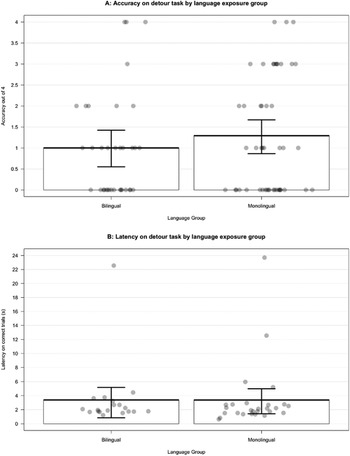
The average accuracy score on the detour reaching task, where touching the knob first gave a score of 1 and touching the door first gave a score of 0 (total score out of 4), did not differ statistically between language group (M Bilingual = 1.00, SD Bilingual = 1.24, M Monolingual = 1.29, SD Monolingual = 1.38, F(1,81) = 0.98, p = .32; see Figure 1A). Here, language group accounted for 1.6% of the variation in accuracy in the detour reaching task (η2 = 0.016). Next, we looked at whether, across both language groups, infants showed a significant improvement in their accuracy in the detour reaching task. Overall, infants did show this improvement (i.e., main effect of trial; F(3, 243) = 8.19, p < .01, η2 = 0.092). Breaking this down, infants showed a statistically significant improvement from trial 1 to trial 2 (Mdifference Trial 1 – Trial 2 = −0.13, p = .019), 3 (Mdifference Trial 1 – Trial 3 = −0.14, p = .009) and 4 (Mdifference Trial 1 – Trial 4 = −0.27, p < .01). Given that the largest difference was seen between trials 1 and 4, we compared between-group performance on these trials. Bilinguals and monolinguals did not differ in their accuracy from trial 1 to trial 4 (i.e., no interaction between Trial and Language Group; M Difference Monolinguals Trial 1 – Trial 4 = −0.23, M Difference Bilinguals Trial 1 – Trial 4 = −0.32, F(3, 243) = 0.60, p = .61, η2 = 0.007). In addition, the average latency to touch the knob (on correct trials) for bilingual children (M = 3.38s, SD = 4.73) did not differ from that of monolingual children (M = 3.37s, SD = 4.67, F(1,44) = 0.00, p = 0.995); see Figure 1B). Here, language group accounted for less than 1% of the variation in latency to touch the knob in the detour reaching task (η2 = 0.00023). Similarly, comparing latency on the first trial to latency on the last trial, response latency did differ between monolingual and bilingual infants (i.e., an interaction between Trial and Language Group; F(3, 219) = 3.13, p = .026, η2 = 0.041). Thus, monolingual infants show a greater decrease in latency to respond from trial 1 to trial 4 when responding correctly (M Bilingual Difference between trial 1 and 4 = 0.060s, M Monolingual Difference between trial 1 and 4 = 2.18s).
A) Average accuracy for Detour Task and B) Average latency to touch the knob on correct trials in the Detour Task (in seconds).

Multiple location task
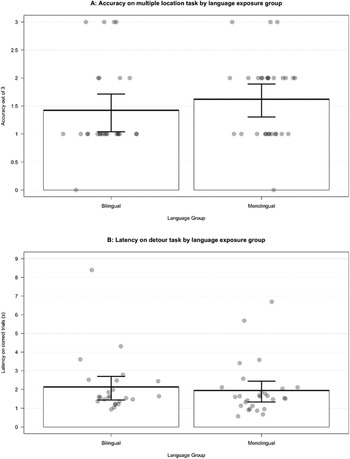
On the working memory task, accuracy was calculated as the number of correct trials out of 3. Bilinguals (M = 1.42, SD = 0.81) and monolingual infants (M = 1.62, SD = 0.73) did not differ statistically in their performance (F(1, 53) = 0.91, p = .34; see Figure 2A). Here, language group only accounts for 1.7% of the variation in accuracy on the multiple location task (η2 = 0.017). Moreover, bilingual (M = 2.14s, SD = 1.56) and monolingual infants (M = 1.95s, SD = 1.40) also did not differ on their latency to respond on correct trials (F(1,50) = 0.21, p = .65; see Figure 2B). Here, language group accounts for less than 1% of the variation in latency to respond in the multiple location task (η2 = 0.0042). Moreover, these results did not differ by order. That is, monolinguals and bilinguals did not differ in their accuracy nor in their latency to respond when their answer was correct, regardless of which drawer the toy was hidden in first (right, middle or left; Accuracy: F(5,43) = 0.93, p = .47, η2 = 0.097; Latency: F(5,40) = 0.39, p = .85, η2 = 0.046).
A) Average accuracy on the multiple location task and B) Average latency on correct trials on the multiple location task (in seconds).

Delayed response task
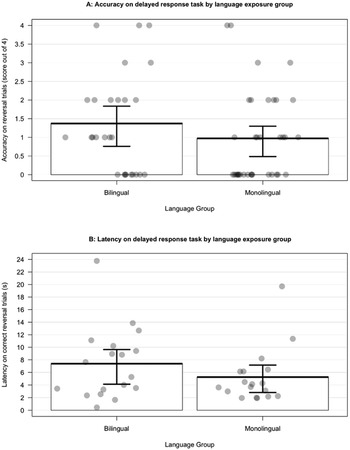
Given that there were four reversal trials, the average correct reversal was calculated (a score out of 4). The average correct reversal trials on the delayed response task did not differ by group (MBilingual = 1.37, SDBilingual = 1.33, MMonolingual = 0.97, SDMonolingual = 1.20, F(1,60) = 1.53, p = 0.22; see Figure 3A). That is, language group only accounts for 2% of the variation in accuracy on reversal trials in the delayed response task (η2 = 0.025). Moreover, the average latency on correct reversal trials also did not differ by group (MBilingual = 7.38, SDBilingual = 5.75, MMonolingual = 5.25, SDMonolingual = 4.39, F(1, 34) = 1.57, p = .22; see Figure 3B). Here, language group accounts for roughly 4% of the variation in latency on correct reversals in the delayed response task (η2 = 0.044). Moreover, these results did not differ by order. That is, monolinguals and bilinguals did not differ in their accuracy nor in their latency to respond when their answer was correct, regardless of which order the ball was hidden (Accuracy: F(1,58) = 1.16, p = .29, η2 = 0.020; Latency: F(1,32) = 1.80, p = .19, η2 = 0.53).
A) Accuracy on reversal trials (score out of 4) on the delayed response task and B) Average latency on the correct reversal trials (in seconds).

Task order effects
The order of the Detour and Delayed Response tasks was counterbalanced to eliminate any possible order effects, and the Multiple Location task was always presented last. After exclusion, the proportion of monolingual and bilingual children who completed each order was roughly equivalent across all tasks and variables. To check for order effects, ANOVA's were computed looking for the interaction between Language Group and task order on Accuracy and Latency. No order effects were found for Accuracy or Latency for any of the tasks, except for an interaction between Language Group and task order on Latency (F(1, 32) = 10.20, p = .003, η2 = 0.24) on the Delayed Response task. That is, bilinguals showed a longer average latency to respond when answering correctly on reversal trials than monolinguals when the Delayed Response task came after the Detour task (i.e., Order 1: Detour task, Delayed Response task, then Multiple Location task). There was no such difference when the Delayed Response task came before the Detour task (i.e., Order 2: Detour task, Delayed Response task, then Multiple Location task).
Within-group comparisons
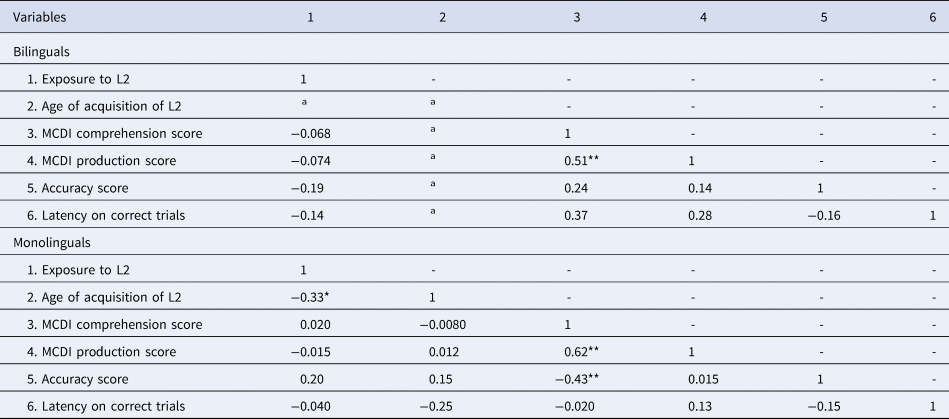
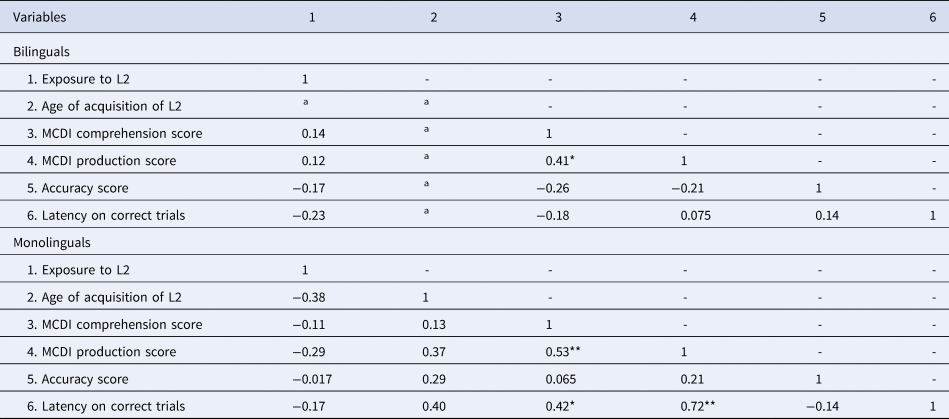
Within the bilingual group, correlations between the four different predictors of language skill (age of acquisition of L2, exposure to L2, MCDI comprehension score, MCDI production score) and the accuracy and latency scores of each task were conducted to investigate the possibility of a link between language development and task performance. As shown in Tables 2, 3, and 4, only vocabulary showed a statistically significant correlation with accuracy scores or latency on some executive functioning tasks, but only for monolinguals. Unexpectedly, the few relations observed were in the unexpected direction, with higher vocabulary linked to lower accuracy scores or longer latencies in some of the tasks, suggesting spurious effects. This pattern of mainly null results suggests no effect of bilingual experience nor proficiency in the non-dominant language on the accuracy and latency components of the executive function tasks in bilinguals.
Zero-order correlations between predictors on the Detour Reaching task

Note. * p < 0.05, ** p < 0.01, *** p < 0.001, a = Cannot be computed because at least one of the variables is constant.
Zero-order correlations between predictors on the Multiple Location task

Note. * p < 0.05, ** p < 0.01, *** p < 0.001,a = Cannot be computed because at least one of the variables is constant.
Zero-order correlations between predictors on the Delayed Response task

Note. * p < 0.05, ** p < 0.01, *** p < 0.001, a = Cannot be computed because at least one of the variables is constant.
Discussion
The main goal of the present study was to determine whether monolingual and bilingual infants differed in their performance on executive functioning skills, that have been reported to be stronger in older bilingual children. Given that a bilingual cognitive advantage has been often reported in young children (but see Lowe et al., Reference Lowe, Cho, Goldsmith and Morton2021), bilinguals were expected to outperform monolinguals on measures of cognitive flexibility (Adesope et al., Reference Adesope, Lavin, Thompson and Ungerleider2010; Adi-Japha et al., Reference Adi-Japha, Berberich-Artzi and Libnawi2010; Bialystok, Reference Bialystok2017; Brito et al., Reference Brito, Greaves, Leon-Santos, Fifer and Noble2020; Crivello et al., Reference Crivello, Kuzyk, Rodrigues, Friend, Zesiger and Poulin-Dubois2016; Comishen et al., Reference Comishen, Bialystok and Adler2019; Poulin-Dubois et al., Reference Poulin-Dubois, Blaye, Coutya and Bialystok2011). More specifically, we hypothesized that bilingual toddlers would outperform monolinguals on tasks involving conflict resolution and shifting. In contrast, we predicted no difference in memory skills between the two groups. We also hypothesized that, within the bilingual group, increased use of the non-dominant language, as reflected in cumulative exposure to a second language, would be associated with higher scores on the conflict resolution and shifting tasks. None of these hypotheses were supported. Concerning shifting skills, as measured by the delayed response task, the results did not support the hypothesis of a bilingual advantage, as the language groups did not significantly differ statistically on accuracy nor latency. Moreover, none of the language “proficiency” variables significantly correlated with accuracy and latency scores within the bilingual group for this task. The detour reaching task that we used was originally designed to test 20-month-old infants, who performed well (average score of 3.3 out of 4; McGuigan & Nunez, Reference McGuigan and Nunez2006), while 18-month-olds tested on the same task in previous studies tend to perform more poorly (average score of 2 out of 4; Garon, Smith & Bryson, Reference Garon, Smith and Bryson2013; Poulin-Dubois & Yott, Reference Poulin-Dubois and Yott2014). The present scores were consistent with those observed for this task at a similar age, 1.19 out of 4, as the infants tested in the current study are just, on average, one month younger than those included in some of these studies. Even when the best performance was considered (last trial), both groups performed relatively poorly. Again, we observed that inhibitory control in this age group is not influenced by a child's cumulative exposure to a second language nor language proficiency in the dominant language.
The present findings conflict with those from a study reporting better performance of 24-month-old bilinguals only on the Stroop task (Poulin-Dubois et al., Reference Poulin-Dubois, Blaye, Coutya and Bialystok2011). How could these conflicting findings be reconciled? One obvious reason is the age difference of the bilingual samples, reflected in the large gap in expressive vocabulary size in the dominant language (M = 193 for 24-month-olds vs. M = 15 for 17-month-olds). A small vocabulary limits the opportunities for active code-switching, which is hypothesized to improve inhibitory control (Green & Abutalebi, Reference Green and Abutalebi2013). Furthermore, the 24-month-old bilinguals who showed a small cognitive benefit already had about 38% of translation equivalents in their vocabulary, allowing for code switching opportunities. Although we did not assess the vocabulary in the non-dominant language of our sample (due to the wide range of non-dominant languages), the very small vocabulary in the dominant language suggests that the number of translation equivalents was likely to be minimal.
Another potential explanation for the conflicting results with older toddlers is that previous studies have reported no cognitive benefits of bilingualism for tasks measuring response inhibition (e.g., avoid carrying out a familiar motor response) in contrast to conceptual inhibition (e.g., disregard a feature that was previously relevant and focus on a feature that is currently relevant). Researchers have demonstrated this in toddlers and preschool children by contrasting performance on the Stroop vs. Delay of Gratification tasks (Carlson & Meltzoff, Reference Carlson and Meltzoff2008; Crivello et al., Reference Crivello, Kuzyk, Rodrigues, Friend, Zesiger and Poulin-Dubois2016; Poulin-Dubois et al., Reference Poulin-Dubois, Blaye, Coutya and Bialystok2011). The detour reaching task most likely measures inhibitory control than conflict inhibition. Future studies should be conducted to replicate this effect with tasks measuring conflict resolution at younger ages with recent parental report measures of such abilities in children aged 9–30 months (Hendry & Holmboe, Reference Hendry and Holmboe2020). Furthermore, given the recent shift in the theoretical account for the mechanisms involved in the bilingual advantage (from inhibitory control to executive attention), tasks that are appropriate for toddlers will need to be developed (Bialystok, Reference Bialystok2017). One potential candidate is the ratings of toddlers’ focused attention based on the extent to which the child attends, concentrates, and orients toward task materials, in a free play session, as well as the observed intensity of interest and involvement (Gaertner, Spinrad and Eisenberg, Reference Gaertner, Spinrad and Eisenberg2008).
Findings for the delayed response task also do not support the hypothesis of a bilingual advantage in shifting. That is, language group did not significantly impact children's accuracy on this task. Furthermore, accuracy and latency scores on the delayed response task were not significantly correlated with any of the four language exposure predictors. For the delayed response task performed by 14-month-olds in Devine et al. (Reference Devine, Ribner and Hughes2019), infants averaged 0.69 out of 4 correct reversals, while our sample of infants averaged 1.17 out of 4 correct reversals. Thus, our older sample seems to be performing as expected on this task, suggesting that experience with language did not affect children's performance on this task. Therefore, this aspect of cognitive flexibility does not seem to benefit from passive exposure to a second language. Again, these null results contrast with some previous findings showing better oculomotor shifting abilities in bilingual infants as young as 6 months but are in line with the recent set of studies that did not observe such advantage. It remains to be determined if improvements of such simple forms of shifting can be reproduced in older infants. Moreover, the bilingual advantage in memory generalization observed during the second year might follow from the need to exploit additional cues within the linguistic environment, and thus resulting in adaptive modulation of attention to novelty (Brito et al., Reference Brito, Greaves, Leon-Santos, Fifer and Noble2020). Infants exposed to multiple languages experience more varied speech patterns than monolinguals and are presented with more opportunities to encode information in a variety of language contexts. As such, bilingual infants may use multiple cues to support language learning (Gervain & Werker, Reference Gervain and Werker2013). Within this variable linguistic environment, bilingual infants may learn to exploit additional visual cues, resulting in differences in memory retrieval performance.
For the multiple location task, as expected, the findings did not reveal a bilingual advantage. That is, language status did not significantly impact children's accuracy nor latency on this task. It is worth noting that the success rate of 24-month-olds in Poulin-Dubois et al. (Reference Poulin-Dubois and Yott2014) study was 1.48 out of 3 on this task, while the younger infants in our sample displayed an average of 1.55 out of 3. Thus, performance was excellent, despite that it was the last task to be administered. These results replicate previous research reporting no bilingual advantage in simple working memory tasks. More specifically, it replicates recent findings of no difference in the working memory of young bilinguals when compared to their monolingual counterparts (Brito et al., Reference Brito, Greaves, Leon-Santos, Fifer and Noble2020).
The main hypothesis for the bilingual advantage in children and infants is currently that, in bilinguals, both languages are simultaneously activated, leading to the necessity of a cognitive ability to suppress the language which is not actively being used (i.e., inhibitory control; Kroll, Dussias, Bogulski & Kroff, Reference Kroll, Dussias, Bogulski, Kroff and Ross2012). Consequently, bilingual children are credited with increased training with this inhibitory mechanism, leading to better performance on executive functioning tasks. Our results do not support this hypothesis, as there were no statistically significant differences between the monolingual and bilingual children on any of the executive functioning tasks that were included in our study. As mentioned before, an alternative hypothesis has recently suggested that the mechanism that enables use of the appropriate language is no longer thought to be one of inhibition, but rather one of selection (Bialystok, Reference Bialystok2017; Costa, Hernández, Costa-Faidella & Sebastián-Gallés, Reference Costa, Hernández, Costa-Faidella and Sebastián-Gallés2009). It is argued that the process that unites the results showing a cognitive bilingual advantage across the lifespan is attention. One line of research would be to develop attentional control tasks appropriate for toddlers to test this hypothesis.
One of the original contributions of the present study was to examine the impact of the bilingual “experience” on executive functions in very young bilinguals. Language proficiency, based on previous research, is thought to further drive the advantage that bilinguals are theorized to benefit from (Crivello et al., Reference Crivello, Kuzyk, Rodrigues, Friend, Zesiger and Poulin-Dubois2016). Although there was a direct test of proficiency in the present study, the MCDI was only administered in the infant's dominant language because of the wide range of non-dominant languages included in our sample. These languages either did not have an existing adaptation of the MCDI questionnaire, or when they did, there was no native speaker of that language who could administer and code its data. Consequently, we do not have a gauge for the total vocabulary of bilinguals or for the frequency of translational equivalents that the bilingual infants possess, which in this case would have been used as a better proxy for language proficiency in L2. Furthermore, our results do not show any link between language experience in L2 (exposure) and executive functioning.
The limitations of this study include the self-report nature of the questionnaires administered to measure language exposure and vocabulary. Notably, the LEAT and MCDI questionnaires, although both well-validated measures, could easily be inflated or underestimated depending on how well the parents can estimate their children's capabilities. Another important limitation is the high attrition rate for some of the tasks, which ranged from 17% for the detour reaching task to 52% for the multiple location task. Although the exclusion rates were equivalent across the two groups, the administration of a battery of executive function tasks was challenging in such young children, and the possibility of administering parent-report measures such as the Early Executive Functions Questionnaire offers a promising research avenue (Hendry & Holmboe, Reference Hendry and Holmboe2020). Nonetheless, the present findings help fill a gap in better understanding the mechanisms involved in the bilingual advantage. We believe that before language proficiency reaches a given threshold (e.g., large expressive vocabulary in each language), code switching opportunities might be too infrequent to boost conflict monitoring, but sufficient for the enhanced attentional strategies reported in preverbal infants. In the future, it would be interesting to further investigate the impact of code-switching experience by way of a longitudinal study, needed to reveal how the practice of switching across languages provides a unique opportunity for boosting cognitive flexibility.
Acknowledgements
Special thanks go to Shayla Chilliak, Elizabeth Dutemple and Nathalie Germain who contributed to the design, data collection and statistical analyses of this project, and without whom this research could not have come to fruition. This study was funded by a Discovery grant from the Natural Sciences and Engineering Research Council of Canada (# RGPIN 05090-2018) awarded to Dr. Diane Poulin-Dubois.